
















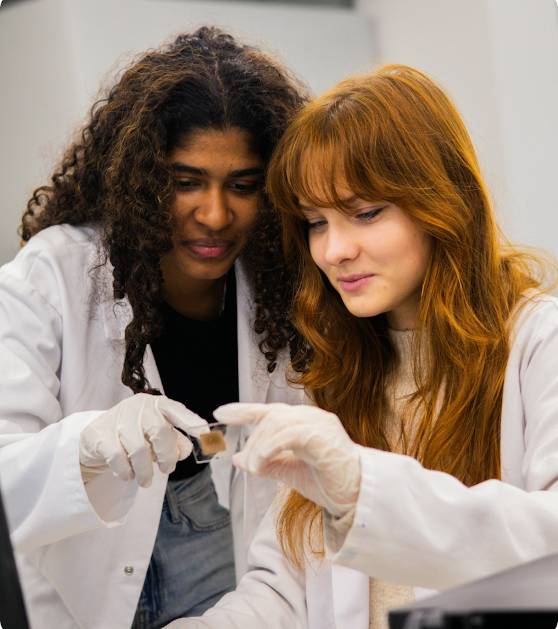


In this regard, white biotechnology lies at the heart of the transition towards a more sustainable and circular economy. Furthermore, this field generates numerous career opportunities in key industrial sectors such as energy, chemicals and the production of sustainable materials.
What is white biotechnology?
White biotechnology is defined as the application of living organisms or their components in industrial processes for the production of goods and services.
Unlike other branches , such as red biotechnology (health) , green (agriculture) , blue (marine) , grey (environmental) , yellow (food) , brown (soil), gold (bioinformatics) or orange (outreach) , and violet (ethics), its focus is on industry: the manufacture of chemicals, materials, energy, food or textiles using biological processes.
This approach enables the transformation of natural raw materials—such as biomass, agricultural waste or microorganisms—into high value-added products, thereby reducing environmental impact and improving production efficiency.
Characteristics of white biotechnology
To appreciate its role in transforming industry towards more environmentally friendly models, it is essential to understand the properties and principles that underpin white biotechnology.
Use of microorganisms and enzymes
At the heart of white biotechnology are microorganisms (bacteria, yeasts, fungi) and enzymes, which act as natural catalysts in industrial processes.
Replacement of traditional chemical processes
It enables conventional chemical-based processes to be replaced by cleaner and more efficient alternatives, reducing the use of toxic substances.
Energy efficiency
Biotechnological processes generally require lower temperatures and pressures, which means lower energy consumption.
Use of renewable raw materials
It relies on biological resources such as agricultural waste, biomass or industrial by-products, thereby promoting the circular economy.
Reduced environmental impact
It minimises the generation of waste, pollutant emissions and the consumption of non-renewable resources.
Applications of white biotechnology
White biotechnology extends its transformative potential to a wide range of industrial sectors, offering innovative solutions for more efficient and environmentally friendly production.
Biofuel production
One of the most significant applications is the production of energy from biomass, which includes bioethanol, biodiesel and biogas. These fuels help to reduce dependence on fossil fuels.
Food industry
White biotechnology is used to optimise production processes through the use of enzymes and microorganisms to improve efficiency, yield and sustainability on an industrial scale.
Chemical industry
It enables the production of chemical compounds in a more sustainable manner through biological processes. This includes:
- Organic acids
- Alcohols
- Biopolymers
Production of bioplastics
Bioplastics are an alternative to petroleum-based plastics. They are produced from biodegradable and renewable materials, thereby reducing their environmental impact.
Textile industry
Enzymes are used to improve textile processes, such as:
- Fabric treatment
- Reducing the use of chemicals
- Improvement of finishes
Detergents and cleaning products
Enzymes enable the development of more effective and sustainable detergents, which work at lower temperatures and have a lower environmental impact.
Examples of white biotechnology
From bioplastics to industrial enzymes, these examples demonstrate the versatility and potential of white biotechnology for a more sustainable industry.
- Production of bioethanol from biomass. An alternative to fossil fuels.
- Fermentation in the food industry. A key process in bakery, dairy and beverage production.
- Use of enzymes in detergents. They enable stains to be removed at low temperatures.
- Production of bioplastics. Biodegradable materials derived from natural resources.
- Synthesis of organic acids. Used in the chemical and food industries.
Advantages and disadvantages of white biotechnology
Whilst white biotechnology offers innovative solutions for industrial production and sustainability, it is crucial to analyse both the significant benefits it brings and the potential limitations and barriers to its adoption.
Advantages
- Reduced environmental impact
- Use of renewable resources
- Lower energy consumption
- More efficient processes
- Promotion of the circular economy
Disadvantages
- High initial implementation costs
- Need for advanced technological development
- Industrial scalability in some processes
- Dependence on specific biological conditions
Career opportunities in white biotechnology
White biotechnology offers career opportunities primarily in industrial settings, where more sustainable and efficient production processes are designed and optimised. Key options include:
- Industrial R&D and process development. Design and improvement of biotechnology processes in sectors such as chemicals, energy, food and materials.
- Production and industrial operations. Management of biotechnology plants, process scaling and production control in industrial settings.
- Quality control and process validation. Monitoring the quality of products and processes, ensuring regulatory compliance and efficiency.
- Chemical industry and sustainable materials. Development of bioplastics, biopolymers and chemical compounds derived from biomass.
- Energy and biofuels. Involvement in projects for the production of bioethanol, biodiesel or biogas from renewable resources.
- Consultancy in sustainability and the circular economy. Advising companies on process optimisation, reducing environmental impact and transitioning to sustainable models.
Furthermore, these career paths can be pursued in industrial companies, technology centres, public bodies or start-up projects focused on innovation and sustainability.
The strategic role of white biotechnology
White biotechnology is key to the transition towards sustainable industrial models. It enables a reduction in dependence on fossil fuels, the optimisation of resources and the minimisation of waste.
Its integration into traditional industrial sectors is transforming the way goods are produced, driving a more efficient, circular economy aligned with sustainability objectives.
Furthermore, its connection with other areas (such as green or blue biotechnology) reinforces its role within a global biotechnology ecosystem.
This growth is driving demand for specialists in industrial biotechnology, particularly in areas such as processes, sustainability and production.
Conclusion
White biotechnology is the application of biotechnology to industrial processes to make them more sustainable, efficient and environmentally friendly.
Thanks to its applications in energy, food, chemicals and materials, it is positioned as a key discipline for the future of industry and the transition towards a more sustainable economy.
Sources used