
See all Online Master's Degrees in Health
See all Master's Degrees in Engineering
Most searched curriculums
Official qualification
Enter a sector with 100% employability.
Prepare yourself with a market-oriented master's degree with which you will acquire a complete vision of cybersecurity (strategy, operation and technology) and develop the necessary skills to work from day one.
The cybersecurity sector is growing at an unstoppable pace and faces a real skills shortage, which translates into a constant demand for specialised professionals. This Master’s degree prepares you with a practical and up-to-date approach, with a clear objective: your entry into the job market, backed by a model with a 100 per cent employability rate.
Through a 360° training programme that combines strategy, operations and technology, you will acquire the skills needed to design security architectures, manage incidents, operate in SOC (Security Operations Centre) environments and apply cyber intelligence (Threat Intelligence) methodologies, working with real-world tools and case studies aligned with market demands.
Its professional approach will enable you both to enter a sector with high employability right from the start and to progress from IT roles into specialised cybersecurity roles, broadening your career opportunities.
This Master’s programme offers practical and comprehensive training in cybersecurity, with a holistic approach ranging from ethical hacking and vulnerability detection to defence and incident response.
Thanks to its 100% online and flexible format, you can progress at your own pace whilst acquiring skills applicable to real-world environments.
Furthermore, it incorporates cross-cutting and up-to-date content, including privacy, the regulatory framework and supply chain security, alongside 150 hours of work placement and access to over 8,800 agreements with leading companies, strengthening your experience and career prospects.
You will acquire the technical and strategic skills needed to protect organisations against cyber threats.
Defines security strategies and communicates risks to senior management in compliance with sectoral regulations.
Manages Security Operation Centres and executes cyber-attack response plans
Master the hacking tools most commonly used by Red Team experts.
Apply Threat Intelligence methodologies to identify cybersecurity risks and trends
Protects information and technology platforms from various types of cyber-attacks
Assesses security levels, proposes corrective measures and ensures compliance with regulations.
Transform the way you work with generative artificial intelligence. This micro-credential enables you to apply tools such as ChatGPT, Copilot or Gemini in information analysis, content creation and decision-making, integrating innovative solutions in an ethical and responsible way in real professional environments.

Develop your professional potential through leadership and interpersonal skills. This micro-credential provides you with the keys to manage teams, communicate effectively and solve problems in real-world environments, combining personal leadership techniques with practical productivity and collaboration tools.
Master's Degree in Cybersecurity
First Year
FIRST FOUR-MONTH PERIOD
| Code | Subjects | Character* | ECTS | ||||
|---|---|---|---|---|---|---|---|
| SM141700 | Risk analysis | OB | 2 | ||||
Risk analysisCódigo: SM141700 Imprimir Course 1: First-semester module. Compulsory. 2 credits. Profesores
Objectives To understand the main methodologies used to analyse the cybersecurity risks affecting organisations and the strategies for managing them. Prerequisites None Skills To understand the context of cybersecurity within a company’s business operations, with the aim of designing an organisational structure, policies and cybersecurity plans that are appropriate to the needs and requirements of the company’s management. Apply methodologies and tools for analysing and assessing cybersecurity risks to draw up management plans suited to an organisation’s risk profile. Design a cybersecurity operations centre with the necessary capabilities for the prevention, detection and response to cybersecurity incidents. Assess software development processes by identifying opportunities for improvement in the application of secure programming principles, as well as identifying cybersecurity weaknesses present in executable code. Learning outcomes RA4. Apply analysis techniques to cybersecurity risks that may affect the organisation, identifying the current situation and analysing the gap between this and the desired situation, whilst being able to organise the various action plans to be implemented to bridge this gap. RA5. Gains an in-depth understanding of the principles of life-cycle management for various assets, including systems and software developments, and is able to develop an optimal strategy for protecting assets and techniques to ensure the use of appropriate security controls in accordance with different scenarios. Description of the content Methods for identifying and quantifying threats and vulnerabilities Methods for quantifying the impact of a potential cybersecurity incident Strategies for mitigating identified risks Training activities AV1 Lectures AV2 Online seminars AV3 Practical activities (case studies, problem-solving, simulations, etc.) AV4 Study of course content and supplementary material (independent study) AV5 Online tutoring AV6 Knowledge assessments Assessment system and criteria SE1 Practical activities (case studies, problem-solving and challenges, project work, oral presentations, debates, etc.) SE2 Final knowledge assessments Bibliography Supplementary: 1. Ross Anderson Security Engineering: A Guide to Building Dependable Distributed Systems, 3rd edition Wiley. 2021. 2. Various authors The Cyber Security Body of Knowledge, version 1.1 cybok.org. 2021. |
|||||||
| SM141701 | Cybersecurity risk management | OB | 4 | ||||
Cybersecurity risk managementCódigo: SM141701 Imprimir Course 1: First-term module. Compulsory. 4 credits. Profesores
Objectives To understand how the defined control models work to ensure that everything within the organisation operates in accordance with its requirements, and how they apply to cybersecurity. Prerequisites None Competencies To understand the context of cybersecurity within a company’s business operations, with the aim of designing the organisational structure, policies and cybersecurity plans appropriate to the needs and requirements of the company’s management. Apply methodologies and tools for analysing and assessing cybersecurity risks to draw up management plans suited to an organisation’s risk profile. Design a cybersecurity operations centre with the necessary capabilities for the prevention, detection and response to cybersecurity incidents. Analyse the cybersecurity aspects of supplier-customer relationships and design a suitable cybersecurity model within that context. Analyse the rules, regulations and standards applicable in the field of cybersecurity, ensuring and demonstrating compliance within an organisation. Learning outcomes LA9. Implements within the organisation the various technological controls or specific processes relating to asset management, technological risk and the implications of intrinsic, extrinsic or legacy risks within the organisation, developing and implementing the corresponding processes to ensure the full lifecycle of cybersecurity risk management. RA10. Defines and implements a specific control model to keep the risks arising from relationships with third parties within the organisation’s tolerable risk limits. Description of the content Definition and adaptation of control models in the field of cybersecurity. Main control models used in the field of cybersecurity Definition of a control model based on multiple lines of defence Monitoring cybersecurity risks through the internal control model Monitoring of cybersecurity risks through the internal and external audit functions Training activities AV1 Lectures AV2 Virtual seminars AV3 Practical activities (case studies, problem-solving, simulations, etc.) AV4 Study of course content and supplementary material (self-directed study) AV5 Online tutoring AV6 Knowledge assessments Assessment system and criteria SE1 Practical activities (case studies, problem-solving and challenges, project work, oral presentations, debates, etc.) SE2 Final knowledge assessments Bibliography Supplementary: 1. Ross Anderson Security Engineering: A Guide to Building Dependable Distributed Systems, 3rd edition Wiley. 2021. 2. Various authors The Cyber Security Body of Knowledge, version 1.1 cybok.org. 2021. |
|||||||
| SM141702 | Cybersecurity governance | OB | 3 | ||||
Cybersecurity governanceCódigo: SM141702 Imprimir Course 1: First-semester module. Compulsory. 3 credits. Profesores
Objectives To understand the aspects relating to the organisation and management of a cybersecurity team Prerequisites None Skills To understand the context of cybersecurity within a company’s business operations, with the aim of designing an organisational structure, policies and cybersecurity plans that are appropriate to the needs and requirements of the company’s management. Apply methodologies and tools for analysing and assessing cybersecurity risks to draw up management plans suited to an organisation’s risk profile. Design a cybersecurity operations centre with the necessary capabilities for the prevention, detection and response to cybersecurity incidents. Learning outcomes LA1. Gain an in-depth understanding of the different cybersecurity approaches used in the main cybersecurity frameworks, understanding the process from start to finish, as well as the causes and effects of the strategies to be implemented in line with the organisation’s strategy. RA2. Define a cybersecurity organisation tailored to the organisation’s needs. LA3. Understand and utilise the available sources of information to identify and assess relevant threats that require protection and monitoring measures. Course content Definition of the objectives of the cybersecurity function within an organisation. Internal functioning and organisation of a Cybersecurity Department. Definition of cybersecurity policies, standards and procedures. The relationship between cybersecurity and the rest of the organisation. Cybersecurity planning. Cybersecurity metrics and reporting. Training activities AV1 Lectures AV2 Online seminars AV3 Practical activities (case studies, problem-solving, simulations, etc.) AV4 Study of course content and supplementary material (independent study) AV5 Online tutoring AV6 Knowledge assessments Assessment system and criteria SE1 Practical activities (case studies, problem-solving and challenges, project work, oral presentations, debates, etc.) SE2 Final knowledge assessments Bibliography Supplementary: 1. Ross Anderson Security Engineering: A Guide to Building Dependable Distributed Systems, 3rd edition Wiley. 2021. 2. Various authors The Cyber Security Body of Knowledge, version 1.1 cybok.org. 2021. |
|||||||
| SM141703 | Threat intelligence | OB | 3 | ||||
Threat intelligenceCódigo: SM141703 Imprimir Course 1: First-semester module. Compulsory. 3 credits. Profesores
Objectives To understand the tools and procedures used to characterise all relevant aspects of the cyber security threats affecting an organisation. Prerequisites None Skills To understand the context of cybersecurity within a company’s business operations, with the aim of designing an organisational structure, policies and cybersecurity plans that are appropriate to the needs and requirements of the company’s management. Apply methodologies and tools for analysing and assessing cybersecurity risks to draw up management plans suited to an organisation’s risk profile. Design a cybersecurity operations centre with the necessary capabilities for the prevention, detection and response to cybersecurity incidents. Learning outcomes LA1. Gain an in-depth understanding of the different cybersecurity approaches used in the main cybersecurity frameworks, understanding the process from start to finish, as well as the causes and effects of the strategies to be implemented in line with the organisation’s strategy. RA2. Define a cybersecurity organisation tailored to the organisation’s needs. LA3. Understand and utilise the available sources of information to identify and assess relevant threats that require protection and monitoring measures. Course content description Cybercrime Classification and analysis of attack methods Methodologies for gathering information on threats from public sources Forums specialising in cybercrime Training activities AV1 Lectures AV2 Online seminars AV3 Practical activities (case studies, problem-solving, simulations, etc.) AV4 Study of course materials and supplementary documentation (independent study) AV5 Online tutoring AV6 Knowledge assessments Assessment system and criteria SE1 Practical activities (case studies, problem-solving and challenges, project work, oral presentations, debates, etc.) SE2 Final knowledge assessments Bibliography Supplementary: 1. Ross Anderson Security Engineering: A Guide to Building Dependable Distributed Systems, 3rd edition Wiley. 2021. 2. Various authors The Cyber Security Body of Knowledge, version 1.1 cybok.org. 2021. |
|||||||
| SM141704 | Regulatory framework | OB | 3 | ||||
Regulatory frameworkCódigo: SM141704 Imprimir Course 1: First-semester module. Compulsory. 3 credits. Profesores
Objectives To understand the fundamentals of the laws and regulations affecting cybersecurity Prerequisites None Skills To understand the context of cybersecurity within a company’s business operations, with the aim of designing an organisational structure, policies and cybersecurity plans that are appropriate to the needs and requirements of the company’s management. Apply methodologies and tools for analysing and assessing cybersecurity risks to draw up management plans suited to an organisation’s risk profile. Design a cybersecurity operations centre with the necessary capabilities for the prevention, detection and response to cybersecurity incidents. Analyse the applicable rules, regulations and standards in the field of cybersecurity, ensuring and demonstrating compliance within an organisation. Learning outcomes RA6. Understands the various regulations applicable to their organisation in the field of cybersecurity and is able to define and implement a strategy to ensure compliance. RA7. Understands and applies the specific principles of privacy within their organisation, and the impact on the various information systems, applying the relevant measures and/or controls to ensure compliance, as well as establishing processes to guarantee that such compliance is maintained over time. RA8. Analyses the various audit activities within a regulatory and legal framework, distinguishing the scope of each and identifying the systems and groups responsible. This is done by drawing on frameworks both external to and internal to the company and the sector. Description of the content General structure of the regulatory framework applicable to an organisation Types of regulations relating to cybersecurity management in organisations Cybersecurity obligations imposed by regulations Methods for ensuring compliance with cybersecurity regulations Ways of demonstrating compliance with cybersecurity regulations Training activities AV1 Lectures AV2 Online seminars AV3 Practical activities (case studies, problem-solving, simulations, etc.) AV4 Study of course content and supplementary material (independent study) AV5 Online tutoring AV6 Knowledge assessments Assessment system and criteria SE1 Practical activities (case studies, problem-solving and challenges, project work, oral presentations, debates, etc.) SE2 Final knowledge assessments Bibliography Supplementary: 1. Ross Anderson Security Engineering: A Guide to Building Dependable Distributed Systems, 3rd edition Wiley. 2021. 2. Various authors The Cyber Security Body of Knowledge, version 1.1 cybok.org. 2021. |
|||||||
| SM141705 | Privacy | OB | 3 | ||||
PrivacyCódigo: SM141705 Imprimir Course 1: First-semester module. Compulsory. 3 credits. Profesores
Objectives To understand the concept of privacy, its relationship with cybersecurity, and the applicable laws and regulations Prerequisites None Skills To understand the context of cybersecurity within a company’s business operations, with the aim of designing an organisational structure, policies and cybersecurity plans that are appropriate to the needs and requirements of the company’s management. Apply methodologies and tools for analysing and assessing cybersecurity risks to draw up management plans suited to an organisation’s risk profile. Design a cybersecurity operations centre with the necessary capabilities for the prevention, detection and response to cybersecurity incidents. Analyse the applicable rules, regulations and standards in the field of cybersecurity, ensuring and demonstrating compliance within an organisation. Learning outcomes RA6. Understands the various regulations applicable to their organisation in the field of cybersecurity and is able to define and implement a strategy to ensure compliance. RA7. Understands and applies the specific principles of privacy within their organisation, and the impact on the various information systems, applying the relevant measures and/or controls to ensure compliance, as well as establishing processes to guarantee that such compliance is maintained over time. RA8. Analyses the various audit activities within a regulatory and legal framework, distinguishing the scope of each and identifying the systems and groups responsible. This is done by drawing on frameworks both external to and internal to the company and the sector. Course content Regulations aimed at ensuring the protection of personal data Compliance with privacy regulations in international contexts Training activities AV1 Lectures AV2 Online seminars AV3 Practical activities (case studies, problem-solving, simulations, etc.) AV4 Study of course content and supplementary material (independent study) AV5 Online tutoring AV6 Knowledge assessments Assessment system and criteria SE1 Practical activities (case studies, problem-solving and challenges, project work, oral presentations, debates, etc.) SE2 Final knowledge assessments Bibliography Supplementary: 1. Ross Anderson Security Engineering: A Guide to Building Dependable Distributed Systems, 3rd edition Wiley. 2021. 2. Various authors The Cyber Security Body of Knowledge, version 1.1 cybok.org. 2021. |
|||||||
| SM141706 | Supply chain security | OB | 2 | ||||
Supply chain securityCódigo: SM141706 Imprimir Course 1: First-semester module. Compulsory. 2 credits. Profesores
Objectives To understand the cybersecurity implications of an organisation’s relationships with third parties Prerequisites None Competencies To understand the cybersecurity context for a company’s business, with the aim of designing the organisational structure, policies and cybersecurity plans appropriate to the needs and requirements of the company’s management. Apply methodologies and tools for analysing and assessing cybersecurity risks to draw up management plans suited to an organisation’s risk profile. Design a cybersecurity operations centre with the necessary capabilities for the prevention, detection and response to cybersecurity incidents. Analyse the cybersecurity aspects of supplier-customer relationships and design a suitable cybersecurity model within that context. Analyse the rules, regulations and standards applicable in the field of cybersecurity, ensuring and demonstrating compliance within an organisation. Learning outcomes LA9. Implements within the organisation the various technological controls or specific processes relating to asset management, technological risk and the implications of intrinsic, extrinsic or legacy risks within the organisation, developing and implementing the corresponding processes to ensure the full lifecycle of cybersecurity risk management. RA10. Defines and implements a specific control model to keep the risks arising from relationships with third parties within the organisation’s tolerable risk limits. Description of the content Security in the procurement process Security certifications Cybersecurity ratings Third-party security monitoring Managed Security Services (MSS) Case study: guide to supplier relations Training activities AV1 Masterclasses AV2 Virtual seminars AV3 Practical activities (case studies, problem-solving, simulations, etc.) AV4 Study of course content and supplementary materials (independent study) AV5 Online tutoring AV6 Knowledge assessments Assessment system and criteria SE1 Practical activities (case studies, problem-solving and challenges, project work, oral presentations, debates, etc.) SE2 Final knowledge assessments Bibliography Supplementary: 1. Ross Anderson Security Engineering: A Guide to Building Dependable Distributed Systems, 3rd edition Wiley. 2021. 2. Various authors The Cyber Security Body of Knowledge, version 1.1 cybok.org. 2021. |
|||||||
| SM141707 | Safety in technological processes | OB | 4 | ||||
Safety in technological processesCódigo: SM141707 Imprimir Course 1: First-semester module. Compulsory. 4 credits. Profesores
Objectives To understand the security implications that must be taken into account in technology management processes Prerequisites None Competencies To understand the context of cybersecurity within a company’s business operations, with the aim of designing an organisational structure, policies and cybersecurity plans that are appropriate to the needs and requirements of the company’s management. Apply methodologies and tools for analysing and assessing cybersecurity risks to draw up management plans suited to an organisation’s risk profile. Design a cybersecurity operations centre with the necessary capabilities for the prevention, detection and response to cybersecurity incidents. Assess software development processes by identifying opportunities for improvement in the application of secure programming principles, as well as identifying cybersecurity weaknesses present in executable code. Learning outcomes RA4. Apply analysis techniques to cybersecurity risks that may affect the organisation, identifying the current situation and analysing the gap between this and the desired situation, whilst being able to organise the various action plans to be implemented to bridge this gap. RA5. Gains an in-depth understanding of the principles of life-cycle management for various assets, including systems and software developments, and is able to develop an optimal strategy for protecting assets and techniques to ensure the use of appropriate security controls in accordance with different scenarios. Description of the content Cybersecurity functions to be considered in the operational processes of software development and procurement Cybersecurity functions to be considered in the operational processes of information and communications technologies Training activities AV1 Lectures AV2 Online seminars AV3 Practical activities (case studies, problem-solving, simulations, etc.) AV4 Study of course content and supplementary materials (independent study) AV5 Online tutoring AV6 Knowledge assessments Assessment system and criteria SE1 Practical activities (case studies, problem-solving and challenges, project work, oral presentations, debates, etc.) SE2 Final knowledge assessments Bibliography Supplementary: 1. Ross Anderson Security Engineering: A Guide to Building Dependable Distributed Systems, 3rd edition Wiley. 2021. 2. Various authors The Cyber Security Body of Knowledge, version 1.1 cybok.org. 2021. |
|||||||
| SM141708 | Cybersecurity architectures | OB | 3 | ||||
Cybersecurity architecturesCódigo: SM141708 Imprimir Course 1: First-semester module. Compulsory. 3 credits. Profesores
Objectives To understand the basic principles that define an organisation’s cybersecurity framework Prerequisites Introduction to information technology Introduction to communications networks Skills To analyse the design techniques for a secure network, as well as its monitoring for the detection, investigation and response to cybersecurity attacks. Analyse the cybersecurity features inherent in modern operating systems in order to design a security system suited to the requirements of functionality and information protection. Learning Outcomes RA11. Identifies the various security technologies, and the principles of design and construction of security architectures, with the aim of enabling the various protection mechanisms within the organisation’s business or technological processes, following industry-standard principles or developing bespoke ones tailored to the business. RA12. Understands and implements an appropriate strategy for protecting communications networks based on the available architecture, clearly identifying the role of each protection technology used in specific cases in order to achieve protection consistent with business needs. Description of the content Factors to consider when defining the cybersecurity strategy and general guidelines Standard cybersecurity architectures, including their characteristics, advantages and disadvantages Definition of a cybersecurity strategy based on architectures Training activities AV1 Lectures AV2 Online seminars AV3 Practical activities (case studies, problem-solving, simulations, etc.) AV4 Study of course content and supplementary material (independent study) AV5 Online tutoring AV6 Knowledge assessments Assessment system and criteria SE1 Practical activities (case studies, problem-solving and challenges, project work, oral presentations, debates, etc.) SE2 Final knowledge assessments Bibliography Supplementary: 1. Ross Anderson Security Engineering: A Guide to Building Dependable Distributed Systems, 3rd edition Wiley. 2021. 2. Various authors The Cyber Security Body of Knowledge, version 1.1 cybok.org. 2021. |
|||||||
| SM141710 | Information access control: cryptography and Identity, Credential and Access Management (ICAM) | OB | 3 | ||||
Information access control: cryptography and Identity, Credential and Access Management (ICAM)Código: SM141710 Imprimir Course 1: First-semester module. Compulsory. 3 credits. Profesores
Objectives To understand the mechanisms used to control access to information Prerequisites Introduction to information technology Introduction to communications networks Skills To analyse techniques for designing a secure network, as well as its monitoring for the detection, investigation and response to cyber-security attacks. Analyse the cybersecurity features inherent in modern operating systems in order to design a security system suited to the requirements of functionality and information protection. Analyse cryptosystems and cryptographic algorithms commonly used in the industry, selecting and correctly applying those best suited to each circumstance. Learning Outcomes RA13. Gain an in-depth understanding of the specific security elements in different operating systems and databases to support the overall security strategy within the architecture, ensuring that these complement the principles established by the various policies and regulations in place. RA14. Gains an in-depth understanding of the various cryptographic mechanisms and techniques to be used in different scenarios, depending on the specific use case, to ensure the confidentiality of information. RA15. Understand the principles and techniques of identity and access management in order to support the organisation’s overall cybersecurity and business strategy. Description of the content Mechanisms available for controlling access to information assets. Cryptographic systems and processes. Processes and technologies for user identification and authentication. Processes and technologies for authorising user access to information and the systems used to process it. Teaching activities AV1 Lectures AV2 Online seminars AV3 Practical activities (case studies, problem-solving, simulations, etc.) AV4 Study of course content and supplementary material (independent study) AV5 Online tutoring AV6 Knowledge assessments Assessment system and criteria SE1 Practical activities (case studies, problem-solving and challenges, project work, oral presentations, debates, etc.) SE2 Final knowledge assessments Bibliography Supplementary: 1. Ross Anderson Security Engineering: A Guide to Building Dependable Distributed Systems, 3rd edition Wiley. 2021. 2. Various authors The Cyber Security Body of Knowledge, version 1.1 cybok.org. 2021. |
|||||||
| TOTAL: | 30 | ||||||
SECOND FOUR-MONTH PERIOD
| Code | Subjects | Character* | ECTS | ||
|---|---|---|---|---|---|
| SM141709 | Cloud security | OB | 3 | ||
Cloud securityCódigo: SM141709 Imprimir Course 1. Second-term module. Compulsory. 3 credits. Profesores
Objectives To understand the security strategy and measures to be applied to systems deployed across different types of cloud. Prerequisites Introduction to information technology Introduction to communications networks Skills Analyse techniques for designing a secure network, as well as its monitoring for the detection, investigation and response to cyber-security attacks. Analyse the cybersecurity features inherent in modern operating systems in order to design a security system suited to the requirements of functionality and information protection. Learning Outcomes RA16. Develops and extends the various specific mechanisms in public, private and hybrid cloud environments in accordance with the technology strategy, delving deeper into the different mechanisms to enable coexistence with traditional environments by making use of available technologies or managed services that enable protection in such environments. RA17. Analyses new technological models with the aim of incorporating the mitigation of any new risks that may arise into the overall cybersecurity strategy, utilising current protection standards and frameworks based on specific technologies and the appropriate processes for the purpose of each element. Description of the content Classification of the different types of cloud service provision and their implications for cybersecurity Application of cybersecurity principles in cloud-based technological environments Specific technologies for the protection of cloud environments Allocation of cybersecurity responsibilities in the provision of cloud services Training activities AV1 Lectures AV2 Online seminars AV3 Practical activities (case studies, problem-solving, simulations, etc.) AV4 Study of course content and supplementary material (independent study) AV5 Online tutoring AV6 Knowledge assessments Assessment system and criteria SE1 Practical activities (case studies, problem-solving and challenges, project work, oral presentations, debates, etc.) SE2 Final knowledge assessments Bibliography Supplementary: 1. Ross Anderson Security Engineering: A Guide to Building Dependable Distributed Systems, 3rd edition Wiley. 2021. 2. Various authors The Cyber Security Body of Knowledge, version 1.1 cybok.org. 2021. |
|||||
| SM141711 | Ethical hacking | OB | 3 | ||
Ethical hackingCódigo: SM141711 Imprimir Course 1. Second-term module. Compulsory. 3 credits. Profesores
Objectives To understand the processes and tools used to identify vulnerabilities in information systems that could be exploited by an attacker. Prerequisites Introduction to information technology Introduction to communications networks Skills Design a cybersecurity operations centre with the necessary capabilities for the prevention, detection and response to cybersecurity incidents. Design cybersecurity forensic audit methods, practices and technologies, ensuring compliance with applicable regulations. Assess the techniques used to carry out cyberattacks in order to analyse and design security measures capable of stopping them. Learning Outcomes RA18. Explores and understands the various techniques used to carry out technology audits in accordance with current risk frameworks for these specific areas, understanding the different threats and their technical analysis in order to make appropriate decisions within the organisation to mitigate the various threats and identify the actors involved. RA19. Defines and implements the set of methodologies, processes and technologies required to identify and analyse anomalies that may indicate the existence of a cyber incident, as well as the subsequent response, investigation and recovery should a breach be confirmed. Course content Cyber-attack strategies Techniques, tactics and procedures applied during the various phases of a cyberattack Ethical hacking team management strategies Training activities AV1 Lectures AV2 Online seminars AV3 Practical activities (case studies, problem-solving, simulations, etc.) AV4 Study of course content and supplementary material (independent study) AV5 Online tutoring AV6 Knowledge assessments Assessment system and criteria SE1 Practical activities (case studies, problem-solving and challenges, project work, oral presentations, debates, etc.) SE2 Final knowledge assessments Bibliography Supplementary: 1. Ross Anderson Security Engineering: A Guide to Building Dependable Distributed Systems, 3rd edition Wiley. 2021. 2. Various authors The Cyber Security Body of Knowledge, version 1.1 cybok.org. 2021. |
|||||
| SM141712 | Work Placements | OB | 6 | ||
Work PlacementsCódigo: SM141712 Imprimir Course 1. Second-term module. Compulsory. 6 credits. Profesores
Objectives To apply the knowledge acquired during the Master’s programme in a real-world work environment Prerequisites To have successfully completed 50% of the Master’s programme Skills Apply the cybersecurity knowledge acquired in a real business environment. Learning outcomes RA20. Applies and integrates the knowledge and skills acquired on the Master’s programme within the context of a business activity. Course description Apply the concepts learnt on the programme in a real-world setting. Students will join a real-world cybersecurity team and have the opportunity to apply their knowledge in that real-world setting. Learning Activities AV1 Virtual class AV4 Independent study AV5 Online tutorial AV9 Work placement Assessment system and criteria SE5 External placement tutor’s report SE6 Report by the academic supervisor of the external work placement SE7 External Placement Report |
|||||
| SM141713 | Monitoring and response procedures | OB | 3 | ||
Monitoring and response proceduresCódigo: SM141713 Imprimir Course 1. Second-term module. Compulsory. 3 credits. Profesores
Objectives To understand the procedures used by an organisation to detect cyberattacks and respond in order to defend itself. Prerequisites Introduction to Information Technology Introduction to communications networks Skills Design a cybersecurity operations centre with the necessary capabilities for the prevention, detection and response to cybersecurity incidents. Design cybersecurity forensic audit methods, practices and technologies, ensuring compliance with applicable regulations. Assess the techniques used to carry out cyberattacks in order to analyse and design security measures capable of stopping them. Learning Outcomes RA18. Explores and understands the various techniques used to carry out technology audits in accordance with current risk frameworks for these specific areas, understanding the different threats and their technical analysis in order to make appropriate decisions within the organisation to mitigate the various threats and identify the actors involved. RA19. Defines and implements the set of methodologies, processes and technologies required to identify and analyse anomalies that may indicate the existence of a cyber incident, as well as the subsequent response, investigation and recovery should a breach be confirmed. Description of the content Processes and mechanisms required to detect and analyse anomalies that may indicate the occurrence of a cyber incident Response methods available to minimise the impact of a cyber incident on the organisation. Organisation of the incident response Coordination and support bodies for incident response Training activities AV1 Lectures AV2 Online seminars AV3 Practical activities (case studies, problem-solving, simulations, etc.) AV4 Study of course content and supplementary material (independent study) AV5 Online tutoring AV6 Knowledge assessments Assessment system and criteria SE1 Practical activities (case studies, problem-solving and challenges, project work, oral presentations, debates, etc.) SE2 Final knowledge assessments Bibliography Supplementary: 1. Ross Anderson Security Engineering: A Guide to Building Dependable Distributed Systems, 3rd edition Wiley. 2021. 2. Various authors The Cyber Security Body of Knowledge, version 1.1 cybok.org. 2021. |
|||||
| SM141714 | Security in communications networks | OB | 3 | ||
Security in communications networksCódigo: SM141714 Imprimir Course 1. Second-term module. Compulsory. 3 credits. Profesores
Objectives To understand the strategy and security measures for protecting an organisation’s communications network. Prerequisites Introduction to information technology Introduction to communications networks Skills Analyse the design techniques for a secure network, as well as its monitoring for the detection, investigation and response to cyber-security attacks. Analyse the cybersecurity features inherent in modern operating systems in order to design a security system suited to the requirements of functionality and information protection. Learning Outcomes RA11. Identifies the various security technologies, and the principles of design and construction of security architectures, with the aim of enabling the various protection mechanisms within the organisation’s business or technological processes, following industry-standard principles or developing bespoke ones tailored to the business. RA12. Understands and implements an appropriate strategy for protecting communications networks based on the available architecture, clearly identifying the role of each protection technology used in specific cases in order to achieve protection consistent with business needs. Description of the content Security threats in an organisation’s network environment Network architectures for cybersecurity Deployment of security measures within the network environment Training activities AV1 Lectures AV2 Online seminars AV3 Practical activities (case studies, problem-solving, simulations, etc.) AV4 Study of course content and supplementary material (independent study) AV5 Online tutoring AV6 Knowledge assessments Assessment system and criteria SE1 Practical activities (case studies, problem-solving and challenges, project work, oral presentations, debates, etc.) SE2 Final knowledge assessments Bibliography Supplementary: 1. Ross Anderson Security Engineering: A Guide to Building Dependable Distributed Systems, 3rd edition Wiley. 2021. 2. Various authors The Cyber Security Body of Knowledge, version 1.1 cybok.org. 2021. |
|||||
| SM141715 | Security in wireless, mobile, OT and IoT systems. | OB | 3 | ||
Security in wireless, mobile, OT and IoT systems.Código: SM141715 Imprimir Course 1. Second-term module. Compulsory. 3 credits. Profesores
Objectives To understand the strategy and security measures for protecting domestic and industrial information systems Prerequisites Introduction to information technology Introduction to communications networks Skills Analyse techniques for designing a secure network, as well as monitoring it to detect, investigate and respond to cyber-security attacks. Analyse the cybersecurity features inherent in modern operating systems in order to design a security system suited to the requirements of functionality and information protection. Learning Outcomes RA16. Develops and extends the various specific mechanisms in public, private and hybrid cloud environments in accordance with the technology strategy, delving deeper into the different mechanisms to enable coexistence with traditional environments by making use of available technologies or managed services that enable protection in such environments. RA17. Analyses new technological models with the aim of incorporating the mitigation of any new risks that may arise into the overall cybersecurity strategy, utilising current protection standards and frameworks based on specific technologies and the appropriate processes for the purpose of each element. Description of the content Cybersecurity implications of deploying ‘Internet of Things’ devices Security strategies for the protection of ‘Internet of Things’ devices Protection of industrial control devices Security in personal and domestic communications networks Security in user communications networks Training activities AV1 Lectures AV2 Virtual seminars AV3 Practical activities (case studies, problem-solving, simulations, etc.) AV4 Study of course content and supplementary material (independent study) AV5 Online tutoring AV6 Knowledge assessments Assessment system and criteria SE1 Practical activities (case studies, problem-solving and challenges, project work, oral presentations, debates, etc.) SE2 Final knowledge assessments Bibliography Supplementary: 1. Ross Anderson Security Engineering: A Guide to Building Dependable Distributed Systems, 3rd edition Wiley. 2021. 2. Various authors The Cyber Security Body of Knowledge, version 1.1 cybok.org. 2021. |
|||||
| SM141716 | Security in operating systems and databases | OB | 3 | ||
Security in operating systems and databasesCódigo: SM141716 Imprimir Course 1. Second-term module. Compulsory. 3 credits. Profesores
Objectives To understand the strategy and security measures for protecting data processing systems Prerequisites Introduction to information technology Introduction to communications networks Skills Analyse techniques for designing a secure network, as well as its monitoring for the detection, investigation and response to cyber-security attacks. Analyse the cybersecurity features inherent in modern operating systems in order to design a security system suited to the requirements of functionality and information protection. Analyse cryptosystems and cryptographic algorithms commonly used in the industry, selecting and correctly applying those best suited to each circumstance. Learning Outcomes RA13. Gain an in-depth understanding of the specific security elements in different operating systems and databases to support the overall security strategy within the architecture, ensuring that these complement the principles established by the various policies and regulations in place. RA14. Gains an in-depth understanding of the various cryptographic mechanisms and techniques to be used in different scenarios, depending on the specific use case, to ensure the confidentiality of information. RA15. Understand the principles and techniques of identity and access management in order to support the organisation’s overall cybersecurity and business strategy. Course content Security threats to information processing and storage systems Implementation of security measures for information processing and storage equipment Training activities AV1 Lectures AV2 Online seminars AV3 Practical activities (case studies, problem-solving, simulations, etc.) AV4 Study of course content and supplementary material (independent study) AV5 Online tutoring AV6 Knowledge assessments Assessment system and criteria SE1 Practical activities (case studies, problem-solving and challenges, project work, oral presentations, debates, etc.) SE2 Final knowledge assessments Bibliography Supplementary: 1. Ross Anderson Security Engineering: A Guide to Building Dependable Distributed Systems, 3rd edition Wiley. 2021. 2. Various authors The Cyber Security Body of Knowledge, version 1.1 cybok.org. 2021. |
|||||
| SM141717 | Master’s Thesis | OB | 6 | ||
Master’s ThesisCódigo: SM141717 Imprimir Course 1. Second-term module. Compulsory. 6 credits. Profesores
Objectives To produce an original piece of work on one of the topics covered in the Master’s programme Prerequisites Successful completion of all other modules on the Master’s programme Skills To produce, present and defend an original piece of work that synthesises the cybersecurity skills acquired during the programme. Learning outcomes LA21. Documents and presents to an examination board an original piece of work relating to part of the content covered in the various modules of the programme. Course content To produce a piece of work on a specific topic related to the degree programme and to present it to an examination board. Learning Activities AV2 Virtual seminar AV5 Online tutorial AV7 Preparation of the Master’s Thesis AV8 Public oral defence of the Master’s Thesis Assessment system and criteria SE 5 Master’s Thesis Report SE 6 Defence and presentation of the Master’s Thesis before the Assessment Panel |
|||||
| TOTAL: | 30 | ||||
*Character: BT: Basic Training, Ob: Required, Op: Optional
The main reason why at UAX there are students like you is the possibility of making your personal, professional and academic life compatible. Our differential value is a methodology without barriers, focused on you and your desire to learn.
How is our methodology?
In addition, you will have the complete availability of our campus in Madrid, to carry out your formalities, solve your doubts and enjoy the facilities it offers.
Our degree is official, verified by the Council of Universities and fully valid in Spain, as well as in the European Higher Education Area.
It is recognised by the Education Systems of Latin America, being recognised and approved by the different Ministries of Education in Latin America:
SENESCYT, MEN (MinEducation), SEP, Mescyt, among others, automatically.

By studying Cybersecurity at the UAX you will do 150 hours of work experience in companies and you can benefit from more than 8,800 agreements between the university and major technology companies such as IBM, Microsoft, Hispasat and Telefónica, among many others.
Professionals with one year of experience in cybersecurity-related positions can validate their internships.
In addition, you will receive personalised support from professional advisors, who will help you make the most of your time and studies.
The flexibility of online learning, with opportunities to connect
Take your exams online wherever you are or, if you prefer, in person at our designated centres in Spain and Latin America, subject to availability and capacity.
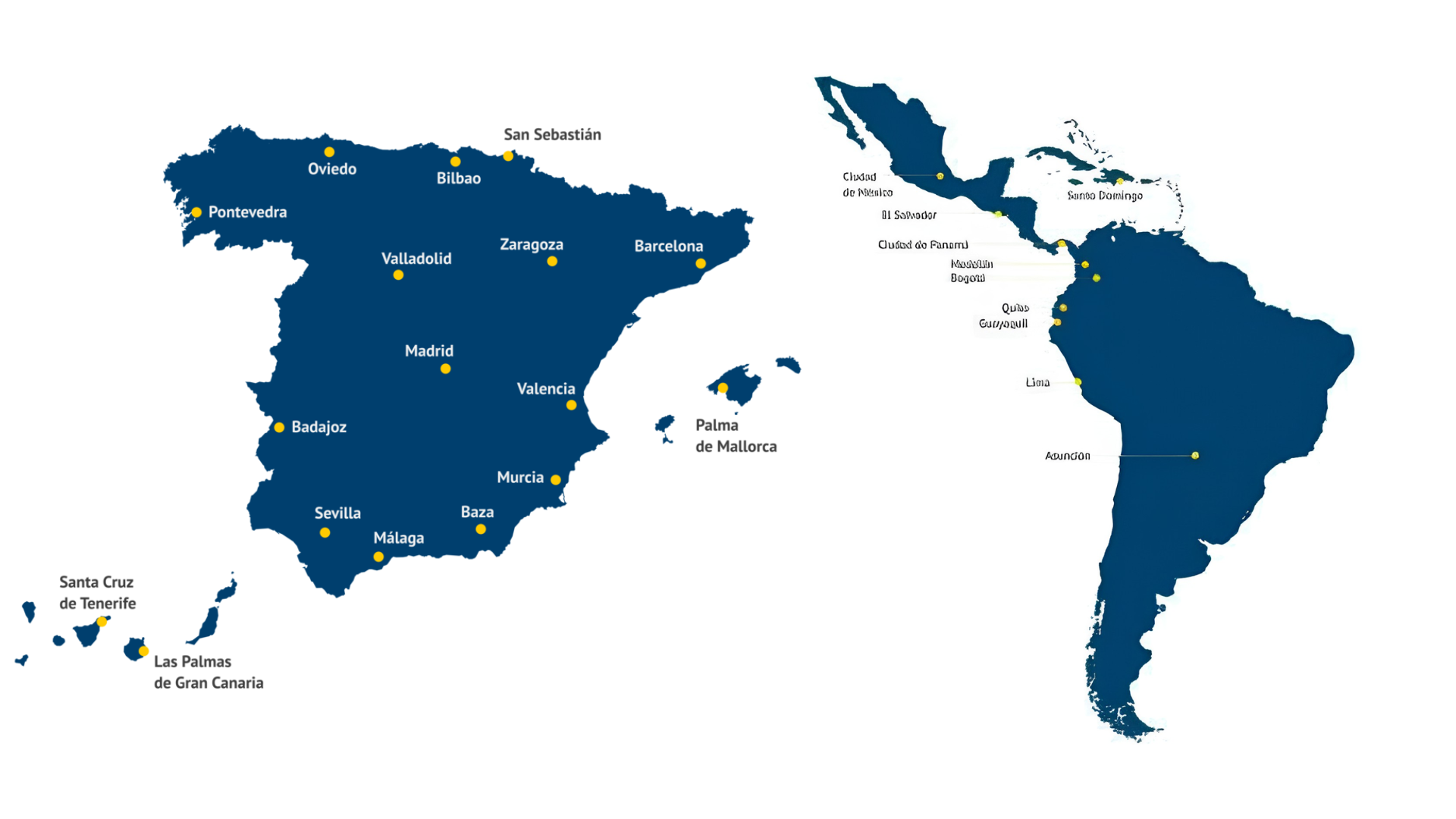
What’s more, as a student at UAX Online, you’ll have access to our Campus Hubs – a network of exclusive physical spaces where you can study, access libraries, work in co-working areas and connect with other students. Because studying online doesn’t mean studying alone.
Campus Hubs available in: Alcobendas, Alcorcón, Valencia San Vicente, Murcia, Barcelona, Málaga, Seville and Arganda.
Access is via your UAX student card, subject to availability and the opening hours of each centre.

Boost your career in cybersecurity with networking skills
Gain knowledge of networks, infrastructure and communication protocols to design and secure IT environments with this Packt certification, which is designed to prepare you for the Cisco CCNA certification.
As a highlight of our Master in Cybersecurity, our students experienced the International Congress on Cybersecurity: Business, Research and Society, the central event of the European project PECIEE developed with INCIBE.
An immersion experience in the sector:
This conference was a practical demonstration of the Master's vision: to train professionals who connect with the real ecosystem of cybersecurity, from research to business application.
Recommended profile for the Master’s in Cybersecurity
The Online Master’s Degree in Cybersecurity is an officially recognised master’s programme, so you will be eligible to enrol if you have:
Admissions process
To begin the process, you must provide the following documentation:
Teaching staff
Train in cybersecurity alongside the best professionals.
PhD in Computer Science from the University of Alcalá with Cum Laude mention. He holds a Master's degree in Cybersecurity, obtaining Honours in his TFM. Responsible for cybersecurity and DPD at Movistar+. More than 20 years as a teacher in different universities, both public and private.
Business Continuity Manager and head of non-financial risks at Volkswagen Bank, with a focus on operational resilience, IT risks and cybersecurity. Banking and consulting experience (KPMG, Santander, Popular) in highly regulated environments. PhD candidate at ICADE pursuing a PhD in Non-Financial Risk Management and ESG.
Internal Network and Cybersecurity Audit Manager at Telefónica. PhD in Information Security, 19 years of experience in telecommunications, 20 years as a university professor.
Director of privacy and data protection at MAPFRE at corporate level, with more than 25 years of experience in privacy, data protection and risk management. Degree in Mathematics, accredited as DPO and Director of private security and with multiple certifications.
DevOps Engineer at mlean -leading company in continuous improvement software tools for industry-. Computer Engineer with more than 15 years of professional experience, researcher on quantum cryptographic key distribution in networks and university lecturer for the last 5 years.
Lawyer and insurance broker, specialist in cybersecurity, cyber risk management and compliance. Co-founding partner of SECURIZABLE, a risk management consultancy, she leads the cyber risk area. Certified in ethical hacking and compliance expert, trainer in several educational institutions. Member of the Board of Women4cyber.
Senior Manager BBVA. 13 years of experience in the Big 4, 10 years of experience in the financial sector and 4 years as a university professor. Experienced in the field of technology risk management and cybersecurity.
Cybersecurity technician in the Red Team of Telefónica de España. 10 years of experience in the field of private IT security and experience in university teaching and technology talks.
Senior Telecommunications Engineer responsible for Electronic Prescription within the Official College of Pharmacists of Madrid. Responsible for the engineering, development, security and control of special protection services projects within the healthcare area and communications networks for healthcare dispensing in the Community of Madrid.
Postdoctoral researcher at the University of Oviedo, in post-quantum cryptography, quantum algorithms and computer algebra. Mathematician, with a Master's degree in Mathematics from Rheinische Friedrich-Wilhelms-Universität Bonn. PhD in Mathematics and Statistics from the University of Oviedo, 3 years of experience as a university lecturer.
Director of the company "DarFe Learning & Consulting S.L.". PhD in Computer Engineering, MBA, former Chief of Networks of the Argentinean Army, former Director of the Computer Security Research Centre of Argentina (CISI.ar), Author of 5 books on cybersecurity and 30 years of teaching experience.
Computer Engineer and Master in Cybersecurity with 12 years in the technology sector, especially in the secure development of applications for means of payment. Currently Cybersecurity Manager at Atradius (GCO), leading projects for Italy, France and Nordic countries, ensuring every stage, from design to operational resilience.
Cybersecurity technician at Movistar Plus+, with previous experience as a security analyst at Línea Directa. Computer Engineer and Master's Degree in Computer Engineering, where he obtained the highest mark in his TFM. Recognised among the best graduates in Spain according to SEDEA.
Law graduate specialising in Personal Data Protection (certified as a DPD under the AEPD scheme), Administrative Law and Digital Law. Member of the Data Protection Office of the Agency for Digital Administration of the Community of Madrid.
Assistant professor at the URJC, where he teaches cybersecurity and programming. His research activity focuses on the design and automatic validation of algorithms, with special interest in optimisation and the development of efficient solutions. He actively participates in CTF competitions and specialised events in the field of cybersecurity.
PhD in Artificial Intelligence, lecturer and researcher at the URJC. Member of the GRAFO group, specialising in optimisation and cybersecurity projects with CAM/EC. Founder of CiberScore and winner of the II National Cyber League of the Guardia Civil and the JNIC (2022, 2024).
We need to know a little bit about you so that we can provide you with a personalised service.
All fields are required

At UAX we know that studying is an investment, that's why we provide you with the facilities you need to access our degrees. Find out about some of our scholarships and grants:
You will be able to develop your professional career in different fields such as:
The Online Master's Degree in Cybersecurity is an official academic programme that will allow you to access if you meet any of the following requirements:
El el máster en ciberseguridad online, tiene una duración de 9 meses y es una titulación oficial de 60 créditos ECTS.
El máster en seguridad informática ofrece una amplia gama de oportunidades profesionales en un campo en constante crecimiento y demanda. Algunas de las salidas profesionales para quienes completan un Master en Ciberseguridad incluyen: Ingeniería de Seguridad, Consultoría de Seguridad, Gestor de riesgos de Seguridad, Director de Seguridad y Auditoría de Sistemas.
To study cybersecurity, there is no specific bachelor's degree that is required on a compulsory basis. Cybersecurity is an interdisciplinary field that combines aspects of computer science, information technology, engineering and information security. Therefore, students interested in pursuing a career in cybersecurity can come from different majors and bachelor's degrees.
Other related qualifications
We offer a wide range of courses, so you’re sure to find a programme that suits you.
Master's Degree in Occupational Risk Prevention (online)
In collaboration with:
Start:
October
Length:
9 months
Online Master's Degree in Renewable Energies
Start:
October
Length:
9 months
Online University Master's Degree in Big Data for Business
Start:
October
Length:
9 months

Online degree in Computer Engineering
Start:
October
Length:
4 years
Online Higher National Diploma in Networked Computer Systems Administration (ASIR)
Start:
September
Length:
2 years

Enquiries, complaints and claims
We respond to the genuine needs of our students and staff, because we believe in the continuous improvement of our results. That is why we always want to hear whatever you have to say.

If you are already part of UAX, please visit the ‘Customer Service: complaints, suggestions and compliments’ section on thevirtual campus , logging in with your username and password.