See all Online Master's Degrees in Health
See all Master's Degrees in Engineering
Most searched curriculums
Official qualification
Madrid
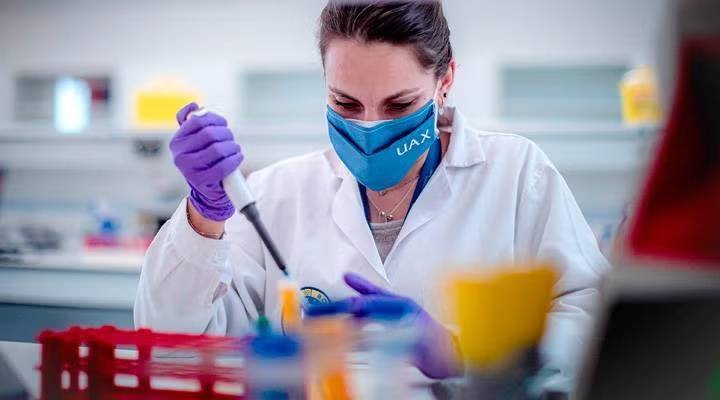
Companies demand profiles capable of understanding the impact of new technologies on the business world. Train with the only degree with a focus on computational physics and employability to maximise your professional opportunities. + Certificate in Digital Business
98% EMPLOYABILITY
98% of our graduates get their first job after completing their degree.
8800 CONVENTIONS
Collaboration so that you can do your internship in the best companies in the sector.
95% ACTIVE TEACHERS
Your training, aligned with professional reality
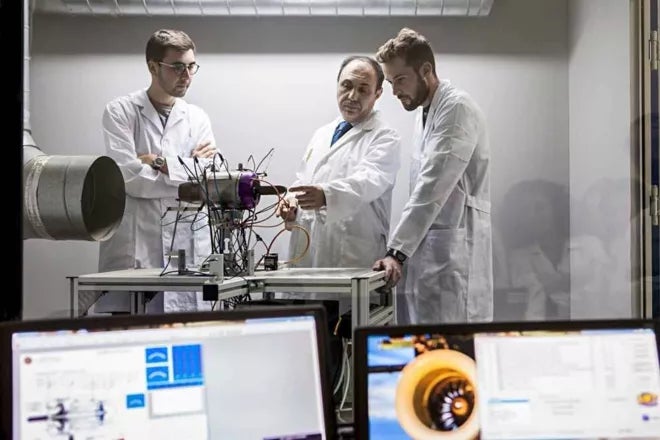
The demand for physics professionals has been on the rise due to the growing need for advanced analytical skills and applied scientific knowledge across a wide range of industries.
Physicists’ ability to apply mathematical models, carry out advanced analysis and develop simulations makes them indispensable in sectors such as artificial intelligence, quantum computing, robotics and data science.
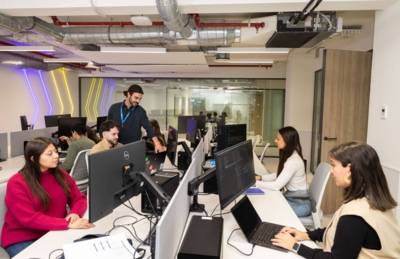
As a student on the Bachelor’s degree in Physics, you will also build your own portfolio of real-world projects with companies, develop the ability to work in multidisciplinary teams, and gain proficiency in Agile methodologies such as Scrum, Lean and XP.
The degree includes the Google Business Certificate

UAX MAKERS
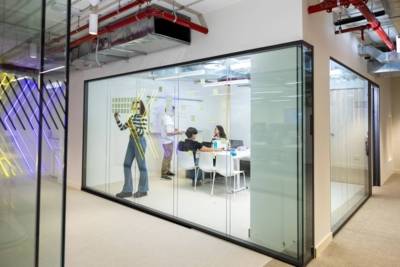
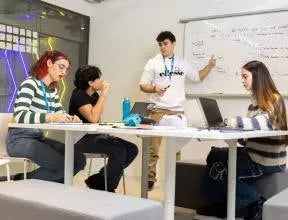
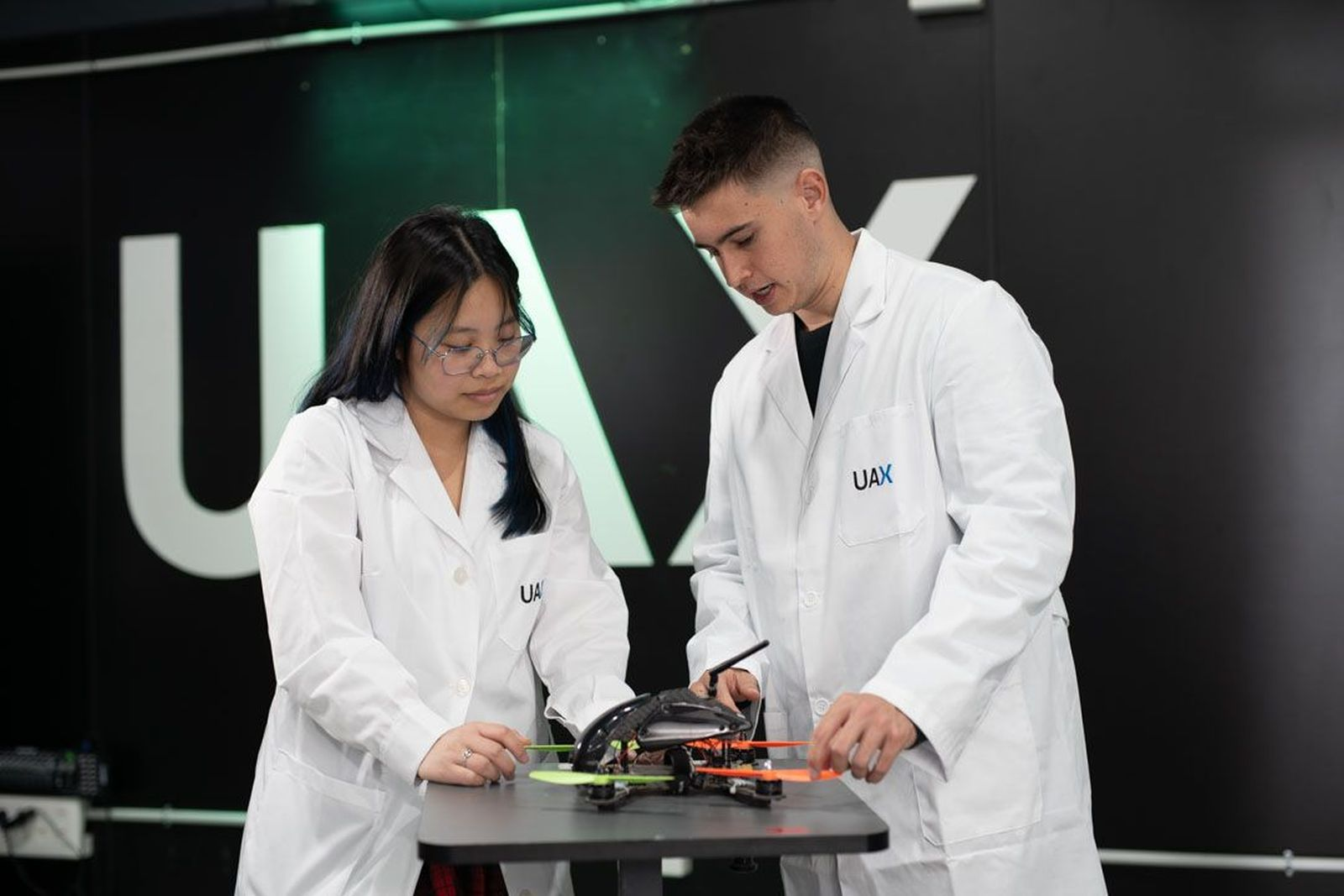
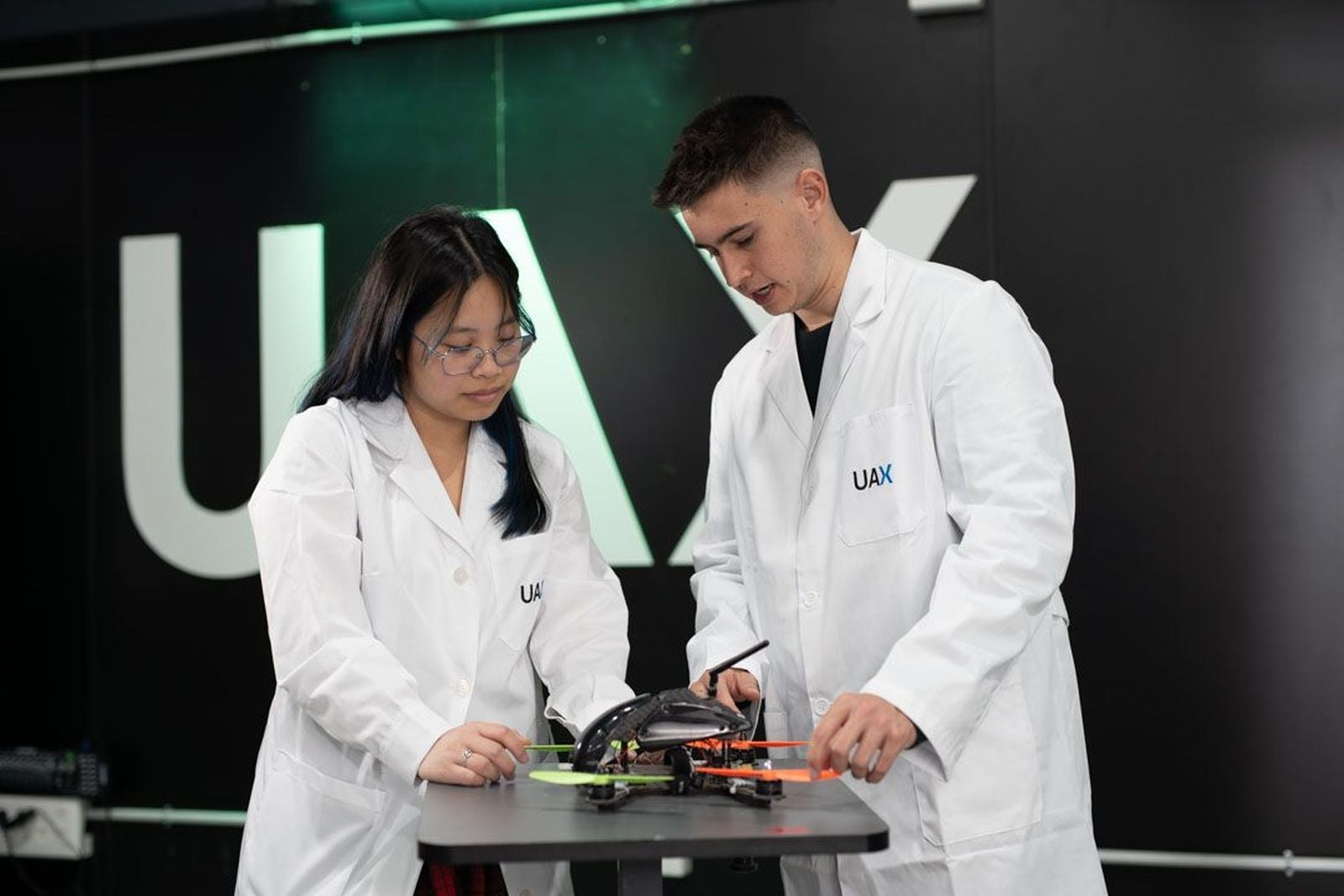
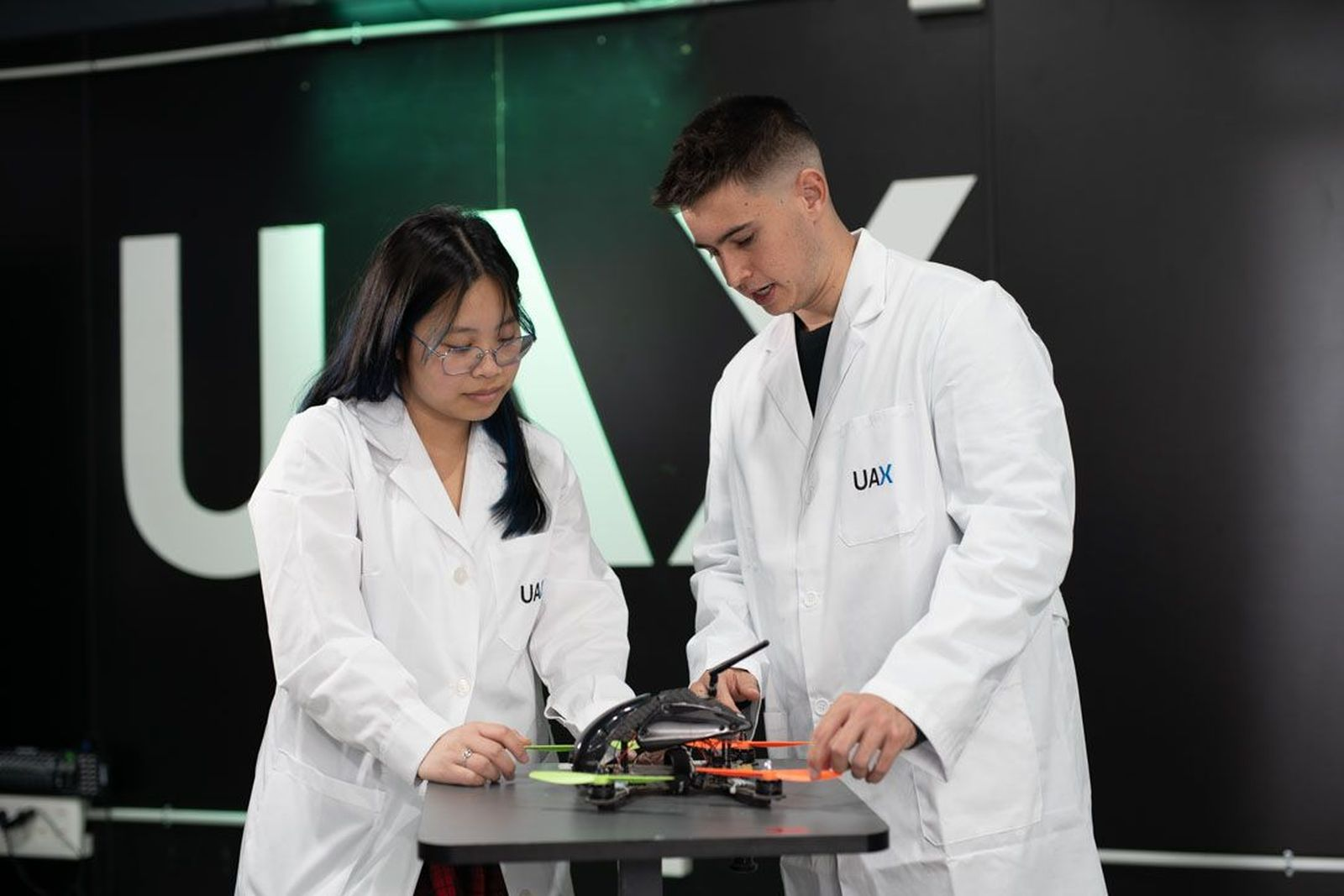
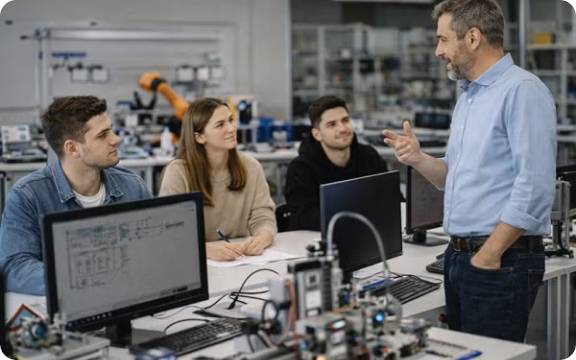
Work on real-world projects with companies. The UAX Makers model is based on collaborative work between students who come together to tackle a real-world project. To this end, we bring together students from different degree programmes, fostering a diversity of approaches and teamwork as key to achieving the best possible solution.
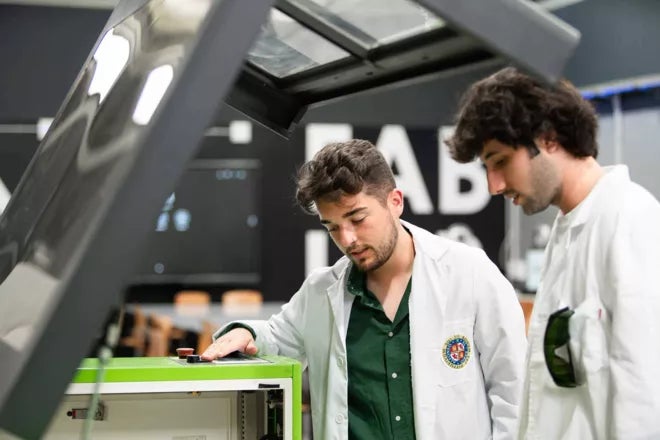
Development of a virtual twin of the Villanueva de la cañada campus.
Use of artificial intelligence techniques to predict working hours in large international engineering projects.

Development of innovative solutions to optimise customer operations at CaixaBank, through the use of predictive models, AI and data analysis.
Application of mathematical models and data analysis in the design of a health school for patients and families, improving management and communication in the health sector.
Collaboration in the design and development of an analytical architecture to derive patterns in global cybersecurity-related data.
Use of Industry 5.0 techniques to build an analytical environment for real-time image processing and offer a unique user experience in the sector.
Build a solid knowledge base in business and technology, allowing you to transition into a future career where you can make an impact.
Degree in Physics
First Year
FIRST FOUR-MONTH PERIOD
| Code | Subjects | Character* | ECTS | ||||||||||||||||||||||||||||||||||||||||||||||||||||||||||||||||||||||||||||||||||||||||||||||||||||||||||||||||||||||||||||||||||||||||||||||||||||||||||||||||||||||||||||||||||||||||||||||||||||||||||||||||||||||||||||||||||||||||||||||||||||||||||||
|---|---|---|---|---|---|---|---|---|---|---|---|---|---|---|---|---|---|---|---|---|---|---|---|---|---|---|---|---|---|---|---|---|---|---|---|---|---|---|---|---|---|---|---|---|---|---|---|---|---|---|---|---|---|---|---|---|---|---|---|---|---|---|---|---|---|---|---|---|---|---|---|---|---|---|---|---|---|---|---|---|---|---|---|---|---|---|---|---|---|---|---|---|---|---|---|---|---|---|---|---|---|---|---|---|---|---|---|---|---|---|---|---|---|---|---|---|---|---|---|---|---|---|---|---|---|---|---|---|---|---|---|---|---|---|---|---|---|---|---|---|---|---|---|---|---|---|---|---|---|---|---|---|---|---|---|---|---|---|---|---|---|---|---|---|---|---|---|---|---|---|---|---|---|---|---|---|---|---|---|---|---|---|---|---|---|---|---|---|---|---|---|---|---|---|---|---|---|---|---|---|---|---|---|---|---|---|---|---|---|---|---|---|---|---|---|---|---|---|---|---|---|---|---|---|---|---|---|---|---|---|---|---|---|---|---|---|---|---|---|---|---|---|---|---|---|---|---|---|---|---|---|---|---|---|---|
| C0142600 | Algebra I | FB | 6 | ||||||||||||||||||||||||||||||||||||||||||||||||||||||||||||||||||||||||||||||||||||||||||||||||||||||||||||||||||||||||||||||||||||||||||||||||||||||||||||||||||||||||||||||||||||||||||||||||||||||||||||||||||||||||||||||||||||||||||||||||||||||||||||
Algebra ICódigo: C0142600 Imprimir Course 1: First-term module. Foundation course. 6 credits. Profesores
Objectives The aim of this module is for students to develop skills in Linear Algebra, a branch of mathematics that is essential to the study of physics. Students are expected to understand matrix calculus from a conceptual perspective and to be able to apply it to solving problems specific to their field of study. Prerequisites There are no prerequisites Competencies RK2 Understand physically distinct phenomena and their underlying analogies in order to apply known solutions to new problems RK6 Understand the principles of mathematics and statistics that underpin the study of physics in classical and quantum systems RS1 Apply the most important knowledge, concepts and methods from the various branches of physics. RS2 Carry out calculations, assessments, studies, reports and tasks to produce high-quality work in the field of physics. RS4 Apply mathematical and numerical methods to the modelling and explicit solution of problems in physics and related disciplines, selecting the appropriate tools and interpreting results. RC3 Acquire IT knowledge and skills enabling the development of methods and technologies applicable to the relevant fields of study Learning outcomes RA10 Solve typical problems in linear algebra and apply the knowledge and skills acquired in relation to physics-related concepts. RA11 Understands the abstract structure of vector spaces and is able to tackle problems of higher dimensionality. RA12 Analyses, evaluates and interprets the results obtained when solving systems of equations. LA13 Reason abstractly, using logical and algorithmic thinking, when solving exercises relating to linear applications and their matrix representations RA14 Carries out work in the field of linear algebra using knowledge of and computer tools. Description of the content Topic 1: Matrices and systems of linear equations Topic 2: Vector spaces Topic 3: Homomorphisms between vector spaces Topic 4: Diagonalisation of endomorphisms Topic 5: Bilinear and quadratic forms. Scalar product. Norm. Learning activities AP1. Participatory lectures AP2. Seminars or practical application sessions AP3. Practical activities (case studies, project work, simulations, etc.) AP4. Independent study AP5. Tutoring AP6. Knowledge assessments Assessment system and criteria Without prejudice to any other requirements that may be set out in the relevant course syllabus, as a general rule, failure to attend more than 70 per cent of the course’s teaching activities requiring the student’s physical or virtual presence will result in the loss of the right to continuous assessment during the standard examination period. In this case, the examination to be held during the official period set by the University will be the sole assessment criterion, with the weighting specified in the course syllabus. ---- The assessment process will consist of evaluating the extent to which the student has acquired the competences associated with the module. REGULAR EXAMINATION PERIOD – CONTINUOUS ASSESSMENT VERY IMPORTANT: in order for students to benefit from continuous assessment, they must attend at least 70 per cent of the scheduled class hours (SESSION, WORKSHOP). If attendance is less than 70 per cent, the module may be passed by sitting a single examination during an official examination period (ordinary or supplementary). During the ordinary examination period, in accordance with the ‘SE2 – Final Knowledge Tests’ assessment system, as set out in the report for the degree verification application, this exam will account for 60 per cent of the mark, which means that a student who has forfeited their right to continuous assessment may obtain, at most, a mark of 6.0 out of 10 for the module in that sitting; to pass the module, they must therefore achieve a mark of 8.34 out of 10 in the exam. Continuous assessment will consist of the following components: -- an individual portfolio (for each student), accounting for 10 per cent of the final mark for the module, which will consist of evidence of the use of computer tools such as Wolfram Alpha, GeoGebra or any other (MATLAB, Mathematica, Python with NumPy, etc.) to solve various linear algebra problems throughout the term. -- a practical case study, accounting for 30 per cent of the final course mark, which students will undertake in small groups throughout the academic term; this practical case study will involve the submission of several deliverables (in order to analyse the progress of the different working groups), each of which will be assessed and will carry its corresponding weighting in the case study’s mark. Submission dates will be announced well in advance. -- a mid-term exam (not a pass/fail exam), accounting for 20% of the final mark for the module. The date of this exam, which will take place during the term, will be announced well in advance; it will cover topics 1 and 2. -- a final examination, which will take place during the ordinary examination period (January), on the date set by the university for that period. This exam will assess all the content covered in the module, and it will account for 40% of the final mark, provided that the student achieves a mark of 4.0 out of 10 or higher. ***** Only the examinations will be subject to re-marking. Should a student have forfeited their right to continuous assessment, they may, as described above, pass the module by sitting the examination covering all the content taught in the module during the ordinary examination session. However, as already noted, this exam will account for 60 per cent of the final mark for the module, so the student will need to achieve a minimum of 8.4 out of 10 in it in order to pass. *** The module is considered to have been passed in the ordinary examination period if the final mark is 5.0 or higher. SUPPLEMENTARY EXAMINATION PERIOD Regardless of their attendance during the term, in the supplementary assessment period students will be examined on all the content covered in the course in a single examination. The mark for this assessment period will be that obtained in this examination (continuous assessment will not be taken into account). *** The module is considered passed in the supplementary examination period if the final mark is 5.0 or higher. Timetable Click on this link to view the detailed timetable in Excel
Bibliography Essential: 1. Juan De Burgos Román Algebra and Geometry. Definitions, Theorems and Results García Maroto Editores. 2010. ISBN: 9788492976942 2. Luis Merino and Evangelina Santos Linear Algebra using Elementary Methods Paraninfo. 2010. ISBN: 978-84-9732-4 Supplementary: 3.- Gilbert Strang Introduction to Linear Algebra Wellesley Cambridge Press. 2008. ISBN: 8175968117 4.- Juan De Burgos Román Linear Algebra. 80 Useful Problems García Maroto Publishers. 2007. ISBN: 9788493601805 Others: 5. Eugenio Hernández Linear Algebra and Geometry 3rd ed. ADDISON WESLEY. 2012. ISBN: 9788478291298 6. Jesús Rojo Linear Algebra McGraw-Hill. 2001. ISBN: 8448130162 7. Jesús Rojo Exercises and Problems in Linear Algebra 2nd ed. McGraw-Hill. 2005. ISBN: 8448198581 8. Stanley I. Grossman and José Job Flores Linear Algebra McGraw-Hill. 2012. ISBN: 978-607-15-07 |
|||||||||||||||||||||||||||||||||||||||||||||||||||||||||||||||||||||||||||||||||||||||||||||||||||||||||||||||||||||||||||||||||||||||||||||||||||||||||||||||||||||||||||||||||||||||||||||||||||||||||||||||||||||||||||||||||||||||||||||||||||||||||||||||
| C0142601 | Analysis I | FB | 6 | ||||||||||||||||||||||||||||||||||||||||||||||||||||||||||||||||||||||||||||||||||||||||||||||||||||||||||||||||||||||||||||||||||||||||||||||||||||||||||||||||||||||||||||||||||||||||||||||||||||||||||||||||||||||||||||||||||||||||||||||||||||||||||||
Analysis ICódigo: C0142601 Imprimir Course 1: First-term module. Foundation course. 6 credits. Profesores
Objectives The aim of the module is to equip students with the mathematical tools necessary for solving problems in the field of physics. Prerequisites No prerequisites Learning Outcomes RK2 Understand physically distinct phenomena and their underlying analogies in order to apply known solutions to new problems RK6 Understand the principles of mathematics and statistics that underpin the study of physics in classical and quantum systems RS1 Apply the most important knowledge, concepts and methods from the various branches of physics. RS2 Carry out calculations, assessments, studies, reports and tasks to produce high-quality work in the field of physics. RS4 Apply mathematical and numerical methods to the modelling and explicit solution of problems in physics and related disciplines, selecting the appropriate tools and interpreting results. RC3 Acquire IT knowledge and skills enabling the development of methods and technologies applicable to the relevant fields of study Learning outcomes RA1 Solve problems involving differential calculus of a real variable. RA2 Develops and applies abstract reasoning and logical and algorithmic thinking when working with real functions of a real variable. RA3 Performs mental and written calculations involving real numbers, expansions using numerical sequences and series, and mathematical calculations with ease. LA4 Produces work in the field of differential and integral calculus of a single variable through the knowledge and use of computer tools. Description of the content 1) Real numbers. Sequences of real numbers: convergence. Series of real numbers: convergence criteria. Operations on series. 2) Real functions of a real variable. Continuity. The derivative: Rolle’s theorem, the mean value theorem, the generalised mean value theorem, L’Hopital’s rule . Applications of the derivative: Taylor’s formula with its error term, representation of functions. 3) Integration. Riemann integral: the fundamental theorem of calculus. Integration techniques: direct integration, integration by parts, change of variable, rational, irrational and trigonometric integrals. Applications: calculation of areas, lengths and volumes. Teaching activities AP1. – Participatory lectures 96 4 100 AP2. – Seminars or practical application classes 60 2.5 100 AP3.- Practical activities (case studies, project work, simulations, etc.) 144 3 50 AP4.- Independent study 240 0 0 AP5.- Tutorials 48 0.6 30 AP6.- Knowledge assessments 12 0.5 100 TOTAL 600 10.6 Assessment system and criteria Without prejudice to any other requirements that may be set out in the relevant course syllabus, as a general rule, failure to attend more than 70 per cent of the course’s teaching activities—which require the student’s physical or virtual presence—will result in the loss of the right to continuous assessment during the standard assessment period. In this case, the examination to be held during the official period set by the University will be the sole assessment criterion, with the weighting specified in the course syllabus. ---- SE1.- Practical activities (case studies, problem-solving and challenges, project work, etc.): 30% SE2.- Two multiple-choice mid-term exams (a minimum mark of 4 is required to be included in the average). If the average is 5 or higher, the student is exempt from the ordinary January examination session. 50% SE3.- Submission of exercises: 20% The following assessments will be carried out as part of continuous assessment: 1) A first assessment on Topic 1, in early November, which will count for 10% 2) A second assessment on Topic 2, at the end of December, worth 10% 3) A third assessment on Topic 3, in January, which will account for 10% 4) The official exam in the ordinary examination session, which will account for 70% of the overall mark for the course. Students who, for any reason, miss the continuous assessment will sit the ordinary examination, which will count for 100% The supplementary sitting will count for 100% Addendum Assessment system Min. weighting % Max. weighting % SE1.- Practical activities (case studies, problem-solving and challenges, project work, oral presentations, debates, etc.) 20 30 SE2. Final knowledge assessments 60 60 SE4.- Portfolio 10 20 |
|||||||||||||||||||||||||||||||||||||||||||||||||||||||||||||||||||||||||||||||||||||||||||||||||||||||||||||||||||||||||||||||||||||||||||||||||||||||||||||||||||||||||||||||||||||||||||||||||||||||||||||||||||||||||||||||||||||||||||||||||||||||||||||||
| C0142602 | Fundamentals of Physics I | FB | 6 | ||||||||||||||||||||||||||||||||||||||||||||||||||||||||||||||||||||||||||||||||||||||||||||||||||||||||||||||||||||||||||||||||||||||||||||||||||||||||||||||||||||||||||||||||||||||||||||||||||||||||||||||||||||||||||||||||||||||||||||||||||||||||||||
Fundamentals of Physics ICódigo: C0142602 Imprimir Course 1: First-term module. Foundation course. 6 credits. Profesores
Objectives The aim of the module is to equip students with the necessary tools to tackle fundamental problems in the field of physics (historical context, kinematics, dynamics, energy and associated theorems, systems of multiple particles), thereby providing them with the necessary foundation for subsequent modules. Prerequisites No prior requirements have been met. Learning Outcomes RK1 Understand the most important phenomena and theories in the various branches of physics, as well as their historical context RK3 To analyse the fundamental concepts and principles of physical systems in order to develop approximations that enable the construction of a simplified model RS3 Estimate orders of magnitude to interpret laboratory phenomena in the field of physics and its related disciplines, as well as in chemistry. RS4 Apply mathematical and numerical methods to the modelling and explicit solution of problems in physics and related disciplines, selecting the appropriate tools and interpreting results. RS5 Use appropriate electronic instruments and/or computer tools in modelling to find solutions to physics problems. Learning outcomes RA1 Identifies the relevant physical principles and, where necessary, makes simplifications and uses estimates of orders of magnitude in order to model and solve practical problems. RA2 Handles fundamental concepts such as particles and fields, force, work, etc., with ease, in order to describe physical systems correctly. LR3 Applies Newton’s laws appropriately to solving problems involving particles and systems of particles, and in relation to oscillatory motion. RA4 Understands the units of the International System of Units and correctly assigns them to each of the physical quantities studied, as well as other units commonly used in the field of physics. RC1 Work independently on the management of projects related to the different areas of physics Description of the content - Historical introduction. - Particle kinematics. Types of motion. - Particle dynamics. - Work and energy, and associated theorems. - Oscillatory motion. - Systems of particles. Geometry of masses. - Statics. - Elasticity. Training activities Teaching activity No. of hours* Contact hours (8–12)** % of contact time AP1.- Participatory lectures 50 2.78 100 AP2.- Seminars or practical application classes 30 1.67 100 AP3.- Practical activities (case studies, project work, simulations, etc.) 72 2 50 AP4.- Independent study 180 0 0 AP5. – Tutorials 36 0.6 30 AP6.- Knowledge assessments 8 0.44 100 AP10.- Workshop and/or laboratory activities 74 4.11 100 TOTAL 450 11.60 Assessment system and criteria Assessment system Weighting (%) SE1.- Practical activities (case studies, problem-solving and challenges, project work, oral presentations, debates, etc.) 30 AS2.- Final knowledge assessments 50 50 SE3.- Laboratory practical booklet 20 Timetable Click on this link to view the detailed timetable in Excel
|
|||||||||||||||||||||||||||||||||||||||||||||||||||||||||||||||||||||||||||||||||||||||||||||||||||||||||||||||||||||||||||||||||||||||||||||||||||||||||||||||||||||||||||||||||||||||||||||||||||||||||||||||||||||||||||||||||||||||||||||||||||||||||||||||
| C0142603 | Fundamentals of Computer Science | FB | 6 | ||||||||||||||||||||||||||||||||||||||||||||||||||||||||||||||||||||||||||||||||||||||||||||||||||||||||||||||||||||||||||||||||||||||||||||||||||||||||||||||||||||||||||||||||||||||||||||||||||||||||||||||||||||||||||||||||||||||||||||||||||||||||||||
Fundamentals of Computer ScienceCódigo: C0142603 Imprimir Course 1: First-term module. Foundation course. 6 credits. Profesores
Objectives The aim of the module is to equip students with the necessary programming language tools to enable them to solve more complex scientific problems. Prerequisites None Learning Outcomes RC1 To work independently on the management of projects related to the various areas of physics RC3 Acquire the IT knowledge and skills required to develop methods and technologies applicable to the relevant fields of study RODS Develop effective communication, teamwork, analytical thinking, creativity and ethical leadership from a cross-disciplinary perspective, clearly inspired by democratic principles and values, as well as the Sustainable Development Goals, in order to conduct oneself with integrity in the professional sphere. Learning outcomes RA1 Describes the fundamentals of basic general-purpose programming structures. RA2 Uses IT tools to solve physical problems and illustrate mathematical concepts. LA3 Formulates algorithms and models simple physical problems in order to implement them in a programming language (Python, Java or similar). LA4 Reads and analyses programmes in order to identify the problem they solve or to detect possible errors, as well as to make modifications to adapt them to solving other similar scientific problems. Course content - Introduction to programming languages. Fundamentals of programming. Fundamentals of Python, Java or similar. - Application structure. Data and expressions. - Control structures. Classes and objects. - Libraries. Data types and structures. Data input/output. - Computer fundamentals. Computer architecture. Storage systems. Performance evaluation. Training activities Training activity No. of hours* Face-to-face hours (8–12)** % face-to-face AP1.- Participatory lectures 48 4 100 AP2.- Seminars or practical application classes 30 2.5 100 AP3.- Practical activities (case studies, project work, simulations, etc.) 72 3 50 AP4.- Independent study 120 0 0 AP5. – Tutoring 24 0.6 30 AP6.- Knowledge assessments 6 0.5 100 TOTAL 300 10.6 Assessment system and criteria Assessment system Min. weighting % Max. weighting % SE1.- Practical activities (case studies, problem-solving and challenges, project work, oral presentations, debates, etc.) 20 30 AS2.- Final knowledge assessments 60 60 SE4.- Portfolio 10 20 Timetable Click on this link to view the detailed timetable in Excel
|
|||||||||||||||||||||||||||||||||||||||||||||||||||||||||||||||||||||||||||||||||||||||||||||||||||||||||||||||||||||||||||||||||||||||||||||||||||||||||||||||||||||||||||||||||||||||||||||||||||||||||||||||||||||||||||||||||||||||||||||||||||||||||||||||
| C0142604 | Introduction to Statistics and Data Science | FB | 6 | ||||||||||||||||||||||||||||||||||||||||||||||||||||||||||||||||||||||||||||||||||||||||||||||||||||||||||||||||||||||||||||||||||||||||||||||||||||||||||||||||||||||||||||||||||||||||||||||||||||||||||||||||||||||||||||||||||||||||||||||||||||||||||||
Introduction to Statistics and Data ScienceCódigo: C0142604 Imprimir Course 1: First-semester module. Foundation course. 6 credits. Profesores
Objectives - To apply basic knowledge of statistics and probability to the analysis of data relating to physical phenomena and processes. - To carry out statistical data analysis applied to solving real-world problems using mathematical software development packages (Python + NumPy). - To apply probability calculations through the identification of models. - To describe and apply the basic principles of statistical inference. Prerequisites No prerequisites have been set. Competencies RC1 Work independently on the management of projects relating to the various areas of physics RC3 Acquire IT knowledge and skills enabling the development of methods and technologies applicable to the relevant fields of study RODS Develop effective communication, teamwork, analytical thinking, creativity and ethical leadership from a cross-disciplinary perspective, clearly inspired by democratic principles and values, as well as the Sustainable Development Goals, in order to conduct oneself with integrity in the professional sphere. Learning outcomes RA5 Apply basic knowledge of statistics and probability to the analysis of data relating to physical phenomena and processes. RA6 Performs statistical data analysis applied to the resolution of real-world cases using mathematical software development packages (Python + NumPy, SPSS or similar). LA7 Applies probability calculations through the identification of models. LA8 Describes and applies the basic principles of statistical inference. Course content Topic 1. Descriptive statistics. Topic 2. Probability. Topic 3. Random variables. Topic 4. Probability distributions. Topic 5. Statistical inference. Teaching activities AP1. Participatory lectures 48 4 100 AP2. Seminars or practical application sessions 30 2.5 100 AP3. Practical activities (case studies, project work, simulations, etc.) 72 3 50 AP4. Independent study 120 0 0 AP5. – Tutoring 24 0.6 30 AP6.- Knowledge assessments 6 0.5 100 Assessment system and criteria ASSESSMENT FOR THE REGULAR EXAM SESSION The final mark for the module will be calculated as a weighted average of projects and examinations as follows: - Continuous assessment (40%) + Submission of exercises (10%) + Python project (30%) - Final exam (60%) ASSESSMENT FOR THE SUPPLEMENTARY EXAMINATION - 100% Final exam mark for the module, based on the completion of theoretical and practical exercises in an exam. |
|||||||||||||||||||||||||||||||||||||||||||||||||||||||||||||||||||||||||||||||||||||||||||||||||||||||||||||||||||||||||||||||||||||||||||||||||||||||||||||||||||||||||||||||||||||||||||||||||||||||||||||||||||||||||||||||||||||||||||||||||||||||||||||||
| TOTAL: | 30 | ||||||||||||||||||||||||||||||||||||||||||||||||||||||||||||||||||||||||||||||||||||||||||||||||||||||||||||||||||||||||||||||||||||||||||||||||||||||||||||||||||||||||||||||||||||||||||||||||||||||||||||||||||||||||||||||||||||||||||||||||||||||||||||||
SECOND FOUR-MONTH PERIOD
| Code | Subjects | Character* | ECTS | ||||
|---|---|---|---|---|---|---|---|
| C0142605 | Algebra II | FB | 6 | ||||
Algebra IICódigo: C0142605 Imprimir Course 1. Second-term module. Foundation course. 6 credits. Profesores
Objectives This module, together with Algebra I, aims not only to familiarise students with the main results of linear algebra, but also to enable them to understand matrix calculus from a conceptual perspective and to apply it to solving problems typical of physics; it therefore forms part of the mathematical foundation not only for other subjects within the degree programme, but also essential for the professional practice of a physics graduate. Algebra II will cover what is known as linear geometry, which encompasses the study of vector spaces and Euclidean affine spaces, affine varieties, affine mappings and transformations (in particular, rigid transformations), the algebraic description of conics and quadric surfaces, and, finally, an introduction to projective geometry. Throughout this module, students will continue to be trained in the use of computer tools for solving problems in linear algebra and, in particular, in the associated geometry. Prerequisites No prerequisites Learning outcomes RK2 Understand physically distinct phenomena and their underlying analogies in order to apply known solutions to new problems RK6 Understand the principles of mathematics and statistics that underpin the study of physics in classical and quantum systems RS1 Apply the most important knowledge, concepts and methods from the various branches of physics. RS2 Carry out calculations, assessments, studies, reports and tasks to produce high-quality work in the field of physics. RS4 Apply mathematical and numerical methods to the modelling and explicit solution of problems in physics and related disciplines, selecting the appropriate tools and interpreting results. RC3 Acquire IT knowledge and skills enabling the development of methods and technologies applicable to the relevant fields of study Learning outcomes RA15 Solves typical problems in linear geometry and applies the knowledge and skills acquired in relation to concepts associated with physics. RA16 Demonstrates the ability to distinguish between quadratic and conic sections. RA17 Analyses, evaluates and interprets the results obtained when solving problems in linear geometry. LA18 Explains affine transformations and movements in an affine Euclidean space and solves related exercises. RA19 Produces work in the field of linear geometry using knowledge of and computer tools. Description of the content - Euclidean vector spaces. - Affine spaces. Linear varieties: lines and planes. Affine transformations. - Euclidean affine spaces. Transformations in a Euclidean affine space. - Spectral theory of symmetric and orthogonal matrices for application in the study of transformations. - Conics and quadric surfaces. - Projective geometry. Teaching activities AP1. – Participatory lectures AP2. Seminars or practical application classes AP3. Practical activities (case studies, project work, simulations, etc.) AP4. Independent study AP5. Tutoring Assessment system and criteria The assessment process will consist of evaluating the extent to which the student has acquired the competences associated with the module. REGULAR EXAMINATION PERIOD – CONTINUOUS ASSESSMENT VERY IMPORTANT: in order for students to benefit from continuous assessment, they must attend at least 70 per cent of the scheduled class hours (SESSION, WORK). If attendance is less than 70 per cent, the module must be passed by sitting a single examination during an official examination period (ordinary or supplementary). During the ordinary examination period, in accordance with the ‘SE2 – Final Knowledge Tests’ assessment system, as set out in the report for the degree verification application, this exam will account for 60% of the mark, which means that a student who has forfeited their right to continuous assessment due to attendance below 70 per cent may obtain, at most, a mark of 6.0 points for the module in that examination session; to pass the module, they must therefore achieve a mark of 8.34 points in the examination. Continuous assessment will consist of the following components: -- portfolio (SE4), individual, accounting for 10 per cent of the final mark for the module, which will consist of evidence of the use of computer tools such as Wolfram Alpha, GeoGebra or any other (MATLAB, Mathematica, Python with NumPy, etc.) to solve various linear algebra problems throughout the term. -- a practical case study (SE1), accounting for 10% of the final mark for the module, which students will undertake in small groups throughout the academic term; this practical case study will involve the submission of several deliverables (in order to analyse the progress of the different working groups), each of which will be assessed and will carry its corresponding weighting in the case study’s mark. Submission dates will be announced well in advance. -- a mid-term exam (SE1), accounting for 20% of the final mark for the module. The date of this exam, which will take place during the term, will be announced in good time; it will cover topics 1 and 2. -- a final exam (SE2) accounting for 60% of the final mark for the module. This will take place during the ordinary examination period (January), on the date set by the university for that period. A minimum mark of 4/10 is required to pass the module. *** The module is considered passed in the ordinary examination period if the final mark is 5.0 or higher. EXTRAORDINARY EXAMINATION SESSION Regardless of their attendance during the term, in the extraordinary examination period students will be examined on all the content covered in the module in a single examination. The mark for this examination period will be that obtained in this examination (continuous assessment will not be taken into account). *** The module is considered passed in the supplementary examination period if the final mark is 5.0 or higher. Bibliography Essential: 1.- Juan De Burgos Román Algebra and Geometry. Definitions, Theorems and Results García Maroto Editores. 2010. ISBN: 9788492976942 2. Luis Merino and Evangelina Santos Linear Algebra using Elementary Methods Paraninfo. 2010. ISBN: 978-84-9732-4 Supplementary: 3.- Gilbert Strang Introduction to Linear Algebra Wellesley Cambridge Press. 2008. ISBN: 8175968117 4.- Juan De Burgos Román Linear Algebra. 80 Useful Problems García Maroto Publishers. 2007. ISBN: 9788493601805 Others: 5. Eugenio Hernández Linear Algebra and Geometry 3rd ed. ADDISON WESLEY. 2012. ISBN: 9788478291298 6. Jesús Rojo Linear Algebra McGraw-Hill. 2001. ISBN: 8448130162 7. Jesús Rojo Exercises and Problems in Linear Algebra 2nd ed. McGraw-Hill. 2005. ISBN: 8448198581 8. Stanley I. Grossman and José Job Flores Linear Algebra McGraw-Hill. 2012. ISBN: 978-607-15-07 |
|||||||
| C0142606 | Analysis II | FB | 6 | ||||
Analysis IICódigo: C0142606 Imprimir Course 1. Second-term module. Foundation course. 6 credits. Profesores
Objectives The aim of this module is to provide students with a sound grounding in differential and integral calculus of several variables, enabling them to tackle complex mathematical problems applied to physical phenomena. By the end of the module, students will be able to: Understand and analyse the geometry of Euclidean space, applying concepts of vectors, planes and surfaces to the solution of physical problems. Study functions of several variables, examining their properties relating to limits, continuity and differentiability. Calculate higher-order derivatives and apply Taylor’s theorem in several variables to approximate functions and solve optimisation problems. Work with vector functions, analysing trajectories and curves in space, as well as their properties of continuity and differentiability. Calculate multiple integrals (double and triple) by applying Fubini’s theorem and the change of variables theorem, with applications to the calculation of volumes and masses. Solve line integrals and surface integrals, applying them to the study of vector fields and flux through surfaces. Apply the fundamental theorems of vector analysis (Green’s, Gauss’s and Stokes’s) to physics problems, such as electrostatics and fluid dynamics. Interpret and analyse the results obtained from mathematical calculations, applying them to the modelling and solving of physical problems. Prerequisites No prerequisites Competencies RK2 Understand physically distinct phenomena and their underlying analogies in order to apply known solutions to new problems RK6 Understand the principles of mathematics and statistics that underpin the study of physics in classical and quantum systems RS1 Apply the most important knowledge, concepts and methods from the various branches of physics. RS2 Carry out calculations, assessments, studies, reports and tasks to produce high-quality work in the field of physics. RS4 Apply mathematical and numerical methods to the modelling and explicit solution of problems in physics and related disciplines, selecting the appropriate tools and interpreting results. RC3 Acquire IT knowledge and skills enabling the development of methods and technologies applicable to the relevant fields of study Learning outcomes RA5 Apply integrals in calculations associated with physics-related concepts. RA6 Explain the geometry of multidimensional space and demonstrate three-dimensional spatial awareness. RA7 Uses specific formal mathematical language with rigour RA8 Produces work in the field of integral calculus through the knowledge and use of computer tools. RA9 Analyses, evaluates and interprets the results obtained when solving problems involving differential calculus of several real variables. Description of the content Topic 1. The geometry of Euclidean space Vectors in Euclidean space: magnitude, direction and vector operations. Planes and surfaces: equations and geometric properties. Topic 2. Functions of several variables: limits and continuity. Differentiation. Functions of several variables: domain, range and graphs. Limits and continuity in several variables. Partial derivatives and differentiability. Tangent plane and linear approximation. Topic 3. Higher-order derivatives Higher-order partial derivatives. Hessian and convexity criteria. Taylor’s theorem for several variables. Applications in optimisation and stability analysis. Topic 4. Functions with vector-valued outputs Vector functions: continuity, differentiability and applications. Parametric curves in space. Derivatives of vector functions: velocity and acceleration. Vector fields and lines of flow. Topic 5. Double and triple integrals. Fubini’s theorem and the change of variables Double and triple integrals: definition and properties. Change of order of integration: Fubini’s theorem. Change of variables in multiple integrals. Applications to the calculation of areas, volumes, masses and centres of mass. Topic 6. Integrals over curves and surfaces Line integrals: over scalar and vector fields. Surface integrals: flux through a surface. Topic 7. Integration theorems in vector calculus Green’s theorem: circulation and flux in the plane. Gauss’s theorem (divergence): flux through closed surfaces. Stokes’ theorem: relationship between circulation and rotational flux. Learning activities AP1. Participatory lectures AP2. Seminars or practical application classes AP3. Practical activities (case studies, project work, simulation, etc.) AP4. Independent study AP5. Tutoring Assessment system and criteria Regular examination period VERY IMPORTANT: in order for students to benefit from continuous assessment during the ordinary assessment period, they must attend at least 70 per cent of the scheduled class hours (SESSION, WORK). Practical group activities (20 per cent): Solving physics-related problems using analytical tools. Submission of exercises (20 per cent): Individual exercises to consolidate theoretical and practical concepts. Final exam (60%): A minimum mark of 4 is required to be included in the average. Supplementary examination The final mark for the module will correspond to 100 per cent of the mark obtained in this exam. Bibliography Core: 1. JERROLD E. MARSDEN and ANTHONY J. TROMBA Vector Calculus. Pearson. 2004. ISBN: 9780201629354 |
|||||||
| C0142607 | Fundamentals of Physics II | FB | 6 | ||||
Fundamentals of Physics IICódigo: C0142607 Imprimir Course 1. Second-term module. Foundation course. 6 credits. Profesores
Objectives To provide students with the physical knowledge of fluid mechanics, electrical phenomena and magnetic fields necessary to tackle more complex physical problems. Prerequisites No prerequisites have been set. Learning Outcomes RK1 Understand the most important phenomena and theories in the various branches of physics, as well as their historical context RK3 To analyse the fundamental concepts and principles of physical systems in order to develop approximations that enable the construction of a simplified model RS3 Estimate orders of magnitude to interpret laboratory phenomena in the field of physics and its related disciplines, as well as in chemistry. RS4 Apply mathematical and numerical methods to the modelling and explicit solution of problems in physics and related disciplines, selecting the appropriate tools and interpreting results. RS5 Use appropriate electronic instruments and/or computer tools in modelling to find solutions to physics problems. RC1 Work independently on the management of projects related to the different areas of physics Learning outcomes RA5 Understands, at a basic level, the limitations of so-called Classical Physics and of the experiments that led to the formulation of Special Relativity. RA6 Applies the knowledge acquired to formulate and solve problems, identifying the relevant physical principles and using order-of-magnitude estimates in relation to fluids, thermodynamics, waves, electric fields and magnetic fields. LA7 Interprets electrical and magnetic phenomena in nature in terms of electromagnetic fields and their interactions with matter. RA8 Develops a broad overview of the scope of modern physics. Course content - Rigid bodies - Fluids (statics and dynamics) - Wave motion. - Electric field. - Magnetic field. - Introduction to thermodynamics. - Optics. - Special relativity and modern physics. Teaching activities AP1. – Interactive lectures AP2. Seminars or practical application classes AP3.- Practical activities (case studies, project work, simulations, etc.) AP4. Independent study AP5. Tutoring AP6. Assessment tests AP10.- Workshop and/or laboratory activities Assessment system and criteria Regular assessment period VERY IMPORTANT: in order for students to benefit from continuous assessment during the standard assessment period, they must attend at least 70 per cent of the scheduled class sessions (SESSION, LAB). Assessment system Weighting SE1.- Practical activities (case studies, problems and challenges, possible project to boost marks) 20 % SE2. Final knowledge assessments (with a minimum mark of 4.5/10 to be included in the average with the other assessment methods) 50% SE3.- Mid-term knowledge assessments (with a minimum mark of 4.5/10 to be included in the overall average) 30 % Extraordinary examination session The final mark for the module will correspond to 100 per cent of the mark obtained in this examination |
|||||||
| C0142608 | Fundamentals of Chemistry | FB | 6 | ||||
Fundamentals of ChemistryCódigo: C0142608 Imprimir Course 1. Second-term module. Foundation course. 6 credits. Profesores
Objectives The objectives set out for the ‘Fundamentals of Chemistry’ module within the Bachelor’s Degree in Physics respect effective equality between women and men as laid down in Organic Law 3/2207 of 22 March, the principles of equal opportunities, non-discrimination and universal accessibility for people with disabilities, as set out in Act 51/2203 of 2 December, and promote education for peace, non-violence and human rights, as set out in Act 27/2005 of 30 November. The specific objectives proposed for the ‘Fundamentals of Chemistry’ module are as follows: To provide training in science, with a particular focus on chemistry, enabling students to undertake the study of technological subjects. To ensure the acquisition of cross-curricular competences and skills that enable and enhance the application of the knowledge acquired. To foster the capacity for innovation and the dissemination of scientific findings. To foster a commitment to ethical standards in both professional and social contexts. Prerequisites No prerequisites. Competencies RK2 Understand physically distinct phenomena and their underlying analogies in order to apply known solutions to new problems RS2 Carry out calculations, assessments, studies, reports and tasks to produce high-quality work in the field of Physics. RS3 Estimate orders of magnitude to interpret laboratory phenomena in the field of Physics and its sub-disciplines, as well as in Chemistry. Learning outcomes RA1 List, at a basic level, the principles that explain the physicochemical properties of matter. RA2 Formulate and name simple inorganic compounds. RA3 Describe the main mechanisms involved in a chemical reaction, identify different types of reaction, determine the quantities of reactants, and use thermodynamic potentials to characterise the reaction in terms of energy. LA4 Determine the mechanisms responsible for chemical equilibrium and explain how the parameters on which it depends act. RA5 Determines the acidity of a solution. RA6 Identifies some of the main organic functional groups and determines their most important chemical reactions. RA7 Analyses, evaluates and interprets the results obtained when solving problems. Description of the content - Atoms and chemical bonding. Inorganic formulae and nomenclature. Intermolecular forces. - States of matter and phase diagrams. Fundamentals of thermochemistry. Mixtures. Solutions. - Chemical reactions: mechanisms and rates; stoichiometry. - Chemical equilibrium: constants; Le Chatelier’s principle. Solubility equilibrium. Acids and bases. - Oxidation-reduction reactions and electrochemistry. Introduction to organic chemistry. - Oxidation-reduction reactions and electrochemistry. Introduction to organic chemistry. Teaching activities AP1.- Interactive lectures AP2. – Seminars or practical application classes AP3.- Practical activities (case study sessions, project work, simulations, etc.) AP4. – Independent study AP5. Tutoring AP6. Assessment tests AP10.- Workshop and/or laboratory activities Assessment system and criteria REGULAR EXAM SESSION Both parts, Chemistry and Physics: Same assessment system. The weighted average of both parts must be 5 (with a minimum mark of 4 in each part to be included in the average) to pass. IT WILL NOT BE POSSIBLE TO PASS THE COURSE BASED ON MID-TERM EXAMS ALONE. A) CONTINUOUS ASSESSMENT with group assignments - 15% practicals. Minimum mark of 5.0 to pass. - 10% Mid-term 1, treated as a group assignment - 5% class activities (group assignments on the virtual campus) - 5% inorganic chemistry problem-solving exam - 5% organic chemistry problem-solving exam B) FINAL EXAM - Two parts (Chemistry and Physics) - Students must sit the standard exam for both the Chemistry and Physics sections. - If a student has failed the laboratory examination for either the inorganic or organic chemistry modules, they may also retake this in the final examination. - The mark obtained in the course activities will be retained for the calculation of the final mark. SUPPLEMENTARY EXAMINATION SESSION In the final exam for the supplementary sitting, the entire course (Chemistry, Physics and Practical Work) will be assessed, and the mark for this exam will account for 100 per cent of the final mark for the course. |
|||||||
| C0142609 | Basic experimental techniques | FB | 6 | ||||
Basic experimental techniquesCódigo: C0142609 Imprimir Course 1. Second-term module. Foundation course. 6 credits. Profesores
Objectives To carry out laboratory measurements in accordance with established protocols, involving the calibration of instruments, the estimation of systematic and random uncertainties and the identification of strategies for their elimination, the collection of data and the mathematical analysis of that data. Establish measurement protocols, particularly those relating to the safety of the experimenter. To prepare reports on measurement procedures, the analysis of results and the conclusions drawn. Prerequisites No prerequisites. Competencies RK1 Understand the most important phenomena and theories in the various branches of physics, as well as their historical context RK3 Analyse the fundamental concepts and principles of physical systems in order to develop approximations that enable the construction of a simplified model RS3 Estimate orders of magnitude to interpret laboratory phenomena in the field of physics and its related disciplines, as well as in chemistry. RS4 Apply mathematical and numerical methods to the modelling and explicit solution of problems in physics and related disciplines, selecting the appropriate tools and interpreting results. RS5 Use appropriate electronic instruments and/or computer tools in modelling to find solutions to physics problems. RC1 Work independently on the management of projects related to the different areas of physics Learning outcomes RA9 Carries out laboratory measurements in accordance with established protocols, including the calibration of instruments, the estimation of systematic and random uncertainties (identifying strategies for their elimination), the collection of data and the mathematical analysis of that data. LA10 Follow measurement protocols, particularly those relating to the safety of the experimenter. RA11 Prepares reports on measurement procedures, the analysis of results and the conclusions drawn. Description of the content - The nature of physical phenomena and their measurement. - Processing of experimental data and calculation of errors. - General physics laboratory practicals related to Fundamentals of Physics I and Fundamentals of Physics II Teaching activities AP1.- Participatory lectures AP2. Seminars or practical application classes AP3. Practical activities (case studies, project work, simulations, etc.) AP4. Independent study AP5. Tutoring AP6. Assessment tests AP10.- Workshop and/or laboratory activities Assessment system and criteria Regular examination period VERY IMPORTANT: in order for students to benefit from continuous assessment during the ordinary assessment period, they must attend at least 70 per cent of the scheduled class hours (SESSION, LAB). Assessment system Weighting SE1.- Practical activities (case studies, problem-solving and challenges, project work, oral presentations, debates, etc.) 10 SE2. Final knowledge assessments (with a minimum mark of 4/10 to be included in the average with the other assessment components) 50 SE3. – Laboratory practical workbook (students must submit the provided scripts for the practicals carried out for assessment) 40 Extraordinary examination session The final mark for the module will correspond to 100 per cent of the mark obtained in this examination |
|||||||
| TOTAL: | 30 | ||||||
Second Year
FIRST FOUR-MONTH PERIOD
| Code | Subjects | Character* | ECTS | ||||||||||||||||||||||||||||||||||||||||||||||||||||||||||||||||||||||||||||||||||||||||||||||||||||||||||||||||||||||||||||||||||||||||||||||||||||||||||||||||||||||||||||||||||||||||||||||||||||||||||||||||||||||||||||||||||||||||||||||||||||||||||||||||||||||
|---|---|---|---|---|---|---|---|---|---|---|---|---|---|---|---|---|---|---|---|---|---|---|---|---|---|---|---|---|---|---|---|---|---|---|---|---|---|---|---|---|---|---|---|---|---|---|---|---|---|---|---|---|---|---|---|---|---|---|---|---|---|---|---|---|---|---|---|---|---|---|---|---|---|---|---|---|---|---|---|---|---|---|---|---|---|---|---|---|---|---|---|---|---|---|---|---|---|---|---|---|---|---|---|---|---|---|---|---|---|---|---|---|---|---|---|---|---|---|---|---|---|---|---|---|---|---|---|---|---|---|---|---|---|---|---|---|---|---|---|---|---|---|---|---|---|---|---|---|---|---|---|---|---|---|---|---|---|---|---|---|---|---|---|---|---|---|---|---|---|---|---|---|---|---|---|---|---|---|---|---|---|---|---|---|---|---|---|---|---|---|---|---|---|---|---|---|---|---|---|---|---|---|---|---|---|---|---|---|---|---|---|---|---|---|---|---|---|---|---|---|---|---|---|---|---|---|---|---|---|---|---|---|---|---|---|---|---|---|---|---|---|---|---|---|---|---|---|---|---|---|---|---|---|---|---|---|---|---|---|---|---|---|---|---|---|
| C0242600 | Differential equations | OB | 6 | ||||||||||||||||||||||||||||||||||||||||||||||||||||||||||||||||||||||||||||||||||||||||||||||||||||||||||||||||||||||||||||||||||||||||||||||||||||||||||||||||||||||||||||||||||||||||||||||||||||||||||||||||||||||||||||||||||||||||||||||||||||||||||||||||||||||
Differential equationsCódigo: C0242600 Imprimir Year 2, Course 2. First term. Compulsory. 6 credits. Profesores
Objectives To understand and apply methods for solving ordinary differential equations and linear and non-linear systems. To develop analytical skills through transforms, series and dynamic models. To encourage the practical application of theory through problems, projects and exercises. Prerequisites None Competencies RK2 Understand physically distinct phenomena and their underlying analogies in order to apply known solutions to new problems RK6 Understand the principles of mathematics and statistics that underpin the study of physics in classical and quantum systems RS1 Apply the most important knowledge, concepts and methods from the various branches of physics. RS2 Carry out calculations, assessments, studies, reports and tasks to produce high-quality work in the field of physics. RS4 Apply mathematical and numerical methods to the modelling and explicit solution of problems in physics and related disciplines, selecting the appropriate tools and interpreting results. Learning outcomes LA1 Solves ordinary differential equations, linear differential equations and systems of non-linear equations. RA2 Demonstrates proficiency in applying solution methods to basic physics equations. RA3 Analyses the results and interprets the solutions to differential equations. LR4 Carries out work by understanding, selecting and applying the operational method best suited to a particular problem. Course content - Methods for solving Ordinary Differential Equations (ODEs). ODEs with separable variables, homogeneous ODEs, exact ODEs and integral factors. - Systems of first-order linear equations and higher-order linear equations. - ODEs involving families of curves. Order reduction. - Systems of linear and quasi-linear ordinary differential equations. Solving linear equations using series expansions. - Laplace transform. - Systems of non-linear equations: equilibria and linearisation. The logistic model: bifurcations and transition to chaos. Training activities Learning activity No. of hours* Contact hours (8–12)** % Face-to-face AP1.- Participatory lectures 24 4 100 AP2.- Seminars or practical application classes 15 2.5 100 AP3.- Practical activities (case studies, project work, simulations, etc.) 36 3 50 AP4.- Independent study 60 0 0 AP5.- Tutoring 12 0.6 30 AP6.- Knowledge assessments 3 0.5 100 TOTAL 150 10.6 Assessment system and criteria Assessment system Weighting (%) AS1.- Practical activities (case studies, problem-solving and challenges, project work, oral presentations, debates, etc.) 30 AS2.- Final knowledge assessments 60 SE4.- Portfolio 10 Bibliography Core: 1. Dennis G. Zill Differential Equations with Modelling Applications Cengage Learning. 2001. ISBN: 60-7526-631-3 2. George F. Simmons Differential Equations: With Applications and Historical Notes McGraw-Hill. 1993. ISBN: 84-4810-045-X |
|||||||||||||||||||||||||||||||||||||||||||||||||||||||||||||||||||||||||||||||||||||||||||||||||||||||||||||||||||||||||||||||||||||||||||||||||||||||||||||||||||||||||||||||||||||||||||||||||||||||||||||||||||||||||||||||||||||||||||||||||||||||||||||||||||||||||
| C0242601 | Electromagnetism I | OB | 6 | ||||||||||||||||||||||||||||||||||||||||||||||||||||||||||||||||||||||||||||||||||||||||||||||||||||||||||||||||||||||||||||||||||||||||||||||||||||||||||||||||||||||||||||||||||||||||||||||||||||||||||||||||||||||||||||||||||||||||||||||||||||||||||||||||||||||
Electromagnetism ICódigo: C0242601 Imprimir Year 2 Course. First semester module. Compulsory. 6 credits. Profesores
Objectives Students will learn the fundamental concepts of electromagnetism: its place in the history of physics, with particular emphasis on the effective application of vector calculus to relevant problems in electrostatics, magnetostatics and problems involving boundary conditions. Prerequisites None Learning Outcomes RA1 Has a firm grasp of the basic description of how electromagnetic fields are generated by charges and currents, and of the action of these fields on charges. RA2 Understands how material media behave in the presence of electric and magnetic fields and knows how to calculate these fields. RA3 Understands and applies analytical and numerical techniques relating to boundary value problems for potential. RA4 Understands and is able to use Maxwell’s equations in their differential and integral forms. Learning outcomes o RK1 Understand the most important phenomena and theories in the various branches of physics, as well as their historical context o RK2 Understand physically distinct phenomena and their underlying analogies, enabling the application of known solutions to new problems o RK3 Analyse the fundamental concepts and principles of physical systems in order to develop approximations that enable the construction of a simplified model o RK7 Understand the laws and principles of physics, identifying their logical and mathematical structure, their experimental basis and the phenomena described by them o RK11 Understand the fundamentals and basic concepts of electric and magnetic fields, as well as the interrelationship between these fields and their unification in electromagnetism o RS1 Apply the most important knowledge, concepts and methods from the various branches of physics. o RS4 Apply mathematical and numerical methods to the modelling and explicit solution of problems in physics and related disciplines, selecting the appropriate tools and interpreting results. Course content Topic 1. Electrostatics Topic 2. Magnetostatics and Electric Current Topic 3. Boundary value problems Learning activities Learning activity | No. of hours (8–12) | Contact hours | % Contact time AP1. – Participatory lectures | 48 | 4 | 100 AP2.- Seminars or practical application classes |30 |2.5 |100 AP3.- Practical activities (case studies, project work, simulations, etc.) |72 |3 |50 AP4.- Independent study |120 |0 |0 AP5.- Tutorials | 24 |0.6 |30 AP6. – Knowledge assessments |6 |0.5 |100 TOTAL 300 10.6 Assessment system and criteria Regular assessment period: Assessment system Weighting % SE1.- Practical activities (case studies, problem-solving and challenges, project work, oral presentations, debates, etc.) 30 SE2. – Final knowledge assessments 60 SE4.- Portfolio 10 Extraordinary examination session. In the resit, the exam will account for 100 per cent of the final mark. Bibliography Essential: 1. Griffiths, David J Introduction to Electrodynamics / David J. Griffiths Harlow, UK: Pearson. 2014. ISBN: 1108420419 2. Richard P. Feynman, Robert B. Leighton, Matthew Sands The Feynman Lectures on Physics, Vol. II The New Millennium Edition: Mainly Electromagnetism and Matter Basic Books. 2011. ISBN: 9780465024940 |
|||||||||||||||||||||||||||||||||||||||||||||||||||||||||||||||||||||||||||||||||||||||||||||||||||||||||||||||||||||||||||||||||||||||||||||||||||||||||||||||||||||||||||||||||||||||||||||||||||||||||||||||||||||||||||||||||||||||||||||||||||||||||||||||||||||||||
| C0242602 | Scientific English | OB | 6 | ||||||||||||||||||||||||||||||||||||||||||||||||||||||||||||||||||||||||||||||||||||||||||||||||||||||||||||||||||||||||||||||||||||||||||||||||||||||||||||||||||||||||||||||||||||||||||||||||||||||||||||||||||||||||||||||||||||||||||||||||||||||||||||||||||||||
Scientific EnglishCódigo: C0242602 Imprimir Year 2 Course. First semester module. Compulsory. 6 credits. Profesores
Objectives Technical English is a four-level course aimed at students on technical or vocational courses, as well as employees undergoing on-the-job training. It covers the basic language and skills required to communicate effectively in various technical fields. Course description Key features: • Technical concepts are presented clearly through engaging texts and illustrations. • The topics reflect the latest technological developments and are tailored to students’ needs. • Basic, common language is used that can be adapted to various technical disciplines. • Grammar is practised regularly, with comprehensive sections on grammar summaries. Assessment system and criteria Continuous assessment • Two written tests covering Units 1–10. Each will assess: o Listening o Reading comprehension o Grammar o Vocabulary and specialist terminology (Terminology) • An oral test, held on a separate date. Weighting • Written tests (2): 70% • Oral examination: 20% • Assessed activities: 10% Addendum 1. It is compulsory to sit all assessment tests during the continuous assessment period. If a student fails to sit any of the mid-term tests, they forfeit their right to continuous assessment and must sit the exam in the Ordinary Examination Session (100% of the module). 2. The topic of the oral presentation (individual or in pairs) must be agreed in advance with the lecturer. 3. The dates of the assessments will be announced in advance and, unless otherwise stated, will take place in the usual lecture theatre. Textbook: Technical English 4, Second Edition (Pearson) Author: David Bonamy Other books: 1. Scientific English: A Guide for Scientists and Other Professionals Authors: Robert A. Day & Nancy Sakaduski 2. The Scientist’s Guide to Writing (2nd Edition) Bibliography Basic: 1. Christopher Jacques Technical English, 2nd Edition. Level 4. Workbook (with Answer Key and Audio CD Pack) Pearson. 2022. ISBN: 1292424532 2. David Bonamy Technical English, 2nd Edition. Level 4. Coursebook and eBook Pearson. 2022. ISBN: 1292424494 Supplementary: 3.- Cambridge English for Scientists Tamzen Armer Cambridge. 2011. ISBN: 3125351863 |
|||||||||||||||||||||||||||||||||||||||||||||||||||||||||||||||||||||||||||||||||||||||||||||||||||||||||||||||||||||||||||||||||||||||||||||||||||||||||||||||||||||||||||||||||||||||||||||||||||||||||||||||||||||||||||||||||||||||||||||||||||||||||||||||||||||||||
| C0242603 | Mechanics and Waves I | OB | 6 | ||||||||||||||||||||||||||||||||||||||||||||||||||||||||||||||||||||||||||||||||||||||||||||||||||||||||||||||||||||||||||||||||||||||||||||||||||||||||||||||||||||||||||||||||||||||||||||||||||||||||||||||||||||||||||||||||||||||||||||||||||||||||||||||||||||||
Mechanics and Waves ICódigo: C0242603 Imprimir Year 2 Course. First semester module. Compulsory. 6 credits. Profesores
Objectives This module, which together with Mechanics and Waves II forms the subject of Mechanics and Waves, has as its main objective to familiarise students with the Newtonian formulation of classical mechanics and to enable them to apply it correctly to the solution of mechanical problems. More specifically, students must understand the basic concepts of oscillatory motion, as well as the associated phenomena; they must be able to describe both the kinematics and dynamics of a rigid body in a plane and in space; and they must understand the relationship between symmetries and conservation laws in physics. Prerequisites None Competencies RK1 Understand the most important phenomena and theories in the various branches of physics, as well as their historical context RK2 Understand physically distinct phenomena and their underlying analogies in order to apply known solutions to new problems RK3 To analyse the fundamental concepts and principles of physical systems in order to develop approximations that enable the construction of a simplified model RK5 To understand the scope and limitations of classical physics that led to the formulation of special and general relativity, as well as quantum mechanics, in order to address the new problems arising in modern physics. RK7 Understand the laws and principles of physics, identifying their logical and mathematical structure, their experimental basis and the phenomena described by them RK12 Understand the theories, laws and models governing physical phenomena related to mechanics RS1 Apply the most important knowledge, concepts and methods from the various branches of physics. RS4 Apply mathematical and numerical methods to the modelling and explicit solution of problems in physics and related disciplines, selecting the appropriate tools and interpreting results. Learning outcomes RA1 Applies the Newtonian formulation appropriately to the solution of mechanical problems. RA2 Understands the basic concepts of wave motion, as well as the basic phenomenology of oscillatory motion, including coupled oscillations and resonance, and is able to solve problems involving free, forced and damped oscillations. LA3 Describes both the kinematics and dynamics of a rigid body in a plane and in space, and applies this knowledge to solving problems involving rigid bodies. RA4 Relates symmetries and conservation laws in physics, applying them to solve practical exercises. Course content The module covers the following topics: 1. Particle kinematics. 2. Newtonian dynamics. 3. Oscillations. 4. Non-inertial reference frames. 5. Kinematics of a rigid body. 6. Dynamics of a rigid body. Teaching activities Learning activity No. of hours* Contact hours (8–12)** % Face-to-face AP1. Participatory lectures 48 4 100 AP2.- Seminars or practical application classes 30 2.5 100 AP3.- Practical activities (case studies, project work, simulations, etc.) 72 3 50 AP4.- Independent study 120 0 0 AP5.- Tutoring 24 0.6 30 AP6.- Knowledge assessments 6 0.5 100 TOTAL 300 10.6 Assessment system and criteria The assessment process will consist of verifying and evaluating the student’s acquisition of the required competences. ASSESSMENT SYSTEMS The assessment systems for this module are: - AS1: Practical activities (case studies, problem-solving and challenges, project work, oral presentations, debates, etc.). - AS2: Final knowledge assessments. - AS4: Portfolio. ASSESSMENT CRITERIA The assessment methods described above are set out in the following assessment criteria. There are two official examination sessions: the ordinary and the supplementary. +++REGULAR EXAMINATION PERIOD+++ The final mark for this sitting is the weighted average of a set of assessment tasks detailed below: - Practical activities (SE1), accounting for 20% of the final mark. - Final knowledge assessments (SE2): two mid-term exams, each accounting for 15% of the final mark, and a final exam, accounting for 30%. - Portfolio (SE4), accounting for 20% of the final mark. This assessment system involves completing and submitting exercises, which may be undertaken individually or in small groups. For continuous assessment (comprising the practical activities, the portfolio and the two mid-term exams) to be taken into account, students must achieve a mark of 4.0 or higher in the final exam during the ordinary examination period. Otherwise, their mark will correspond directly to that obtained in that exam. The module is considered passed in the ordinary examination period if the mark obtained in accordance with the above guidelines is 5.0 or higher. +++SUPPLEMENTARY EXAMINATION PERIOD+++ If a student has not passed the module during the ordinary examination period, they may sit the extraordinary examination. The supplementary examination session will take place during the July examination period (for further information, please consult the Academic Calendar). It consists of a single examination covering the entire syllabus of the module. The module is considered passed in the extraordinary examination period if the final mark is 5.0 or higher. GRADES Article 5 of Royal Decree 1125/2003 of 5 September establishes the grading system applicable to modules within degree programmes falling within the scope of the European Higher Education Area. This system is as follows: To obtain the corresponding credits, students must have passed the associated examinations or assessment tests. The level of learning achieved by students will be expressed as numerical marks on a scale of 0 to 10, to one decimal place, to which the corresponding qualitative mark may be added: - 0–4.9: Fail (SS). - 5.0–6.9: Pass (AP). - 7.0–8.9: Good (NT). - 9.0–10: Distinction (SB). The distinction ‘Honours’ shall be awarded to students who have obtained a mark of 9.0 or higher. The number of students awarded this distinction may not exceed five per cent of those enrolled on the course in the relevant academic year, unless the number of enrolled students is fewer than 20, in which case only one ‘First Class Honours’ may be awarded. Timetable Click on this link to view the detailed timetable in Excel
Bibliography Basic: 1. A. Fernández Rañada Classical Dynamics Alianza. 1994. ISBN: 84-206-8133-4 Supplementary: 2.- J.R. Taylor Classical Mechanics Reverté. 2013. ISBN: 8429143122 Others: 3. C. Kittel, W.D. Knight, M.A. Ruderman Mechanics Reverté. 1968. ISBN: 978-84-291-42 4. S.T. Thornton, J.B. Marion Classical Dynamics of Particles and Systems Reverté. 1975. ISBN: 9788429140941 |
|||||||||||||||||||||||||||||||||||||||||||||||||||||||||||||||||||||||||||||||||||||||||||||||||||||||||||||||||||||||||||||||||||||||||||||||||||||||||||||||||||||||||||||||||||||||||||||||||||||||||||||||||||||||||||||||||||||||||||||||||||||||||||||||||||||||||
| C0242604 | Thermodynamics | OB | 6 | ||||||||||||||||||||||||||||||||||||||||||||||||||||||||||||||||||||||||||||||||||||||||||||||||||||||||||||||||||||||||||||||||||||||||||||||||||||||||||||||||||||||||||||||||||||||||||||||||||||||||||||||||||||||||||||||||||||||||||||||||||||||||||||||||||||||
ThermodynamicsCódigo: C0242604 Imprimir Year 2 Course. First semester module. Compulsory. 6 credits. Profesores
Objectives The aim of the module is to equip students with the necessary tools to understand thermodynamic processes and the principles and laws that govern them, so that they are able to successfully analyse and solve problems within the field of thermodynamics. Prerequisites None Learning Outcomes RK1 To be familiar with the most important phenomena and theories in the various branches of physics, as well as their historical context RK2 Understand physically distinct phenomena and their underlying analogies in order to apply known solutions to new problems RK3 To analyse the fundamental concepts and principles of physical systems in order to develop approximations that enable the construction of a simplified model RK7 Understand the laws and principles of physics, identifying their logical and mathematical structure, their experimental basis and the phenomena described by them RS1 Apply the most important knowledge, concepts and methods from the various branches of physics. RS4 Apply mathematical and numerical methods to the modelling and explicit solution of problems in physics and related disciplines, selecting the appropriate tools and interpreting results. RS10 Apply the principles and laws of thermodynamics involved in the analysis of physical phenomena. Learning outcomes RA1 Identify the essential aspects of physical phenomena, describing them quantitatively and qualitatively using thermodynamic formalism RA2 Presents and interprets thermodynamic information (graphs, tables, etc.) RA3 Understands the First Law as a general principle of energy conservation, with a state function, namely internal energy. LA4 States the Laws of Thermodynamics, analyses their implications and applies them to problem-solving RA5 Understands how entropy and its properties account for the thermodynamic behaviour of systems. RA6 Identifies thermodynamic potentials and analyses the thermodynamic behaviour of systems. Description of the content - The zeroth law. The concept of temperature. - Thermodynamic relations. - Fundamental thermodynamic equation. - Thermodynamic processes - First law: work, internal energy and heat. Enthalpy. - Second law: entropy. - Thermodynamic potentials, equilibrium and stability. - Open systems, phase transitions, critical points. - Third law. Training activities Training activity No. of hours* Contact hours (8–12)** % Face-to-face AP1.- Participatory lectures 24 4 100 AP2.- Seminars or practical application classes 15 2.5 100 AP3.- Practical activities (case studies, project work, simulations, etc.) 36 3 50 AP4.- Independent study 60 0 0 AP5.- Tutoring 12 0.6 30 AP6.- Knowledge assessments 3 0.5 100 Assessment system and criteria Assessment system Weighting min. % Weighting Max. % SE1.- Practical activities (case studies, problem-solving and challenges, project work, oral presentations, debates, etc.) 20 20 SE2. – Final knowledge assessments 60 60 SE4.- Portfolio 20 20 |
|||||||||||||||||||||||||||||||||||||||||||||||||||||||||||||||||||||||||||||||||||||||||||||||||||||||||||||||||||||||||||||||||||||||||||||||||||||||||||||||||||||||||||||||||||||||||||||||||||||||||||||||||||||||||||||||||||||||||||||||||||||||||||||||||||||||||
| TOTAL: | 30 | ||||||||||||||||||||||||||||||||||||||||||||||||||||||||||||||||||||||||||||||||||||||||||||||||||||||||||||||||||||||||||||||||||||||||||||||||||||||||||||||||||||||||||||||||||||||||||||||||||||||||||||||||||||||||||||||||||||||||||||||||||||||||||||||||||||||||
SECOND FOUR-MONTH PERIOD
| Code | Subjects | Character* | ECTS | ||||
|---|---|---|---|---|---|---|---|
| C0242605 | Electromagnetism II | OB | 6 | ||||
Electromagnetism IICódigo: C0242605 Imprimir Year 2 Course. Second term module. Compulsory. 6 credits. Profesores
Objectives The aim of this module is to provide students with a basic understanding of electrodynamics and its relationship with special relativity. Prerequisites No prerequisites Learning Outcomes RK1 To be familiar with the most important phenomena and theories in the various branches of physics, as well as their historical context RK2 To understand physically distinct phenomena and their underlying analogies, in order to apply known solutions to new problems RK3 To analyse the fundamental concepts and principles of physical systems in order to develop approximations that enable the construction of a simplified model RK7 Understand the laws and principles of physics, identifying their logical and mathematical structure, their experimental basis and the phenomena described by them RK11 Understand the fundamentals and basic concepts of electric and magnetic fields, as well as the interrelationship between these fields and their unification in electromagnetism RS1 Apply the most important knowledge, concepts and methods from the various branches of physics. RS4 Apply mathematical and numerical methods to the modelling and explicit solution of problems in physics and related disciplines, selecting the appropriate tools and interpreting results. Learning outcomes RA5 Understands the relevant aspects of the propagation of electromagnetic waves in free space and in the presence of boundaries RA6 Identifies the mechanisms of electromagnetic wave emission. RA6 Analyses the phenomena of propagation and emission of electromagnetic waves. LO7 Demonstrates an understanding of the close relationship between electromagnetism and the theory of relativity. Course content Topic 1: Conductors in electrostatic equilibrium Topic 2: Electrodynamics -Electromotive force -Electromagnetic induction -Maxwell’s equations -Electromagnetic waves Topic 3: Electromagnetism and relativity. Topic 4: Electromagnetic radiation and radiating systems. Teaching activities AP1.- Interactive lectures AP2.- Seminars or practical application classes AP3. Practical activities (case studies, project work, simulations, etc.) AP4. Independent study AP5. Tutoring AP6. Knowledge assessments Assessment system and criteria Continuous assessment Activity Weighting (%) SE1.- Practical activities 40 Mid-term exam (20%). Submission of questions and problems not solved in class (20%). SE2. Final knowledge assessments. 60 For component SE1 to count towards the final mark, a minimum mark of 4/10 must be obtained in the final exam during the regular examination period. In any other case, this component will be weighted at 0/10. Extraordinary final assessment In the supplementary sitting, the exam mark counts for 100 per cent of the final mark. Bibliography Core: 1. Griffiths, David J. Introduction to Electrodynamics Pearson. 2014. ISBN: 9781292021423 2. Jackson, J.D. Classical Electrodynamics, Cambridge University Press. 2017. ISBN: 9781119770763 Supplementary: 3.- R.P. Feynman, R.B. Leighton, M. Sands The Feynman Lectures on Physics, Vol. II: The New Millennium Edition: Mainly Electromagnetism and Matter: 02 Inter-American Educational Fund. 1972. ISBN: 9780465040841 |
|||||||
| C0242606 | Experimental Laboratory I | OB | 6 | ||||
Experimental Laboratory ICódigo: C0242606 Imprimir Year 2 Course. Second term module. Compulsory. 6 credits. Profesores
Objectives The aim of this course is to introduce students to experimentation in physics, data analysis and error propagation in the fields of mechanics, electromagnetism and thermodynamics. Prerequisites No prerequisites Learning Outcomes RK2 Understand physically distinct phenomena and their underlying analogies in order to apply known solutions to new problems RS2 Carry out calculations, assessments, studies, reports and tasks to produce high-quality work in the field of physics. RS3 Estimate orders of magnitude to interpret laboratory phenomena in the field of Physics and its sub-disciplines, as well as in Chemistry. RS5 Use appropriate electronic instruments and/or computer tools in modelling to find solutions to physics problems. Learning outcomes LA1 Understands the principles, techniques and measuring instruments, as well as the phenomena of interest in Mechanics and Waves, Thermodynamics and Electromagnetism. RA2 Uses measuring equipment appropriately and efficiently (Mechanics and Waves, Thermodynamics and Electromagnetism), following measurement protocols, particularly those relating to the safety of the experimenter. LA3 Is able to assess the limitations of measurement methods due to interference, the simplicity of models and the effects that are neglected in the measurement method (Mechanics and Waves, Thermodynamics and Electromagnetism). RA4 Plots data graphically, extracts information from the plot, analyses the data, models the results and compares them with the physical laws relating to Mechanics and Waves, Thermodynamics and Electromagnetism. RA5 Documents the measurement process in terms of its basis, the instrumentation required and the conditions under which it is valid, carrying out a complete analysis in accordance with the IMRD format (Mechanics and Waves, Thermodynamics and Electromagnetism). RC1 Work independently on the management of projects related to the different areas of physics Course description Six experiments will be carried out: Mechanics Labs: Free fall Thermodynamics Labs: 2. Ideal gas law 3. Thermal conductivity 4. Adiabatic gas law Electromagnetism Labs: 5. Magnetic field in coils 6. Faraday’s law of induction Training activities AP1. – Participatory lectures AP2. Seminars or practical application classes AP3. Practical activities (case studies, project work, simulations, etc.) AP4. Independent study AP5. Tutoring AP6. Assessment tests AP10.- Workshop and/or laboratory activities Assessment system and criteria 1. Writing of laboratory reports (SE1 + SE3, 40%), one of which must be in article format (SE2, 20%): a PDF produced using LaTeX with the provided template and written in English. The remaining reports may be in any format preferred by the student, although LaTeX remains compulsory............. 60% 2. Laboratory notebook (SE3)............................................................................... 20% 3. Oral exam (SE2)............................................................ 20% |
|||||||
| C0242607 | Discrete mathematics | OB | 6 | ||||
Discrete mathematicsCódigo: C0242607 Imprimir Year 2 Course. Second term module. Compulsory. 6 credits. Profesores
Aims The aim of this module is to provide students with a sound grounding in the fundamentals of mathematical logic, combinatorics, graph theory and number theory, equipping them to model and solve problems typical of discrete mathematics. By the end of the module, students will be able to: 1. Understand and apply the fundamentals of mathematical logic, including propositional and predicate logic, as well as rigorous methods of proof. 2. Develop structured mathematical reasoning to tackle abstract and applied problems in various contexts. 3. Analyse properties of integers using number theory, covering topics such as divisibility, modular arithmetic and congruences. 4. Understand and use relations and functions in the context of finite and infinite sets, applying them to the modelling of mathematical structures. 5. To study combinatorial structures and apply fundamental principles of combinatorics to the counting and enumeration of discrete configurations. 6. Formulate and solve problems in graph theory, including properties of graphs, paths, cycles and connectivity. 7. Apply knowledge of discrete mathematics to practical problems involving optimisation, algorithms and modelling in science and engineering. 8. Develop analytical and algorithmic skills for problem-solving using discrete approaches. Prerequisites No prerequisites Competencies RK6 Understand the principles of mathematics and statistics underpinning the study of physics in classical and quantum systems RS2 Carry out calculations, assessments, studies, reports and tasks to produce high-quality work in the field of physics. RS4 Apply mathematical and numerical methods to the modelling and explicit solution of problems in physics and related disciplines, selecting the appropriate tools and interpreting results. RC1 Work independently on the management of projects related to the various areas of physics RC3 Acquire IT knowledge and skills enabling the development of methods and technologies applicable to the relevant fields of study RS5 Use appropriate electronic instruments and/or computer tools in modelling to find solutions to physics problems. Learning Outcomes RA1 Appreciate the foundations of logic, mathematical proofs and algorithmic reasoning. RA2 Formulates information using logical statements. RA3 Applies the fundamentals of number theory to problem-solving. RA4 Relates the basic properties of trees and graphs to examples from intelligent systems. Course description - Basic concepts. Propositional logic. Predicate logic. Inference in predicate logic. - Sets. Relations and functions. Combinatorics. - Lattices and Boolean algebras. Boolean functions. - Number theory. Graph theory. - Binary operations. Divisibility and modular arithmetic. Counts, basic structures and rules of combinatorics. Recurrence and induction. Lists and sets. - Applications, equivalence and order relations. Combinatorial optimisation. Application examples using mathematical software (Python, Java or similar) Teaching activities AP1.- Participatory lectures AP2. Seminars or practical application sessions AP3.- Practical activities (case studies, project work, simulation, etc.) AP4. – Independent study AP5. Tutoring AP6. Knowledge assessments Assessment system and criteria ENG: Continuous assessment during the regular term: Group practical activities (10 per cent): Solving applied problems in the field of discrete mathematics and its applications. Assignment submissions (10%): Individual exercises to reinforce theoretical and practical concepts. One mid-term exam (20%): A minimum mark of 4 is required for it to be included in the average. Regular term final exam (60%): A minimum mark of 4.0/10 in the regular term exam is required for it to be included in the final course mark. In addition, continuous assessment activities will always count towards the final mark in the regular session. Extraordinary session exam: The exam mark will account for 100 per cent of the course mark. ESP: Continuous assessment in the regular session: Group practical activities (10%): Solving applied problems in the field of discrete mathematics and its applications. Submission of exercises (10%): Individual exercises to consolidate theoretical and practical concepts. A mid-term exam (20%): A minimum mark of 4 is required for the mark to be included in the final average. Main examination (60%). A minimum mark of 4.0/10 is required in the main examination for it to count towards the final mark for the module. Furthermore, continuous assessment activities will always be factored into the mark for the ordinary examination. Supplementary exam: The exam mark will account for 100% of the course mark Bibliography Essential: 1. Johnsonbaugh, Richard Discrete Mathematics 6th ed.: Pearson Education. 2005. ISBN: 9702606373 |
|||||||
| C0242608 | Mechanics and Waves II / Mechanics and Waves II | OB | 6 | ||||
Mechanics and Waves II / Mechanics and Waves IICódigo: C0242608 Imprimir Year 2 Course. Second term module. Compulsory. 6 credits. Profesores
Aims This course, together with ‘Mechanics and Waves I’, forms part of the Mechanics and Waves module. Its main objective is for students to become familiar with Lagrangian mechanics and Hamiltonian mechanics, two reformulations of Newtonian mechanics upon which much of modern fundamental physics is built (including Quantum Field Theory and General Relativity). In addition to understanding the conceptual foundations of these formalisms, students should be able to apply them to solving mechanical problems. Furthermore, an introduction to the two-body problem will be provided, and the dynamics of particles interacting via central forces and the resulting orbits will be discussed. Finally, the implications of moving away from the classical notion of absolute space and time and adopting the postulates of Special Relativity in the development of a mechanical theory will be explored. Prerequisites No prerequisites Learning Outcomes RK1 Understand the most important phenomena and theories in the various branches of physics, as well as their historical context RK2 To understand physically distinct phenomena and their underlying analogies, enabling the application of known solutions to new problems RK3 To analyse the fundamental concepts and principles of physical systems in order to develop approximations that enable the construction of a simplified model RK5 Understand the scope and limitations of classical physics that led to the formulation of special and general relativity, as well as quantum mechanics, to address the new problems arising in modern physics. RK7 Understand the laws and principles of physics, identifying their logical and mathematical structure, their experimental basis and the phenomena they describe RK12 Understand the theories, laws and models governing physical phenomena related to mechanics RS1 Apply the most important knowledge, concepts and methods from the various branches of physics. RS4 Apply mathematical and numerical methods to the modelling and explicit solution of problems in physics and related disciplines, selecting the appropriate tools and interpreting results. Learning outcomes RA5 Applies the Lagrangian and Hamiltonian formulations appropriately to the solution of mechanical problems. RA6 Formulates the equations of motion for central forces, solving them completely and obtaining the solutions for the motion and the trajectories. LA7 Formulates and solves the equations of a system that deviates from its equilibrium position, classifying said equilibrium. RA8 Deepens their understanding of the fundamentals of special relativity and its most significant physical consequences, developing proficiency in the study of particle kinematics and dynamics within the context of Minkowski spacetime. Description of the content - Lagrangian mechanics. - The two-body problem. Central forces. Orbits. - Hamiltonian mechanics. - Relativistic mechanics. Teaching activities AP1.- Interactive lectures AP2. Seminars or practical application sessions AP3.- Practical activities (case studies, project work, simulation, etc.) AP4.- Independent study Assessment system and criteria ING The assessment process will consist of verifying and evaluating the student’s acquisition of the required competencies. ASSESSMENT SYSTEMS The assessment systems for this course are: - SE1: Practical activities. These consist of two mid-term exams taken during the teaching period. - SE2: Final knowledge assessment. This consists of a final exam covering the entire course syllabus. - SE4: Portfolio. This assessment method involves the completion and submission of approximately four sets of exercises, which may be carried out individually or in small groups depending on the progress of the course. ASSESSMENT CRITERIA The assessment methods described above are set out in the following assessment criteria. There are two official examination sessions: the ordinary and the extraordinary. ORDINARY SESSION The final mark for this session is the weighted average of the assessment components detailed below: - Practical activities (SE1): 25% of the final mark (12.5% for each mid-term exam). - Final knowledge assessment (SE2): 60% of the final mark. - Portfolio (SE4): 15% of the final mark. For the continuous assessment (comprising the portfolio and the two mid-term exams) to be taken into account, students must achieve a minimum mark of 4.0 in the final exam of the ordinary session. Otherwise, the final mark will correspond directly to the mark achieved in that exam. The course is considered passed in the ordinary session if the final mark is 5.0 or higher. EXTRAORDINARY SESSION If a student does not pass the course in the ordinary session, they may sit the extraordinary session. The supplementary session takes place during the July examination period (for further information, please consult the Academic Calendar). It consists of a single examination covering the entire course content. The mark in the supplementary session corresponds directly to the mark obtained in this examination. The course is considered passed in the extraordinary session if the final mark is 5.0 or higher. GRADING SYSTEM Article 5 of Royal Decree 1125/2003, of 5 September, sets out the grading system applicable to modules within degree programmes in the European Higher Education Area. To obtain the corresponding credits, students must pass the exams or assessment tests associated with the course. The level of learning achieved by students will be expressed using numerical marks on a scale from 0 to 10, to one decimal place, to which a qualitative mark may be added: - 0–4.9: Fail (SS). - 5.0–6.9: Pass (AP). - 7.0–8.9: Good (NT). - 9.0–10: Excellent (SB). The distinction ‘Honours’ (Matrícula de Honor) may be awarded to students who achieve a mark of 9.0 or higher. The number of such distinctions may not exceed five per cent of the students enrolled on the course during the relevant academic year, unless the number of enrolled students is fewer than 20, in which case only one “Honours” distinction may be awarded. ESP The assessment process will consist of verifying and evaluating the student’s acquisition of the required competences. ASSESSMENT SYSTEMS The assessment methods for this module are: - AS1: Practical activities. These consist of two mid-term examinations held during the term. - AS2: Final knowledge assessments. These consist of a final exam covering the entire syllabus of the module. - AS4: Portfolio. This assessment method involves completing and submitting approximately four sets of exercises, which may be undertaken individually or in small groups depending on the progress of the course. ASSESSMENT CRITERIA The assessment systems described above are set out in the following assessment criteria. There are two official examination sessions: the ordinary and the supplementary. REGULAR EXAMINATION PERIOD The final mark for this sitting is the weighted average of the assessment components detailed below: - Practical activities (SE1): 25% of the final mark (12.5% for each mid-term exam). - Final knowledge assessments (SE2): 60% of the final mark. - Portfolio (SE4): 15% of the final mark. For continuous assessment (comprising the portfolio and the two mid-term exams) to be taken into account, students must achieve a minimum mark of 4.0 in the final exam of the ordinary assessment period. Otherwise, their mark will correspond directly to that obtained in that exam. The module is considered passed in the ordinary examination period if the final mark is 5.0 or higher. SUPPLEMENTARY EXAMINATION SESSION If a student has not passed the module during the ordinary examination period, they may sit the extraordinary examination. The supplementary examination session will take place during the July examination period (for further information, please consult the Academic Calendar). It consists of a single examination covering the entire syllabus of the module. The mark for the supplementary examination session corresponds directly to the mark obtained in this examination. The module is considered to have been passed in the extraordinary examination session if the final mark is 5.0 or above. GRADES Article 5 of Royal Decree 1125/2003 of 5 September establishes the grading system applicable to modules within degree programmes falling within the scope of the European Higher Education Area. This system is as follows: The award of the corresponding credits is conditional upon passing the associated examinations or assessment tests. The level of learning achieved by students will be expressed as numerical marks on a scale of 0 to 10, to one decimal place, to which the corresponding qualitative mark may be added: - 0–4.9: Fail (SS). - 5.0–6.9: Pass (AP). - 7.0–8.9: Good (NT). - 9.0–10: Distinction (SB). The distinction ‘Honours’ shall be awarded to students who have obtained a mark of 9.0 or higher. The number of students awarded this distinction may not exceed five per cent of those enrolled on the course in the relevant academic year, unless the number of enrolled students is fewer than 20, in which case only one ‘First Class Honours’ may be awarded. Bibliography Essential: 1. A. Fernández Rañada Classical Dynamics 1st ed. Alianza. 1994. ISBN: 8420681334 2. H. Goldstein Classical Mechanics Addison-Wesley. 1950. ISBN: 9780201025101 3. J.R. Taylor Classical Mechanics Reverté. 2013. ISBN: 8429143122 4. S.T. Thornton, J.B. Marion Classical Dynamics of Particles and Systems Reverté. 1975. ISBN: 9788429140941 |
|||||||
| C0242609 | Complex variables and Fourier analysis | OB | 6 | ||||
Complex variables and Fourier analysisCódigo: C0242609 Imprimir Year 2 Course. Second term module. Compulsory. 6 credits. Profesores
Objectives To understand, study and apply the theoretical and practical results of analytic functions, in particular elementary functions and their compositions. Understand and apply the Cauchy–Gousart theorem and the Cauchy integral formula, in its various forms for functions of a complex variable, to the integration of holomorphic functions. Understand and correctly apply Cauchy’s residue theorem and its applications. Understand the discrete Fourier transform and its properties, and apply it to signal theory: the fast Fourier transform and signal filtering; and apply it to image processing and audio compression. Prerequisites No prerequisites. Learning Outcomes RK2 Understand physically distinct phenomena and their underlying analogies in order to apply known solutions to new problems RK6 Understand the principles of mathematics and statistics that underpin the study of physics in classical and quantum systems RS1 Apply the most important knowledge, concepts and methods from the various branches of physics. RS2 Carry out calculations, assessments, studies, reports and tasks to produce high-quality work in the field of physics. RS4 Apply mathematical and numerical methods to the modelling and explicit solution of problems in physics and related disciplines, selecting the appropriate tools and interpreting results. Learning outcomes LA1 Solve problems involving complex functions of a complex variable and integration in the complex plane. RA2 Explains the concepts of series convergence, singularities and residues. RA3 Applies the residue theorem when calculating integrals to solve physics problems. LA4 Carries out work by applying knowledge of and using the elementary complex functions that appear in various areas of physics. LA5 Applies the Fourier transform to solve physics problems. Course content - Complex numbers. The complex plane. Complex functions of complex variables. Analytic functions and their properties. - Elementary complex functions and transformations. - Integration in the complex plane. Cauchy’s theorem. Series, singularities and residues. - Applications of the residue theorem. - Fourier series and their applications - Fourier analysis. Integral Fourier transform and applications. Teaching activities AP1.- Interactive lectures AP2. Seminars or practical application sessions AP3. Practical activities (case studies, project work, simulation, etc.) AP4. – Independent study AP5. Tutoring AP6. Knowledge assessments Assessment system and criteria Compulsory continuous assessment consists of two written examinations. Calculators and formula sheets are not permitted. These assessments do not exempt students from further coursework. They each account for 15% of the mark. Students will also be required to submit practical exercises on a specific section of the course, which account for 10% of the mark. Students will also sit the official exam in the main examination session, which will follow the same format as the assessments and account for 60% of the mark. Students sitting the supplementary examination will sit a single exam, which accounts for 100% of the mark. |
|||||||
| TOTAL: | 30 | ||||||
Third Year
FIRST FOUR-MONTH PERIOD
| Code | Subjects | Character* | ECTS | ||||||||||||||||||||||||||||||||||||||||||||||||||||||||||||||||||||||||||||||||||||||||||||||||||||||||||||||||||||||||||||||||||||||||||||||||||||||||||||||||||||||||||||||||||||||||||||||||||||||||||||||||||||||||||||||||||||||||||||||||||||||
|---|---|---|---|---|---|---|---|---|---|---|---|---|---|---|---|---|---|---|---|---|---|---|---|---|---|---|---|---|---|---|---|---|---|---|---|---|---|---|---|---|---|---|---|---|---|---|---|---|---|---|---|---|---|---|---|---|---|---|---|---|---|---|---|---|---|---|---|---|---|---|---|---|---|---|---|---|---|---|---|---|---|---|---|---|---|---|---|---|---|---|---|---|---|---|---|---|---|---|---|---|---|---|---|---|---|---|---|---|---|---|---|---|---|---|---|---|---|---|---|---|---|---|---|---|---|---|---|---|---|---|---|---|---|---|---|---|---|---|---|---|---|---|---|---|---|---|---|---|---|---|---|---|---|---|---|---|---|---|---|---|---|---|---|---|---|---|---|---|---|---|---|---|---|---|---|---|---|---|---|---|---|---|---|---|---|---|---|---|---|---|---|---|---|---|---|---|---|---|---|---|---|---|---|---|---|---|---|---|---|---|---|---|---|---|---|---|---|---|---|---|---|---|---|---|---|---|---|---|---|---|---|---|---|---|---|---|---|---|---|---|---|---|---|---|---|---|---|---|---|
| C0342600 | Electronics | OB | 6 | ||||||||||||||||||||||||||||||||||||||||||||||||||||||||||||||||||||||||||||||||||||||||||||||||||||||||||||||||||||||||||||||||||||||||||||||||||||||||||||||||||||||||||||||||||||||||||||||||||||||||||||||||||||||||||||||||||||||||||||||||||||||
ElectronicsCódigo: C0342600 Imprimir Course 3. First-semester module. Compulsory. 6 credits. Profesores
Objectives This module will lay the foundations of electronics and electronic circuits, providing students with the knowledge required to analyse electronic circuits and understand their uses and applications. Furthermore, it will introduce students to electronic design and its applications in everyday life. The most important electronic components will be studied, beginning with RLC circuits, covering both direct current and alternating current, followed by operational amplifiers and diodes, and concluding with BJT transistors and MOSFETs. Particular emphasis will be placed on the applications of these circuits, such as the description of power supply circuits and the main logic gates. Prerequisites None Learning Outcomes RK1 Understand the most important phenomena and theories in the various branches of physics, as well as their historical context RK3 To analyse the fundamental concepts and principles of physical systems in order to develop approximations that enable the construction of a simplified model RC4 Understand the processes involved in obtaining various types of materials, their physical principles and their applications. Learning outcomes RA1 Analyses direct current and alternating current circuits. RA2 Understands the fundamental devices – diodes and bipolar and field-effect transistors – and their description using simple functional models. RA3 Understands the main applications of the transistor in amplifier circuits: basic amplifier circuits and operational amplifiers. LA4 Designs circuits using operational amplifiers. LA5 Understands and uses electronic simulation software. RA6 Understands the applications of the transistor in digital electronics. Course content - Ohm’s Law and Kirchhoff’s Laws; analysis of direct current circuits. - Analysis of RLC circuits. AC circuits. Transient phenomena; analysis of AC circuits. Steady-state phenomena. - Network analysis: Thevenin and Norton methods - Biasing. Small-signal equivalent model. Single-stage amplifiers. Frequency response. Cascading of amplifier stages. - Operational amplifiers and applications. Ideal operational amplifier. - Amplifiers. Equivalent circuits of amplifiers. Feedback. Frequency-domain analysis. Amplification stages. - Introduction to semiconductor theory. p-n junction. Diode, bipolar junction transistor (BJT) and MOSFET. Characteristic equations. Amplifying function of the BJT and the MOSFET. Training activities Learning activity No. of hours* Contact hours (8–12)** % Face-to-face AP1.- Participatory lectures 24 4 100 AP2.- Seminars or practical application classes 15 2.5 100 AP3.- Practical activities (case studies, project work, simulations, etc.) 36 3 50 AP4.- Independent study 60 0 0 AP5.- Tutoring 12 0.6 30 AP6.- Knowledge assessments 3 0.5 100 TOTAL 150 10.6 Assessment system and criteria Assessment will consist of the following components: Continuous assessment (40 per cent): -Portfolios 10% -Case studies/problem-solving: 30% Objective assessment (60%): -Term exam: 60% Timetable Click on this link for the detailed timetable in Excel
Bibliography Basic: 1. Charles, K., & Alexander, S. Fundamentals of Electrical Circuits McGraw-Hill Interamerican. 2013. ISBN: 978-607-15-09 |
|||||||||||||||||||||||||||||||||||||||||||||||||||||||||||||||||||||||||||||||||||||||||||||||||||||||||||||||||||||||||||||||||||||||||||||||||||||||||||||||||||||||||||||||||||||||||||||||||||||||||||||||||||||||||||||||||||||||||||||||||||||||||
| C0342601 | Data Structures and Algorithms / Data structure and algorithms | OB | 6 | ||||||||||||||||||||||||||||||||||||||||||||||||||||||||||||||||||||||||||||||||||||||||||||||||||||||||||||||||||||||||||||||||||||||||||||||||||||||||||||||||||||||||||||||||||||||||||||||||||||||||||||||||||||||||||||||||||||||||||||||||||||||
Data Structures and Algorithms / Data structure and algorithmsCódigo: C0342601 Imprimir Course 3. First-semester module. Compulsory. 6 credits. Profesores
Prerequisites None Learning outcomes RK6 Understand the principles of mathematics and statistics that underpin the study of physics in classical and quantum systems. / Know the principles of mathematics and statistics that support the study of physics in classical and quantum systems. RS2 Carry out calculations, assessments, studies, reports and tasks to produce high-quality work in the field of physics. / Conduct calculations, assessments, studies, reports and tasks to develop high-quality work in the field of physics. RS4 Apply mathematical and numerical methods to the modelling and explicit solution of problems in physics and related disciplines, selecting the appropriate tools and interpreting results. / Apply mathematical and numerical methods in the modelling and explicit resolution of problems in physics and related disciplines, selecting appropriate tools and interpreting results. RS6 Prepare reports, written works and other scientific documents in the field of physics, communicating them clearly and effectively both in writing and orally, including in English. / Prepare reports, written works and other scientific documents in the field of physics, communicating them clearly and effectively both in writing and orally, including in English. RC1 Work independently on the management of projects related to the various areas of physics. / Develop independent work in the management of projects related to the various areas of physics. RC3 Acquire computer knowledge and skills that enable the development of methods and technologies applicable in the relevant fields of knowledge. / Acquire computer knowledge and skills that enable the development of methods and technologies applicable in the relevant fields of knowledge. Learning outcomes RA1 Understands the various models and data structures and develops algorithms appropriate to the data, depending on the requirements of the problem to be solved RA2 Applies knowledge of algorithms and computational complexity to solve problems in physical systems and related fields RA3 Identifies and proposes solutions to problems relating to algorithm efficiency LA4 Designs and scales algorithms for environments of varying size and complexity RA5 Solves problems that may arise in physics by applying knowledge relating to the structure and programming of computer systems Course description - Introduction, architecture, design and database models · Abstract data type (ADT). · Linear and associative ADTs. Tree ADTs. Graph ADTs. · Data structures on disk. · Analysis of algorithm efficiency. · Algorithm design. Algorithmic techniques: greedy algorithms, divide and conquer. · Introduction to dynamic programming. · Applications in solving problems relating to physical systems and physics, using programming languages (Python, Java or similar). Teaching activities Learning activity No. of hours* Contact hours (8–12)** % Face-to-face AP1. – Participatory lectures 24 4 100 AP2. – Seminars or practical application classes 15 2.5 100 AP3.- Practical activities (case studies, project work, simulations, etc.) 36 3 50 AP4.- Independent study 60 0 0 AP5.- Tutorials 12 0.6 30 AP6.- Knowledge assessments 3 0.5 100 TOTAL 150 10.6 Assessment system and criteria Assessment system Weighting min. % Weighting Max. % SE1.- Practical activities (case studies, problem-solving and challenges, project work, oral presentations, debates, etc.) 20 30 SE2. – Final knowledge assessments 60 60 SE4.- Portfolio 10 20 |
|||||||||||||||||||||||||||||||||||||||||||||||||||||||||||||||||||||||||||||||||||||||||||||||||||||||||||||||||||||||||||||||||||||||||||||||||||||||||||||||||||||||||||||||||||||||||||||||||||||||||||||||||||||||||||||||||||||||||||||||||||||||||
| C0342602 | Quantum Physics I | OB | 6 | ||||||||||||||||||||||||||||||||||||||||||||||||||||||||||||||||||||||||||||||||||||||||||||||||||||||||||||||||||||||||||||||||||||||||||||||||||||||||||||||||||||||||||||||||||||||||||||||||||||||||||||||||||||||||||||||||||||||||||||||||||||||
Quantum Physics ICódigo: C0342602 Imprimir Course 3. First-semester module. Compulsory. 6 credits. Profesores
Objectives The aim of this module is for students to develop their initial skills in quantum physics, the most recent of the major branches of physics and one that is highly relevant today due to its technological applications, and, more specifically, in Old Quantum Theory. Students are expected to acquire a conceptual understanding of the physics underlying the phenomena that led humankind to the formal development of this area of knowledge, using the earliest mathematical formulations and concepts such as the quantisation of energy in interactions and the wave-particle duality-particle duality of both electromagnetic radiation and matter. Students must also be able to solve relatively complex problems in Old Quantum Theory. Prerequisites None Learning Outcomes RK1 To be familiar with the most important phenomena and theories in the various branches of physics, as well as their historical context RK2 Understand physically distinct phenomena and their underlying analogies in order to apply known solutions to new problems RK3 To analyse the fundamental concepts and principles of physical systems in order to develop approximations that enable the construction of a simplified model RK5 To understand the scope and limitations of classical physics that led to the formulation of special and general relativity, as well as quantum mechanics, in order to address the new problems arising in modern physics. RK6 Understand the principles of mathematics and statistics that underpin the study of physics in classical and quantum systems RK7 Understand the laws and principles of physics, identifying their logical and mathematical structure, their experimental basis and the phenomena described by them RK8 Understand the fundamental concepts of quantum physics in modelling phenomena at the atomic and subatomic scales RS1 Apply the most important knowledge, concepts and methods from the various branches of physics. Learning outcomes RA1 Apply the experimental foundations of quantum physics and its postulates to discuss laboratory exercises and/or experiments effectively. RA2 Applies the mathematical formulation of quantum mechanics appropriately to simple one-dimensional and three-dimensional systems to successfully complete practical activities. LA3 Understands the dual nature of microscopic entities and its implications for their characteristics and description. RA4 Understands the experimental foundations of quantum physics and is proficient in handling the orders of magnitude of various physical quantities at the atomic scale. Course content Topic 1: Thermal radiation and Planck’s postulate. Topic 2: Particulate properties of electromagnetic radiation. Topic 3: de Broglie’s hypothesis and the wave properties of matter. Topic 4: Classical and semi-classical atomic models. Topic 5: The wave formulation of quantum mechanics. Topic 6: The time-independent Schrödinger equation. Topic 7: Schrödinger’s atomic model. Training activities Learning activity No. of hours* Contact hours (8–12)** % Face-to-face AP1.- Participatory lectures 48 4 100 AP2. – Seminars or practical application classes 30 2.5 100 AP3.- Practical activities (case studies, project work, simulations, etc.) 72 3 50 AP4.- Independent study 120 0 0 AP5.- Tutoring 24 0.6 30 AP6.- Knowledge assessments 6 0.5 100 TOTAL 300 10.6 Assessment system and criteria The assessment process will consist of evaluating the extent to which the student has acquired the competences associated with the module. REGULAR EXAM SESSION – CONTINUOUS ASSESSMENT Continuous assessment will consist of the following components: -- a case study, accounting for 20% of the final mark for the module, which students will undertake in small groups throughout the term; this practical case study will involve the submission of one or more deliverables, each of which will be assessed and will carry its corresponding weighting in the case study mark. Submission dates will be announced well in advance. -- a mid-term exam, accounting for 20% of the final mark for the module. The date of the first exam, which will cover topics 1 to 3, will be announced well in advance (it will take place during November). -- a final exam, accounting for 60 per cent of the final mark for the module, which will cover all the content (topics) taught and will take place on the date set by the university for the ordinary examination session (officially announced at the start of the term). ***** The weighted average of all these assessment tests will be calculated only if the mark obtained in the final exam is 4.0 out of 10 or higher. Furthermore, only the examinations will be subject to re-marking. ***** The student will have passed the module in the ordinary examination session if, and only if, they obtain a final mark (weighted average of all assessment tests) of 5.0 out of 10 or higher. Otherwise, the student may pass the module in the supplementary examination period. EXTRAORDINARY EXAMINATION SESSION In this sitting, the student will be examined on all the content (topics) covered in a final examination to be held on the date set by the university for the supplementary sitting. The mark for this sitting will be solely and exclusively that obtained in this examination, and the module will be deemed passed if the mark is 5.0 out of 10 or higher. Timetable Click on this link to view the detailed timetable in Excel
Bibliography Essential: 1. Juan José Gómez Cadenas Quantum Mechanics: Introduction and Applications Ediciones Paraninfo. 2012. ISBN: 8498825126 2. Robert Martin Eisberg and Robert Resnick Quantum Physics: Atoms, Molecules, Solids, Nuclei and Particles Limusa S.A. de C.V. (Mexico). 1978. ISBN: 978-968180419 Supplementary: 3.- Alberto Galindo and Pedro Pascual Quantum Mechanics Reverte Publishers. 1991. ISBN: 8429158801 4. Ramón Fernández and José Luis Sánchez 100 Problems in Quantum Physics Alianza Editorial. 2001. ISBN: 8420686336 Others: 5. David J. Griffiths Introduction to Quantum Mechanics Cambridge University Press. 2018. ISBN: 1107189632 6. J. J. Sakurai J. J. Sakurai – Modern Quantum Mechanics Addison-Wesley. 2017. ISBN: 1108422411 |
|||||||||||||||||||||||||||||||||||||||||||||||||||||||||||||||||||||||||||||||||||||||||||||||||||||||||||||||||||||||||||||||||||||||||||||||||||||||||||||||||||||||||||||||||||||||||||||||||||||||||||||||||||||||||||||||||||||||||||||||||||||||||
| C0342603 | Experimental Laboratory II | OB | 6 | ||||||||||||||||||||||||||||||||||||||||||||||||||||||||||||||||||||||||||||||||||||||||||||||||||||||||||||||||||||||||||||||||||||||||||||||||||||||||||||||||||||||||||||||||||||||||||||||||||||||||||||||||||||||||||||||||||||||||||||||||||||||
Experimental Laboratory IICódigo: C0342603 Imprimir Course 3. Subject: First term. Compulsory. 6 credits. Profesores
Objectives The aim of this course is to introduce students to experimentation in optics and electronics. Prerequisites No prerequisites Learning Outcomes Understand phenomena of physically different nature and their underlying analogies for the application of known solutions to new problems. RS3 Estimate orders of magnitude to interpret laboratory phenomena in the field of Physics and its related disciplines, as well as in Chemistry. / Estimate orders of magnitude to interpret laboratory phenomena in the field of Physics and its related disciplines, as well as in Chemistry. RS4 Apply mathematical and numerical methods in the modelling and explicit solution of problems in Physics and related disciplines, selecting appropriate tools and interpreting results. / Apply mathematical and numerical methods in the modelling and explicit solution of problems in Physics and related disciplines, selecting appropriate tools and interpreting results. RS5 Use appropriate electronic instruments and/or computer tools in modelling to find solutions to physical problems. / Use appropriate electronic instruments and/or computer tools in modelling to find solutions to physical problems. RC1 Carry out independent work in the management of projects related to the various areas of physics. / Develop independent work in the management of projects related to the various areas of physics. Learning outcomes RA1 Understands the principles, techniques and measuring instruments, as well as the phenomena of interest in Mechanics and Waves, Thermodynamics and Electromagnetism. RA2 Uses measuring instruments appropriately and efficiently (Mechanics and Waves, Thermodynamics and Electromagnetism), following measurement protocols, particularly those relating to the safety of the experimenter. LO3 Is able to assess the limitations of measurement methods due to interference, the simplicity of models and the effects that are neglected in the measurement method (Mechanics and Waves, Thermodynamics and Electromagnetism). RA4 Plots data graphically, extracts information from the plot, analyses the data, models the results and compares them with the physical laws relating to Mechanics and Waves, Thermodynamics and Electromagnetism. RA5 Documents the measurement process in terms of its basis, the instrumentation required and the conditions under which it is valid, carrying out a complete analysis in accordance with the IMRD format (Mechanics and Waves, Thermodynamics and Electromagnetism). Course description Optics and electronics laboratory practicals. Data processing, analysis techniques and error calculation. Training activities Learning activity No. of hours* Contact hours (8–12)** % Face-to-face AP1.- Participatory lectures 6 0.33 100 AP2.- Seminars or practical application classes 6 0.33 100 AP3.- Practical activities (case studies, project work, simulations, etc.) 18 0.5 50 AP4.- Independent study 180 0 0 AP5.- Tutorials 36 0.6 30 AP6.- Knowledge assessments 6 0.33 100 AP10.- Workshop and/or laboratory activities 198 11 100 TOTAL 450 13.09 Assessment system and criteria SE1.- Practical activities (case studies, problem-solving and challenges, project work, oral presentations, debates, etc.) 20 AS2.- Final knowledge assessments 40 AC3.- Laboratory practical logbook 40 |
|||||||||||||||||||||||||||||||||||||||||||||||||||||||||||||||||||||||||||||||||||||||||||||||||||||||||||||||||||||||||||||||||||||||||||||||||||||||||||||||||||||||||||||||||||||||||||||||||||||||||||||||||||||||||||||||||||||||||||||||||||||||||
| C0342604 | Optics | OB | 6 | ||||||||||||||||||||||||||||||||||||||||||||||||||||||||||||||||||||||||||||||||||||||||||||||||||||||||||||||||||||||||||||||||||||||||||||||||||||||||||||||||||||||||||||||||||||||||||||||||||||||||||||||||||||||||||||||||||||||||||||||||||||||
OpticsCódigo: C0342604 Imprimir Course 3. First-semester module. Compulsory. 6 credits. Profesores
Objectives - To understand how the particle and wave nature of light has evolved with the progress of scientific research in physics. - To recognise the different optical processes that occur when light propagates through a medium. - To understand Fermat’s principle and its physical implications. - To understand the principles and laws of geometrical optics. - Determine the position and characteristics of images formed by optical systems. - Understand how optical instruments (microscopes and telescopes) work. - Identify the possible states of polarisation of light and how light can be polarised. - Apply Malus’s law. - Understand Fresnel’s equations and how to apply them. - Calculate the rate of energy flow using the Poynting vector and its time average. - Understand the phenomenon of interference and how to calculate intensities. - Understand the function of the Michelson interferometer and the Fabry–Pérot interferometer. - Understand the physical meaning of coherence and the distinction between spatial and temporal coherence. - Describe diffraction through a single slit. - Distinguish between the Fraunhofer and Fresnel approximations in the theory of diffraction. - Describe how diffraction gratings work. - Understand the mechanisms of radiation-matter interaction: absorption, spontaneous emission and stimulated emission. - Analyse the main characteristics of laser radiation, how a laser works and some types of lasers. Prerequisites None Learning Outcomes RK1 To be familiar with the most important phenomena and theories of the various branches of physics, as well as their historical context. RK2 Understand physically distinct phenomena and their underlying analogies, enabling the application of known solutions to new problems. RK3 Analyse the fundamental concepts and principles of physical systems in order to make approximations that enable the construction of a simplified model. RK4 Understand the most relevant physical principles for their practical application to the most important areas of optics. RK7 Understand the laws and principles of Physics, identifying their logical and mathematical structure, their experimental basis and the phenomena described by them. / Understand the laws and principles of Physics, identifying their logical and mathematical structure, their experimental basis and the phenomena described by them. RS1 Apply the most important knowledge, concepts and methods from the various branches of physics. / Apply the most important knowledge, concepts and methods from the various branches of physics. RS4 Apply mathematical and numerical methods to the modelling and explicit solution of problems in physics and related disciplines, selecting appropriate tools and interpreting results. / Apply mathematical and numerical methods in the modelling and explicit resolution of problems in physics and related disciplines, selecting appropriate tools and interpreting results. Learning outcomes LA1 Describes and analyses optical processes within the framework of a wave model, including the phenomena of propagation, polarisation, interference and diffraction, applying them to problem-solving. LA2 Understands the concept of coherence. LA3 Understands the principles underlying the various types of interferometers and diffraction gratings, and knows how to apply this knowledge to problem-solving LA4 Describes and analyses the principles of geometric optics and their application to the study of optical systems. RA5 Explains and analyses the fundamentals of modern optics and understands the principles underpinning laser devices and the techniques used in the generation of light pulses. Course content - Properties of light. - Geometrical optics. - Optical instruments. - Wave optics: reflection, refraction, polarisation. - Interference (introduction to coherence theory, superposition of fields, interferometers). - Scalar theory of diffraction (Fraunhofer and Fresnel approximations). Resolving power of instruments. Diffraction gratings. Introduction to spatial frequency filtering. - Emission and absorption of radiation. - Introduction to modern optics. Amplification of stimulated radiation: the laser. Teaching activities Teaching activity No. of hours* Contact hours (8–12)** % Face-to-face AP1.- Participatory lectures 24 4 100 AP2.- Seminars or practical application classes 15 2.5 100 AP3.- Practical activities (case studies, project work, simulations, etc.) 36 3 50 AP4.- Independent study 60 0 0 AP5.- Tutoring 12 0.6 30 AP6.- Knowledge assessments 3 0.5 100 Assessment system and criteria Assessment system Weighting (%) SE1.- Practical activities (case studies, problem-solving and challenges, project work, oral presentations, debates, etc.) 20 AS2.- Final knowledge assessments 60 AS4.- Portfolio 20 Timetable Click on this link to view the detailed timetable in Excel
Bibliography Basic: 1. Guenther, Robert D. Modern Optics/ 2nd ed. Oxford University Press, 2015. ISBN: 9780198824329 2. Hecht, Eugene Optics 3rd ed. Pearson Addison-Wesley, 2000. ISBN: 9788478290253 |
|||||||||||||||||||||||||||||||||||||||||||||||||||||||||||||||||||||||||||||||||||||||||||||||||||||||||||||||||||||||||||||||||||||||||||||||||||||||||||||||||||||||||||||||||||||||||||||||||||||||||||||||||||||||||||||||||||||||||||||||||||||||||
| TOTAL: | 30 | ||||||||||||||||||||||||||||||||||||||||||||||||||||||||||||||||||||||||||||||||||||||||||||||||||||||||||||||||||||||||||||||||||||||||||||||||||||||||||||||||||||||||||||||||||||||||||||||||||||||||||||||||||||||||||||||||||||||||||||||||||||||||
SECOND FOUR-MONTH PERIOD
| Code | Subjects | Character* | ECTS | ||||
|---|---|---|---|---|---|---|---|
| C0342605 | Partial differential equations | OB | 6 | ||||
Partial differential equationsCódigo: C0342605 Imprimir Course 3. Second-term module. Compulsory. 6 credits. Profesores
Objectives The aim of this module is for students to solve non-linear first-order ODEs and find all their solutions, and to solve linear second-order ODEs in two variables using separation of variables and Sturm–Liouville theory Prerequisites PR1 Identify the basic elements, terms, and initial and boundary conditions of a partial differential equation (PDE). RA2 Solve physics problems by formulating a partial differential equation (PDE) with its corresponding conditions RA3 Understands the properties of the special functions most commonly used in physics and Sturm–Liouville theory. RA4 Applies the method of separation of variables to reduce a PDE to a system of ordinary differential equations. RA5 Assess the validity of a solution to a physical problem and correct it using appropriate methods. Competencies RK2 Understand physically distinct phenomena and their underlying analogies in order to apply known solutions to new problems RK6 Understand the principles of mathematics and statistics that underpin the study of physics in classical and quantum systems RS1 Apply the most important knowledge, concepts and methods from the various branches of physics. RS2 Carry out calculations, assessments, studies, reports and tasks to produce high-quality work in the field of physics. RS4 Apply mathematical and numerical methods to the modelling and explicit solution of problems in physics and related disciplines, selecting the appropriate tools and interpreting results. Learning outcomes LA1 RA2 RA3 RA4 LR5 Course description - First-order PDEs The linear equation. The semi-linear equation. Pfaff’s equation. The general equation. Cauchy’s problem. The space of continuous functions Pointwise convergence. Uniform convergence. Convergence in norm: completion of this space. Trigonometric bases: Fourier series. Some results on convergence. Boundary value problems for ODE: Sturm–Liouville’s theorem Introduction. Self-adjoint operators: eigenvalues and eigenfunctions. The Sturm–Liouville theorem: generalised Fourier series. Solving the boundary value problem Solving a second-order linear PDE in two variables Separation of variables method. Coordinate transformations. Learning activities AP1. – Participatory lectures AP2. – Seminars or practical application sessions AP3. Practical activities (case studies, project work, simulation, etc.) AP4. – Independent study AP5. Tutoring AP6. Knowledge assessments Assessment system and criteria Compulsory continuous assessment consists of two written examinations (40 per cent) in which students must solve, using differential calculus, certain differential equations of the type explained in the course content. Calculators and formula sheets are not permitted. These assessments do not exempt students from further coursework. They carry a weighting within the established range. Students will also sit the official examination during the ordinary examination period, which has the same format as the assessments (60%). Furthermore, to be included in this weighting, students must obtain a minimum of 4 marks in the official examination. Students who fail to meet the continuous assessment requirements, primarily due to absences, will sit the official examination and will forfeit the corresponding weighting from the other continuous assessment activities. Students sitting the supplementary examination will sit a single exam, which will account for 100 per cent of the mark Addendum To follow this module, students must be able to solve ordinary differential equations covered in a previous module, which in turn requires them to be able to solve the most important types of integrals: direct integration, integration by parts, rational integrals, integration by substitution, irrational integrals and trigonometric integrals. |
|||||||
| C0342606 | Solid-state physics | OB | 6 | ||||
Solid-state physicsCódigo: C0342606 Imprimir Course 3. Second-term module. Compulsory. 6 credits. Profesores
Objectives To familiarise students with the fundamental concepts of the solid state. To learn about and understand crystal structures, types of atomic bonds and their implications for the properties of solids. To understand the mechanical, thermal, electronic and magnetic properties of solids Prerequisites No prerequisites Learning outcomes RK1 To be familiar with the most important phenomena and theories in the various branches of physics, as well as their historical context RK2 Understand physically distinct phenomena and their underlying analogies in order to apply known solutions to new problems RK3 To analyse the fundamental concepts and principles of physical systems in order to develop approximations that enable the construction of a simplified model RK7 Understand the laws and principles of physics, identifying their logical and mathematical structure, their experimental basis and the phenomena described by them RS3 Estimate orders of magnitude to interpret laboratory phenomena in the field of physics and its sub-disciplines, as well as in chemistry. RS5 Use appropriate electronic instruments and/or computer tools in modelling to find solutions to physics problems. RS7 Apply the principles of solid-state physics to the design of devices and circuits. RC4 Understand the processes involved in obtaining various types of materials, their physical fundamentals and their applications. Learning outcomes RA1 Analyses the most common defects observed in crystals and their relationship to some of their physical properties. RA2 Understand the relationship between structure, bonding characteristics and the properties of solids, as well as the phenomenon of vibration in crystal lattices and the models used to describe them. RA3 Understands the emergence of cooperative phenomena such as ferromagnetism or superconductivity. LA4 Demonstrates proficiency in the use of instrumentation (Solid-State Physics), following measurement protocols, particularly those relating to the safety of the experimenter. RA5 Consistently documents the measurement process in the laboratory with regard to its rationale, the instrumentation required and the conditions under which it is valid, carrying out a complete analysis in accordance with the IMRD format (Solid-State Physics). RA6 Applies the knowledge acquired to formulate and solve typical problems in solid-state physics, identifying the relevant physical principles. Description of the content -Topic 1: Chemical bonding (ionic, covalent, metallic, hydrogen bonding and Van der Waals forces) -Topic 2: Crystal structure (Bravais lattices, atomic packing fraction, defects, etc.) -Topic 3: Reciprocal lattice and X-ray and neutron diffraction patterns. -Topic 4: Lattice vibrations. -Topic 5: Thermal properties of solids. -Topic 6: Free-electron model (Drude model, quasi-free electrons, Bloch’s theorem) -Topic 7: Band theory and tight-binding theory. -Topic 8: Introduction to electronic properties and transport (insulators, conductors and semiconductors) -Topic 9: Cooperative phenomena (magnetism and superconductivity). Teaching activities AP1.- Participatory lectures AP2.- Seminars or practical application sessions AP4.- Independent study AP5.- Tutoring AP6. Knowledge assessments AP10.- Workshop and/or laboratory activities Assessment system and criteria A. Continuous Assessment and Ordinary Examination: 30 per cent of the continuous assessment will consist of two problem-solving activities carried out in class, each accounting for 15 per cent. The remaining 10 per cent of the continuous assessment will be the portfolio, comprising three submissions to be completed during the course The ordinary examination is not part of the continuous assessment and will account for 60 per cent of the mark. The minimum mark required to be included in the average with the continuous assessment is 4. B. Supplementary Examination: The module may be passed in the resit by sitting a comprehensive assessment covering the entire syllabus, which will account for 100 per cent of the final mark. A mark of 5 or above is required to pass the module in this resit. |
|||||||
| C0342607 | Statistical physics | OB | 6 | ||||
Statistical physicsCódigo: C0342607 Imprimir Course 3. Second-term module. Compulsory. 6 credits. Profesores
Aims The objectives of the module are to familiarise students with the methodology and fundamental content of statistical physics (collectives, classical and quantum statistics). Prerequisites No prerequisites Learning Outcomes RK1 To understand the most important phenomena and theories in the various branches of physics, as well as their historical context RK2 Understand physically distinct phenomena and their underlying analogies in order to apply known solutions to new problems RK3 Analyse the fundamental concepts and principles of physical systems in order to develop approximations that enable the construction of a simplified model Learning outcomes RA1 Is familiar with the different statistical collectives and understands their connections with entropy and thermodynamic potentials. RA2 Identifies the different statistical theories (Maxwell–Boltzmann, Bose–Einstein and Fermi–Dirac) and is aware of their limitations. RA3 Is familiar with and can describe the fundamental postulates of statistical physics. LA4 Applies the knowledge acquired to formulate and solve typical problems in statistical physics, identifying the relevant physical principles. Course content • Unit 0: Motivation and fundamentals of thermodynamics. • Unit 1: Fundamental postulates of statistical physics. • Unit 2: Fermion and boson systems. Learning activities AP1.- Interactive lectures AP2. Seminars or practical application sessions AP3. Practical activities (case studies, project work, simulations, etc.) AP4. – Independent study AP5. Tutoring AP6. Knowledge assessments Assessment system and criteria Continuous Assessment Assessment Component Weighting min–max (%) SE1.- Practical activities. 40 Mid-term exam (20%). Submission of questions and problem sets not solved in class (20%). SE2. Knowledge tests. 60 In order for the SE1 component to be included in the final mark, a minimum mark of 4/10 must be achieved in the final exam; otherwise, SE1 will be weighted as 0/10. Extraordinary Final Assessment The supplementary final exam will account for 100% of the course mark. |
|||||||
| C0342608 | Data Management | OB | 6 | ||||
Data ManagementCódigo: C0342608 Imprimir Course 3. Second-term module. Compulsory. 6 credits. Profesores
Objectives The objectives of the course ‘Fundamentals of Data Management’ are to understand the basic principles of data management and to acquire initial skills in relational and non-relational databases, R analysis and emerging standards, with practical applications in physics. Among the general objectives, students will learn the fundamentals of data—its definition, lifecycle, and essential concepts—to manage it effectively in scientific contexts, master the Entity/Relationship and relational models, along with normalisation, to model complex physical phenomena, and become familiar with formal SQL query languages, query optimisation, and high-availability systems applied to large experimental datasets. The specific objectives include applying basic R syntax in the exploratory analysis of physical data, such as statistical fitting in quantum measurements; understanding NoSQL databases, their characteristics, applications and models for handling unstructured sensor data; and analysing the FAIR principles, the impact of Big Data on projects such as the LHC, and future trends in scientific data management. Prerequisites No prerequisites Competencies RC2 Manage information relating to the fields of study in Physics and other related disciplines for professional practice. RC3 Acquire IT knowledge and skills enabling the development of methods and technologies applicable to the relevant fields of knowledge RC5 Implement data management strategies to uncover relationships and generate knowledge in computing environments applied to physics. RODS Develop effective communication, teamwork, analytical thinking, creativity and ethical leadership from a cross-disciplinary perspective, clearly inspired by democratic principles and values, as well as the Sustainable Development Goals, in order to conduct oneself with integrity in the professional sphere. Learning outcomes RA1 Analyses different database architectures and the implications for performance, speed and scalability of various data partitioning strategies. LA2 Understands the multidimensional data model and the type of data analysis it facilitates, and knows how to apply it to current real-world problems LA3 Understands the different information storage systems, including both SQL and NoSQL systems, and possesses the basic principles required to define, design and implement information management systems using these systems. RA4 Understands the FAIR principles for data management and administration within the scientific method. Course content description Fundamentals of Data Management What data is Data lifecycle Basic concepts Relational Databases Entity-Relationship Model and Relational Model Normalisation of relations SQL Formal query languages for relational databases Query optimisation High-availability systems Data Analysis with R Basic concepts R syntax Analytics with R NoSQL Introduction to NoSQL databases Characteristics and applications NoSQL models FAIR Principles and Emerging Technologies FAIR Principles Big Data Future trends in data management Training activities AP1. – Interactive lectures AP2.- Seminars or practical application sessions AP3.- Practical activities (case studies, project work, simulations, etc.) AP4. Independent study AP5. Tutoring AP6. Knowledge assessments Assessment system and criteria Continuous Assessment Practical activities and mid-term exams (SE1 + SE4), accounting for 40% of the final mark. Two mid-term exams, accounting for a total of 20% (10% each). Assignments, accounting for 10% of the final mark (this 10% is based on the average of all assignments). UAX Skill School: 10%. Continuous assessment is always taken into account. Final Examination The ordinary exam (SE2) accounts for 60% of the mark. To achieve the course average or pass the course, a minimum mark of 4/10 is required. If this mark is not achieved, it will not be possible to calculate the weighted average including continuous assessment. The course is considered passed in the ordinary session if the final mark (weighted average of continuous assessment and the ordinary exam) is 5.0 or higher. Extraordinary Examination The course is considered passed in the supplementary session if the final mark is 5.0 or higher. |
|||||||
| C0342609 | Numerical methods | OB | 6 | ||||
Numerical methodsCódigo: C0342609 Imprimir Course 3. Second-term module. Compulsory. 6 credits. Profesores
Objectives This module will lay the foundations of numerical computation, providing students not only with a wide range of algorithms designed to provide approximate solutions to complex mathematical problems or those without an analytical solution, but also with the essential knowledge both of its limitations and of those arising from the very operation of the computing machines on which these algorithms are implemented. Various methods will be studied for, for example, approximating functions using interpolating polynomials, derivatives and definite integrals, the approximate solution of non-linear equations or systems of linear equations, the diagonalisation of matrices, and the solution of ordinary differential equations and difference equations. Finally, some of the methods studied will be implemented using the Python programming language, and the programmes developed will be used to solve various mathematical problems with applications in physics. Prerequisites No prerequisites Learning outcomes RK6 Understand the principles of mathematics and statistics underpinning the study of physics in classical and quantum systems RS2 Carry out calculations, assessments, studies, reports and tasks to produce high-quality work in the field of physics. RS4 Apply mathematical and numerical methods to the modelling and explicit solution of problems in physics and related disciplines, selecting the appropriate tools and interpreting results. RS5 Use appropriate electronic instruments and/or computer tools in modelling to find solutions to physics problems. RC1 Work independently on the management of projects related to the various areas of physics RC3 Acquire IT knowledge and skills enabling the development of methods and technologies applicable to the relevant fields of study Learning outcomes RA1 Use computers and IT systems to represent and solve scientific problems. LA2 Apply computational methods for the numerical solution of various mathematical models. RA3 List the fundamental phases of the development process for computer applications and their different models. RA4 Design a complex computer application using modelling software tools in Python or a similar language. RA5 Simulates systems in various fields of physics Course content description - Floating-point representation and arithmetic. - Polynomial interpolation, interpolating polynomials. Numerical differentiation and integration. - Numerical methods for solving non-linear equations. The Newton-Raphson method. - Numerical linear algebra. Solving systems of linear equations using direct and iterative numerical methods. Calculation of the eigenvalues and eigenvectors of a matrix. Singular value decomposition. - Numerical methods for ordinary differential equations and systems of ordinary differential equations. Initial value problems, the Runge–Kutta method. Boundary value problems. Models for difference equations. - Applications to solving mathematical problems arising in the analysis and simulation of physical phenomena, using Python or similar software. Teaching activities AP1.- Participatory lectures AP2.- Seminars or practical application sessions AP3.- Practical activities (case studies, project work, simulation, etc.) AP4. Independent study AP5. Tutoring AP6. Knowledge assessments Assessment system and criteria The assessment process will consist of evaluating the extent to which the student has acquired the competences associated with the module. REGULAR EXAMINATION PERIOD – CONTINUOUS ASSESSMENT Continuous assessment will consist of the following components: -- Portfolio (SE4), individual, accounting for 10% of the final mark. This will involve solving various numerical methods problems throughout the academic term. -- Mid-term exam (SE1), accounting for 30% of the final mark. The date will be announced in good time. ***** The weighted average will only be applied if the marks for both the continuous assessment and the final exam are 4.0 or above. The mark for continuous assessment will be calculated by weighting the portfolio and the mid-term exam. The final exam may be re-marked within the timeframe set by the University Rector’s Office, and continuous assessment tasks may only be re-marked before the start of the ordinary examination period. ***** The module is considered passed in the ordinary examination period if the final mark is 5.0 or higher. EXTRAORDINARY EXAMINATION PERIOD Regardless of attendance during the teaching period, in the extraordinary examination period the student will be assessed on all the content covered in the module via a single examination. The mark for this examination period will be that obtained in this examination (continuous assessment will not be taken into account). *** The module is considered passed in the supplementary examination period if the final mark is 5.0 or higher. |
|||||||
| TOTAL: | 30 | ||||||
Year 4
ANNUAL SUBJECTS
| Code | Subjects | Character* | ECTS |
|---|---|---|---|
| C0442600 | Final-Year Project | OB | 12 |
| TOTAL: | 12 | ||
FIRST FOUR-MONTH PERIOD
| Code | Subjects | Character* | ECTS |
|---|---|---|---|
| C0442601 | Machine Learning | OB | 6 |
Machine LearningCódigo: C0442601 Imprimir Course 4. First-semester module. Compulsory. 6 credits. Prerequisites None Competencies RK6 Understand the principles of mathematics and statistics underpinning the study of physics in classical and quantum systems RS5 Use appropriate electronic instruments and/or computer tools in modelling to find solutions to physical problems. RS9 Apply machine learning techniques to transform data into knowledge and develop systems capable of modelling physics-related problems using both supervised and unsupervised classification. RC1 Work independently on the management of projects relating to the various areas of physics RC3 Acquire IT knowledge and skills enabling the development of methods and technologies applicable to the relevant fields of study Learning outcomes RA1 Understands classification, association and dependency techniques for knowledge extraction RA2 Develops the ability to design the stages of a complete data analysis process based on machine learning techniques RA3 Understands the most representative and up-to-date techniques for unsupervised, semi-supervised and supervised learning, with and without reinforcement. LA4 Uses the most up-to-date tools and working environments in the field of machine learning and applies them to the resolution and modelling of problems in physics and related fields Course description · Introduction - Pattern recognition · Supervised classification: - Evaluation methods - Nearest neighbours - Bayesian classifiers - Logistic regression - Classification trees - Rule induction - Variable selection - Meta-classifiers - Multi-class classification · Unsupervised classification: - Partitioning methods - Hierarchical ascending clustering - Probabilistic clustering - Introduction to Artificial Intelligence - Applications of machine learning to the solution and modelling of problems in physics and related fields through the use of programming languages (Python or similar). Training activities Training activity No. of hours Contact hours (8–12) % Face-to-face AP1.- Participatory lectures 24 4 100 AP2.- Seminars or practical application classes 15 2.5 100 AP3.- Practical activities (case studies, project work, simulations, etc.) 36 3 50 AP4. – Independent study 60 0 0 AP5. – Tutorials 12 0.6 30 AP6.- Knowledge assessments 3 0.5 100 TOTAL 150 10.6 Assessment system and criteria Assessment system Weighting min. % Weighting Max. % SE1.- Practical activities (case studies, problem-solving and challenges, project work, oral presentations, debates, etc.) 20 30 SE2. – Final knowledge assessments 60 60 SE4.- Portfolio 10 20 |
|||
| C0442602 | Structure of Matter | OB | 6 |
| C0442603 | Quantum Physics II | OB | 6 |
| C0442604 | Experimental Laboratory III | OB | 6 |
| TOTAL: | 24 | ||
SECOND QUARTER
| Code | Subjects | Character* | ECTS |
|---|---|---|---|
| C0442605 | Introduction to Quantum Computing and Information / Introduction to Quantum Computing and Information | OB | 6 |
Introduction to Quantum Computing and Information / Introduction to Quantum Computing and InformationCódigo: C0442605 Imprimir Course 4. Second-term module. Compulsory. 6 credits. Objectives To understand the fundamentals of quantum mechanics as applied to computing (superposition, entanglement, measurement). To master the notation and operations involving qubits, quantum gates and reversible logic circuits. To understand and apply fundamental quantum algorithms to search, factorisation and simulation problems. Develop skills in using quantum programming libraries (Qiskit) to implement algorithms and circuits. To analyse current technological limitations and advances in quantum hardware. Prerequisites No prerequisites, although knowledge of linear algebra (vectors, matrices, eigenvalues), differential and integral calculus, and basic probability is recommended. It is advisable to have a grounding in quantum mechanics and experience of programming in Python (preferably using libraries such as Qiskit). Skills RK9 Understand the fundamental concepts of quantum information theory and quantum computing, including examples of quantum algorithms and their modelling. RS2 Carry out calculations, assessments, studies, reports and tasks to produce high-quality work in the field of Physics. RC2 Manage information relating to the fields of study in physics and other related disciplines for professional practice. RCE3 Acquire IT knowledge and skills enabling the development of methods and technologies applicable to the relevant areas of knowledge Learning outcomes RA1 Performs basic operations with quantum bits. RA2 Applies quantum entanglement as a technological tool in scientific phenomena. RA3 Understands and applies quantum cryptography. RA4 Implements simple quantum logic circuits. LA5 Understand and apply simple quantum algorithms in the modelling of physics-related problems. Course content Topic 1. Fundamentals of quantum computing and quantum computers Topic 2. Hilbert spaces Topic 3. Quantum circuits and gates Topic 4. Bell states and QFT Topic 5. Quantum algorithms I and II Topic 6. VQE and QAOA Training activities Learning activity No. of hours* Contact hours (8–12)** % Face-to-face AP1. Participatory lectures 24 4 100 AP2. Seminars or practical application classes 15 2.5 100 AP3.- Practical activities (case studies, project work, simulations, etc.) 36 3 50 AP4.- Independent study 60 0 0 AP5.- Tutorials 12 0.6 30 AP6.- Knowledge assessments 3 0.5 100 TOTAL 150 10.6 Assessment system and criteria Participation and continuous assessment (50%) Regular attendance and participation in class. Quantum programming exercises and practicals. Mid-term exam Final exam (50%) Written and practical assessment covering the entire syllabus. A minimum mark of 4 is required in the final exam to pass the module. |
|||
| C0442606 | External academic placements | OB | 6 |
| TOTAL: | 12 | ||
ELECTIVE COURSES
| Code | Subjects | Character* | ECTS |
|---|---|---|---|
| N/A | Elective | OP | 12 |
| TOTAL: | 12 | ||
List of Elective Modules
SECOND FOUR-MONTH PERIOD
| Code | Subjects | Character* | ECTS |
|---|---|---|---|
| C0442630 | Big Data Science | OP | 6 |
| C0442631 | Experimentation in materials physics / Experimentation in material physics | OP | 6 |
| C0442632 | Photonics | OP | 6 |
PhotonicsCódigo: C0442632 Imprimir Course 4. Second-term module. Elective. 6 credits. Objectives To introduce students to photonics Learning outcomes LA1 Understands the field of light generation, detection and control, including the physical phenomena involved. LR2 Understands the fundamentals of the propagation of light through a material medium, as well as the problems this presents, and is familiar with various technological solutions to these problems. LR3 Demonstrates an understanding of the basic operating principles of devices used in photonics, and is familiar with the different types and the general characteristics of each, within the sensor-actuator context RA4 Is familiar with various current applications of photonics in order to develop an intuition for identifying new uses. Course content - Light emitters: types and properties of emission. Photon statistics in laser, thermal and quantum radiation - Filters and monochromators. Polarisers. Interferometers. - Lasers: balance equations, gain, threshold, resonators, types. - Photodetectors: types and characteristics. - Propagation of light in optically anisotropic media, optical waveguides, photonic crystals and non-linear media. - Optical Kerr effect. - Temporal and chromatic dispersion. Kramers–Kronig relations. Attenuation and amplification. - Modulation of light: longitudinal (electro-optical, acousto-optical and magneto-optical effects), transverse and frequency modulation. Modulators. - Other optical devices. Photonic sensors and actuators. - Integrated photonic systems. - Applications of photonics in various scientific and technical fields Training activities Training activity No. of hours* Contact hours (8–12)** % Face-to-face AP1.- Participatory lectures 5 0.83 100 AP2.- Seminars or practical application classes 4 0.67 100 AP3.- Practical activities (case studies, project work, simulations, etc.) 17 1.42 50 AP4.- Independent study 60 0 0 AP5.- Tutorials 12 0.6 30 AP6.- Knowledge assessments 2 0.33 100 AP10.- Workshop and/or laboratory activities 48 8.33 100 Assessment system and criteria Regular assessment period: Practical activities 15% (SE1) Final exam 60% (SE2) A minimum mark of 4/10 is required to pass the module Laboratory practicals 25% (SE3) Regular assessment period: Final exam 100% |
|||
| C0442633 | Artificial Intelligence | OP | 6 |
Artificial IntelligenceCódigo: C0442633 Imprimir Course 4. Second-term module. Elective. 6 credits. Objectives To gain a broad understanding of Machine Learning and its most common applications. Implement different models using the syntax of the Python programming language. To learn and analyse how to train Machine Learning models. Apply Machine Learning models to a variety of real-world problems. To understand and correctly use the tools and techniques for deploying pre-trained models. Prerequisites There are no prerequisites, but knowledge of the Python programming language is recommended, as it will be used as the main programming language in this Machine Learning course. Learning outcomes LA1 Understands the different artificial intelligence models and algorithms covered in the course content. LA2 Models solutions to artificial intelligence problems using the tools learnt. LA3 Implement artificial intelligence algorithms and explain how they work. RA4 Develop software that uses artificial intelligence models and algorithms to solve physics problems or problems related to physics LA5 Applies principles and techniques of artificial intelligence to the simulation of physical problems. Course content description Topic 0. Review of neural networks Topic 1. Convolutional neural networks (CNN) Topic 2. Recurrent neural networks (RNN) Topic 3. Support vector machines Topic 4. Generative AI Topic 5. AI and quantum computing Training activities Training activity No. of hours* Contact hours (8–12)** % Face-to-face AP1. – Participatory lectures 24 4 100 AP2. – Seminars or practical application classes 15 2.5 100 AP3.- Practical activities (case studies, project work, simulations, etc.) 36 3 50 AP4.- Independent study 60 0 0 AP5.- Tutoring 12 0.6 30 AP6.- Assessments 3 0.5 100 TOTAL 150 10.6 Assessment system and criteria Participation and attendance + completion of case studies (50%): Regular attendance at classes and scheduled activities. Active participation in discussions and debates Correct and complete completion of use cases Final exam (50%): exam held during the standard examination period, comprising 50% theoretical questions and 50% case studies. A minimum mark of 4 is required to pass the module. |
|||
| TOTAL: | 24 | ||
*Character: BT: Basic Training, Ob: Required, Op: Optional
In the Bachelor's Degree in Physics you will be trained to turn ideas into tangible projects, using technology with purpose and becoming a creative, autonomous, collaborative and passionate professional. All projects are aligned with the SDG 2030 (Sustainable Development Goals) of the 2030 agenda established by the United Nations Assembly.
These are some of the current projects:
Students collaborate in an interdisciplinary project on the design and development of an analytical architecture to derive patterns in global cybersecurity-related data.
Using Industry 5.0 techniques to build an analytical environment for real-time image processing and deliver a unique user experience in the industry.
Development of a digital twin of the Villanueva de la Cañada campus for the automation of tasks with the company Avanade by Microsoft.
Use of artificial intelligence techniques to predict working hours in large international engineering projects.
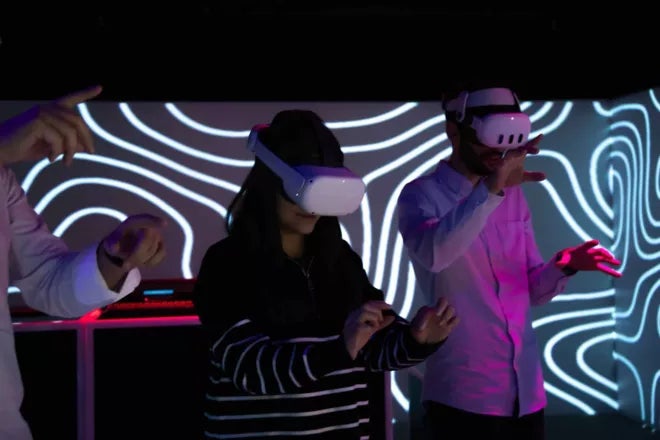
International placements: As a student at UAX Business and Tech you will have the opportunity to undertake international placements at leading universities in key destinations such as the USA, London, China, Germany and Canada, among others.
These are some of the international universities where you will be able to do international placements:
International Internships: Students of the Bachelor's Degree in Physics will be able to carry out international internships in countries such as the USA, UK, Germany or Asian countries such as China, South Korea or Japan, among others.
Studying the degree in Physics, you will be trained by 95% of lecturers who combine teaching with professional activity in leading companies:
Chemical Engineer by the UAX and PhD in Computer Science (specialising in Computational Chemistry) with Cum Laude mention. He holds an MBA, Master Business Intelligence & Big Data and Master in Industry 4.0 by EOI, where he was awarded for the best MBA project 2004-2005. Winner of the CDO 2023 Award (Club Chief Data Officer) for the best advanced analytics project. With more than 20 years of business experience in mathematical modelling and data science, he has implemented more than 100 artificial intelligence and mathematical modelling models, leading multidisciplinary teams in different companies. Recently, as Head of Data, he led the global (worldwide) data science department, developing cloud architectures, data governance and advanced analytics and AI projects.
Degree in Mathematics from the UAM. He obtained the Diploma of Advanced Studies at UCM for my work on the classification of differentiable subvarieties in Lie geometry and Plücker geometry. With more than 25 years of teaching experience, he has professional certifications in Differential Equations for Engineers, Particle Physics and Introduction into General Theory of Relativity. He teaches Algebraic Structures, Differential Equations, Differential Geometry, among others, in the Mathematical Engineering degree.
José Antonio holds a degree in Materials Physics from the Complutense University of Madrid. He carried out studies at the Instituto de Microelectrónica de Madrid (CSIC) on optical properties of quantum semiconductor nanostructures, having published in high impact scientific journals (Physical Review Letters, Applied Physics Letters, Physical Review B, etc). As a university lecturer, he has 25 years of experience teaching mainly mathematics and physics, currently teaching, among other subjects, linear algebra, numerical methods and quantum physics.
Joaquín holds a PhD in condensed matter physics from the Sorbonne University in Paris. He is interested in the quantum phases of matter, with special attention to Dirac and Weyl fermions. He has published numerous scientific articles in journals of high scientific impact, including Materials Today, Physical Review Letters and Communications Physics-Nature. He is currently Coordinator of the Physics Degree at the UAX and teaches the subjects Fundamentals of Physics for the Mathematical Engineering and Physics Degrees, Electromagnetism, Optics and Experimental Laboratory II in the Physics Degree. He is also interested in the internalisation of the student body, being the Coordinator of the Tech degrees of the B&T faculty.
Hugo holds a PhD in Mathematics from the University of Seville and a MSc in Mathematical Engineering from the University Carlos III of Madrid. His research focuses on game theory and operations research. He has published articles in high impact scientific journals in the field of applied mathematics and computation such as Fuzzy Sets and Systems or International Journal of General Systems. He has also taught at several universities and is currently professor of statistics and operations research at the Alfonso X el Sabio University.
Industrial Engineer (University of Malaga) with more than 11 years of experience in the optimisation of operational and strategic processes in multinational companies. PMP, Six Sigma Green Belt (UPC) and Cyber Security Professional (ISMS Forum). He has performed Project Management Office functions in more than 30 Engineering and Construction projects, mainly in Energy, Gas and Petrochemical plants. He currently combines his work as a lecturer in several universities with the leadership of innovation projects for the digitalisation and transfer of knowledge, holding the position of "Process Improvement Coordinator" of the company Técnicas Reunidas.
Consult the complete list of the faculty of the Bachelor's Degree in Physics
Be inspired by those who are already pushing the boundaries of science. Projects, experiences and university life that show how studying Physics at UAX is about much more than just theory.
Companies are an integral part of your day-to-day life on campus. You’ll take part in innovation projects, have your skills certified, and be offered work placements from your first year onwards. Companies such as Avanade, CIMPA and Sener are already developing talent and working on projects alongside our students.

Commit to a curriculum that maximises employability
Our approach transforms theoretical physics to focus on the power of emerging technologies such as Industry 5.0, Big Data and predictive modelling.
30 ECTs of training in key business areas such as strategic management, user experience and digital product innovation.
Data Driven Thinking as a driver for decision making and Google certification in new technologies.
You will develop your own portfolio of real innovation projects with companies, internships from first years and international placements.
Agile methodologies and certifications in communication, leadership, analytical and disruptive thinking.
Physicists continue to be in increasing demand for their ability to apply mathematical models, perform advanced analysis and develop simulations, being key in artificial intelligence, quantum computing, robotics and data science. The Physics degree opens doors to key sectors where innovation and advanced analysis are essential.
A versatile and highly demanded profile in the age of technology and science: 98% of UAX Physics graduates find a job in less than 6 months.
Professionals’ Council
Engineer and PhD in Chemistry, specialist in AI and Data Science, with more than 20 years of experience and a solid track record in international projects in Big Data, machine learning and quantum computing. He is co-founder of OncomIA, a biomedical company that applies advanced technology in the fight against cancer. He is currently Head of Studies in Mathematical Engineering and Physics at UAX, where he teaches artificial intelligence and quantum computing.
Degree in Mathematics from the UAM. I obtained the Diploma of Advanced Studies at the UCM for my work on the classification of differentiable subvarieties in Lie geometry and Plücker geometry. With more than 25 years of teaching experience, he holds professional certifications in Differential Equations for Engineers, Particle Physics and Introduction into General Theory of Relativity. He teaches undergraduate courses in Mathematical Engineering and Physics in Algebraic Structures, Differential Equations, Differential Geometry and others.
José Antonio holds a degree in materials physics from the Complutense University of Madrid. He carried out studies at the Instituto de Microelectrónica de Madrid (CSIC) on optical properties of quantum semiconductor nanostructures, having published in high impact scientific journals (Physical Review Letters, Applied Physics Letters, Physical Review B, etc). As a university lecturer, he has 25 years of experience teaching mainly mathematics and physics, currently teaching, among other subjects, linear algebra, numerical methods and quantum physics. He is also Coordinator of the degree in Mathematical Engineering and Coordinator of Internships in the technological area of the Business & Tech faculty.
PhD in Computer Science, expert in digital teaching, systemic leadership and technological innovation applied to education. Vice-Dean of Technology and Director of the Liquid Innovation Hub at Alfonso X el Sabio University. He has extensive experience in university digital transformation, research in emerging technologies (AI, data, cybersecurity) and academic management, combining university, business and innovation.
In shared spaces on campus, in joint innovation projects and through internships from the first years.
Academic and professional mentoring programme that focuses your efforts and achievements towards your best profile.
You will be trained through innovation projects with real companies and students from other degrees, developing products and solutions based on technology.
+700h of certified training in new technologies, advanced analytics and professional skills.
Internships and placements in strategic markets such as Asia, Europe or the USA and a progressive bilingual model.
Scholarships and Financial Support for Studying at UAX
We know that studying is an investment. That’s why we want to remove financial barriers and make things easier for you. Fill in the form and let our advisers help you discover the scholarships, agreements and personalised financial support that best suit your situation.
Community of Madrid
Financial support for students with a disability of 33 per cent or more who are studying at universities or higher education institutions specialising in the arts in the Community of Madrid.
Ministry of Education, Vocational Training and Sport
Find out about the scholarships and grants offered by the Ministry of Education, Vocational Training and Sport, categorised by type and level of education.
Attracting Pre-doctoral Research Talent
Financial support for outstanding students who wish to carry out innovative research and contribute to the advancement of knowledge in their disciplines.
If you’ve already decided to take the plunge, enrol early and benefit from a direct grant. It’s a way of rewarding your commitment and giving you a head start in planning your future.
Students from Ibero-America
This programme is aimed at Ibero-American citizens or foreign nationals legally resident in countries within the OEI’s sphere of influence. The scholarship covers a 50% discount on the total tuition fees.
Students from Ecuador
This programme is aimed at citizens with Ecuadorian nationality and/or residence who wish to study an online master’s degree in Spain. The scholarship covers a 50% discount on the total tuition fees.
2025, 2nd Edition
Grants for students on higher-level vocational training, undergraduate, postgraduate or master’s programmes enrolled at Spanish universities with a Santander agreement. A financial supplement to support you whilst undertaking your work placements.
If you graduated from UAX and are now thinking of studying for a new degree, we want to continue supporting you. That’s why we’re offering you a 10 per cent discount on tuition fees.
If you have an immediate family member (up to the second degree of kinship) enrolled at UAX, you can benefit from a 5 per cent discount on tuition fees. Because studying as a family is even better.
Studying for two degrees at the same time is a challenge, and we want to support you. If you’re already at UAX and enrol on a second degree programme, you’ll be eligible for a grant towards your booking fee and tuition fees.
If you’d like to continue your studies with us and progress from vocational training to a bachelor’s degree, from one bachelor’s degree to another, or from a bachelor’s degree to a postgraduate degree, we’re here to support you with a grant covering up to 25 per cent of your tuition fees.
If you have a strong academic record, we would like to recognise your talent with a scholarship designed for new students. (Excludes the degree in Medicine).
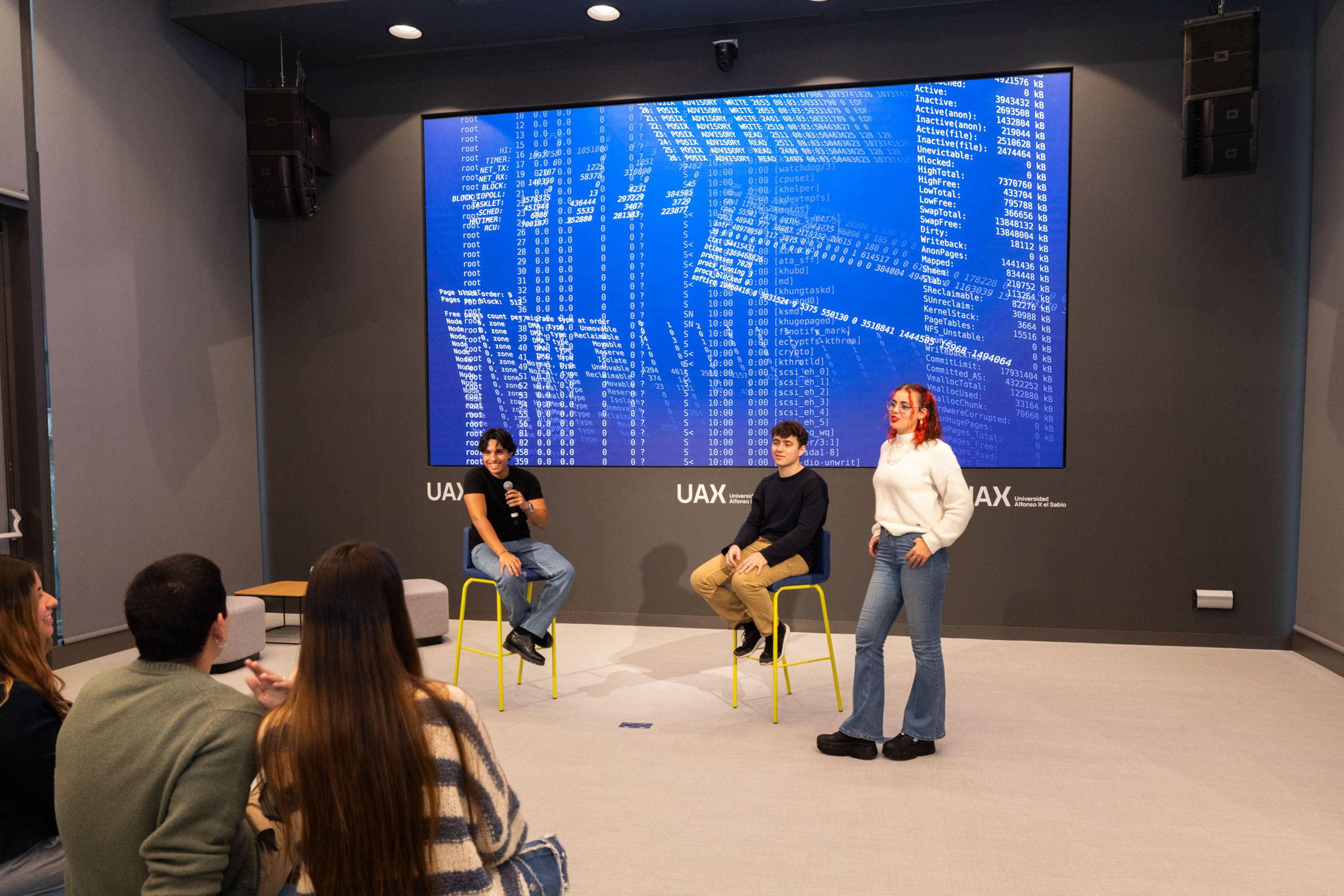
If you’re a high-performance athlete, at UAX we want to help you balance your passion with your studies. We offer specific grants that can cover up to 50% of your tuition fees.
Recognised for helping to shape your career
The rankings place UAX amongst the best universities in Spain for graduate employability, innovation and an educational model that is closely linked to the world of work.

Forbes ranks UAX as the private university with the most graduates working in its area (nearly 90%), thanks to a unique educational model firmly linked to the labour market through more than 8,800 agreements with companies.

The prestigious ranking of the BBVA Foundation and the IVIE recognises us as the university with the best job placement in Spain 2023, consolidating our model focused on the real employability of our graduates.

The Coordenadas Institute of Governance and Applied Economics places UAX as the private university of reference in Madrid, highlighting our practical training model aligned with the reality of the market.

UAX obtains the highest rating of 5 stars and the overall "Excellent" badge for Employability, Teaching, Academic Development, Facilities, Online Teaching and Good Governance in the prestigious international QS Stars rating.
UAX is recognised as the second most innovative university in Spain, the only private university among the top three in the ranking. This recognition highlights our transversal commitment to AI and training in sustainability.
Según la Lista Forbes 2025, UAX se sitúa en el TOP 2 Universidades españolas referentes en la adopción de IA Generativa en la formación de sus estudiantes, desarrollando herramientas y modelos de aprendizaje innovadores alineados con la evolución tecnológica.
We need to know a little bit about you so that we can provide you with a personalised service.
All fields are required
The Bachelor's Degree in Physics at UAX prepares you to become a key figure in leading companies in many sectors, such as industry, the energy sector, strategic consultancy or the world of banking and insurance, focusing on the exploitation of new technologies such as data analysis and visualisation, problem solving or R&D.
You will be trained in statistics, algebra, mechanics, quantum physics, data analysis and programming, through Agile methodologies, you will receive strategic training for digital business management and you will work on interdisciplinary projects with students from other faculties and companies such as Avanade, Ecoalf, Quirónsalud and Caixabank, among others.
The Physics degree is dynamic and always presents new challenges and opportunities for lifelong learning. In addition, physics education offers a wide range of career opportunities.
According to current regulations, the requirements for university entrance include the possession of the Bachiller's degree and passing the EVAU (University Entrance Examination). It is also considered valid to hold a Higher Technical qualification in any discipline, whether it be Vocational Training, Plastic Arts and Design or Sports. On the other hand, there is also the possibility of access to university for people over 25 years of age by passing the corresponding entrance exam.
With the UAX Bachelor's Degree in Physics you will be connected to the professional world from the very first day:
In addition, you will have the support of the Career Services Office where we provide you with everything you need to carry out your internships and institutions, to encourage contact with the professional world right from the start.
The duration of the Physics degree at the UAX is 4 years.
Other related qualifications
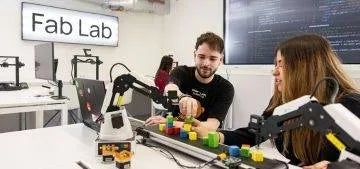
Degree in Mathematical Engineering
+ Data, Coding and Web Certificate by

Start:
September
Length:
4 years

Degree in Mathematical Engineering
Start:
September
Length:
4 years

Bachelor’s Degree in Business Analytics
In collaboration with:

Start:
September
Length:
4 years
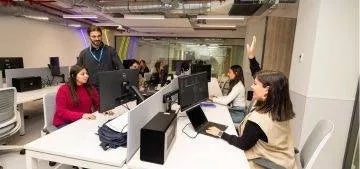
Bachelor's Degree in Computer Engineering
Start:
September
Length:
4 years

Online Advanced Diploma in Industrial Automation and Robotics
Start:
September
Length:
2 years

Online Advanced Diploma in Web Application Development
Start:
September
Length:
2 years
Online Advanced Vocational Qualification in Cross-Platform Application Development (DAM)
Start:
September
Length:
2 years

Online Advanced Diploma in Administration and Finance
In collaboration with:

Start:
September
Length:
2 years
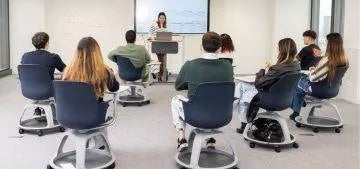
Bachelor’s Degree in Business Analytics + Business Administration and Management
In collaboration with:

Start:
September
Length:
4.5 years

Degree in Mathematical Engineering
Start:
September
Length:
5 years
The Degree Monitoring and Improvement Committee is made up of the degree programme management, a representative of the degree teaching staff, a student representative and a representative of the Vice-Rector's Office for Studies and Quality. In addition, guest members may be invited to deal with specific issues that need to be monitored.