See all Online Master's Degrees in Health
See all Master's Degrees in Engineering
Most searched curriculums
Official Master’s Degree
Learn to teach by understanding how the brain works and transform learning through scientific evidence
Specialise in educational neuropsychology with a master’s degree that will enable you to understand, support and optimise learning in the classroom, making a real difference to your students whilst enhancing your academic and professional prospects.
What’s more, gain credits that count towards teacher recruitment exams for primary and secondary schools.
In collaboration with:

The UAX Master’s in Educational Neuropsychology equips you to understand how the brain works and to apply that knowledge to learning with scientific rigour. In a context where approximately 15 per cent of pupils have learning difficulties, there is a vital need for professionals capable of effectively identifying, assessing and intervening.
Throughout the programme, you will learn to understand learning as a holistic process, influenced by cognition, emotion, the body and the environment, enabling you to design evidence-based educational interventions that can be applied from day one.
You will explore key areas such as executive functions, memory, language and development, and specialise in learning disorders such as dyslexia, ADHD and ASD, drawing on a scientific understanding of diversity in development and learning, whilst maintaining a holistic view of the student body.
This Master’s programme prepares you to analyse and respond to real-life educational situations through case studies and the design of interventions based on scientific evidence.
You will learn to make neuroscience-informed decisions that directly impact pupils’ learning, developing key skills such as critical thinking, effective communication and emotional self-regulation.
In addition, you will benefit from a teaching staff of practising professionals and access to work placements in schools and specialist centres, as part of a programme that fosters your professional and academic development (civil service examinations and PhD studies).
You will develop specialised skills to transform educational practice through neuroscience
Identifies the optimal time to initiate each learning process according to brain development.
Learn about the key stages of cognitive development and their impact on the learning process.
Tailors educational strategies to the cognitive development of each student to maximise their talents.
Detects and assesses neurodevelopmental disorders such as ADHD, dyslexia and dyscalculia
Applies the scientific foundations of evidence-based neuroeducation
Identifies and addresses language, communication, numeracy, motor development and attention problems
Enhance your teaching practice by understanding learning through the lens of neuroeducation. This micro-credential equips you to analyse students’ cognitive, emotional and behavioural processes, identify potential difficulties at an early stage, and apply evidence-based inclusive teaching strategies in the classroom.

Transform the way you work with generative artificial intelligence. This micro-credential empowers you to apply tools like ChatGPT, Copilot, and Gemini to analyze information, create content, and make decisions in real-world academic contexts, integrating solutions ethically and responsibly within the educational field.

Develop your potential in education through leadership and interpersonal skills. This microcredential provides you with the keys to managing teams, communicating effectively, and solving problems in real-world educational settings, combining personal leadership techniques with practical productivity and collaboration tools.
The Master's Degree in Educational Neuropsychology focuses on the specific aspects that neuropsychology brings to the field of education and trains its students in the pedagogy demanded by today's 21st century education.
The list of subjects allows students to receive comprehensive training in this field and enables them to face the educational challenges that arise in the classroom.
Master's Degree in Educational Neuropsychology
First Year
FIRST FOUR-MONTH PERIOD
| Code | Subjects | Character* | ECTS | ||||||||||||||||||||||||||||||||||||||||||||||||||||||||||||||||||||||||||||||||||||||||
|---|---|---|---|---|---|---|---|---|---|---|---|---|---|---|---|---|---|---|---|---|---|---|---|---|---|---|---|---|---|---|---|---|---|---|---|---|---|---|---|---|---|---|---|---|---|---|---|---|---|---|---|---|---|---|---|---|---|---|---|---|---|---|---|---|---|---|---|---|---|---|---|---|---|---|---|---|---|---|---|---|---|---|---|---|---|---|---|---|---|---|---|
| M121200 | Attention, Executive Functions and Hyperactivity | OB | 6 | ||||||||||||||||||||||||||||||||||||||||||||||||||||||||||||||||||||||||||||||||||||||||
Attention, Executive Functions and HyperactivityCódigo: M121200 Imprimir Course 1: First-semester module. Compulsory. 6 credits. Profesores
Objectives When discussing educational neuropsychology, it is essential to examine the various cognitive aspects and skills that have a significant impact on a child’s development and their ability to learn. In this module, you are expected to acquire the basic knowledge needed to understand what executive functions and attention entail, what neural correlates can be identified, which learning, behavioural and developmental problems are linked to these abilities, and why they are important cognitive functions in an educational context. Conceptual objectives: - To enable you to appreciate the importance of understanding the development of attention and executive functions. - To understand the importance of having an in-depth understanding of neuropsychological development throughout pupils’ lives. -To consolidate the fundamentals of real neuroscience as the backbone of positive neuro-educational teaching. - To establish the foundations of real neuroscience as the backbone of positive neuro-educational teaching. Prerequisites No prior requirements have been established, apart from those set out in current legislation governing access to postgraduate studies. Learning outcomes Knowledge: RK0. Identifies the different parts of the nervous system by applying the imaging techniques used in its study to define the function of each part in relation to cognition. RK1. Defines the specific cognitive characteristics of psychosocial development, enabling the formulation of guidelines for actions aimed at improving the management of this type of pupil from various perspectives, both within the classroom and in relation to their families. RK2. Learns about brain development and the functional blocks underpinning neurodevelopment in children and young people, in order to understand the biological basis of developmental psychology. RK4. Recognises the neuropsychological processes associated with attention from the perspective of higher cognitive processes in general and executive functions in particular, in order to assess situations where these are impaired. Skill: RS4. Apply observation guidelines and resources to identify the specific needs of pupils with attention deficit hyperactivity disorder and provide educational solutions to the problems of this nature identified in the teaching and learning process. RS2. Selects observation guidelines and resources to identify pupils’ specific needs. RS3. Applies thinking strategies defined by cognitive science within the teaching and learning process. RS14. Resolves problems that may arise in the educational context from a neuroscientific perspective. Competence: RC2. Analyses the characteristics of Attention Deficit Hyperactivity Disorder in relation to higher-order cognitive processes to establish guidelines for improvement measures in the classroom and within families. RC7. Develops work plans that promote the cognitive management of executive functions through neuroeducation, thereby transforming the educational process into a neuroeducational one. RC0. Links higher-order cognitive processes to brain function, whilst being able to distinguish between the various ‘neuromyths’ associated with neuroscience. RC10. Analyses case studies and practical experiences of applying neuropsychological skills related to reading, writing and mathematical learning, in order to develop specific plans and activities for these areas in school practice. RC13. Analyses specific needs according to the type of pupil, from defining and specifying these needs to translating them into specific teaching activities, thereby being able to design appropriate intervention strategies. Description of the content · The neuropsychological process of attention. · Neuropsychological processes of executive functions. · Neuropsychological assessment measures and instruments, and observation guidelines. · The relationship between executive functions and the study of subject-specific content across the curriculum, and its application in the classroom. · Programmes to improve attention and executive functions. · Experiences and research on the application of Educational Neuropsychology in this field. Training activities INDEPENDENT STUDENT WORK This is designed as a reflective and applied portfolio, demonstrating the acquisition of cross-curricular and subject-specific skills. - Forum (10 hours) An introductory exercise applying basic theoretical and methodological content. It enables students to assess their understanding and receive early feedback. -Project 1 (15 hours) Development of an intermediate practical case study in which concepts of analysis and synthesis are applied. This may be carried out in groups or individually with minimal supervision from teaching staff. -Project 2 (20 hours) An activity integrating the learning acquired in the previous tasks. -Self-assessment test (6 hours) A tool for metacognition and assessment of learning, designed to encourage students’ self-regulation. -Independent study (40 hours, not directly weighted) Includes preparatory activities, reading of academic materials and individual study to support the learning process and preparation for the final exam. LEARNING ACTIVITIES • Interactive classes: 12 hours • Oral presentations, discussions, debates: 6 hours • Knowledge assessments: 3 hours • Asynchronous lectures: 15 hours • Case studies and projects: 10 hours • Critical analysis sessions: 6 hours ACADEMIC CONSULTATIONS 7 hours Assessment system and criteria REGULAR EXAM SESSION The assessment criteria are: •The final multiple-choice exam for the module will account for: 50% of the final mark. •The remaining 50 per cent of the mark will be based on your performance in continuous assessment (assessed activities). The activities are as follows and together constitute a portfolio for the module, as they are conceptually interlinked: - Forum (10%). - Project 1 (15%) - Project 2 (20%) - Final self-assessment test (5% of the mark). EXTRA SESSION • The final exam for the module will account for: 100% of the final mark. It will be a mixed-format exam. Timetable Click on this link to view the detailed timetable in Excel
|
|||||||||||||||||||||||||||||||||||||||||||||||||||||||||||||||||||||||||||||||||||||||||||
| M121202 | An Introduction to Child and Adolescent Neuropsychology | OB | 6 | ||||||||||||||||||||||||||||||||||||||||||||||||||||||||||||||||||||||||||||||||||||||||
An Introduction to Child and Adolescent NeuropsychologyCódigo: M121202 Imprimir Course 1: First-semester module. Compulsory. 6 credits. Profesores
Objectives This module teaches students to define the foundations of neuropsychology based on basic biology and established findings in neuroscience, in order to understand how this knowledge impacts psychology. To this end, the course examines the biological foundations of the nervous system – both neuroanatomical and neurobiochemical – as well as the biological (developmental milestones) and social foundations of development during childhood and adolescence. Conceptual objectives: - To enable you to appreciate the importance of understanding the anatomy and function of the nervous system as the cornerstone of neuroscience. - To enable you to understand the importance of having an in-depth understanding of neuropsychological development throughout pupils’ lives. -To establish the foundations of real neuroscience as the backbone of positive neuroeducational teaching. To achieve the objectives of this course, we need you to participate in classes, in the proposed discussions and in the activities we suggest, as this will enable you to achieve a more comprehensive and enriching learning experience. We do not want passive students who simply receive and process information; we want students with their own opinions who are keen to learn and contribute different perspectives. Prerequisites No prior requirements have been set, apart from those described in current legislation governing access to postgraduate studies. Learning outcomes Knowledge: RK0. Identifies the different parts of the nervous system by applying the imaging techniques used in its study to define the function of each part in relation to cognition. RK2. Learns about brain development and the functional blocks that underpin neurodevelopment in children and adolescents in order to understand the biological basis of developmental psychology. Skills: RS2. Selects observation guidelines and resources to identify pupils’ specific needs. RS3. Applies the thinking strategies defined by cognitive science within the teaching and learning process. RS14. Resolve problems that may arise in the educational context from a neuroscientific perspective. Competence: RODS. Develops effective communication, teamwork, analytical thinking, creativity and ethical leadership from a cross-curricular perspective, clearly inspired by democratic principles and values, as well as the Sustainable Development Goals, in order to operate with integrity in a professional environment. RC1. Designs neurodidactic interventions aimed at transforming the educational process into a neuroeducational one. RC5. Derives the necessary information from the biological milestones of cognitive development to design specific interventions for pupils. RC13. Designs research processes with a neuroscientific focus, employing different methodological approaches. RC15. Establishes, from a scientific perspective, pedagogical links between neuroscientific aspects relating to brain function—free from neuromyths—with the aim of creating educational activities based on genuine neuropedagogy. Description of the content · The nervous system, its development and relationship with cognition and emotion. · The brain, brain functions and brain plasticity relevant to learning. · Characteristics of neuropsychological development in childhood and changes during adolescence. · Neuropsychological assessment tools and observation guidelines applicable during the school years. · Experiences and research on the application of Educational Neuropsychology. · Resources and sources of information. Training activities STUDENT INDEPENDENT WORK This is designed as a reflective and practical portfolio, demonstrating the acquisition of cross-curricular and subject-specific skills. -Activity 1 (10 hours) An introductory exercise applying basic theoretical and methodological content. It enables students to assess their understanding and receive early feedback. -Project 1 (15 hours) Development of an intermediate practical case study in which concepts of analysis and synthesis are applied. This may be carried out in groups or individually with minimal supervision from teaching staff. -Project 2 (20 hours) An activity integrating the learning acquired in the previous tasks. -Self-assessment test (6 hours) A tool for metacognition and assessment of learning, designed to encourage students’ self-regulation. -Independent study (40 hours, not directly marked) Includes preparatory activities, reading of academic materials and individual study to support the learning process and preparation for the final exam. LEARNING ACTIVITIES • Interactive classes: 12 hours • Oral presentations, discussions, debates: 6 hours • Knowledge assessments: 3 hours • Asynchronous lectures: 15 hours • Case studies and projects: 10 hours • Critical analysis sessions: 6 hours ACADEMIC CONSULTATIONS 7 hours Assessment system and criteria REGULAR EXAM SESSION The assessment criteria are: •The final multiple-choice exam for the module will account for: 50% of the final mark. •The remaining 50 per cent of the mark will be based on your continuous assessment (assessed activities). The activities are as follows and together constitute a portfolio for the module, as they are conceptually interlinked: - Activity 1 (10%) - Project 1 (15%) - Project 2 (20%) - Final self-assessment test (5% of the mark). EXTRA SESSION • The final exam for the module will account for: 100% of the final mark. It will be a mixed-format exam. Timetable Click on this link to view the detailed timetable in Excel
|
|||||||||||||||||||||||||||||||||||||||||||||||||||||||||||||||||||||||||||||||||||||||||||
| M121203 | Memory, higher-order skills and neurodidactics | OB | 6 | ||||||||||||||||||||||||||||||||||||||||||||||||||||||||||||||||||||||||||||||||||||||||
Memory, higher-order skills and neurodidacticsCódigo: M121203 Imprimir Course 1: First-semester module. Compulsory. 6 credits. Profesores
Objectives This module examines the neurobiological basis of memory and the different types of memory, as well as the teaching strategies best suited to fostering memory in line with neuroscience. It also explores how the various systems and processes involved in storing and retrieving memories can be affected, and what the consequences of their deterioration might be. Building on an understanding of how memory and information processing function—across different stages and phases—students learn how to develop various strategies that facilitate and enhance processes such as the acquisition or retrieval of information. Conceptual objectives: - To appreciate the importance of understanding how the different memory systems work and their relationship with information processing. - To recognise the need for an in-depth understanding of the different stages of the cognitive processes that underpin learning and memory systems, as well as the various information-processing strategies involved in higher-order skills. -To assimilate the essential concepts that will enable you to apply your knowledge of how memory and higher-order skills function to the field of teaching. Prerequisites No prior requirements have been established, apart from those set out in current legislation governing access to postgraduate studies. Learning outcomes Knowledge: RK3. Identify, from a neurobiological perspective, the concept of memory and the different types of memory, with a view to applying this knowledge to the learning process of pupils. RK2. Learns about brain development and the functional components underpinning neurodevelopment in children and young people, in order to understand the biological basis of developmental psychology. Skills: RS3. Applies the thinking strategies defined by cognitive science within the teaching and learning process. RS14. Solves problems that may arise in an educational context from a neuroscientific perspective. Competence: RC0. Link higher-order cognitive processes with brain function, whilst being able to distinguish between the various neuromyths associated with neuroscience. RC1. Designs neurodidactic activities that transform the educational process into a neuroeducational one. RC6. Plans learning situations, drawing on knowledge of the cognitive processes related to memory in order to facilitate the acquisition of memory. RC13. Analyses specific needs according to the type of student, from defining and specifying these needs to translating them into concrete teaching activities, thereby being able to design appropriate intervention strategies. Description of the content · The neuropsychological process of memory and its types. · Neuropsychological processes underlying higher-order thinking skills and strategies. · The relationship between memory and higher-order skills and the study of content across curricular areas, and the application of neurodidactics. · Neuropsychological assessment tools and guidelines for observing memory and higher-order thinking skills, applicable during the school years. · Programmes to improve memory and higher-order cognitive skills. · Experiences and research on the application of Educational Neuropsychology. · Resources and sources of information for teachers and for advising families. Training activities STUDENT INDEPENDENT WORK This is designed as a reflective and practical portfolio, demonstrating the acquisition of cross-curricular and subject-specific skills. -Forum (10 hours) An introductory exercise applying basic theoretical and methodological content. It enables students to assess their understanding and receive early feedback. -Project 1 (15 hours) Development of an intermediate practical case study in which concepts of analysis and synthesis are applied. This may be carried out in groups or individually with minimal supervision from teaching staff. -Project 2 (20 hours) An activity integrating the learning acquired in the previous tasks. -Self-assessment test (6 hours) A tool for metacognition and assessment of learning, designed to encourage students’ self-regulation. -Independent study (40 hours, not directly weighted) Includes preparatory activities, reading of academic materials and individual study to support the learning process and preparation for the final exam. LEARNING ACTIVITIES • Interactive classes: 12 hours • Oral presentations, discussions, debates: 6 hours • Knowledge assessments: 3 hours • Asynchronous lectures: 15 hours • Case studies and projects: 10 hours • Critical analysis sessions: 6 hours ACADEMIC CONSULTATIONS 7 hours Assessment system and criteria REGULAR EXAM SESSION The assessment criteria are: •The final multiple-choice exam for the module will account for: 50% of the final mark. •The remaining 50 per cent of the mark will be based on your continuous assessment (assessed activities). The activities are as follows and together constitute a portfolio for the module, as they are conceptually interlinked: - Forum (10%). - Project 1 (15%) - Project 2 (20%) - Final self-assessment test (5% of the mark). EXTRA SESSION • The final exam for the module will account for: 100% of the final mark. It will be a mixed-format exam. Timetable Click on this link to view the detailed timetable in Excel
|
|||||||||||||||||||||||||||||||||||||||||||||||||||||||||||||||||||||||||||||||||||||||||||
| M121204 | Neuropsychology of language and communication disorders | OB | 6 | ||||||||||||||||||||||||||||||||||||||||||||||||||||||||||||||||||||||||||||||||||||||||
Neuropsychology of language and communication disordersCódigo: M121204 Imprimir Course 1: First-semester module. Compulsory. 6 credits. Profesores
Objectives This module covers the neurological foundations of language, the components involved in listening comprehension and the different stages of typical language development. In addition, students will examine various language disorders and the basic methods for assessing them; towards the end of the module, they will be introduced to different forms of intervention and will have the opportunity to explore this topic through the latest scientific literature, enabling them to share this knowledge in the classroom. Conceptual objectives: - To develop a holistic understanding that incorporates knowledge of the anatomical, developmental, psychological and environmental factors involved in communication disorders. - To familiarise you with the various language disorders and the factors involved in them. - To learn the different approaches to intervention in this field from a multidisciplinary perspective. Prerequisites No prior requirements have been established, apart from those set out in current legislation governing access to postgraduate studies. Learning outcomes Knowledge: RK1. Defines the specific cognitive characteristics of psychosocial development, enabling the formulation of guidelines for actions aimed at improving the management of this type of pupil from various perspectives within the classroom and in relation to their families. RK6. Identifies the neuropsychological processes underlying language and communication disorders, thereby enabling an understanding of the reality within the classroom across this range of possible situations. Skills: RS1. Selects observation guidelines and neuropsychological assessment tools to detect possible cognitive difficulties relating to language and communication. RS6. Provides resources for teachers and families of children with these types of difficulties and disorders, thereby facilitating understanding with the guidance team. RS14. Resolves problems that may arise in the educational context from a neuroscientific perspective. Competence: RODS. Develops effective communication, teamwork, analytical thinking, creativity and ethical leadership from a cross-curricular perspective, clearly inspired by democratic principles and values, as well as the Sustainable Development Goals, in order to operate with integrity in a professional environment. RC4. Develops neuro-educational interventions, both group-based and personalised, tailored to the diversity of students and their specific educational support needs in relation to their cognitive processes. RC9. Analyses case studies to propose applications in coordination with the relevant support teams and counsellors. RC10. Analyses case studies and experiences of applying neuropsychological skills related to reading, writing and mathematical learning, in order to develop specific plans and activities for these areas in school practice. RC13. Analyses specific needs according to the type of pupil, from defining and specifying these needs to translating them into specific teaching activities, in order to be able to design appropriate intervention strategies. Description of the content · Neuropsychological processes of language and communication disorders. · Neuropsychological foundations of oral comprehension, phonological, syntactic and semantic disorders. · Neuropsychological bases of oral production and expression and their disorders. · Neuropsychological assessment tools for language and language disorders. Programmes and resources for language development and those specifically designed for . · Experiences and research on the application of Educational Neuropsychology in this field. · Resources and sources of information for teachers and for advising families. Training activities STUDENT INDEPENDENT WORK This is designed as a reflective and applied portfolio, demonstrating the acquisition of cross-curricular and subject-specific skills. -Forum (10 hours) An introductory exercise applying basic theoretical and methodological content. It enables students to assess their understanding and receive early feedback. -Project 1 (15 hours) Development of an intermediate practical case study in which concepts of analysis and synthesis are applied. This may be carried out in groups or individually with minimal supervision from teaching staff. -Project 2 (20 hours) An activity integrating the learning acquired in the previous tasks. -Self-assessment test (6 hours) A tool for metacognition and assessment of learning, designed to encourage students’ self-regulation. -Independent study (40 hours, not directly marked) Includes preparatory activities, reading of academic materials and individual study to support the learning process and preparation for the final exam. LEARNING ACTIVITIES • Interactive classes: 12 hours • Oral presentations, discussions, debates: 6 hours • Knowledge assessments: 3 hours • Asynchronous lectures: 15 hours • Case studies and projects: 10 hours • Critical analysis sessions: 6 hours ACADEMIC CONSULTATIONS 7 hours Assessment system and criteria REGULAR EXAM SESSION The assessment criteria are: •The final multiple-choice exam for the module will account for: 50% of the final mark. •The remaining 50 per cent of the mark will be based on your performance in continuous assessment (assessed activities). The activities are as follows and together form a portfolio for the module, as they are conceptually interlinked: - Forum (10% of the mark). - Project 1 (10%) - Project 2 (30 per cent) - Final self-assessment test (5% of the mark). EXTRA SESSION • The final exam for the module will account for: 100% of the final mark. It will be a mixed-format exam. Timetable Click on this link to view the detailed timetable in Excel
|
|||||||||||||||||||||||||||||||||||||||||||||||||||||||||||||||||||||||||||||||||||||||||||
| M121206 | Perception, motor skills, handedness and learning | OB | 6 | ||||||||||||||||||||||||||||||||||||||||||||||||||||||||||||||||||||||||||||||||||||||||
Perception, motor skills, handedness and learningCódigo: M121206 Imprimir Course 1: First-semester module. Compulsory. 6 credits. Profesores
Objectives This module examines the development of visual and auditory perception, which are key sensory functions enabling the brain to process verbal and written information effectively. Furthermore, we will study sensorimotor development, motor processes and the areas of the brain involved in the acquisition of writing and the development of both motor and cerebral laterality. Students will learn to recognise warning signs to identify pupils with possible difficulties in these areas, so as to recommend appropriate referrals, bearing in mind that the early years of life are crucial for the development of neural processes and that timely intervention ensures a better prognosis. Conceptual objectives: - To enable you to appreciate the importance of understanding human motor development and its direct influence on learning. - To understand the importance of having an in-depth understanding of neuropsychological development throughout pupils’ lives. - To establish the foundations of real neuroscience as the backbone of positive neuro-educational teaching. Prerequisites No prior requirements have been established, apart from those set out in current legislation governing access to postgraduate studies. Learning outcomes Knowledge: RK5. Identifies the perception and functioning of vision and hearing in relation to the cognitive processes involved in reading and writing, in order to establish their relationship with motor skills. Skills: RS0. Defines the relationship between laterality, the acquisition of motor skills and the development of learning. RS5. Relates the perception and functioning of vision and hearing to brain processes in order to create teaching situations that promote the proper development of literacy. RS14. Resolves problems that may arise in the educational context from a neuroscientific perspective. Competence: RC8. Identifies the tools required to draw up guidelines for observation and intervention in educational processes where pupils require educational support relating to vision and hearing, with the aim of analysing these and devising educational solutions to problems of this nature detected in the teaching-learning process. RC13. Analyses specific needs according to the type of pupils, from identifying and defining these needs to translating them into specific teaching strategies, thereby enabling the design of appropriate intervention strategies. Description of the content · Visual perception, the visual system, its development and its relationship with reading, writing and academic performance. · Auditory perception, the auditory system and its relationship with language and learning. · Motor processes and skills, coordination and balance for writing. · Development of lateralisation and spatio-temporal awareness in relation to mathematical learning. · Neuropsychological assessment tools and observation guidelines applicable to pre-school and primary school children, as well as for learning difficulties. · Experiences and research on the implementation of programmes for perceptual and motor neuropsychological skills. · Resources and sources of information for teachers, and guidance for families on this subject. Training activities STUDENT INDEPENDENT WORK This is designed as a reflective and applied portfolio, demonstrating the acquisition of cross-curricular and subject-specific skills. - Forum (10 hours) An introductory exercise applying basic theoretical and methodological content. It enables students to assess their understanding and receive early feedback. -Project 1 (15 hours) Development of an intermediate practical case study in which concepts of analysis and synthesis are applied. This may be carried out in groups or individually with minimal supervision from teaching staff. -Project 2 (20 hours) An activity integrating the learning acquired in the previous tasks. -Self-assessment test (6 hours) A tool for metacognition and assessment of learning, designed to encourage students’ self-regulation. -Independent study (40 hours, not directly weighted) Includes preparatory activities, reading of academic materials and individual study to support the learning process and preparation for the final exam. LEARNING ACTIVITIES • Interactive classes: 12 hours • Oral presentations, discussions, debates: 6 hours • Knowledge assessments: 3 hours • Asynchronous lectures: 15 hours • Case studies and projects: 10 hours • Critical analysis sessions: 6 hours ACADEMIC CONSULTATIONS 7 hours Assessment system and criteria REGULAR EXAM SESSION The assessment criteria are: •The final multiple-choice exam for the module will account for: 50% of the final mark. •The remaining 50 per cent of the mark will be based on your performance in continuous assessment (assessed activities). The activities are as follows and together constitute a portfolio for the module, as they are conceptually interlinked: - Forum (10% of the mark). - Project 1 (15%) - Project 2 (20 per cent) - Final self-assessment test (5% of the mark). EXTRA SESSION • The final exam for the module will account for: 100% of the final mark. It will be a mixed-format exam. Timetable Click on this link to view the detailed timetable in Excel
Bibliography Basic: 1. IRENE PELLICER ROYO NEUROEF: A PHYSICAL REVOLUTION THROUGH NEUROSCIENCE Self-published, 2015. ISBN: 9788497293501 2. Rudy José Nodari The Science of Human Motricity Nova Science Publishers Inc. 2022. ISBN: 978-168507431 3. Sagrario del Valle Perceptual-Motor Model Onporsport S.L. 2014. ISBN: 978-84-940254 Supplementary: 4.- Francisco Alarcón López Neuroscience, Sport and Education WANCEULEN. 2018. ISBN: 978-849993847 Others: 5. Vicki Bruce, Mark A. Georgeson & Patrick R. Green Visual Perception: Physiology, Psychology and Ecology Psychology Press. 2003. ISBN: 9781841692371 |
|||||||||||||||||||||||||||||||||||||||||||||||||||||||||||||||||||||||||||||||||||||||||||
| M121254 | Neural plasticity, perception and attention | CM | 4 | ||||||||||||||||||||||||||||||||||||||||||||||||||||||||||||||||||||||||||||||||||||||||
Neural plasticity, perception and attentionCódigo: M121254 Imprimir Course 1: First-semester module. Supplementary module for the Master’s degree. 4 credits. Profesores
Objectives In this module, you will learn what two of the most important cognitive functions are – perception and attention – and how they relate to one another. You will also learn what we mean by neural plasticity and how this mechanism of the nervous system relates to the cognitive processes that a person engages in to tackle such important everyday tasks as acquiring new knowledge or forming memories. Conceptual objectives: - To enable you to understand how perception functions as a fundamental mechanism for interacting with the world and for learning. - To understand the importance of attention as a fundamental process in our daily lives, but particularly in an educational context. - To understand the basic neuroscientific principles linked to learning, such as neural plasticity. Prerequisites No prior requirements have been established, apart from those set out in current legislation governing access to postgraduate studies. Competencies Analyses the relationship between perception and the attentional process in order to design neuroeducational interventions that successfully integrate both phases. Learning outcomes Knowledge: Understands the characteristics associated with the human perceptual process in order to identify basic brain function in relation to the functioning of the senses. Skills: Classifies the various higher-order cognitive processes in order to study their specific functions. Description of the content · Perception as a process. · Attention: definition and attentional processes. · Attention: explanatory models, biological bases, maturation and attentional tasks. · Neural plasticity. Learning activities INDEPENDENT STUDENT WORK This is designed as a reflective and applied portfolio, demonstrating the acquisition of cross-curricular and subject-specific skills. - Forum (15 hours) An introductory exercise applying basic theoretical and methodological content. It enables students to assess their understanding and receive early feedback. -Project 1 (20 hours) Development of an intermediate case study in which concepts of analysis and synthesis are applied. This may be carried out in groups or individually with minimal supervision from teaching staff. -Self-assessment test (3 hours) A tool for metacognition and assessment of learning, designed to encourage students’ self-regulation. -Independent study (28 hours, not directly weighted) Includes preparatory activities, reading of academic materials and individual study to support the learning process and preparation for the final exam. SESSIONS • Interactive classes: 8 hours • Asynchronous lectures: 15 hours • Project work and problem-solving: 7 hours • Knowledge assessments: 3 hours ACADEMIC CONSULTATIONS 5 hours Assessment system and criteria REGULAR EXAM SESSION The marking criteria are: •The final multiple-choice exam for the module will account for: 50% of the final mark. •The remaining 50 per cent of the mark will be based on your performance in continuous assessment (assessed activities). The assessed activities are as follows: - Forum (15% of the mark). - Project 2 (25%) - Final self-assessment test (10% of the mark). EXTRA SESSION • The final exam for the module will account for: 100% of the final mark. It will be a mixed-format exam. Timetable Click on this link to view the detailed timetable in Excel
|
|||||||||||||||||||||||||||||||||||||||||||||||||||||||||||||||||||||||||||||||||||||||||||
| M121255 | Developmental psychology | CM | 4 | ||||||||||||||||||||||||||||||||||||||||||||||||||||||||||||||||||||||||||||||||||||||||
Developmental psychologyCódigo: M121255 Imprimir Course 1: First-semester module. Supplementary module for the Master’s degree. 4 credits. Profesores
Objectives The aim of this course is to provide the essential foundations for understanding the field of evolutionary psychology, which focuses on exploring the biological, psychological and social influences on human development. Throughout this module, the different stages that make up the human life cycle will be explained in detail, as well as the most significant events that characterise each of these stages. Evolutionary psychology is a discipline that seeks to unravelling the processes of development and change throughout a person’s life, from childhood to old age. By studying this subject, students gain a deeper understanding of how biological, psychological and social factors interact to shape the course of human life. Conceptual objectives: - To enable you to appreciate the importance of understanding human development and evolutionary psychology - To understand the importance of having an in-depth understanding of the factors that influence human development throughout the life span. - To consolidate the fundamentals of neuroscience as the backbone of human development. Prerequisites No prior requirements have been established, apart from those set out in current legislation governing admission to postgraduate studies. Competencies Analyses the social environments in which development occurs during childhood, adolescence, adulthood and old age in order to design the most appropriate neuro-educational interventions in each case. Learning outcomes Knowledge: - Understands and describes basic concepts of developmental psychology, thereby enabling them to identify situations that deviate from the norm. Skills: - Understands the importance of family relationships in the early stages of life for healthy psychological development. Course content · Neurodevelopment. Long-term synapses. · Psychological development during the prenatal period and childhood. · Psychological development during adolescence. · Psychological development in adulthood Learning activities INDEPENDENT STUDENT WORK This is designed as a reflective and applied portfolio, demonstrating the acquisition of cross-cutting and specific skills. - Forum (15 hours) An introductory exercise applying basic theoretical and methodological content. It enables students to assess their understanding and receive early feedback. -Project 1 (20 hours) Development of an intermediate case study in which concepts of analysis and synthesis are applied. This may be carried out in groups or individually with minimal supervision from teaching staff. -Self-assessment test (3 hours) A tool for metacognition and assessment of learning, designed to encourage students’ self-regulation. -Independent study (28 hours, not directly weighted) Includes preparatory activities, reading of academic materials and individual study to support the learning process and preparation for the final exam. SESSIONS • Interactive classes: 8 hours • Asynchronous lectures: 15 hours • Project work and problem-solving: 7 hours • Knowledge assessments: 3 hours ACADEMIC CONSULTATIONS 5 hours Assessment system and criteria REGULAR EXAM SESSION The marking criteria are as follows: •The final multiple-choice exam for the module will account for: 50% of the final mark. •The remaining 50 per cent of the mark will be based on your performance in continuous assessment (assessed activities). The assessed activities are as follows: - Forum (15% of the mark). - Project 2 (25%) - Final self-assessment test (10% of the mark). EXTRA SESSION • The final exam for the module will account for: 100% of the final mark. It will be a mixed-format exam. Timetable Click on this link to view the detailed timetable in Excel
|
|||||||||||||||||||||||||||||||||||||||||||||||||||||||||||||||||||||||||||||||||||||||||||
| TOTAL: | 38 | ||||||||||||||||||||||||||||||||||||||||||||||||||||||||||||||||||||||||||||||||||||||||||
SECOND FOUR-MONTH PERIOD
| Code | Subjects | Character* | ECTS | ||||||||||||||||||||||||||||||||||||||||||||||||||||||||||||||||||||||||||||||||||||||
|---|---|---|---|---|---|---|---|---|---|---|---|---|---|---|---|---|---|---|---|---|---|---|---|---|---|---|---|---|---|---|---|---|---|---|---|---|---|---|---|---|---|---|---|---|---|---|---|---|---|---|---|---|---|---|---|---|---|---|---|---|---|---|---|---|---|---|---|---|---|---|---|---|---|---|---|---|---|---|---|---|---|---|---|---|---|---|---|---|---|
| M121201 | Difficulties and disorders relating to reading, writing and arithmetic | OB | 6 | ||||||||||||||||||||||||||||||||||||||||||||||||||||||||||||||||||||||||||||||||||||||
Difficulties and disorders relating to reading, writing and arithmeticCódigo: M121201 Imprimir Course 1. Second-term module. Compulsory. 6 credits. Profesores
Objectives This module teaches students how to identify, assess and intervene in the main specific learning disorders. To this end, the course examines the biological underpinnings of dyslexia, dysgraphia and dyscalculia. It also covers the neuropsychological assessment tools used and provides recommendations regarding treatment and rehabilitation. Conceptual objectives: - To enable you to identify and diagnose specific learning disorders. - To be able to carry out neuropsychological assessments. - To understand each disorder and each patient in order to develop an individualised intervention plan. Prerequisites No prior requirements have been established, apart from those set out in current legislation governing access to postgraduate studies. Learning outcomes Knowledge: RK1. Defines the specific cognitive characteristics of psychosocial development, enabling the formulation of guidelines for actions aimed at improving the management of this type of pupil from various perspectives within the classroom and in relation to families. RK7. Knows and understands the neuropsychological processes involved in reading, writing and mathematical learning, enabling them to identify the underlying causes of dyslexia, dysgraphia and dyscalculia. Skills: RS7. Applies observation guidelines and neuropsychological assessment tools to identify difficulties and disorders in reading, writing and mathematical learning. RS14. Resolves problems that may arise in the educational context from a neuroscientific perspective. Competence: RC3. Analyses tools for measuring cognitive efficiency in relation to reading, writing and arithmetic, with the aim of transforming the educational process into a neuro-educational one. RC4. Develops neuro-educational interventions, both group-based and personalised, tailored to the diversity of pupils and their specific educational support needs in relation to their cognitive processes. RC10. Analyses case studies and practical experiences of applying neuropsychological skills related to reading, writing and mathematical learning, in order to develop specific plans and activities for these areas in school practice. RC13. Analyses specific needs according to the type of pupil, from defining and specifying these needs to translating them into concrete teaching activities, in order to be able to design appropriate intervention strategies. Description of the content · Neuropsychological processes involved in reading, writing and learning mathematics. · Neuropsychological processes and characteristics of dyslexia, dysgraphia and dyscalculia. · Neuropsychological assessment tools for difficulties and disorders in reading, writing and mathematical learning. · Programmes and resources relating to dyslexia, dysgraphia and dyscalculia. · Experiences and research on the application of Educational Neuropsychology in this field. · Resources and sources of information for teachers and for advising families Training activities STUDENT INDEPENDENT WORK This is designed as a reflective and applied portfolio, demonstrating the acquisition of both cross-curricular and subject-specific skills. - Forum (10 hours) An introductory exercise applying basic theoretical and methodological content. It enables students to assess their understanding and receive early feedback. -Project 1 (15 hours) Development of an intermediate practical case study in which concepts of analysis and synthesis are applied. This may be carried out in groups or individually with minimal supervision from teaching staff. -Project 2 (20 hours) An activity integrating the learning acquired in the previous tasks. -Self-assessment test (6 hours) A tool for metacognition and assessment of learning, designed to encourage students’ self-regulation. -Independent study (40 hours, not directly weighted) Includes preparatory activities, reading of academic materials and individual study to support the learning process and preparation for the final exam. LEARNING ACTIVITIES • Interactive classes: 12 hours • Oral presentations, discussions, debates: 6 hours • Knowledge assessments: 3 hours • Asynchronous lectures: 15 hours • Case studies and projects: 10 hours • Critical analysis sessions: 6 hours ACADEMIC CONSULTATIONS 7 hours Assessment system and criteria REGULAR EXAM SESSION The assessment criteria are: •The final multiple-choice exam for the module will account for: 50% of the final mark. •The remaining 50 per cent of the mark will be based on your performance in continuous assessment (assessed activities). The assessed activities are as follows: - Forum (10%). - Project 1 (15%) - Project 2 (20%) - Final self-assessment test (5% of the mark). EXTRA SESSION • The final exam for the module will account for: 100% of the final mark. It will be a mixed-format exam. Timetable Click on this link to view the detailed timetable in Excel
|
|||||||||||||||||||||||||||||||||||||||||||||||||||||||||||||||||||||||||||||||||||||||||
| M121205 | Assessment and programmes for autism spectrum disorders | OB | 6 | ||||||||||||||||||||||||||||||||||||||||||||||||||||||||||||||||||||||||||||||||||||||
Assessment and programmes for autism spectrum disordersCódigo: M121205 Imprimir Course 1. Second-term module. Compulsory. 6 credits. Profesores
Objectives Throughout this module, students will gain an in-depth understanding of autism spectrum disorders from a neuropsychological perspective applied to clinical and educational practice. The course begins with an introduction to the conceptualisation of ASD, its neuropsychological underpinnings, and an understanding of the processes involved and the associated symptoms. The third and fourth units are designed to provide the knowledge and strategies required to plan and carry out the assessment process for individuals suspected of having ASD. Finally, the last two units aim to lay the foundations for planning an intervention and to equip students with the tools to do so. Conceptual objectives: - To enable you to understand the neuropsychological and developmental foundations of autism spectrum disorder so that you can make informed decisions regarding the assessment and intervention for these individuals. - To enable you to apply a rigorous assessment model grounded in a thorough understanding of ASD and to make use of the resources provided in the teaching units. - To learn how to develop an intervention plan based on the assessment carried out and to master the strategies for neuropsychological and educational intervention to meet the needs of these individuals. Prerequisites No prior requirements have been established, apart from those set out in current legislation governing access to postgraduate studies. Learning outcomes Knowledge: RK9. Identifies the main methods of information retrieval relating to neuroscience applied to education, thereby maintaining an up-to-date profile that directly impacts their scientific competence. Skills: RS0. Defines the relationship between lateralisation, the acquisition of motor skills and the development of learning. RS1. Selects observation guidelines and neuropsychological assessment tools to detect possible cognitive dysfunctions relating to language and communication. RS10. Analyses the specific needs of pupils in order to address them through specific neurodidactic interventions within educational and psychoeducational settings. RS14. Resolves problems that may arise in the educational context from a neuroscientific perspective. Competencies: RODS. Develops effective communication, teamwork, analytical thinking, creativity and ethical leadership from a cross-disciplinary perspective, clearly inspired by democratic principles and values, as well as the Sustainable Development Goals, in order to operate with integrity in a professional environment. RC0. Links higher-order cognitive processes with brain function, whilst being able to distinguish between the various ‘neuromyths’ associated with neuroscience. RC1. Designs neurodidactic interventions aimed at transforming the educational process into a neuroeducational one. RC10. Analyses case studies and practical experiences of applying neuropsychological skills related to reading, writing and mathematical learning, in order to develop specific plans and activities for these areas in school practice. RC13. Analyses specific needs according to the type of pupils, from defining and specifying these needs to translating them into specific teaching activities, thereby being able to design appropriate intervention strategies. RC16. Produces a structured and rigorous written account of the observation or recording process followed and the conclusions reached based on the analysis of the information gathered. Description of the content · Current conceptualisation and neuropsychological processes of Autism Spectrum Disorder. · Characteristics of autism and its relationship with learning and behaviour. · Neuropsychological assessment tools and observation guidelines. · Neuropsychological and technological programmes to improve outcomes for this condition. · Studies and experiences involving pupils with Autism Spectrum Disorder. · Resources for teachers and guidance for families with children who have this disorder Training activities STUDENT INDEPENDENT WORK - Forum (10 hours) An introductory exercise applying basic theoretical and methodological content. This enables students to assess their understanding and receive early feedback. -Project 1 (15 hours) Development of an intermediate practical case study in which concepts of analysis and synthesis are applied. This may be carried out in groups or individually with minimal supervision from teaching staff. -Project 2 (20 hours) An activity integrating the learning acquired in the previous tasks. It is designed as a reflective and applied portfolio, demonstrating the acquisition of cross-cutting and specific competences. -Self-assessment test (6 hours) A tool for metacognition and assessment of learning, designed to encourage student self-regulation. -Independent study (40 hours, not directly weighted) Includes preparatory activities, reading of academic materials and individual study to support the learning process and preparation for the final exam. STUDENT-LED WORK -Forum (10% of the final mark, 10 hours) An introductory exercise applying basic theoretical and methodological content. It enables students to assess their understanding and receive early feedback. -Project 1 (15% of the final mark, 15 hours) Development of an intermediate case study in which concepts of analysis and synthesis are applied. This may be carried out in groups or individually with minimal supervision from teaching staff. -Project 2 (20% of the final mark, 20 hours) An activity integrating the learning acquired in the previous tasks. It is designed as a reflective and applied portfolio, demonstrating the acquisition of cross-cutting and specific competences. -Self-assessment test (5% of the final mark, 6 hours) A tool for metacognition and assessment of learning, designed to encourage students’ self-regulation. -Independent study (40 hours, not directly weighted) Includes preparatory activities, reading of academic materials and individual study that underpin the learning process and preparation for the final exam. -Face-to-face final examination (3 hours) Comprehensive assessment of the extent to which the course’s learning outcomes have been achieved. It is held during the regular and supplementary examination periods, in accordance with current regulations. SESSIONS • Interactive classes: 12 hours • Oral presentations, discussions, debates: 6 hours • Knowledge tests: 3 hours • Asynchronous lectures: 15 hours • Case studies and projects: 10 hours • Critical analysis sessions: 6 hours Assessment system and criteria STUDENT-LED INDEPENDENT WORK This takes the form of a reflective and applied portfolio, demonstrating the acquisition of cross-cutting and specific skills. -Forum (10 hours) An introductory exercise applying basic theoretical and methodological content. It enables students to test their understanding and receive early feedback. -Project 1 (15 hours) Development of an intermediate practical case study in which concepts of analysis and synthesis are applied. This may be carried out in groups or individually with minimal supervision from teaching staff. -Project 2 (20 hours) An activity integrating the learning acquired in the previous tasks. -Self-assessment test (6 hours) A tool for metacognition and assessment of learning, designed to encourage students’ self-regulation. -Independent study (40 hours, not directly weighted) Includes preparatory activities, reading of academic materials and individual study to support the learning process and preparation for the final exam. LEARNING ACTIVITIES • Interactive classes: 12 hours • Oral presentations, discussions, debates: 6 hours • Knowledge assessments: 3 hours • Asynchronous lectures: 15 hours • Case studies and projects: 10 hours • Critical analysis sessions: 6 hours ACADEMIC CONSULTATIONS 7 hours Timetable Click on this link to view the detailed timetable in Excel
|
|||||||||||||||||||||||||||||||||||||||||||||||||||||||||||||||||||||||||||||||||||||||||
| M121208 | Master’s Thesis | OB | 6 | ||||||||||||||||||||||||||||||||||||||||||||||||||||||||||||||||||||||||||||||||||||||
Master’s ThesisCódigo: M121208 Imprimir Course 1. Second-term module. Compulsory. 6 credits. Profesores
Objectives To search for, analyse and utilise up-to-date information on advances in educational neuropsychology in order to produce a theoretical and/or practical research project demonstrating the acquisition of skills, knowledge and aptitudes, whilst exhibiting appropriate critical thinking. The Master’s Thesis must be original and unpublished, and must be carried out either individually or in a group, under the supervision and guidance of the relevant supervisor or academic tutor. In both cases, the defence and assessment of the thesis will be conducted on an individual basis. Prerequisites In order to defend the Master’s Final Project before an assessment panel, the student must have passed the 54 credits relating to the modules and external placements of the programme. Furthermore, they must have received approval from their supervisor, who must consider that their thesis has followed the necessary guidelines to be defended and to complete their postgraduate studies. Learning outcomes Skill: RS11. Applies the content learnt in the modules and external placements relating to the neuroscientific basis of education to the creation of a research project in the natural sciences or an action-research project in neuroeducational intervention, under the supervision and guidance of a lecturer. RS12. Applies the methods for using the main search engines to research topics of interest within the Master’s programme in order to select the information required for their professional development. RS13. Designs research processes with a neuroscientific focus, using different methodological approaches. RS14. Solves problems that may arise in the educational context from a neuroscientific perspective. Competence: RODS. Develops effective communication, teamwork, analytical thinking, creativity and ethical leadership from a cross-cutting perspective, clearly inspired by democratic principles and values, as well as the Sustainable Development Goals, in order to operate with integrity in a professional environment. RC13. Analyses specific needs according to the type of pupils, from defining and specifying these needs to translating them into concrete teaching activities, thereby being able to design appropriate intervention strategies. RC16. Produces a structured and rigorous written account of the observation or recording process followed and the conclusions reached based on the analysis of the information gathered. RC17. Correctly formulates research questions and develops the corresponding hypotheses within the research design. RC18. Designs a research project that encompasses the necessary requirements in terms of practical qualitative and quantitative research skills for carrying out a literature review, the setting of objectives, experimental research and/or the development of the intervention programme and action plan, which will be defended through a public oral presentation before a qualified examination board Description of the course content The Master’s Final Project (TFM) consists of applying the content learnt in the theoretical and practical modules and during the external placements undertaken as part of the programme. In the MTh, the student must demonstrate that they have carried out the entire process characteristic of a neuropsychological intervention project under the supervision of a tutor who will guide their work. They must submit a high-quality piece of work that meets the necessary requirements for a literature review, the setting of objectives, the planning of the intervention and the action plan, which will be defended through a public oral presentation before a panel qualified to assess it. The Master’s Thesis must be original and unpublished, and must be carried out either individually or in a group, under the supervision and guidance of the relevant academic tutor. In both cases, the defence and assessment of the thesis will be conducted on an individual basis. Training activities A supervisor for the Master’s Thesis is assigned at the start of the second term. - Interactive classes (synchronous) 5h - Online tutorials (synchronous/asynchronous) 9 hours - Preparation of the Master’s Thesis (independent work) 134h - Public oral defence of the Master’s thesis (synchronous or face-to-face) 2 hours Assessment system and criteria - Master’s thesis: 70% of the mark - Defence before an assessment panel: 30% of the mark. |
|||||||||||||||||||||||||||||||||||||||||||||||||||||||||||||||||||||||||||||||||||||||||
| M121209 | Research Methodology in Educational Neuropsychology | OB | 6 | ||||||||||||||||||||||||||||||||||||||||||||||||||||||||||||||||||||||||||||||||||||||
Research Methodology in Educational NeuropsychologyCódigo: M121209 Imprimir Course 1. Second-term module. Compulsory. 6 credits. Profesores
Objectives In this module, students will learn to define the scientific method, the different types of research, how to select a sample, and how to approach both theoretical and practical studies. The module will also cover the formulation and testing of hypotheses, as well as the basics of statistics. Conceptual objectives: - To enable you to appreciate the importance of carefully selecting the theoretical material to be studied when undertaking research. - To understand the importance of having an in-depth knowledge of the different types of research that exist. - To consolidate your understanding of basic statistical concepts. - To learn how to formulate hypotheses. Prerequisites No prior requirements have been established, apart from those set out in current legislation governing admission to postgraduate studies. Learning outcomes Knowledge: RK11. Clearly identifies research methodologies and techniques in neuroeducation in relation to the paradigm within which they are framed. Skills: RS9. Uses information-search tools efficiently to construct sound theoretical frameworks in natural and social sciences research. RS13. Designs research processes with a neuroscientific focus, employing different methodological approaches RS14. Solves problems that may arise in an educational context from a neuroscientific perspective. Competence: RODS. Develops effective communication, teamwork, analytical thinking, creativity and ethical leadership from a cross-disciplinary perspective, clearly inspired by democratic principles and values, as well as the Sustainable Development Goals, in order to operate with integrity in a professional environment. RC0. Links higher-order cognitive processes to brain function, whilst being able to distinguish between the various ‘neuromyths’ associated with neuroscience RC1. Designs neurodidactic activities that transform the educational process into a neuroeducational one. RC12. Identifies the different types of research in the social, psychological and educational sciences, thereby being able to design research projects by setting reasonable objectives based on the problem, the timeframe and the available resources. RC13. Analyses specific needs according to the type of student, from identifying and defining these needs to translating them into specific teaching activities, thereby being able to design appropriate intervention strategies. RC14. Identifies basic avenues of research that can be pursued within their professional context in educational and psycho-educational settings. RC17. Correctly formulates research problems and develops the corresponding hypotheses within the research design. Description of the content · Conceptualisation of the definitions of natural science and social science. Definition of the scientific method. · Imaging techniques used in neuroscience. · Types of research in applied social sciences. · · Qualitative research. Search engines and databases. Reliability. · Qualitative-quantitative research, action research, case studies. · Sampling. · Practical research: designing objectives. · Bioethics and neuroscience. Training activities INDEPENDENT STUDENT WORK This is conceived as a reflective and applied portfolio, demonstrating the acquisition of cross-cutting and specific skills. -Activity 1 (15 hours) An introductory exercise applying basic theoretical and methodological content. It enables students to assess their understanding and receive early feedback. -Activity 2 (15 hours) Development of an intermediate practical case study in which concepts of analysis and synthesis are applied. This may be carried out in groups or individually with minimal supervision from teaching staff. -Activity 3 (15 hours) An activity integrating the learning acquired in the previous tasks. -Self-assessment test (6 hours) A tool for metacognition and assessment of learning, designed to encourage students’ self-regulation. -Independent study (35 hours, not directly weighted) Includes preparatory activities, reading of academic materials and individual study to support the learning process and preparation for the final exam. LEARNING ACTIVITIES • Interactive classes: 12 hours • Oral presentations, discussions, debates: 6 hours • Knowledge assessments: 3 hours • Asynchronous lectures: 15 hours • Case studies and projects: 10 hours • Critical analysis sessions: 6 hours ACADEMIC CONSULTATIONS 7 hours Assessment system and criteria REGULAR EXAM SESSION The assessment criteria are: •The final multiple-choice exam for the module will account for: 50% of the final mark. •The remaining 50 per cent of the mark will be based on your performance in continuous assessment (assessed activities). The activities are as follows and together constitute a portfolio for the module, as they are conceptually interlinked: - Activity 1 (15% of the mark). - Activity 2 (15% of the mark) - Activity 3 (15% of the mark) - Final self-assessment test (5% of the mark). EXTRA SESSION • The final exam for the module will account for: 100% of the final mark. It will be a mixed-format exam. Timetable Click on this link to view the detailed timetable in Excel
|
|||||||||||||||||||||||||||||||||||||||||||||||||||||||||||||||||||||||||||||||||||||||||
| M121210 | Practicum | OB | 6 | ||||||||||||||||||||||||||||||||||||||||||||||||||||||||||||||||||||||||||||||||||||||
PracticumCódigo: M121210 Imprimir Course 1. Second-term module. Compulsory. 6 credits. Profesores
Objectives Work placements are essential for students to develop their skills in a professional setting. They enable students to apply their knowledge and learn more about the field in which they have chosen to specialise. The main aim of the work placement is for students, under the guidance and supervision of a mentor at the placement organisation, to gain practical experience that directly relates to the teaching received in the various modules of the Master’s programme. Prerequisites To undertake an external work placement, students must have enrolled in all modules. Learning outcomes Knowledge: RK9. Identifies the main methods of information retrieval relating to neuroscience applied to education, thereby maintaining an up-to-date profile that directly impacts their scientific competence. Skill: RS0. Defines the relationship between lateralisation, the acquisition of motor skills and the development of learning. RS1. Selects observation guidelines and neuropsychological assessment tools to detect possible cognitive dysfunctions relating to language and communication. RS10. Analyses the specific needs of pupils in order to address them through specific neurodidactic interventions within educational and psychoeducational settings. RS14 Resolves problems that may arise in the educational context from a neuroscientific perspective. Competence RODS. Develops effective communication, teamwork, analytical thinking, creativity and ethical leadership from a cross-disciplinary perspective, clearly inspired by democratic principles and values, as well as the Sustainable Development Goals, in order to conduct oneself with integrity in a professional environment. RC0. Links higher-order cognitive processes with brain function, whilst being able to distinguish between the various ‘neuromyths’ associated with neuroscience. RC1. Designs neurodidactic activities that transform the educational process into a neuroeducational one. RC10 Analyses case studies and practical experiences of applying neuropsychological skills related to reading, writing and mathematical learning, in order to develop specific plans and activities for these areas in school practice. RC13. Analyses specific needs according to the type of pupils, from defining and specifying these needs to translating them into specific teaching activities, thereby being able to design appropriate intervention strategies. RC16 Produces a structured and rigorous written account of the observation or recording process followed and the conclusions reached based on the analysis of the information gathered. Description of the course content To undertake a period of supervised practical training in an educational establishment, a psycho-educational centre, or an organisation and/or foundation, based on the observation of difficulties and disorders identified through professional observation and neuro-educational and/or neuro-psychosocial intervention linked to the design of a neuro-educational response. Training activities -Lectures (asynchronous): 2 hours - Self-study, case studies or problem-solving, literature reviews (independent work) 28 hours -Online tutorials (synchronous/asynchronous): 5 hours -External placements (face-to-face): 115 hours Assessment system and criteria • Placement Centre Assessment (30%) • Interim placement report (30%) • Submission of final project report (40%) |
|||||||||||||||||||||||||||||||||||||||||||||||||||||||||||||||||||||||||||||||||||||||||
| M121256 | Neuropsychological bases of learning difficulties | CM | 4 | ||||||||||||||||||||||||||||||||||||||||||||||||||||||||||||||||||||||||||||||||||||||
Neuropsychological bases of learning difficultiesCódigo: M121256 Imprimir Course 1: Second-term module. Supplementary module for the Master’s degree. 4 credits. Profesores
Objectives This section analyses the impact of brain function on the learning process, as well as its influence on educational challenges. It also examines the development of various cognitive processes and their fundamental characteristics , and addresses the most common neurodevelopmental disorders and the learning difficulties they cause, emphasising the crucial importance of early intervention in optimising a child’s full developmental potential. Conceptual objectives: - To understand neurodevelopmental disorders from a neurobiological and psychopedagogical perspective, analysing their clinical manifestations and their impact on learning and socialisation within the educational context. - To identify and distinguish the specific educational support needs (SEN) associated with Autism Spectrum Disorders (ASD), Attention-Deficit/Hyperactivity Disorder (ADHD), Borderline Intelligence (BI) and High Abilities (HA), with a view to designing inclusive and effective teaching strategies. - To explore the neuro-social foundations of learning, understanding the interaction between neurobiological factors and the social environment in the construction of knowledge and in the school adaptation of students with functional diversity. Prerequisites No prerequisites have been established, apart from those set out in current legislation governing access to postgraduate studies. Competencies Analyses the cognitive characteristics of pupils with SEN in order to apply this knowledge to optimising each teaching and learning process. Learning outcomes Knowledge: - Understand what neurodevelopmental disorders entail in order to gain a realistic understanding of what happens in the classroom - Know how to use activities tailored to the specific educational support needs identified, in order to encourage participation in different learning situations. Skills: - To analyse the cognitive characteristics of pupils with SEN in order to apply this knowledge to optimise each teaching and learning process. Description of the content · Neurodevelopmental disorders. · Addressing diversity and learning difficulties. · Neuro-social foundations associated with Autism Spectrum Disorder (ASD), Attention-Deficit/Hyperactivity Disorder (ADHD), Borderline Intelligence (BI) and High Ability (HA). · Socio-economic background, exclusion and the reality of education. Training activities STUDENT INDEPENDENT WORK This is designed as a reflective and applied portfolio, demonstrating the acquisition of both cross-curricular and subject-specific skills. -Forum (15 hours) An introductory exercise applying basic theoretical and methodological content. It enables students to assess their understanding and receive early feedback. -Project 1 (20 hours) Development of an intermediate case study in which concepts of analysis and synthesis are applied. This may be carried out in groups or individually with minimal supervision from teaching staff. -Self-assessment test (3 hours) A tool for metacognition and assessment of learning, designed to encourage students’ self-regulation. -Independent study (28 hours, not directly weighted) Includes preparatory activities, reading of academic materials and individual study to support the learning process and preparation for the final exam. SESSIONS • Interactive classes: 8 hours • Asynchronous lectures: 15 hours • Project work and problem-solving: 7 hours • Knowledge assessments: 3 hours ACADEMIC CONSULTATIONS 5 hours Assessment system and criteria REGULAR EXAM SESSION The marking criteria are as follows: •The final multiple-choice exam for the module will account for: 50% of the final mark. •The remaining 50 per cent of the mark will be based on your performance in continuous assessment (assessed activities). The assessed activities are as follows: - Activity 1 (15% of the mark). - Project 1 (25%) - Final self-assessment test (10% of the mark). EXTRA SESSION • The final exam for the module will account for: 100% of the final mark. It will be a mixed-format exam. Timetable Click on this link to view the detailed timetable in Excel
|
|||||||||||||||||||||||||||||||||||||||||||||||||||||||||||||||||||||||||||||||||||||||||
| M121257 | Education and neuroscience | CM | 4 | ||||||||||||||||||||||||||||||||||||||||||||||||||||||||||||||||||||||||||||||||||||||
Education and neuroscienceCódigo: M121257 Imprimir Course 1: Second-term module. Supplementary module for the Master’s degree. 4 credits. Profesores
Objectives This module explores the relationship between neuroscience and pedagogy as applied to teaching. Furthermore, it explores the correlation between behaviourism and neuroscience, with a focus on the reward system and fear. It also examines cognitivism through the lens of neuroscience, highlighting the processes of reflection and memory. Finally, students will learn about constructivism and neuroscience through social and inquiry-based learning. Conceptual objectives: - To be able to relate neuroscience to the various learning theories that form the basis of neuropedagogy and neurodidactics, with a view to improving the teaching and learning process. - To understand the importance of selecting an appropriate learning theory, taking into account the task, the learners and their context. - To learn about the guidelines and principles of Universal Design for Learning (UDL) to better cater for the neurodiversity of learners. Prerequisites No prerequisites have been established, apart from those set out in current legislation governing access to postgraduate studies. Competencies To identify the links between neuroscience and basic pedagogy in order to design educational protocols based on scientific evidence. Learning outcomes Knowledge: -Understands how the main pedagogical approaches relate to neuroscience in order to comprehend the teaching-learning process in relation to brain function. Skills: -Selects specific guidelines supported by neuroscience in order to provide concrete educational solutions. Course content · Pedagogy and Didactics. Neurodidactics. · Behaviourism and Neuroscience. The reward system. Fear. · Cognitivism and neuroscience. Processes of reflection and memory. · Constructivist approaches and neuroscience. Social and inquiry-based learning. Learning activities INDEPENDENT STUDENT WORK This is conceived as a reflective and applied portfolio, demonstrating the acquisition of cross-curricular and subject-specific competences. -Forum (15 hours) An introductory exercise applying basic theoretical and methodological content. It enables students to assess their understanding and receive early feedback. -Project 1 (20 hours) Development of an intermediate case study in which concepts of analysis and synthesis are applied. This may be carried out in groups or individually with minimal supervision from teaching staff. -Self-assessment test (3 hours) A tool for metacognition and assessment of learning, designed to encourage students’ self-regulation. -Independent study (28 hours, not directly weighted) Includes preparatory activities, reading of academic materials and individual study to support the learning process and preparation for the final exam. SESSIONS • Interactive classes: 8 hours • Asynchronous lectures: 15 hours • Project work and problem-solving: 7 hours • Knowledge assessments: 3 hours ACADEMIC CONSULTATIONS 5 hours Assessment system and criteria REGULAR EXAM SESSION The marking criteria are as follows: •The final multiple-choice exam for the module will account for: 50% of the final mark. •The remaining 50 per cent of the mark will be based on your performance in continuous assessment (assessed activities). The assessed activities are as follows: - Forum (15% of the mark). - Project 2 (25%) - Final self-assessment test (10% of the mark). EXTRA SESSION • The final exam for the module will account for: 100% of the final mark. It will be a mixed-format exam. Timetable Click on this link to view the detailed timetable in Excel
|
|||||||||||||||||||||||||||||||||||||||||||||||||||||||||||||||||||||||||||||||||||||||||
| TOTAL: | 38 | ||||||||||||||||||||||||||||||||||||||||||||||||||||||||||||||||||||||||||||||||||||||||
*Character: BT: Basic Training, Ob: Required, Op: Optional
The main reason why at UAX there are students like you is the possibility of making your personal, professional and academic life compatible. Our differential value is a methodology without barriers, focused on you and your desire to learn.
How is our methodology?
In addition, you will have the full availability of our campus in Madrid, to carry out your formalities, solve your doubts and enjoy the facilities it offers you.
Our teaching team is made up of experts in the field with extensive experience in each of the subjects they teach, and they combine teaching with their professional work, so they will offer you an up-to-date view of the reality of the education sector and the various applications of the knowledge you will acquire in the Master's Degree.
Discover the official status of your degree and official recognition in your country:
Once you have completed your studies in the Online University Master's Degree in Educational Neuropsychology,
you will receive your official European degree issued by the Alfonso X el Sabio University, the first private university in Spain with more than 30 years of experience. Its official programmes are degrees verified by the Council of Universities and fully valid in Spain, as well as in the European Higher Education Area. It has the homologation and automatic recognition by the Educational Systems of Latin America and their corresponding Ministries of Education.
- SENESCYT -SEP
-MEN (MinEducation) -Mescyt
-Others
You will train to work in one of the most in-demand specialisations for professionals in Education and Psychology.
You will benefit from the different collaboration agreements and agreements with which the university has to complete your profile by doing internships** in different educational centres, social services, institutes, specialised offices, etc.
Some of the centres where you can do an internship.
** Note: if you have a degree in psychology and/or psychopedagogy and also have one year's experience (at the start of the master's degree) in psychopedagogy offices and/or guidance departments, you will be able to have half of the internships recognised upon legal accreditation and a report from the centres where you have worked, with a breakdown of your duties, signed and stamped by the relevant managers.
A network of exam centres and spaces to enhance your university experience
Take your in-person exams at our designated centres in Spain and Latin America, so you can choose the location that best suits your needs. Centres are subject to availability and capacity.
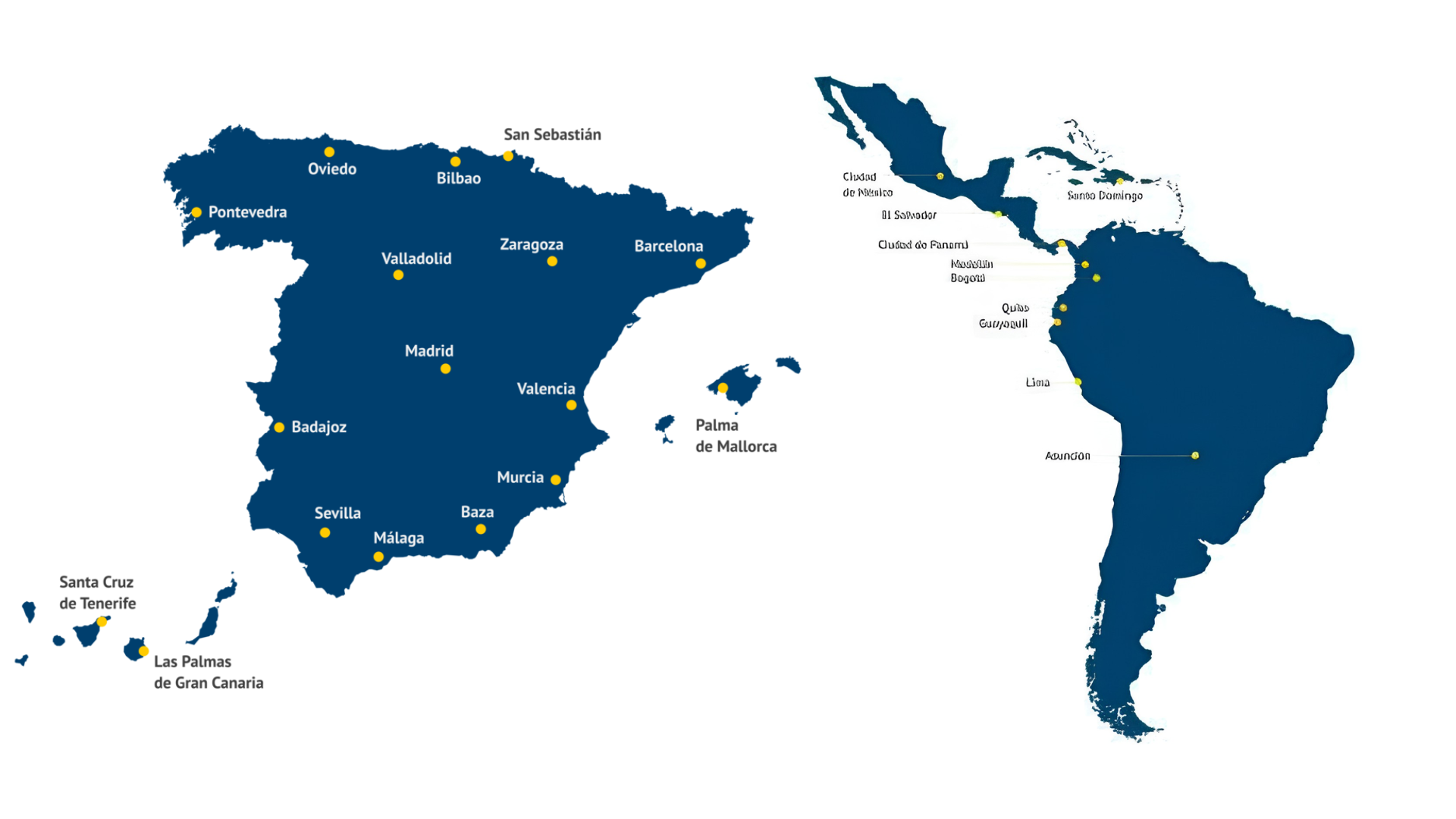
Furthermore, as a student at UAX Online, you’ll have access to our Campus Hubs – a network of exclusive physical spaces where you can study, access libraries, work in co-working areas and connect with other students. Because studying online doesn’t mean studying alone.
Campus Hubs available in: Alcobendas, Alcorcón, Valencia San Vicente, Murcia, Barcelona, Málaga, Seville and Arganda.
Access is granted with your UAX student card, subject to availability and the opening hours of each centre.

Boost your career with the skills the job market demands
Master Microsoft 365 Copilot and boost your productivity with AI. Learn how to automate tasks, create content, analyse data and optimise your work in Word, Excel, PowerPoint, Outlook and Teams to work more efficiently with this official Microsoft certification.
Hear first-hand accounts of our education students’ experiences, be inspired, and discover what life is like as a student at UAX and all the opportunities that await you.
You can access this course if you have a university degree related to this academic area:
You will be able to access by taking complementary training courses:
The following criteria will be taken into account for the admission of candidates, which will be applied only in the case where demand exceeds supply:
Ranking of admission:
To start the admission process you must provide the following documentation:
In addition, if you already have previous professional experience related to the competences inherent to this degree, it may be recognised in the form of credits. The recognition of ECTS will require a personalised study. Contact our advisors and they will inform you personally.
The transfer of credits consists of the inclusion in the student's official academic documents, relating to the current course, of all the credits obtained by the student in official courses taken previously, at the same or another university, which have not led to the award of an official qualification.
The recognition of credits in official Master's degree courses shall be carried out taking into account the adequacy between the competences and knowledge derived from the courses taken and those foreseen in the syllabus of the corresponding courses.
In the credit recognition system of this master's degree, if you already have previous professional experience related to the competences inherent to this degree, it may be recognised in the form of credits, up to a maximum of 6 ECTS (only psychologists and educational psychologists). This recognition will require a personalised study. Contact our advisors and they will inform you personally.
We need to know a little bit about you so that we can provide you with a personalised service.
All fields are required
At UAX we know that studying is an investment, that's why we provide you with the facilities you need to access our degrees. Find out about some of our scholarships and grants to study the Master's Degree in Neuroeducation:
Lecturers on the Master’s in Neuropsychology
Learn from the very best professionals

Dr. Biochemistry and Molecular Biology. Professor specialising in the physiological functioning of the nervous system and in the translation of this knowledge to the design of educational proposals based on neurodidactics.
Doctor in Health Sciences (CAFYD). Expert in movement control, physical education and teacher of Early Childhood Education. Teacher in CFGS and CFGM of sports education. Researching the influence of physical exercise on Parkinson's patients.
PhD student in Social and Legal Sciences. Technician specialising in Attention to Diversity and ASD, Educational Counsellor, Primary Education Teacher and specialist in Therapeutic Pedagogy/Special Education.
El máster prepara para desarrollar tu carrera en el ámbito educativo y psicopedagógico, con un perfil especializado en neuroeducación y mejora del aprendizaje.
The master's degree in educational neuropsychology can open the door to various career opportunities related to the understanding and application of neuropsychological principles in the field of education. Some of the career opportunities that may be available to graduates of this master's degree include: specialised teaching staff in educational centres, psycho-pedagogical offices, associations, socio-health centres, foundations, technology centres and research teams.
El máster en neuropsicología educativa de UAX tiene una duración de 9 meses y es una titulación oficial de 60 créditos ECTS.
The UAX master's degree in educational neuropsychology has a flexible methodology that is compatible with your professional life. The online classes are in the evenings from 18:00h.
Neuroeducation, also known as neurodidactics, is an innovative educational discipline that focuses on the study of how the brain works during the teaching-learning process. It aims to understand how the brain develops and how it reacts to different stimuli, which are then converted into knowledge. This new educational perspective focuses on the implementation of educational strategies and technologies based on brain functioning, merging the fields of neuroscience, psychology and education to optimise the teaching and learning process.
In short, neuroeducation is defined as a bridge between neuroscience and educational sciences, where educational psychology plays a fundamental role. It is a scientific project that seeks to integrate knowledge about brain functioning with educational processes, with the aim of applying what is known about how the brain learns and what stimulates its development in the school environment.
Moreover, if you are an ICT lover, the Master's Degree in Educational Technology is an outstanding example of how technology can enhance and enrich teaching methodologies, adapting to the cognitive and emotional needs of students to improve their educational experience and promote more effective and meaningful learning.
Other related qualifications
We offer a wide range of courses, so you’re sure to find a programme that suits you.
Master's Degree in Educational Technology and Digital Competences for Teachers - ICT (online)
In collaboration with:
Start:
October
Length:
9 months

Online Master's Degree in Emotional Education and Pedagogical Accompaniment
Start:
October
Length:
9 months

Master's Degree in Psychopedagogy (online)
In collaboration with:
Start:
October
Length:
9 months

Master’s Degree in Teacher Training for Compulsory Secondary Education and Sixth Form
In collaboration with:
Start:
October
Length:
1 year

Online Master’s Degree in Instrumental Pedagogy
Start:
October
Length:
9 months
Online Course in Pedagogical and Didactic Training for Vocational Training Teachers
Start:
October
Length:
9 months

Master’s Degree in Teaching Spanish as a Foreign Language (Online)
In collaboration with:

Start:
October
Length:
9 months

Master’s Degree in Supporting Diversity and Inclusive Education (Online)
In collaboration with:

Start:
October
Length:
9 months

Online Master's Degree in Leadership and Management of Educational Centres
In collaboration with:
Start:
October
Length:
9 months

Online Master's Degree in Didactics in Mathematics
Start:
October
Length:
9 months

Online Master's Degree in Educational Innovation
Start:
October
Length:
9 months

Online Master's Degree in Conflict Prevention and Mediation in Educational Settings
Start:
October
Length:
9 months

Online Master's Degree in Research Methodologies in Education
Start:
October
Length:
9 months
Link to UAX regulations:
The Degree Monitoring and Improvement Committee is made up of the master's degree management, a representative of the degree's teaching staff, a student representative and a representative of the Vice-Rector's Office for Studies and Quality Assurance. In addition, guest members may be invited to deal with specific issues that need to be monitored.


You can view the various indicators via the following links:
Employability: View
Satisfaction results: View
Rates and indicators: View
Improvement measures implemented for the degree programme during the academic year: