






















Although less well known than other branches such as green or red biotechnology, brown biotechnology plays a significant role in sustainability, the restoration of degraded soils and the improvement of production systems in terrestrial environments.
Furthermore, this discipline creates career opportunities in fields such as soil management, agricultural sustainability and animal production.
What is brown biotechnology?
Brown biotechnology can be defined as the application of biotechnology in terrestrial ecosystems, particularly soils and arid areas, with the aim of improving their productivity, sustainability and ecological balance.
It focuses on the use of soil microorganisms, plants adapted to extreme conditions and biological processes that enable:
- Regenerate degraded soils
- Improving fertility
- Adapt crops to challenging environments
- Optimise production systems
Unlike green biotechnology , which focuses on agricultural production, and grey biotechnology , which focuses on environmental decontamination, brown biotechnology focuses on the management and improvement of soils and terrestrial ecosystems, particularly under adverse conditions.
Characteristics of brown biotechnology
Brown biotechnology is characterised by a set of features that position it as an essential tool for the sustainable management of arid and desert soils, and the fight against desertification.
Focus on terrestrial ecosystems
Its main area of application is soil, particularly soil that is degraded, contaminated or of low productivity.
Use of soil microbiology
It is based on the study and application of microorganisms such as bacteria and fungi that influence soil fertility and health.
Adaptation to extreme conditions
It operates in environments such as:
- Arid regions
- Poor soils
- Degraded ecosystems
Application in sustainability
Aims to improve the use of natural resources and reduce environmental impact.
Relation to animal health
It has applications in livestock farming and veterinary medicine, particularly in sustainable production systems.
Applications of brown biotechnology
Brown biotechnology extends its potential to a wide range of solutions for agriculture in arid areas, the rehabilitation of degraded soils and the optimisation of water resources in desert environments.
Improving soil fertility
The use of microorganisms enables:
- Increase the availability of nutrients
- Improving soil structure
- Promote plant growth
Restoration of degraded soils
Biotechnological techniques are applied to restore soils affected by:
- Pollution
- Erosion
- Overexploitation
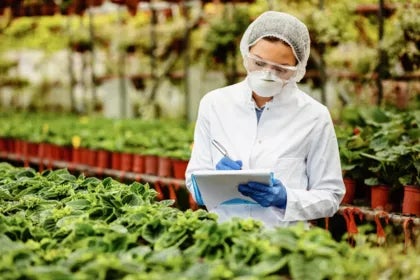
Agriculture in arid areas
This enables the development of agricultural systems in adverse conditions, optimising resources such as water and nutrients.
Use of biofertilisers
Microorganism-based biofertilisers replace chemical products, improving sustainability.
Applications in livestock farming and veterinary medicine
Brown biotechnology is also linked to:
- Improvements in animal feed
- Optimisation of livestock systems
- The use of beneficial microorganisms in animals
Brown biotechnology in veterinary medicine
One of the most interesting areas is its application in animal health and livestock production.
Improving animal microbiota
The use of beneficial microorganisms helps to improve animals’ digestive health and performance.
Sustainable feeding
It enables the development of more efficient feed tailored to the needs of livestock.
Reducing the use of antibiotics
The use of biological solutions can reduce reliance on antibiotics in animal production.
Optimisation of livestock systems
It improves the production efficiency and sustainability of livestock farms.
In this context, biotechnology is primarily applied to the optimisation of livestock production systems from a sustainable perspective.
Examples of brown biotechnology
To illustrate its impact in challenging environments, below are specific examples of how brown biotechnology is offering innovative ways to support life and productivity in arid and semi-arid regions.
- Use of nitrogen-fixing bacteria. Improves soil fertility.
- Remediation of contaminated soils. Application of microorganisms for restoration.
- Natural biofertilisers. Replacing chemical fertilisers.
- Crops adapted to poor soils. Optimising production under extreme conditions.
- Probiotics in animal feed. Improved health and performance.
- Agricultural systems on degraded or low-quality soils. Efficient use of resources.
- Application of microorganisms to degraded agricultural soils. Use of bacteria and fungi to restore soil fertility and improve productivity on farms.
Advantages and disadvantages of brown biotechnology
Like any technology applied to the restoration of complex ecosystems, brown biotechnology strikes a balance between its promising benefits for the sustainability of arid areas and the technical and economic challenges involved in its implementation.
Advantages
- Improved soil fertility
- Restoration of degraded ecosystems
- Reduction in environmental impact
- Optimisation of natural resources
- Application in agriculture and livestock farming
Disadvantages
- Slow processes in some cases
- Dependence on environmental conditions
- Need for specialised technical knowledge
- Limitations in certain soils or environments
Career opportunities in brown biotechnology
Brown biotechnology offers career opportunities focused on the management of soils, terrestrial ecosystems and production systems in complex environments. Key options include:
- Management and improvement of agricultural soils. Application of biotechnological solutions to improve soil fertility, structure and productivity, particularly in degraded or low-quality environments.
- Restoration of terrestrial ecosystems. Involvement in projects to rehabilitate soils affected by pollution, erosion or overexploitation.
- Veterinary science and sustainable animal production. Optimising animal nutrition, health and performance through the use of microorganisms and biotechnological solutions.
- Agriculture in extreme conditions. Development of production systems in arid or resource-constrained areas, improving the efficiency of water and nutrient use.
- Research into soil microbiology. Study of microorganisms that influence soil fertility and their application in agricultural and environmental systems.
- Consultancy on sustainability and land resource management. Advice on projects relating to efficient land use, sustainable agriculture and livestock farming.
The strategic role of brown biotechnology
Brown biotechnology is key to the sustainable management of terrestrial ecosystems. It enables productivity to be improved without compromising natural resources and contributes to food security in challenging environments.
Furthermore, its connection with other branches of biotechnology – such as red , blue , yellow , violet and gold biotechnology – makes it a fundamental component of the global biotechnology ecosystem, demonstrating the interconnected nature of these disciplines.
Conclusion
Brown biotechnology is the branch of biotechnology focused on soils and terrestrial ecosystems, with applications in agriculture, the environment and veterinary science.
Its ability to improve soil fertility, restore ecosystems and optimise production systems makes it a discipline of key importance for sustainability and the future of food production.
Sources used