


















If you’ve already passed the MIR (congratulations!), it’s time to face the big question: what next? Which specialism best matches what you’re passionate about?
Choosing a medical specialism, , isn’t just another step after passing the MIR; it’s one of the most important decisions of your career as a doctor. This choice will shape your day-to-day life, your professional environment and, in many cases, the deepest meaning of your vocation.
There are many options: from clinical to surgical specialities, including those focused on prevention, research or constant contact with patients. Each has its own challenges, rewards and lifestyle, and it’s normal to have doubts.
In this article, I’ll help you better understand the different options and reflect on which might be the best path for you.
How many medical specialities are there in Spain?
In Spain, there are a total of 48 medical specialities divided into clinical, surgical, medico-surgical and laboratory specialities. Many of these specialities are recognised in other countries, but some are unique to Spanish medicine.
Medical specialities
- Allergology
- Anaesthetology and resuscitation
- Gastroenterology
- Cardiology
- Endocrinology and Nutrition
- Geriatrics
- Haematology and haemotherapy
- Space medicine
- Intensive care
- Internal medicine
- Legal and forensic medicine
- Preventive medicine and public health
- Occupational medicine
- Nephrology
- Respiratory medicine
- Neurology
- Clinical Neurophysiology
- Medical Oncology
- Radiotherapy Oncology
- Paediatrics
- Psychiatry
- Child and Adolescent Psychiatry
- Physical Medicine and Rehabilitation
- Rheumatology
- Family and Community Medicine
Surgical specialities
- Cardiovascular Surgery
- General and Gastrointestinal Surgery
- Oral and Maxillofacial Surgery
- Orthopaedic and Traumatology Surgery
- Paediatric surgery
- Plastic, cosmetic and reconstructive surgery
- Thoracic surgery
- Neurosurgery
Medical and surgical specialities
- Angiology and vascular surgery
- Medical and surgical dermatology and venereology
- Obstetrics and gynaecology
- Ophthalmology
- Ear, Nose and Throat (ENT)
- Urology
Laboratory specialisms
- Clinical analysis
- Pathology
- Clinical biochemistry
- Clinical pharmacology
- Immunology
- Nuclear medicine
- Microbiology and Parasitology
- Clinical neurophysiology
- Radiodiagnostics
* The emergency medicine and clinical genetics programmes are currently awaiting approval.
Salaries for medical specialities in Spain
A doctor’s salary in Spain can vary considerably depending on experience, specialism and the sector in which they work (public or private).
According to data from Talent.com, the average salary for a doctor in Spain is around €35,000 per year (approximately €17.95 per hour). Those starting out in their careers usually earn around €24,000 a year, whilst more experienced doctors can earn up to €59,100.
Meanwhile, Glassdoor estimates that a specialist doctor earns an average of €52,000 a year, with total remuneration of around €57,000, including potential extras such as bonuses, commissions or profit-sharing.
Highest-paid medical specialities
Although vocation is key, financial considerations also play a part when choosing a specialism. These are some of the best-paid specialisms at present:
· Gynaecology and Dermatology: Earnings can exceed €100,000 a year in the private sector.
· Orthopaedics: Average salary of around €70,000 per year.
· Cardiology (interventional): Around €70,000 a year.
· Gastroenterology: Around €65,600 a year.
· Neurosurgery: Approximately €60,000 per year, with potential for growth depending on experience and the healthcare centre.
Where do doctors earn the most?
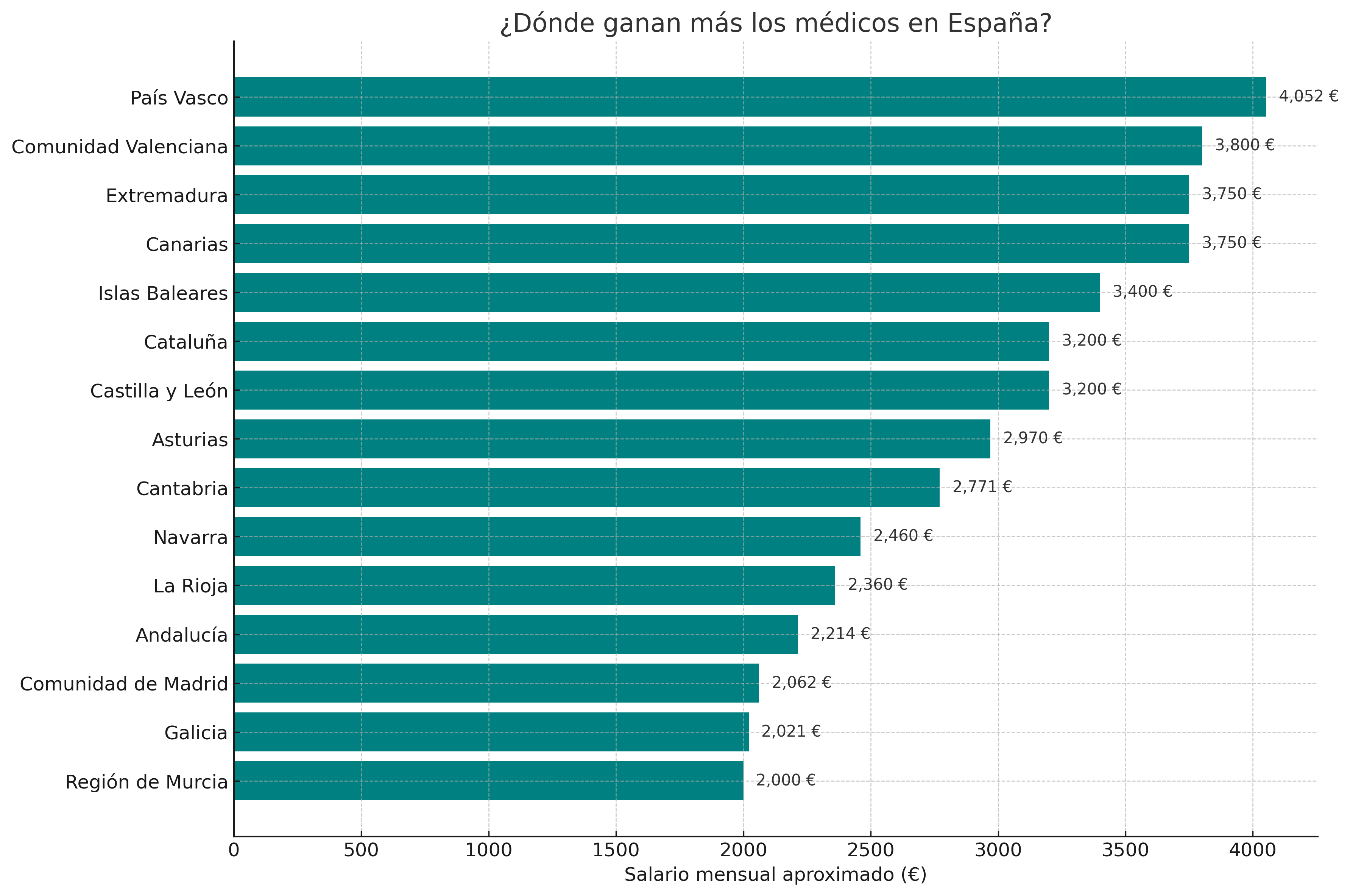
Source: Research Centre of the Granada Doctors’ Union
Duration of training in each speciality
The duration of medical specialisation programmes, in accordance with Annex I.1 of Royal Decree 183/2008 of 8 February, under the residency scheme, is as follows:
| Specialism | Training Period (Years) |
| ALLERGOLOGY | 4 |
| CLINICAL ANALYSIS | 4 |
| PATHOLOGICAL ANATOMY | 4 |
| ANAESTHESIOLOGY AND INTENSIVE CARE | 4 |
| ANGIOLOGY AND VASCULAR SURGERY | 5 |
| GASTROINTESTINAL TRACT | 4 |
| CLINICAL BIOCHEMISTRY | 4 |
| CARDIOVASCULAR SURGERY | 5 |
| GENERAL AND GASTROINTESTINAL SURGERY | 5 |
| ORAL AND MAXILLOFACIAL SURGERY | 5 |
| ORTHOPAEDIC SURGERY AND TRAUMATOLOGY | 5 |
| PAEDIATRIC SURGERY | 5 |
| PLASTIC, COSMETIC AND RECONSTRUCTIVE SURGERY | 5 |
| THORACIC SURGERY | 5 |
| CARDIOLOGY | 5 |
| DERMATOLOGY, COSMETIC SURGERY AND VENEREOLOGY | 4 |
| ENDOCRINOLOGY AND NUTRITION | 4 |
| CLINICAL PHARMACOLOGY | 4 |
| GERIATRICS | 4 |
| HAEMATOLOGY AND HAEMOTHERAPY | 4 |
| IMMUNOLOGY | 4 |
| FAMILY AND COMMUNITY MEDICINE | 4 |
| PHYSICAL MEDICINE AND REHABILITATION | 4 |
| INTENSIVE CARE MEDICINE | 5 |
| INTERNAL MEDICINE | 5 |
| NUCLEAR MEDICINE | 4 |
| PREVENTIVE MEDICINE AND PUBLIC HEALTH | 4 |
| OCCUPATIONAL MEDICINE | 4 |
| MICROBIOLOGY AND PARASITOLOGY | 4 |
| NEPHROLOGY | 4 |
| RESPIRATORY MEDICINE | 4 |
| NEUROSURGERY | 5 |
| CLINICAL NEUROPHYSIOLOGY | 4 |
| NEUROLOGY | 4 |
| OBSTETRICS AND GYNAECOLOGY | 4 |
| OPHTHALMOLOGY | 4 |
| MEDICAL ONCOLOGY | 4 |
| RADIOTHERAPY ONCOLOGY | 4 |
| ENT | 4 |
| PAEDIATRICS AND ITS SUB-SPECIALITIES | 4 |
| PSYCHIATRY | 4 |
| RADIOLOGY | 4 |
| RHEUMATOLOGY | 4 |
| UROLOGY | 5 |
A long-term commitment, driven by dedication and continuous learning
Becoming a specialist doctor is no accident: behind it lie years of study, hard work and sacrifice. Passing the degree in Medicine , passing the MIR and deciding which specialism to choose are milestones that shape your professional path… but also your personal one. Every step demands commitment and passion for a profession that brooks no half-measures.
The truth is that becoming a doctor is not a final destination, but the start of a lifelong learning journey. Keeping your knowledge up to date is an essential part of medical life: conferences, new techniques, emerging treatments, diagnostic advances… Learning never ends. But it is not a burden; it is a way of staying at the cutting edge so that you can always offer the best care to patients.
With every year of experience, with every case you treat, your connection to the profession also grows. Your specialism will not just be a field of work; it will be the place where you give your very best every day.
Practising medicine is an opportunity to contribute actively to the well-being of society. It is a career which, despite its challenging moments, also offers great personal and professional rewards. After all, few things bring as much satisfaction as knowing that your vocation can change — and save — lives.