




















Studying physiotherapy opens the door to a profession with a wide range of career opportunities. As in all professional fields, once you have obtained your qualification, specialisation must ‘come knocking’ if you are to progress in your career, thus ensuring that you take the right steps towards a promising professional future.
There is a vast array of specialisms within physiotherapy , which we have previously discussed in detail on our blog. Therefore, before committing to one option or another, it is important to consider which branch of physiotherapy most piques your interest. This is, of course, a fundamental aspect in any field of knowledge, as there is an ever-increasing demand for professionals who stand out as experts in a specific aspect of their professional practice.
Over the years, the number of specialisms within physiotherapy has grown. Consequently, today more than ever we have access to a wide variety of postgraduate programmes through which we can specialise in the area of the profession that we are passionate about.
The most important aspect of the profession is the patient; therefore, we must have an in-depth understanding of all the advances taking place in physiotherapy to ensure the highest quality of care. And if we practise as specialists in what we are truly passionate about, we will be able to give our very best when tackling any clinical case we may encounter in our professional practice.
Sooner or later, we will all need to visit a physiotherapy specialist – our best ally in recovering from an injury or condition that requires their help to improve our quality of life.
However, before deciding on a postgraduate programme after completing a degree in Physiotherapy , it is important to understand what the sector actually demands today. This is a key factor in making the best decision when choosing one specialism over another. But of course, as we’ve mentioned before, it’s also crucial that you choose the option you’re passionate about. The aim is to enjoy the profession we’ve chosen – our greatest asset in offering the very best of ourselves to each and every patient.
Among the most sought-after master’s degrees for physiotherapists at present, we’d like to highlight three that are undoubtedly the most in-demand and innovative in the sector. Read on!
Top postgraduate courses in Physiotherapy
Firstly, amongst this year’s best postgraduate courses for physiotherapists, we’d like to highlight the Master’s Degree in Sports Physiotherapy. Sports physiotherapy is one of the specialisms that is gaining more and more followers and is set to be in high demand in the coming years. As a result, an increasing number of professionals are opting for this training programme for physiotherapists, which focuses on helping athletes with injury recovery and rehabilitation.
Those wishing to specialise in sports physiotherapy must complete this qualifying Master’s degree for physiotherapists in order to practise this essential profession , which we discussed in this other post.
Studying the Master’s in Sports Physiotherapy opens the door to a profession with a 95 per cent employability rate, and one that has seen increasing specialisation in recent years. Bear in mind that, if you specialise in sports physiotherapy, you will acquire the skills and resources needed to prevent, treat and achieve a rapid restoration of function in injured athletes.
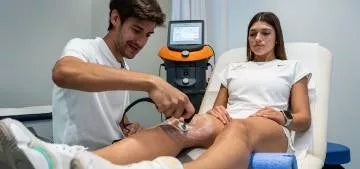
With this Master’s degree, you will be able to diagnose, plan and treat conditions specific to athletes, whether professional or amateur. You will also become an expert in the latest techniques and treatments used in the world of sport: EPTE® (Percutaneous Therapeutic Electrolysis), trigger point treatments using dry needling, ultrasound-guided techniques, non-invasive neuromodulation, state-of-the-art electrotherapy, and more.
By training in sports physiotherapy, you will acquire a range of skills enabling you to design treatment protocols, functional rehabilitation programmes and sports injury prevention strategies for each athlete; you will be able to carry out a comprehensive assessment and select the most appropriate physiotherapy technique(s) for each injury, throughout its progression and recovery process, mastering their application and management; whilst also being able to identify the causes and mechanisms underlying injuries in different sporting disciplines; you will learn to apply the latest invasive and ultrasound-guided therapies, as well as the most advanced and effective techniques; and you will be able to design and carry out research projects in the field of sports physiotherapy using the scientific method.
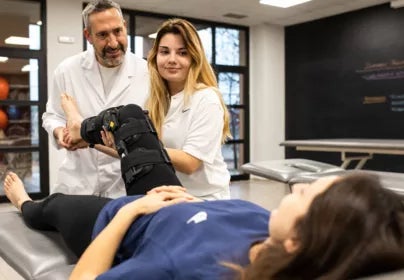
Another postgraduate programme for physiotherapists that is making a successful impact in the sector, and which is set to be in high demand in the coming years, is the Master’s Degree in Neurophysiotherapy , which will enable you to specialise in one of the most sought-after areas of physiotherapy.
With this Master’s degree in neurological physiotherapy, you will be able to deepen your understanding of the anatomy and physiology of the central nervous system, as well as the latest scientific advances regarding its functions and their applications in neurorehabilitation. Furthermore, you will be able to apply the most cutting-edge techniques: intensive therapies, new technologies, ultrasound-guided dry needling, amongst many others, whilst also covering classic therapies such as ‘Bobath Therapy’.
Undoubtedly, this specialisation provides solid clinical training in the treatment of neurological disorders and conditions, through knowledge grounded in scientific evidence and advances in motor control, neurophysiology, manual therapy and technological interventions.
As for the skills acquired through training in neurophysiotherapy, the following stand out: assessing, treating and devising a therapeutic plan for neurological patients, ranging from the fundamentals of the Bobath concept to the application of the most innovative and scientifically validated techniques in neurorehabilitation; gaining the most rigorous knowledge of advances in the neurosciences; applying the various specialisms of physiotherapy to the treatment of patients with neurological conditions; and analysing the patient from all angles to obtain a holistic view of their condition and be able to offer them the best solutions.
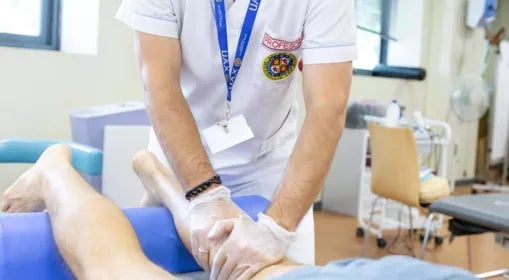
Finally, we would like to highlight the Master’s Degree in Manual Physiotherapy and Therapeutic Exercise. This is another forward-looking programme, in high demand within the sector, which equips students to address musculoskeletal conditions using manual techniques from a holistic perspective. It is an innovative postgraduate programme that encompasses the main techniques in manual physiotherapy, osteopathic manipulative techniques and therapeutic Pilates sessions, amongst others. It also covers disciplines for the treatment of soft tissue, joint mobilisation techniques, motor control, mobilisation of the peripheral nervous system, invasive techniques, etc.
In short, by specialising in manual physiotherapy and therapeutic exercise, you will gain an understanding of the neurophysiology and pathophysiology of pain, the mechanisms and effects of nervous system sensitisation and the modulation mechanisms involved; you will learn about the various methods of treatment and rehabilitation; whilst also learning to identify and avoid the contraindications, risks and general complications associated with the various techniques; you will understand the pathophysiology of myofascial trigger points; and you will be able to correctly apply the various invasive dry needling techniques for trigger points in cases of muscular pain.
Interesting options, aren’t they? Delve into one of these fascinating specialisations for physiotherapists, which are greatly needed in society now and always. Help others within your area of expertise by applying these cutting-edge techniques to improve each patient’s optimal condition. Is this your path for the future?