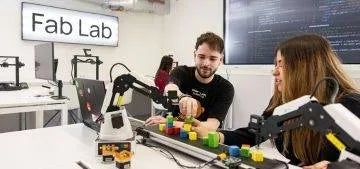
























What is Computer Engineering?
Computer Engineering is the art and science of designing and building the digital world. It is a discipline that combines the principles of computer science (software, algorithms) with electronic and telecommunications engineering (hardware, communications) to create comprehensive technological solutions.
From your computer’s operating system and the apps on your mobile, to the artificial intelligence that recommends a film or the cybersecurity that protects your data, everything is possible thanks to computer engineering.
Why study Computer Engineering today?
In the midst of the digital age, Computer Engineering has established itself as one of the most prominent and in-demand STEM (Science, Technology, Engineering and Mathematics) degree programmes on the job market. Computer scientists are currently among the most sought-after professionals by companies across all sectors, as all organisations need specialists to ensure cybersecurity, manage data and develop the technology that keeps them competitive.
Labour market figures reflect this trend. Computer Engineering stands out for its high levels of employability and job security, as a large proportion of professionals in the sector secure permanent contracts within a few years of entering the labour market, which translates into competitive salaries and a secure future. Studying this degree is not just a choice for the future; it is an investment in a solid career path and a range of professional opportunities that are constantly expanding.
What do you study on a Computer Engineering degree?
To practise as a computer engineer, you need to acquire a range of knowledge covering a wide variety of areas:
1. Software engineering
This is the discipline of ‘software architects’. It is not just about learning to programme, but about applying professional methodologies (such as Agile and Scrum) to design, build and maintain large-scale applications. Here you’ll learn to manage the entire life cycle of a software product, from the initial idea and requirements gathering right through to its deployment and future updates, whilst always ensuring its quality and reliability.
2. Artificial Intelligence and Data Science
You’ll delve into the field that is revolutionising technology and the world. You’ll study the algorithms that enable machines to learn from data ( Machine Learning ), such as neural networks and pattern recognition. The aim is for you to be able to design intelligent systems that give businesses a competitive edge, extracting knowledge and value from data.
3. Hardware Architecture and Electronic Systems
For a computer engineer, it is crucial to understand the machine at a low level – ‘what’s inside the box’. In this area, you will study the fundamentals of electronics to design interfaces between computers and other devices, and you will analyse the architecture of microprocessors (CPUs) and memory. Understanding the hardware will enable you to write software much more quickly, efficiently and optimally.
4. Communications Networks and Cybersecurity
Here you will learn the fundamentals that make the Internet and all digital communication possible. You will study how information is encoded and transmitted via different media using protocols such as TCP/IP. Inseparably linked to networks is cybersecurity , the discipline responsible for protecting information and systems against threats – an area of critical importance today.
5. Computer Science Theory and Algorithms
This is the scientific heart of computer science. You will learn to design efficient algorithms, which are the logical ‘recipes’ that a computer follows to solve any problem. You will study computability theory (what can and cannot be solved) and algorithmic complexity, which will enable you to always find the optimal and fastest solution for automating any process.
6. Project Management and Business Organisation
The success of a technology project depends not only on the quality of the code, but also on good management. In this area, you will gain knowledge of business organisation so that you can plan, manage and monitor IT projects from start to finish. You’ll be prepared to lead teams, manage budgets and deadlines, and align technological objectives with business strategy.
Now that you know the main areas covered by this degree, would you like to see how they translate into an actual curriculum? Discover in detail all the modules on the Bachelor’s Degree in Computer Engineering , explained year by year, in our comprehensive guide.
What skills does a computer engineer develop?
A computer engineer develops a combination of technical skills and professional competencies that enable them to design, create and manage technological systems. As well as knowing how to programme and develop software, they acquire the ability to:
- Problem-solving: the ability to analyse complex problems and find efficient solutions using algorithms, systems or technological tools.
- Logical and analytical thinking: this enables them to structure processes, optimise systems and understand how programmes and technological infrastructures work.
- Database management: the knowledge to design, administer and analyse databases that store large amounts of information.
- Cybersecurity and data protection: the ability to protect computer systems against attacks, vulnerabilities or unauthorised access.
- Teamwork and project management: computer engineers often work in multidisciplinary teams, so they develop skills in collaboration, communication and the organisation of technology projects.
Taken together, these skills enable computer engineers to create innovative technological solutions and adapt to a constantly evolving sector.
Do I have what it takes to be a computer engineer?
If you’re passionate about problem-solving, think logically and have an innate curiosity about how the technology around you works, you’re well on your way. A good computer science student combines creativity in devising new solutions with the discipline and rigour to build them in an organised and efficient manner.
You don’t need to be a maths genius, but it is important to have a solid foundation and, above all, a great ability to adapt and a desire to learn constantly. Technology never stands still, and a good engineer is a lifelong learner.
The academic pathway at UAX: bachelor’s degree, certificate and master’s degree
To practise as a computer engineer, the main route is to study the Bachelor’s Degree in Computer Engineering. At UAX, you can choose either the on-campus option or the Online Bachelor’s Degree in Computer Engineering , which offers you greater flexibility. After four years of study, you’ll be awarded the title of Technical Engineer in Computer Science.
But UAX’s programme goes one step further. Simultaneously and as an integrated part of the degree, you’ll have the unique opportunity to study for the Certificate in Business & Product Innovation. This in-house qualification provides you with a business and strategic outlook that will set you apart in the job market, creating a hybrid profile combining technology and management that is highly sought after by companies.
If you subsequently wish to pursue further specialisation or aim for the title of Senior Engineer, the next step is to undertake a master’s degree. There are postgraduate programmes that allow you to specialise in high-demand areas, such as the Master’s in Artificial Intelligence or the Master’s in Cybersecurity , which will make you an expert in system protection. Furthermore, there are also pathways via vocational training, such as the Higher National Diploma in ASIR (Networked Computer Systems Administration) available both as a online.
Summary
Ultimately, studying computer engineering is about much more than just learning to programme. It is about acquiring a set of multidisciplinary tools to understand, design and build the digital future. From corporate security to the artificial intelligence that assists us every day, computer engineers are the architects of our present and future – a professional role for which demand and opportunities are constantly growing. Are you up for the challenge?