




















Table of Contents
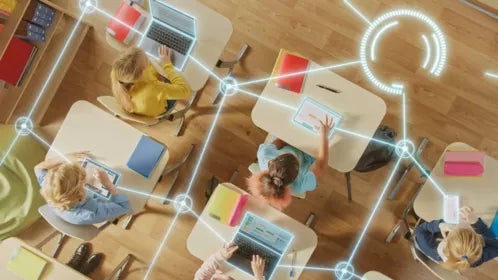
One of the main goals of neurotechnology is to understand the brain in order to improve teaching dynamics and processes, thereby enhancing pupils’ learning in a changing world where educational technologies have become the norm. This is a new science of learning that utilises tools such as augmented reality to achieve its objectives. It has been demonstrated that, thanks to AI, typical learning difficulties can be addressed, helping to capture pupils’ attention and motivate them in the classroom.
Neurotechnology is, therefore, a set of tools used to analyse and influence the human nervous system, particularly the brain. Its application to education is one of the most effective ways to ensure pupils’ academic success. This is the goal set by every teaching professional.
Learning through discovery, using neuroeducation, is one of the key principles of effective teaching in the 21st century, bearing in mind that this century is characterised by technological disruption. It is the pupil themselves who must guide their own learning, with the appropriate support and guidance from the teacher. There is a wide variety of technological tools available to students to stimulate their curiosity about learning and boost their motivation, thereby enabling them to delve into the wonderful world of learning in any field of knowledge, whilst also removing any barriers.
To this end, we must delve into how students’ brains work, creating effective applications that enable them to learn more quickly and in the most educational and entertaining way possible. Alongside curiosity, this is the key to sparking their unique motivation for learning, which is always closely linked to the emotional side of each individual student, as their learning paces are not always the same.
We could say that emotion is the spark that ignites learning, where curiosity and attention lie in wait – that is, the desire to learn – quietly waiting for us to awaken them. The psychology of learning is a universe brimming with questions awaiting their respective answers, which are crucial when it comes to identifying the best approach to support pupils in their learning process.
Educational technology has revolutionised the way we teach and learn, complementing the fundamental aspect of the teaching process: the human brain. Through the Master’s in Neuroeducation , you will explore in depth how neuropsychology can complement and enhance educational technology. This unique programme offers an interdisciplinary perspective that will enable you not only to master the digital tools of the 21st century, but also to understand how these tools interact with the brain during the learning process. If you wish to become an educator of the future, capable of integrating technology with a deep understanding of the human mind, we invite you to explore this fascinating degree programme.

Benefits of using neuroeducation in the classroom
Neuroeducation in the classroom is a resource that offers significant benefits, chief among which is that pupils themselves are able to motivate themselves and develop a special passion for discovery during the learning process.
Neuroeducation finds a powerful ally in educational neurotechnology, as this is what enables the design of strategies, the classification of software and the application of methodologies that address cognitive development and brain maturation, alongside different learning styles, as well as the difficulties and disorders observed in school-age pupils.
When we refer to neuroeducation applied to ICT, we are combining neuroeducation – or educational neuroscience – with the concept of educational technology, the main aim being to provide teachers with useful knowledge about how the brain functions in relation to learning and the use of ICT.
In this way, we make use of ICT methodology in the classroom – the role of which we discussed in this other post – but with a focus on the brain’s learning process, as well as the reward or motivation circuit, the influence of emotions, stress and special educational needs, amongst other key factors affecting brain activity.
In short, neuroeducation seeks to provide teachers with an understanding of how the brain functions in relation to learning and how to enhance their teaching by making the most of ICT in the classroom. It also offers significant benefits, notably the following:
- It helps to understand how the brain functions in relation to learning in the classroom and how to improve it.
- It helps to understand the benefits of educational games, enabling teachers to distinguish between what may be beneficial and what may be harmful.
- It clarifies complex concepts within a subject through a multi-sensory approach using ICT.
To successfully implement this methodology in their school, teachers who require it can receive specific training in neuroeducation applied to ICT. It is, without doubt, extremely useful for teaching in the 21st century.
If you are studying a Master’s in Online Educational Technology , you will gain a qualification designed to provide you with training that will enable you to acquire a high level of digital skills, setting you apart as a 21st-century teacher. What does the future hold?