




















In recent decades, education systems around the world have shifted from focusing solely on the teaching of conceptual content to promoting the development of procedural and attitudinal knowledge.
Organisations and institutions, both public and private, have promoted frameworks and initiatives aimed at equipping pupils with the skills needed for the 21st century, known as ‘soft skills’.
Students must acquire skills such as:
- Critical thinking
- The ability to understand, make decisions and engage in dialogue
- Oral and written communication
- Use of new technologies
- Information retrieval and evaluation
Furthermore, it is essential that they develop emotional skills such as:
- Taking on responsibilities
- Striving to improve
- Setting personal goals
They also need social skills, such as:
- Cooperating and working as a team
- Managing conflicts
- Showing empathy
- Being citizens capable of interacting with people from different cultures
The greatest challenge facing today’s education systems is to equip students with these skills, so that they can adapt flexibly and proactively to constant change. This challenge also falls on teachers at all stages and in all areas of education.
Vocational training teachers bring a wealth of ‘know-how’ to the classroom, the result of years of experience in solving real-world problems within specialised professions. However, conveying this knowledge in the classroom requires:
- Designing lesson plans that group and sequence activities
- Organising the content
- Assessing the impact on learning
In this context, pedagogical and didactic training for vocational education teachers is essential, as their aim is to educate for the full development of the individual and to prepare students for life.
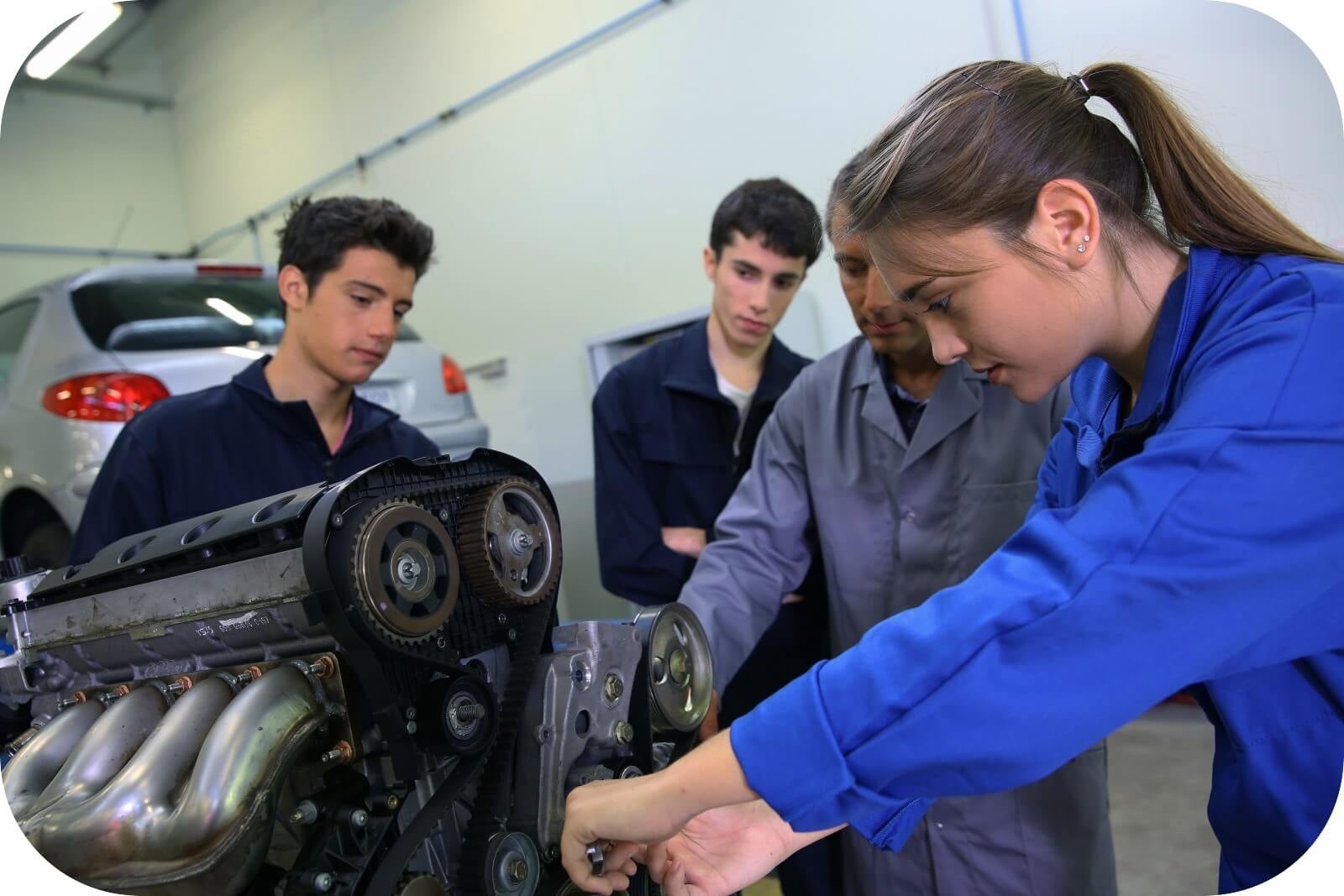
How to acquire the necessary pedagogical and didactic training
To work as a Vocational Training teacher in Spain, you must meet a series of general requirements that apply to all levels and specialisms.
These requirements may vary depending on whether you are applying for a post in state schools via competitive examinations, or whether you wish to work in private or state-subsidised schools, and are as follows:
- Hold a university degree related to the subject specialism to be taught, or a higher-level vocational training qualification in the same specialism, in addition to having successfully completed aMaster’s degree in Teacher Training , which is an essential qualification for practising as a teacher
- In the case of professionals in Specialised Vocational Training Sectors , they must hold theOfficial Certificate in Pedagogical and Didactic Training , which qualifies them to teach
In the case of the Master’s Degree in Teacher Training, university graduates or those with a higher-level vocational training qualification who hold the CAP (Certificate of Pedagogical Aptitude), and those who have previously taught, are exempt from undertaking this programme.
Challenges faced by vocational training teachers
There are many challenges that a vocational education teacher must tackle in their teaching practice, and there are many training programmes to help you address them.
We are referring, for example, to the new learning ecosystem created by:
- The use of digital resources in the classroom (Master’s in Educational Technology and Digital Skills )
- The need to teach with a focuson diversity (Master’s in Supporting Diversity and Inclusive Education )
- Preparing students for a globalised world (Master’s in Bilingual Education )
- Promoting deep and meaningful learning (Master’s in Educational Psychology )
Vocational training teachers need not so much ‘training for life’ as ‘lifelong learning’, because only professionals capable of adapting to change and new ways of learning will be able to face the future with confidence.
Career opportunities as a vocational education and training (VET) teacher
The demand for vocational training teachers has grown considerably in recent years, as this form of education has become one of the main routes into the labour market in Spain.
Being a vocational training teacher not only offers job security but also the chance to have a direct impact on the training of the country’s future workforce.
As for the general requirements for joining the teaching staff, these are the usual ones for any public selection process, including:
- Being at least 18 years of age and not exceeding the maximum age limit.
- Not suffering from any illness or being affected by any physical or mental impairment incompatible with the performance of the duties of a vocational training teacher.
- Not having been dismissed from the service of any public administration as a result of disciplinary proceedings.
- Proving proficiency in the co-official language of the autonomous community organising the competition, in accordance with its regulations.
If you are planning to sit the competitive examinations to become a vocational training teacher, you should bear in mind that certain official master’s degrees award extra points in the examination marking scheme. These master’s degrees may be related to your area of specialisation and enable you to achieve a higher score in the merit-based selection process.
To conclude…
Being a vocational training teacher is an excellent option if you want to combine your technical knowledge with practical teaching. Whether you choose to sit the competitive examinations or prefer to work at a private college, vocational training offers a dynamic educational environment that is in high demand in the labour market.
Start planning your path to becoming a vocational training teacher today!
Sources:
- Spanish Ministry of Education and Vocational Training
- Royal Decree 276/2007
- R. M. Hutchins. The Learning Society . Harmondsworth. Penguin. 1970