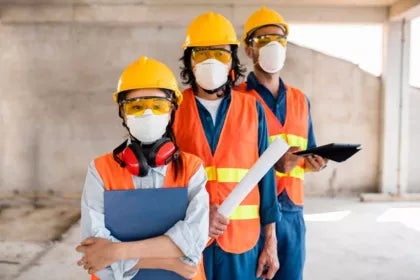
























An Occupational Health and Safety (OHS) technician is a qualified professional whose main role is to promote, design, implement and coordinate the activities necessary to ensure safety and protect the health of workers against the risks arising from their working environment. Acting as the main driving force behind a company’s prevention culture, they play an essential role in identifying hazards, assessing risks and establishing control measures to prevent accidents and occupational illnesses, whilst ensuring compliance with current legislation.
Whether as part of the in-house team at a large corporation or as a consultant for an external prevention service, their responsibilities are wide-ranging and have a significant impact.
Technical and analytical functions
This forms the basis upon which the entire prevention strategy is built. Before taking any action, the technician must have a thorough understanding of the working environment, identify hazards and assess their potential for harm. This is a crucial phase of study and diagnosis.
Risk Assessment
The most important role of an occupational health and safety technician is the assessment of workplace risks, a systematic and documented process involving:
- Identifying hazards: analysing every post, task, piece of equipment and substance present in the workplace to detect any element with the potential to cause harm. This can range from a machine without adequate protection, a poorly stored chemical or high noise levels, to psychosocial factors such as stress or burnout .
- Assessing the risk: once the hazard has been identified, the likelihood of harm occurring and the severity of its consequences are assessed. For example, the risk of tripping in a walkway may be common but have minor consequences, whilst the risk of being trapped in a hydraulic press is less likely but could have very serious consequences.
- Prioritising action: based on this assessment, the technician determines which risks require the most urgent attention. Those deemed ‘intolerable’ or ‘significant’ will require immediate action.
Proposed measures to control and reduce risks
Following the assessment, the technician does not merely identify the problems; their main role is to propose solutions. This involves designing a set of preventive and corrective measures to eliminate or, if that is not possible, minimise the identified risks. These measures always follow an order of priority:
- Risk elimination: this is the ideal solution. For example, replacing a hazardous chemical with a non-hazardous alternative.
- Collective protection measures: if the risk cannot be eliminated, the aim is to protect all workers simultaneously. Examples include: installing guardrails to prevent falls, fume extraction systems or soundproofing a noisy machine.
- Personal protective equipment (PPE): when the above measures are insufficient, Personal Protective Equipment (helmets, gloves, harnesses, etc.). The health and safety officer must determine which PPE is appropriate, ensure it is certified and supervise its correct use.
Planning preventive measures within the company
All this work involving analysis and the proposal of measures is set out in the Occupational Health and Safety Plan. The safety officer is the architect of this plan, a document that structures all preventative activities, and which forms part of their remit – a role enhanced by advanced training programmes such as the Online Master’s in Occupational Risk Prevention. Their responsibilities in this regard include:
- Defining the objectives and targets to be achieved.
- Assigning responsibilities to the various individuals and departments within the company.
- Establishing the necessary human and financial resources.
- Drawing up a schedule of actions and follow-up measures.
Operational and monitoring functions
Once the strategy has been planned, the technician must ‘get out into the field’ to ensure that the measures are implemented correctly and are effective. This is the implementation and monitoring phase.
Carrying out regular checks on working conditions
Prevention is not a one-off action, but a process of continuous improvement. Therefore, the technician must regularly monitor that working conditions remain safe. They do this through:
- Safety inspections: scheduled visits to the premises to check for tidiness, cleanliness, the condition of machinery, emergency exits, etc.
- Task observations: analysing how workers carry out their duties to identify unsafe behaviour or procedures that could be improved.
- Internal audits: more in-depth and systematic reviews of compliance with the entire occupational health and safety management system.
Investigation of accidents and occupational illnesses
When preventive measures fail and an accident occurs or an occupational illness is detected, the OSH technician has the vital role of investigating what happened. The aim is not to assign blame, but to understand the root causes to prevent a recurrence. This process involves:
- Collecting data on the incident (interviews, photographs, measurements).
- Analysing the chain of failures that led to the incident.
- Drawing up a detailed report setting out the identified causes.
- Proposing a new set of corrective measures to ensure the incident does not recur.
Collaboration in health surveillance
Although the conduct of medical examinations falls within the remit of healthcare staff, the occupational health and safety technician works closely with them. Their role is to ensure that health surveillance is consistent with the risks identified. For example, if the risk assessment has identified a risk due to exposure to noise, the health and safety technician will ensure that medical examinations include audiometric tests to monitor the hearing of exposed workers.
Training and communication roles
There is no point in having the best safety measures if workers are unaware of them, do not understand them or are not convinced of their importance. Communication and training are the cornerstones of creating a genuine culture of prevention.
Prevention training for staff
One of the most visible roles of the safety officer is training for workers. They must design and deliver training programmes tailored to the needs of each role and each individual. Training must be:
- Theoretical and practical: it is not enough simply to explain the risks; workers must be taught how to use protective equipment, how to act in an emergency and how to adopt correct postures.
- Specific: tailored to the specific risks of the job (an administrative staff member does not require the same training as a welding operator).
- Ongoing: it must be updated regularly and whenever changes are made to the workplace.
Information and awareness-raising at all levels of the organisation
Beyond formal training, the health and safety officer must foster a culture of prevention throughout the organisation. This is achieved through constant communication, using tools such as:
- Safety briefings.
- Information posters and signage.
- Awareness campaigns on specific topics (musculoskeletal disorders, psychosocial risks , etc.).
- Good practice guides.
The ultimate aim is for safety not to be seen as an imposition, but as a shared value and a responsibility for everyone.
Management and documentation functions
All preventative activities must be rigorously documented, not only to comply with the law, but to ensure effective monitoring and follow-up.
Document management for the prevention system
The health and safety officer is the custodian of all documentation generated by the system. They are responsible for drawing up, organising and keeping up to date a large number of documents, including:
- The risk assessment for each workstation.
- The planning of preventative measures.
- Records of training and information provided to workers.
- Accident investigation reports.
- The results of periodic checks and audits.
This documentation is vital in the event of a labour inspection or to demonstrate the company’s effective management of health and safety.
Coordination of Business Activities (CAE)
When employees from several companies are present at the same workplace (for example, the main company and a cleaning or maintenance contractor), the risks multiply. The occupational health and safety officer is responsible for managing the Coordination of Business Activities (CAE). This involves exchanging information on the risks faced by each company and establishing coordination measures to ensure the safety of all workers present, regardless of who they work for.
Summary
As we have seen, the duties of an occupational occupational risk prevention are far broader and more strategic than is often realised. They are versatile professionals who must combine technical knowledge (engineering, chemistry, hygiene) with management skills, communication and training abilities, and meticulous attention to documentation.
Their work not only saves lives and prevents illness, but also brings immense value to the organisation by reducing absenteeism, improving the working environment and ensuring compliance with increasingly stringent regulations. In short, the occupational health and safety technician is the driving force that fosters and sustains a culture of health and safety at the heart of the organisation.
Sources consulted:
- Law 31/1995 of 8 November , on Occupational Risk Prevention. Official State Gazette.
- Royal Decree 39/1997, of 17 January , approving the Regulations on Prevention Services. Official State Gazette.
- National Institute for Occupational Safety and Health (INSST).