























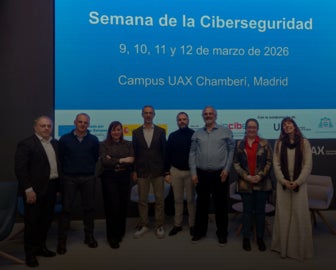
Alfonso X el Sabio University (UAX) has held its 4th Cybersecurity Week in collaboration with leading companies from various sectors, which have demonstrated how they are adapting their ecosystems in the face of cyber threats, against a backdrop where geopolitics and other economic factors are shaping European defence and sovereignty strategies. The event took place from 9 to 12 March at UAX’s Business & Tech Faculty, on the university’s Madrid Chamberí campus.
The event, which forms part of the Strategic Project for Cybersecurity, Research, Education and Business (PECIEE) – an agreement under the Recovery, Transformation and Resilience Plan, Next Generation EU, developed by the University of Oviedo and UAX – in collaboration with INCIBE, featured a range of presentations and round-table discussions with experts from renowned leading companies such as Microsoft, Telefónica, Accenture, IBM, BBVA and Women4Cyber, amongst others, who shared different perspectives on cybersecurity, training and talent. José Antonio Marcos García, Vice-Dean of Technology at the UAX Faculty of Business & Tech and Coordinator of Cybersecurity Week, highlighted the importance of providing cross-disciplinary and purpose-driven technology training to address global challenges and drive responsible development: “Cybersecurity training must extend to all roles within a company, not just technical profiles. Digital security and trust have become a strategic pillar for businesses, a competitive and reputational advantage grounded in ethics and responsibility in the use of data. For this reason, cross-functional training and hybrid talent combining business and security skills are key for all professionals. The various stakeholders involved – universities, businesses and public bodies – must work together to achieve this. There should be training in digital security across all degree programmes. “Another unavoidable challenge is being able to attract female talent to technology in general and to cyber security in particular, ” he explains.
In this regard, the specialists stated that awareness of digital security must begin at an early stage, in schools themselves or at home, from the moment children first come into contact with or become aware of electronic devices. “These are digital devices; there must be protection and awareness for children, and they need to know the dangers involved in using these devices,” said Víctor Hernández, Managing Director of Cybersecurity at Accenture.
How artificial intelligence is redefining cybersecurity risks and solutions
Organisations must be prepared to manage the growing complexity of their technological infrastructure resulting from the integration of AI. As more AI-powered applications and platforms are rolled out, companies face the challenge of ensuring that these tools operate within the boundaries defined by their security policies. In particular, Santiago Nuñez Martínez, Cyber Security Architect at Microsoft Security Enterprises, stated that “one of the challenges when implementing AI is visibility. In many cases, organisations do not know which AI systems or applications are being used within the company, what data they have access to, or who is using them”.
In this regard, the emergence of artificial intelligence is forcing a rewriting of the concept of cybersecurity as we have known it until now, and it is precisely the students who “will play a part in this rewriting”, as stated by Llorenç Huguet i Rotger, Professor of Computing, Cryptography and AI at the University of the Balearic Islands. The mathematician asserts that “we are in the midst of a paradigm shift. Cybersecurity is no longer just a technical department; it must now be integrated into the organisation at the highest level. In the future, cybersecurity will have to be a strategic element in the development and survival of companies themselves ”.
Lack of female talent in the field of cybersecurity
During the conference, the shortage of female talent in cybersecurity was also highlighted. Society tends to steer women towards social care and healthcare studies, and there is a lack of female role models in the field of technology in general and cybersecurity in particular. Ana Gómez Blanco, Senior Manager of Corporate Cybersecurity at BBVA and a board member of Women4Cyber, stated that “cybersecurity is about care and trust. “Women are vastly outnumbered in cybersecurity, but it’s not so much a lack of vocation or ability as a lack of role models – of someone to guide you, for example, through mentoring by women in technology.” Along these lines, Beatriz Garrido Jaramillo, a Computer Engineering student, commented that “the guidance we girls receive at school or within our families does not steer us towards a career in technology. It is very important to have female role models and to feel comfortable in a technological context”.
High-quality training that incorporates technology across all fields will ensure that future professionals drive sustainable technological development in line with the needs of businesses, so that cybersecurity becomes an essential driver of progress and transformation in our digital society. Through this conference, UAX aims to transfer knowledge and broaden its students’ skills in the field of cybersecurity, so that they can begin to add value from day one when they enter the world of work.