














Table of Contents
What does CAFYD stand for and where does it come from?
What areas of knowledge does CAFYD cover?
How does CAFYD differ from other degree programmes in the sector?
What skills does a CAFYD graduate develop?
What sort of person is best suited to CAFYD?
What do you need to study CAFYD?
What are the main career prospects for CAFYD graduates?
Summary
What does CAFYD stand for and where does the name come from?
CAFYD is the current name for what was known for decades as INEF (National Institute of Physical Education). With the adaptation of the Spanish university system to the Bologna Process, from 2010 onwards, Physical Education studies were reorganised as an official university degree under the name of Physical Activity and Sport Sciences, although the core of the programme remained essentially the same.
It is a four-year degree comprising 240 ECTS credits, officially recognised in Spain and equivalent within the European Higher Education Area. It can be studied on a full-time or blended learning basis, depending on the institution.
What sets it apart from other degrees in the field of sport is precisely its academic and scientific nature: it is not merely practical training for coaching or teaching, but a degree that equips you to understand, research and apply knowledge of human movement from multiple perspectives.
What areas of knowledge does CAFYD cover?
The degree programme integrates disciplines of very different natures that converge on a single subject of study: physical activity and sport in all their complexity. Broadly speaking, the areas of study are as follows:
- Biological sciences applied to sport: anatomy, exercise physiology, biomechanics. These enable you to understand how the human body responds to physical exertion and how to optimise that process.
- Behavioural and social sciences: sports psychology , sociology, pedagogy. These prepare you to work with people, manage groups and understand sport as a social phenomenon.
- Training theory and methodology: sports training planning, performance assessment, load management. The technical core of the degree programme.
- Physical activity and health: exercise prescription, working with special populations, promoting healthy habits. A constantly growing field.
- Sports management and organisation: facility management, club and event management, sports administration.
- Physical education and teaching methods: methodology for teaching sport, design of educational programmes, assessment of motor learning.
If you’d like to find out how these subjects are spread across the four years, see the article on the modules of the CAFYD degree programme you’ll find the curriculum explained in detail.
How does CAFYD differ from other degree programmes in the sector?
One of the most common questions when choosing this degree is understanding what sets it apart from other sport and health-related courses.
CAFYD and the TSAF are not the same, although both qualify you to work as a personal trainer. The Higher Technical Certificate in Physical Conditioning is a two-year higher-level vocational training course, which is more practical and focused on fitness and physical conditioning. CAFYD is a four-year university degree with a broader scientific foundation, opening the door to roles that the TSAF does not qualify you for: teaching at secondary school level, elite athletic training, sports management or entry to qualifying master’s degrees. If you are certain you want to focus exclusively on gym-based training, the TSAF may be a more direct route; if you are looking for versatility and greater career prospects, CAFYD opens more doors.
CAFYD and Physiotherapy do not compete with one another; they complement each other. The physiotherapist treats injuries and restores function; the CAFYD professional optimises performance, prevents injuries and works on physical conditioning. In many top-level sports teams, both roles coexist. The choice between one and the other depends on whether your vocation is more oriented towards sports performance or clinical rehabilitation.
This table summarises the key differences:
CAFYD | TSAF (Higher-level Professional Training) | Physiotherapy | |
| Type of training | University degree (4 years) | Vocational training programme (2 years) | Undergraduate degree (4 years) |
| Main focus | Performance, health, education and sports management | Fitness and personal training | Rehabilitation and injury treatment |
| Scope of practice | Healthy individuals, athletes, special groups | Primarily healthy individuals in fitness settings | People with injuries or functional conditions |
| Work environment | Clubs, sports centres, schools, hospitals, management | Gyms, fitness centres | Clinics, hospitals, rehabilitation centres |
| Access to teaching | Yes, with a Master’s in Teaching | No | No |
| Eligibility for technical civil service examinations | Yes | Limited | Not in the field of sport |
If you’re still weighing up different training options in the world of sport and aren’t sure which one suits you best, in this article on university degrees related to sport you’ll find a broader overview of the range of options available.
What skills does a CAFYD graduate develop?
Beyond technical knowledge, the CAFYD programme develops a professional profile with skills that are highly valued across various sectors:
Technical skills:
- Designing and planning training programmes tailored to different objectives and groups
- Assess physical fitness and sporting performance using specific tests and protocols
- Manage training loads to maximise performance and reduce the risk of injury
- Apply pedagogical principles when teaching motor and sporting skills
- Organise and manage sports services, facilities or events
Transversal skills:
- Leadership and team management: working with teams, motivating athletes and coordinating professionals from different fields.
- Communication: explaining technical concepts clearly, to athletes as well as other professionals and families.
- Critical thinking: interpreting data, evaluating results and making decisions based on scientific evidence.
- Adaptability: every athlete, every group and every environment requires different solutions. Flexibility is a key skill in this sector.
What sort of person is best suited to CAFYD?
CAFYD isn’t just for those who practise sport intensively, although that background does help. It’s a degree programme that suits people particularly well who share several of these characteristics:
It might be a good fit for you if:
- You’re passionate about sport and physical activity, but you’re also interested in understanding why things work: how the body responds to training, what enables a person to improve their performance, and how psychology influences competition.
- You enjoy working with people and have a knack for motivating, communicating and leading.
- You’re drawn to a degree with a wide range of career options: you don’t want to close any doors by choosing a single specialism from the outset.
- You balance physical and intellectual work well and are comfortable with the academic and scientific aspects of the programme.
- You’re interested in health, but not from an exclusively clinical or medical perspective; rather, from the perspective of prevention and performance.
This may not be the right choice for you if:
- Your aim is to treat injuries directly or work in a clinical hospital setting: in that case, Physiotherapy is a better fit for you.
- You’re looking for a shorter, more practical course focused solely on fitness: the TSAF may be a more efficient route towards that specific goal.
- You’re only interested in a very specific sport: sports federations and technical training programmes offer more specialised training pathways for coaches in specific disciplines.
What’s interesting about CAFYD is precisely that it doesn’t require a single profile. Some people come from a background in competitive sport, others from biology or the health sciences, and others are simply driven by a curiosity about human movement. This diversity enriches the course and the learning environment.
What do you need to study CAFYD?
To gain entry to the CAFYD degree programme, you must meet the following requirements:
- Entry qualification: EvAU, CFGS in Physical Conditioning or CFGS in Social and Sports Education and Activities
- Minimum age: 18 years
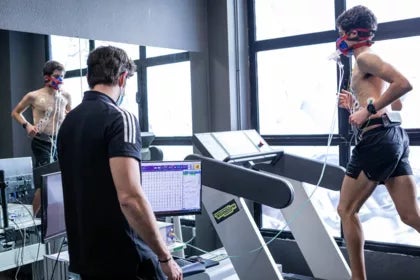
- Fitness test: a cardiorespiratory ergometry test to confirm that you are physically fit to undertake the degree programme
Once these requirements have been met, the admissions process is assessed as follows:
- Academic record: 70%
- Skills assessment: 20%
- Statement of purpose: 5% (for guidance only, not used for selection)
- Language test: 5% (for guidance only, not a selection criterion)
As regards the fitness test, you will normally need to arrange this yourself at a specialist centre. At UAX, this test is carried out directly at the university and also includes a comprehensive functional assessment report, which allows you to gauge your actual fitness level before starting the degree.
What are the main career prospects for CAFYD graduates?
CAFYD graduates can pursue careers in personal training and physical conditioning, teaching physical education, sports management, working in healthcare with specific population groups, or research in sports science. Each of these areas encompasses different roles, with work environments and salaries that vary considerably.
If you’d like to find out in detail what each role involves, the sectors in which they operate and what you can expect in terms of pay, you can consult our comprehensive guide to career opportunities for CAFYD graduates.
Summary
CAFYD (Physical Activity and Sports Sciences) is a four-year university degree that prepares professionals to work in coaching, education, health and sports management. It is the successor to the former INEF and differs from qualifications such as the TSAF – which is more practical and focused on fitness – or Physiotherapy – which is geared towards clinical rehabilitation – due to its breadth, scientific basis and the diversity of career paths it offers. It is particularly well-suited to people who combine a passion for sport with intellectual curiosity, a desire to work with people and a wish to build a versatile career.
Sources
- Higher Sports Council — Regulatory framework for sports professions in Spain
- National Agency for Quality Assessment and Accreditation (ANECA) — White Paper on the Bachelor’s Degree in Physical Activity and Sport Sciences
- Royal Decree 1670/1993, establishing the official university degree of Bachelor of Science in Physical Activity and Sport