Why study Pharmacy today?
Pharmacy is one of those degree programmes that stands the test of time. Pharmacists are essential healthcare professionals: they form part of the healthcare system from the very first stage of patient care right through to the most advanced research. And demand continues to grow.
We live in a world where health is a top priority for society. An ageing population, the rise of personalised medicine, the expansion of the pharmaceutical industry and the growing importance of parapharmacy and nutritional products are just some of the reasons why pharmacists have become increasingly important figures.
But beyond the job market, studying Pharmacy has a very strong vocational element. It is a degree course that connects you directly with people’s wellbeing, whether you’re advising customers at your local chemist’s, developing new medicines in a laboratory or providing advice in a hospital. Job satisfaction in this sector is consistently among the highest in the healthcare field.
What’s more, Pharmacy offers something few other degree programmes do: versatility. You can work in a pharmacy, in the pharmaceutical industry, for regulatory bodies, in research or in teaching. If you’d like to find out more about all the possibilities, take a look at the articles on career prospects in Pharmacy and salaries.
What sort of person is suited to a degree in Pharmacy?
Before we talk about entry requirements and universities, it’s worth asking yourself whether you have the right profile. Studying Pharmacy requires:
- An affinity for science: chemistry, biology and physiology form the core of the degree. If you enjoy these subjects – or at least don’t find them off-putting – you’re on the right track.
- An eye for detail: handling medicines and dispensing them correctly requires precision and responsibility.
- Communication skills and empathy: especially if you’re set on working in a pharmacy, you’ll be dealing with patients on a daily basis, which requires active listening and the ability to convey complex information clearly.
- Entrepreneurial spirit (optional, but valuable): if you ever consider opening your own pharmacy, you’ll need both clinical insight and business management skills.
Don’t worry if you don’t excel in all these areas from the outset. A well-designed degree programme will help you develop these skills over the course of the five-year course.
What do you study on the Bachelor’s Degree in Pharmacy?
The Bachelor’s Degree in Pharmacy lasts five years (300 ECTS credits), making it one of the most comprehensive university degrees in the healthcare sector. This length is no coincidence: pharmacy requires a very comprehensive and rigorous education to ensure that professionals can practise with complete confidence.
Throughout the degree, you will combine modules in:
- Basic sciences: organic chemistry, biochemistry, cell biology, microbiology, physiology.
- Pharmaceutical sciences: pharmacology, toxicology, pharmaceutical technology (how medicines are manufactured), pharmacokinetics.
- Clinical and health sciences: clinical pharmacy, pharmaceutical care, nutrition, pharmaceutical legislation.
- Supervised placements: the fifth year is largely devoted to supervised placements in pharmacies, hospitals and other healthcare settings; these are compulsory and regulated by law.
The programme combines theory with a significant amount of practical laboratory work, which is essential for developing the skills required for professional practice.
What are the entry requirements for studying Pharmacy?
There are several routes to accessing a Bachelor’s degree in Pharmacy in Spain:
- Bachillerato + PAU (University Entrance Exam) This is the most common route. It is recommended that you take the Science stream of the Bachillerato, as Biology and Chemistry carry the highest weighting in the specific phase of the EBAU and are the subjects that make the difference to your admission mark. Remember that the highest possible mark is 14 (entry mark + up to 4 points from the specific phase).
- Higher-Level Vocational Training (CFGS). If you hold a Higher-Level Vocational Qualification, preferably in the field of Healthcare or Chemistry, you can gain direct entry. If the cut-off mark for the university you are interested in is high, you can also sit the specific phase of the EBAU to improve your score.
- Other routes. There are entrance exams for those aged 25, 40 and 45, as well as the option to gain entry if you already hold a university degree.
What marks do you need?
The entry requirements for the Bachelor’s Degree in Pharmacy at public universities usually range from 10.5 to 12.5 out of 14, depending on the university. For the 2025–2026 academic year, some indicative figures are:
| University | Entry mark (guide) |
| Complutense University of Madrid | 11.641 |
| Rey Juan Carlos University | 11.778 |
| University of Barcelona | 11,038 |
| University of Salamanca | 11,379 |
| University of Granada | ~11.5 |
At private universities, the minimum legal entry mark is 5,000. The admissions process varies from institution to institution and usually includes institution-specific exams, interviews or aptitude tests, in addition to the academic record.
Where can you study Pharmacy in Spain?
In Spain, you can study for a Bachelor’s degree in Pharmacy at more than 60 institutions, both public and private. Your choice depends on many factors: your grade, your city, the type of programme you’re looking for and, above all, the kind of professional you want to become.
UAX: practical training from day one
Alfonso X el Sabio University (UAX) is the number one private university in Spain for employability in Pharmacy (U-Ranking 2023, BBVA Foundation), with 100 per cent of its graduates finding employment within the first year. You can study the course on a full-time or blended learning basis, with campuses in Madrid and Málaga.
The curriculum allows you to specialise in one of these three areas from the very first years:
- Community Pharmacy: patient care, management and digital pharmacy.
- Pharmaceutical Industry: drug development, biotechnology and cosmeceuticals.
- Hospital Pharmacy: clinical nutrition, radiopharmacy and clinical management.
What sets UAX apart
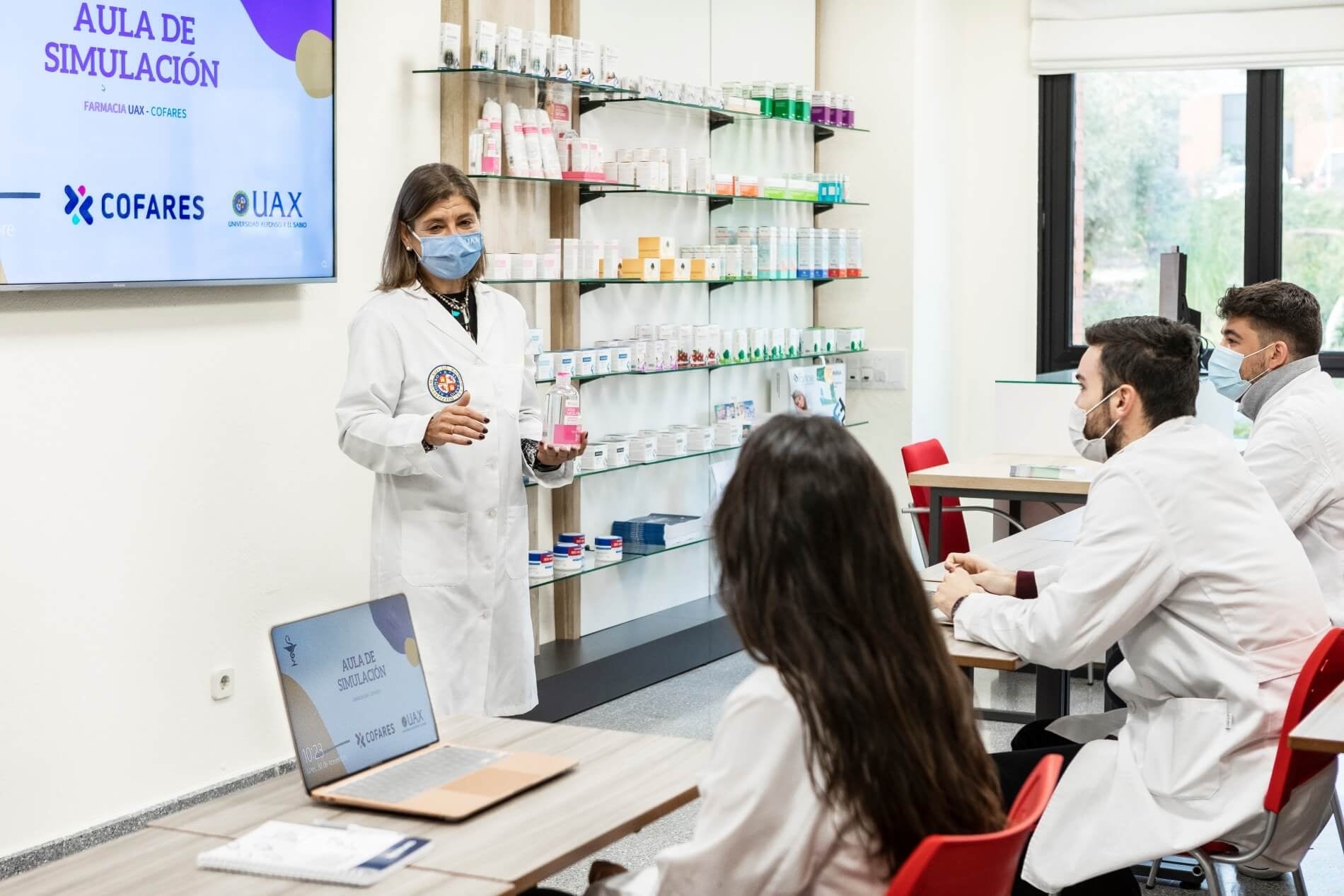
- Pharmacy Simulation Classroom: you’ll practise in a full-scale replica of a pharmacy before starting your supervised placements in the fifth year.
- Small groups: an average of 15 students per lecturer in laboratory sessions, with personalised support.
- Additional certifications included in the degree: digital pharmacy management, professional soft skills and international certifications from Coursera.
- Work placement network: over 300 pharmacies and 580 agreements with companies in the sector.
Are you interested in combining two degree programmes? UAX also offers the Double Degree in Pharmacy + Human Nutrition and Dietetics.
Leading public universities
If you have high grades and are looking for a public university, these are some of the most highly regarded:
- Complutense University of Madrid: one of the oldest universities with a long-standing tradition in pharmacy.
- University of Barcelona: a leader in pharmaceutical research.
- University of Salamanca: with one of the most demanding entry requirements in the country.
- University of Granada and University of Seville: two very strong options in southern Spain.
The choice between a public and a private university is not solely down to the entry mark. Class size, simulation facilities, the work placement network and the profile of the teaching staff are equally decisive factors.
How long does a Pharmacy degree take, and what comes next?
The Bachelor’s degree in Pharmacy lasts a minimum of five academic years. The fifth year is unique, as a large part of the course load consists of supervised placements (a period of supervised training in community pharmacies, hospitals or other settings), which are compulsory for obtaining the degree.
Once you have graduated, if you wish to specialise or take on a management role, your training doesn’t have to end there. There are specific postgraduate programmes for pharmacists that allow you to specialise in areas such as community pharmacy management, hospital pharmacy or the pharmaceutical industry.
Summary
Studying Pharmacy means choosing a career with excellent employability prospects, real potential for advancement and a profound impact on people’s health. To gain entry, you need to pass the EBAU or hold a CFGS qualification, with marks that at public universities usually exceed 10.5. As for where to study, UAX stands out for its unique practical model, featuring real-life pharmacy simulations and an additional certification in management. Public universities are also an excellent option if your grades allow it. In any case, the most important thing is to choose the institution that best suits how you want to practise the profession.
Sources:
- Ministry of Universities – University entry cut-off marks
- General Council of Official Colleges of Pharmacists – cgcof.es
- Law 44/2003 of 21 November on the regulation of the healthcare professions (BOE)
- Royal Decree 1393/2007 of 29 October, establishing the organisation of official university courses (BOE)