

























The name TEACCH is an acronym for ‘Treatment and Education of Autistic and Related Communication Handicapped Children’.
What is the TEACCH methodology?
The TEACCH methodology is based on an educational philosophy that prioritises adapting the environment to facilitate the development and learning of pupils with ASD.
- It focuses on building on the student’s strengths, rather than concentrating on their limitations.
- It aims to enhance the child’s independence and encourage their adaptation to the school and social environment
- It centres on structuring the physical environment, tasks and students’ time
By establishing clear routines and providing visual supports, children with autism can improve their ability to learn, reduce their anxiety and facilitate their adaptation.
What does the TEACCH programme involve?
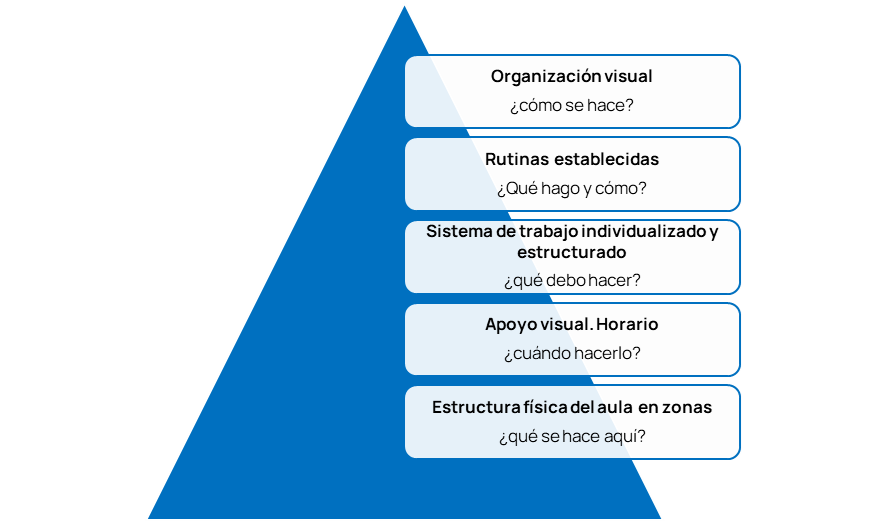
It is important to visually structure the physical space using visual aids, organising work areas (classrooms with designated corners, zones or areas for… IT, reading, play, personal independence…); tasks, using a visual diary or individual timetable to let them know in advance what is going to be done at any given time and where, thereby helping to prevent anxiety and frustration; the working system should be routine yet flexible; in this way, we foster independence, and to achieve this, we must train them using various strategies; tasks must include visual content as a form of information, with a simple and organised structure so that, with this visual support, the pupil can carry out the activity without further explanation, as well as knowing when an activity begins and ends.
The TEACCH programme is characterised by its structured approach, which sets it apart from other educational methods for people with autism. Some of the key elements that define it are:
- Physical structure: The organisation of the space is fundamental. In the classroom, areas are clearly demarcated so that the pupil knows where to carry out each activity. For example, there may be an area for reading, another for working with a teacher and another for playing.
- Visual supports: Visual cues, such as pictograms, calendars and timetables, are used to help pupils understand which tasks they need to carry out and in what order. These visual supports are essential for providing them with a sense of security and enabling them to anticipate changes.
- An individualised and structured approach: Tasks are tailored to each pupil’s abilities and needs. The aim is for the child to be able to carry out activities independently and at their own pace.
- Established routines: Children with ASD respond better to well-defined routines. The TEACCH method establishes fixed timetables and predictable daily activities, which reduces anxiety and promotes learning.
It is important to carry out an ongoing evaluation of the programme so that it is constantly adapted to the pupil’s progress and changing needs, adjusting teaching strategies to maximise their development.
Benefits of the TEACCH method for pupils with ASD
The TEACCH model has proven to be a highly effective tool for improving the learning and integration of pupils with autism within the school environment. Some of the main benefits include:
Improved communication
The use of visual aids facilitates the understanding and expression of ideas, enabling pupils to communicate more effectively with their teachers and classmates.
Development of social skills
Routines and collaborative activities encourage interaction with other children, helping to develop social skills.
Increased independence
The programme is designed to enable pupils to gradually become more independent in their daily activities.
Reduced anxiety
The predictability and structure of the method help to reduce anxiety, as the pupil knows what to expect at every point in the day.
Enhances learning
By adapting the environment and tasks to the pupil’s individual needs, learning becomes more accessible and effective.
Adaptation to the educational environment
The method helps students with ASD to integrate better into the classroom and participate actively in school activities.
Examples of TEACCH methodology activities in the classroom
The TEACCH method offers a wide range of activities that can be adapted to the needs and abilities of each student. At Alfonso X El Sabio University, we are committed to the UAX Makers methodology to professionally prepare the citizens of the future; therefore, on the Bachelor’s Degree in Early Years Education and the Bachelor’s Degree in Primary Education , you will be able to learn more about this methodology and its practical application in the classroom.
Here are some examples of tasks that can be implemented in the classroom:
- Use of pictograms to establish daily routines: Teachers can create a visual timetable using pictograms to indicate the activities that will take place during the day, such as reading, playing or having lunch.
- Structured activity boxes: A series of individual tasks is prepared in boxes or trays, each containing everything needed to complete an activity, such as sorting objects by colour or doing a jigsaw puzzle.
- Sequences of activities: Teaching pupils to follow sequential steps to complete tasks, such as washing their hands or packing their school bag, using visual aids.
- Sensory games: Activities that engage different senses, such as touching objects with different textures or recognising sounds, help develop sensory and motor skills.
- Imitation tasks: Encouraging pupils to copy movements or gestures from their classmates or teachers to improve non-verbal communication.
It is important that there is genuine and effective collaboration between professionals and with the family. Teachers must work as a team to ensure progress is made in the teaching and learning process. The family will be responsible for continuing the work started by the teachers, so that there is consistency between home and school.
Training at UAX
At Alfonso X El Sabio University (UAX), we recognise the importance of training professionals who are equipped to work with pupils with special educational needs. To this end, we offer a wide range of degree programmes and specialised training aimed at future teachers and education professionals who wish to learn how to implement methods such as TEACCH.
Studying at UAX will enable you to acquire the knowledge and skills needed to make a difference in the lives of students with autism.
Sources: