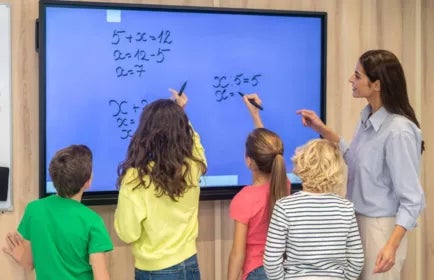
























What is gamification?
It is the application of elements and techniques typical of games in non-recreational contexts with the aim of increasing motivation, concentration and effort, amongst other positive outcomes. In the educational context, gamification is not simply about playing games in class. It is not about turning the entire subject into a video game, but rather about using this resource as a motivational tool – something taught on degree courses such as Educational Psychology.
Educational gamification: strategies and benefits
The power of gamification lies in harnessing our natural psychological predisposition towards play. Factors such as overcoming challenges, receiving immediate rewards, narrative and collaboration activate our brain’s motivation and reward circuits. This causes our brain to release dopamine and makes the activity we’re engaged in more stimulating. By applying these mechanisms to the classroom, we stop learning out of obligation and start learning for fun and out of interest.
Strategies
- Dynamics: These are the concepts that drive the experience. The most important is narrative. Creating a story that encompasses the entire subject (for example, we are astronauts exploring the galaxy of knowledge) provides an exciting context. Other essential dynamics include progress (the sense of making headway), healthy competition (rankings or head-to-head contests) and cooperation (working in teams towards a common goal).
- Mechanics: These are the rules and procedures that bring the dynamics to life. This may include:
- Point systems: points are awarded for completing tasks or giving correct answers.
- Badges or Achievements: these are visual rewards that certify the attainment of a specific milestone.
- Leaderboards: these encourage healthy competition, but must be used with care so as not to demotivate those further down the rankings.
- Levels and progress bars: these clearly show the pupil’s progress and what they still need to do to reach the next target.
- Challenges and missions: these set specific and engaging objectives that go beyond traditional homework.
Benefits
The advantages of implementing a good gamification strategy are far-reaching and backed up by classroom experience. Some of the most tangible benefits are:
- Motivation: the desire to overcome a challenge, earn points or level up becomes a stimulus for learning.
- Engagement and participation: lessons become more dynamic and pupils are more engaged.
- Continuous and Immediate Feedback: points and badges provide constant feedback on performance.
- Skills development: perseverance, problem-solving and teamwork are encouraged, whilst long-term learning and resilience in the face of failure are fostered.
- Personalised learning and inclusion: students can progress at their own pace and unlock content as they move up through the levels.
Gamification in the classroom: some practical examples
Gamification in the classroom does not have a single format. It can be adapted to the age group, subject and available resources. Below, we explore some alternatives.
Gamification in Early Years
At this stage of young children’s development, it is essential to focus on sensory experiences and immediate interactions. Here are some ideas for doing so:
- Simple role-play games (pretending to be animals or characters from stories).
- Achievement charts with stickers.
- Songs and gamified routines for daily habits.
For example, a Superhero Passport would be a good idea. For every habit you want to work on – such as tidying up toys, washing hands or waiting their turn – the children receive a sticker in their passport. When they complete a page, they earn a superpower (a treat, such as choosing the story for the evening). Every day is a new mission; using magical and adventurous language makes it easier to capture their attention.
Gamification in Primary School
At this stage, curiosity is high, as is the motivation to learn. Gamification can be integrated through:
- Adventure missions: the classroom becomes a territory for exploration.
- Points for participation and completed tasks.
- Digital badges for specific achievements.
Imagination and immersion are key. For example, a very effective strategy could be to create a system of houses (as in Harry Potter). Pupils are divided into teams and earn points for their team if they behave well, hand in excellent work or help their classmates. A physical board can be set up in the classroom with progress bars for each team to monitor results.
Gamification in Physical Education
The aim here is to encourage the achievement of goals, promote teamwork and assess progress. For example:
- Tiered challenges (achieving a sporting milestone).
- Cooperative challenges: passing a final test as a group.
- Tracking progress using apps that record progress in real time.
In this subject, imagination finds fertile ground. A boring athletics session can be transformed into ‘The Hunger Games ’. Pupils must train to survive (to avoid being eliminated). Running long distances could become training to escape from danger. Badges can be awarded for each challenge completed. The key is to adapt it to the age group and the pupils, but as you can see, the possibilities are endless.
Gamification with ICT and digital tools
Technology is gamification’s greatest ally. Digital tools make it much easier and more accessible to manage the entire gamification strategy.
These platforms or alternatives expand the possibilities for learning in a fun way:
- Kahoot! for competitive quizzes.
- Classcraft to turn the classroom into a role-playing game.
- Genially for creating interactive presentations.
- Digital escape rooms.
These options not only motivate pupils, but also generate useful data that allows you to track each pupil’s progress.
Gamification in Maths
Making something complex fun can put an end to the infamous question, ‘What’s the point of this?’. Gamification in maths helps to transform perceptions of the subject; this can be achieved through:
- Daily challenges with points and friendly leaderboards.
- Stories where solving problems allows you to progress.
- The use of platforms such as Prodigy or Mathletics helps make maths more accessible and enables pupils to perform better.
Conclusion
Gamification is a powerful teaching strategy which, when carefully designed, harnesses the natural mechanisms of human motivation to transform the learning experience. When learning is experienced as an exciting challenge rather than an obligation, academic and personal achievements flourish, at any age.
Give it a go at UAX!