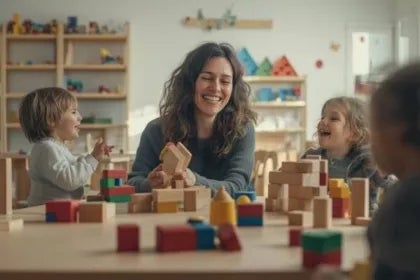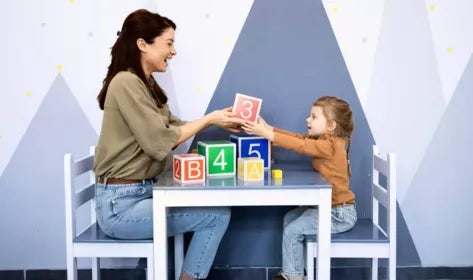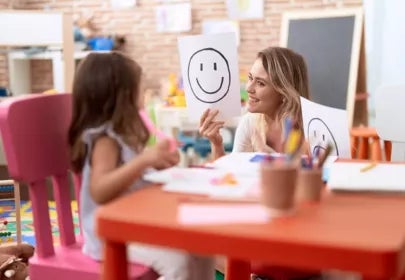












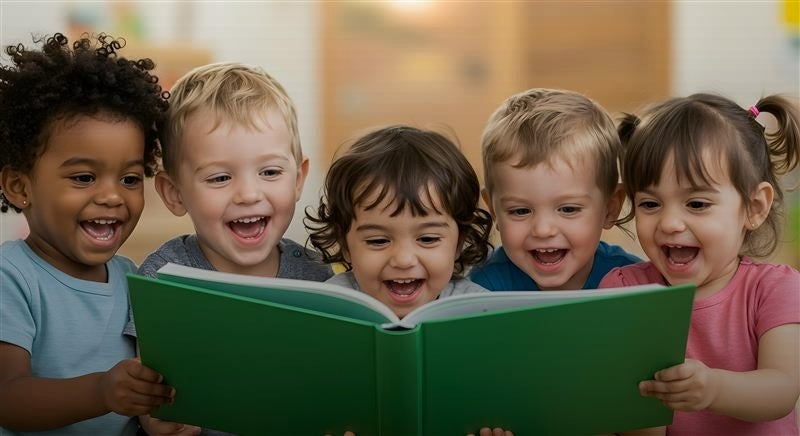
At this stage, children learn through play, and every moment counts. Their games, their first friendships, and even their little frustrations all help shape the way they see the world.
Experts say the same thing time and time again: if we want a better future, it all starts with how we bring up our youngest children.
Table of contents
Definition and objectives of early years education
Why is early years education so important?
The stages of early childhood education
Areas of early years education
The relationship between early years education and primary education
Definition and objectives of early years education
Early years education is the stage of education spanning from birth to the age of 6, constituting the first level of the education system.
This learning phase covers the educational cycle prior to compulsory schooling, catering for children aged 0 to 6.
Under Spanish legislation, it is divided into two cycles :
· First cycle: from 0 to 3 years
· Second cycle: from 3 to 6 years of age
The objectives of education during this first stage of life are:
· To promote the child’s holistic development in all areas
· To foster habits of independence and socialisation
· To stimulate curiosity and an interest in learning
· To help children adapt to the school and social environment
Why is early years education so important?
The early years are not just a ‘lovely phase’ that we will look back on with nostalgia. They lay the foundations for everything that follows. When a young child learns to share their toys, they are developing social skills. When they discover they can solve a jigsaw puzzle, they are building their self-esteem. When their teacher reads them a story, they are sparking a love of learning.
The OECD is spot on when it says that investing in early years education is the smartest thing we can do as a society. But beyond the statistics, any parent or educator knows this: these early years make all the difference. And truly understanding what a good early years education entails is the first step towards giving our little ones the best opportunities to grow up happy and self-confident.
The stages of early years education
As a future early years teacher , you will be trained to work with children during two crucial stages of their development, each with unique challenges that you will tackle through our specialised curriculum.
From 0 to 3 years: building the first bonds
During this first stage, you will develop the skills to support the youngest children in their earliest discoveries. Through modules such as ‘Child Development Psychology’ and ‘Health, Emotion and Psychological Well-being’, you will learn to observe, assess and stimulate their sensory and emotional development. At this stage, you will master early stimulation techniques and safe routines that promote holistic growth.
Ages 3 to 6: fostering a love of learning
It is during this second stage that you will see all your hard work come to fruition. With modules such as ‘Logical and Mathematical Thinking’, ‘Teaching Language and Literature’ and ‘New Educational Trends: Play and Projects’, you’ll be prepared to introduce children to the fascinating world of structured learning. You’ll learn to design activities that respect their pace whilst they build the foundations for their academic future.
Areas of early years education
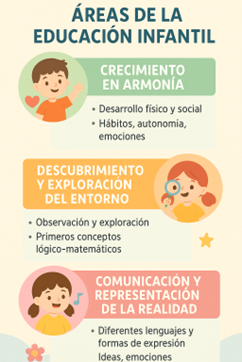
Early Years Education in Spain is officially organised into three key areas in accordance with Royal Decree 95/2022 of 1 February, published in the Official State Gazette (BOE) and by the Ministry of Education and Vocational Training. These areas aim to foster the holistic and harmonious development of children aged between 0 and 6, combining experiences, knowledge and key competences.
Harmonious Growth
This area encompasses children’s physical, personal and social development. The focus is on developing healthy habits, independence in daily routines, emotional awareness and management, as well as building a positive and balanced self-image. It also includes education in values and the promotion of coexistence, respect and equality.
Discovery and exploration of the environment
This focuses on fostering curiosity and hands-on learning through observation, active exploration and engagement with the physical, social and natural environment. Here, children develop their first logical-mathematical, scientific and technological skills, as well as attitudes of respect and care for the environment. This area reinforces social interaction skills and a sense of belonging.
Communication and representation of reality
The aim is to enhance communication skills through different forms of expression (oral, body language, visual, musical and technological). It fosters expressive and creative development, the comprehension and production of messages, and the use of different ways of representing reality. This area helps pupils learn to express their ideas, emotions and experiences in a constructive way.
The relationship between early years education and primary education
Although they are closely linked, early years education and primary education have distinct objectives and methods, as well as being aimed at different audiences.
Differences between primary and early years education
Characteristic | Early Years Education | Primary Education |
Age | 0–6 years | 6–12 years |
Approach | Holistic, experience-based | Subject-based, by subject area |
Assessment | Ongoing observation | Periodic assessments |
Methodology | Play, exploration, experimentation | Structured teaching |
What is covered on the Bachelor’s Degree in Early Years Education?
The Bachelor’s Degree in Early Years Education is a four-year programme where you will combine theory and practice, step by step, until you feel ready for real-life classroom situations.
In the first few years, you will learn the fundamentals of education, developmental psychology and teaching methodology, whilst learning to observe, assess and design adapted teaching materials.
You will then delve into areas such as language, maths, art and music, and will be able to specialise in one of six specialisms: English, Physical Education, Speech and Language, Music Education, Therapeutic Pedagogy or Technology and Media.
In the final years, you’ll delve deeper into subject-specific teaching methods and psychomotor skills, culminating in your Final Year Project, where you’ll put everything you’ve learnt into practice.
The skills that will make you an exceptional teacher
By the end of your course, you will have developed skills that go far beyond the academic:
Teaching skills
- Proficiency in active teaching methodologies such as gamification and project-based learning
- Ability to design meaningful learning experiences
- Skills to assess and monitor each child’s individual development
- In-depth knowledge of the developmental stages from 0 to 6 years
Technological and innovation skills
- Proficiency in using digital tools applied to early years education
- Design of multimedia resources tailored to very young children
- Implementation of disruptive methodologies in the classroom
- Responsible use of technology in early childhood
Social and emotional skills
- Communication skills with children, families and teaching teams
- Managing diversity and inclusive education
- Conflict resolution and mediation
- Developing emotional intelligence in the classroom
Educational leadership skills
- Ability to work in multidisciplinary teams
- Classroom and school management
- School guidance and family support
- Promotion of civic and sustainable values
At the end of these four years, not only will you have an official qualification enabling you to work throughout Europe, but you will also have developed an innovative mindset and the skills needed to be the sort of teacher who truly transforms lives.
Your future as an early years teacher begins at UAX
Early years education is much more than just looking after children: it is an opportunity to influence the most formative years of a person’s life. Every smile you bring to a child’s face, every ‘I can do it myself’ you hear, every moment of curiosity you nurture, will form the foundation of that child’s future.
If you feel called to be part of this transformation, the UAX’s Bachelor’s Degree in Early Years Education will equip you with innovative teaching methods and real-world practical experience to become the teacher that today’s children need.
The little ones are waiting for their ideal teacher. Will it be you?
Do it at UAX!
Sources:
· Royal Decree 95/2022, of 1 February
· Ministry of Education and Vocational Training