















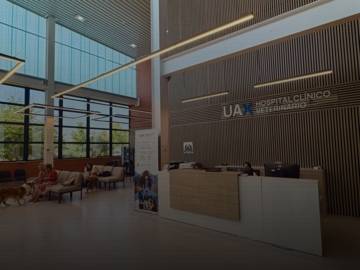
The Veterinary Teaching Hospital (HCV) at Alfonso X el Sabio University (UAX) is celebrating its 20th anniversary, having established itself as one of the leading centres for veterinary care and the practical training of professionals in the sector. During this period, the HCV, which forms part of the UAX healthcare campus, has developed a distinctive model based on genuine integration between the Faculty of Veterinary Medicine and clinical practice, establishing itself as a benchmark at both national and European level.
Since its inception, the HCV has been committed to a combination of academic excellence, technological innovation and real-world clinical experience. Its team, comprising more than 80 highly specialised vets, operates in state-of-the-art facilities that enable them to manage the entire care process, from prevention to rehabilitation. This approach results in a unique training model in which the hospital plays a fundamental role in the education of UAX’s veterinary students. In this way, students gain access to real-world clinical practice, tackling complex cases and acquiring, from the very beginning, the skills necessary for their professional development.
The hospital provides round-the-clock veterinary care 365 days a year, with a fully operational ICU. Consequently, over the past two decades, the impact of the UAX Veterinary Teaching Hospital has resulted in more than 7,600 students trained and more than 150,000 animals treated, alongside a volume of 15,000 clinical procedures per year. In addition, it treats more than 900 horses a year, of which around 30 per cent are elite horses, and performs some 780 equine surgical procedures annually.
The HCV also stands out for its wide range of clinical specialities, covering disciplines such as dentistry, dermatology, neurology, oncology, ophthalmology and internal medicine, amongst others, whilst also including areas such as exotic animal medicine, reproduction, and rehabilitation and physiotherapy. Furthermore, it has a teaching team made up of practising professionals, ensuring a direct link between teaching and the realities of the job market.
“Reaching our 20th anniversary means recognising the work of all the professionals who have made it possible for the hospital to grow without losing its essence, which is none other than to offer highly specialised veterinary care of the highest standard and to turn every clinical case into a learning opportunity. Having treated such a high volume of patients and trained more than 7,600 students reflects the strength of a model in which care, teaching and innovation go hand in hand,” says Fernando Ánibal Vázquez Fernández, director of the UAX Veterinary Teaching Hospital.
“The Veterinary Teaching Hospital is a natural extension of the Faculty of Veterinary Medicine and a crucial environment for our students to develop clinical judgement, decision-making skills and a holistic view of the profession. We have already achieved significant milestones for our students, such as obtaining EAEVE European accreditation and opening the Veterinary Simulation Centre. Looking ahead, our aim will continue to be to bring students into contact with real-world practice at an earlier stage and to promote specialisation through a global and interdisciplinary approach to health,” explains Isabel Rodríguez Hurtado, Dean of the Faculty of Veterinary Medicine at UAX.
The HCV has evolved into a university model inspired both by the organisation of the hospital environment and by the European Framework for Research Careers. Through the R1, R2 and R3 levels, young vets progress from an initial stage of supervised learning to assuming greater levels of autonomy, specialisation and clinical and research responsibility. This pathway provides continuity for the best students and graduates, linking clinical practice, postgraduate training and the generation of knowledge.
In this context, the hospital and the Faculty are carrying out pioneering research, such as that aimed at understanding the mechanisms of brain ageing in cetaceans and their relationship with neurodegenerative diseases such as Alzheimer’s, in collaboration with the Coordinadora para o Estudo dos Mamíferos Mariños (CEMMA), which has recently been published in the scientific journal ‘Biology’ and is led by UAX researchers Fernando Vázquez and Belén Alonso-Estanillo.
Strategy 2030: leadership in veterinary education
Looking to the future, the UAX Veterinary Teaching Hospital aims to evolve its model with the aim of strengthening its leadership and adapting to the latest cutting-edge technologies. Among its main areas of development are the intensification of practical experience, encouraging student involvement in clinical decision-making, and the promotion of early specialisation in specific areas.
A commitment to digitalisation will be another key objective, with the introduction of tools such as AI-supported diagnosis, the use of clinical data for learning, advanced simulation and veterinary telemedicine. In addition, a veterinary ambulance service offering home visits will be launched, thereby extending the hospital’s reach.
Furthermore, the HCV will continue to attract talent and strengthen its partnerships with companies such as Royal Canin, MSD Animal Health, Elanco and RAL, as well as with the wider veterinary community, to ensure that training is fully aligned with market needs.