


















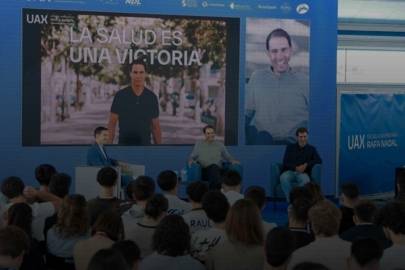
On Tuesday, the UAX Rafa Nadal University College hosted the fourth edition of its Sports Performance and Health Conference, a leading event featuring Rafa Nadal and Raúl González as keynote speakers, alongside other athletes and professionals from the sector. Both shared their views on elite sport, mental and physical preparation, the importance of training, and health care following retirement or the longevity of athletes.
During the event, Rafa Nadal emphasised that “education and sport are vital tools for healthy development and for growing up with the right values. Education is essential, but sport also offers highly relevant experiential learning, and I believe the two go hand in hand”, whilst for Raúl, the greatest challenge in his transition from footballer to coach has been “instilling good habits and values in the lads. “I’m talking about nutrition, rest patterns, values, talent, perseverance and empathy.” Values which, in sport, education and life , inevitably include “respect” for Nadal . It’s a simple word, but I believe it’s vital for ecosystems – such as the Academy or the UAX Rafa Nadal University School – to function properly. A mutual respect between teachers and professionals and the students, and vice versa.”
With regard to difficult times, Rafa Nadal noted that “for me, the most challenging injuries weren’t the ones involving tears with a fixed timetable for returning to competition. The difficult ones were those with no set timeframe, where you didn’t know when you’d be back.” In such adverse situations, the former tennis player emphasised that “tolerance for frustration and seeing the glass as half full sometimes makes all the difference” in achieving goals, results and success. Drawing on his experience as a coach, Raúl González explained that “a mistake should not be seen as a failure, but as a path to improvement. Young people sometimes tend to get frustrated, but learning from their mistakes is what leads them to become better every day”.
Furthermore, the former tennis player pointed out that “if you want to be the best, it’s never enough. There’s always room for improvement, to work a little harder, to push yourself and to explore your limits. Over time, knowing those limits helps you realise how far you can – or cannot – go”. To round things off, Raúl González admitted that his biggest challenge right now “is beating Rafa at golf”.
Innovations, professional experiences and injury treatments
Throughout the day, the UAX Congress on Sports Performance and Health addressed key topics such as the importance of nutrition aimed at improving performance, rehabilitation following an injury, multidisciplinary work within the medical team, and how to manage the pressure faced by a footballer.
In this regard, Gemma Bes, Director of Nutrition at the Rafa Nadal Academy and of the Online Master’s in Sports Nutrition and Training at the UAX Rafa Nadal University School, explained how nutrition is a key factor in the physical performance of elite athletes, but also of amateurs. “Digestion is key in sport, and for it to be successful, good absorption is essential. Only then can we ensure there is no nutrient deficiency,” noted Bes. Regarding the process of acclimatising the stomach to achieve better performance in a professional athlete, Bes pointed out that “Rafa is a great example of that resilience and of stepping out of his comfort zone to achieve it”.
Another major topic at the event was the physical rehabilitation of an athlete, a subject addressed from a professional perspective by Joaquín Juan, the physiotherapist for Leo Messi, Cristiano Ronaldo and Pau Gasol. For Juan, “the pressure and the rush to return to competition must never limit or restrict decision-making during the recovery process”. Ángel Ruiz Cotorro, Head of Medical Services at the Royal Spanish Football Federation (RFEF) since 1992, explained that in rehabilitation processes it is essential “to be able to instil confidence in the athlete and those around them. It is also important to know how to work in a multidisciplinary way and to always do so united as a single team”. For his part, Víctor Paredes, a fitness coach for teams such as Rayo Vallecano and Real Madrid, emphasised that in these situations “you have to listen to the footballer”, so as to always place him at the centre of the process.
They were all joined at the round table by Míchel González, a former footballer and manager of teams including Sevilla, Olympique de Marseille and Málaga, amongst others, who emphasised the human factor and the importance of a personalised recovery programme, because “the diagnosis is important, a personalised recovery plan agreed upon by all the professionals (doctors, physiotherapists, etc.), the use of technology, but, above all, the human factor and also the psychological aspect”. Mario Suárez, a former footballer who played for teams such as Atlético de Madrid, Rayo Vallecano and Mallorca, expressed a similar view, stating that “trusting the healthcare professionals who are looking after you and knowing how to manage the pressure from those around you regarding the possibility of a return that is too early are the foundation of everything. And that human factor that Míchel was talking about,” Suárez reaffirmed.
UAX, a model of practical training applied to high performance
Experiences such as these highlight UAX’s educational model, which stands out for its practical approach, integrating theory, real-world experience and direct contact with leaders, experts and practising professionals. It also highlights the connection between the playing fields and the classrooms, through interdisciplinary integration and learning, which was also featured during the Congress thanks to UAX lecturers such as Juan Ramón Heredia, Coordinator of the Bachelor’s Degree in Physical Activity and Sport Sciences (CAFyD) and Director of the Master’s in Sports Performance, and Víctor G. Fonseca, a physiotherapist and Director of the Master’s in Sports Physiotherapy at the UAX Rafa Nadal University School.
UAX’s Sports Leaders Week: a meeting point for the sports industry
The Congress on Sports Performance and Health follows on from last week’s Sports Leaders Week at the UAX Rafa Nadal University School, which brought together leading organisations, companies and professionals from the sector to explore key trends and challenges facing the sports industry, covering topics such as brand building, management, sponsorship and the role of the media in sport. All this whilst bearing in mind that at the UAX Rafa Nadal Sports School “we are preparing future professionals to receive a well-rounded education that has a real and comprehensive impact on the sports industry, whilst also keeping technological developments firmly in mind”, noted Nadal during an interview at the university’s Sports Leaders Week. As a recipe for success off the courts, the former Balearic tennis player advocates applying the same methodology that led to his success in the business world: “active listening and trust in the experts and the people around you”.