














What do you need to study to work in A&E as a nurse?
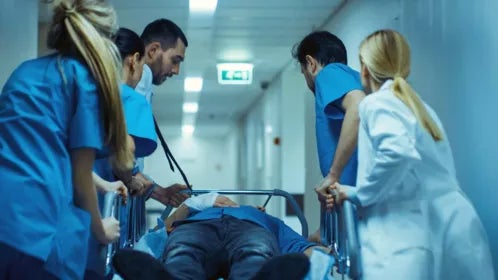
A degree in Nursing provides the foundation. However, hospital A&E departments and out-of-hospital emergencies require a level of response that goes far beyond this: advanced life support protocols, structured triage, disaster management and care for critically ill patients. Specialised training bridges that gap.
The Master’s Degree in Adult Emergency and Urgent Care is the official training pathway to achieve this. A 60-ECTS-credit programme lasting 9 months, which you can study either 100% online or via a blended learning format at the UAX campus in Málaga, taught by practising professionals from SAMUR, SUMMA and the military.
A course backed by an institution recognised as the best university for Health Sciences at the 2026 Student Choice Awards.
What are the annual modules?
The annual modules total 18 ECTS credits and form the practical backbone of the programme:
| Module | Type | ECTS credits |
| External Academic Placements I | Compulsory | 7 |
| External Academic Placements II | Compulsory | 5 |
| Master’s Thesis (TFM) | Compulsory | 6 |
| TOTAL | 18 |
The external placements , comprising 122 hours of hospital-based placements and 84 hours of non-hospital placements, immerse you in real A&E departments and emergency units, working alongside practising professionals. The Master’s Final Project allows you to explore a line of research or a proposal for improvement within the field of A&E.
Which modules are studied in the first term?
The first term comprises 24 ECTS credits and covers the main areas of hospital emergency care:
| Module | Type | ECTS credits |
| Critical Care | Compulsory | 6 |
| Emergencies in Internal Medicine | OB | 6 |
| General A&E | OB | 6 |
| Obstetric A&E | OB | 6 |
| TOTAL | 24 |
Critical Emergencies (6 ECTS): the core of the Master’s programme
Three modules, all essential. The first covers neurological emergencies and patients with multiple trauma: traumatic brain injury, stroke, seizures, coma and central nervous system infections. The second focuses on burns and poisonings, including anaphylactic shock. The third covers the most common gastrointestinal emergencies: gastrointestinal haemorrhage, acute abdominal pain and acute biliary disorders.
The programme is complemented by MEGACODES: on-site simulations where you practise real-life emergency scenarios through active participation, not just observation.
Emergencies in Internal Medicine (6 ECTS)
It is divided into two modules. The first focuses on cardiovascular emergencies: ranging from basic and advanced life support in cardiorespiratory arrest to the management of arrhythmias, acute coronary syndrome, heart failure and hypertensive emergencies. The second module addresses respiratory and endocrine-metabolic emergencies: acute respiratory failure, airway management, and acute endocrine and metabolic decompensations. As with the rest of the programme, the theory is complemented by MEGACODES in simulation laboratories.
The programme includes certification in Advanced Cardiovascular Life Support (ACLS), a programme run by the American Heart Association (AHA) which certifies healthcare professionals in advanced resuscitation techniques: management of cardiopulmonary arrest, arrhythmias, stroke and other cardiovascular emergencies.
General A&E (6 ECTS)
The most procedure-oriented module of the first semester. The first module covers the structure and organisation of A&E departments: key definitions, the clinical history in A&E, the Manchester and MAT-SET triage systems, and the ten-point guide to out-of-hospital care. The second module focuses on nursing procedures in A&E: central and arterial line insertion, thoracocentesis, drainage paracentesis, administration of blood products, compression bandages and emergency pharmacology. All procedures are practised using MEGACODES in simulation laboratories.
Obstetric Emergencies (6 ECTS)
A single but very intensive module. It covers specific triage in obstetrics and gynaecology, basic and advanced life support for pregnant women, and the main emergencies: metrorrhagia, hypertensive disorders of pregnancy, cord prolapse, uterine rupture, preterm labour and care during out-of-hospital deliveries. This is supplemented by MEGACODES in simulation laboratories.
Which modules are studied in the second term?
The second term comprises 18 ECTS credits and extends the training to more complex scenarios:
| Course | Type | ECTS credits |
| Disasters | Compulsory | 6 |
| Mental Health Emergencies and Abuse | OB | 6 |
| Clinical Management and Patient Safety in A&E | OB | 6 |
| TOTAL | 18 |
Disasters (6 ECTS)
Two very different modules. The first covers healthcare provision in incidents involving multiple casualties, disasters and nuclear, biological or chemical (NBC) incidents: general concepts, emergency plans, healthcare logistics, triage in mass casualty situations and protocols for action in each type of scenario.
The second module focuses on medical rescue and the transport of critically ill patients: the pathophysiology of land and air transport, helicopter transport, high-altitude mountain and aquatic rescue, and transfer protocols according to medical condition.
Mental Health Emergencies and Abuse (6 ECTS)
Two modules with very different content. The first combines psychosocial care in emergencies ( support for victims and intervention teams in disasters, terrorist attacks and incidents involving multiple casualties) with mental health emergencies: suicidal behaviour, acute psychosis, psychomotor agitation, anxiety disorders and withdrawal syndrome. The second module addresses three forms of abuse and their legal and ethical implications: gender-based violence, child abuse and elder abuse, including emergency intervention in each case.
Clinical Management and Patient Safety in A&E (6 ECTS)
Identification of incidents, management of adverse events, and indicators of quality of care. Essential if you wish to understand A&E not only from the patient’s perspective, but also from the point of view of service management.
What skills and competencies will you develop?
This master’s degree does not just teach you protocols. It trains you to make decisions under pressure, lead teams and adapt to environments that can change in a matter of minutes:
- Advanced clinical assessment. You will assess critically ill adult patients rapidly, identify the degree of urgency and make evidence-based therapeutic decisions.
- Advanced life support. You will master advanced cardiopulmonary resuscitation protocols and the management of difficult airways. Includes ACLS certification.
- Structured triage. You will systematically classify patients according to severity, an essential skill in any high-demand setting.
- Disaster management and mass casualty incidents. You will coordinate the healthcare response to mass emergencies alongside other emergency services.
- Mental health care and abuse. You will manage acute psychiatric crises and identify situations of abuse or gender-based violence, applying the relevant protocols.
- Clinical safety. You will identify and manage safety incidents, contributing to the continuous improvement of the service.
- High-fidelity clinical simulation. Through the MEGACODES, you will practise in on-site simulations that replicate real-life emergency situations, developing technical and non-technical skills: communication, leadership and teamwork.
Microcredentials included
The Master’s programme includes access to two micro-credentials to enhance your professional profile:
Boost your talent with Generative AI
It equips you to use tools such as ChatGPT, Copilot, Gemini and Claude for analysing information, creating content and optimising professional tasks, whilst integrating innovative solutions ethically and responsibly in real-world contexts.
Leadership and Soft Skills
Develop your professional potential through leadership and interpersonal skills in healthcare settings. It provides you with the keys to managing teams, communicating effectively and solving problems in real-world environments, applying personal leadership techniques and practical productivity tools within the healthcare sector.
How can you take this course? Online or in Málaga
Online option
100% online theoreticaltraining with 24/7 access to the virtual campus. Live and recorded classes, course materials, forums and academic advisers from day one. Face-to-face practical sessions are concentrated at weekends, so you can fit them in around your shifts or on-call duties.
UAX Campus in Málaga
At UAX Mare Nostrum, the teaching approach is designed to allow you to balance your studies with your professional and personal life. Teaching is blended: live online classes combined with face-to-face practical workshops over five weekends in Málaga.
The online classes are held in the afternoons and are all recorded; they are accessible via the virtual campus 24/7, along with course materials, discussion forums and study plans. You study wherever and whenever you like, at your own pace.
The in-person workshops are your chance to put what you’ve learnt into practice. They include intensive practical sessions and training to obtain the American Heart Association’s Advanced Cardiovascular Life Support (ACLS) certification.
The Málaga programme also includes Paediatric Emergency Care and Research Methodology, and features a tailored curriculum.
Conclusion
A&E is one of the most demanding settings in nursing. And also one of the most intense. If this is where you want to develop your career, the UAX Master’s Degree in Adult A&E for Nursing Professionals provides you with the clinical skills, ACLS certification and practical experience to be fully prepared. Study online or in Málaga, without having to stop working.
Frequently asked questions
What do you need to study to work in A&E as a nurse? The most common route is to complete a Bachelor’s degree in Nursing and specialise with an official Master’s degree in A&E. This type of training prepares you to work in hospital A&E departments, out-of-hospital emergencies and critical care units.
Can I study this course from Málaga? Yes. Online from anywhere in Spain, or via a blended-learning format at the UAX campus in Málaga , with face-to-face workshops in the city.
Sources