What exactly is mechanical engineering and what does a mechanical engineer do on a day-to-day basis?
Before we delve into career prospects, it is essential to understand what this discipline entails. Mechanical engineering is a branch of engineering that applies the principles of physics, thermodynamics, materials science and mechanics to the design, analysis, manufacture and maintenance of mechanical systems.
Essentially, if something moves or uses energy, it is highly likely that a mechanical engineer has been involved in its creation. Your day-to-day work could vary enormously depending on the sector and the role:
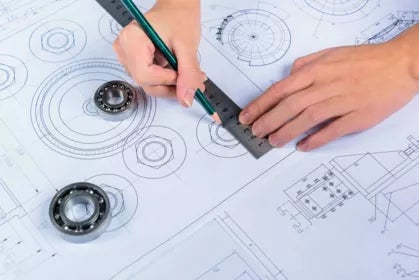
- Design and Simulation: you’ll use advanced computer-aided design (CAD) and computer-aided engineering (CAE) software to create and virtually test everything from a small component, such as a screw for a medical implant, to a complex system like an aeroplane engine.
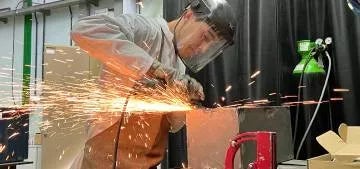
- Manufacturing and Production: you might be based in a production plant, optimising processes to make manufacturing more efficient, safe and cost-effective. You’d oversee quality control, manage industrial robotics and ensure the assembly line runs smoothly.
- Research and Development (R&D): if curiosity drives you, your place is in R&D. Here, you would research new materials, develop more sustainable technologies or create the next generation of products set to revolutionise the market.
- Project Management and Consultancy: with experience, many mechanical engineers move into management roles, leading teams and entire projects, or work as consultants, contributing their technical expertise to solve specific problems in various companies.
What are the most traditional sectors for a mechanical engineer?
There are industries that have been the mainstay of mechanical engineering for decades. Although they are considered ‘traditional’, they are constantly evolving, so innovation remains a key factor. The solid grounding provided by the UAX Bachelor’s Degree in Mechanical Engineering specifically prepares you to excel in these highly competitive fields.
- Automotive Industry: this is one of the most popular career paths. Here, mechanical engineers play a vital role in the design of chassis and bodywork, the development of more efficient engines (including electric and hydrogen-powered ones), improving vehicle safety, and optimising suspension and braking systems.
- Aerospace and Defence Sector: you will work on the design of aeroplanes, helicopters, satellites and space vehicles. Your work will focus on aerodynamics, the selection of ultra-lightweight and high-strength materials such as carbon fibre, and the design of propulsion systems and landing gear. Precision and safety are the top priorities in this sector.
- Energy Industry: whether in the oil and gas sector or in conventional electricity generation, your role will be crucial. You will design turbines, pumps, heat exchangers and piping systems, as well as ensuring the efficiency and safety of power stations.
- Machinery and Capital Goods: this sector is dedicated to manufacturing ‘the machines that make machines’. As a mechanical engineer, you will design all kinds of industrial equipment, from robots for assembly lines to agricultural machinery and construction equipment.
What are the career progression opportunities and what does the future hold for mechanical engineering?
Understanding career opportunities is the first step, but it is equally important to visualise the path you might take throughout your working life and how major technological trends are redefining the profession. Mechanical engineering is not a static discipline but a constantly evolving field.
Your career path: From Junior Engineer to Expert or Manager
Your career as a mechanical engineer can take different paths, but it generally progresses through the following stages:
- Early Stage (Junior Engineer): upon graduating with a Bachelor’s degree in Mechanical Engineering from UAX, you will usually start in a junior role. During this phase (the first 2–4 years), your main objective is to learn and apply your knowledge under the supervision of more experienced engineers. You will carry out design tasks, take part in testing, assist with production management and familiarise yourself with the company’s processes and culture.
- Consolidation Stage (Engineer or Senior Engineer): with the experience you have gained, you will take on greater responsibilities and autonomy. You will lead smaller projects or project modules, make important design decisions and act as a technical mentor to junior engineers. At this stage, many professionals choose to specialise in a specific area: CAE simulation, machinery design, thermodynamics, etc.
- Leadership Stage (Dual Track: Technical or Management): once you are a senior professional, your career can branch out in two directions:
- Technical Track (Expert or Principal Engineer): if your passion lies in solving complex technical problems, you can become your company’s leading technical expert in a particular field. You won’t manage large teams, but you will tackle the most difficult challenges and focus on innovation and technical mentoring.
- Management Track (Project or Team Lead): if you enjoy leading people and have a more business-oriented outlook, you can move into management. You’ll start as a Project Manager, managing budgets and deadlines, and could go on to become Director of Engineering or even hold senior executive roles (CEO, CTO).
Are there opportunities in emerging or less obvious sectors?
This is where the versatility of mechanical engineering and its career prospects really shine. The transition towards a more sustainable and technology-driven economy has opened up fascinating new fields where mechanical engineers are needed more than ever.
Are you interested in renewable energy?
The renewable energy sector is one of the fastest-growing. As a mechanical engineer, you can have a direct impact on the fight against climate change:
Wind Energy: designing wind turbine blades to maximise their efficiency, power transmission systems, or the towers and foundations that support them, both onshore and offshore.
Solar Energy: developing solar tracking systems that orient the panels to capture maximum radiation, or designing solar concentration systems and the turbines that generate electricity in solar thermal power stations.
Other renewables: researching and designing systems to harness energy from waves (wave power), tides (tidal power) or the Earth’s heat (geothermal energy).
What about the healthcare sector or biomechanics?
This is one of the most exciting areas with the greatest social impact. Biomechanics applies the principles of mechanics to the human body. Your contributions can change people’s lives:
- Design of prostheses and implants: you will create knee or hip prostheses, dental implants, artificial heart valves or even advanced bionic limbs that integrate with the patient’s nervous system.
- Medical equipment: you’ll design diagnostic imaging equipment (such as housings for MRI systems), surgical robots that enable less invasive and more precise operations, or rehabilitation equipment.
- Tissue engineering: at the cutting edge of science, you’ll collaborate on research to create biomechanical ‘scaffolds’ on which cells can grow to regenerate tissues or organs.
What role do you play in robotics and artificial intelligence?
Whilst software engineers design the ‘brain’ of robots, mechanical engineers design their ‘body’. Your work is essential for creating the physical structure, actuators (motors), sensors and gripping systems (grippers) of robots. This applies to industrial robots, service robots (cleaning, logistics), drones and even robotic explorers for other planets.
What skills do you need to succeed in the field of mechanical engineering?
A successful career depends on more than just technical knowledge. To stand out and gain access to the best career opportunities in mechanical engineering, you’ll need a combination of hard and soft skills.
Technical Skills (Hard Skills):
- Proficiency in CAD/CAE software: tools such as SolidWorks, CATIA or Ansys are part of your daily routine.
- Solid knowledge of thermodynamics, fluid mechanics, materials science and control theory.
- Basic programming: knowing how to programme in languages such as Python or MATLAB is increasingly valued for automating tasks and analysing data.
Soft Skills:
- Problem-solving: the essence of engineering. You must be able to analyse a complex problem, break it down and find an efficient and creative solution.
- Teamwork: you will rarely work alone. You will collaborate with engineers from other disciplines, designers, technicians and managers.
- Effective communication: being able to explain your technical ideas to a non-specialist audience is crucial.
- Lifelong learning: technology is advancing at a dizzying pace. Curiosity and a desire to learn throughout your career are essential.
Summary
In short, the career prospects after completing a Bachelor’s degree in Mechanical Engineering offer great versatility, allowing you to work in established industries such as the automotive and aerospace sectors, or to pioneer emerging fields such as renewable energy, robotics or biomechanics. Your day-to-day work will involve combining creativity with analysis to apply scientific principles to solving practical problems, designing the solutions of tomorrow. Success in this career, which has an exceptionally promising future due to the growing demand for qualified professionals, depends on the ability to adapt and continuously learn new technologies.
Sources
Career opportunities in mechanical engineering
Career opportunities for mechanical engineers (Sernauto)
Curriculum for the UAX Bachelor’s Degree in Mechanical Engineering