























Table of Contents
What is the flywheel in marketing?
Key differences between the flywheel and the funnel
The 3 fundamental pillars of the sales flywheel
What is the flywheel effect and how does it work?
Netflix: Personalised entertainment
Apple: An integrated ecosystem
Spotify: Personalisation and virality
Tesla: Customers as brand ambassadors
Common implementation mistakes
Key metrics for measuring your flywheel
Develop your expertise in flywheel marketing
Bachelor’s Degree in Marketing: Solid Foundations
Master’s in Digital Marketing: Advanced mastery of the flywheel
Higher National Diploma in Marketing and Advertising: Direct entry into the sector
Have you noticed how some companies seem to grow exponentially whilst others struggle to retain their customers? The difference often lies in their strategic approach. Whilst the traditional marketing funnel model focuses on linear customer acquisition, flywheel marketing revolutionises this perspective with a circular and self-sustaining approach.
What is the marketing flywheel?
It is a concept that HubSpot popularised in 2018, although its roots lie in physics. A flywheel is a heavy wheel that stores rotational energy. In marketing, it represents a circular model where each stage feeds into the next, creating a cycle of perpetual growth.
Unlike the traditional funnel, which ends with conversion, flywheel marketing places the customer at the centre and recognises that satisfied customers become advocates who drive further growth.
Key differences between the flywheel and the funnel
Compared to the funnel:
- It is linear: attract, convert and close.
- It assumes the process ends with the sale.
As for the flywheel:
- It is circular: it attracts, engages and delights, with each phase reinforcing the others.
- It recognises that the sale marks the beginning of long-term value creation.
The three fundamental pillars of the sales flywheel
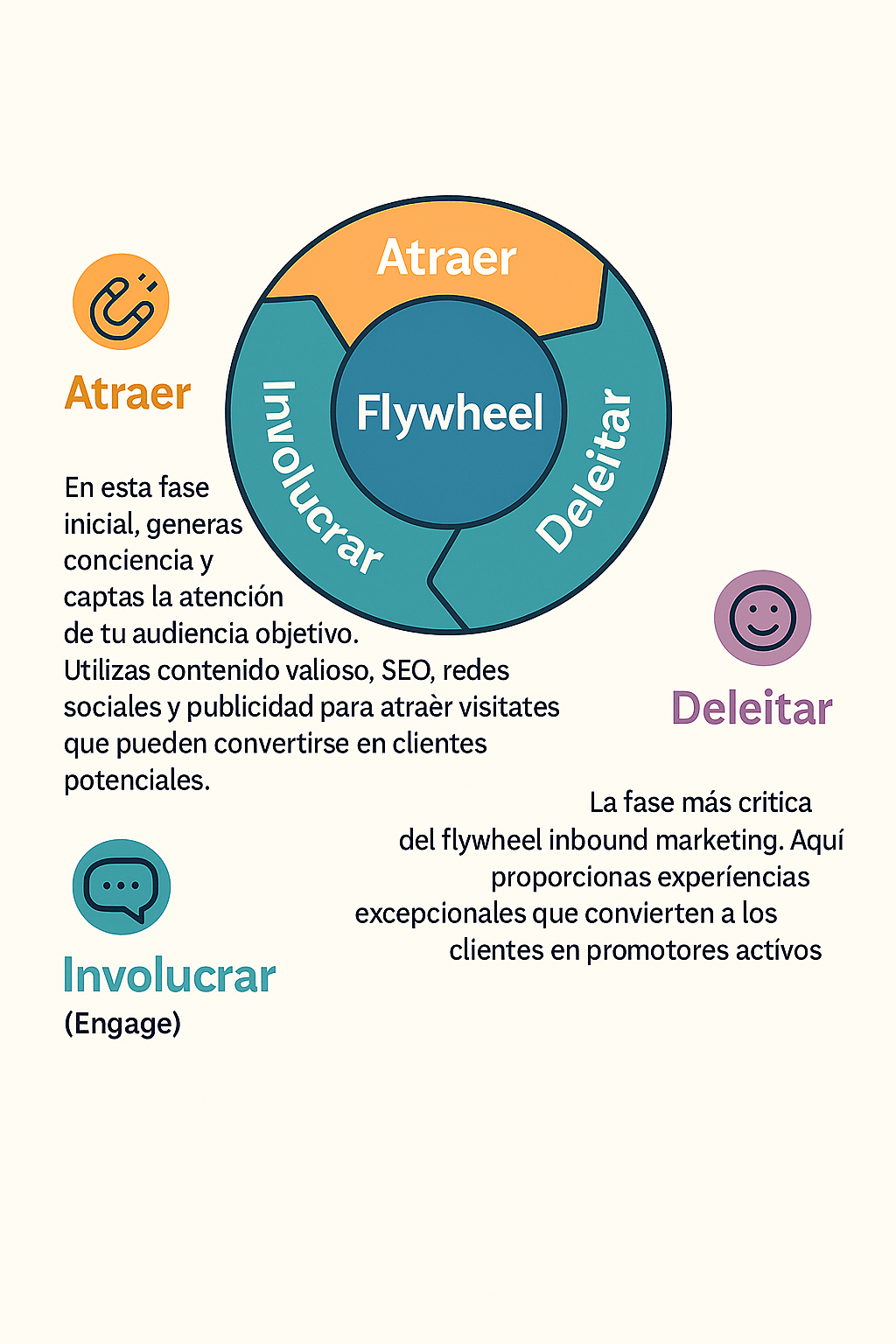
As HubSpot highlights in its official documentation : “ The new inbound methodology is a circle. The three phases of your flywheel are attract, engage and delight.”
Attract
In this initial phase, you build awareness and capture the attention of your target audience. You use valuable content, SEO, social media and advertising to attract visitors who may become leads.
Key strategies:
- Relevant content marketing
- Search engine optimisation
- Active social media presence
- Targeted and contextual advertising
Engage
Once you’ve attracted your audience, you need to engage them in a meaningful way. This is where you build relationships, nurture leads and facilitate the purchasing process through personalised experiences.
Effective tactics:
- Segmented email marketing
- Marketing automation
- Personalised content
- Proactive customer service
Delight
The most critical phase of the inbound marketing flywheel. This is where you deliver exceptional experiences that turn customers into active advocates for your brand.
Essential elements:
- Exceptional customer service
- Loyalty programmes
- Proactive solicitation of feedback
- Building brand communities
What is the flywheel effect and how does it work?
The flywheel effect refers to the moment when your strategy reaches a critical mass where growth becomes self-sustaining. As the Harvard Business Review explains: “Each rotation of the flywheel builds on the work done previously, capitalising on your investment of effort.” Satisfied customers generate referrals, referrals turn into new customers, and these new customers, when well looked after, become further advocates.
This effect is amplified because:
- It reduces the cost of customer acquisition
- It increases customer lifetime value
- It improves retention and loyalty
- It generates sustainable organic growth
Examples and success stories
Amazon: The e-commerce giant
Amazon perfected the flywheel model by focusing on three core elements: low prices, a superior customer experience and a wide selection of products. According to specialist analysis, “Amazon’s flywheel model is centred on price value ”, where lower, more competitive prices attract more customers, which in turn attracts more third-party sellers, creating a self-sustaining virtuous cycle.
Netflix: Personalised entertainment
Netflix uses viewing data to improve recommendations, which increases user satisfaction, reduces cancellations and generates more data to refine the algorithm.
Apple: Integrated ecosystem
Apple has created a flywheel where each product reinforces the value of the others, generating extreme loyalty and sustained growth across multiple product categories.
Spotify: Personalisation and Virality
Spotify is a clear example of how the flywheel can be masterfully applied in the digital music industry.
Its strategy is based on:
- Behavioural data: Every time a user listens to a song, Spotify collects data to feed its algorithm.
- Algorithmic personalisation: Based on this data, it offers highly personalised playlists such as Discover Weekly or Daily Mix.
- Satisfied users: These recommendations increase user satisfaction and engagement.
- Organic promotion: Users share their playlists, annual statistics (‘Spotify Wrapped’) and discoveries, generating viral buzz on social media.
- New users: Recommendations from friends and content shared on platforms such as Instagram or TikTok attract new users.
- Reinforced cycle: Each new user contributes more data, which further improves personalisation and closes the cycle.
This model has been key to Spotify maintaining a competitive advantage based on personalised experience and community-driven viral growth.
Tesla: Customers as brand ambassadors
Tesla has created a flywheel unique to the automotive sector, based on innovation, product differentiation and an active community.
The cycle works as follows:
- Highly innovative product: Tesla’s electric vehicles offer distinctive design, advanced technology and superior performance.
- Enthusiastic customers: The product experience and brand philosophy generate highly satisfied and emotionally engaged customers.
- Word of mouth and virality: Many owners become spontaneous brand ambassadors who recommend the brand, share their experiences online and take part in Tesla forums or events.
- Constant feedback: The vehicles are connected and send data directly to Tesla, enabling software optimisation, the development of continuous improvements and the release of OTA (Over-the-Air) updates.
- Growing appeal: Constant improvements and positive word of mouth attract new customers who, in turn, enter the loyalty cycle.
This approach has enabled Tesla to grow without relying on traditional advertising, demonstrating the power of the flywheel when the product and the customer experience are at the centre.
Practical implementation
Step 1: Audit your current process
Assess how your current customers experience each stage of the journey. Identify friction points and opportunities for improvement.
Step 2: Identifying forces and friction points
- Drivers are elements that accelerate your flywheel (viral content, exceptional service, referrals).
- Frictions are obstacles that slow it down (complicated processes, slow response times, negative experiences).
Step 3: Continuous optimisation
The flywheel requires constant monitoring. Use metrics such as NPS (Net Promoter Score), CLV (Customer Lifetime Value) and CAC (Customer Acquisition Cost) to measure your progress.
Step 4: Technology integration
Implement tools that support your flywheel: integrated CRM, marketing automation, analytics platforms and customer experience management systems.
Common implementation mistakes
Avoid these common mistakes when implementing your flywheel strategy:
- Excessive focus on acquisition: Do not neglect the engagement and delight phases by prioritising acquisition alone.
- Lack of cross-departmental alignment: Marketing, sales and customer service must work in coordination.
- Incorrect metrics: Measuring only immediate conversions ignores the long-term value of the model.
- Impatience: The flywheel takes time to gain momentum. Exponential results do not appear immediately.
Key metrics for measuring your flywheel
To assess the effectiveness of your flywheel, focus on:
- Flywheel velocity: Average duration of the full customer cycle
- Net Promoter Score (NPS): Measures the likelihood of recommendation
- Customer Lifetime Value (CLV): The total value a customer brings
- Referral rate: The percentage of new customers who come via referrals
- Retention rate: The percentage of customers who remain active
Develop your expertise in flywheel marketing
Successfully implementing flywheel marketing requires specific skills that go beyond superficial knowledge. You need to master data analysis, automation, consumer psychology, marketing technologies and advanced retention strategies.
Degree in Marketing: Solid foundations
A Marketing Degree provides you with the essential theoretical and practical foundation for understanding how consumer behaviour actually works at each stage of the flywheel. You will learn about market research, advanced segmentation, buyer persona development and positioning strategies, which are fundamental to the ‘Attract’ stage of your flywheel.
The programme includes specific modules on:
- Analysis of digital consumer behaviour
- Integrated communication strategies
- Customer experience management
- Relationship marketing and loyalty programmes
Master’s in Digital Marketing: Advanced mastery of the flywheel
The Master’s in Digital Marketing offers the most advanced specialisation for professionals seeking to lead comprehensive digital transformations. Here, you will master the most sophisticated technologies and methodologies of flywheel marketing.
Specific programme skills:
- Advanced Marketing Automation: Designing complex workflows that fuel every phase of the flywheel
- Predictive analytics: Using machine learning to optimise the flywheel’s speed
- Growth hacking: Advanced techniques to accelerate the flywheel’s momentum
- Customer data platforms: Integrating data for personalisation at scale
- Agile methodologies: Rapid implementation and continuous optimisation of the flywheel
The Master’s programme includes a final project in which you design and implement a complete flywheel for a real company, with metrics tracked over several months.
Higher Technical Diploma in Marketing and Advertising: Direct entry into the sector
If you’re looking for a more practical course leading directly to employment, the Higher Technician in Marketing and Advertising provides you with the essential operational skills to implement the flywheel in small and medium-sized enterprises.
This programme focuses on:
- Specific automation tools (HubSpot, Marketo, Salesforce)
- Content creation for each phase of the flywheel
- Social media management and community management
- Flywheel metrics analysis and reporting
- Graphic design and creativity applied to digital marketing
Sources:
- HubSpot Official Documentation – The Flywheel Model (2024)
- Harvard Business Review – “Replacing the Sales Funnel with the Sales Flywheel” (2018)
- Amazon Business Strategy Analysis – Various studies on Amazon’s flywheel model (2024–25)
- Jim Collins – “Good to Great”: The Flywheel Effect
- Brafton Marketing Research – “Flywheel Marketing: Complete Guide” (2024)
- Growth Operations Research - "Flywheel Methodology in 2024" (February 2024)