























Table of Contents
What is sports sponsorship? Concept and scope
Why is sponsorship key to a sports branding strategy?
Strategies for securing sports sponsorship
Benefits of sports sponsorship for businesses
Leading companies in sports sponsorship in Spain
Legal and tax aspects of sports sponsorship
Measuring ROI in sports sponsorship
Master the future of sports marketing with specialised training
What is sports sponsorship? Concept and scope
Sports sponsorship is a commercial agreement whereby a company provides financial resources, products or services in exchange for association rights with an event, team or athlete. It is not charity, but a strategic investment with clear return objectives.
Sponsorship of a sporting event goes beyond a simple financial exchange. It involves developing activations that maximise brand exposure during the competition. This may include a social media presence, side events, VIP experiences for customers and exclusive multimedia content.
Why is sponsorship key to a sports branding strategy?
Sports sponsorship is not just a way to gain visibility; it is one of the most powerful tools for building a brand within the sporting world. Its true value lies in the ability to emotionally associate a brand with the values, emotions and experiences generated by sport.
Through sponsorship, a company can:
- Embody values such as self-improvement, teamwork, resilience or passion, by aligning itself with athletes, teams or events that already represent these attributes.
- Build brand recognition and affinity by appearing in contexts that evoke strong emotional engagement among the audience.
- Create memorable brand experiences, from event activations to audiovisual content that connects directly with fans.
- Gain access to highly engaged communities, where loyalty to a club or athlete can be transferred to associated brands.
Ultimately, sports sponsorship activates and amplifies the branding strategy, transforming corporate identity into something vibrant, tangible and relatable for the consumer. When managed strategically, it becomes a high-impact tool for building a brand with purpose and relevance within the sporting ecosystem.
Roles of a sports sponsor
A sports sponsor fulfils multiple roles, ranging from financial support to strategic collaboration:
· Funding: It provides the necessary resources to enable athletes, teams or events to carry out their activities. Without the support of sponsors, many sports would be unable to maintain their competitive level.
· Cross-promotion: They use their communication channels to boost the visibility of the sponsored party, whilst the latter does the same for the sponsoring brand.
· Product development: Collaborates on the creation of specific products related to the sport or sponsored athlete. Basketball players’ signature trainers are a classic example of this collaboration.
· Narrative building: Help create compelling stories that connect with the audience. Sponsorship works best when there is an authentic narrative linking the brand and the sport.
Strategies for securing sports sponsorship
Securing sports sponsorship requires a professional and strategic approach:
Develop your value proposition
Clearly define what you can offer sponsors. This includes audience metrics, fan demographics, media exposure values and activation opportunities.
Research potential sponsors
Identify companies whose values and target audience align with your sporting profile. A nutritional supplements brand will be more interested in sponsoring elite athletes than a corporate software company.
Create a professional portfolio
Prepare a presentation that includes your sporting career, achievements, future prospects, communication plan and specific collaboration proposals.
Build relationships
Sports sponsorship is based on human relationships. Attend industry events, take part in networking activities and maintain regular contact with decision-makers at relevant brands.
Demonstrate ROI
Provide clear metrics on the return on investment that sponsors can expect. This includes media coverage, social media engagement and tangible conversions.
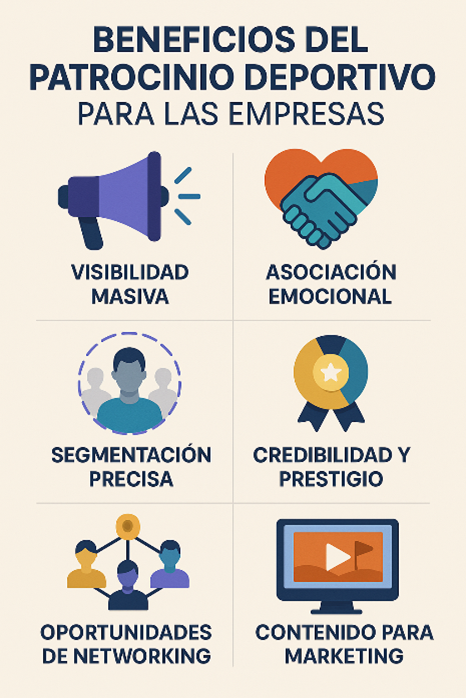
Benefits of sports sponsorship for businesses
Businesses that invest in sports sponsorship can reap multiple benefits:
1. Massive visibility: Sporting events attract audiences numbering in the millions. The Champions League final reaches over 400 million viewers globally, offering unrivalled exposure.
2. Emotional connection: Sport generates intense emotions that are transferred to the sponsoring brands. Consumers develop emotional ties with companies that support their favourite teams.
3. Precise targeting: Different sports attract specific demographics, enabling brands to reach their target audience efficiently.
4. Credibility and prestige: Partnering with elite athletes or prestigious events enhances the brand’s reputation in the market.
5. Networking opportunities: Sporting events bring together business decision-makers, facilitating the development of valuable business relationships.
6. Marketing content: Sponsorship generates audiovisual material and narratives that can be used in marketing campaigns for months on end.
Types of sports sponsors
Sports sponsors are categorised according to their level of investment and rights:
· Title sponsor: Has the broadest rights and the greatest visibility. Their logo appears in the most prominent positions and they receive the maximum contractual benefits.
· Official sponsor: Enjoys specific rights in exclusive categories. For example, they may be the event’s ‘official bank’ or ‘official drink’.
· Supporting sponsor: Makes a smaller investment but gains a presence in promotional materials and the right to use the event’s image in its communications.
· Category sponsor: Specialises in supporting specific divisions, such as youth teams or Paralympic sports.
· Technical sponsor: Provides sports equipment, kits or specific technology required for the sport.
Leading companies in sports sponsorship in Spain
The landscape of sports sponsorship in Spain includes companies from various sectors that have developed innovative strategies:
· Financial sector: Santander maintains a constant presence in Spanish and international football, having sponsored La Liga since 2016 and holding agreements with Real Madrid and other European clubs. Its investment exceeds 40 million annually in naming rights and sponsorship. CaixaBank supports a wide range of sports, from handball to athletics, with a particular focus on grassroots and women’s sport through its “Futur@s Campion@s” programme.
· Telecommunications: Movistar has invested significantly in sports sponsorship, particularly as the official sponsor of the Movistar Team cycling team since 2011, one of the longest-standing partnerships in professional cycling. It also maintains a presence in MotoGP with Yamaha and has sponsored the Olympic Games as an official broadcaster. Its strategy combines broadcasting rights with active sponsorship.
· Automotive: SEAT uses sport to connect with young audiences, sponsoring the Copa del Rey football tournament and maintaining partnerships with the Spanish national football team. Furthermore, it is actively involved in motor sport through the SEAT León Cup and collaborates with sports influencers on digital campaigns.
· Energy: Repsol has found sports sponsorship to be an effective way of humanising its corporate brand, having been the main sponsor of the Honda team in MotoGP since 1995. Its investment in this sport exceeds 15 million annually. Endesa has sponsored the ACB basketball league since 2011, renaming it the “Liga Endesa”, and supports Paralympic sport through agreements with the Spanish Paralympic Committee.
· Food and drink: Mahou San Miguel capitalises on the natural connection between beer and sport by sponsoring Real Madrid, Atlético de Madrid and numerous sporting events. Its “Somos de los que” campaign has achieved great visibility by associating the brand with sporting values. Coca-Cola maintains a presence at events such as the FIFA World Cup and sponsors national youth leagues.
· Technology: Telefónica uses sponsorship to demonstrate innovation and connectivity, acting as the official technology sponsor for events such as the Madrid 2020 Olympic Games (bid) and maintaining agreements with LaLiga for the development of 5G technologies in stadiums. Orange sponsors esports and urban sports events to connect with millennial audiences.
· Retail and distribution: El Corte Inglés maintains a diversified sponsorship strategy, supporting everything from tennis (Mutua Madrid Open) to athletics, whilst MediaMarkt has specialised in sponsoring gaming and esports events, adapting to new trends in sports entertainment.
Sector | Company | Sponsored Disciplines/Events | Objective / Key Strategy |
| Financial | Santander | La Liga, Real Madrid, European clubs | Global visibility, naming rights, presence in elite football |
| CaixaBank | Athletics, handball, grassroots and women’s sport | Support for inclusive and grassroots sport (the ‘Futur@s Campion@s’ programme) | |
| Telecommunications | Movistar | Cycling (Movistar Team), MotoGP, Olympic Games | Combines broadcasting rights with active sponsorship |
| Automotive | SEAT | Copa del Rey, Spanish national team, motor sports | Engaging with a young audience, use of influencers and digital marketing |
| Energy | Repsol | MotoGP (Honda team) | Long-standing partnership, humanising the brand |
| Endesa | ACB League (naming rights), Paralympic sport | Widespread visibility + social commitment | |
| Food and drink | Mahou San Miguel | Real Madrid, Atlético de Madrid, various sporting events | Reinforcing sporting values through emotional campaigns (“We’re the kind of people who…”) |
| Coca-Cola | World Cup, youth leagues | Global presence, commitment to grassroots sport | |
| Technology | Telefónica | Olympic Games (Madrid 2020), LaLiga (5G in stadiums) | Positioning as an innovative brand |
| Orange | Esports, urban sports | Connecting with young and digital audiences | |
| Retail and distribution | El Corte Inglés | Tennis (Mutua Madrid Open), athletics | Multi-sport strategy with a national focus |
| MediaMarkt | Esports and gaming | Adapting to new trends in sports entertainment |
Legal and tax aspects of sports sponsorship
A sports sponsorship contract must address a range of legal issues:
· Image rights: Clearly specifies how and where the sponsored party’s image may be used, including time and geographical restrictions.
· Exclusivity: Defines whether the sponsorship is exclusive within certain categories of products or services.
· Mutual obligations: These detail the responsibilities of each party, including public appearances, use of products and participation in promotional events.
· Term and renewal: It sets out the duration of the agreement and the conditions for its extension or termination.
· Penalties: Includes clauses regarding inappropriate conduct, injuries, changes in performance or breach of obligations.
With regard to the tax treatment of sports sponsorship, companies may deduct these expenses as a marketing investment provided they meet certain requirements. Sponsored individuals must declare the income received and may benefit from specific tax deductions for high-performance athletes.
Measuring ROI in sports sponsorship
Assessing the return on investment in sports sponsorship requires specific metrics:
· Media exposure value: Calculates the cost that would have been incurred to purchase the same amount of exposure time in traditional media.
· Social media engagement: Measure interactions, mentions, hashtags and follower growth related to the sponsorship.
· Brand recognition: Assess the increase in brand awareness before and after the sponsorship through specific surveys.
· Direct conversions: Track sales, leads or sign-ups generated directly by sponsorship activations.
· Relationship value: Consider intangible benefits such as networking, attendance at exclusive events and the building of business relationships.
Master the future of sports marketing with specialised training
If you find sponsorship strategies, brand activations and sports event management fascinating, it’s because you sense something that the data confirms: sports marketing will be one of the fastest-growing sectors in the coming years.
Spain has established itself as a key market for sports sponsorship , with a compound annual growth rate of 13 per cent since 2020. Investment in sports sponsorship is estimated to reach 1,850 million euros by 2025, with the potential to exceed 1,900 million under favourable conditions.
Why specialise?
The professional landscape in sports marketing is undergoing rapid transformation. Companies are no longer looking for generalist marketers who ‘also know a bit about sport’. They need specialists who speak the emotional language of sport and can translate it into effective business strategies.
The UAX Master’s in Sports Marketing: your career booster
Our students on the Master’s in Sports Marketing experience a quantum leap in their professional careers. They not only acquire technical knowledge; they develop the strategic mindset that characterises industry leaders.
🎓 100% online programme
📊 Learning method based on real-life case studies
👨🏫 Teaching staff who are active in the sector
🚀 Access to the industry from day one
🔄 Comprehensive approach: from branding to measurement
At UAX, we won’t just train you in sports marketing. We’ll turn you into the professional the industry is looking for.
Ask us for more information!
Sources:
· Nielsen Sports & Entertainment – global sponsorship benchmark reports
· PwC Sports Survey – annual business trends in sport
· Deloitte Sports Business Group – reports on the economic return from sporting events
· LaLiga Tech – digitalisation of sports assets
· SportBusiness Sponsorship Reports – analysis of top activations
· FIFA & UEFA Commercial Reports – analysis of visibility and exposure
· Global Sports Trends Report 2024 (Euromericas Sport Marketing)