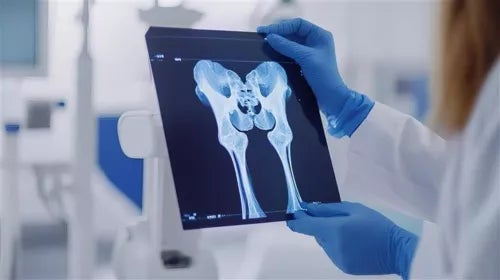
Diagnostic Imaging and Nuclear Medicine forms part of that field where science and technology come together to improve people’s health. But what does this discipline actually involve, and what does training in it entail? In this article, we explain it in detail so that you can understand why it is one of the most important areas within today’s healthcare sector.
If you’re considering studying a healthcare vocational qualification with a strong technological focus, you’re probably wondering what Diagnostic Imaging and Nuclear Medicine is and what role it plays within today’s healthcare system. It is one of the most important qualifications in the healthcare sector, as it enables you to play a direct role in diagnosing illnesses through medical imaging techniques.
Throughout this article, you’ll find a comprehensive overview of what this course entails, what you’ll learn during the programme, and what career opportunities it offers in hospitals, clinics and specialist centres.
Professional profile: Diagnostic Imaging and Nuclear Medicine technician
Typical level of education:
Higher-level Vocational Training in the healthcare sector.
Main duties:
- Carrying out diagnostic imaging tests.
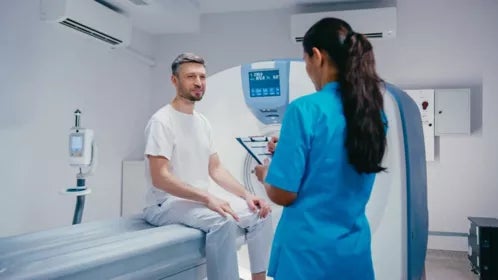
- Operating radiology, CT or MRI equipment.
- Collaborating with the medical team in the diagnosis of diseases.
Where they work:
- Public and private hospitals.
- Specialist clinics.
- Diagnostic imaging centres.
Indicative salary in Spain:
Between €20,000 and €28,000 gross per annum at the start of their career.
Level of demand for this role:
A technical role in high demand within the healthcare sector due to the growing need for early diagnosis and advanced medical technology.
What is Diagnostic Imaging and Nuclear Medicine?
What does this healthcare qualification involve?
The Diagnostic Imaging and Nuclear Medicine qualification is a Higher-Level Vocational Training course that prepares professionals to acquire, process and analyse medical images for diagnostic purposes. This role is key within the healthcare system, as many medical decisions depend on tests such as X-rays, MRI scans or nuclear medicine studies.
How it aids in the diagnosis and monitoring of diseases
Imaging techniques enable the detection of medical conditions, the assessment of their progression and the verification of treatment effectiveness. For example, an MRI scan can identify internal lesions, whilst a scintigraphy allows the functioning of certain organs to be analysed. This makes this role a cornerstone of early diagnosis, one of the most important factors in modern medicine.
The difference between diagnostic imaging and nuclear medicine
Although they are often mentioned together, there are important differences:
- Diagnostic imaging (radiology) uses techniques such as X-rays, CT scans or MRI to obtain anatomical images.
- Nuclear nuclear medicine uses radioactive substances to analyse the functioning of organs and tissues.
Both fields complement each other and form part of a technician’s day-to-day work.
What does a Diagnostic Imaging and Nuclear Medicine Technician do?
Key responsibilities in hospitals and diagnostic centres
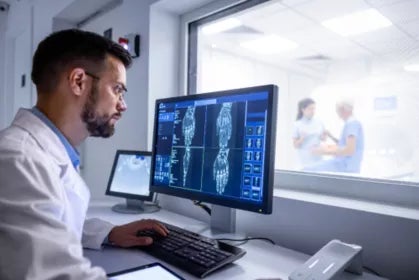
In their day-to-day work, these professionals are responsible for preparing the patient, carrying out the tests and ensuring that the images obtained are useful for medical diagnosis. They must also follow strict protocols and work in coordination with radiologists and other specialists.
Tests and technologies they work with
Among the most common tests are:
- X-rays
- Computed tomography (CT)
- Magnetic resonance imaging (MRI)
- Nuclear medicine (PET, scintigraphy)
Each of these techniques requires specific knowledge and the ability to use advanced technology.
The technician’s role in patient safety
One of the most important aspects of the job is radiation protection. The technician must ensure that radiation exposure is kept to the minimum necessary, both for the patient and for the healthcare environment.
What do you study in Diagnostic Imaging and Nuclear Medicine?
What healthcare and technological knowledge will you acquire?
Throughout the course, you’ll combine knowledge of anatomy, medical physics and technology applied to healthcare. It’s not just about learning how to operate equipment, but also about understanding how to interpret the images obtained.
Key modules of the programme
The most relevant modules include:
- Anatomy through imaging
- Radiation protection
- Conventional radiology techniques
- Magnetic resonance imaging techniques
- Nuclear medicine
What you will learn about anatomy, medical imaging and radiation protection
Students develop a detailed understanding of the human body from an imaging perspective, enabling them to identify structures, detect abnormalities and understand pathological processes.
Technologies and tests covered in this vocational training course
Conventional radiography
This is the most widely used technique and the starting point for understanding diagnostic imaging.
CT scans, MRI and ultrasound
These technologies provide more detailed and accurate images, which are essential in modern diagnosis.
Nuclear medicine and other diagnostic procedures
This includes techniques that analyse how the body functions, not just its structure, providing key information on complex diseases.
How long does the Diagnostic Imaging and Nuclear Medicine programme last?
Official duration of the programme
This programme lasts 2,000 hours, spread over two academic years.
How the 2,000 hours are allocated
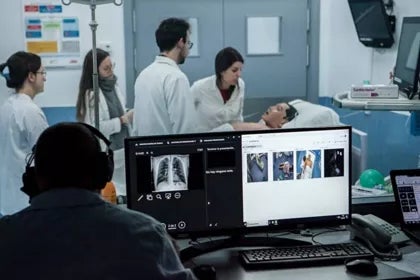
It combines theoretical training, practical training in educational centres and applied learning in real-world settings.
Work-based learning and practical component
It includes the In-Company Training Phase (FEE), during which students gain experience in hospitals or healthcare centres, applying their knowledge in real-life situations.
What career opportunities are there in Diagnostic Imaging and Nuclear Medicine?
This qualification offers a wide range of career opportunities within the healthcare sector, particularly in a context where medical technology is becoming increasingly important.
Positions in which a technician may work
- Radiodiagnostic technician.
- Nuclear medicine technician.
- Medical imaging specialist.
Where they can work: hospitals, clinics and specialist centres
The work is mainly carried out in:
- Hospitals
- Private clinics
- Diagnostic imaging centres
- Nuclear medicine units
Specialisation and career prospects for this role
The growing importance of diagnostic imaging within the healthcare system has increased the demand for these professionals, particularly in settings where technology is key to medical decision-making.
Who would I recommend to study Diagnostic Imaging and Nuclear Medicine?
Ideal student profile
This course is particularly suitable for those interested in the healthcare sector, with an eye for detail and an aptitude for working with technology.
Skills and interests suited to this vocational training programme
- An interest in health and anatomy
- Accuracy and responsibility
- Ability to work as part of a team
- An interest in technology
Where can you study Diagnostic Imaging and Nuclear Medicine?
If you’re looking for a course tailored to the current healthcare environment, you can find out more about the UAX’s Higher National Diploma in Diagnostic Imaging and Nuclear Medicine , which combines technical knowledge, practical experience and links to the professional world.
Frequently asked questions about Diagnostic Imaging and Nuclear Medicine
Are there career prospects in Diagnostic Imaging and Nuclear Medicine?
Yes, it is one of the healthcare vocational training courses offering the greatest job security, as diagnostic imaging is essential to the healthcare system.
Does this vocational training programme involve a lot of practical work?
Yes. The course includes work placements in real-world settings, where students work with equipment and in situations similar to those encountered in a professional environment.
How does it differ from other healthcare vocational training programmes?
It is a highly technology-driven programme, focused on diagnostic imaging, unlike other vocational training programmes that are more oriented towards direct patient care.
SOURCES