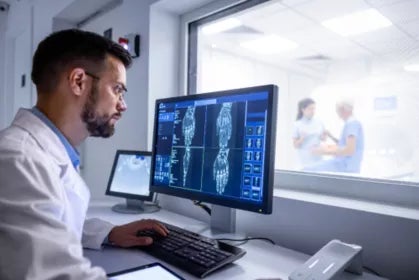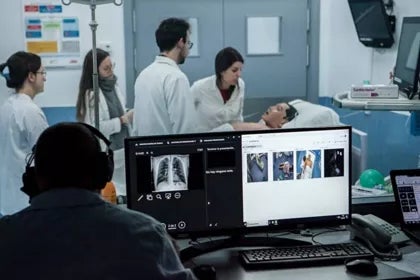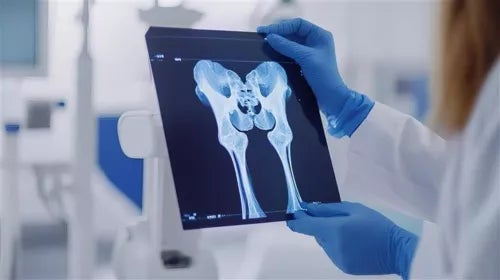
























The Higher-Level Technician in Diagnostic Imaging and Nuclear Medicine plays a vital role in the healthcare sector, as they are responsible for obtaining internal images of the human body to assist doctors in the diagnosis and treatment of diseases.
If you’re thinking of studying this vocational training programme, in this article we’ll tell you how much an X-ray technician earns and the various career opportunities this qualification offers.
Salary of an X-ray technician
The salary of a radiographer, also known as a Diagnostic Imaging Technician, can vary significantly depending on a number of factors.
Generally speaking, the basic salary of an X-ray technician in Spain ranges from 16,000 to 23,000 euros gross per year, which equates to an average of around 1,500 euros per month.
Factors affecting salary
The salary of a radiography technician is not uniform and can be affected by a number of variables. Below, we break down the main factors that influence the salary of a diagnostic imaging technician:
- Experience: Experience is a key factor in determining pay. A newly qualified technician may start on a salary at the lower end of the scale, whilst those with several years’ experience and a proven track record can command higher salaries.
- Specialisation: Specialisation in specific areas of diagnostic imaging, such as magnetic resonance imaging (MRI), computed tomography (CT) or nuclear medicine , can increase a radiographer’s salary. Professionals who acquire additional skills and specialise in advanced techniques are generally more highly valued in the labour market.
- Geographical location: There are salary differences between autonomous communities. Madrid, Catalonia, the Basque Country and Navarre generally offer better pay conditions compared with other regions.
| Autonomous Community | Average annual salary (gross euros) |
| Andalusia | 18,000 – 20,000 |
| Aragon | 18,000 – 20,000 |
| Asturias | 16,000 – 18,000 |
| Balearic Islands | 14,000 – 15,000 |
| Canary Islands | 22,000 – 23,000 |
| Cantabria | 18,000 – 20,000 |
| Castile-La Mancha | 16,000 – 18,000 |
| Castile and León | 16,000 – 18,000 |
| Catalonia | 20,000 – 28,000 |
| Madrid | 15,000 – 16,000 |
| Extremadura | 16,700 – 18,000 |
| Galicia | 16,000 – 18,000 |
| La Rioja | 22,000 – 23,000 |
| Navarre | 20,000 – 22,000 |
| Basque Country | 20,000 – 28,000 |
| Murcia | 14,300 – 16,000 |
* These ranges are approximate and vary according to the collective agreement and the conditions at each facility.
- Type of healthcare facility: Salary also depends on whether the professional works in a public hospital ( following competitive examinations organised by the National Health System) or in a private hospital or clinic. Private facilities may offer more flexible contracts and additional pay.
- Working hours and working conditions: Working conditions, including working hours and shifts, affect the salary. Technicians who work night shifts, at weekends or on public holidays usually receive additional compensation.
- Salary supplements: In some cases, technicians may receive allowances for hazardous work, night work, on-call duty or productivity, which increase their final salary.
What career prospects are there for a radiodiagnostic technician?
The employability rate for radiographers stands at approximately 80 per cent, according to data from the INE.
The Higher Vocational Training in Diagnostic Imaging and Nuclear Medicine offers a range of career opportunities.
Healthcare sector
- Public and private hospitals: Radiographers are essential in hospitals, where they carry out diagnostic tests that are fundamental to medical care.
- Health centres and medical clinics: As well as hospitals, these professionals can work in health centres and medical clinics, assisting in the detection and monitoring of various conditions.
- Specialist centres: There are centres specialising in diagnostic imaging that require technicians with specific training to operate advanced equipment and carry out complex examinations.
- Dental and maxillofacial clinics: In the field of dentistry and maxillofacial surgery, radiographers take X-rays that are crucial for planning treatments and surgical procedures.
- Veterinary centres: Veterinary medicine also requires diagnostic imaging technicians, as imaging techniques are essential for the diagnosis and treatment of animals.
Other career opportunities
- Medical imaging equipment companies: The technical expertise of these professionals is highly valued by companies that manufacture or distribute medical imaging equipment, where they can take on roles in training, technical support or sales.
- Research and development (R&D) sector: Research into new imaging techniques and the development of innovative technologies offer opportunities for technicians interested in innovation and scientific advancement.
- Teaching: Teaching at educational institutions that provide training in diagnostic imaging is another career path, enabling technicians to share their experience and knowledge with future professionals.
- Occupational health and safety sector: Radiographers can assist in the assessment and control of risks associated with radiation exposure, contributing to workplace safety in environments where imaging equipment is used.
Conclusion
If you are interested in the healthcare sector and are looking for a profession with high demand, becoming a radiographer could be an excellent option.
It is worth noting that pay increases exponentially as you gain experience, making this a profession with excellent future salary prospects.
The Diagnostic Imaging Technician course, delivered via a blended learning format by UAX FP, offers you specialised training in medical technology, guaranteeing stability and professional growth. Don’t miss the opportunity to turn your vocation into a successful career.
Find out more today and take the first step towards your professional future!