

















Table of Contents
What are special educational needs?
SEN vs NEAE: key differences every educator should know
Why is it crucial to classify them correctly?
Understanding this classification will help you to
Legislation and regulatory framework for SEN in Spain
Constitutional and legal framework
Organic Law on Education (LOMLOE)
Royal Decree on Educational Organisation
Regulations on rights and accessibility
How to identify a pupil with SEN?
Strategies for working with pupils with special educational needs
How can I specialise in working with children with special educational needs?
What are special educational needs?
According to the Spanish Ministry of Education, pupils with special educational needs (SEN) are those who face barriers that limit their access, attendance, participation or learning.
These barriers generally stem from a disability or from serious behavioural, communication and language disorders. They may arise at some point during a pupil’s schooling or throughout their entire school career. Consequently, these pupils require specific educational support and attention to achieve the objectives appropriate to their development.
SEN vs NEAE: key differences every educator should know
Although SEN and NEAE may seem synonymous, understanding the difference between them is essential for providing the correct educational support to each pupil.
- Special educational needs (SEN) refer to pupils with disabilities or severe disorders who require significant curricular adaptations and specialised support to access learning.
- Specific educational support needs (NEAE) include pupils who, whilst not having a disability, require additional support due to various circumstances.
Types of special educational needs
SEN can have a wide range of causes: from physical, sensory or cognitive factors to cultural or linguistic factors. It is important to understand that a single pupil may experience difficulties in multiple areas simultaneously.
Category | Specific type | Description |
| Associated with physical disabilities | Motor disability | Mobility limitations affecting active participation in the classroom |
| Sensory disability | Hearing or visual impairments requiring resources such as hearing aids, interpreters or adapted materials | |
| Health conditions | Chronic illnesses or medical conditions requiring adjustments to support the student’s wellbeing | |
| Associated with cognitive disabilities | Intellectual disability | Significant difficulties in cognitive and adaptive development |
| Specific learning difficulties | Such as dyslexia, dyscalculia or dysorthographia, which affect specific areas of learning | |
| Associated with neurodevelopmental disorders | Autism spectrum disorders (ASD) | Difficulties with communication, social interaction and restrictive or repetitive behaviour patterns |
| ADHD | Characterised by impulsivity, inattention or hyperactivity | |
| Language disorders | Significant problems with verbal expression or comprehension | |
| Associated with emotional and behavioural disorders | Emotional disorders | Such as anxiety, depression or post-traumatic stress, which affect academic performance |
| Behavioural disorders | Disruptive or defiant behaviours requiring educational intervention | |
| Traumatic experiences | Changes in behaviour resulting from situations such as abuse, violence or the loss of a family member | |
| Associated with social or contextual factors | Sociocultural deprivation | Lack of educational resources within the family environment |
| Displacement or seeking refuge | Adaptation to a new environment due to migration or situations of seeking refuge | |
| Complex family situations | Such as orphanhood, family conflicts or joint custody | |
| Associated with high intellectual ability | Giftedness | Pupils with exceptional intellectual abilities who require additional challenges |
| Specific talent | They excel in specific areas, such as music, maths or sport | |
| Related to academic difficulties | Educational disadvantage | Pupils who do not reach the expected standard due to a lack of resources or support |
| Academic adaptation | Need for adjustments to content or teaching methods |
Why is it crucial to classify them correctly?
Accurate identification enables specialists to:
- Carry out more effective assessments
- Determine exactly what each pupil needs
- Design personalised and successful interventions
Understanding this classification will help you to:
- Identify early warning signs in your pupils
- Request the appropriate support when necessary
- Create a more inclusive environment in your classroom
Legislation and regulatory framework for SEN in Spain
Constitutional and legal framework
The Spanish education system establishes a robust regulatory framework for the provision of support to pupils with Special Educational Needs (SEN). The Spanish Constitution of 1978 lays down the fundamental principles:
- Article 27: Guarantees the universal right to education
- Article 49: Requires public authorities to ensure the inclusion of people with disabilities
Organic Law on Education (LOMLOE)
The Organic Law 3/2020 (LOMLOE) , which amends the 2006 LOE, reinforces the inclusive approach. Chapter I of Title II is specifically dedicated to pupils with specific educational support needs (NEAE).
This legislation classifies pupils with SEN into three main categories:
- Pupils with special educational needs
- Pupils with high intellectual abilities
- Pupils entering the education system at a later stage
Royal Decree on Educational Organisation
The Royal Decree 696/1995 sets out the framework for the education of pupils with special educational needs, defining the resources and support required for their effective integration.
Regulations on Rights and Accessibility
The General Law on the Rights of Persons with Disabilities (LGDPD, 2013) complements the educational framework, guaranteeing equal access to the education system and promoting the removal of architectural and communication barriers.
Implementation at regional level
Each Autonomous Community implements this national legislation through specific decrees and orders that adapt the regulations to their particular territorial circumstances, whilst always upholding the principles of inclusion, equity and educational quality established at national level.

How can a pupil with SEN be identified?
Identifying a pupil with SEN is a process that involves continuous observation, assessment and collaboration between teachers, families and specialists. Some key signs include:
- Persistent difficulties with learning or behaviour
- Limited response to general teaching strategies
- A need for additional support to meet academic targets
The steps involved in identification usually include team meetings, the use of diagnostic tests and consultation with specialists, such as educational psychologists , therapists or speech and language therapists. It is important to follow the school’s plan for supporting diversity.
Strategies for working with pupils with special educational needs
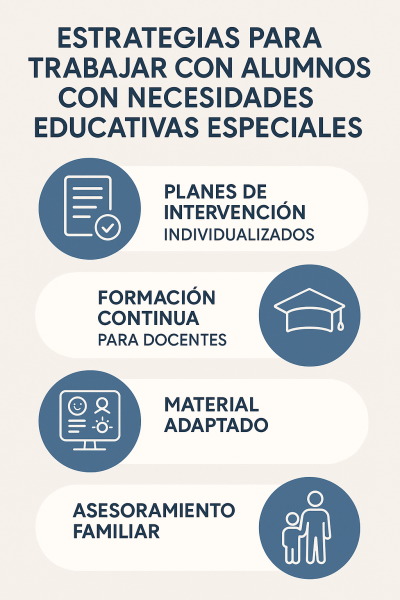
Identifying SEN is only the first step. The real challenge lies in creating an environment where every pupil can fulfil their potential. How can this be achieved? These strategies have proven to be the most effective:
- Individualised Intervention Plans (IIPs) Imagine having a personalised roadmap for every pupil. These documents set out exactly what adjustments each pupil needs and how to implement them on a day-to-day basis.
- Continuing professional development for teachers Keeping up to date is not optional: it is essential. Specialised courses and workshops on inclusive education will give you the practical tools that really work in the classroom.
- Adapted materials that make all the difference: From pictograms to specialised educational software, the right tools can completely transform your pupils’ learning experience.
- Family guidance: support at home Parents are your greatest allies. Guiding them in implementing routines and strategies at home multiplies the impact of your work in the classroom.
The result: an educational ecosystem where diversity becomes a strength.
How can I specialise in working with children with special educational needs?
Special educational needs( ) present both a challenge and an opportunity to transform education into an inclusive and equitable environment.
If you are passionate about teaching and wish to train to work with pupils with SEN, at Alfonso X el Sabio University (UAX) we offer specialised degree programmes such as the Master’s in Supporting Diversity and Inclusive Education. This 100% online programme will provide you with key tools to understand and address diversity in the classroom, ensuring an inclusive and high-quality education.
Be part of educational change with UAX!