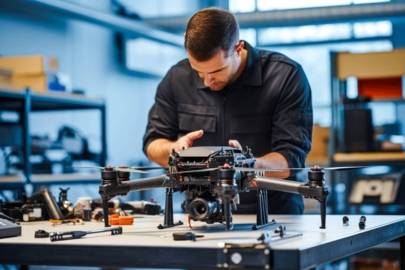
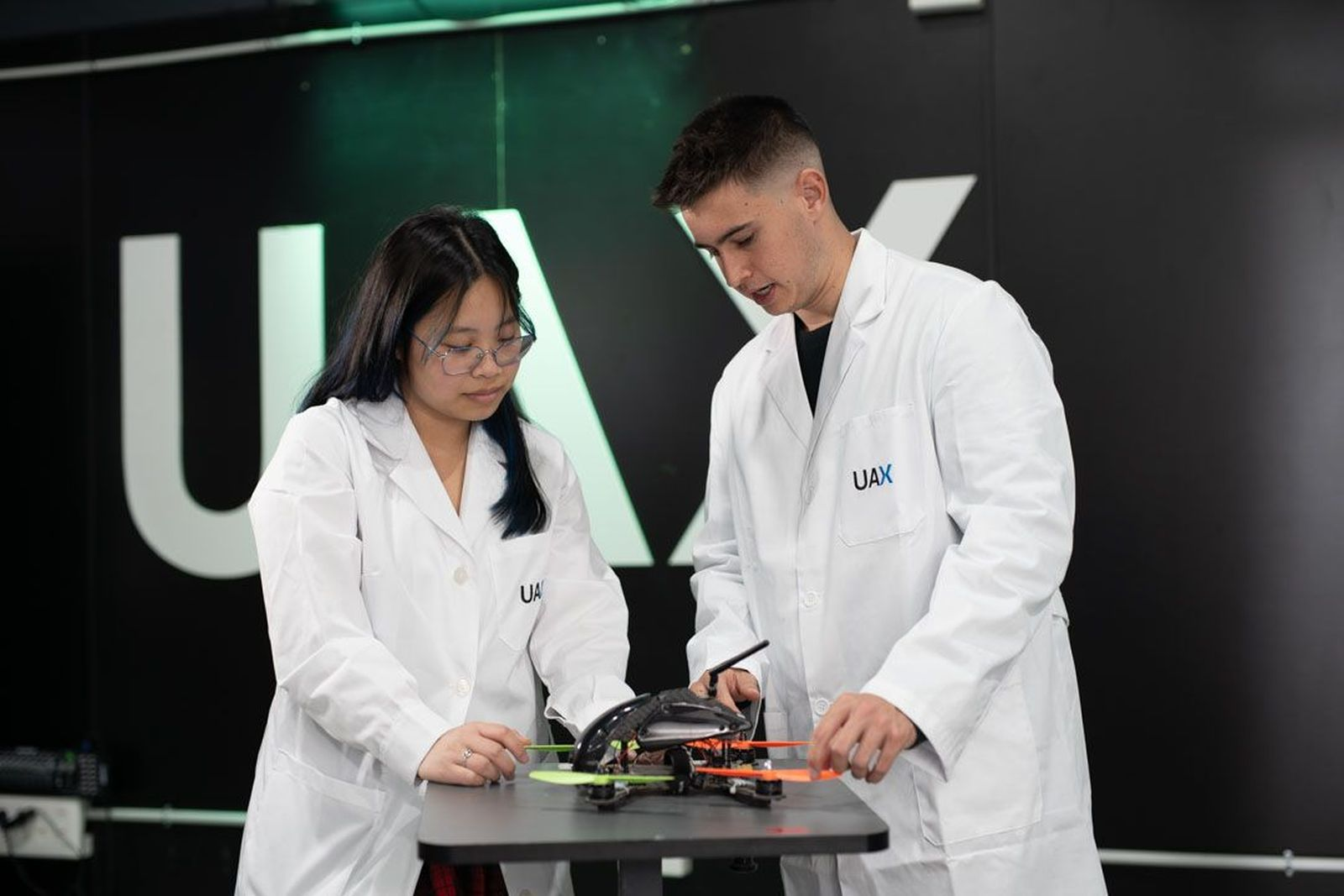
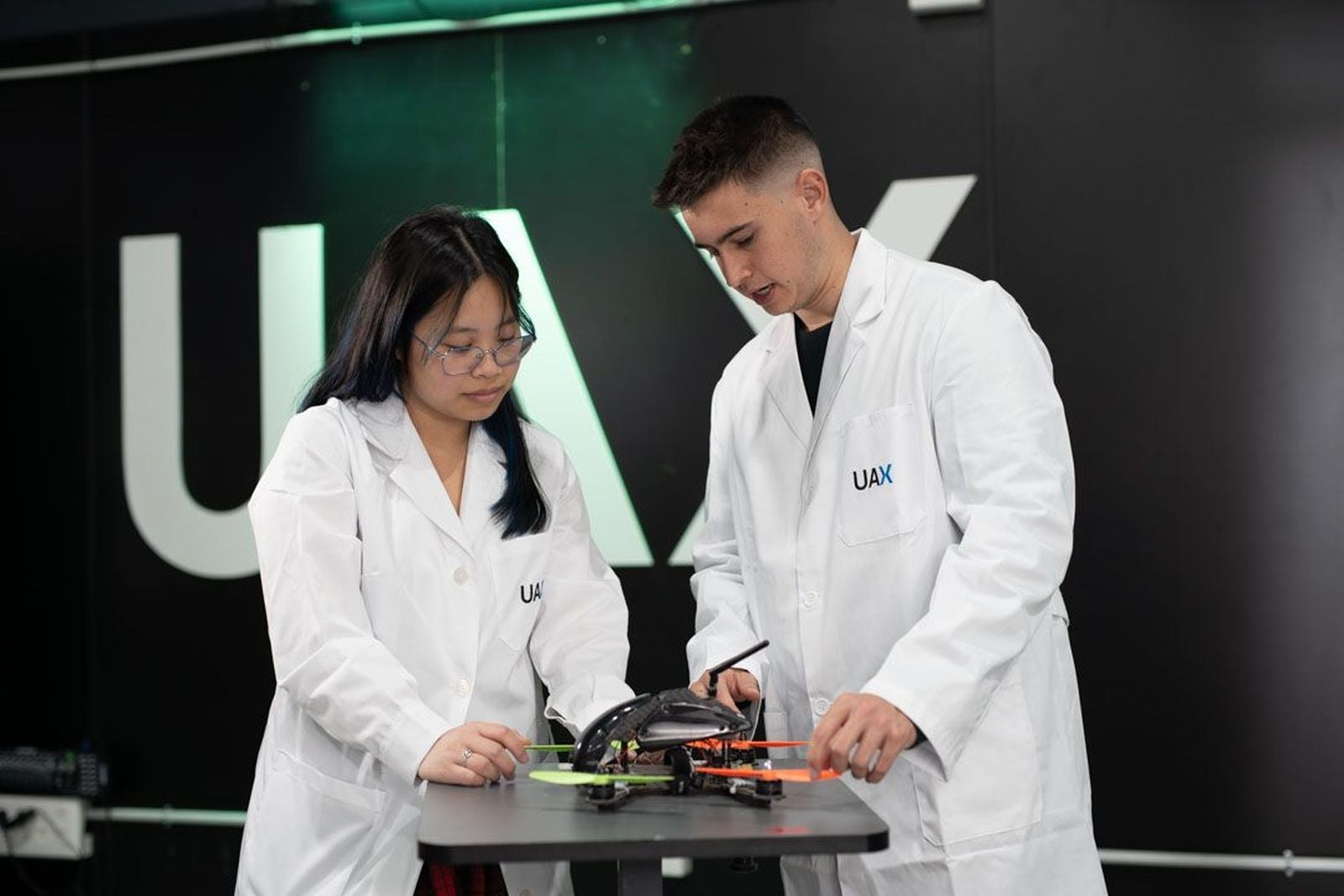
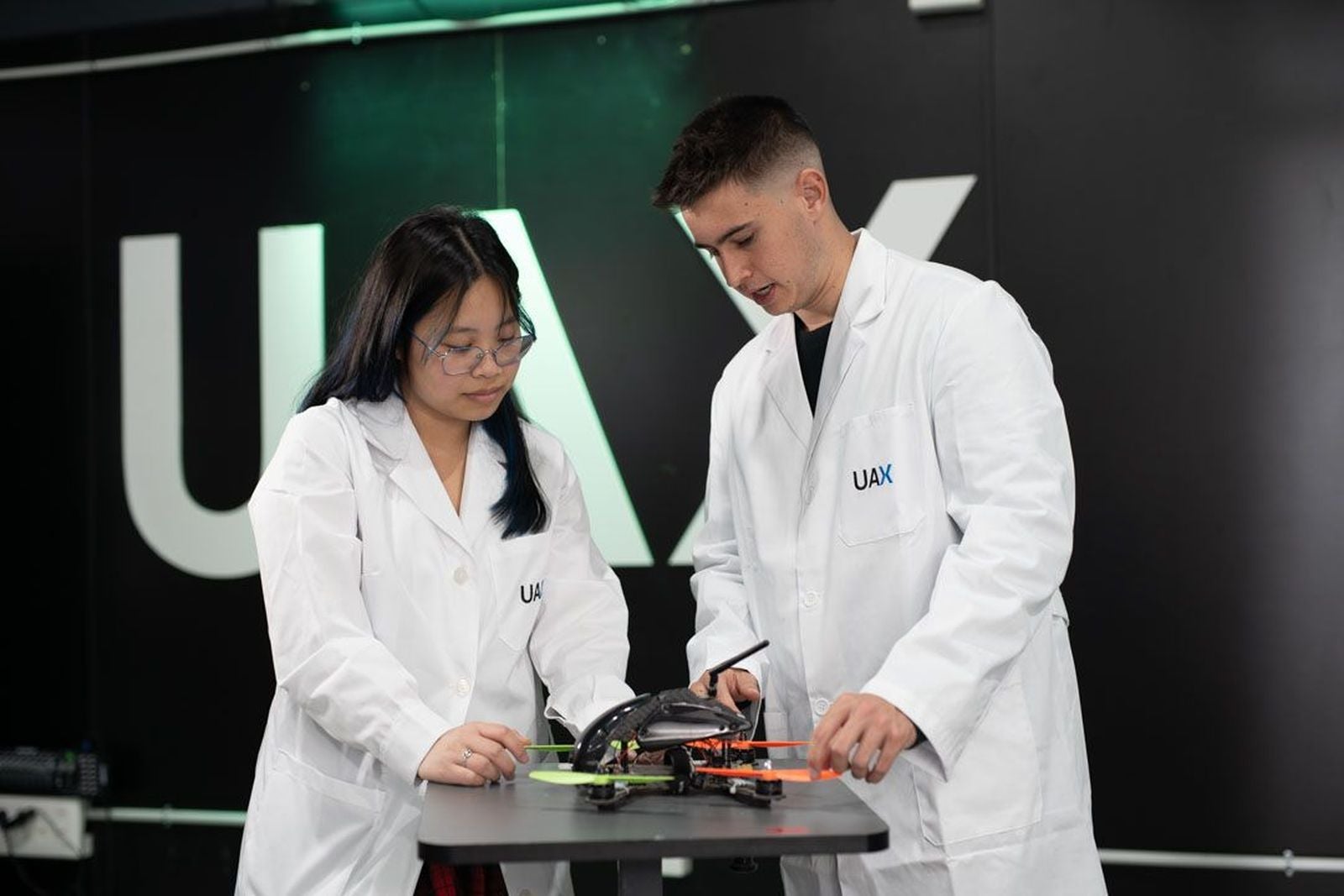
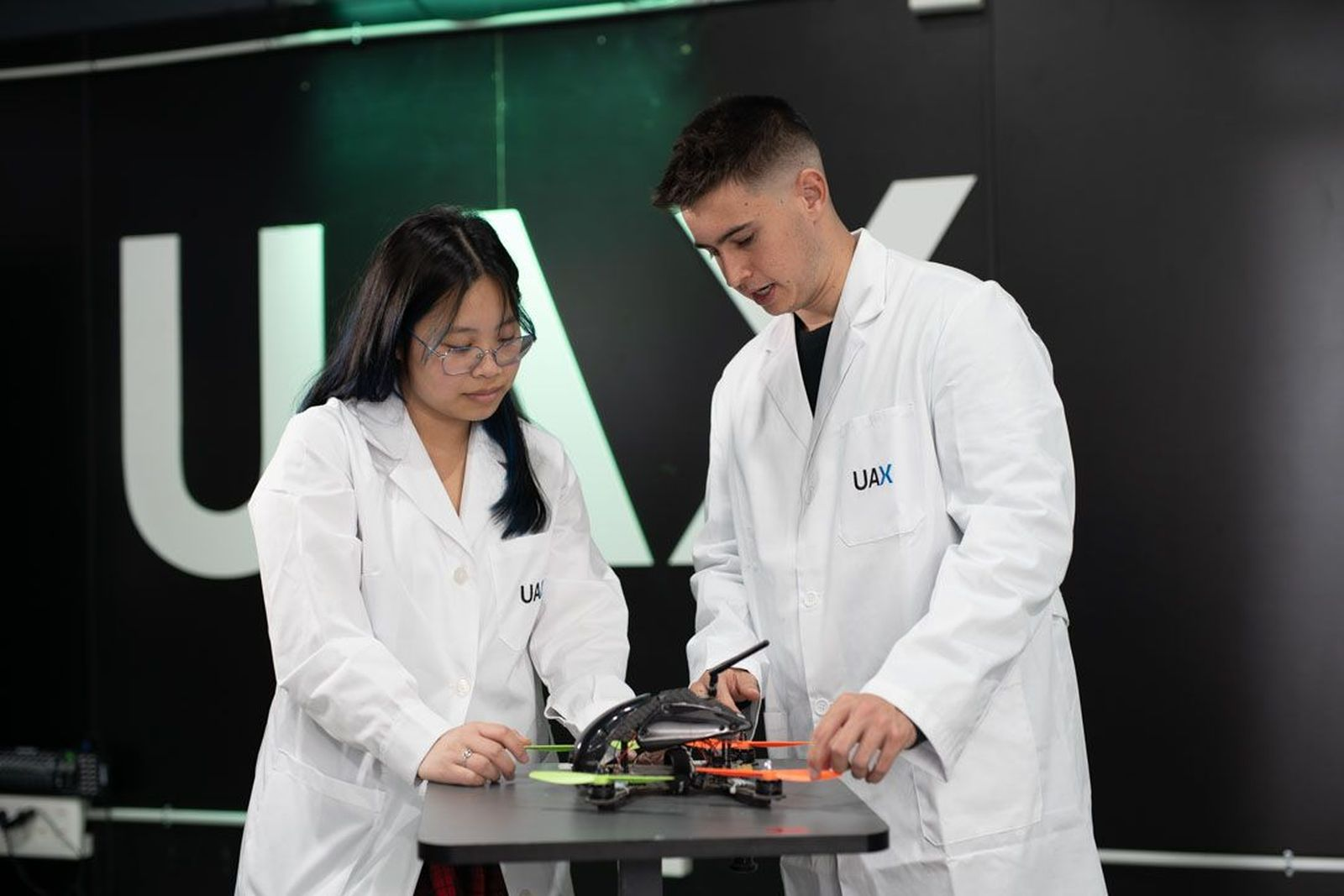
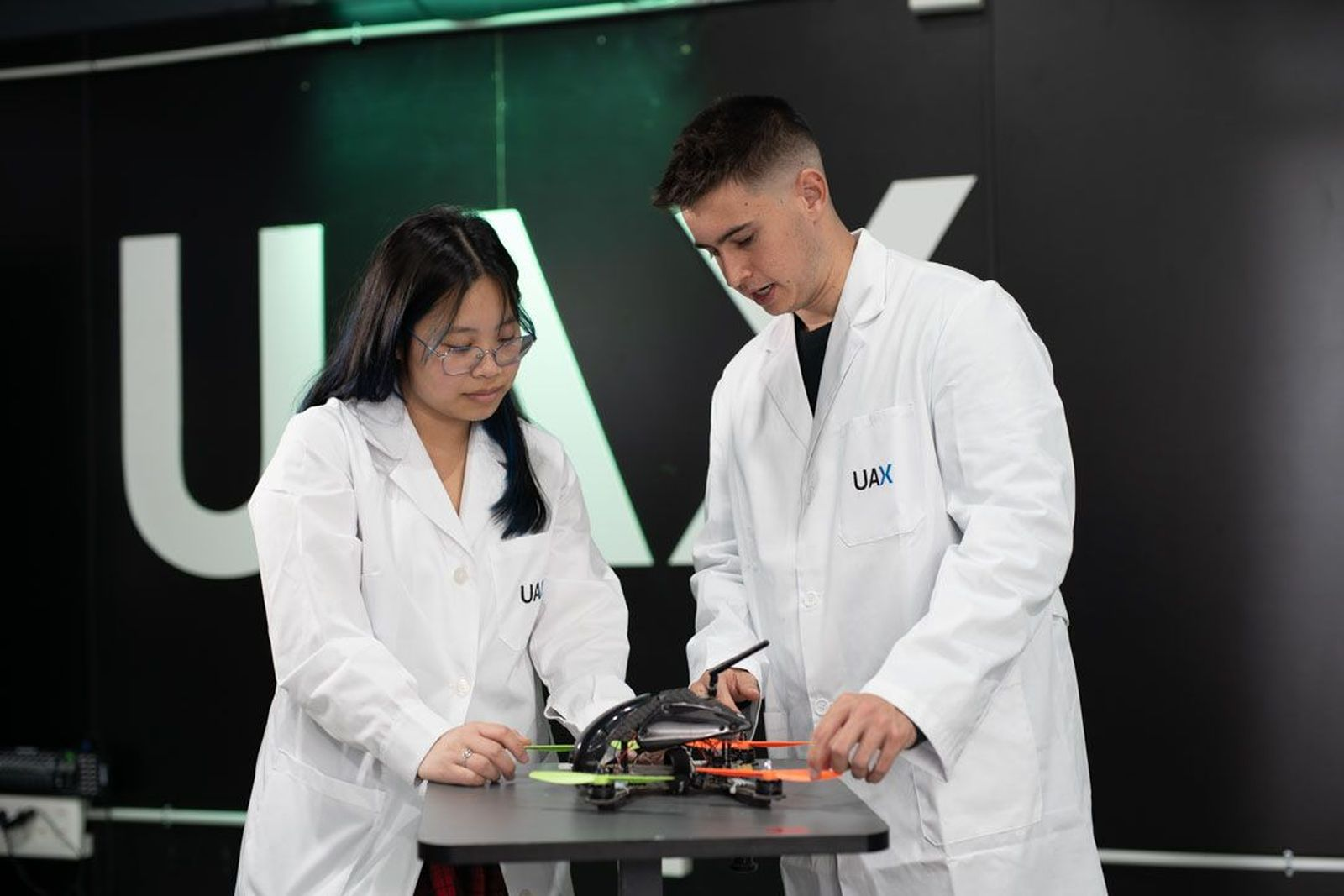
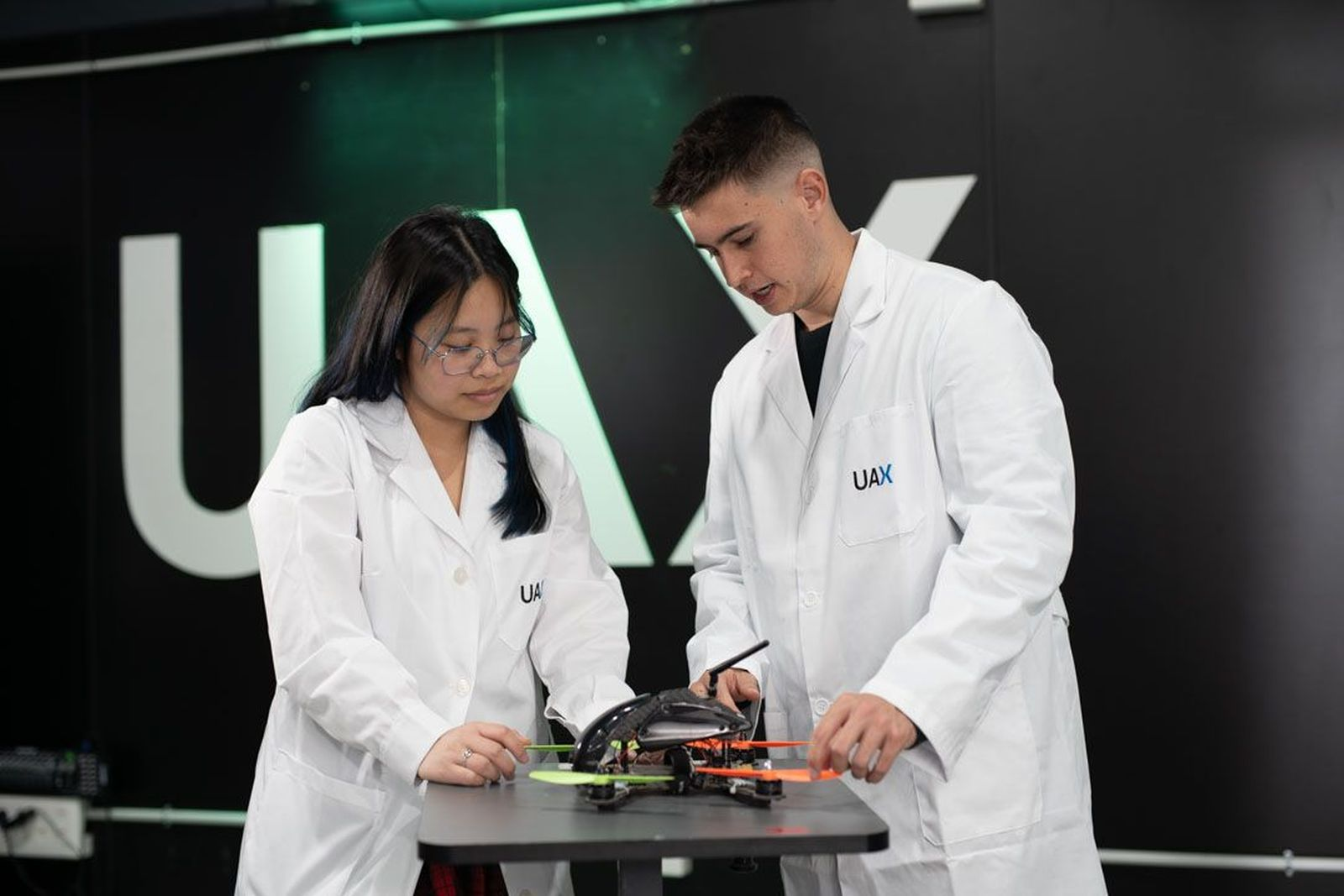
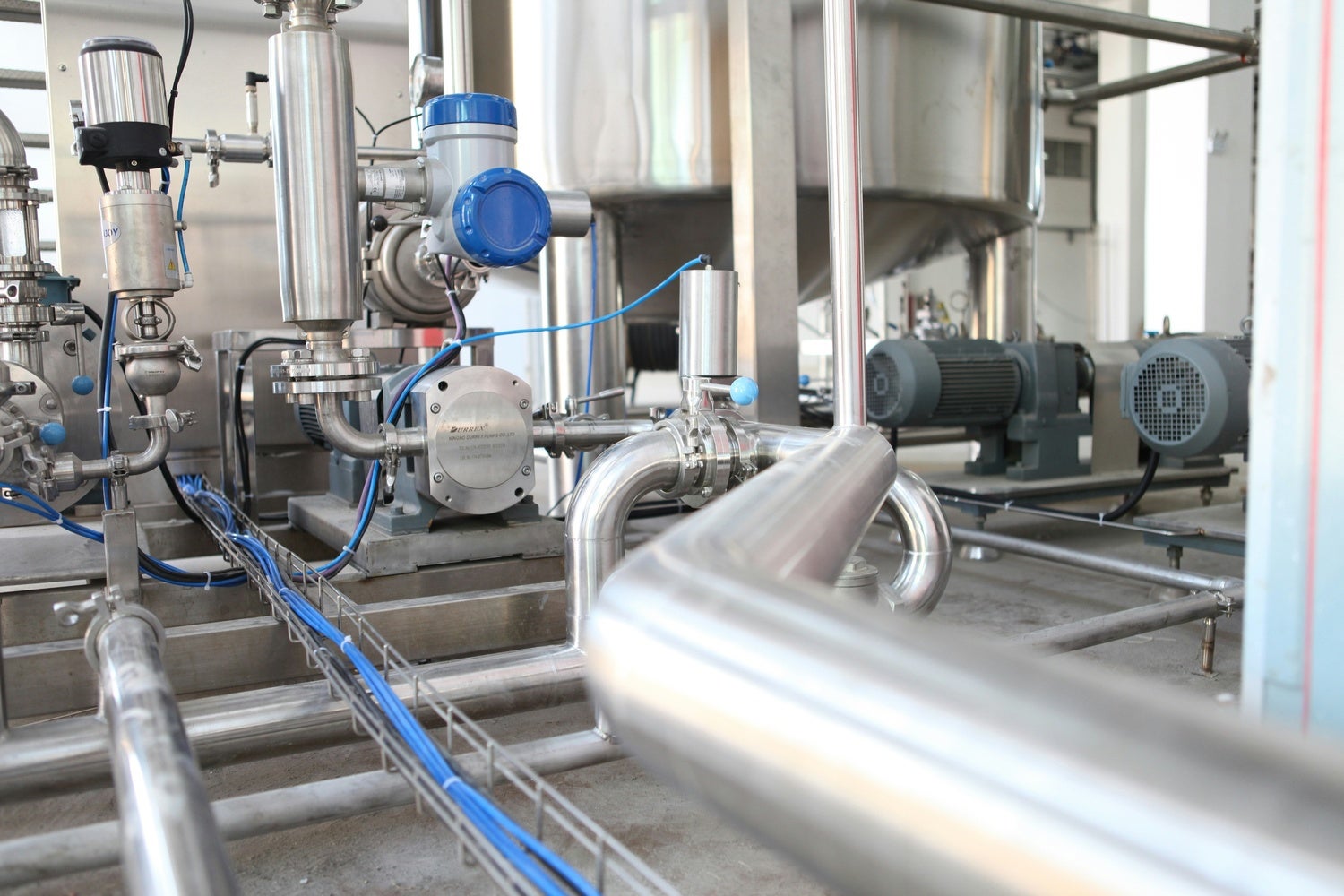
Gain a broad understanding of engineering and prepare yourself to evaluate, organise and manage projects in industrial companies with the Master’s degree in Industrial Engineering.
Entry requirements: A degree in Industrial Engineering, subject to an individual assessment of the applicant’s academic record and, where applicable, additional training.
Why study the Master’s Degree in Industrial Engineering at UAX?
Because it qualifies you to practise as an industrial engineer, combining advanced technical training, a broad understanding of engineering and close links with industry and the professional world
25,000 M²from actual installations
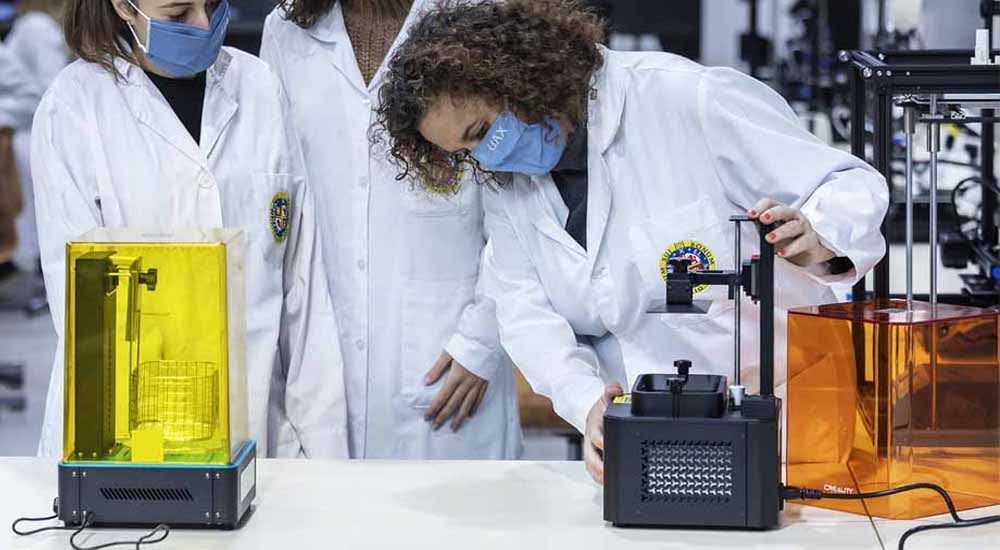
A wind tunnel, a turbojet test rig, an Airbus A320 flight simulator, AeroLab and a FABLAB equipped with 3D printing, laser cutting and robotic arms.
99%EMPLOYABILITY
99 per cent of our students are in employment upon graduation
1000AGREEMENTS
Airbus Defence & Space, Iberia, Hispasat, Indra, Thales Alenia Space, INECO, Sacyr, Accenture, Capgemini, GMV, Swiftair, Air Europa and ELA Aviación, amongst others
90%CURRENTLY WORKING TEACHERS
This provides students with an education that is more closely aligned with the realities of the workplace.
+ 100REAL PROJECTS
Take part in the development and actual launch of a microsatellite alongside the aerospace company B2Space, as part of the UAX FABLAB Makers programme.
What will you learn on the Master’s Degree in Industrial Engineering?
The UAX Master’s Degree in Industrial Engineering is committed to sustainability, training in new technologies and direct links with businesses, with the aim of producing all-round industrial engineers with a broad range of personal skills and the most up-to-date knowledge of the sector.
By studying the Qualifying Master’s Degree in Industrial Engineering in Madrid:
You will learn about the latest technological innovations such as Big Data, the connected industry and digitalisation.
You’ll open the doors to your future thanks to 8,800 partnerships with the sector’s most renowned companies.
You’ll have access to a prestigious teaching staff who combine teaching with professional practice at companies such as IBM, Repsol, Endesa and Airbus.
You’ll be able to enjoy our incredible campus, with over 25,000 m² of laboratories and specialised facilities for ‘the engineering of the future’, including 3D printers, a wind tunnel, a road surface research laboratory, hybrid classrooms and much more.
Furthermore, you’ll gain access to the regulated profession of Industrial Engineer.
If you’re looking to balance your academic and professional life, we offer an innovative format for working professionals, allowing you to study at weekends and access course content via our digital platform. You’ll also be able to work with our team to design a personalised, modular enrolment plan tailored to your needs. Find out more!
Businesses as key players
Companies will be an integral part of your day-to-day life, proposing innovation projects, validating your skills and preparing you through work placements so that you can develop the best possible skills.
Information on the Master’s in Industrial Engineering
Curriculum
You will develop the skills required to design, build, oversee, manage and operate industrial facilities, plants, processes and systems, preparing you to tackle the professional challenges inherent in industrial engineering.
Throughout the master’s programme, you will work using an applied methodology based on problem-solving, project-based learning, the case study method, practical activities and collaborative work. In modules related to integrated project management, R&D&I management and technological innovation, you will also learn about current approaches to project management, including agile methodologies and references to professional best practices such as those promoted by PMI.
In addition, you will have the opportunity to use digital tools and technical software applied to engineering, design, calculation, simulation and project management. Depending on the teaching plan for each module, you will be able to work with tools related to CAD/CAM environments, structural simulation, numerical calculation, technical analysis and project planning, including software such as CATIA, ANSYS, MATLAB and Microsoft Project, amongst others.
You will also develop key cross-disciplinary skills essential for your professional development as an engineer, such as analytical thinking, communicating results, innovative thinking, leadership, professional ethics and working in multidisciplinary teams.
Holds a Bachelor’s degree and is a PhD candidate in Industrial Engineering at the Universidad Pontificia Comillas in Madrid
He has over twenty (20) years’ teaching experience in the fields of power generation, as well as twenty-six (26) years’ professional experience in the technical evaluation of projects, the execution of design projects, the manufacture, installation and supervision of electromechanical equipment and the sites where it operates: test benches, and urban and industrial wastewater treatment works.
Development of biogas, CO2 and H2 storage projects, primarily in industrial settings, water treatment plants and desalination plants.
Research activity in the field of water reclamation and microplastic removal
PhD in Industrial Technologies Specialisation (Field/Specialisation): Construction Engineering, Structural Mechanics and Seismic Engineering.UNED. DOCTORATE IN INDUSTRIAL ENGINEERING (CUM LAUDE)
MASTER’S DEGREE IN INDUSTRIAL ENGINEERING, European University of Madrid (UEM), 2017
MASTER’S IN ORGANISATIONAL ENGINEERING, PROJECT MANAGEMENT AND BUSINESS MANAGEMENT, UEM, 2017
TECHNICAL ENGINEER IN INDUSTRIAL CHEMISTRY, Polytechnic University of Madrid, 1987
MASTER’S IN SYSTEMS AND CONTROL ENGINEERING, Complutense University (Master’s Thesis pending), 2017
Professional experience
EMPRESARIOS AGRUPADOS INTERNACIONAL SA
April 2021/ Project Manager
TECNICAS REUNIDAS SA.
2021/2025 Project Manager.
2017/2021 Head of the Instrumentation and Control Department, Energy and Water Division
ISOLUX CORSAN (Energy Business Unit)
2015/ 2017 Engineering Director
2013/2015 Deputy Engineering Director, Head of the Electrical and Instrumentation & Control Department
2011/2013 Head of the Electrical, Instrumentation & Control Department
ABEINSA (Industrial Plants Business Unit)
2010/2011 Technical Director, IP Business Unit.
COBRA INSTALACIONES Y SERVICIOS (Cobra Industrial Plants)
2005/2010 EPC Project Manager
EMPRESARIOS AGRUPADOS (TRSA)
1997/2005 Head of I&C Projects. Detailed and Basic
PUBLICATIONS
Sánchez Colmenarejo JI, Camprubí FM, González-Gaya C, Sánchez-Lite A. Power Plant Construction Projects Risk Assessment: A Proposed Method for Temporary Systems of Commissioning. Buildings. 2022; 12(8):1260. https://doi.org/10.3390/buildings12081260
José Ignacio, S.C.; Cristina, G.-G.; Felipe, M.C. Risk analysis in power plant construction projects. In Proceedings of the 25th International Congress on Project Management and Engineering. Available online: http://dspace.aeipro.com/xmlui/handle/123456789/3031.
José Ignacio Sánchez Colmenarejo, Cristina Gonzalez-Gaya, F.M.C. Hazards and risk identification during the commissioning of installations. In Proceedings of the 6th International Conference on Technological Innovation in Building (CITE 2021), Madrid, Spain, 24–26 March 2021.
Available online: https://www.edificacion.upm.es/images/Congresos/Libro_de_Abstracts_CITE2021.pdf .
Objectives
The aim of the Energy Technology module is for students to understand, analyse, utilise and manage the various energy sources used in the industrial sector, taking into account their technical, economic, environmental and regulatory aspects.
The module covers the utilisation of energy sources, fuels, renewable energy and the energy market, providing students with an integrated view of energy systems and their role in Industrial Engineering.
Students should be familiar with the basic principles of energy conversion and use, the main conventional and renewable energy sources, and the technical, economic and environmental criteria that determine their application in industrial settings.
Furthermore, the module will enable students to develop analytical skills and professional judgement to evaluate energy alternatives, interpret technical information relating to the energy sector, and link energy technologies to sustainability, industrial competitiveness and the management of facilities, plants and technology centres.
Prerequisites
No prerequisites have been set
Learning Outcomes
The following learning outcomes will be acquired and developed in this module:
- RC1 / CG04. Carry out research, development and innovation in products, processes and methods.
- RC2 / CG05. Carry out strategic planning and apply it to systems relating to construction, production, quality and environmental management.
- RC3 / CG06. Manage projects, facilities, plants, companies and technology centres from both a technical and economic perspective.
- RC4 / CG07. Be able to perform general management, technical management and R&D&I project management functions in plants, companies and technology centres.
- RC5 / CG09. Be able to integrate knowledge and deal with the complexity of forming judgements based on information which, whilst incomplete or limited, includes reflections on the social and ethical responsibilities linked to the application of their knowledge and judgements.
- RC6 / CG10. Be able to communicate conclusions, and the knowledge and underlying reasons that support them, to specialist and non-specialist audiences clearly and unambiguously.
- RC7 / CG12. Knowledge, understanding and the ability to apply the legislation required for the practice of the profession of Industrial Engineer.
- RC11 / A6. Knowledge and skills enabling students to understand, analyse, utilise and manage different sources of energy.
Learning outcomes
The module contributes to the acquisition of the following learning outcomes:
1. KNOWLEDGE
- RK1 / CG01. To have adequate knowledge of the scientific and technological aspects of: mathematical, analytical and numerical methods in engineering; electrical engineering; energy engineering; chemical engineering; mechanical engineering; continuum mechanics; industrial electronics; automation; manufacturing; materials, quantitative management methods, industrial computing, urban planning, infrastructure, etc.
2. SKILLS AND COMPETENCIES
- RS1 / CG02. To plan, calculate and design products, processes, installations and plants.
- RS2 / CG03. Lead, plan and supervise multidisciplinary teams.
- RS3 / CG08. Apply acquired knowledge and solve problems in new or unfamiliar environments within broader, multidisciplinary contexts.
- RS4 / CG11. Possess the learning skills necessary to continue studying in a self-directed or independent manner.
Course description
The module will address the utilisation of energy sources, fuels, renewable energy and the energy market.
The course content is as follows:
1) Energy, the economy, the environment and sustainable development.
2) Energy conversion and uses.
3) Oil and natural gas.
4) Coal.
5) Hydropower and other renewable energy sources.
6) Nuclear energy.
Teaching activities
The teaching activities for this module are as follows:
1) Classroom presentations on concepts related to the module and problem-solving exercises to enable students to understand how to tackle these concepts, as well as other face-to-face group sessions such as discussion classes, group work, case studies or equivalent activities: 47 hours.
2) Carrying out group work in small groups outside the classroom: 15 hours.
3) Independent study, report writing, project work, analysis of technical documentation and other activities carried out independently by the student or a group of students: 85 hours.
4) Assessment tests: 3 hours.
Total: 150 hours.
Assessment system and criteria
The assessment systems used to verify and evaluate students’ acquisition of learning outcomes and competences are as follows:
1) Type A. Written assessments throughout the semester to assess the technical competences associated with the module acquired through the student’s individual study: 60 per cent.
2) Type B. Reports on laboratory practical work: 0 per cent.
3) Type C. Problem-solving, completion of assignments, preparation of reports, and the presentation and defence of practical case studies or projects, either individually or in small groups: 40 per cent.
Continuous assessment for the module will consist of written examinations and a practical assignment relating to the analysis, utilisation or management of energy sources.
The written examination component may be organised into two mid-term examinations, each accounting for 30 per cent of the final mark.
The ‘Type C’ component will consist of the completion of an assignment, report, practical case study or applied project, which may include a written report and an oral presentation or defence, accounting for 40 per cent of the final mark.
To pass the module, students must achieve a final mark of 5 out of 10 or higher, in accordance with the general marking scheme applicable to official university degrees.
If a student fails the module through continuous assessment, they may sit the ordinary or supplementary examination in accordance with the applicable academic procedure. The resit must allow for the assessment of the learning outcomes associated with both the written examinations and the assignment, report, practical case study or applied project.
Week 1 – MG Session 1: Energy, the economy, the environment and sustainable development (key concepts, applications and guided problem-solving).
2
MG
Week 1 – MG Session 2: Energy conversion and uses (key concepts, applications and guided problem-solving).
3
MG
Week 1 – MG Session 3: Oil and natural gas (key concepts, applications and guided problem-solving).
4
SM
Week 1 – SM Session 1: Exercises, case studies or practical work on energy, economics, the environment and sustainable development.
5
CN
Week 2 – CN Session 1: progress monitoring, academic tutoring and clarification of queries on energy, economics, the environment and sustainable development.
Nuclear Forum – A Spanish-language resource with explanations on nuclear energy, Spanish power stations, how a power station works, frequently asked questions and a glossary.
Bachelor’s degree in Physical Sciences, Master’s degree in Renewable Energy from the Polytechnic University of Madrid. Accredited PhD in Physical Sciences. Since 2016, Managing Director of HMH SOLAR (Mexico). Associate Professor and PhD holder at numerous universities, including Qatar University and the Polytechnic University of Madrid, amongst others. Scientific Adviser at Laser Tech-Med. Member of the Lasers and Molecular Beams Research Group at the Multidisciplinary Institute, Complutense University of Madrid. Member of the IMDEA Energy Research Group
Objectives
The aim of the Electrical Technology module is for students to gain a comprehensive and holistic understanding of electrical power generation, transmission and distribution systems, with particular emphasis on the technical, regulatory and operational aspects involved in the electricity system.
The course will enable students to understand and analyse electricity generation systems, including thermal, nuclear, combined-cycle and renewable sources, as well as the infrastructure for the transmission and distribution of electricity.
Students will be expected to understand the characteristics and basic elements of transmission networks, interconnected systems, electricity system management, distribution networks, substations, low-voltage transformation and distribution centres, and the applicable regulatory framework.
The module also aims to develop the ability to analyse, calculate and solve technical problems associated with the electricity system, applying criteria relating to design, regulations, technical documentation and the management of electrical infrastructure within the field of Industrial Engineering.
Prerequisites
No prerequisites have been set
Learning Outcomes
The following learning outcomes will be acquired and developed in this module:
- RC1 / CG04. Carry out research, development and innovation in products, processes and methods.
- RC2 / CG05. Carry out strategic planning and apply it to systems relating to construction, production, quality and environmental management.
- RC3 / CG06. Manage projects, facilities, plants, companies and technology centres from both a technical and economic perspective.
- RC4 / CG07. Be able to carry out general management, technical management and R&D&I project management functions in plants, companies and technology centres.
- RC5 / CG09. Be able to integrate knowledge and deal with the complexity of forming judgements based on information which, whilst incomplete or limited, includes reflections on the social and ethical responsibilities associated with the application of their knowledge and judgements.
- RC6 / CG10. Be able to communicate conclusions, and the knowledge and underlying reasoning that support them, to specialist and non-specialist audiences clearly and unambiguously.
- RC7 / CG12. Knowledge, understanding and the ability to apply the legislation required for the practice of the profession of Industrial Engineer.
- RC8 / A1. Knowledge and ability to analyse and design systems for the generation, transmission and distribution of electrical energy.
Learning outcomes
The module contributes to the acquisition of the following learning outcomes:
1. KNOWLEDGE
- RK1 / CG01. To have adequate knowledge of the scientific and technological aspects of: mathematical, analytical and numerical methods in engineering, electrical engineering, energy engineering, chemical engineering, mechanical engineering, continuum mechanics, industrial electronics, automation, manufacturing, materials, quantitative management methods, industrial computing, urban planning, infrastructure, etc.
2. SKILLS AND COMPETENCIES
- RS1 / CG02. To plan, calculate and design products, processes, installations and plants.
- RS2 / CG03. Lead, plan and supervise multidisciplinary teams.
- RS3 / CG08. Apply acquired knowledge and solve problems in new or unfamiliar environments within broader, multidisciplinary contexts.
- RS4 / CG11. Possess the learning skills necessary to continue studying in a self-directed or independent manner.
Course description
The module will cover the study of power stations, renewable energy sources, electricity transmission, grid components and characteristics, grid management, the electricity market, regulations, distribution, power lines and substations.
The course content is as follows:
1) Generation. Thermal, nuclear and combined cycle.
2) Generation. Renewables.
3) Transmission. Characteristics and basic components, interconnected systems and new technologies.
4) Electricity system management.
5) Distribution networks: architectures, substations and power lines.
6) Low-voltage transformer and distribution stations.
7) Regulatory framework.
Teaching activities
The teaching activities for this module are as follows:
1) Classroom presentations on concepts related to the module and problem-solving exercises designed to enable students to understand how to tackle these concepts, as well as other face-to-face group sessions such as discussion classes, group work, case studies or equivalent activities: 58 hours.
2) Laboratory activities of increasing difficulty designed to enable students to gradually develop the ability to solve problems independently: 4 hours.
3) Carrying out small-group work outside the classroom: 10 hours.
4) Self-study, report writing, practical work and other activities carried out independently by the student or a group of students: 75 hours.
5) Assessment tests: 3 hours.
Total: 150 hours.
Assessment system and criteria
Continuous assessment for the module is structured into four components:
1) Generation: 30 per cent.
2) Transmission: 40 per cent.
3) Distribution: 15%.
4) Practical work with Powerworld: 15 per cent.
In accordance with the degree programme specifications, the overall weighting of the assessment methods will be as follows:
1) Type A. Written tests: 45 per cent.
2) Type B. Laboratory practical reports: 15 per cent.
3) Type C. Problem-solving, assignments, reports, case studies or projects: 40 per cent.
The Generation, Transmission and Distribution modules may be assessed through a combination of written examinations and practical activities, such that the total weighting of the written examinations is 45 per cent and the total weighting of problem-solving exercises, assignments, reports, case studies or projects is 40 per cent.
The Powerworld Practical session module will account for 15 per cent and will be assessed through reports or evidence of laboratory practicals.
To pass the module, students must achieve a final mark of 5 out of 10 or higher.
If a student fails the course based on continuous assessment, they may sit the ordinary or supplementary examination in accordance with the applicable academic procedure.
Week 1 – MG Session 1: Power generation. Thermal, nuclear and combined-cycle (key concepts, applications and guided problem-solving).
2
MG
Week 1 – MG Session 2: Power generation. Renewables (key concepts, applications and guided problem-solving).
3
MG
Week 1 – MG Session 3: Transmission. Characteristics and basic elements, interconnected systems and new technologies (key concepts, applications and guided problem-solving).
4
SM
Week 1 – SM, Session 1: Exercises, case studies or practical work on power generation: thermal, nuclear and combined cycle.
5
CN
Week 2 – CN Session 1: progress monitoring, academic tutoring and clarification of queries on thermal, nuclear and combined-cycle power generation.
6
MG
Week 2 – MG, session 4: Electricity system management (key concepts, applications and guided problem-solving).
7
MG
Week 2 – MG Session 5: Distribution networks. Architectures, substations and lines (key concepts, applications and guided problem-solving).
8
MG
Week 2 – MG Session 6: Low-voltage transformer and distribution centres (key concepts, applications and guided problem-solving).
9
SM
Week 3 – SM, Session 2: Exercises, case studies or practical work on power generation. Renewables.
10
CN
Week 3 – CN, Session 2: progress review, academic tutoring and clarification of queries on Renewable Energy Generation.
Week 3 – MG Session 8: Power generation. Thermal, nuclear and combined cycle (key concepts, applications and guided problem-solving).
13
MG
Week 4 – MG, Session 9: Power generation. Renewables (key concepts, applications and guided problem-solving).
14
SM
Week 4 – SM, Session 3: Exercises, case studies or practical work on Transmission. Characteristics and basic elements, interconnected systems and new technologies.
15
CN
Week 4 – CN, session 3: progress monitoring, academic tutoring and answering queries on Transport. Characteristics and basic elements, interconnected systems and new technologies.
16
MG
Week 4 – MG, session 10: Transport. Characteristics and basic elements, interconnected systems and new technologies (key concepts, applications and guided problem-solving).
17
MG
Week 5 – MG, session 11: Power system management (key concepts, applications and guided problem-solving).
18
MG
Week 5 – MG Session 12: Distribution networks. Architectures, substations and lines (key concepts, applications and guided problem-solving).
19
SM
Week 5 – SM, Session 4: Exercises, case studies or practical work on electricity system management.
20
CN
Week 5 – CN, session 4: progress review, academic tutoring and clarification of queries on Electricity System Management.
21
MG
Week 6 – MG, session 13: Low-voltage transformer and distribution stations (key concepts, applications and guided problem-solving).
Week 6 – SM, Session 5: Exercises, case studies or practical work on distribution networks. Architectures, substations and power lines.
24
MG
Week 6 – MG, Session 15: Generation. Thermal, nuclear and combined cycle (key concepts, applications and guided problem-solving).
25
MG
Week 7 – MG, Session 16: Power generation. Renewables (key concepts, applications and guided problem-solving).
26
SM
Week 7 – SM, Session 6: Exercises, case studies or practical work on low-voltage transformer and distribution stations.
27
MG
Week 7 – MG, session 17: Transmission. Characteristics and basic elements, interconnected systems and new technologies (key concepts, applications and guided problem-solving).
28
MG
Week 7 – MG Session 18: Electricity system management (key concepts, applications and guided problem-solving).
29
SM
Week 8 – SM, session 7: exercises, case studies or practical work on the regulatory framework.
30
MG
Week 8 – Mid-term assessment / interim assignment: material covered to date.
31
MG
Week 8 – MG, session 20: Low-voltage transformation and distribution centres (key concepts, applications and guided problem-solving).
32
SM
Week 8 – SM, Session 8: Exercises, case studies or practical work on power generation: thermal, nuclear and combined-cycle.
Week 9 – MG Session 22: Power generation. Thermal, nuclear and combined cycle (key concepts, applications and guided problem-solving).
35
MG
Week 9 – MG Session 23: Power generation. Renewable energy (key concepts, applications and guided problem-solving).
36
MG
Week 9 – MG Session 24: Transmission. Characteristics and basic elements, interconnected systems and new technologies (key concepts, applications and guided problem-solving).
37
MG
Week 10 – MG Session 25: Power system management (key concepts, applications and guided problem-solving).
38
MG
Week 10 – MG Session 26: Distribution networks. Architectures, substations and lines (key concepts, applications and guided problem-solving).
39
MG
Week 10 – MG session 27: Low-voltage transformer and distribution stations (key concepts, applications and guided problem-solving).
Week 11 – MG, session 29: Power generation. Thermal, nuclear and combined cycle (key concepts, applications and guided problem-solving).
42
MG
Week 11 – MG, Session 30: Power generation. Renewables (key concepts, applications and guided problem-solving).
43
MG
Week 11 – MG, session 31: Transmission. Characteristics and basic elements, interconnected systems and new technologies (key concepts, applications and guided problem-solving).
44
MG
Week 11 – MG Session 32: Power system management (key concepts, applications and guided problem-solving).
45
MG
Week 12 – MG, session 33: Distribution networks. Architectures, substations and power lines (key concepts, applications and guided problem-solving).
46
MG
Week 12 – MG Session 34: Low-voltage transformer and distribution stations (key concepts, applications and guided problem-solving).
Week 12 – MG Session 36: Power generation. Thermal, nuclear and combined cycle (key concepts, applications and guided problem-solving).
49
MG
Week 13 – MG, session 37: Power generation. Renewables (key concepts, applications and guided problem-solving).
50
MG
Week 13 – MG Session 38: Transmission. Characteristics and basic elements, interconnected systems and new technologies (key concepts, applications and guided problem-solving).
51
MG
Week 13 – MG Session 39: Power System Management (key concepts, applications and guided problem-solving).
52
MG
Week 13 – MG session 40: Distribution networks. Architectures, substations and lines (key concepts, applications and guided problem-solving).
53
MG
Week 14 – MG, hour 41: Low-voltage transformer and distribution stations (key concepts, applications and guided problem-solving).
Week 14 – MG Session 43: Power generation. Thermal, nuclear and combined cycle (key concepts, applications and guided problem-solving).
56
MG
Week 14 – Final assessment / presentation or submission of practical assignment.
57
MG
Week 15 – MG, session 45: Transport. Characteristics and basic elements, interconnected systems and new technologies (key concepts, applications and guided problem-solving).
58
SM
Week 15 – SM, session 9: Exercises, case studies or practical work on power generation. Renewables.
59
SM
Week 15 – SM, Session 10: exercises, case studies or practical work on Transmission. Characteristics and basic elements, interconnected systems and new technologies.
60
SM
Week 15 – SM, session 11: exercises, case studies or practical work on electricity system management.
61
SM
Week 16 – SM, session 12: exercises, case studies or practical work on distribution networks. Architectures, substations and power lines.
62
SM
Week 16 – SM, session 13: exercises, case studies or practical work on low-voltage transformer and distribution stations.
63
SM
Week 16 – SM, session 14: exercises, case studies or practical work on the regulatory framework.
64
SM
Week 16 – SM, session 15: exercises, case studies or practical work on power generation: thermal, nuclear and combined cycle.
65
CN
Week 17 – CN, session 5: progress review, academic tutoring and Q&A on distribution networks: architectures, substations and power lines.
66
CN
Week 17 – CN, Session 6: progress review, academic tutoring and Q&A on low-voltage transformer and distribution centres.
67
CN
Week 17 – CN, session 7: progress review, academic tutoring and Q&A on the regulatory framework.
Regulations for High-Voltage Lines and their Technical Foundations
Paraninfo. 2008.
ISBN: 9788428330343
Supplementary:
3.- Barrero González, Fermín
ELECTRICAL POWER SYSTEMS
THOMSON PARANINFO, S.A. 2020.
ISBN: 9788497322836
4.- Gómez Expósito, A
ANALYSIS AND OPERATION OF ELECTRICAL POWER SYSTEMS
MC GRAW HILL. 2003.
ISBN: 9788448135928
5. Grainger, John J.; Stevenson, William
ANALYSIS OF POWER SYSTEMS
MC GRAW HILL. 2004.
ISBN: 9789701009086
6. Queijo Garcia G
FUNDAMENTALS OF ELECTRICAL TECHNOLOGY
U.N.E.D. 2010.
ISBN: 9788436258899
Links
Red Eléctrica — Real-time electricity demand – Up-to-date display of actual, forecast and scheduled electricity demand. A very useful resource for explaining the operation of the electricity system and the balance between generation and demand.
Red Eléctrica — e·sios – Information platform of the Spanish electricity system operator. Allows users to consult data on generation, consumption, markets, prices, demand, international exchanges and non-peninsular systems.
OMIE — Iberian electricity market – Portal of the Iberian electricity market operator. A useful resource for understanding the functioning of the day-ahead and intraday markets, price formation and energy settlement.
UFD — Electricity distribution – Official website of UFD, the Naturgy Group’s electricity distributor. A useful resource for learning about the activities of a distribution company, distribution networks, supply points and network operation.
Ministry of Industry — High-voltage electrical installations — Official website on the Regulations governing high-voltage electrical installations and their supplementary technical instructions. A suitable resource for substations, transformer stations and high-voltage installations.
Industrial Engineer. 15 years’ teaching experience at UAX in the fields of Mechanical, Thermal and Fluid Engineering. His research focuses on tribology and machinery dynamics. Head of the Signalling and Power Engineering Service, Engineering and Maintenance Division at Metro de Madrid.
Master’s Degree in Industrial Mathematics, specialising in Advanced Mathematical Modelling. Industrial Engineer specialising in Energy Technology. Areas of expertise: Applied Mathematics for Engineering; Integration of smart energy management systems; Dynamics and Operation of rail transport systems; Electric Traction Systems; Thermodynamics and Heat Transfer; Fluid Mechanics. Project Manager in the Engineering Department at Metro de Madrid since 2002.
Objectives
The Thermal and Fluid Engineering module aims to equip students with the knowledge and skills required for the design, calculation and analysis of thermal machines and engines, hydraulic machines, and industrial heating and cooling systems.
The course covers the study of hydraulic networks, hydraulic turbomachinery, thermal engines, heat generation plants, steam cycles, gas cycles, combined cycles and industrial heating and cooling systems.
Students will learn to analyse, calculate, select and optimise technical solutions relating to industrial hydraulic and thermal systems, applying the fundamentals of fluid mechanics, thermodynamics, energy transfer and heating and cooling production technologies.
Furthermore, the module will enable students to develop the ability to solve technical problems in industrial settings, interpret data and operating conditions, evaluate design alternatives and apply criteria relating to efficiency, safety, technical feasibility and professional quality.
Prerequisites
No prerequisites have been set.
Competencies
The following learning outcomes will be acquired and developed in this module:
- RC1 / CG04. Carry out research, development and innovation in products, processes and methods.
- RC2 / CG05. Carry out strategic planning and apply it to systems relating to construction, production, quality and environmental management.
- RC3 / CG06. Manage projects, facilities, plants, companies and technology centres from both a technical and economic perspective.
- RC4 / CG07. Be able to carry out general management, technical management and R&D&I project management functions in plants, companies and technology centres.
- RC5 / CG09. Be able to integrate knowledge and deal with the complexity of forming judgements based on information which, whilst incomplete or limited, includes reflections on the social and ethical responsibilities associated with the application of their knowledge and judgements.
- RC6 / CG10. Be able to communicate conclusions, and the knowledge and underlying rationale supporting them, to specialist and non-specialist audiences clearly and unambiguously.
- RC7 / CG12. Knowledge, understanding and the ability to apply the legislation required for the practice of the profession of Industrial Engineer.
- RC10 / A5. Knowledge and skills for the design and analysis of machines and thermal engines, hydraulic machines, and industrial heating and cooling systems.
Learning Outcomes
The module contributes to the acquisition of the following learning outcomes:
1. KNOWLEDGE
- RK1 / CG01. To have adequate knowledge of the scientific and technological aspects of: mathematical, analytical and numerical methods in engineering; electrical engineering; energy engineering; chemical engineering; mechanical engineering; continuum mechanics; industrial electronics; automation; manufacturing; materials, quantitative management methods, industrial computing, urban planning, infrastructure, etc.
2. SKILLS AND ABILITIES
- RS1 / CG02. To plan, calculate and design products, processes, installations and plants.
- RS2 / CG03. Lead, plan and supervise multidisciplinary teams.
- RS3 / CG08. Apply acquired knowledge and solve problems in new or unfamiliar environments within broader, multidisciplinary contexts.
- RS4 / CG11. Possess the learning skills necessary to continue studying in a self-directed or independent manner.
Course description
The module will cover the study of industrial refrigeration, heat generation plants, hydraulic machinery, and thermal engines and machines.
The course content is as follows:
1) Hydraulic systems.
2) Hydraulic turbomachinery: parameters, types, uses, selection and control.
3) Thermal engines.
4) Heat generation plants.
5) Steam, gas and combined cycles.
Teaching activities
The teaching activities for this module are as follows:
1) Classroom presentations on concepts related to the course and problem-solving exercises to enable students to understand how to tackle these concepts, as well as other face-to-face group sessions such as discussion classes, group work, case studies or equivalent activities: 50 hours.
2) Laboratory activities of increasing difficulty, enabling students to gradually acquire the ability to solve problems independently: 8 hours.
3) Carrying out small-group work outside the classroom: 12 hours.
4) Self-study, report writing, practical work and other activities carried out independently by students or student groups: 76 hours.
5) Assessment tests: 4 hours.
Total: 150 hours.
Assessment system and criteria
Continuous assessment for the module will be structured into three components:
Written tests: 50 per cent.
During the teaching period, two tests will be held, one on fluid mechanics and the other on thermal engineering. Both may include theoretical and practical aspects, as well as problem-solving exercises.
Reports or evidence of laboratory practicals: 10 per cent.
Laboratory practicals will be assessed on the basis of the work carried out during the sessions, the presentation of results and conclusions or, where applicable, the submission of reports.
Problem-solving, practical case studies, assignments, reports or applied activities: 40 per cent.
During the teaching period, assignments, exercises, practical case studies or applied activities will be set, which may be carried out in class or as independent work by the student. This may include the public defence or explanation of an exercise or practical case study.
The overall weighting of the assessment methods will therefore be as follows:
Type A. Written tests: 50 per cent.
Type B. Laboratory practical reports: 10 per cent.
Type C. Problem-solving, assignments, reports, practical case studies or projects: 40 per cent.
To pass the module, students must achieve a final mark of 5 out of 10 or higher.
If a student fails the module based on continuous assessment, they may sit the ordinary or supplementary examination in accordance with the applicable academic procedure.
Week 17 – CN, session 5: follow-up, academic tutoring and clarification of queries regarding steam, gas and combined cycles.
66
CN
Week 17 – CN Session 6: progress review, academic tutoring and Q&A on hydraulic networks.
67
CN
Week 17 – CN Session 7: progress review, academic tutoring and Q&A on hydraulic turbomachinery: parameters, types, uses, selection and regulation.
Bibliography
Core:
1. Agüera Soriano, José
Incompressible Fluid Mechanics and Hydraulic Turbomachinery
Madrid: Editorial Ciencia, 2002. 2002.
ISBN: 84953910105
2. Arias-Paz, Manuel
Car Manual
Madrid: Dossat 2000, 1996. 1999.
ISBN: 8489656096
3. Cengel, Yunus A.
Thermodynamics /
Mexico, Madrid, etc.: McGraw-Hill, 2012.
ISBN: 9781456218379
4. Muñoz Domínguez, Marta
Thermal Engineering
Madrid: UNED, 2006. 2006.
ISBN: 8436253167
5. Muñoz, M
Reciprocating Internal Combustion Engines
Madrid: Publications Section of the Higher Technical School of Engineering, 1989.
ISBN: 8486451019
Links
Canal de Isabel II — The complete water cycle – A resource on water abstraction, treatment, distribution, sanitation and reuse. Includes videos, images and technical documentation, useful for water networks and fluid systems.
IDAE — Energy efficiency - Portal of the Institute for Energy Diversification and Saving on energy efficiency in industry, construction, transport and other sectors. Useful for contextualising heating systems from the perspective of energy efficiency and savings.
MITECO — Regulations on Thermal Installations in Buildings - Official website of the RITE, which sets out the conditions that heating, air-conditioning and domestic hot water installations must meet to ensure the rational use of energy.
NIST — Thermophysical Properties of Fluid Systems — A technical database for looking up the thermophysical properties of fluids. Very useful for exercises on thermodynamics, cycles, fluids, refrigerants and the analysis of thermal installations.
PhD candidate in Industrial Engineering, Master’s in Data Science and AI, Master’s in Business Administration and Master’s in Railway Systems.
He has spent 25 years working at Talgo in various roles within the Maintenance department and currently holds the position of Head of Intelligent Maintenance Systems and New Projects Engineering.
He currently leads new technological developments and the paradigm shift within Talgo’s Maintenance Department, developing new digital projects based on real-time monitoring, artificial intelligence and robotics.
Director of the Master’s in Industrial Engineering and the Master’s in Industry 4.0 at Alfonso X El Sabio University.
He has published numerous technical articles in high-impact Q1 journals.
Objectives
The aim of the module ‘Industrial Structures and Construction’ is for students to acquire the knowledge and skills necessary to undertake the calculation and design of structures, as well as to understand the fundamental aspects of industrial construction within the field of Industrial Engineering.
The module will enable students to develop the ability to solve problems with initiative, decision-making, creativity and critical thinking, as well as to communicate and convey knowledge, skills and competences in the field of Industrial Engineering.
This module also covers the acquisition of knowledge relating to industrial urban planning, industrial plants, building regulations, the calculation of steel and concrete structures, foundations, and the maintenance and operation of industrial plants.
Prerequisites
No prerequisites have been established.
Competencies
The following learning outcomes will be acquired and developed in this module:
- RC2 / CG05. Carry out strategic planning and apply it to construction, production, quality and environmental management systems.
- RC5 / CG09. Be able to integrate knowledge and deal with the complexity of making judgements based on incomplete or limited information, including reflections on social and ethical responsibilities linked to the application of their knowledge and judgements.
- RC6 / CG10. Be able to communicate conclusions, and the knowledge and underlying reasoning that support them, to specialist and non-specialist audiences clearly and unambiguously.
- RC7 / CG12. Knowledge, understanding and the ability to apply the legislation required for practising the profession of Industrial Engineer.
- RC17 / C3. Knowledge and skills for the calculation and design of structures.
- RC18 / C4. Knowledge and skills in planning and designing electrical and fluid systems, lighting, air conditioning and ventilation, energy saving and efficiency, acoustics, communications, home automation, smart buildings and security systems.
Learning outcomes
The module contributes to the attainment of the following learning outcomes:
1. KNOWLEDGE
- RK1 / CG01. To have adequate knowledge of the scientific and technological aspects of: mathematical, analytical and numerical methods in engineering; electrical engineering; energy engineering; chemical engineering; mechanical engineering; continuum mechanics; industrial electronics; automation; manufacturing; materials, quantitative management methods, industrial computing, urban planning, infrastructure, etc.
- RK6 / C2. Knowledge of construction, building, installations, infrastructure and urban planning within the field of Industrial Engineering.
2. SKILLS AND COMPETENCIES
- RS1 / CG02. To plan, calculate and design products, processes, installations and plants.
- RS3 / CG08. Apply the knowledge acquired and solve problems in new or unfamiliar environments within broader, multidisciplinary contexts.
- RS4 / CG11. Possess the learning skills required to continue studying in a self-directed or independent manner.
- RS9 / C1. Ability to design, construct and operate industrial plants.
Course Content
The module will cover knowledge relating to industrial planning, industrial plants, industrial construction, building and construction regulations, structural analysis, and the maintenance and operation of industrial plants.
The course content is as follows:
1. Industrial planning.
2. Industrial plants.
3. Building and construction regulations.
4. Structural analysis of steel and concrete structures.
5. Foundations.
6. Maintenance and operation of industrial plants.
Training activities
The teaching activities for this module are as follows:
1. Classroom presentations on concepts related to the module and problem-solving exercises designed to enable students to understand how to tackle these problems, as well as other face-to-face group sessions such as discussion classes, group work, case studies or equivalent activities.
2. Practical or laboratory activities of increasing difficulty, enabling students to become independent in problem-solving.
3. Carrying out work in small groups outside the classroom.
4. Independent study, report writing, practical work and other activities carried out independently by the student or a group of students.
5. Assessment tests.
Assessment system and criteria
Continuous assessment for the module will be structured in three parts:
1. Written tests: 40 per cent.
2. Reports or evidence of laboratory practicals: 25 per cent.
3. Problem-solving, assignments, reports, case studies or projects: 35 per cent.
The overall weighting of the assessment methods will therefore be as follows:
1. Type A. Written tests: 40 per cent.
2. Type B. Laboratory practical reports: 25 per cent.
3. Type C. Problem-solving, assignments, reports, case studies or projects: 35 per cent.
The written examinations will assess students’ theoretical and practical knowledge of the subject, particularly in relation to industrial construction, regulations, structures and foundations.
Laboratory practicals or practical activities will be assessed through reports, evidence of progress, results or technical documentation.
Assignments, problems, reports, case studies or projects will enable the assessment of the application of course content to situations typical of Industrial Engineering, including the analysis, calculation, design or justification of technical solutions.
To pass the module, students must achieve a final mark of 5 out of 10 or higher.
If a student fails the module through continuous assessment, they may sit the ordinary or supplementary examination in accordance with the applicable academic procedure. The resit must enable the assessment of the learning outcomes associated with written examinations, laboratory practicals, and assignments, problems, reports, case studies or projects.
Week 16 – LB, session 15: practical/applied laboratory session on building and construction regulations.
65
CN
Week 17 – CN, session 5: progress review, academic tutorial and Q&A on foundations.
66
CN
Week 17 – CN Session 6: Progress review, academic tutoring and Q&A on the maintenance and operation of industrial plants.
67
CN
Week 17 – CN Session 7: progress review, academic tutoring and Q&A on Industrial Planning.
Bibliography
Core:
1. Oñate Ibañez de Navarra, Eugenio
Structural Analysis by the Finite Element Method:
2nd ed. Barcelona: International Centre for Numerical Methods. 2004.
ISBN: 8487867006
2. Warren C. Young, Richard G. Budynas
Roark’s Formulas for Stress and Strain
McGraw-Hill. 2002.
ISBN: 1260453758
Supplementary:
3.- Argüelles Álvarez, R.
Steel Structures. Fundamentals and Design in accordance with CTE, EAE and EC-3.
Bellisco Ediciones. 2013.
ISBN: 978-849297052
4.- Calavera Ruiz, J.
Design and calculation of mass concrete, reinforced and prestressed concrete structures.
INTEMAC. 2019.
ISBN: 9788488764058
5.- Ferdinand P. Beer, E. Russell Johnston, Jr., David F. Mazurek
VECTOR MECHANICS FOR ENGINEERS
McGraw-Hill. 2013.
ISBN: 1259062910
6. Vázquez Fernández, Manuel
The Finite Element Method Applied to Structural Analysis
Madrid: Noela, 2001. 2001.
ISBN: 8488012063
7. Zienkiewicz, O. C.
The Finite Element Method
Barcelona [etc.]: Reverté, 1980. 1980.
ISBN: 8429148949
Links
Technical Building Code — CTE - Official portal for the Technical Building Code, featuring basic documents, application tools and regulatory resources. A key resource for construction regulations, structural safety, fire safety, habitability and sustainability.
Ministry of Transport — Structural Code — Official website on the Structural Code, regulations applicable to concrete, steel and composite structures. It replaces previous references such as EHE and EAE within the current regulatory framework.
European Commission — Eurocodes – European portal for the Eurocodes, European standards for the structural and geotechnical design of buildings and infrastructure. Includes explanatory resources, examples and training materials.
Building Regulations Act — LOE — Reference text providing context for the legal framework governingbuilding construction, the parties involved, responsibilities and basic requirements for buildings.
Industrial Engineer. 15 years’ teaching experience at UAX in the fields of Mechanical, Thermal and Fluid Engineering. His research focuses on tribology and machinery dynamics. Head of the Signalling and Energy Engineering Department, Engineering and Maintenance Division at Metro de Madrid.
Objectives
The aim of the Industrial Organisation module is for students to acquire knowledge and skills relating to production systems, work organisation, stock management, production management, logistics, quality management systems and maintenance management in industrial settings.
The module will enable students to understand how production and logistics systems operate, analyse industrial processes, apply criteria for work organisation and planning, and use management tools geared towards efficiency, quality and continuous improvement.
Furthermore, the module will help students develop the ability to analyse and solve industrial organisation problems, manage resources and processes, interpret operational information, and make technical and economic decisions within the context of an industrial enterprise.
Prerequisites
No prerequisites have been set.
Competencies
The following competences will be acquired and developed in this module:
- RC1 / CG04. Carry out research, development and innovation in products, processes and methods.
- RC2 / CG05. Carry out strategic planning and apply it to systems relating to construction, production, quality and environmental management.
- RC3 / CG06. Manage projects, facilities, plants, companies and technology centres from both a technical and economic perspective.
- RC4 / CG07. Be able to carry out general management, technical management and R&D&I project management functions in plants, companies and technology centres.
- RC5 / CG09. Be able to integrate knowledge and deal with the complexity of making judgements based on incomplete or limited information, including reflections on social and ethical responsibilities linked to the application of their knowledge and judgements.
- RC6 / CG10. Be able to communicate conclusions, and the knowledge and underlying reasoning that support them, to specialist and non-specialist audiences clearly and unambiguously.
- RC7 / CG12. Knowledge, understanding and the ability to apply the legislation required for practising as an Industrial Engineer.
- RC12 / B1. Knowledge and skills to organise and manage businesses.
- RC13 / B2. Knowledge and skills in strategy and planning applied to different organisational structures.
- RC14 / B6. Skills in work organisation and human resources management.
Learning outcomes
The module contributes to the attainment of the following learning outcomes:
1. KNOWLEDGE
- RK4 / B5. Knowledge of management information systems, industrial organisation, production systems and logistics, and quality management systems.
- RK5 / B6ii. Knowledge of occupational health and safety.
2. SKILLS AND ABILITIES
- RS2 / CG03. Leading, planning and supervising multidisciplinary teams.
- RS3 / CG08. Apply acquired knowledge and solve problems in new or unfamiliar environments within broader, multidisciplinary contexts.
- RS4 / CG11. Possess the learning skills necessary to continue studying in a self-directed or independent manner.
Course content
The module will cover knowledge relating to industrial organisation, production systems, logistics, quality management systems, work organisation, resource management and the prevention of occupational risks in industrial settings.
The course content is as follows:
1. Production systems and industrial organisation.
2. Work organisation and planning.
3. Production management.
4. Stock and inventory management.
5. Logistics and procurement systems.
6. Quality management and continuous improvement systems.
7. Industrial maintenance management.
8. Occupational health and safety in industrial settings.
Training activities
The teaching activities for this module are as follows:
1. Classroom presentations on concepts related to the module and problem-solving exercises designed to enable students to understand how to tackle these issues, as well as other face-to-face group sessions such as discussion classes, group work, case studies or equivalent activities.
2. Practical activities of increasing difficulty designed to enable students to become independent in solving industrial organisation problems.
3. Carrying out group work in small groups.
4. Self-study, report writing, completing exercises, case studies and other activities carried out independently by the student or a group of students.
5. Assessment tests.
Assessment system and criteria
Continuous assessment for the module will be structured into four parts:
1. First mid-term exam: 25 per cent.
2. Second mid-term exam: 25 per cent.
3. Practical activities, case studies, exercises or applied reports: 10 per cent.
4. Project and presentation: 40 per cent.
To ensure this assessment aligns with the degree programme requirements, the overall weighting of the assessment methods will be as follows:
1. Type A. Written tests: 50 per cent.
2. Type B. Reports or evidence of practical activities: 10 per cent.
3. Type C. Problem-solving, assignments, reports, practical case studies or projects: 40 per cent.
The first and second mid-term assessments will evaluate students’ theoretical and practical knowledge of the subject.
The practical activities, case studies, exercises or applied reports will enable the assessment of the acquisition of skills related to industrial organisation, production systems, logistics, quality, maintenance and occupational risk prevention.
The project and its presentation will enable the assessment of the integrated application of the course content to a problem or situation specific to an industrial enterprise.
To pass the module, students must achieve a final mark of 5 out of 10 or higher.
If a student fails the course based on continuous assessment, they may sit the ordinary or supplementary examination in accordance with the applicable academic procedure.
Week 17 – CN, session 5: progress review, academic tutoring and Q&A on Logistics and Supply Chain Management.
66
CN
Week 17 – CN session 6: progress review, academic tutoring and Q&A on Quality Management Systems and Continuous Improvement.
67
CN
Week 17 – CN session 7: progress review, academic tutoring and Q&A on Industrial Maintenance Management.
Bibliography
Core:
1. Heizer, J.; Render, B.
Production and Operations Management
Pearson. 2007.
ISBN: 8483223600
2. Taha, H. A.
Operations Research: An Introduction
Pearson. 2007.
ISBN: 0131889230
3. VOLLMANN, THOMAS E.
Production Planning and Control
McGraw-Hill. 2005.
ISBN: 9701050665
Supplementary:
4.- CHASE, R.B.; AQUILANO, N.J., and DAVIS, M.M.
Production and Operations Management
Irwin-McGraw-Hill, 2000.
ISBN: 978-145626141
5.- HIRANO, H
Manual for the Implementation of JIT (I and II)
TGP-Hoshin. 2001.
ISBN: 978-091529966
6. SUZAKI, K
Competitiveness in Manufacturing: Techniques for Continuous Improvement
TGP-Hoshin. 2000.
ISBN: 978-849273531
Links
ASCM — Inventory Management - An up-to-date resource on inventory management, stock control, demand planning and the supply chain. It replaces the previous APICS link and covers production, procurement and logistics.
Lean Enterprise Institute — Lean Thinking & Practice - Portal with resources, articles, videos and materials on Lean, continuous improvement, waste elimination, operations, problem-solving and process management.
Spanish Maintenance Association — AEM – A leading website in Spain on industrial and building maintenance. A useful resource for content on maintenance management, reliability, predictive maintenance and best practice.
INSST — Occupational Risk Prevention Management — Official resource on integrating occupational risk prevention into business management, prevention plans and implementation at all organisational levels.
He holds a PhD in Telecommunications Engineering from the Polytechnic University of Madrid and a Master’s degree in Management of Information and Communications Systems and Technologies. Accredited as a Doctoral-level Lecturer, he has research experience in electronics and high-frequency technology, as well as an extensive professional background in systems analysis, technological design, management and e-government. His profile combines academic activity, research skills and experience in complex technological environments.
Objectives
The aim of this module is for students to grasp the concept, structure and methodology involved in the development, organisation and management of an engineering project, as a means of integrating and applying the various areas of knowledge they acquire throughout their degree programme, whilst complying with relevant standards and regulations.
Furthermore, this module will provide students with a brief introduction to project management software.
Prerequisites
No prior requirements have been set.
Competencies
Basic and general competences
CG1 The ability to draft, finalise and carry out projects in the field of mechanical technology within industrial engineering, which are aimed at, in accordance with the knowledge acquired as set out in section 5 of this Order, the construction, refurbishment, repair, maintenance, demolition, manufacture, installation, assembly or operation of: structures, mechanical equipment, energy systems, electrical and electronic systems, industrial facilities and plants, and manufacturing and automation processes.
CG2 The ability to manage the activities covered by the engineering projects described in the previous section.
CG3 Knowledge of basic and technological subjects, enabling them to learn new methods and theories, and equipping them with the versatility to adapt to new situations.
CG4 The ability to solve problems through initiative, decision-making, creativity and critical thinking, and to communicate and convey knowledge, skills and competences in the field of Industrial Engineering.
CG5 Knowledge required to carry out measurements, calculations, assessments, valuations, expert reports, studies, reports, work plans and other similar tasks.
CG6 The ability to handle specifications, regulations and mandatory standards.
CG7 The ability to analyse and assess the social and environmental impact of technical solutions.
CG8 Ability to organise and plan within the context of a company, and other institutions and organisations.
CG9 Ability to work in a multilingual and multidisciplinary environment.
CG10 Knowledge, understanding and ability to apply the legislation required for practising as an Industrial Technical Engineer.
CG11 Ability to apply quality principles and methods.
Specific competences
CE20 Knowledge and skills to organise and manage projects. Understanding the organisational structure and functions of a project office
Learning outcomes
LR1 Is able to manage time, costs, specifications, human resources and materials to achieve a project’s objectives
LR2 Understanding the organisational structure and functions of a Technical Department
LR3 Understands the procedures and regulations governing the processing and approval of industrial equipment
LR4 Is able to independently and comprehensively develop an industrial project, taking into account current standards, legislation and regulations.
RA5 Is able to recognise the multidisciplinary nature of industrial engineering, as well as its social, economic and environmental implications.
RA6 Is able to work as part of a team, apply critical thinking, make decisions and communicate knowledge and conclusions in the field of industrial engineering.
Course content description
1. The Project Management Office (PMO).
2. General Project Theory.
2.1. Types of Industrial Projects.
2.2. Roles and responsibilities of engineers
2.3. The ‘Preliminary Project’ Document
2.4. The ‘Project’ Document.
2.5. Documents required for project approval
3. Procedures and regulations for the processing and approval of industrial equipment.
4. Project Planning and Scheduling
4.1. Project Timeline
4.2. Gantt chart
4.3. Graph-based methods.
4.4. CPM-PERT scheduling method and precedences
5. Project Feasibility Study
5.1. Justification for Preliminary Studies, Scope and Types. Market Study. Technical Feasibility Study.
5.2. Economic Feasibility Study.
5.3. Financial Return Ratios
6. Introduction to Microsoft Project.
Training Activities
A1 Classroom-based presentation of concepts relating to the topics covered in each subject and problem-solving exercises to enable students to understand how to tackle them, as well as other face-to-face group sessions such as discussion classes, group discussions, etc.
A2 Laboratory activities of increasing difficulty, enabling students to gradually develop the ability to solve problems independently.
A3 Carrying out projects in small groups.
A4 Independent study, report writing, practical work, etc., carried out by individual students or groups of students.
A5 Assessment tests.
A9 Tutorials.
Assessment system and criteria
Without prejudice to any other requirements that may be specified in the relevant course syllabus, as a general rule, failure to attend more than 60 per cent of the course’s teaching activities—which require the student’s physical or virtual presence—will result in the loss of the right to continuous assessment during the standard examination period. In this case, the examination to be held during the official period set by the University shall be the sole assessment criterion, with the weighting specified in the course syllabus.
----
The assessment systems used to verify and evaluate students’ acquisition of learning outcomes can be categorised into three types:
- E1: Written tests throughout the semester, to assess the technical competences associated with the module acquired through the student’s individual study.
- E2: Reports on laboratory practical work to verify the acquisition of the skills developed.
- E3: Problem-solving, completing assignments, drafting reports, and presenting and defending case studies or projects (individually or in small groups).
Assessment criteria:
CONTINUOUS ASSESSMENT:
50% for each part. Part 1: 2 reports (requirements management and evaluation/implementation) Part 2:
To pass the module, students must achieve 5 out of 10.
There are no minimum marks, but students who do not achieve 5 marks must sit the entire module in the supplementary examination session. Under no circumstances will parts of the module be carried over from one examination session to the next.
REGULAR JANUARY EXAM SESSION OR JULY SESSION: STUDENTS WHO DO NOT PASS THE MODULE THROUGH CONTINUOUS ASSESSMENT WILL BE REQUIRED TO TAKE A FINAL EXAM.
Industrial Engineer. 15 years’ teaching experience at UAX in the fields of Mechanical, Thermal and Fluid Engineering. His research focuses on tribology and machinery dynamics. Head of the Signalling and Energy Engineering Service, Engineering and Maintenance Division at Metro de Madrid.
Course 1: First-term module. Supplementary module for the Master’s degree. 6 credits.
Objectives
The course will enable students to gain an understanding of and develop proficiency in the basic techniques involved in structural analysis. In addition, it will cover industrial buildings and their specific characteristics, as well as the most common construction solutions.
Prerequisites
No prerequisites have been set.
Competencies
Basic and general competences
CG1 The ability to draft, approve and develop projects in the field of mechanical technology within industrial engineering, aimed at, in accordance with the knowledge acquired as set out in section 5 of this Order, the construction, refurbishment, repair, maintenance, demolition, manufacture, installation, assembly or operation of: structures, mechanical equipment, energy systems, electrical and electronic systems, industrial facilities and plants, and manufacturing and automation processes.
CG2 The ability to manage the activities covered by the engineering projects described in the previous section.
CG3 Knowledge of basic and technological subjects, enabling them to learn new methods and theories, and equipping them with the versatility to adapt to new situations.
CG4 The ability to solve problems through initiative, decision-making, creativity and critical thinking, and to communicate and convey knowledge, skills and competences in the field of Industrial Engineering.
CG5 Knowledge required to carry out measurements, calculations, assessments, valuations, expert reports, studies, reports, work plans and other similar tasks.
CG6 The ability to handle specifications, regulations and mandatory standards.
CG9 Ability to work in a multilingual and multidisciplinary environment.
CG10 Knowledge, understanding and ability to apply the legislation required for practising as a Technical Industrial Engineer.
CG11 Ability to apply quality principles and methods.
Specific competences
CE25 Knowledge and ability to calculate and design industrial structures and constructions.
Learning outcomes
RA1 Is able to work in a team, apply critical thinking, make decisions and communicate knowledge and conclusions in the field of industrial engineering.
RA2 Calculate and dimension articulated structures in accordance with criteria of stiffness and strength
LR3 Understand and apply matrix methods to structural analysis.
LA4 Understand the characteristics of industrial buildings and their structural elements
LA5 Understand the types of ground and foundation systems according to their properties
RA6 Understand the current regulations governing the construction of industrial buildings.
Course content
Structural analysis. Deformation energy method. Matrix method. General study of industrial structures and installations. Applications to industrial buildings. Current regulations. Analysis and design of structural elements for industrial plants. Characteristics of industrial buildings. Construction solutions.
Teaching activities
A1 Classroom presentation of concepts related to the subjects comprising each module and problem-solving exercises enabling students to understand how to approach them, as well as other face-to-face group sessions such as discussion classes, group work, etc.
A3 Carrying out assignments in small groups.
A4 Independent study, report writing, practical work, etc., carried out by individual students or groups of students.
A5 Assessment tests.
A9 Tutorials
Assessment system and criteria
The assessment systems used to verify and evaluate students’ acquisition of the required competences can be divided into two types:
- E1: Written assessments throughout the semester, to assess the technical competences associated with the module acquired through the student’s individual study.
- E3: Problem-solving, completing assignments, drafting reports, and presenting and defending case studies or projects (either individually or in small groups).
Assessment criteria:
The module is divided into two blocks, the assessment of which is detailed below:
− BLOCK 1: Structures
− Test 1: Multiple-choice exam, accounting for 22 per cent of the mark.
− Assignment/presentation: To be carried out/presented in pairs. This accounts for 12%.
− BLOCK 2: Structures
− Test 1: Problem-solving and/or theory exam, accounting for 18%.
− Test 2: Problem-solving and/or theory exam, accounting for 22 per cent of the mark.
− Test 3: Problem-solving and/or theory exam, accounting for 14 per cent of the mark.
− Test 4: Problem-solving and/or theory test, accounting for 12% of the mark.
To pass the module under the continuous assessment scheme, students must have obtained a mark of 3 out of 10 or higher in each of the sections (CONSTRUCTIONS/STRUCTURES), and an overall mark of 5 out of 10 or higher, with the weightings stated above.
Students who, throughout the academic year, achieve a mark of at least 3 out of 10 in any of the sections (STRUCTURES/CONSTRUCTIONS) through continuous assessment may sit the ordinary examination (June) only for those sections in which their mark is below 3 out of 10. If a student sits an exam in any of the sections in which they had previously achieved a mark equal to or higher than the minimum mark (3 marks), it will be understood that they are waiving the mark obtained through continuous assessment, which will be replaced by the mark obtained in the ordinary exam (whether this is higher or lower than the previous one).
Students who do not achieve the minimum mark of 3 marks in any of the components, or who obtain an overall average of less than 5 marks, must sit the supplementary examination, which will cover the entire course.
"The format of the assessment tests may include multiple-choice questions, short-answer questions, essay questions, problem-solving exercises, case studies, laboratory tests or workshops, or the design of prototypes, products or models, to be completed in writing or orally. Where applicable, the coordinator will provide details of the type of assessment to be undertaken prior to the examinations taking place.”
Permanent research fellow with a PhD at CIEMAT, specialising in structural and functional materials for nuclear fusion. PhD in Materials Science and Engineering from Rey Juan Carlos University, awarded with the distinction ‘cum laude’, recipient of the Spanish Nuclear Society Award for the best doctoral thesis in Nuclear Science and Technology and the Extraordinary Doctoral Award. His research focuses on irradiation damage, RAFM and EUROFER steels, ODS alloys, advanced ceramic materials, coatings, W-EUROFER joints and additively manufactured materials for nuclear applications.
He has advanced experience in electron microscopy (SEM, FIB, TEM, STEM, EELS, EBSD), the preparation of irradiated samples, nanoindentation, micromechanics and multi-scale characterisation. He has participated in and led tasks within national and international projects, particularly in EUROfusion, DONES, TECHNOFUSION and initiatives relating to materials for fusion reactors. He is the author of some 40 scientific publications, numerous technical reports and contributions to international conferences, as well as a guest editor and reviewer for JCR journals.
He combines his research work with university teaching in materials science, composite materials, finite element simulation, manufacturing processes and biomedical physics. He also acts as a technical evaluator for R&D&I projects and carries out scientific outreach activities on nuclear fusion and materials technology.
A Chemical Engineer from the Complutense University of Madrid, he is currently a lecturer at Alfonso X el Sabio University (UAX), where he teaches on engineering degree programmes and master’s courses in areas related to chemistry, chemical processes and energy. He teaches on undergraduate and postgraduate courses in Aerospace Engineering, Industrial Engineering, Renewable Energy and Veterinary Science, combining theoretical, practical and laboratory-based teaching. He also carries out academic coordination duties and supervises Master’s dissertations.
He has over five years’ professional experience as a Process Engineer on international projects in the energy, petrochemical and oil & gas sectors, having participated in the design, commissioning and start-up phases of industrial plants in Europe and the Middle East. He also possesses knowledge and experience in technological environments, including cloud architectures and data analysis.
His profile combines a solid technical foundation in chemical engineering with an applied and multidisciplinary approach, aimed at training graduates with analytical skills, critical thinking and a practical mindset.
He holds a PhD in Chemical Engineering from the Complutense University of Madrid and currently works as Head of Studies for the Bachelor’s degree in Mechanical Engineering and the Bachelor’s degree in Electronic and Industrial Automation Engineering, and as Co-ordinator of the Bachelor’s degree in Aerospace Engineering at UAX. I have over 7 years’ experience as a university lecturer at various universities (UCM, UAX, VIU and UNIR), primarily in the fields of Chemical Engineering, Aerospace Engineering, Mechanical Engineering and Industrial Systems Engineering. Previously, I worked for 10 years as a Process Engineer with experience in petrochemical, fertiliser and power generation projects, covering the Design, Commissioning, commissioning and acceptance testing, including four years’ international experience in Saudi Arabia and the United Kingdom.
Objectives
The aim of the Chemical Process Technology module is for students to acquire knowledge of the main industrial chemical processes and to develop the ability to analyse and design chemical processes.
The module will provide criteria for selecting the most appropriate solution to the various needs that arise in the chemical industry, taking into account technical, operational, economic and environmental aspects.
Students should be familiar with transport operations and process design, industrial applications relating to petroleum, natural gas, biofuels and other chemical processes, as well as tools for process simulation and optimisation.
Prerequisites
No prerequisites have been set.
Competencies
The following learning outcomes will be acquired and developed in this module:
- RC1 / CG04. Carry out research, development and innovation in products, processes and methods.
- RC2 / CG05. Carry out strategic planning and apply it to systems relating to construction, production, quality and environmental management.
- RC3 / CG06. Manage projects, facilities, plants, companies and technology centres from both a technical and economic perspective.
- RC4 / CG07. To be able to carry out general management, technical management and R&D&I project management functions in plants, companies and technology centres.
- RC5 / CG09. Be able to integrate knowledge and deal with the complexity of making judgements based on incomplete or limited information, including reflections on social and ethical responsibilities linked to the application of their knowledge and judgements.
- RC6 / CG10. Be able to communicate conclusions, and the knowledge and underlying reasoning that support them, to specialist and non-specialist audiences clearly and unambiguously.
- RC7 / CG12. Knowledge, understanding and the ability to apply the legislation required for the practice of the profession of Industrial Engineer.
Learning outcomes
The module contributes to the attainment of the following learning outcomes:
1. KNOWLEDGE
- RK1 / CG01. To have adequate knowledge of the scientific and technological aspects of: mathematical, analytical and numerical methods in engineering; electrical engineering; energy engineering; chemical engineering; mechanical engineering; continuum mechanics; industrial electronics; automation; manufacturing; materials, quantitative management methods, industrial computing, urban planning, infrastructure, etc.
2. SKILLS AND COMPETENCIES
- RS1 / CG02. To plan, calculate and design products, processes, installations and plants.
- RS2 / CG03. Lead, plan and supervise multidisciplinary teams.
- RS3 / CG08. Apply acquired knowledge and solve problems in new or unfamiliar environments within broader, multidisciplinary contexts.
- RS4 / CG11. Possess the learning skills necessary to continue studying in a self-directed or independent manner.
- RS6 / A4. Ability to analyse and design chemical processes.
Course description
The module will cover the study of industrial chemical processes, including petroleum products, natural gas, biofuels and other applications, as well as tools for the simulation and optimisation of chemical processes.
The course content is as follows:
1. Industrial chemical processes: transport operations and process design.
2. Petroleum, natural gas, biofuels and other applications.
3. Simulation and optimisation of chemical processes.
Teaching activities
The teaching activities for the course are as follows:
1. Classroom presentations on concepts related to the module and problem-solving exercises designed to enable students to understand how to tackle these concepts, as well as other face-to-face group sessions such as discussion classes, group work, case studies or equivalent activities.
2. Laboratory activities of increasing difficulty, enabling students to develop autonomy in problem-solving.
3. Carrying out group work in small groups.
4. Independent study, report writing, practical work and other activities carried out independently by the student or a group of students.
5. Assessment tests.
Assessment system and criteria
Continuous assessment for the module will be structured into three components:
1. Written tests: 50 per cent.
During the teaching period, written assessments covering the course content will be held. These may be organised into two mid-term exams and may include theoretical and practical aspects, as well as problem-solving exercises.
2. Reports or evidence of laboratory practicals: 10 per cent.
A laboratory practical or applied activity on simulation tools and the optimisation of chemical processes will be carried out. Assessment may be based on the performance of the practical, the presentation of results or the submission of a report.
3. Problem-solving, case studies, assignments, reports or applied activities: 40 per cent.
During the teaching period, exercises, debates, presentations, practical case studies or applied assignments linked to the analysis and design of chemical processes will be set.
The overall weighting of the assessment methods will therefore be as follows:
1. Type A. Written examinations: 50 per cent.
2. Type B. Laboratory practical reports: 10 per cent.
3. Type C. Problem-solving, assignments, reports, practical case studies or projects: 40%.
To pass the module, students must achieve a final mark of 5 out of 10 or higher.
If a student fails the module based on continuous assessment, they may sit the ordinary or supplementary examination in accordance with the applicable academic procedure.
Week 1 – MG Session 1: Industrial chemical processes: transport operations and process design (key concepts, applications and guided problem-solving).
2
SM
Week 1 – SM, Session 1: Exercises, case studies or practical work on Industrial Chemical Processes: Transport Operations and Process Design.
3
LB
Week 1 – LB, session 1: practical/laboratory work on Industrial Chemical Processes: transport operations and process design.
4
CN
Week 1 – CN, Session 1: monitoring, academic tutoring and answering queries on Industrial Chemical Processes: Transport Operations and Process Design.
5
MG
Week 2 – MG, Session 2: Oil, natural gas, biofuels and other applications (key concepts, applications and guided problem-solving).
6
SM
Week 2 – SM, Session 2: Exercises, case studies or practical work on oil, natural gas, biofuels and other applications.
7
LB
Week 2 – LB, session 2: practical/laboratory work on oil, natural gas, biofuels and other applications.
8
CN
Week 2 – CN, session 2: follow-up, academic tutoring and clarification of queries regarding oil, natural gas, biofuels and other applications.
9
MG
Week 3 – MG, session 3: Simulation and optimisation of chemical processes (key concepts, applications and guided problem-solving).
10
SM
Week 3 – SM, Session 3: Exercises, case studies or practical work on the simulation and optimisation of chemical processes.
11
LB
Week 3 – LB, session 3: practical/laboratory work on simulation and optimisation of chemical processes.
12
CN
Week 3 – CN, session 3: progress review, academic tutoring and clarification of queries regarding the simulation and optimisation of chemical processes.
13
MG
Week 4 – MG, session 4: Industrial chemical processes: transport operations and process design (key concepts, applications and guided problem-solving).
14
SM
Week 4 – SM, Session 4: Exercises, case studies or practical work on Industrial Chemical Processes: Transport Operations and Process Design.
15
CN
Week 4 – CN, session 4: progress monitoring, academic tutoring and clarification of queries on Industrial Chemical Processes: Transport Operations and Process Design.
16
MG
Week 4 – MG, Session 5: Oil, natural gas, biofuels and other applications (key concepts, applications and guided problem-solving).
17
SM
Week 5 – SM, Session 5: Exercises, case studies or practical work on oil, natural gas, biofuels and other applications.
18
MG
Week 5 – MG, Session 6: Simulation and optimisation of chemical processes (key concepts, applications and guided problem-solving).
Week 5 – MG, Session 7: Industrial chemical processes: transport operations and process design (key concepts, applications and guided problem-solving).
21
SM
Week 6 – SM, Period 7: Exercises, case studies or practical work on Industrial Chemical Processes: Transport Operations and Process Design.
22
MG
Week 6 – MG, Session 8: Oil, natural gas, biofuels and other applications (key concepts, applications and guided problem-solving).
23
SM
Week 6 – SM, Session 8: Exercises, case studies or practical work on oil, natural gas, biofuels and other applications.
24
MG
Week 6 – MG, Session 9: Simulation and optimisation of chemical processes (key concepts, applications and guided problem-solving).
25
MG
Week 7 – MG Session 10: Industrial chemical processes: transport operations and process design (key concepts, applications and guided problem-solving).
26
MG
Week 7 – MG, Session 11: Oil, natural gas, biofuels and other applications (key concepts, applications and guided problem-solving).
27
MG
Week 7 – MG Session 12: Simulation and optimisation of chemical processes (key concepts, applications and guided problem-solving).
28
MG
Week 7 – MG Session 13: Industrial chemical processes: transport operations and process design (key concepts, applications and guided problem-solving).
29
MG
Week 8 – MG, Session 14: Oil, natural gas, biofuels and other applications (key concepts, applications and guided problem-solving).
30
MG
Week 8 – MG Session 15: Simulation and optimisation of chemical processes (key concepts, applications and guided problem-solving).
31
SM
Week 8 – SM, session 9: exercises, case studies or practical work on the simulation and optimisation of chemical processes.
32
SM
Week 8 – SM, session 10: exercises, case studies or practical work on industrial chemical processes: transport operations and process design.
33
SM
Week 9 – SM, session 11: exercises, case studies or applied work on oil, natural gas, biofuels and other applications.
34
SM
Week 9 – SM, session 12: exercises, case studies or practical work on simulation and optimisation of chemical processes.
35
SM
Week 9 – SM, session 13: exercises, case studies or practical work on industrial chemical processes: transport operations and process design.
36
SM
Week 9 – Final assessment / presentation or submission of applied project.
37
SM
Week 10 – SM, session 15: exercises, case studies or practical project on simulation and optimisation of chemical processes.
38
LB
Week 10 – LB, session 4: practical/laboratory work on industrial chemical processes: transport operations and process design.
39
LB
Week 10 – LB, session 5: practical/applied laboratory session on oil, natural gas, biofuels and other applications.
40
LB
Week 10 – LB, session 6: practical/applied laboratory session on simulation and optimisation of chemical processes.
41
CN
Week 11 – CN, session 5: follow-up, academic tutoring and answering queries on oil, natural gas, biofuels and other applications.
42
CN
Week 11 – CN, Session 6: progress review, academic tutoring and Q&A on the simulation and optimisation of chemical processes.
43
CN
Week 11 – CN Session 7: progress review, academic tutoring and Q&A on Industrial Chemical Processes: Transport Operations and Process Design.
Bibliography
Core:
1. Calleja G. et al.
A New Introduction to Chemical Engineering (Vol. 1)
Sintesis. 2016.
ISBN: 8490773963
2. Calleja G. et al.
A New Introduction to Chemical Engineering (Vol. 2)
Sintesis. 2016.
ISBN: 8490773971
3. Gavin Towler and R.K. Sinnot
: Chemical Engineering Design: Principles, Practice and Economics of Plant and Process Design
: Elsevier Science and Technology Books. 2012.
ISBN: 9780080966595
4. Martín Gandía, Penélope
Organisation and Management in the Chemical Industry
Sintesis. 2021.
ISBN: 9788413570938
5. Vian Ortuño, Ángel
An Introduction to Industrial Chemistry
Barcelona [etc.]: Reverté, 1999. 1999.
ISBN: 842917933X
Supplementary:
6. Ozcan Konur
Bioenergy and Biofuels
CRC Press. 2018.
ISBN: 9781138032811
7. Muñoz Camacho, Eugenio et al.
Environmental Engineering
UNED. 2018.
ISBN: 9788436273816
8. Perry, R. H.; Green, D. W.
The Chemical Engineer’s Handbook
7th ed. Madrid: McGraw-Hill, 2001. 2001.
ISBN: 8448130081
9. Ramos Carpio, M. A.
Petroleum Refining, Natural Gas and Petrochemicals
Madrid: Fundación Fomento de la Innovación Industrial, 1. 1997.
ISBN: 8460567559
10. Robert A. Meyers
Handbook of Petroleum Refining Processes
McGraw-Hill. 2003.
ISBN: 0071391096
11. Walter H. Duda
Cement. Technical Manual
Editores Técnicos Asociados, S.A. 2003.
ISBN: 8471460955
Links
LearnChemE — Chemical Engineering Teaching Resources – An educational portal featuring videos, screencasts, simulations and self-study modules on unit operations, thermodynamics, kinetics, reactors, processes and the fundamentals of chemical engineering. A very useful and engaging resource for students.
AspenTech — Aspen Plus - Official website for Aspen Plus, chemical process simulation software. This ties in with the chemical process simulation and optimisation module included in the course.
NPTEL — Aspen Plus Simulation Software: A Basic Course – An open course on basic simulation using Aspen Plus, focused on modelling common operations in a chemical plant. A particularly useful resource if simulation exercises are carried out.
European Commission JRC — BAT Reference Documents - European portal for BREF documents on Best Available Techniques in industrial facilities. A suitable resource for linking chemical processes with emissions, sustainability, effluent treatment and industrial regulation.
Juan Dayron López Cardona (Engineer in Telecommunications and Electronics and Doctor of Engineering), holds a PhD in Electrical, Electronic and Automatic Engineering from Carlos III University in Madrid, with the distinction ‘Outstanding Cum Laude’, the Extraordinary Doctoral Award and an International Doctoral Honour. He is currently a lecturer at Alfonso X el Sabio University. He is accredited by ANECA as Assistant Professor, Contracted Professor and Private University Lecturer.
He was a lecturer and researcher at Carlos III University of Madrid between 2015 and 2023, working with the Displays and Photonic Applications Group in the Department of Electronic Technology. His research focuses on electronic and optoelectronic systems for photonic applications, with a particular emphasis on PoF, RoF, and fronthaul architectures for 5G and 6G networks, areas in which he has produced his entire body of scientific work. He has been directly involved in projects under the Spanish National Research Plan and in various European Horizon 2020 projects, and is currently working as a researcher on the European MUSIC project.
He has over ten years’ experience in the development of electronic systems applied to instrumentation systems and fibre-powered remote nodes. He is the author of publications in high-impact (Q1) international journals, has presented at prestigious international conferences, and is co-author of a patent in the field of monitoring. He currently combines his academic and research work with technological innovation in the railway sector as an Innovation Engineer at Patentes Talgo S.L.
Objectives
The aim of the Electronic and Automation Technology module is for students to acquire the knowledge and skills required for the design and development of electronic systems, industrial instrumentation systems, automation systems and advanced process control systems.
The course will enable students to understand the fundamentals of analogue and digital industrial instrumentation, the use of sensors, programmable logic controllers (PLCs), data acquisition, industrial communications, system modelling and analysis, as well as advanced technologies applied to industrial environments.
Students will develop the ability to analyse, design, integrate and apply electronic and automation solutions in production systems, industrial installations and processes.
Furthermore, the module will help students acquire the technical judgement required to solve problems in industrial settings, select appropriate technologies, interpret technical information and apply automation, instrumentation and control solutions with rigour, safety and professional standards.
Prerequisites
No prerequisites have been established.
Competencies
The following competences will be acquired and developed in this module:
- RC1 / CG04. Carry out research, development and innovation in products, processes and methods.
- RC2 / CG05. Carry out strategic planning and apply it to construction, production, quality and environmental management systems.
- RC3 / CG06. Manage projects, facilities, plants, companies and technology centres from both a technical and economic perspective.
- RC4 / CG07. Be able to carry out general management, technical management and R&D&I project management functions in plants, companies and technology centres.
- RC5 / CG09. Be able to integrate knowledge and deal with the complexity of making judgements based on incomplete or limited information, including reflections on the social and ethical responsibilities associated with the application of their knowledge and judgements.
- RC6 / CG10. Be able to communicate conclusions, and the knowledge and underlying reasoning that support them, to specialist and non-specialist audiences clearly and unambiguously.
- RC7 / CG12. Knowledge, understanding and the ability to apply the legislation required for practising as an Industrial Engineer.
Learning Outcomes
The module contributes to the attainment of the following learning outcomes:
1. KNOWLEDGE
- RK1 / CG01. To have adequate knowledge of the scientific and technological aspects of: mathematical, analytical and numerical methods in engineering; electrical engineering; energy engineering; chemical engineering; mechanical engineering; continuum mechanics; industrial electronics; automation; manufacturing; materials, quantitative management methods, industrial computing, urban planning, infrastructure, etc.
2. SKILLS AND COMPETENCIES
- RS1 / CG02. To plan, calculate and design products, processes, installations and plants.
- RS2 / CG03. Lead, plan and supervise multidisciplinary teams.
- RS3 / CG08. Apply acquired knowledge and solve problems in new or unfamiliar environments within broader, multidisciplinary contexts.
- RS4 / CG11. Possess the learning skills necessary to continue studying in a self-directed or independent manner.
- RS7 / A7. Ability to design electronic and industrial instrumentation systems.
- RS8 / A8. Ability to design and develop automated production systems and advanced process control.
Course description
The module will cover the study of electronic instrumentation, sensors, industrial automation, data acquisition, industrial communications, systems modelling and analysis, and advanced technologies applied to industrial systems.
The course content is as follows:
1. Industrial instrumentation. Analogue systems.
2. Industrial instrumentation. Digital systems.
3. Programmable logic controllers.
4. Data acquisition and industrial communications.
5. System modelling and analysis.
6. Systems based on continuous engineering.
7. Cutting-edge technologies.
Teaching activities
The teaching activities for this module are as follows:
1. Classroom presentations on concepts related to the module and problem-solving exercises designed to enable students to understand how to tackle these concepts, as well as other face-to-face group sessions such as discussion classes, group work, case studies or equivalent activities.
2. Laboratory activities of increasing difficulty designed to enable students to become independent in problem-solving.
3. Carrying out projects in small groups.
4. Independent study, report writing, practical work and other activities carried out independently by the student or by a group of students.
5. Assessment tests.
Assessment system and criteria
Continuous assessment for the module will be structured into four parts:
1. First mid-term exam: 25 per cent.
2. Second mid-term exam: 25 per cent.
3. Laboratory work: 15 per cent.
4. Assignments, submissions, problems, reports or practical case studies: 35 per cent.
The overall weighting of the assessment components will therefore be as follows:
1. Type A. Written examinations: 50 per cent.
2. Type B. Laboratory practical reports: 15 per cent.
3. Type C. Problem-solving, assignments, reports, practical case studies or projects: 35 per cent.
Mid-term examinations will assess students’ theoretical and practical knowledge of the subject.
The laboratory component will assess the practical application of the course content relating to instrumentation, automation, data acquisition, industrial communications, modelling and control, through reports or evidence of practical work.
Assignments, submissions, problems, reports or practical case studies will enable the assessment of the application of the course content to situations typical of electronic systems, instrumentation, automation and industrial control.
To pass the module, students must have completed the scheduled assessment activities and achieved a final mark of 5 out of 10 or higher.
If a student fails the course through continuous assessment, they may sit the ordinary or supplementary examination in accordance with the applicable academic procedure.
Week 15 – SM, session 6: exercises, case studies or practical work on systems based on continuous engineering.
59
SM
Week 15 – SM, session 7: exercises, case studies or practical work on cutting-edge technologies.
60
SM
Week 15 – SM, session 8: exercises, case studies or practical work on industrial instrumentation. Analogue systems.
61
SM
Week 16 – SM, session 9: exercises, case studies or practical work on industrial instrumentation. Digital systems.
62
LB
Week 16 – LB, session 4: practical/laboratory work on data acquisition and industrial communications.
63
LB
Week 16 – LB, session 5: practical/applied laboratory session on Systems Modelling and Analysis.
64
LB
Week 16 – LB, session 6: practical/applied laboratory session on systems based on continuous engineering.
65
CN
Week 17 – CN, session 5: follow-up, academic tutorial and clarification of queries on systems modelling and analysis.
66
CN
Week 17 – CN Session 6: progress review, academic tutoring and clarification of queries regarding continuous engineering-based systems.
67
CN
Week 17 – CN session 7: progress review, academic tutoring and Q&A on cutting-edge technologies.
Bibliography
Essential:
1. Al-Hadithi, Basil M.
Analysis and Design of Discrete Control Systems
Vision Net Publishers. 2006.
ISBN: 8498214890
2. Al-Hadithi, Basil M.
Discrete Control Systems: A Practical Approach
Vision Net Publishers. 2007.
ISBN: 9788498218725
3. Ogata, Katsuhiko
Modern Control Engineering / Katsuhiko Ogata
Pearson-Prentice-Hall, 2009.
ISBN: 8420536784
Supplementary:
4.- C. A. Smith and A. Corripio
Principles and Practice of Automatic Process Control
John Wiley. 2005.
ISBN: 471431907
5.- J.A. Somolinos, R. Morales, E. Tremps.
Fundamentals of Control Engineering
Ramón Areces University Press. 2013.
ISBN: 978-84-9961-1
6. K. J. Aström and R. M. Murray
Feedback Systems: An Introduction for Scientists and Engineers
Princeton University Press. 2011.
ISBN: 978-069113576
7. Miguel A. Pérez García
Electronic Instrumentation
Paraninfo. 2014.
ISBN: 9788428337021
8. Ogata, Katsuhiko
Discrete-Time Control Systems
2nd ed. Prentice Hall. 1996.
ISBN: 9688805394
9. Richard S. Figliola
Theory and Design for Mechanical Measurements
John Wiley. 1995.
ISBN: 978-111888127
10. Tattamangam R. Padmanabham
Industrial Instrumentation: Principles and Design
Springer. 2000.
ISBN: 978-1-4471-04
Links
Siemens SCE — Learning and Training Documents – Siemens training materials for educational institutions on industrial automation. These are organised into self-contained modules and are useful for lessons, practical sessions and self-study.
PLCopen — IEC 61131-3 - Resource on the IEC 61131-3 standard for programmable controller programming languages: structured text, contact diagram, function blocks and instruction list.
Control Tutorials for MATLAB and Simulink – Tutorials for learning control system analysis and design using MATLAB and Simulink. A practical and visual resource to reinforce modelling, analysis and control.
MathWorks — Control Tutorials for MATLAB and Simulink - A structured course comprising modules on control, system dynamics and controller design. Useful for practical exercises, simulation and self-directed learning.
PhD in Mechanical Engineering from Alfonso X el Sabio University (UAX), specialising in simulation, mechanical vibrations, instrumentation and testing. Master’s degree in Theory and Application of Advanced Finite Element Simulation Techniques from the UNED; Senior Industrial Engineer in Energy Technologies and Technical Engineer in Mechanical Engineering from Carlos III University of Madrid.
With 19 years’ experience as a tenured lecturer at a private university and 16 years’ professional experience at Airbus Defence and Space and Airbus Operations, carrying out engineering, simulation and analysis work applied to the aerospace sector.
He has participated in projects of particular significance such as the Advanced In-Flight Refuelling System (ARBS), the prediction of material behaviour under fire as part of a European Horizon 2020 project, the Thermal Management System for the ZEROe hydrogen-powered aircraft, and currently on the SIRTAP and Eurodrone programmes.
In the field of research, he holds a six-year research accreditation recognised by ANECA and has extensive experience in supervising final-year undergraduate and postgraduate theses. Among his accolades, a Honourable Mention from the University of Alcalá for the Design, Calculation and Manufacture of a Mechanically Actuated Respirator stands out.
Industrial Engineer, Polytechnic University of Madrid
MBA from IESE, Barcelona.
He has over 6 years’ teaching experience in Mechanical Engineering and Business Administration (having supervised around 15 Master’s theses and previously chaired the assessment panel for 7 students’ Master’s theses in myo26 at the EU), as well as 24 years’ professional experience in Renewable Energy
Industrial Engineer. 15 years’ teaching experience at UAX in the fields of Mechanical, Thermal and Fluid Engineering. His research focuses on tribology and machinery dynamics. Head of the Signalling and Energy Engineering Service, Engineering and Maintenance Division at Metro de Madrid.
Objectives
The aim of the Manufacturing and Machine Technology module is for students to acquire the knowledge and skills required to plan, calculate and design integrated manufacturing systems, as well as to design, dimension and test machines.
The module is organised into two main areas: manufacturing technology and machine technology.
Manufacturing technology covers manufacturing systems, assembly and production lines, integrated manufacturing systems, flexible manufacturing and the organisation of production systems.
Machinery technology focuses on the design, sizing and optimisation of mechanical components and machines, taking into account the behaviour of materials under different types of stress, machine testing and vibration analysis.
Students must develop the ability to analyse, calculate, select and justify technical solutions in the fields of manufacturing and machinery, applying criteria relating to design, reliability, efficiency, safety and professional quality.
Prerequisites
No prerequisites have been established
Learning Outcomes
The following learning outcomes will be acquired and developed in this module:
- RC1 / CG04. Carry out research, development and innovation in products, processes and methods.
- RC2 / CG05. Carry out strategic planning and apply it to systems relating to construction, production, quality and environmental management.
- RC3 / CG06. Manage projects, facilities, plants, companies and technology centres from both a technical and economic perspective.
- RC4 / CG07. Be able to carry out general management, technical management and R&D&I project management functions in plants, companies and technology centres.
- RC5 / CG09. Be able to integrate knowledge and deal with the complexity of making judgements based on incomplete or limited information, including reflections on the social and ethical responsibilities associated with the application of their knowledge and judgements.
- RC6 / CG10. Be able to communicate conclusions, and the knowledge and underlying reasoning that support them, to specialist and non-specialist audiences clearly and unambiguously.
- RC7 / CG12. Knowledge, understanding and the ability to apply the legislation required for practising the profession of Industrial Engineer.
- RC9 / A2. Knowledge and ability to plan, calculate and design integrated manufacturing systems.
Learning outcomes
The module contributes to the acquisition of the following learning outcomes:
1. KNOWLEDGE
- RK1 / CG01. To have adequate knowledge of the scientific and technological aspects of: mathematical, analytical and numerical methods in engineering; electrical engineering; energy engineering; chemical engineering; mechanical engineering; continuum mechanics; industrial electronics; automation; manufacturing; materials, quantitative management methods, industrial computing, urban planning, infrastructure, etc.
2. SKILLS AND COMPETENCIES
- RS1 / CG02. To plan, calculate and design products, processes, installations and plants.
- RS2 / CG03. Lead, plan and supervise multidisciplinary teams.
- RS3 / CG08. Apply acquired knowledge and solve problems in new or unfamiliar environments within broader, multidisciplinary contexts.
- RS4 / CG11. Possess the learning skills necessary to continue studying in a self-directed or independent manner.
- RS5 / A3. Ability to design and test machinery.
Course description
The module will cover the design and sizing of machine components, machine testing, production and assembly lines, integrated manufacturing systems and flexible manufacturing.
The course content is as follows:
1. Machine elements. Design and sizing.
2. Vibrations in machinery.
3. Machine testing.
4. CIM.
5. Manufacturing systems: cell technology, production lines and FMS systems.
Teaching activities
The course’s teaching activities are as follows:
1. Classroom presentations on concepts related to the course and problem-solving exercises designed to enable students to understand how to tackle these concepts, as well as other face-to-face group sessions such as discussion classes, group work, case studies or equivalent activities.
2. Laboratory activities of increasing difficulty, enabling students to develop autonomy in problem-solving.
3. Carrying out group work in small groups.
4. Independent study, report writing, practical work and other activities carried out independently by the student or a group of students.
Assessment system and criteria
Continuous assessment for the module will be structured into four components:
1. Machine technology: design, sizing, fatigue and mechanical behaviour: 40 per cent.
2. Vibrations and machine testing: 15 per cent.
3. Manufacturing technology and integrated manufacturing systems: 35 per cent.
4. Laboratory practicals: 10 per cent.
To ensure this assessment aligns with the degree programme requirements, the overall weighting of the assessment methods will be as follows:
1. Type A. Written examinations: 50 per cent.
2. Type B. Laboratory practical reports: 10 per cent.
3. Type C. Problem-solving, assignments, reports, case studies or projects: 40 per cent.
The modules on machine technology, vibrations and manufacturing technology may be assessed through a combination of written examinations, problem-solving, assignments, reports or practical activities.
Laboratory practicals will be assessed through reports, evidence of practical work, results or technical documentation.
To pass the module, students must achieve a final mark of 5 out of 10 or higher.
A minimum mark may be set for the components assessed by written examinations in order to calculate the average, in accordance with the applicable academic procedure.
If a student fails the module through continuous assessment, they may sit the ordinary or supplementary examination in accordance with the applicable academic procedure. The resit must allow for the assessment of the learning outcomes associated with written examinations, laboratory practicals, and problems, assignments, reports, case studies or projects.
Continuous assessment mark per academic year (divided into four parts):
1 Machine Technology (fatigue):
- Mid-term 1: 25% of the final mark (statics) (may be substituted by an assignment)
- Mid-term 2: 30 per cent of the final mark (dynamics and others)
2 Machine Technology (vibrations):
- Mid-term 3: 15% of the final mark
3 Manufacturing Technology:
- Mid-term 4 – test: 18% of the final mark
- Mid-term 5 – Assignment: 7% of the final mark
4 Work experience: 5 per cent (work experience reports)
Please note:
- Minimum mark for continuous assessment components: 3 marks (a mark below 3 will not be included in the average)
- Components passed in the ordinary examination period (manufacturing, machinery, vibrations and practical sessions) will be recognised
- Components are not recognised for the supplementary examination period.
Week 14 – Final assessment / presentation or submission of applied project.
57
MG
Week 15 – MG, session 45: Manufacturing systems: assembly line technology, production lines and FMS systems (key concepts, applications and guided problem-solving).
58
SM
Week 15 – SM, Session 6: Exercises, case studies or practical work on machine elements. Design and dimensioning.
59
SM
Week 15 – SM, session 7: exercises, case studies or practical work on machine vibrations.
60
SM
Week 15 – SM, Session 8: exercises, case studies or practical work on machine testing.
61
SM
Week 16 – SM, session 9: exercises, case studies or practical work on CIM.
62
LB
Week 16 – LB, session 4: practical/laboratory work on ICD.
63
LB
Week 16 – LB, Session 5: Practical session/applied laboratory work on manufacturing systems: group technology, production lines and FMS systems.
64
LB
Week 16 – LB, session 6: practical/applied laboratory session on machine elements. Design and sizing.
65
CN
Week 17 – CN, session 5: progress monitoring, academic tutoring and clarification of queries regarding Manufacturing Systems: technology of production cells, production lines and FMS systems.
66
CN
Week 17 – CN session 6: progress review, academic tutoring and Q&A on Machine Elements. Design and dimensioning.
67
CN
Week 17 – CN session 7: progress review, academic tutoring and Q&A on machine vibrations.
Bibliography
Core:
1. Espinosa Escudero, Mª del Mar
Introduction to Manufacturing Processes
Madrid: National University of Distance Education. 2000.
ISBN: 8436241398
2. Mikell P. Groover
Fundamentals of Modern Manufacturing
McGraw-Hill. 2007.
ISBN: 970106240X
3. Norton, Robert
Machine Design
Mexico: Prentice Hall Hispanoamericana, 1999. 1999.
ISBN: 9701702573
Supplementary:
4.- Besa Gonzálvez, A.J. et al
Machine Components: High-Cycle Fatigue: Problems and
Madrid: Pearson Educación, 2003. 2003.
ISBN: 8420539074
5.- Decker, Karl-Heinz
Elements of Machinery
Bilbao: Urmo, 1980. 1980.
ISBN: 8431403403
6. Juvinall, Robert C.
Fundamentals of Mechanical Engineering Design
Mexico [etc.]: Limusa Noriega, 1999. 1999.
ISBN: 968183836X
7. Mott, Robert L.
Design of Machine Elements
Mexico [etc.]: Prentice Hall Hispanoamericana, 19. 2006.
ISBN: 9688805750
8. Norton, Robert L.
Machinery Design: An Introduction to Synthesis and
Mexico: McGraw-Hill, 1995. 1995.
ISBN: 007047799X
9. Pedrero Moya, José Ignacio
Machine Design Problems
Madrid: UNED, 1999. 1999.
ISBN: 8436239741
10. Pedrero Moya, José Ignacio
Machine Technology, Volume I: Fundamentals, Shafts and Couplings
MIT OpenCourseWare — Design and Manufacturing II – Open course on modern manufacturing, processes, equipment, control, design for manufacture, cost, quality and flexibility. Closely aligned with manufacturing, production lines and manufacturing systems.
SKF — Product Select – An online bearing selection tool. Useful for designing machine components, selecting supports and carrying out basic checks on mechanical components.
KHK Gears — Gear Technical Reference – A technical reference on gears for machine designers, covering fundamentals, terminology, types, dimensions and design criteria.
PhD candidate in Industrial Engineering; Master’s in Data Science and AI; Master’s in Business Administration; and Master’s in Railway Systems.
He has spent 25 years working at Talgo in various roles within the Maintenance department and currently holds the position of Head of Engineering for Intelligent Maintenance Systems and New Projects.
He currently leads new technological developments and the paradigm shift within Talgo’s Maintenance Department, developing new digital projects based on real-time monitoring, artificial intelligence and robotics.
Director of the Master’s in Industrial Engineering and the Master’s in Industry 4.0 at Alfonso X El Sabio University.
He has published numerous technical articles in Q1-impacted journals.
Degree in Industrial Engineering. He also lectures on other degree programmes at UAX, such as the Master’s Degree in Industrial Engineering, the Master’s Degree in Teaching for Compulsory Secondary Education and Sixth Form, Vocational Training and Language Teaching, Bachelor’s Degree in Industrial Systems Engineering, and Bachelor’s Degree in Mechanical Engineering. His areas of expertise include Statistics, Mechanics, Plant Engineering and Industrial Transport. He has 20 years’ teaching experience and 7 years’ professional experience. He spent several years working in the family business, designing and installing electrical systems.
Graduate and PhD candidate in Industrial Engineering at the Pontifical University of Comillas in Madrid
He has over twenty (20) years’ teaching experience in the fields of power generation, as well as twenty-six (26) years’ professional experience in the technical evaluation of projects, the execution of design projects, the manufacture, installation and supervision of electromechanical equipment and the sites where it is used: test benches, and urban and industrial wastewater treatment plants.
Development of biogas, CO₂ and H₂ storage projects, primarily in industrial settings, water treatment plants and desalination plants.
Research activity in the field of water reclamation and microplastic removal
Industrial Engineer. 15 years’ teaching experience at UAX in the fields of Mechanical, Thermal and Fluid Engineering. His research focuses on tribology and machinery dynamics. Head of the Signalling and Power Engineering Service, Engineering and Maintenance Division at Metro de Madrid.
Objectives
The aim of the Industrial Installations module is for students to acquire the knowledge and skills required to plan, calculate and design industrial installations within the field of Industrial Engineering.
The module will enable students to become familiar with the materials, equipment, calculation methods and regulations applicable to the industrial installations covered, as well as to develop technical criteria for selecting, sizing and justifying solutions in industrial settings.
Students will develop the ability to undertake the design and calculation of fluid systems, electrical installations, heating, ventilation and air-conditioning (HVAC) systems, building automation and communications systems, and solutions focused on energy saving and efficiency.
Furthermore, the module will contribute to the development of skills for analysing, planning and documenting industrial installations, applying criteria relating to safety, efficiency, regulations, technical feasibility and professional quality.
Prerequisites
No prerequisites have been set.
Competencies
The following learning outcomes will be acquired and developed in this module:
- RC2 / CG05. To carry out strategic planning and apply it to construction, production, quality and environmental management systems.
- RC5 / CG09. Be able to integrate knowledge and deal with the complexity of making judgements based on incomplete or limited information, including reflections on the social and ethical responsibilities linked to the application of their knowledge and judgements.
- RC6 / CG10. Be able to communicate conclusions, and the knowledge and underlying reasoning that support them, to specialist and non-specialist audiences clearly and unambiguously.
- RC7 / CG12. Knowledge, understanding and the ability to apply the legislation required for practising as an Industrial Engineer.
- RC17 / C3. Knowledge and skills for the calculation and design of structures.
- RC18 / C4. Knowledge and skills in planning and designing electrical and fluid systems, lighting, air conditioning and ventilation, energy saving and efficiency, acoustics, communications, home automation, smart buildings and security systems.
Learning outcomes
The module contributes to the acquisition of the following learning outcomes:
1. KNOWLEDGE
- RK1 / CG01. Possessing adequate knowledge of the scientific and technological aspects of: mathematical, analytical and numerical methods in engineering; electrical engineering; energy engineering; chemical engineering; mechanical engineering; continuum mechanics; industrial electronics, automation, manufacturing, materials, quantitative management methods, industrial computing, urban planning, infrastructure, etc.
- RK6 / C2. Knowledge of construction, building, installations, infrastructure and urban planning within the field of Industrial Engineering.
2. SKILLS AND COMPETENCIES
- RS1 / CG02. To plan, calculate and design products, processes, installations and plants.
- RS3 / CG08. To apply acquired knowledge and solve problems in new or unfamiliar environments within broader, multidisciplinary contexts.
- RS4 / CG11. Possess the learning skills necessary to continue studying in a self-directed or independent manner.
- RS9 / C1. Ability to design, construct and operate industrial plants.
Course description
The module will cover the design and calculation of industrial installations, including fluid systems, electrical installations, air-conditioning and ventilation systems, building automation, communications and energy efficiency.
The course content is as follows:
1. Industrial plants and installations.
2. Maintenance and operation of industrial plants.
3. Design and calculation of fluid systems.
4. Design and calculation of electrical installations.
5. Design and calculation of air-conditioning systems.
6. Design and calculation of ventilation systems.
7. Home automation and communications systems.
8. Energy efficiency.
Training activities
The teaching activities for this module are as follows:
1. Classroom presentations on concepts related to the module and problem-solving exercises that enable students to learn how to tackle these issues, as well as other face-to-face group sessions such as discussion classes, group work, case studies or equivalent activities.
2. Practical or laboratory activities of increasing difficulty, enabling students to become independent in problem-solving.
3. Carrying out projects in small groups.
4. Self-study, report writing, practical work and other activities carried out independently by the student or a group of students.
5. Assessment tests.
Assessment system and criteria
7. ASSESSMENT SYSTEMS AND CRITERIA
The assessment systems used to verify and evaluate students’ acquisition of learning outcomes and competences are as follows:
1) Type A. Written tests throughout the semester to assess the technical competences associated with the module, acquired through the student’s individual study: 40 per cent.
2) Type B. Reports on laboratory work or practical activities to verify the acquisition of the competencies developed: 25 per cent.
3) Type C. Problem-solving, completion of assignments, preparation of reports, and the presentation and defence of practical case studies or projects, either individually or in small groups: 35 per cent.
REGULAR EXAM SESSION
The module is divided into four blocks, each accounting for 25% of the mark.
The assessment of each block will be carried out in accordance with the following criteria:
1) Written test or mid-term exam for the block: 10 per cent.
2) Report or evidence of practical work, practical activity or applied laboratory work: 6.25 per cent.
3) Practical case study, problem-solving exercise, assignment, report or applied project: 8.75 per cent.
The overall weighting for the module will therefore be:
1) Type A. Written tests: 40 per cent.
2) Type B. Reports or evidence of practical work or practical activities: 25 per cent.
3) Type C. Practical case studies, problems, assignments, reports or projects: 35 per cent.
To pass the module through continuous assessment, students must have completed the assessment activities set out in the four modules and achieved a final mark of 5 out of 10 or higher.
Students who do not pass the module through continuous assessment may sit the ordinary resit in accordance with the applicable academic procedure. The resit must allow for the assessment of the learning outcomes associated with the written tests, practical sessions or activities, and the case studies, problems, assignments, reports or projects.
EXTRAORDINARY EXAMINATION SESSION
Students who have not passed the module in the ordinary assessment period may sit the extraordinary assessment period in accordance with the applicable academic procedures. The extraordinary assessment must allow for the recovery or equivalent substitution of the evidence corresponding to the various assessment systems set out in the module description.
Week 8 – MG, 7.00 pm: Design and calculation of fluid systems (key concepts, applications and guided problem-solving).
31
MG
Week 8 – MG Session 20: Design and calculation of electrical installations (key concepts, applications and guided problem-solving).
32
SM
Week 8 – SM, session 8: exercises, case studies or practical work on energy efficiency.
33
MG
Week 9 – MG, session 21: Design and calculation of air-conditioning systems (key concepts, applications and guided problem-solving).
34
MG
Week 9 – MG Session 22: Design and calculation of ventilation systems (key concepts, applications and guided problem-solving).
35
MG
Week 9 – MG Session 23: Home automation and communications systems (key concepts, applications and guided problem-solving).
36
MG
Week 9 – MG Session 24: Energy efficiency (key concepts, applications and guided problem-solving).
37
MG
Week 10 – MG Session 25: Industrial plants and facilities (key concepts, applications and guided problem-solving).
38
MG
Week 10 – MG Session 26: Maintenance and operation of industrial plants (key concepts, applications and guided problem-solving).
39
MG
Week 10 – MG Session 27: Design and calculation of fluid systems (key concepts, applications and guided problem-solving).
40
MG
Week 10 – MG, session 28: Design and calculation of electrical installations (key concepts, applications and guided problem-solving).
41
MG
Week 11 – MG, session 29: Design and calculation of air-conditioning systems (key concepts, applications and guided problem-solving).
42
MG
Week 11 – MG, session 30: Design and calculation of ventilation systems (key concepts, applications and guided problem-solving).
43
MG
Week 11 – MG, session 31: Home automation and communications systems (key concepts, applications and guided problem-solving).
44
MG
Week 11 – MG, session 32: Energy efficiency (key concepts, applications and guided problem-solving).
45
MG
Week 12 – MG, session 33: Industrial plants and facilities (key concepts, applications and guided problem-solving).
46
MG
Week 12 – MG Session 34: Maintenance and operation of industrial plants (key concepts, applications and guided problem-solving).
47
MG
Week 12 – MG session 35: Design and calculation of fluid systems (key concepts, applications and guided problem-solving).
48
MG
Week 12 – MG, session 36: Design and calculation of electrical installations (key concepts, applications and guided problem-solving).
49
MG
Week 13 – MG, session 37: Design and calculation of air-conditioning systems (key concepts, applications and guided problem-solving).
50
MG
Week 13 – MG, session 38: Design and calculation of ventilation systems (key concepts, applications and guided problem-solving).
51
MG
Week 13 – MG, session 39: Home automation and communications systems (key concepts, applications and guided problem-solving).
52
MG
Week 13 – MG, Session 40: Energy efficiency (key concepts, applications and guided problem-solving).
53
MG
Week 14 – MG, session 41: Industrial plants and facilities (key concepts, applications and guided problem-solving).
54
MG
Week 14 – MG Lesson 42: Maintenance and operation of industrial plants (key concepts, applications and guided problem-solving).
55
MG
Week 14 – MG, lesson 43: Design and calculation of fluid systems (key concepts, applications and guided problem-solving).
56
MG
Week 14 – Final assessment / presentation or submission of practical assignment.
57
SM
Week 15 – SM, period 9: exercises, case studies or practical project on industrial plants and facilities.
58
SM
Week 15 – SM, session 10: exercises, case studies or practical work on the maintenance and operation of industrial plants.
59
SM
Week 15 – SM, session 11: exercises, case studies or practical work on the design and calculation of fluid systems.
60
SM
Week 15 – SM, Session 12: exercises, case studies or practical work on the design and calculation of electrical installations.
61
SM
Week 16 – SM, session 13: exercises, case studies or practical work on the design and calculation of air-conditioning systems.
62
SM
Week 16 – SM, Session 14: Exercises, case studies or practical work on the design and calculation of ventilation systems.
63
SM
Week 16 – SM, session 15: exercises, case studies or practical work on home automation and communications systems.
64
CN
Week 16 – CN session 5: progress review, academic tutoring and clarification of queries regarding the design and calculation of air-conditioning systems.
65
CN
Week 17 – CN, session 6: progress review, academic tutoring and clarification of queries regarding the design and calculation of ventilation systems.
66
CN
Week 17 – CN Session 7: progress review, academic tutoring and Q&A on home automation and communications systems.
Bibliography
Essential:
1. A. J. Conejo.
Electrical Installations.
McGraw-Hill. 2007.
ISBN: 9788448156398
2. Franco Martín Sánchez
PRACTICAL MANUAL ON LIGHTING
AMV Ediciones. 2005.
ISBN: 9788487440106
3. Franco Martín Sánchez
New Manual on Plumbing, Sanitation and Heating Installations.
AMV Ediciones. 2007.
ISBN: 9788496709089
4. Ministry for Ecological Transition.
Regulations on heating systems in buildings.
Ministry for Ecological Transition. 2007.
ISBN: 9788426733313
Supplementary:
5.- Antonio Crespo.
Fluid Mechanics
Ediciones Paraninfo, S.A.; 1st edition (17 April 2006). 2006.
URALITA SANITATION MANUAL: QUALITY SYSTEMS IN WATER SANITATION
PARANINFO. 2003.
ISBN: 9788428328715
7.- Shan K. Wang (Author)
Handbook of Air Conditioning and Refrigeration (MECHANICAL ENGINEERING)
McGraw Hill; 2nd edition. 2000.
ISBN: 978-007068167
Links
Ministry of Industry — Low-Voltage Electrotechnical Regulations ( REBT) – Official website of the REBT and its supplementary technical instructions. Key resource for low-voltage electrical installations, lighting, indoor installations, safety measures and technical documentation.
MITECO — Regulations on Thermal Installations in Buildings – Official website of the RITE. An essential resource for heating, air-conditioning, ventilation, domestic hot water, energy efficiency, maintenance and safety of thermal installations.
Ministry of Industry — Fire safety in industrial premises – Official website for the Fire Safety Regulations for Industrial Premises, approved by Royal Decree 164/2025. A key resource for safety installations in industrial plants.
KNX Association — Home and building automation – An introductory resource on the KNX standard for home automation, building automation and smart buildings. Useful for the home automation, communications and smart buildings module.
Degree in Industrial Engineering. He also teaches on other degree programmes at UAX, such as the Master’s Degree in Industrial Engineering, the Master’s Degree in Teaching for Compulsory Secondary Education and Sixth Form, Vocational Training and Language Teaching, Bachelor’s Degree in Industrial Systems Engineering, and Bachelor’s Degree in Mechanical Engineering. His areas of expertise include Statistics, Mechanics, Plant Engineering and Industrial Transport. He has 20 years’ teaching experience and 7 years’ professional experience. For several years, he worked in the family business, designing and installing electrical systems.
PhD in Engineering, Civil and Mining Engineer, with three official master’s degrees in transport, materials and mining. Currently Senior Infrastructure and TTI Advisor at the International Union of Railways (UIC), with previous experience at technology centres and universities. Accredited as a Contracted Doctoral Lecturer and with a six-year period of research recognised by ANECA. Author of more than 20 scientific publications and participant in R&D&I projects on sustainability and railway materials.
Objectives
The aim of the course ‘Industrial Transport and Material Handling Techniques’ is for students to gain a comprehensive understanding of the modes of transport and the means of material handling commonly used in industry.
The module will enable students to understand and analyse industrial transport systems, vertical transport, industrial vehicles and material handling equipment, as well as the criteria for their selection, application, verification and control in industrial settings.
Students will develop the ability to identify technical solutions for industrial transport and material handling, analyse how they operate, assess their conditions of use, and apply technical, regulatory, safety and efficiency criteria within the field of Industrial Engineering.
Prerequisites
No prerequisites have been established
Learning Outcomes
The following learning outcomes will be acquired and developed in this module:
- RC2 / CG05. Carry out strategic planning and apply it to systems relating to construction, production, quality and environmental management.
- RC5 / CG09. Be able to integrate knowledge and deal with the complexity of making judgements based on incomplete or limited information, including reflections on social and ethical responsibilities linked to the application of their knowledge and judgements.
- RC6 / CG10. Be able to communicate conclusions, and the knowledge and underlying reasoning that support them, to specialist and non-specialist audiences clearly and unambiguously.
- RC7 / CG12. Knowledge, understanding and the ability to apply the legislation required for practising the profession of Industrial Engineer.
- RC19 / C6. Knowledge and skills to carry out verification and control of installations, processes and products.
- RC20 / C7. Knowledge and skills to carry out certifications, audits, verifications, tests and reports.
Learning outcomes
The module contributes to the acquisition of the following learning outcomes:
1. KNOWLEDGE
- RK1 / CG01. To have adequate knowledge of the scientific and technological aspects of: mathematical, analytical and numerical methods in engineering; electrical engineering; energy engineering; chemical engineering; mechanical engineering; continuum mechanics; industrial electronics; automation; manufacturing; materials, quantitative management methods, industrial computing, urban planning, infrastructure, etc.
- RK7 / C5. Knowledge of methods and techniques relating to transport and industrial material handling.
2. SKILLS AND ABILITIES
- RS1 / CG02. To plan, calculate and design products, processes, installations and plants.
- RS3 / CG08. Apply acquired knowledge and solve problems in new or unfamiliar environments within broader, multidisciplinary contexts.
- RS4 / CG11. Possess the learning skills necessary to continue studying in a self-directed or independent manner.
Course description
The module will cover the methods and techniques of industrial transport and material handling, including modes of transport, vertical transport, industrial vehicles and material handling equipment.
The course content is as follows:
1. Modes of transport and industrial transport.
2. Cranes, bucket elevators and conveyor belts.
3. Lifts, goods lifts, escalators and moving walkways.
4. Forklift trucks.
Learning activities
The teaching activities for this module are as follows:
1. Classroom presentations on concepts related to the module and problem-solving exercises to enable students to understand how to tackle these issues, as well as other face-to-face group sessions such as discussion classes, group work, case studies or equivalent activities.
2. Small-group work.
3. Independent study, report writing, completing exercises, case studies and other activities carried out independently by the student or a group of students.
4. Assessment tests.
Assessment system and criteria
The assessment systems used to verify and evaluate students’ acquisition of learning outcomes and competences are as follows:
Type A. Written tests throughout the semester to assess the technical competences associated with the module acquired through students’ individual study: 60 per cent.
Type B. Reports on laboratory practical work: 0 per cent.
Type C. Problem-solving, completing assignments, preparing reports, and presenting and defending practical cases or projects, either individually or in small groups: 40 per cent.
REGULAR EXAM SESSION
Under continuous assessment, the module will be assessed through two written examinations and a project, assignment, report, practical case study or presentation, with the following weightings:
Mid-term 1: 30 per cent.
Mid-term 2: 30 per cent.
Project, assignment, report, practical case study or presentation: 40 per cent.
To pass the course through continuous assessment, students must have completed the required assessment activities and achieved a final mark of 5 out of 10 or higher.
If a student fails the module through continuous assessment, they may sit the ordinary examination in accordance with the applicable academic procedure. The resit must allow for the assessment of both the written examination component and the project, assignment, report, case study or presentation component.
EXTRAORDINARY EXAMINATION SESSION
Students who have not passed the module in the ordinary assessment period may sit the extraordinary assessment in accordance with the applicable academic procedure.
The extraordinary assessment must allow students to retake or provide an equivalent substitute for the evidence corresponding to the assessment methods set out in the course description: written examinations, accounting for 60 per cent, and a project, assignment, report, practical case study or presentation, accounting for 40 per cent.
BOE — Royal Decree 355/2024, ITC AEM 1 Lifts – Regulatory text approving the new ITC AEM 1 “Lifts” under the Regulations on Lifting and Handling Equipment. It replaces the previous regulatory framework for lifts and serves as the basic regulatory reference for the subject.
INSST — Lifting and Handling Equipment — List of Technical Prevention Notes on lifting and handling equipment: forklift trucks, overhead cranes, work platforms, pallet trucks and other equipment. Very useful for safety, operation and risk prevention.
INSST — NTP 214 Forklift Trucks – Specific technical note on forklift trucks, load handling, conditions of use and safety. A resource directly aligned with the forklift truck module.
Industrial Engineer, with P.D.D. management training from IESE Business School, and a lecturer in the field of energy technology. His professional career has been linked to the energy sector and to business and technology organisations involved in energy, renewables and industrial innovation. He combines teaching experience, managerial vision and applied knowledge of the sector.
Objectives
The aim of the Industrial Safety module is for students to acquire the knowledge and skills required to apply methods and techniques for the verification and control of installations, processes and products within the field of Industrial Engineering.
The module will enable students to understand the procedures for certification, verification, testing and reporting, as well as the main technical areas relating to industrial safety, particularly fire safety installations and machinery safety.
Students will develop the ability to analyse technical situations relating to industrial safety, identify applicable regulatory and technical requirements, propose control measures and prepare technical documentation, reports, verification documents or certificates.
Prerequisites
No prerequisites have been set
Competencies
The following competences will be acquired and developed in this module:
- RC2 / CG05. Carry out strategic planning and apply it to systems relating to construction, production, quality and environmental management.
- RC5 / CG09. Be able to integrate knowledge and deal with the complexity of making judgements based on incomplete or limited information, including reflections on the social and ethical responsibilities associated with the application of their knowledge and judgements.
- RC6 / CG10. Be able to communicate conclusions, and the knowledge and underlying reasoning that support them, to specialist and non-specialist audiences clearly and unambiguously.
- RC7 / CG12. Knowledge, understanding and the ability to apply the legislation required for practising as an Industrial Engineer.
- RC19 / C6. Knowledge and skills to carry out verification and control of installations, processes and products.
- RC20 / C7. Knowledge and skills to carry out certifications, audits, verifications, tests and reports.
Learning outcomes
1. KNOWLEDGE
- RK1 / CG01. Possess adequate knowledge of the scientific and technological aspects of: mathematical, analytical and numerical methods in engineering; electrical engineering; energy engineering; chemical engineering; mechanical engineering; continuum mechanics; industrial electronics; automation; manufacturing; materials, quantitative management methods, industrial computing, urban planning, infrastructure, etc.
- RK7 / C5. Knowledge of methods and techniques relating to industrial transport and material handling.
2. SKILLS AND COMPETENCIES
- RS1 / CG02. To plan, calculate and design products, processes, installations and plants.
- RS3 / CG08. Apply the knowledge acquired and solve problems in new or unfamiliar environments within broader, multidisciplinary contexts.
- RS4 / CG11. Possess the learning skills that enable students to continue studying in a self-directed or independent manner.
Course description
The module will cover the methods and techniques for the verification and control of installations, processes and products, as well as the preparation of certifications, verifications, tests and reports in the field of industrial safety.
The course content is as follows:
1. Techniques and methods for the verification and control of installations, processes and products.
2. Certifications, verifications and reports.
3. Fire safety installations.
4. Machine safety.
Learning activities
The teaching activities for this module are as follows:
1. Classroom presentations on concepts related to the course and problem-solving exercises designed to enable students to learn how to tackle these concepts, as well as other face-to-face group sessions such as discussion classes, group work, case studies or equivalent activities.
2. Carrying out work in small groups.
3. Independent study, report writing, completing exercises, case studies and other activities carried out independently by individual students or student groups.
4. Assessment tests.
Assessment system and criteria
7. ASSESSMENT SYSTEMS AND CRITERIA
The assessment systems used to verify and evaluate students’ attainment of learning outcomes and competences are as follows:
1) Type A. Written assessments throughout the semester: 60 per cent.
2) Type B. Reports on laboratory practical work: 0 per cent.
3) Type C. Problem-solving, completion of assignments, preparation of reports, and presentation and defence of practical case studies or projects: 40 per cent.
REGULAR EXAM SESSION
The course assessment system comprises two written examinations and a project, assignment, report or practical case study, weighted as follows:
1) Mid-term exam 1: 30 per cent.
2) Mid-term exam 2: 30 per cent.
3) Project, assignment, report or practical case study: 40 per cent.
Students who achieve a weighted mark of 5 out of 10 or higher will pass the module through continuous assessment.
If a student does not pass the module through continuous assessment, they may sit the ordinary examination for the relevant parts, in accordance with the applicable academic procedure.
EXTRAORDINARY EXAMINATION SESSION
If a student does not pass the module in the ordinary examination session, they may sit a comprehensive examination in the extraordinary examination session.
The comprehensive exam will cover the entire syllabus and may include theoretical questions, practical problems, case studies, applied exercises or questions relating to the assignments and projects undertaken during the course.
The mark obtained in this exam will constitute 100 per cent of the final mark for the extraordinary examination period. No partial marks or passed sections will be carried over to this examination period.
Week 1 – MG Session 1: Techniques and methods for verifying and controlling installations, processes and products (key concepts, applications and guided problem-solving).
2
SM
Week 1 – SM, Session 1: Exercises, case studies or practical work on techniques and methods for verifying and controlling installations, processes and products.
3
MG
Week 1 – MG, session 2: Certifications, verifications and reports (key concepts, applications and guided problem-solving).
4
SM
Week 1 – SM, session 2: exercises, case studies or practical work on Certifications, Verifications and Reports.
5
MG
Week 2 – MG, session 3: Fire safety installations (key concepts, applications and guided problem-solving).
6
SM
Week 2 – SM, Session 3: Exercises, case studies or practical work on fire safety installations.
Week 2 – SM, Session 4: Exercises, case studies or practical work on machine safety.
9
MG
Week 3 – MG, session 5: Techniques and methods for the verification and control of installations, processes and products (key concepts, applications and guided problem-solving).
10
SM
Week 3 – SM, session 5: Exercises, case studies or practical work on techniques and methods for verifying and controlling installations, processes and products.
11
MG
Week 3 – MG, Session 6: Certifications, verifications and reports (key concepts, applications and guided problem-solving).
12
SM
Week 3 – SM, Session 6: Exercises, case studies or practical work on Certifications, Verifications and Reports.
Week 4 – SM, Session 8: Exercises, case studies or practical work on machine safety.
17
MG
Week 5 – MG, session 9: Techniques and methods for the verification and control of installations, processes and products (key concepts, applications and guided problem-solving).
18
MG
Week 5 – MG, Session 10: Certifications, verifications and reports (key concepts, applications and guided problem-solving).
19
MG
Week 5 – MG Session 11: Fire safety installations (key concepts, applications and guided problem-solving).
Week 6 – MG Session 13: Techniques and methods for verifying and controlling installations, processes and products (key concepts, applications and guided problem-solving).
22
MG
Week 6 – MG, Session 14: Certifications, verifications and reports (key concepts, applications and guided problem-solving).
23
MG
Week 6 – MG Session 15: Fire safety installations (key concepts, applications and guided problem-solving).
24
SM
Week 6 – SM, Session 9: Exercises, case studies or practical work on techniques and methods for verifying and controlling installations, processes and products.
25
SM
Week 7 – Final assessment / presentation or submission of practical work.
26
SM
Week 7 – SM, session 11: exercises, case studies or practical assignment on fire safety installations.
27
SM
Week 7 – SM, session 12: exercises, case studies or practical work on machine safety.
28
SM
Week 7 – SM, session 13: exercises, case studies or practical work on techniques and methods for the verification and control of installations, processes and products.
29
SM
Week 8 – SM, session 14: exercises, case studies or practical work on certifications, verifications and reports.
30
SM
Week 8 – SM, session 15: exercises, case studies or practical work on fire safety installations.
Bibliography
Core:
1. César Ramírez Cavassa.
Industrial Safety: An Industrial Approach.
Mexico: Limusa. 2000.
ISBN: 968-18-3856-4
2. Ibáñez-Forés, V.; Bovea Edo, M. D.; Braulio-Gonzalo, M.
Risks, Certifications and Audits in the Industrial Sector
Jaume I University. 2019.
ISBN: 978-84-17429-
3. – Neira Rodríguez, J. A.
Fire protection systems
Confemetal Foundation. 2008.
ISBN: 978-84-96743-
Supplementary:
4.- Asfahl, C. R.; Rieske, D. W.
Occupational Safety and Health Management
Pearson. 2010.
ISBN: 978-607442939
5. César Ramírez Cavassa.
Occupational Safety and Its Management.
Alfaomega. 1991.
ISBN: 968-6223-23-1
Links
Ministry of Industry — Industrial Safety – Official Industrial Safety portal. A key resource for consulting regulations, industrial products, industrial facilities, regulatory control, supervisory bodies and the general framework for industrial safety.
Ministry of Industry — Regulations on Fire Protection Installations — Official page for Royal Decree 513/2017, the Regulations on Fire Protection Installations. Useful for distinguishing between fire safety in industrial premises and active fire protection installations.
Ministry of Industry — Machinery Safety — Official page on machinery safety. Includes references to Regulation (EU) 2023/1230 and Directive 2006/42/EC, the national implementation of which via Royal Decree 1644/2008 is repealed with effect from 14 January 2027.
INSST — Work equipment and machinery – Official resource on national regulations governing work equipment and machinery, including Law 31/1995 on the Prevention of Occupational Risks and Royal Decree 1215/1997 on work equipment.
Industrial Engineer from the Polytechnic University of Madrid
MBA from IESE in Barcelona.
He has over 6 years’ teaching experience in Mechanical Engineering and Business Administration (having supervised around 15 Master’s theses and having once chaired the Master’s thesis examination board for 7 students in myo26 at the EU), as well as 24 years’ professional experience in Renewable Energy
Objectives
The aim of the Business Administration module is for students to acquire the knowledge and skills required to understand, analyse and apply the key elements of business management necessary for the leadership and administration of industrial organisations.
The course will enable students to gain an understanding of areas of business beyond operations management, such as organisational structures, human resources management, financial and cost management, commercial management and strategic management.
Students will develop the ability to interpret economic and organisational information, understand how different business areas function, analyse organisational structures and apply management principles in industrial settings.
Furthermore, the module will help students to integrate technical, economic, organisational and strategic criteria into the management of businesses, facilities, plants and technology centres.
Prerequisites
No prerequisites have been established
Competencies
The following learning outcomes will be acquired and developed during the course:
- RC1 / CG04. Carry out research, development and innovation in products, processes and methods.
- RC2 / CG05. Carry out strategic planning and apply it to systems relating to construction, production, quality and environmental management.
- RC3 / CG06. Manage projects, facilities, plants, companies and technology centres from both a technical and economic perspective.
- RC4 / CG07. Be able to carry out general management, technical management and R&D&I project management functions in plants, companies and technology centres.
- RC5 / CG09. Be able to integrate knowledge and deal with the complexity of making judgements based on incomplete or limited information, including reflections on the social and ethical responsibilities associated with the application of their knowledge and judgements.
- RC6 / CG10. Be able to communicate conclusions, and the knowledge and underlying reasoning that support them, to specialist and non-specialist audiences clearly and unambiguously.
- RC7 / CG12. Knowledge, understanding and the ability to apply the legislation required for practising as an Industrial Engineer.
- RC12 / B1. Knowledge and skills to organise and manage businesses.
- RC13 / B2. Knowledge and skills in strategy and planning applied to different organisational structures.
Learning outcomes
The module contributes to the attainment of the following learning outcomes:
1. KNOWLEDGE
- RK2 / B3. Knowledge of commercial and employment law.
- RK3 / B4. Knowledge of financial and cost accounting.
- RK4 / B5. Knowledge of management information systems, industrial organisation, production systems and logistics, and quality management systems.
- RK5 / B6ii. Knowledge of occupational health and safety.
2. SKILLS AND ABILITIES
- RS2 / CG03. Leading, planning and supervising multidisciplinary teams.
- RS3 / CG08. Apply acquired knowledge and solve problems in new or unfamiliar environments within broader, multidisciplinary contexts.
- RS4 / CG11. Possess the learning skills necessary to continue studying in a self-directed or independent manner.
Course description
The module will cover the main areas of business administration and management, including organisational structures, human resources, financial and cost management, commercial management and strategic management.
The course content is as follows:
1. Business structures.
2. Human resources management.
3. Financial and cost management.
4. Sales management.
5. Strategic management and business decision-making.
Training activities
The teaching activities for this module are as follows:
1. Classroom presentations on concepts related to the module and problem-solving exercises designed to enable students to understand how to tackle these issues, as well as other face-to-face group sessions such as discussion classes, group work, case studies or equivalent activities.
2. Practical activities of increasing difficulty designed to enable students to develop autonomy in solving problems relating to business administration and management.
3. Carrying out group work in small groups.
4. Independent study, report writing, completing exercises, case studies and other activities carried out independently by students or in small groups.
5. Assessment tests.
Assessment system and criteria
7. ASSESSMENT SYSTEMS AND CRITERIA
The assessment systems used to verify and evaluate students’ acquisition of learning outcomes and competences are as follows:
1. Type A. Written tests throughout the semester: 50 per cent.
2. Type B. Reports or evidence of practical activities: 15 per cent.
3. Type C. Problem-solving, completion of assignments, preparation of reports, presentation and defence of practical case studies or projects: 35 per cent.
REGULAR EXAM SESSION
The course assessment system comprises two written examinations, practical activities and a project or applied assignment with a presentation, weighted as follows:
1. First mid-term exam: 25 per cent.
2. Second mid-term exam: 25 per cent.
3. Practical activities, exercises, case studies or applied reports: 15 per cent.
4. Project, applied assignment and group presentation: 35 per cent.
The weighted average mark for the above activities must be 5 out of 10 or higher to pass the module.
Furthermore, a minimum mark of 3 out of 10 must be achieved in the mid-term exams. Should a student fail to achieve this minimum in any of the mid-term exams, they must sit the ordinary final exam and, if necessary, the resit.
The ordinary final examination will cover the entire syllabus, and no previously passed sections or mid-term examinations will be carried forward.
SUPPLEMENTARY EXAM SESSION
If a student does not pass the course in the ordinary sitting, they may sit a comprehensive exam in the supplementary sitting.
The comprehensive exam will cover the entire syllabus and may include theoretical questions, practical questions, case studies, applied exercises or questions relating to the assignments and projects carried out during the course.
The mark obtained in this exam will constitute 100 per cent of the final mark for the supplementary sitting.
Week 7 – MG, session 15: Strategic management and business decision-making (key concepts, applications and guided problem-solving).
26
SM
Week 7 – SM, session 9: exercises, case studies or practical work on commercial management.
27
SM
Week 7 – SM, Session 10: exercises, case studies or practical work on strategic management and business decision-making.
28
SM
Week 7 – Final assessment / presentation or submission of practical assignment.
29
SM
Week 8 – SM, session 12: exercises, case studies or practical assignment on human resources management.
30
SM
Week 8 – SM session 13: exercises, case studies or practical work on Financial and Cost Management.
31
SM
Week 8 – SM, session 14: exercises, case studies or practical work on Sales Management.
32
SM
Week 8 – SM, session 15: exercises, case studies or practical work on strategic management and business decision-making.
33
CN
Week 9 – CN, session 3: progress review, academic tutorial and Q&A on Financial and Cost Management.
34
CN
Week 9 – CN Session 4: progress review, academic tutoring and Q&A on Sales Management.
Bibliography
Core:
1. María Iborra, Ángels Dasí, Consuelo Dolz, Carmen Ferrer
Fundamentals of Business Management. Management Concepts and Skills
PARANINFO. 2006.
ISBN: 9788428399227
2.- P. Kotler and G. Armstrong
Principles of Marketing
Pearson-Prentice Hall. 2008.
ISBN: 9788483224465
3. Richard Brealey, Stewart Myers and Franklin Allen
Principles of Corporate Finance
McGraw-Hill. 2020.
ISBN: 1260565556
Supplementary:
4.- DOMINGUEZ MACHUCA, J.A.
Operations Management: Strategic Aspects of Production and Services
McGraw-Hill, Madrid. 1995.
ISBN: 8448118480
5.- JOSE LUIS MUNUERA ALEMAN
STRATEGIC MARKETING: THEORY AND CASE STUDIES
Pirámide. 1998.
ISBN: 9788436811117
6. Lipsey, Richard G.
An Introduction to Positive Economics
Vicens Vives. 1993.
ISBN: 8431629231
7. Petra Mateos
Management and Objectives of the Modern Enterprise
Ramón Areces. 1998.
ISBN: 9788480042796
Links
Bank of Spain — Central Balance Sheet Register – Publication containing aggregated data on over 800,000 non-financial companies: balance sheets, profit and loss accounts, employment, wages and ratios. Useful for the economic and financial analysis of real companies.
INE — Central Business Register – A statistical resource on Spanish companies and local business units. Useful for analysing business structure, company size, sectors and trends in the business landscape.
BOE — Commercial Code and supplementary legislation – An up-to-date electronic version of the Commercial Code and supplementary legislation. Useful for covering companies, commercial obligations and the basic legal framework for businesses.
Ministry of Labour — Labour Guide – An up-to-date official guide to labour regulations, recruitment, and employment rights and obligations. A suitable resource for the module on human resources and the company’s labour framework.
Finance for All — CNMV and Bank of Spain – An informative financial education portal with tools and content on budgeting, debt, saving, investment and financial decision-making. Useful as an introductory resource for students with no prior knowledge of finance.
Industrial Engineer, with a P.D.D. in management from IESE Business School, and a lecturer in the field of energy technology. His professional career has been linked to the energy sector and to business and technology organisations involved in energy, renewables and industrial innovation. He combines teaching experience, managerial vision and applied knowledge of the sector.
Objectives
The aim of the Integrated Project Management module is for students to acquire the knowledge and skills required for the integrated management of projects within the field of Industrial Engineering.
The module will enable students to understand the fundamentals of project management, the project life cycle, management processes and the key management areas required to plan, execute, monitor and close a project.
Students will develop the ability to apply management tools and models aimed at achieving project objectives in terms of scope, time, cost, risk, quality, resources and procurement.
Furthermore, the module will introduce agile methodologies and tools to support project management and decision-making, encouraging the practical application of the content to industrial and technological projects.
Prerequisites
No prerequisites have been established.
Competencies
The following competences will be acquired and developed in this module:
- RC1 / CG04. Carry out research, development and innovation in products, processes and methods.
- RC2 / CG05. Carry out strategic planning and apply it to construction, production, quality and environmental management systems.
- RC3 / CG06. Manage projects, facilities, plants, companies and technology centres from both a technical and economic perspective.
- RC4 / CG07. Be able to carry out general management, technical management and R&D&I project management functions in plants, companies and technology centres.
- RC5 / CG09. Be able to integrate knowledge and deal with the complexity of making judgements based on incomplete or limited information, including reflections on the social and ethical responsibilities associated with the application of their knowledge and judgements.
- RC6 / CG10. Be able to communicate conclusions, and the knowledge and underlying reasoning that support them, to specialist and non-specialist audiences clearly and unambiguously.
- RC7 / CG12. Knowledge, understanding and the ability to apply the legislation required for the practice of the profession of Industrial Engineer.
- RC15 / B7. Knowledge and skills for integrated project management.
Learning outcomes
The module contributes to the acquisition of the following outcomes of the training and learning process:
1. KNOWLEDGE
- RK4 / B5. Knowledge of management information systems, industrial organisation, production and logistics systems, and quality management systems. - 2. SKILLS AND ABILITIES - RS2 / CG03. Leading, planning and supervising multidisciplinary teams.
2. SKILLS AND COMPETENCIES
- RS2 / CG03 Lead, plan and supervise multidisciplinary teams.
- RS3 / CG08. Apply the knowledge acquired and solve problems in new or unfamiliar environments within broader, multidisciplinary contexts.
- RS4 / CG11. Possess the learning skills necessary to continue studying in a self-directed or independent manner.
Course description
The module will cover integrated project management, tools to support project management, and tools to support decision-making.
1. Fundamentals of integrated project management.
2. Risk analysis.
3. Management of time, resources, costs and procurement.
4. Agile methodologies in project management.
5. Decision-making tools.
The course content is as follows:
1. Fundamentals of project management: Introduction to project management. Key concepts. Project life cycle. Project management processes: initiation, planning, execution, monitoring and control, and closure.
2. Project integration management: Project launch, the project plan and its development.
3. Scope management: Definition of scope, scope planning, scope control and verification.
4. Time and Cost Management: Definition of activities, dependencies, estimation of activity durations, scheduling techniques. Cost estimation, resources, levelling, budgeting, monitoring.
5. Risk management: Risk identification; qualitative and quantitative risk analysis; alternatives and contingency plans.
6. Human resources and procurement management.
7. Quality management systems. Project Quality Plan. Verification, control and auditing of industrial projects.
8. Agile methodologies in project management: Origins and principles.
9. Agile methodologies and artefacts: Kanban. Scrum.
10. Agile team roles.
11. Tools to support project leadership and management. Planner, Trello, Mural.
12. Other tools: Asana, Microsoft Project.
13. Tools to aid decision-making: SWOT analysis, decision tree, Pareto analysis.
14. Other decision-making tools: The 5 Whys technique. Cause-and-effect diagram.
Learning activities
The course’s learning activities are as follows:
1. Classroom presentations on concepts related to the module and problem-solving exercises designed to enable students to understand how to tackle these problems, as well as other face-to-face group sessions such as discussion classes, group work, case studies or equivalent activities.
2. Practical or laboratory activities of increasing difficulty, enabling students to become independent in problem-solving.
3. Carrying out work in small groups.
4. Independent study, report writing, completing exercises, case studies and other activities carried out independently by individual students or groups of students.
Assessment system and criteria
The assessment systems used to verify and evaluate students’ acquisition of learning outcomes and competences are as follows:
1. Type A. Written tests throughout the semester to assess the technical competences associated with the module acquired through the student’s individual study: 40 per cent.
2. Type B. Reports on practical work, exercises or applied activities to verify the acquisition of the competencies developed: 25 per cent.
3. Type C. Problem-solving, completion of assignments, preparation of reports, and the presentation and defence of practical cases or projects, either individually or in small groups: 35 per cent.
REGULAR EXAMINATION SESSION
The course assessment system is structured into three components:
1. E1. Written examination: 40 per cent.
2. E2. Practical sessions, exercises or applied activities: 25 per cent.
3. E3. Assignment, report, practical case study, project or presentation: 35 per cent.
To pass the module, students must achieve a final mark of 5 out of 10 or higher.
If a student fails the course based on continuous assessment, they may sit the ordinary examination in accordance with the applicable academic procedure.
EXTRAORDINARY EXAMINATION SESSION
If a student fails the module in the ordinary examination period, they may sit a comprehensive examination in the extraordinary examination period.
The comprehensive exam will cover the entire syllabus and may include theoretical questions, practical questions, case studies, applied exercises or questions relating to the assignments and projects undertaken during the course.
The mark obtained in this exam will constitute 100 per cent of the final mark for the extraordinary examination session.
Agile methodologies in project management. Origins and principles.
12
MG
Agile methodologies and artefacts: Kanban. Scrum
13
MG
Agile team roles
14
MG
Tools to support project leadership and management: Planner, Trello, Mural
15
MG
Other tools: Asana, Microsoft Project
16
LB
Example of a Kanban methodology using Mural
17
LB
Facilitating a project using Scrum
18
LB
Example using Trello
19
LB
Decision-making tools: SWOT analysis.
20
LB
Examples of decision trees
21
LB
Examples of Pareto analysis
22
LB
Example of the ‘5 Whys’ technique
24
LB
Work process
24
LB
Example of a cause-and-effect diagram
25
LB
Work process
26
LB
Work in progress
27
LB
Work progress
28
SM
Work progress
29
SM
Work in progress
30
SM
Work in progress
31
EV
Type A: Written assessments throughout the semester, to assess the technical skills associated with the subject matter acquired through the student’s independent study
40%
32
EV
Type B: Exercises to assess the acquisition of the skills developed.
40%
33
EV
Type C: Completing assignments, drafting reports, presenting and defending case studies or projects (individually or in small groups)
20%
Bibliography
Core:
1. Heagney, J.
Fundamentals of Project Management
Amacom. 2016.
ISBN: 0814437362
2. Josh Wright
Project Management: The Complete Guide to Agile Project Management, Lean Analytics, Scrum, Kanban,
Josh Wright. 2021.
ISBN: 1914042492
3. Kerzner, H.
Project Management: A Systems Approach to Planning, Scheduling, and Controlling.
John Wiley. 2017.
ISBN: 1119165350
4. Project Management Institute
A Guide to the Project Management Body of Knowledge (PMBOK Guide) – Eighth Edition
Project Management Institute. 2026.
ISBN: 9781628251845
Supplementary:
5.- 12. Hidalgo A, León G, Pavón J.
Innovation and Technology Management in Organisations
Pirámide. 2002.
ISBN: 8436817028
6.- AENOR
AENOR Standard UNE-ISO 157.001:2014 General criteria for the formal drafting of documents constituting a technical project
AENOR. 2014.
ISBN: 9788490640135
7.- AENOR
AENOR Standard UNE-ISO 21502:2020 Project, programme and portfolio management
AENOR. 2020.
ISBN: 9788415915949
8.- Vértice Emprende Foundation
Project Management. Business Leadership and Management
Project Management Institute — PMBOK Guide – Official website of the PMBOK Guide and the PMI’s project management standards. A reference resource for the fundamentals, principles and performance domains of project management.
ISO 21502:2020 — Guidance on Project Management - International standard providing guidelines for project management. A suitable resource to update the previous reference, UNE-ISO 21500:2013.
Scrum Guide — Official Scrum Guide – The official Scrum Guide developed by Ken Schwaber and Jeff Sutherland. A fundamental resource for the module on agile methodologies, roles, events, artefacts and Scrum principles.
Atlassian — Kanban – An introductory and practical resource on Kanban, visual work management, flow, WIP limits and continuous improvement. Useful for practical sessions on agile methodologies.
Ana González Presa holds a degree in Computer Engineering from the Polytechnic University of Madrid and has extensive experience in innovation management and technology projects.
She has built her career at Avanade Spain (a joint venture between Accenture and Microsoft), leading R&D&I initiatives across various sectors.
She currently combines her professional work with teaching in the field of innovation management.
Industrial engineer and Director of the Master’s Degree in Industrial Engineering at Alfonso X el Sabio University (UAX). A senior executive with over 25 years’ experience, he has led digital transformation, innovation and strategic leadership initiatives in sectors such as energy, industry, telecommunications, public administration and academia, combining business acumen with a solid technical foundation.
He is currently president of the General Council of Official Associations of Industrial Engineers and of the Spanish Engineering Council, where he represents more than 250,000 professionals and promotes engineering as a strategic asset for competitiveness, sustainability and the improvement of public policy. At UAX, he serves as director of the Master’s programme and as a lecturer, strengthening the link between university education, professional practice and the changing needs of industry and innovation.
His profile combines executive leadership, institutional representation and academic commitment, with a marked ability to bridge the gap between industry, engineering, technology and society, particularly in fields such as artificial intelligence, digital twins, BIM, 5G, data analytics and immersive environments.
Objectives
The aim of the Research, Development and Innovation Management module is to enable students to understand the strategic role of R&D&I in industrial enterprises and its integration with planning, business competitiveness and the improvement of products, processes and methods.
The module will enable students to gain an understanding of formal R&D&I management systems, particularly the UNE 166002:2021 standard, and their practical application in real-world settings.
Students will develop the ability to plan, manage and justify R&D&I projects, from their technical and economic conception through to their evaluation and closure, integrating technical, economic, organisational, regulatory and sustainability criteria.
Furthermore, the module will cover innovation management tools, decision-making support tools, public-private partnerships, sources of funding, and the transfer and commercialisation of results.
The module will also introduce the application of advanced technological tools, such as artificial intelligence, emerging technologies and low-code platforms, to the innovation process and the management of R&D&I projects.
As a result, students should be able to identify opportunities for innovation, structure proposals for R&D&I projects, justify their feasibility and impact, and relate innovation management to the strategy and competitiveness of industrial companies.
Prerequisites
No prerequisites have been set.
Competencies
The following competences will be acquired and developed during the module:
- RC1 / CG04. Carry out research, development and innovation in products, processes and methods.
- RC2 / CG05. Carry out strategic planning and apply it to construction, production, quality and environmental management systems.
- RC3 / CG06. Manage projects, facilities, plants, companies and technology centres from both a technical and economic perspective.
- RC4 / CG07. Be able to carry out general management, technical management and R&D&I project management functions in plants, companies and technology centres.
- RC5 / CG09. Be able to integrate knowledge and deal with the complexity of making judgements based on incomplete or limited information, including reflections on social and ethical responsibilities linked to the application of their knowledge and judgements.
- RC6 / CG10. Be able to communicate conclusions, and the knowledge and underlying reasoning that support them, to specialist and non-specialist audiences clearly and unambiguously.
- RC7 / CG12. Knowledge, understanding and the ability to apply the legislation required for practising as an Industrial Engineer.
- RC15 / B7. Knowledge and skills for the integrated management of projects.
- RC16 / B8. Ability to manage research, development and technological innovation.
Learning outcomes
The module contributes to the attainment of the following learning outcomes:
1. KNOWLEDGE
- RK4 / B5. Knowledge of management information systems, industrial organisation, production systems and logistics, and quality management systems.
2. SKILLS AND ABILITIES
- RS2 / CG03. Leading, planning and supervising multidisciplinary teams.
- RS3 / CG08. Apply acquired knowledge and solve problems in new or unfamiliar environments within broad and multidisciplinary contexts.
- RS4 / CG11. Possess the learning skills necessary to continue studying in a self-directed or independent manner.
Description of the content
5. DESCRIPTION OF CONTENT
The module will cover the management of R&D&I in industry, the management of R&D&I projects, innovation management tools, decision-making support tools and public-private collaboration in R&D&I.
The course content is as follows:
1. Management of R&D&I in industry.
2. R&D&I projects.
3. R&D&I management tools.
4. Public-private collaboration in R&D&I.
Teaching activities
The teaching activities for this module are as follows:
1. Classroom presentations on concepts related to the module and problem-solving exercises that enable students to understand how to tackle these concepts, as well as other face-to-face group sessions such as discussion classes, group work, case studies or equivalent activities.
2. Practical or laboratory activities of increasing difficulty, enabling students to develop autonomy in problem-solving.
3. Carrying out work in small groups.
4. Independent study, report writing, completing exercises, case studies and other activities carried out independently by students or in small groups.
5. Assessment tests.
Assessment system and criteria
7. ASSESSMENT SYSTEMS AND CRITERIA
The assessment systems used to verify and evaluate students’ acquisition of learning outcomes and competences are as follows:
1. Type A. Written tests throughout the semester to assess the technical competences associated with the module acquired through the student’s individual study: 40 per cent.
2. Type B. Reports on practical work, exercises or applied activities to verify the acquisition of the competences developed: 25 per cent.
3. Type C. Problem-solving, completion of assignments, preparation of reports, and the presentation and defence of practical case studies or projects, either individually or in small groups: 35 per cent.
REGULAR EXAM SESSION
Assessment of the module will be based on the satisfactory completion of a written examination, the completion of practical applied activities and the successful completion of an individual practical assignment.
The assessment system is structured as follows:
1. Written examination: 40 per cent.
The written examination will assess students’ theoretical and practical knowledge of the module, including R&D&I management, formal management systems, R&D&I projects, management tools, public-private partnerships, funding, and the transfer and valorisation of results.
2. Practical activities, applied exercises, case studies or evidence of work on R&D&I management tools: 25 per cent.
These activities will enable the application of R&D&I management tools, standards, processes and criteria to real or simulated situations to be assessed.
3. Individual practical assignment on an R&D&I project proposal: 35 per cent.
The assignment will be carried out individually and will consist of drafting an R&D&I project proposal. Assessment will focus on the identification of the opportunity, the definition of objectives, the scope, the methodology, the planning, the resources, the technical and economic feasibility, the expected impact and consistency with the R&D&I management criteria covered in the module.
To pass the module, students must achieve a final mark of 5 out of 10 or higher.
If a student fails to pass the module through continuous assessment, they must sit a final examination during the ordinary examination period, in accordance with the applicable academic procedure.
EXTRAORDINARY SESSION
If a student fails the module during the standard examination period, they may sit a comprehensive examination during the supplementary examination period.
The comprehensive examination will cover the entire syllabus and may include theoretical questions, practical questions, case studies, applied exercises or questions relating to the R&D&I project proposal developed during the course.
The mark obtained in this examination will constitute 100 per cent of the final mark for the extraordinary examination session.
Week 6 – SM, session 9: exercises, case studies or practical work on R&D&I management in industry.
30
25
SM
Week 7 – Final assessment / presentation or submission of applied work.
26
SM
Week 7 – SM, session 11: exercises, case studies or practical assignment on R&D&I management tools.
27
SM
Week 7 – SM, session 12: exercises, case studies or practical work on public-private partnerships in R&D&I.
28
SM
Week 7 – SM, Session 13: exercises, case studies or practical work on R&D&I management in industry.
29
SM
Week 8 – SM, session 14: exercises, case studies or practical work on R&D&I projects.
30
SM
Week 8 – SM, session 15: exercises, case studies or practical work on R&D&I management tools.
Bibliography
Core:
1. AENOR / UNE
UNE-EN ISO 56001:2024. Innovation management systems. Requirements.
AENOR / UNE. 2024.
ISBN: 9788415915992
2.- AENOR / UNE
UNE-EN ISO 56002:2021 / ISO 56002:2019. Innovation management. Innovation management system. Guidelines
AENOR / UNE. 2021.
ISBN: 9788481435184
3. Joe Tidd, J. R. Bessant
Managing Innovation. Integrating Technological, Market and Organisational Change
Wiley. 2020.
ISBN: 9781119713302
4. Project Management Institute
A Guide to the Project Management Body of Knowledge (PMBOK Guide) – Eighth Edition
Project Management Institute. 2026.
ISBN: 9781628251845
5. Trott, P.
Innovation Management and New Product Development
Pearson. 2020.
ISBN: 9781292251547
Supplementary:
6. Lundvall, B.
Product Innovation and User-Producer Interaction. Industrial Development Research Series, 31.
Aalborg University Press. 1985.
ISBN: 9781847206091
7. Martin, Michael J.C.
Managing Innovation and Entrepreneurship in Technology-based Firms.
Wiley. 1994.
ISBN: 9780471572190
8. OECD
Frascati Manual 2015: Guidelines for Collecting and Reporting Data on Research and Experimental Development
OECD Publishing. 2015.
ISBN: 9789264239012
9. OECD and Eurostat
Oslo Manual 2018: Guidelines for Collecting, Reporting and Using Data on Innovation
OECD Publishing, Paris. 2018.
ISBN: 9789264304604
Links
ISO 56001:2024 — Innovation management system - Official website for the ISO 56001:2024 standard, which sets out requirements and guidance for establishing, maintaining and improving an innovation management system. A key resource for updating the approach set out in the former UNE 166002.
OECD / Eurostat — Oslo Manual 2018 – International reference manual for defining, measuring and analysing innovation in businesses and organisations. Useful for distinguishing between product, process, organisational and market innovation, as well as related activities.
OECD — Frascati Manual 2015 – An international reference manual for defining and measuring research and experimental development activities. Very useful for distinguishing between basic research, applied research and experimental development.
https://www.cdti.es/ayudas-y-servicios – Official portal for CDTI funding for business projects in technological R&D&I and innovation. It includes a list of funding schemes and a user-friendly guide to identifying suitable funding instruments.
European Commission — Horizon Europe – Official portal for Horizon Europe, the European Framework Programme for Research and Innovation 2021–2027, with information on calls for proposals, documentation and funding. Horizon Europe has a budget of 95,500 million euros.
Alejandro Alonso Puig holds a Master’s degree in Artificial Intelligence from the University of Murcia and a degree in Computer Science from the Polytechnic University of Madrid, a qualification corresponding to Level 2 of the Spanish Qualifications Framework for Higher Education, equivalent to a Bachelor’s degree.
He is a lecturer at the School of Engineering, Architecture and Design at Alfonso X el Sabio University, where he teaches subjects such as Artificial Intelligence, Industrial Electronics, Programming, Medical Robotics, Biomedical Instrumentation, Industry 4.0, Sensors, Robots and Data Communications. Previously, he was an associate lecturer at Antonio de Nebrija University on the Computer Engineering degree programme, teaching Advanced Programming in Java and Technology Project Management.
He has over 30 years’ professional experience in national and international technology companies, working in the fields of robotics, industrial automation, embedded systems, software development, professional drones, AGVs/AMRs and complex technological systems. He has worked for companies such as Honeywell, IBM, ABB/ASTI, IXION Industria y Aeroespacio, Infinium Robotics and Kivnon, and was the founder of Quark Robotics.
He has held senior positions such as Director of Engineering, Director of R&D, CTO, Head of Software, Product Manager and Technology Consultant, leading multidisciplinary and international teams and participating in innovation and technology transfer projects.
He is the author of books on electronics, professional drones and ROS, and is active as a public speaker on robotics, artificial intelligence, innovation and applied technology
Objectives
The aim of the External Academic Placements is for students to familiarise themselves with the working environment in any industrial sector and to acquire professional skills relevant to the practice of Industrial Engineering.
External placements should provide students with the opportunity to develop working practices typical of the professional world, applying the knowledge, skills and competences acquired throughout the Master’s programme in a real-world context.
During their placement, students must integrate into a professional environment, participate in activities related to the field of Industrial Engineering, and develop skills in analysis, synthesis, professional communication, teamwork, responsibility, autonomy, self-directed learning, ethical commitment and a focus on high-quality professional development.
The work placement will take place in companies, public or private organisations, technology centres or research centres, always under the supervision of an external tutor from the organisation where the placement is carried out and an academic tutor linked to the degree programme.
The outcome of the student’s work during the placement will consist of the submission of a written report on the work carried out at the external organisation, setting out in detail the work undertaken during the placement period.
Prerequisites
It is recommended that students have completed at least 45 ECTS credits from the proposed curriculum before the start of the External Academic Placements.
This recommendation is based on the professional nature of the placements and on the need for students to have previously acquired a sufficient foundation of knowledge, skills and competences from the Master’s programme to be able to integrate effectively into a professional environment related to Industrial Engineering.
In particular, the aim of the external work placement is for students to apply the learning acquired during the degree programme in a real-world context, to develop working practices characteristic of professional practice, and to be able to carry out tasks with the level of technical maturity, responsibility and autonomy expected in the field of Industrial Engineering.
The work placement must be linked to a training project appropriate to the level of competence attained by the student and will be supervised by an external tutor and an academic tutor.
Competencies
The following competences will be acquired and developed in this module:
- RC5 / CG09. Be able to integrate knowledge and tackle the complexity of making judgements based on information which, whilst incomplete or limited, includes reflections on the social and ethical responsibilities associated with the application of their knowledge and judgements.
- RC6 / CG10. Be able to communicate conclusions, and the knowledge and underlying reasons that support them, to specialist and non-specialist audiences clearly and unambiguously.
- RC7 / CG12. Knowledge, understanding and the ability to apply the legislation required for the practice of the profession of Industrial Engineer.
- RC21 / D2. The ability to integrate into a multidisciplinary team of professionals.
- RC22 / D3. The ability to engage in constructive criticism and analysis, drawing on the knowledge and skills acquired during the degree programme.
- RC23 / D4. Motivation to pursue high-quality work and professional development.
- RC24 / D6. Ethical and personal commitment and involvement.
Learning Outcomes
The module contributes to the attainment of the following learning outcomes:
1. KNOWLEDGE
- RK8 / D1. The ability to analyse and synthesise the work carried out, as well as the ability to communicate through the presentation of written professional reports and oral presentations of the same.
2. SKILLS AND ABILITIES
- RS3 / CG08. The ability to apply acquired knowledge and solve problems in new or unfamiliar environments within broader, multidisciplinary contexts.
- RS4 / CG11. Possess the learning skills necessary to continue studying in a self-directed or independent manner.
- RS10 / D5. Capacity for independent learning and self-assessment.
Description of the content
The content of the External Academic Placements will be based on work experience at a centre that is already linked to the University through an agreement which expressly includes external academic placement activities at that centre.
The subject or scope of activity will be specified before the student’s placement begins and may relate to various professional aspects within the scope of the modules comprising the Master’s Degree in Industrial Engineering.
The outcome of the student’s work carried out during the work placement will consist of the submission of a written report on the work undertaken at the external organisation. This report will set out in detail the work carried out during the time spent on the placement.
Training activities
The training activities for this module are as follows:
1) Tutoring and personalised supervision of external academic placements: 5 hours.
Tutoring and personalised supervision to enable effective guidance for the student by the external supervisor and the academic tutor, so that the objectives set at the start of the placement are met.
2) Placement at the placement centre and professional development in the workplace: 125 hours.
Carrying out the professional activities assigned to the student at the external centre, within the framework of the agreement and the corresponding training project.
3) Independent study: 20 hours.
The student’s personal work focused on drafting the placement report, analysing the experience gained, reflecting on the learning achieved, and preparing the necessary evidence for assessment.
Total: 150 hours.
Assessment system and criteria
The assessment of External Academic Placements will be based on the work carried out by the student at the external organisation, the monitoring carried out during the placement period and the placement report submitted.
The assessment system will consist of the following activities:
1) Assessment by the external supervisor: 40 per cent.
The external supervisor will assess the work carried out at the external organisation, including aspects such as punctuality, commitment, work ethic, relationships with colleagues, relationships with superiors, level of engagement, professional responsibility, autonomy and the extent to which performance meets the established learning objectives.
2) Assessment by the academic tutor: 60 per cent.
The academic tutor will assess the report submitted by the student, their organisational skills, the level of maturity demonstrated throughout the monitoring process, the integration of learning, critical reflection on the experience, and the comments provided by the external tutor during the placement.
The final mark for the module will be the weighted sum of both assessments.
To pass the module, students must achieve a final mark of 5 out of 10 or higher, in accordance with the general marking scheme applicable to official university degrees.
PhD in Environmental Engineering, MSc in Environmental Engineering, Bachelor’s degree in Industrial Design and Technical Engineer in Industrial Design, with over twenty years’ experience in university teaching, academic management and the coordination of degree programmes in the industrial sector. Extensive professional experience as Design Director at Nuzzi Industrial S.A. and as founder of her own design studio, developing projects in furniture, packaging, corporate identity, graphic design, technical and commercial catalogues, exhibition stands and exhibition spaces for companies in the industrial and commercial sectors. She has participated in applied research and knowledge transfer projects linked to sustainable design and environmental acoustics, with various scientific and popular science publications to her name. She has demonstrated leadership in teaching innovation and the creation of specialised laboratories focused on experiential learning and university-industry collaboration, characterised by a multidisciplinary, strategic approach committed to academic excellence.
Objectives
The aim of the Master’s Final Project is for students to carry out, present and defend an original, individual and comprehensive piece of work, consisting of a professional Industrial Engineering project that brings together the knowledge, skills and competences acquired throughout the Master’s programme.
The Master’s Final Project must enable students to demonstrate their ability to conceive, plan, develop and defend a project of sufficient technical complexity in any of the fields specific to Industrial Engineering.
Through the Master’s Final Project, students must integrate technical, methodological, regulatory, economic, organisational and professional knowledge, applying it to the resolution of an engineering problem or need in accordance with criteria of rigour, feasibility, professional responsibility and documentary quality.
The project will be carried out under the academic supervision of a supervisor or tutor, and will culminate in the submission of a written thesis and its oral defence before a university examination board.
Prerequisites
To undertake the Master’s Thesis, students must have enrolled on all other modules of the degree programme.
Students may not present or defend their Master’s Final Project until they have passed all the remaining credits in the curriculum required to obtain the degree.
Competencies
The following competences will be acquired and developed in this module:
1) RC10 / A5. Knowledge and skills for the design and analysis of thermal engines and machines, hydraulic machines, and industrial heating and cooling systems.
2) RC11 / A6. Knowledge and skills enabling students to understand, analyse, utilise and manage different energy sources.
3) RC12 / B1. Knowledge and skills for organising and managing businesses.
4) RC13 / B2. Knowledge and skills in strategy and planning applied to different organisational structures.
5) RC14 / B6. Skills in work organisation and human resources management.
6) RC15 / B7. Knowledge and skills for integrated project management.
7) RC16 / B8. Skills in the management of research, development and technological innovation.
8) RC17 / C3. Knowledge and skills in the calculation and design of structures.
9) RC18 / C4. Knowledge and skills in planning and designing electrical and fluid systems, lighting, air conditioning and ventilation, energy saving and efficiency, acoustics, communications, home automation, smart buildings and security systems.
10) RC19 / C6. Knowledge and skills to carry out verification and control of installations, processes and products.
11) RC20 / C7. Knowledge and skills required to carry out certifications, audits, verifications, tests and reports.
12) RC25 / E1. Once all credits in the curriculum have been obtained, the completion, presentation and defence before a university examination board of an original piece of work carried out individually, consisting of a comprehensive Industrial Engineering project of a professional nature which synthesises the competences acquired during the course.
13) RC26 / E4. To design and carry out industrial engineering projects using the principles and methodologies specific to engineering.
Learning outcomes
The module contributes to the attainment of the following learning outcomes:
3.1. KNOWLEDGE
1) RK1 / CG01. Possess adequate knowledge of the scientific and technological aspects of: mathematical, analytical and numerical methods in engineering; electrical engineering; energy engineering; chemical engineering; mechanical engineering; continuum mechanics; industrial electronics; automation; manufacturing; materials, quantitative management methods, industrial computing, urban planning, infrastructure, etc.
2) RK2 / B3. Knowledge of commercial and employment law.
3) RK3 / B4. Knowledge of financial and cost accounting.
4) RK4 / B5. Knowledge of management information systems, industrial organisation, production systems and logistics, and quality management systems.
5) RK5 / B6ii. Knowledge of occupational health and safety.
6) RK6 / C2. Knowledge of construction, building, installations, infrastructure and town planning within the field of Industrial Engineering.
7) RK7 / C5. Knowledge of methods and techniques relating to transport and industrial material handling.
8) RK9 / E3. The ability to independently acquire new knowledge and techniques appropriate for the design and development of projects within the field of Industrial Engineering.
3.2. SKILLS AND COMPETENCIES
1) RS1 / CG02. To plan, calculate and design products, processes, facilities and plants.
2) RS2 / CG03. Lead, plan and supervise multidisciplinary teams.
3) RS3 / CG08. Apply the knowledge acquired and solve problems in new or unfamiliar environments within broader, multidisciplinary contexts.
4) RS4 / CG11. Possess the learning skills necessary to continue studying in a self-directed or independent manner.
5) RS5 / A3. Ability to design and test machinery.
6) RS6 / A4. Ability to analyse and design chemical processes.
7) RS7 / A7. Ability to design electronic and industrial instrumentation systems.
8) RS8 / A8. Ability to design and develop automated production systems and advanced process control.
9) RS9 / C1. Ability to design, construct and operate industrial plants.
10) RS11 / E2. Acquisition of the general skills and competences described in the degree objectives, together with specific career-oriented skills.
3.3. SPECIFIC OUTCOME OF THE MASTER’S THESIS
As a specific outcome, the student must submit a Master’s Final Project report consisting of a detailed account of all the work carried out during the time devoted to the project, including, amongst other sections, background to the problem, a selection of alternative solutions, a detailed presentation of the solution implemented, conclusions and a bibliography.
Description of the content
The Master’s Final Project must demonstrate the student’s acquisition of the general and specific competences of the degree programme through the design and development of a sufficiently complex, professionally oriented project in any field of Industrial Engineering.
The Master’s Final Project report must present the work carried out by the student in a structured and rigorous manner, including, amongst other elements:
1) A statement of the problem, need or opportunity addressed.
2) Background and technical context.
3) Objectives and scope of the project.
4) State of the art or technical reference framework.
5) Analysis of alternatives.
6) Justification for the solution adopted.
7) Methodology used.
8) Technical development of the project.
9) Applicable regulations, constraints or criteria, where relevant.
10) Analysis of technical, economic, environmental, organisational or implementation feasibility, where applicable.
11) Conclusions.
12) Bibliography and supporting documentation.
The Master’s Final Project must be comprehensive in nature and enable the student to demonstrate their ability to apply the principles and methodologies of Industrial Engineering to a professional project.
Learning activities
The teaching activities for this module are as follows:
1) Personalised supervision of the project.
Supervision by the supervisor or academic tutor, with the aim of guiding the student through the definition, planning, development and completion of the Master’s Thesis.
2) The student’s independent work.
Research and analysis of information, review of background literature, definition of the problem, selection of alternatives, technical development of the project, preparation of calculations, analyses, documentation, plans, models, studies or appendices, as appropriate to the nature of the work.
3) Drafting of the Master’s Final Project report.
Preparation of the written report, with a structure, content, technical rigour and formal quality appropriate to the standard of a professional Industrial Engineering project.
4) Preparation for the oral defence.
Preparation of the presentation of the project, a summary of results, justification of the decisions taken and responses to any questions the examination board may ask.
5) Defence before the examination board.
Public presentation and defence of the Master’s Thesis before a university examination board with expertise in the discipline in which the project was carried out.
Assessment system and criteria
The assessment of the Master’s Thesis will take place once the thesis report has been submitted and following its defence before a panel of lecturers.
For this assessment, the following will be taken into account: the objective and scope of the project; the assessment by the Supervisor or Academic Tutor of the progress made during its various phases; the thesis submitted; and the student’s oral defence before the panel of lecturers.
The assessment system will consist of the following activities:
1) Assessment of the project’s phases by the Supervisor or Academic Tutor: 40 per cent.
The supervisor will assess the monitoring carried out during the various phases of the Master’s Thesis, the degree of progress, the student’s autonomy, their planning ability, the technical quality of the work, the fulfilment of the proposed objectives, and the level of maturity demonstrated during the preparation of the thesis.
This assessment may be supported by the progress reports drawn up during the course of the Master’s Thesis.
2) Defence and assessment of the project before an examination panel: 60 per cent.
The examination board will assess the project carried out, the final report submitted and the oral defence, evaluating the technical quality of the work, its integrative nature, the complexity and professional nature of the project, the methodology employed, the soundness of the work, the clarity of the final report, the quality of the oral presentation and the student’s ability to justify the decisions taken.
The examination board’s assessment will be carried out using an assessment rubric. For the purposes of the final mark for the module, the criteria in the rubric will be weighted as follows:
1) Overall assessment of the work: 12 per cent.
2) State of the art and theoretical framework: 6 per cent.
3) Methodology used: 6 per cent.
4) Development of the work: 12 per cent.
5) Formal aspects: 9 per cent.
6) Master’s thesis defence: 9%.
7) Impact of the Master’s thesis: 6 per cent.
The sum of these criteria accounts for 60 per cent of the final mark awarded for the defence and assessment of the project before the examination board.
The final mark for the module will be the weighted sum of the assessment of the project phases by the Director or Academic Tutor, accounting for 40 per cent, and the defence and assessment of the project before the examination board, accounting for 60 per cent.
To pass the module, students must achieve a final mark of 5 out of 10 or higher, in accordance with the general marking scheme applicable to official university degrees.
Alejandro Alonso Puig holds a Master’s degree in Artificial Intelligence from the University of Murcia and a degree in Computer Science from the Polytechnic University of Madrid, a qualification corresponding to Level 2 of the Spanish Qualifications Framework for Higher Education, equivalent to a Bachelor’s degree.
He is a lecturer at the School of Engineering, Architecture and Design at Alfonso X el Sabio University, where he teaches subjects such as Artificial Intelligence, Industrial Electronics, Programming, Medical Robotics, Biomedical Instrumentation, Industry 4.0, Sensors, Robots and Data Communications. Previously, he was an associate lecturer at Antonio de Nebrija University on the Computer Engineering degree programme, teaching Advanced Java Programming and Technology Project Management.
He has over 30 years’ professional experience in national and international technology companies, working in the fields of robotics, industrial automation, embedded systems, software development, professional drones, AGVs/AMRs and complex technological systems. He has worked for companies such as Honeywell, IBM, ABB/ASTI, IXION Industry and Aerospace, Infinium Robotics and Kivnon, and was the founder of Quark Robotics.
He has held senior positions such as Director of Engineering, Director of R&D, CTO, Head of Software, Product Manager and Technology Consultant, leading multidisciplinary and international teams and participating in innovation and technology transfer projects.
He is the author of books on electronics, professional drones and ROS, and is active as a public speaker on robotics, artificial intelligence, innovation and applied technology
Objectives
The aim of the External Academic Placements is for students to familiarise themselves with the working environment in any industrial sector and to acquire professional skills related to the practice of Industrial Engineering.
External placements should provide students with the opportunity to develop working practices typical of the professional world, applying the knowledge, skills and competences acquired throughout the Master’s programme in a real-world context.
During their placement, students must integrate into a professional environment, participate in activities related to the field of Industrial Engineering, and develop skills in analysis, synthesis, professional communication, teamwork, responsibility, autonomy, self-directed learning, ethical commitment and a focus on high-quality professional development.
The work placement will take place in companies, public or private organisations, technology centres or research centres, always under the supervision of an external tutor from the organisation where the placement is carried out and an academic tutor linked to the degree programme.
The outcome of the student’s work during the placement will consist of the submission of a written report on the work carried out at the external organisation, which will set out in detail the work undertaken during the placement period.
Prerequisites
It is recommended that students have completed at least 45 ECTS credits from the proposed curriculum before the start of the External Academic Placements.
This recommendation is based on the professional nature of the placements and the need for students to have previously acquired a sufficient foundation of knowledge, skills and competences from the Master’s programme to be able to integrate effectively into a professional environment related to Industrial Engineering.
In particular, the aim of the external work placement is for students to apply the learning acquired during the degree programme in a real-world context, to develop working practices typical of professional practice, and to be able to carry out tasks with the level of technical maturity, responsibility and autonomy expected in the field of Industrial Engineering.
The work placement must be linked to a training project appropriate to the level of competence attained by the student and will be supervised by an external tutor and an academic tutor.
Competencies
The following competences will be acquired and developed in this module:
- RC5 / CG09. Be able to integrate knowledge and tackle the complexity of forming judgements based on information which, whilst incomplete or limited, includes reflections on the social and ethical responsibilities associated with the application of their knowledge and judgements.
- RC6 / CG10. Be able to communicate conclusions, and the knowledge and underlying reasons that support them, to specialist and non-specialist audiences clearly and unambiguously.
- RC7 / CG12. Knowledge, understanding and the ability to apply the legislation required for the practice of the profession of Industrial Engineer.
- RC21 / D2. Ability to work as part of a multidisciplinary team of professionals.
- RC22 / D3. The ability to engage in constructive criticism and analysis, utilising the knowledge and skills acquired during the degree programme.
- RC23 / D4. Motivation to pursue high-quality work and professional development.
- RC24 / D6. Ethical and personal commitment and involvement.
Learning Outcomes
The module contributes to the attainment of the following learning outcomes:
1. KNOWLEDGE
- RK8 / D1. The ability to analyse and synthesise the work carried out, as well as the ability to communicate through the presentation of written professional reports and oral presentations of the same.
2. SKILLS AND COMPETENCES
- RS3 / CG08. The ability to apply acquired knowledge and solve problems in new or unfamiliar environments within broader, multidisciplinary contexts.
- RS4 / CG11. Possess the learning skills necessary to continue studying in a self-directed or autonomous manner.
- RS10 / D5. Capacity for independent learning and self-assessment.
Description of the content
The content of the External Academic Placements will be based on work experience at a centre that is already linked to the University through an agreement which expressly includes external academic placement activities at that centre.
The subject or scope of activity will be specified before the student’s placement begins and may relate to various professional aspects within the scope of the modules comprising the Master’s Degree in Industrial Engineering.
The outcome of the student’s work carried out during the work placement will consist of the submission of a written report on the work undertaken at the external organisation. This report will set out in detail the work carried out during the time dedicated to the placement.
Training activities
The training activities for this module are as follows:
1) Tutoring and personalised supervision of external academic placements: 7 hours.
Tutoring and personalised supervision to ensure effective guidance for the student by the external tutor and the academic tutor, so that the objectives set at the start of the placement are met.
2) Placement at the placement centre and professional development in the workplace: 160 hours.
Carrying out the professional activities assigned to the student at the external placement, within the framework of the agreement and the corresponding training programme.
3) Independent study: 58 hours.
The student’s personal work focused on drafting the placement report, analysing the experience gained, reflecting on what has been learnt, and preparing the necessary evidence for assessment.
Total: 225 hours.
Assessment system and criteria
The assessment of the External Academic Placements will be based on the work carried out by the student at the external organisation, the monitoring carried out during the placement period and the placement report submitted.
The assessment system will consist of the following activities:
1) Assessment by the external supervisor: 40 per cent.
The external supervisor will assess the work carried out at the external organisation, including aspects such as punctuality, commitment, work capacity, relationships with colleagues, relationships with superiors, level of involvement, professional responsibility, autonomy and the extent to which performance meets the established learning objectives.
2) Assessment by the academic tutor: 60 per cent.
The academic tutor will assess the report submitted by the student, their organisational skills, the level of maturity demonstrated throughout the monitoring process, the integration of learning, critical reflection on the experience, and the comments provided by the external tutor during the placement.
The final mark for the module will be the weighted sum of both assessments.
To pass the module, students must achieve a final mark of 5 out of 10 or higher, in accordance with the general marking scheme applicable to official university degrees.
PhD in Environmental Engineering, MSc in Environmental Engineering, Bachelor’s degree in Industrial Design and Technical Engineer in Industrial Design, with over twenty years’ experience in university teaching, academic management and the running of degree programmes in the industrial sector. Extensive professional experience as Design Director at Nuzzi Industrial S.A. and as the founder of her own design studio, developing projects in furniture, packaging, corporate identity, graphic design, technical and commercial catalogues, exhibition stands and exhibition spaces for companies in the industrial and commercial sectors. She has participated in applied research and knowledge transfer projects linked to sustainable design and environmental acoustics, with various scientific and popular science publications to her name. She has demonstrated leadership in educational innovation and the creation of specialised laboratories focused on experiential learning and university-industry collaboration, characterised by a multidisciplinary, strategic approach committed to academic excellence.
Objectives
The aim of the Master’s Final Project is for the student to carry out, present and defend an original, individual and comprehensive piece of work, consisting of a professional Industrial Engineering project that brings together the knowledge, skills and competences acquired throughout the Master’s programme.
The Master’s Final Project must enable students to demonstrate their ability to conceive, plan, develop and defend a project of sufficient technical complexity in any of the fields specific to Industrial Engineering.
Through the Master’s Final Project, students must integrate technical, methodological, regulatory, economic, organisational and professional knowledge, applying it to the resolution of an engineering problem or requirement with criteria of rigour, feasibility, professional responsibility and high-quality documentation.
The project will be carried out under the academic supervision of a supervisor or tutor, and will culminate in the submission of a written report and its oral defence before a university examination board.
Prerequisites
To undertake the Master’s Thesis, students must have enrolled on all other modules of the programme.
Students may not present or defend their Master’s Final Project until they have passed all the remaining credits in the curriculum required to obtain the degree.
Competencies
The following competences will be acquired and developed in this module:
1) RC10 / A5. Knowledge and skills for the design and analysis of thermal engines and machines, hydraulic machines, and industrial heating and cooling systems.
2) RC11 / A6. Knowledge and skills enabling students to understand, analyse, utilise and manage different energy sources.
3) RC12 / B1. Knowledge and skills for organising and managing businesses.
4) RC13 / B2. Knowledge and skills relating to strategy and planning applied to different organisational structures.
5) RC14 / B6. Skills in work organisation and human resources management.
6) RC15 / B7. Knowledge and skills for integrated project management.
7) RC16 / B8. Skills in the management of research, development and technological innovation.
8) RC17 / C3. Knowledge and skills in the calculation and design of structures.
9) RC18 / C4. Knowledge and skills in planning and designing electrical and fluid systems, lighting, air conditioning and ventilation, energy saving and efficiency, acoustics, communications, home automation, smart buildings and security systems.
10) RC19 / C6. Knowledge and skills for the verification and control of installations, processes and products.
11) RC20 / C7. Knowledge and skills required to carry out certifications, audits, verifications, tests and reports.
12) RC25 / E1. Once all credits in the curriculum have been obtained, the completion, presentation and defence before a university examination board of an original piece of work carried out individually, consisting of a comprehensive Industrial Engineering project of a professional nature which synthesises the competences acquired during the course.
13) RC26 / E4. To design and carry out industrial engineering projects using the principles and methodologies specific to engineering.
Learning outcomes
The module contributes to the attainment of the following learning outcomes:
3.1. KNOWLEDGE
1) RK1 / CG01. Possess adequate knowledge of the scientific and technological aspects of: mathematical, analytical and numerical methods in engineering; electrical engineering; energy engineering; chemical engineering; mechanical engineering; continuum mechanics; industrial electronics; automation; manufacturing; materials, quantitative management methods, industrial computing, urban planning, infrastructure, etc.
2) RK2 / B3. Knowledge of commercial and employment law.
3) RK3 / B4. Knowledge of financial and cost accounting.
4) RK4 / B5. Knowledge of management information systems, industrial organisation, production systems and logistics, and quality management systems.
5) RK5 / B6ii. Knowledge of occupational health and safety.
6) RK6 / C2. Knowledge of construction, building, installations, infrastructure and urban planning within the field of Industrial Engineering.
7) RK7 / C5. Knowledge of methods and techniques relating to transport and industrial material handling.
8) RK9 / E3. The ability to independently acquire new knowledge and techniques appropriate for the design and development of projects within the field of Industrial Engineering.
3.2. SKILLS AND COMPETENCIES
1) RS1 / CG02. To plan, calculate and design products, processes, installations and plants.
2) RS2 / CG03. Lead, plan and supervise multidisciplinary teams.
3) RS3 / CG08. Apply acquired knowledge and solve problems in new or unfamiliar environments within broader, multidisciplinary contexts.
4) RS4 / CG11. Possess the learning skills necessary to continue studying in a self-directed or independent manner.
5) RS5 / A3. Ability to design and test machinery.
6) RS6 / A4. Ability to analyse and design chemical processes.
7) RS7 / A7. Ability to design electronic and industrial instrumentation systems.
8) RS8 / A8. Ability to design and develop automated production systems and advanced process control.
9) RS9 / C1. Ability to design, construct and operate industrial plants.
10) RS11 / E2. Acquisition of the general skills and competences described in the degree objectives, together with specific career-oriented skills.
3.3. SPECIFIC OUTCOME OF THE MASTER’S THESIS
As a specific outcome, the student must submit a report on the Master’s Final Project consisting of a detailed account of all the work carried out during the time devoted to it, including, amongst other sections, background to the problem, a selection of alternative solutions, a detailed presentation of the solution implemented, conclusions and a bibliography.
Description of the content
The Master’s Final Project must demonstrate the student’s acquisition of the general and specific competences of the degree programme through the design and development of a sufficiently complex project of a professional nature in any of the fields of Industrial Engineering.
The Master’s Final Project report must present the work carried out by the student in a structured and rigorous manner, including, amongst other elements:
1) A statement of the problem, need or opportunity addressed.
2) Background and technical context.
3) Objectives and scope of the project.
4) State of the art or technical frame of reference.
5) Analysis of alternatives.
6) Justification for the solution adopted.
7) Methodology used.
8) Technical development of the project.
9) Applicable regulations, constraints or criteria, where relevant.
10) Analysis of technical, economic, environmental, organisational or implementation feasibility, where applicable.
11) Conclusions.
12) Bibliography and supporting documentation.
The Master’s Final Project must be comprehensive in nature and enable the student to demonstrate their ability to apply the principles and methodologies of Industrial Engineering to a professional project.
Learning activities
The teaching activities for this module are as follows:
1) Personalised supervision of the project.
Supervision by the supervisor or academic tutor, with the aim of guiding the student through the definition, planning, development and completion of the Master’s Thesis.
2) Independent work by the student.
Research and analysis of information, review of background literature, definition of the problem, selection of alternatives, technical development of the project, preparation of calculations, analyses, documentation, plans, models, studies or appendices, as appropriate to the nature of the work.
3) Drafting of the Master’s Final Project report.
Preparation of the written report, with a structure, content, technical rigour and formal quality appropriate to the standard of a professional Industrial Engineering project.
4) Preparation for the oral defence.
Preparation of the presentation of the thesis, a summary of the results, justification of the decisions taken and responses to any questions from the examination board.
5) Defence before an examination board.
Public presentation and defence of the Master’s Final Project before a university examination board with expertise in the discipline in which the project was carried out.
Assessment system and criteria
The assessment of the Master’s Thesis will take place once the thesis report has been submitted and following its defence before a panel of lecturers.
For this assessment, the following will be taken into account: the objective and scope of the project; the assessment by the Supervisor or Academic Tutor of the progress made during the various phases; the submitted report; and the student’s oral defence before the panel of lecturers.
The assessment system will consist of the following activities:
1) Assessment of the project phases by the Supervisor or Academic Tutor: 40 per cent.
The Director or Academic Tutor will assess the monitoring carried out during the various phases of the Master’s Thesis, the degree of progress, the student’s autonomy, their planning ability, the technical quality of the work, the fulfilment of the proposed objectives and the level of maturity demonstrated during the preparation of the thesis.
This assessment may be supported by the progress reports drawn up during the course of the Master’s Thesis.
2) Defence and assessment of the project before an examination board: 60 per cent.
The examination board will assess the project carried out, the final report submitted and the oral defence, evaluating the technical quality of the work, its integrative nature, the complexity and professional nature of the project, the methodology employed, the soundness of the work, the clarity of the final report, the quality of the oral presentation and the student’s ability to justify the decisions taken.
The panel’s assessment will be carried out using an assessment rubric. For the purposes of the final mark for the module, the criteria in the rubric will be weighted as follows:
1) Overall assessment of the work: 12 per cent.
2) State of the art and theoretical framework: 6 per cent.
3) Methodology used: 6 per cent.
4) Development of the work: 12 per cent.
5) Formal aspects: 9 per cent.
6) Master’s thesis defence: 9%.
7) Impact of the Master’s thesis: 6 per cent.
The sum of these criteria accounts for 60 per cent of the final mark awarded for the defence and assessment of the project before the examination board.
The final mark for the module will be the weighted sum of the assessment of the project phases by the Director or Academic Tutor, accounting for 40 per cent, and the defence and assessment of the project before the examination board, accounting for 60 per cent.
To pass the module, students must achieve a final mark of 5 out of 10 or higher, in accordance with the general marking system applicable to official university degrees.
El Máster Universitario en Ingeniería Industrial combina formación técnica avanzada, resolución de problemas, aprendizaje basado en proyectos, método del caso, actividades prácticas y uso de herramientas profesionales vinculadas al ejercicio de la ingeniería.
La formación se apoya en laboratorios físicos, laboratorios virtuales y recursos digitales que permiten aplicar los conocimientos a situaciones próximas a la práctica profesional. UAX cuenta con más de 25.000 m² de laboratorios y espacios técnicos especializados, que permiten reforzar el aprendizaje aplicado mediante herramientas de cálculo, simulación, diseño, análisis y gestión utilizadas habitualmente en empresas de ingeniería, instalaciones industriales, oficinas técnicas y entornos de proyecto.
Entre los recursos vinculados al área de ingeniería industrial, la Universidad cuenta con laboratorios y espacios especializados en:
Laboratorio Informático Virtual.
Laboratorio de fabricación aditiva, prototipado y robótica / FAB LAB UAX.
Laboratorio de Motores, con banco de ensayos de motores de combustión interna alternativos.
Laboratorio de Instalaciones, con recursos vinculados a instalaciones térmicas y de climatización.
Laboratorio de Fabricación y Mecánica, con áreas de metrología, fabricación, mecanismos, elasticidad y resistencia de materiales.
Laboratorio de Materiales, con recursos para procesos de soldadura, fundición de metales, tratamientos térmicos y caracterización de materiales.
Laboratorio de Mecánica de Fluidos y Transmisión de Calor, con equipos e instalaciones para prácticas de fluidos y transferencia térmica.
Laboratorio de Electrotecnia, líneas y redes, electrónica, automática y robótica.
Laboratorio de Ingeniería Química, orientado a operaciones básicas, procesos industriales y tecnologías aplicadas al ámbito químico-industrial.
Laboratorio de Reactores.
Laboratorio de Aerodinámica.
Internships and company connection
The Master's Degree in Industrial Engineering has Career Services, where we provide you with everything you need to carry out your internships and institutions, to encourage contact with the professional world from the very beginning.
These are some of the companies where you can do your internship:
ACCENTURE (Consultancy).
ALEBAT MANAGEMENT CONSULTING (Consultancy and innovation).
ARGOS ENGINEERING AND MATERIALS TECHNOLOGY
BOSCH (Automotive)
COMAPLE (Electrical material, instrumentation and communications)
COMPAÑÍA LOGÍSTICA DE HIDROCARBUROS, S.A. (Energy and Petrochemicals)
CSIC (Scientific research and technological development)
GESTAMP SERVICIOS, S.A. (Automotive)
GRUPO URBASER (Environmental Management)
IBM (Technology and Consulting)
INDRA (Consultancy and Technology)
LCN MECÁNICA S.L. (Automotive)
MAN Truck & Bus Company (Automotive)
MICHELÍN (Automotive).
PATENTES TALGO S.A. (Transport)
PSAG AUTOMÓVILES COMERCIAL ESPAÑA (Automotive)
REPSOL (Energy and petrochemical multinational)
SACYR (Infrastructure and services multinational)
SIEMENS (Multinational in the automation and electronics sectors.)
T.C. INDUSTRIAL (Industrial Automation and Instrumentation)
TECNIBERIA (Spanish Association of Engineering, Consultancy and Technological Services Companies)
Profesorado
En el Máster Universitario en Ingeniería Industrial de la Universidad Alfonso X el Sabio participa un claustro docente integrado por profesorado con una sólida combinación de experiencia académica, trayectoria profesional y especialización técnica en los principales ámbitos de la Ingeniería Industrial. El equipo docente reúne perfiles procedentes de la universidad, la empresa industrial, la ingeniería aplicada, la energía, la fabricación, las instalaciones, la gestión de proyectos, la innovación, la automatización, la seguridad industrial y el sector ferroviario, reforzando el carácter profesionalizante y habilitante del título.
César Franco Ramos. Ingeniero industrial y Director del Máster Universitario en Ingeniería Industrial en la Universidad Alfonso X el Sabio. Cuenta con más de 25 años de experiencia en transformación digital, innovación, estrategia y liderazgo en sectores como energía, industria, telecomunicaciones, administración pública y ámbito académico. Actualmente es presidente del Consejo General de Colegios Oficiales de Ingenieros Industriales y del Consejo de la Ingeniería de España. Su perfil combina liderazgo ejecutivo, representación institucional y compromiso académico, con especial interés en inteligencia artificial, gemelos digitales, BIM, 5G, analítica de datos y entornos inmersivos.
Agustín Romeral Duro. Ingeniero Industrial por la Universidad Politécnica de Madrid y MBA por IESE Business School. Cuenta con experiencia docente en Tecnología Mecánica y Administración de Empresas, así como con una amplia trayectoria profesional en el sector de las energías renovables. Su perfil combina formación técnica, visión empresarial y experiencia aplicada en ámbitos vinculados a la gestión industrial, la administración de empresas y el desarrollo de proyectos en entornos energéticos.
Alejandro Alonso Puig. Máster Universitario en Inteligencia Artificial por la Universidad de Murcia y titulado universitario en Informática por la Universidad Politécnica de Madrid. Profesor en la Escuela de Ingeniería, Arquitectura y Diseño de la UAX, imparte docencia en áreas como inteligencia artificial, electrónica industrial, programación, robótica médica, instrumentación biomédica, industria 4.0, sensores, robots y comunicaciones de datos. Cuenta con más de 30 años de experiencia profesional en empresas tecnológicas, en ámbitos como robótica, automatización industrial, sistemas embebidos, desarrollo software, drones profesionales y vehículos AGV/AMR.
Alejandro Palacios Madrid. Doctorado en Ingeniería Mecánica por la Universidad Alfonso X el Sabio, en la especialidad de simulación, vibraciones mecánicas, instrumentación y ensayos. Es Máster en Técnicas Avanzadas de Simulación basadas en Elementos Finitos por la UNED, Ingeniero Superior Industrial en Tecnologías Energéticas e Ingeniero Técnico Industrial en Mecánica por la Universidad Carlos III de Madrid. Cuenta con una amplia trayectoria docente universitaria y experiencia profesional en Airbus Defence and Space y Airbus Operations, participando en proyectos tecnológicos vinculados a fabricación, materiales, seguridad frente al fuego, hidrógeno y aeronaves no tripuladas.
Alfredo González Rosales. Ingeniero Industrial, con una amplia trayectoria docente en la Universidad Alfonso X el Sabio en titulaciones de máster y grado vinculadas a la ingeniería industrial, la ingeniería mecánica y la formación del profesorado. Su área de conocimiento incluye estadística, mecánica, instalaciones y transporte industrial. Cuenta con 20 años de experiencia docente y experiencia profesional en el diseño y ejecución de instalaciones eléctricas, desarrollada durante varios años en empresa familiar.
Eduardo de la Guerra Ochoa. Ingeniero Industrial, con formación directiva PDD por IESE Business School. Cuenta con experiencia docente en el ámbito de la tecnología energética y con una trayectoria profesional vinculada al sector energético, las energías renovables y la innovación industrial. Ha desarrollado responsabilidades directivas en organizaciones empresariales y tecnológicas relacionadas con la energía, combinando visión de gestión, conocimiento técnico y experiencia aplicada al ámbito industrial.
Hussein Zeaiter Zeaiter. Licenciado en Ciencias Físicas, Máster en Energías Renovables por la Universidad Politécnica de Madrid y Doctor acreditado en Ciencias Físicas. Desde 2016 es Director General de HMH Solar en México. Ha sido Profesor Asociado Doctor en distintas universidades, entre ellas la Universidad de Qatar y la Universidad Politécnica de Madrid. Es consejero científico en Laser Tech-Med y miembro de grupos de investigación vinculados a láseres, haces moleculares e IMDEA Energía.
Íñigo Sanz Fernández. Licenciado y doctorando en Ingeniería Industrial por la Universidad Pontificia Comillas de Madrid. Cuenta con más de 20 años de experiencia docente en el ámbito de la generación energética y más de 26 años de experiencia profesional en evaluación técnica, ejecución de proyectos, diseño, fabricación, instalación y supervisión de equipos electromecánicos. Ha desarrollado proyectos relacionados con almacenamiento de biogás, CO₂ e hidrógeno, especialmente en industrias, plantas de tratamiento de agua y desaladoras. Su actividad investigadora se centra en la regeneración de aguas y la eliminación de microplásticos.
José Antonio Marcos-Alberca Carriazo. Doctorando en Ingeniería Industrial, Máster en Data Science and AI, Máster en Administración de Empresas y Máster en Sistemas Ferroviarios. Cuenta con 25 años de experiencia profesional en Talgo, donde ha ocupado distintas responsabilidades en el área de mantenimiento y actualmente es Jefe de Ingeniería de Sistemas Inteligentes de Mantenimiento y Nuevos Proyectos. Lidera desarrollos tecnológicos vinculados a la monitorización en tiempo real, inteligencia artificial y robótica aplicada al mantenimiento ferroviario. Ha presentado numerosos artículos técnicos en revistas de impacto.
José Galán del Álamo. Doctor en Ingeniería Química por la Universidad Complutense de Madrid. Actualmente es Jefe de Estudios del Grado en Ingeniería Mecánica y del Grado en Ingeniería Electrónica y Automática Industrial, y Coordinador del Grado en Ingeniería Aeroespacial en la Universidad Alfonso X el Sabio. Cuenta con más de siete años de experiencia como profesor universitario en distintas universidades y más de diez años de experiencia profesional como ingeniero de procesos en proyectos de petroquímica, fertilizantes y generación de energía, con experiencia internacional en Arabia Saudí y Reino Unido.
Juan Dayron López Cardona. Ingeniero en Telecomunicaciones y Electrónica y Doctor en Ingeniería Eléctrica, Electrónica y Automática por la Universidad Carlos III de Madrid, con calificación Sobresaliente Cum Laude, Premio Extraordinario de Doctorado y Mención Internacional. Está acreditado por ANECA como Profesor Ayudante Doctor, Profesor Contratado Doctor y Profesor de Universidad Privada. Su investigación se centra en sistemas electrónicos y optoelectrónicos para aplicaciones fotónicas, redes 5G y 6G, y sistemas de instrumentación. Ha participado en proyectos nacionales y europeos y compagina su actividad académica con innovación tecnológica en el sector ferroviario.
María de la O Moreno Balboa. Doctora en Ingeniería del Medioambiente, Máster en Ingeniería Ambiental, Licenciada en Diseño Industrial e Ingeniera Técnica en Diseño Industrial. Cuenta con más de 20 años de experiencia en docencia universitaria, gestión académica y dirección de titulaciones del área industrial. Ha desarrollado una amplia trayectoria profesional como Directora de Diseño en Nuzzi Industrial S.A. y fundadora de estudio propio, con proyectos de mobiliario, packaging, identidad corporativa, diseño gráfico, catálogos técnicos, stands y espacios expositivos. Su perfil combina docencia, gestión académica, diseño industrial, innovación docente, sostenibilidad y transferencia de conocimiento.
Santiago Rincón Arévalo. Ingeniero Industrial, con 15 años de experiencia docente en la Universidad Alfonso X el Sabio en el área de Ingeniería Mecánica, Térmica y de Fluidos. Sus líneas de investigación se centran en la tribología y la dinámica de maquinaria. Desarrolla su actividad profesional como Responsable del Servicio de Ingeniería de Señalización y Energía en la División de Ingeniería y Mantenimiento de Metro de Madrid, combinando experiencia técnica, actividad docente y conocimiento aplicado de sistemas industriales y ferroviarios.
A la hora de establecer las condiciones de acceso al Máster Universitario en Ingeniería Industrial, se tendrá en cuenta lo establecido en el artículo 18 del Real Decreto 822/2021, de 28 de septiembre, relativo al acceso y admisión a las enseñanzas universitarias oficiales de Máster Universitario.
Adicionalmente, al tratarse de un título que habilita para el ejercicio de la profesión regulada de Ingeniero Industrial, se atenderá a los requisitos específicos establecidos en la Orden CIN/311/2009, de 9 de febrero, por la que se fijan los requisitos para la verificación de los títulos universitarios oficiales que habilitan para el ejercicio de dicha profesión, especialmente en lo relativo a las condiciones de acceso al Máster recogidas en su apartado 4.2.
En términos generales, podrán solicitar el acceso los titulados universitarios procedentes de grados del ámbito de la Ingeniería Industrial cuya formación previa resulte adecuada para cursar el Máster. Entre ellos, a título orientativo, se incluyen titulaciones como Ingeniería en Tecnologías Industriales, Ingeniería Mecánica, Ingeniería Eléctrica, Ingeniería Electrónica Industrial y Automática, Ingeniería de Sistemas Industriales, Ingeniería Química, Ingeniería de la Energía, Ingeniería en Organización Industrial u otros grados afines del ámbito industrial.
La Universidad realizará una valoración individual del expediente académico del candidato. En función de la titulación de origen, de las competencias previamente adquiridas y de su adecuación a los requisitos del título, podrá determinarse la necesidad de cursar complementos formativos.
Los complementos formativos, en caso de ser necesarios, se establecerán conforme a la normativa aplicable, a la memoria del título y a los límites previstos para este tipo de formación.
Criterios y Pruebas de Admisión
El proceso de admisión al Máster Universitario en Ingeniería Industrial incluirá la revisión del cumplimiento de los requisitos de acceso establecidos en la normativa vigente y en la memoria del título.
La Universidad valorará individualmente el perfil del candidato a partir de su expediente académico, su currículum vitae y una entrevista personal. Esta valoración permitirá comprobar la adecuación de la formación previa del estudiante al Máster y determinar, en su caso, la necesidad de cursar complementos formativos.
Cuando la demanda de plazas supere la oferta disponible, se aplicarán los criterios de baremación previstos en la memoria del título.
Complementos de formación
Los estudiantes interesados en cursar el Máster Universitario en Ingeniería Industrial deberán cumplir los requisitos generales de acceso y admisión establecidos en el Real Decreto 822/2021, de 28 de septiembre, así como los requisitos específicos previstos para este título habilitante en la Orden CIN/311/2009, de 9 de febrero, por la que se establecen los requisitos para la verificación de los títulos universitarios oficiales que habilitan para el ejercicio de la profesión de Ingeniero Industrial.
La Universidad realizará una valoración individual del expediente académico del candidato. En función de la titulación de origen, de las competencias previamente adquiridas y de su adecuación a los requisitos del título, podrá determinarse la necesidad de cursar complementos formativos.
Los complementos formativos, en caso de ser necesarios, serán establecidos por la Comisión de Admisiones del título conforme a la normativa aplicable, a la memoria verificada del Máster y a los límites previstos para este tipo de formación. Estos complementos no forman parte del plan ordinario de 90 ECTS del Máster, sino que se asignan individualmente cuando resultan necesarios para completar la formación previa del estudiante.
Reconocimiento de créditos
La Universidad Alfonso X el Sabio aplicará el reconocimiento de créditos conforme a la normativa universitaria vigente y a los criterios establecidos para el título.
El reconocimiento de créditos por experiencia profesional podrá aplicarse, en su caso, a la materia de Prácticas Académicas Externas, hasta un máximo de 9 ECTS, siempre previa valoración individual de la experiencia acreditada y de su adecuación a las competencias y resultados de aprendizaje previstos para dicha materia.
Número de plazas de nuevo ingreso ofertadas
80
Requisitos de Acceso
Podrán solicitar el acceso al Máster Universitario en Ingeniería Industrial los titulados universitarios procedentes de grados del ámbito de la Ingeniería Industrial, especialmente aquellos que aporten una formación previa alineada con las tecnologías industriales, la ingeniería mecánica, eléctrica, electrónica, automática, energética, química, de fabricación, organización industrial, instalaciones industriales o áreas afines.
En el caso de titulaciones que no den acceso directo o cuya formación previa no cubra íntegramente las competencias requeridas, la Universidad realizará un estudio individualizado del expediente académico. Como resultado de ese análisis, podrá establecerse la necesidad de cursar complementos formativos.
Shall we see it in action?
Find out what it’s like to study for your Master’s in Industrial Engineering at UAX, be inspired by the creativity and ingenuity of our maker projects, and discover what life is like on our campus, which is brimming with activities and events to suit all tastes.
Career opportunities on the Master's Degree in Industrial Engineering
After graduating from this master's degree, you can work in different technological fields, given that you will have the skills to adapt to new emerging technologies.
In addition, you will be able to direct, plan, manage and organise in industrial sectors as diverse as:
Mechanical, chemical and metallurgical
Automation and industrial electronics
Energy, alternative energies and the environment
Transport, construction and industrial installations
Find out more about studying the Master’s in Industrial Engineering
Any questions? Don’t keep them to yourself – just ask us
We need to know a little bit about you so that we can provide you with a personalised service.
All fields are required
Scholarships and Financial Support for Studying at UAX
We know that studying is an investment. That’s why we want to remove financial barriers and make things easier for you. Fill in the form and let our advisers help you discover the scholarships, agreements and personalised financial support that best suit your circumstances.
Tuition fee assistance for relatives of UAX students
If you have an immediate family member (up to the second degree of kinship) enrolled at UAX, you can benefit from a 5 per cent discount on tuition fees. Because studying as a family is even better.
If you graduated from UAX and are now thinking of studying for a new degree, we want to continue supporting you. That’s why we’re offering you a 10 per cent discount on tuition fees.
If you’re a high-performance athlete, at UAX we want to help you balance your passion with your studies. We offer specific grants that can cover up to 50% of your tuition fees.
If you’d like to continue your studies with us and progress from vocational training to a bachelor’s degree, from one bachelor’s degree to another, or from a bachelor’s degree to a postgraduate degree, we’re here to support you with a grant covering up to 25 per cent of your tuition fees.
If you’ve already decided to take the plunge, enrol early and benefit from a direct grant. It’s a way of rewarding your commitment and giving you a head start in planning your future.
Support for students undertaking two degree programmes simultaneously
Studying for two degrees at the same time is a challenge, and we want to support you. If you’re already at UAX and enrol on a second degree programme, you’ll be eligible for a grant towards your booking fee and tuition fees.
If you have a strong academic record, we would like to recognise your talent with a scholarship designed for new students. (Excludes the degree in Medicine).
Financial support for students with a disability of 33 per cent or more who are studying at universities or higher education institutions specialising in the arts in the Community of Madrid.
Ministry of Education, Vocational Training and Sport
Find out about the scholarships and grants offered by the Ministry of Education, Vocational Training and Sport, categorised by type and level of education.
This programme is aimed at Ibero-American citizens or foreign nationals legally resident in countries within the OEI’s sphere of influence. The scholarship covers a 50% discount on the total tuition fees.
Financial support for outstanding students who wish to carry out innovative research and contribute to the advancement of knowledge in their disciplines.
Santander Scholarships | Work Placement Supplement
2025, 2nd Edition
Grants for students on higher-level vocational training, undergraduate, postgraduate or master’s programmes enrolled at Spanish universities with a Santander agreement. A financial supplement to support you whilst undertaking your work placements.
This programme is aimed at citizens with Ecuadorian nationality and/or residence who wish to study an online master’s degree in Spain. The scholarship covers a 50% discount on the total tuition fees.
The rankings place UAX amongst the best universities in Spain for its graduate employability, innovation and an educational model that is closely aligned with the world of work.
Leader in Employability
Forbes List
Forbes ranks UAX as the private university with the most graduates working in its area (nearly 90%), thanks to a unique educational model firmly linked to the labour market through more than 8,800 agreements with companies.
Nº1 in Job Placement
U-Ranking
The prestigious ranking of the BBVA Foundation and the IVIE recognises us as the university with the best job placement in Spain 2023, consolidating our model focused on the real employability of our graduates.
Nº1 Private University
Coordinates Institute
The Coordenadas Institute of Governance and Applied Economics places UAX as the private university of reference in Madrid, highlighting our practical training model aligned with the reality of the market.
Excellence Rating
QS Stars
UAX obtains the highest rating of 5 stars and the overall "Excellent" badge for Employability, Teaching, Academic Development, Facilities, Online Teaching and Good Governance in the prestigious international QS Stars rating.
Innovation Leader
Ranking El Confidencial 2025
UAX is recognised as the second most innovative university in Spain, the only private university among the top three in the ranking. This recognition highlights our transversal commitment to AI and training in sustainability.
Benchmarks in Generative AI
Forbes 2025 List
According to the Forbes 2025 List, UAX is positioned in the TOP 2 Spanish Universities in the adoption of Generative AI in the training of its students, developing innovative learning tools and models aligned with technological evolution.
Content relating to the Master’s in Industrial Engineering
01 / 07 / 2026
¿Qué es la ingeniería industrial? Todo lo que necesitas saber
17 / 06 / 2026
¿Qué asignaturas tiene el Máster en Ingeniería Industrial?
29 / 05 / 2026
¿Cuáles son las salidas de Ingeniería Industrial?
26 / 05 / 2026
¿Cómo se diseña y desarrolla un producto industrial?
27 / 05 / 2026
¿Qué es la Industria 4.0 y en qué consiste su "Revolución"?
07 / 07 / 2026
Tendencias en diseño industrial: Innovación y sostenibilidad
Other related degree programmes
We offer a wide range of academic programmes, so you’re sure to find one that suits you.
Online
Up to 25 per cent towards study costs before 30/09
Promoting educational and technological resources through the development of new specialised teaching spaces, and the introduction of certifications and supplementary training in digital skills and project management.
Strengthening academic quality and the integrity of the assessment process by implementing standardised criteria for checking the originality of coursework and Master’s theses.
Consolidating leadership and ensuring the continuous improvement of the degree programme by strengthening academic management and maintaining ongoing dialogue with students to identify their needs and suggestions for improvement.
We respond to the genuine needs of our students and staff, because we believe in the continuous improvement of our results. That is why we are always keen to hear anything you wish to tell us.
If you’re already part of UAX, go to the ‘Customer Service: complaints, suggestions and compliments’ section on thevirtual campus and log in with your username and password.