























It is no longer simply a matter of reporting on results or the latest news; the key lies in truly connecting with your audience, in becoming a recognised voice and in building a loyal community.
Table of Contents
The new playing field: Why is personal branding your best signing?
‘Personal branding for sports journalists’: Your ticket to success
What does a sports journalist need to stand out in the digital age?
From pen to pixel: the unstoppable evolution of sports journalism
Essential skills for the 21st-century communicator
Why is it so important to tell an authentic personal story as part of your sports brand?
Authenticity: The secret to connecting with people and building trust
Building a lasting and consistent ‘personal sports brand’
Steps to building a strong personal brand: Your roadmap to success
Key strategies and tools to boost your digital presence
The power of ‘social media’: Beyond simply posting
Streaming and podcasts: The new narratives in sport
Artificial intelligence and data analysis: your allies in information
“Specialist sports journalists”: The key to standing out in niche markets
The new playing field: Why is your personal brand your best signing?
The digital age has completely redefined the rules of the game. The sports journalists have gone from being mere news relays to becoming potential independent content creators, with the ability to reach millions of people without intermediaries. This fundamental shift has driven the need to develop a strong personal brand in sport. In this environment, your name, your unique style and your way of interpreting sport are what set you apart and allow you to stand out in an increasingly crowded sector.
Today, sports news is at your fingertips, 24/7, via social media, specialist websites, apps and streaming services. This ubiquity of information has eroded the exclusive authority once held by the major traditional media outlets. If the news is available everywhere, the true value shifts to the source that interprets it, analyses it and makes it relevant. Consequently, the individual journalist, with their unique perspective and ability to build trust, essentially becomes a ‘new media outlet’.
This evolution of journalism – from a media-centred model to one centred on the journalist – means that personal branding is not merely an added bonus, but an absolute necessity for any communicator aspiring to relevance and professional success.
The ‘personal brand for sports journalists’: Your passport to success
’s personal brand goes far beyond having an attractive social media profile. It involves projecting a consistent professional image, based on your intrinsic values, your experience and your in-depth knowledge of sport, with the aim of generating long-term benefits, even beyond your active career. It’s not just about what you communicate, but how you do so, how you present yourself to the world and, fundamentally, the impression you leave on the minds of your followers.
It is your ability to identify and enhance your unique qualities and characteristics to set yourself apart in a market where competition is fierce.
A crucial concept here is that a personal brand is not built with the primary aim of ‘selling yourself’ in the traditional sense, but rather of ‘being found’ for the valuable contributions you are able to offer to your community and your sphere of influence. This perspective elevates personal branding beyond mere self-promotion, transforming it into a fundamental strategy for positioning and employability.
If your personal brand is the mark you leave and the perception you create, then building it effectively must be based on authenticity, not an artificial façade. Authenticity is the key to building trust, and trust, in turn, is the cornerstone upon which a loyal audience is built. In this way, your personal brand becomes an extension of your true professional self, enabling you to be recognised and sought out for new opportunities, rather than having to actively seek them out yourself.
What does a sports journalist need to stand out in the digital age?
The sports journalism , like any discipline in the information age, demands constant adaptation and the development of new skills. To stand out today, you need to understand the profound transformation the sector has undergone and equip yourself with the skills required of a 21st-century communicator.
From pen to pixel: The unstoppable evolution of sports journalism
Today, we find ourselves in the digital age, where content creation has been democratised as never before. Social media, specialist websites, mobile apps and live streaming have revolutionised the way sport is covered 24/7.
This ‘digital revolution’ has led to unprecedented ‘technological convergence’ and the ‘integration of traditional and digital newsrooms’. This is not merely a change of platform, but a complete redefinition of the roles and skills required of a sports journalist.
The history of sports journalism demonstrates a constant ability to adapt to the media available. Digitalisation, however, is not just another phase, but a convergence of all the previous ones, incorporating hypertext, interactivity and multimedia. This means that a journalist can no longer limit themselves to a single format (print, radio or television), but must be a ‘multi-skilled’ professional and have a 360-degree grasp of digital communication, from news writing to the production of audiovisual content for emerging platforms such as Twitch and YouTube.
Essential skills for the 21st-century communicator
To excel in this new environment, a passion for sport alone is not enough; you need a set of skills that will enable you to navigate and thrive in the digital age:
- Solid knowledge of sport: This goes beyond simply knowing the rules of the game. It involves a deep understanding of the history of sport, the teams, key players and current trends across various disciplines.
- Analytical skills and critical thinking: Modern sports journalism is not limited to simply recounting events. A good journalist must be able to analyse situations, interpret statistics and provide a critical and insightful perspective on the performance of teams and athletes.
- Communication and writing skills: The ability to convey information clearly, engagingly and concisely is essential, whether writing articles, conducting interviews or providing commentary in audiovisual media.
- Adaptability and technological knowledge: In an ever-evolving digital world, keeping up to date with the latest technological trends and platforms is crucial. From the strategic use of social media to the production of multimedia content, adaptability is key.
- Networking and interpersonal skills: Building a strong network of contacts with players, coaches and other sports professionals not only gives you access to exclusive information, but also enhances your credibility and the quality of your coverage.
Today’s audience demands immediacy and personalised content. This demand drives the need for journalists not only to consume and process information, but also to produce valuable content on an ongoing basis.
If you do not produce content on a regular basis, you run the risk of disappearing from your audience’s radar. This dynamic creates a symbiotic relationship: the audience demands, and the journalist must respond with consistent output to maintain their visibility and relevance, which, in turn, strengthens their personal brand.
Why is it so important to tell an authentic personal story as part of your sports brand?
In a digital world saturated with information, what will really make you stand out is your authenticity. Telling your personal story in a genuine way is not just a strategy; it is the foundation upon which you will build a lasting connection and a loyal audience.
Authenticity: The secret to connecting and building trust
Authenticity is the cornerstone of any successful sports personal brand. It is defined as the perfect alignment between the real person you are and the image you project online. It is this consistency that naturally builds trust and credibility with your audience. Being authentic means staying true to yourself, discovering and highlighting the unique traits of your personality and your core values. Don’t try to copy others or be someone you’re not; your uniqueness is, in fact, your greatest asset and what will make you memorable.
Authenticity not only builds a solid foundation of trust, but also fosters a much deeper emotional connection with your audience – a vital factor in cultivating long-term loyalty. In a news landscape where facts are readily available to everyone, audiences are looking for something more: they are seeking a human connection. Authenticity allows journalists to show their more human side, to share their passions, fears, hobbies and personal experiences.
If your audience feels they know you and trust you as a person, they are far more likely to become loyal followers – a key objective in building a lasting and relevant personal brand.
Building a lasting and consistent ‘sports personal brand’
Consistency is the glue that binds your sports personal brand together and makes it easily recognisable, memorable and valuable, which in turn reinforces your credibility. You must strive to maintain a consistent image and message across all your platforms and communications, from the tone of voice you use to the visual style of your content. Sharing your work proactively and consistently is essential, because, as the saying goes, ‘if they don’t see you, they won’t buy from you’. Your content is your shop window.
Building a personal brand that stands the test of time requires a strategic medium- and long-term vision, as well as the ability to adapt and overcome the inevitable crises, demonstrating humility and resilience in the process.
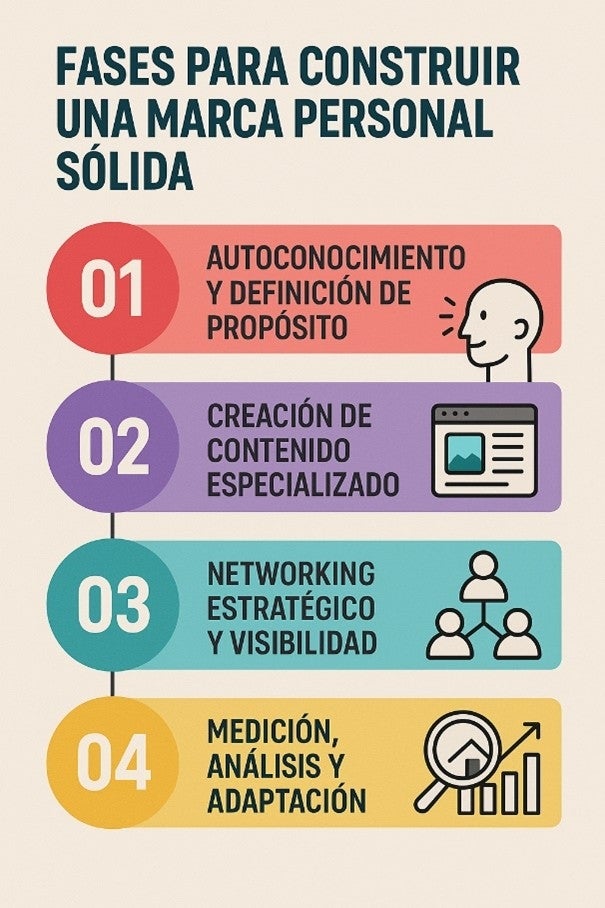
Steps to building a strong personal brand: Your roadmap to success
Step 1: Self-awareness and defining your purpose
Start with an in-depth analysis of yourself. Reflect on:
- What do you truly believe in?
- What is your authentic personality?
- What skills set you apart?
- What makes you different?
Set clear and specific goals, identify your ideal audience (fans, sponsors, the media, clubs) and determine your unique value proposition. This self-awareness is the foundation of any successful personal branding strategy.
Step 2: Creating specialised content
Once you’ve defined your essence, take action by producing relevant, high-quality content:
- Share your experiences and what you’ve learnt
- Offer practical advice
- Celebrate your achievements
- Set up a blog or website as your ‘digital home’
The key to success is specialisation. Focus on a specific niche within sports journalism (motorsport, Formula 1, football, women’s sport). Specialisation sets you apart, positions you as an expert and allows you to serve underserved communities, creating added value and new monetisation opportunities.
Step 3: Strategic networking and visibility
Build a valuable network of contacts that opens doors to job opportunities and collaborations:
- Maintain an active presence on relevant digital platforms
- Optimise your profiles with good photographs and clear descriptions
- Take part in conversations and respond to comments
- Practise ‘coopetition’: share other people’s successes, even those of competitors
Digital networking involves continuous interaction and generosity, which organically boosts your reputation.
Step 4: Measurement, analysis and adaptation
Constantly evaluate your achievements using tools such as Metricool, Instagram Insights or LinkedIn Analytics. Analyse:
- Post reach
- Level of engagement
- Follower growth
- Content performance
Continuous measurement is crucial for keeping your personal brand relevant in an ever-changing digital landscape. Adapt your strategy based on the data you gather to ensure your message continues to resonate with your audience.
Key strategies and tools to boost your digital presence
The power of ‘social media’: Beyond simply posting
Social media has become a vital playing field for sports journalists. It is not just a platform for sharing news, but a space to build relationships, interact directly with your audience and show your more human side.
- X (formerly Twitter): Ideal for sharing opinions, commenting on trends, taking part in debates and using specific hashtags. Perfect for immediacy and content curation.
- Instagram: Excellent for engaging visual content (photos, carousels, Reels) and personal connection via Stories. Encourages interaction with questions and polls.
- YouTube and TikTok: Key platforms for short, dynamic videos that quickly grab attention. They allow you to showcase authentic, informal and relatable content.
- LinkedIn: Essential for professional networking, sharing opinion pieces and success stories. A profile optimised with keywords is essential.
The key is not just to post, but to actively participate in conversations, reply to comments and thank your followers. Social media is a two-way street.
Streaming and podcasts: The new narratives in sport
Sports journalism has embraced new forms of storytelling that go beyond text and static images. Streaming platforms and podcasts are redefining how sports news is consumed.
Streaming (Twitch, YouTube Live):
- Live broadcasts with real-time interaction
- A more informal and accessible style
- Ability to show the ‘behind the scenes’ action
- Successful examples such as Ibai Llanos demonstrate their potential
Podcasts:
- A long-form educational content format
- Ideal for in-depth interviews and analysis
- A more intimate and personal connection with the audience
- They reach listeners’ devices directly
Artificial intelligence and data analysis: your allies in journalism
AI is not a threat, but a powerful tool that transforms the role of the sports journalist:
Automation and efficiency:
- Automates routine tasks such as generating results and statistics
- Frees up time for more creative and analytical tasks
- Particularly useful in sports with high volumes of data
In-depth analysis:
- Collects, organises and presents detailed statistical information
- Enables more robust ‘data journalism’
- Puts facts into context and predicts trends
Content personalisation:
- Predictive analytics tools anticipate audience needs
- Enables the delivery of more relevant and engaging content
AI brings greater dynamism to news coverage and meets the demand for variety and speed. However, the quality of reporting and the journalist’s critical analysis remain irreplaceable. AI is your assistant, not your replacement.
“Specialist sports journalists”: The key to standing out in niche markets
In the vast sports market, specialisation is a winning strategy. Being a specialist sports journalist allows you to build authority and a stronger personal brand within a specific niche.
Motorsport and Formula 1 journalism:
- A passionate, global audience
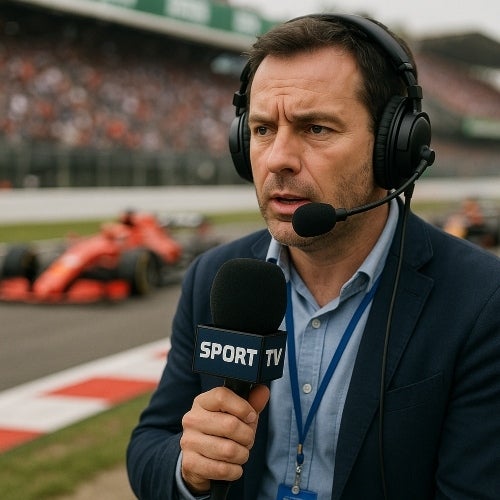
- Example: Miguel Portillo, specialising in Formula 2, Formula 3 and the Porsche Supercup
- Opportunities: technical analysis, access to drivers and teams, history of the sport
Football journalism:
- The ‘beautiful game’ offers multiple sub-niches: tactical analysis, grassroots football, international leagues, women’s football
- Personal branding in football is crucial for securing sponsorships, influencing the landscape and expanding business opportunities
Women’s sports journalism:
- A rapidly growing sector that demands visibility and its own narratives
- Pioneers such as Mari Carmen Izquierdo in Spain
- Current examples: Alexia Putellas and Ana Peleteiro, a Galician athlete and Olympic medallist in the triple jump, whose personal brand stands out for her positive public image, strategic communication management and strong connection with young audiences.
Sports journalism in English:
- Proficiency in English opens doors to international audiences and markets
- It broadens career opportunities in global media
- It positions you to cover international events and work in foreign media
Benefits of the specialisation:
- This specialisation enables you to:
- Offer more in-depth and valuable content
- To resonate with a specific audience
- Build a more loyal community
- Facilitate monetisation and growth
Rather than being just another generalist in the market, specialisation turns you into a recognised expert, increasing your value and setting you apart from the competition.
Innovative business models and content monetisation
Digital transformation has also had an impact on business models in sports journalism. To ensure a sustainable business ecosystem, innovation is essential. Many media organisations have opted for niche markets, generating added value through hyper-localisation or hyper-specialisation.
- Subscriptions and memberships: Rather than relying solely on advertising, media organisations are exploring subscription models that offer exclusive, high-quality content.
- Branded content and strategic sponsorships: Brands seek to partner with public figures and media organisations that manage their personal brands effectively, forging strategic win-win relationships. This includes collaborations with content creators and influential sports personalities.
- Revenue diversification: Journalists and entrepreneurial media outlets are exploring multiple monetisation channels, ranging from programmatic advertising to events, consultancy or the sale of their own products.
Master’s in Sports Communication and Journalism at UAX
The Master’s in Sports Journalism at the Rafa Nadal University School is your springboard to a high-impact career in the world of sports journalism.
Why is this Master’s programme different?
- Mentorship from journalism legends
Learn from leading figures such as Julio Maldonado (Maldini), Paloma del Río and Antonio Arenas. Draw on their expertise in personalised sessions that will transform your professional outlook. - 360° training in digital media
Master radio, TV, streaming and emerging platforms such as Twitch and YouTube. You won’t just consume content… you’ll create it like a professional! - Real-world multi-sport coverage
Football, tennis, motorsport, eSports, golf… Get ready to report with rigour and style across any discipline. Because sport knows no bounds – and neither do you. - Guaranteed work placements at the heart of the industry
Movistar+, AS, Eurosport, Rafa Nadal Academy… Gain access to 3–6-month work placements at leading organisations and cover events such as LaLiga, MotoGP, the Davis Cup and more. - Train in the spirit of Rafa Nadal
Beyond journalism, you’ll learn what it means to win with humility, hard work and resilience. Exclusive training with his personal team. - VIP access to the sports industry
Become part of the 2Playbook Club and the Sports Observatory. Connect with the big names and make yourself seen where it really matters. - Legal insight from the best
Learn from Senn Ferrero, leaders in sports law. Discover how to manage contracts, protect athletes and handle crisis situations.
Make sport your career. Build your brand. Conquer the media.
Enrol today and start building the future you’ve always imagined.
Do it at UAX!