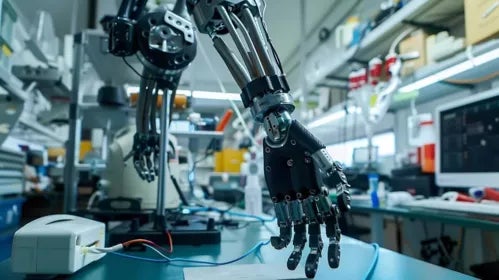





















How long does it take to study Biomedical Engineering?
The Bachelor’s degree in Biomedical Engineering lasts 4 years, with 60 ECTS credits per year until the total of 240 credits is completed. It is a standard-length engineering degree, just like Computer Science or Industrial Engineering, although with highly specialised content that combines engineering disciplines with health sciences.
Unlike other degrees in the healthcare field, such as Medicine (6 years) or Pharmacy (5 years), Biomedical Engineering offers a more streamlined pathway for those wishing to work in the healthcare sector through technology and innovation.
What subjects are required to study Biomedical Engineering?
Before going into detail about each year of study, it is worth knowing what academic background will be helpful. Biomedical Engineering is based on three main pillars:
| Subject Area | Why you need it |
| Mathematics and physics | These form the basis of all engineering disciplines: calculus, algebra, differential equations |
| Biology and chemistry | To understand the human body, its tissues, diseases and materials |
| Electronics and programming | To design, build and programme biomedical equipment and systems |
If you’ve completed a science-focused A-level programme with a solid grounding in physics and mathematics, you have the ideal background to tackle the first year with confidence.
First year: the foundations of engineering and the human body
The first year lays the foundations for the two pillars on which the entire degree programme is based: engineering (mathematics, physics, programming) and biomedical sciences (anatomy, biochemistry). It is an intensive year, but one in which the dual nature of this degree programme is clear from day one.
| Subject | Term | Type | ECTS |
| Biochemistry and Biology | 1st | FB | 6 |
| Calculus | 1st | FB | 6 |
| Graphical Representation | 1st | FB | 6 |
| Physics I | 1st | FB | 6 |
| Chemistry | Year 1 | FB | 6 |
| Algebra | Year 2 | FB | 6 |
| Fundamentals of Bioengineering | 2nd | OB | 3 |
| Physics II | 2nd | FB | 6 |
| Principles of Human Anatomy | 2nd | OB | 9 |
| Syllabus | 2nd | FB | 6 |
| TOTAL | 60 |
- Principles of Human Anatomy (9 ECTS): the course with the most credits in the second term. You study the structure of the human body from an engineer’s perspective: not with the aim of diagnosing, but of understanding the relationship between anatomy and the design of devices that interact with it.
- Fundamentals of Bioengineering (3 ECTS): brief but strategic. It gives you your first overview of what a biomedical engineer does, what sectors exist and where the discipline is heading. The perfect introduction to your future profession.
- Programming (6 ECTS): you learn to programme from the very first year. In Biomedical Engineering, this is not a peripheral subject: it is the tool you will later use to process medical signals, design diagnostic algorithms and develop software for healthcare devices.
Second year: where engineering meets medicine
The second year is where the degree programme reveals its true interdisciplinary nature. Engineering modules (circuits, biomechanics, electronics) and health sciences modules (physiology, pathology, biomaterials) coexist within the same year, requiring you to integrate knowledge from two distinct worlds.
| Module | Term | Type | ECTS |
| Biostatistics | 1st | Compulsory | 6 |
| Biomaterials | 1st | OB | 6 |
| Differential Equations and Numerical Methods | 1st | FB | 6 |
| Physiology | 1st | OB | 6 |
| Circuit Theory | 1st | FB | 6 |
| Automatic Regulation and Control of Biomedical Systems | 2nd | OB | 6 |
| Biomechanics I: Fluids | 2nd | Compulsory | 6 |
| Biomechanics II: Solids | 2nd | Compulsory | 6 |
| Applied Pathology | 2nd | OB | 6 |
| Biomedical Electronics Technology | 2nd | OB | 6 |
| TOTAL | 60 |
- Biomechanics I: Fluids and Biomechanics II: Solids (12 ECTS in total): these two modules examine the mechanical behaviour of the human body from two complementary perspectives: biological fluids (blood, synovial fluid) and solids (bones, cartilage, tendons). They form the basis for the design of prostheses, implants and rehabilitation equipment.
- Physiology (6 ECTS): how the systems of the human body function under normal conditions. Understanding physiology is essential for designing devices that interact with the body without altering its vital functions.
- Applied Pathology (6 ECTS): the study of diseases from an engineer’s perspective. The aim is not to diagnose, but to understand what is happening in the diseased body in order to design the appropriate technological solution.
Third year: applied biomedical technology
The third year is the most technology-focused year of the degree programme. All modules are compulsory, and the focus is on the design, development and management of real-world healthcare equipment, systems and technologies. This is the year when it becomes clearest which direction you can take your professional career in.
| Module | Term | Type | ECTS |
| Bioinstrumentation and Sensors | 1st | Compulsory | 6 |
| Tissue Engineering | 1st | OB | 6 |
| Manufacturing Processes for Medical Equipment | 1st | OB | 6 |
| Signs and Systems | 1st | OB | 6 |
| Mechanical Systems for Sanitary Equipment | 1st | OB | 6 |
| Computer-Aided Engineering and 3D Bioprinting | 2nd | OB | 6 |
| Medical Robotics | 2nd | OB | 6 |
| Healthcare Information Systems | 2nd | OB | 6 |
| Medical Signal Systems and Processing | 2nd | OB | 6 |
| Medical Imaging Systems and Processing | 2nd | OB | 6 |
| TOTAL | 60 |
- Computer-Aided Engineering and 3D Bioprinting (6 ECTS): one of the most innovative modules in the entire degree programme. You will learn to design implants and structures using CAD software and to manufacture them using biomedical 3D printers. At the cutting edge of customised medical device manufacturing.
- Medical Robotics (6 ECTS): the design and programming of robots for medical applications, ranging from surgical assistance systems to rehabilitation robots. One of the fields with the greatest professional and research prospects worldwide.
- Medical Imaging Systems and Processing (6 ECTS): how CT, MRI and ultrasound images are processed and analysed . Here, artificial intelligence and digital processing are applied directly to medical diagnosis.
Fourth year: innovation, management and specialisation
The final year brings the degree to a close by integrating business and healthcare management perspectives, the Final-Year Project and optional modules that allow you to specialise in the area that interests you most.
| Module | Term | Type | ECTS |
| Healthcare Technology Equipment | 1st | Compulsory | 6 |
| Ethics, Certifications and Healthcare Regulations | 1st | OB | 6 |
| Fundamentals of Business Organisation and Healthcare Management | 1st | Compulsory | 6 |
| Clinical Engineering | 1st | OB | 6 |
| Projects and Innovation in Biomedical Engineering | 1st | OB | 6 |
| Final Year Project | 2nd | OB | 12 |
| Elective modules | 2nd | OP | 18 |
| TOTAL | 60 |
- Projects and Innovation in Biomedical Engineering (6 ECTS): you’ll learn to manage technological innovation projects in the healthcare sector, from concept to product. Essential for anyone wishing to start their own business or lead R&D teams in biomedical companies.
- Ethics, Certifications and Healthcare Regulations (6 ECTS): any medical device entering the market must comply with extremely strict regulations. This module teaches you how to navigate the European regulatory framework (CE marking, FDA), which is essential in the industry.
- Final-Year Project (12 ECTS): the final project carries the greatest weighting in the entire degree programme. It may focus on research, device development or proposals for technological innovation, and serves as proof that you have integrated the skills acquired throughout the degree.
What elective modules are available on the Bachelor’s Degree in Biomedical Engineering?
In the fourth year, you must choose 18 optional credits (3 modules of 6 ECTS) from the following options:
| Optional Module | Type | ECTS |
| Bioinformatics | OP | 6 |
| Functional Design of Prostheses and Implants | OP | 6 |
| Advanced Medical Imaging | OP | 6 |
| Biomedical Micro- and Nanodevices | OP | 6 |
| Applied Neuroscience | OP | 6 |
| Work Placements | OP | 6 |
| Advanced Medical Robotics | OP | 6 |
| Telemedicine | OP | 6 |
Choosing your optional modules is a real opportunity to shape your profile. If you’re interested in robotic surgery, Advanced Medical Robotics and Applied Neuroscience are the ideal combination. If your aim is a career in the medical devices industry, Functional Design of Prostheses and Implants and Biomedical Micro- and Nanodevices will give you a clear competitive edge.
What is the most difficult module in Biomedical Engineering?
There is no single answer, but there are subjects that students consistently identify as the most demanding:
- Differential Equations and Numerical Methods (2nd year): the most purely mathematical subject on the degree programme. It requires a solid foundation in calculus and is essential for later understanding control systems and signal processing.
- Signals and Systems (3rd year): the Fourier transform, frequency analysis, digital filters… It is conceptually complex and fundamental to everything that follows in medical signals and imaging.
- Medical Signal Systems and Processing (3rd year): this combines the mathematical complexity of signals with clinical application. It requires a mastery of the theory and the ability to apply it to real-world signals such as the ECG or EEG.
- Biomechanics I and II (2nd year): biological materials exhibit non-linear behaviour, which makes problems considerably more complex than in classical mechanics.
The key to success in Biomedical Engineering is the ability to integrate knowledge of engineering and biology to solve real-world problems. This is also, at the same time, the greatest source of satisfaction in the degree programme.
Summary
The Bachelor’s Degree in Biomedical Engineering at UAX spreads its 240 ECTS credits over four years with a very clear structure: the first year lays the foundations in engineering and biomedical sciences; the second year integrates both disciplines with biomechanics, physiology and electronics; the third year focuses on applied technology, including robotics, medical imaging and 3D bioprinting; and the fourth year concludes with management, innovation and a 12-credit final-year project. The choice of optional modules allows students to specialise in bioinformatics, prosthetics, telemedicine or advanced robotics. The most demanding modules are those based on mathematics and signals, although the interdisciplinary nature of the programme is both its greatest challenge and its most distinctive feature in the labour market.
Sources
- Official Curriculum for the Bachelor’s Degree in Biomedical Engineering — UAX
- National Agency for Quality Assessment and Accreditation (ANECA) — White Paper on Biomedical Engineering
- Ministry of Universities — Register of Universities, Centres and Degrees (RUCT)