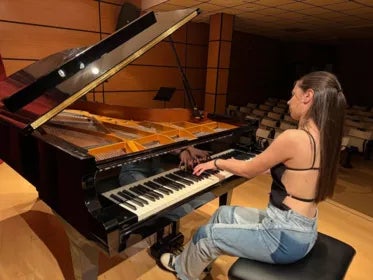
What does a specialist in Instrumental Pedagogy do?
A specialist in instrumental pedagogy is the professional responsible for designing, delivering and assessing the teaching of a musical instrument. Their field of work goes far beyond simply playing an instrument well: it involves knowing how to convey that knowledge effectively, adapting the methodology to each pupil, their age and level of learning.
Their main duties include:
- Delivering individual or group instrument lessons.
- Designing teaching programmes and teaching materials.
- Assessing pupils’ progress and adapting the teaching process.
- Conducting school or professional music ensembles.
- Advising on the design of music curricula in educational institutions.
This role involves working in conservatoires, music schools, schools and special needs schools , private music schools and, increasingly, on online learning platforms.
How much does an instrumental music teacher earn in Spain?
An instrumental teacher’s salary depends, primarily, on the sector in which they work. There are significant differences between the state and private sectors, as well as between autonomous communities.
In the public sector
Teachers at state conservatoires belong to the Corps of Music and Performing Arts Teachers, classified within Group A1 of the civil service – the same category as secondary school teachers. According to the Ministry of Education and Vocational Training’s data on civil service pay (2024/2025), the average salary for these teachers ranges from 32,000 to 35,000 euros gross per annum.
The monthly salary comprises the following components:
| Component | Estimated amount (gross/month) |
| Basic salary (Group A1) | ~€1,326 |
| Post allowance (level 24) | €640 – €780 |
| Specific allowance (varies by autonomous community) | €400 – €900 |
| Length-of-service increments (+€47.67 for every 3 years) | Variable |
For a newly appointed teacher, this translates to a net salary of between 1,900 and 2,800 euros a month, depending on the region.
In the private sector
Private conservatoires, authorised centres and music schools are governed by their own collective agreements. In these cases, the average salary is usually around 24,000 euros gross per annum, although this can vary significantly depending on the type of centre, the teaching load and the terms of the contract.
What are the salary differences between the autonomous communities?
The specific allowance, which is set by each regional government, leads to very significant salary differences between regions. For the same post and level of experience, the salary can vary by up to €10,000 a year depending on where you work.
| Autonomous Community | Estimated gross monthly salary |
| Basque Country and Navarre | €3,200 – €3,600 |
| Madrid, Catalonia and the Balearic Islands | €2,700 – €2,900 |
| Andalusia, Aragon, Valencian Community | €2,400 – €2,500 |
| Other regions | €2,000 – €2,500 |
This regional variation has a direct impact on career planning: in regions such as the Basque Country or Navarre, a conservatoire teacher can earn over €10,000 a year more than their counterparts in other regions holding the same post and with the same length of service.
What factors determine your salary in Instrumental Pedagogy?
Beyond the sector and geographical location, there are other factors that directly influence your earnings as a specialist in instrumental pedagogy:
Professional experience
Length of service has a direct impact on salary, particularly in the public sector. Three-year increments recognise each three-year period of service with a pay rise of approximately €47.67 gross per month. Six-year increments also reward the continuous professional development accumulated every six years of teaching. Taking on managerial roles such as head of department or head of studies also brings additional allowances of between €200 and €700 per month.
Level of Qualification
Specialised training is the factor that most influences the salary ceiling. A professional with a Master’s degree in Instrumental Pedagogy is eligible to sit competitive examinations for posts at higher conservatoires, academic coordination roles and university teaching positions, where salaries are significantly higher. In the private sector, holding an officially recognised postgraduate qualification enables access to more prestigious institutions and the ability to negotiate better terms.
Instrumental specialism
Demand for teachers varies depending on the instrument. Piano, guitar, violin and orchestral specialisms usually account for a larger number of vacancies in public competitive examinations, which can make it easier to secure permanent posts more quickly.
The type of institution
Not all institutions pay the same. Public professional and higher conservatoires offer the most regulated and highest salaries. Municipal music schools, authorised centres and private academies offer more variable and, generally speaking, lower conditions.
What are the main career prospects in Instrumental Pedagogy?
The career prospects for the Master’s in Instrumental Pedagogy are broader than many people realise. Training in this specialism is not limited to traditional teaching.
Teaching at conservatoires and music schools
This is the most direct and widely recognised career path. To secure a post in the public sector, candidates must pass the competitive examinations for the Music and Performing Arts Teaching Corps. In the private sector, the process is more streamlined and is based on an assessment of the CV and an interview.
Teaching in compulsory education schools
With the appropriate qualifications, a specialist in instrumental pedagogy can teach music in public and private primary and secondary schools. In Spain, to teach in compulsory education, it is usually necessary to hold a Master’s degree in Teacher Training.
University teaching and research
An official Master’s degree opens the door to an academic career. With postgraduate training, you can gain access to positions as a teaching assistant, researcher or associate professor in faculties of art, music and education.
Online learning and digital content
The growth of online learning platforms has created a new demand for specialist teachers capable of designing courses, video lessons and teaching materials for digital environments. This is a career path that has seen significant growth in recent years.
Management and leadership of music centres
With experience and training in educational management, many specialists in instrumental pedagogy make the transition to roles such as academic coordinator, head of studies or conservatoire director, where salary supplements are significantly higher.
Music therapy and support for learners with special needs
Instrumental pedagogy also has applications in therapeutic and special educational contexts, where music is used as an intervention tool for people with specific educational support needs.
How does a Master’s in Instrumental Pedagogy affect your salary?
Undertaking a Master’s degree in Instrumental Pedagogy has a concrete and measurable impact on the professional career of a musician wishing to pursue a career in teaching:
- Access to higher-level competitive examinations: many calls for applications for posts at higher conservatoires and university teaching positions specifically require or place greater value on a Master’s degree.
- Points in job pools: in the temporary teaching pools of several autonomous communities, an official Master’s degree earns points and improves one’s position on the ranking list for access to substitute teaching posts.
- Greater pedagogical autonomy: specialised training enables you to develop your own teaching methodologies and gain access to higher-level institutions with better salary conditions.
- Credibility in the private sector: in music schools, authorised centres and digital platforms, an official postgraduate qualification strengthens your professional profile and justifies higher fees.
The UAX Online Master’s Degree in Instrumental Pedagogy, worth 60 ECTS credits, offers eight instrumental specialisations (strings, woodwinds, brass, piano, classical guitar, percussion and voice) and is designed to allow you to balance your studies with your professional commitments. As it is an officially recognised qualification, it counts towards civil service examinations and opens the door to PhD programmes.
Is it worthwhile pursuing a career in Instrumental Pedagogy in Spain?
Yes, although there are clear differences depending on the sector.
The public sector offers job security, objective salary progression and a well-defined long-term career path. Entry via competitive examination guarantees regulated working conditions. The patience required to pass the selection process is rewarded with years of job security and pay rises based on length of service.
The private sector offers less stability but greater flexibility. Professionals who combine teaching with other activities (performing, online training, pedagogical consultancy) can achieve higher and more diversified incomes.
In any case, specialised training is the factor that most determines the salary ceiling in this profession. A specialist with a master’s degree has access to a significantly wider range of opportunities, which are better paid and offer greater career prospects.
Summary
Salaries in instrumental teaching range from €24,000 per annum in the private sector to €32,000–€35,000 or more in the state education system. Salary differences between autonomous communities can exceed €10,000 per year for the same post. The factors that most influence salary are accumulated experience, the sector of employment, the instrumental specialism and, above all, the level of qualification. Holding a Master’s degree in Instrumental Pedagogy enables access to higher-level competitive examinations, improves one’s ranking on job pools and enhances professional value in the private sector. Career opportunities extend far beyond teaching at conservatoires and include educational management, research, online training and supporting diversity.
Frequently Asked Questions (FAQ)
Is a Master’s in Instrumental Pedagogy required to teach at a conservatoire? To teach at a state conservatoire in Spain, you must pass the competitive examination for the Corps of Music and Performing Arts Teachers. The Master’s degree is not compulsory to sit the exam, but it adds points to your score and can be a deciding factor in highly competitive recruitment rounds.
How long does it take to see a pay rise based on length of service at a state conservatoire? Length-of-service increments are awarded every three years of service and add approximately €47.67 gross per month. Six-year increments, which also take continuous professional development into account, are awarded every six years. The effect of length of service is gradual but very significant in the long term.
Can a specialist in Instrumental Pedagogy work online? Yes. The growth of online music teaching platforms has opened up a well-established career path. A specialist with a Master’s degree has a more competitive profile for designing courses, delivering virtual lessons and creating digital educational content.
Does the Master’s in Instrumental Pedagogy provide access to a PhD? Yes. As it is an official university qualification, the Master’s in Instrumental Pedagogy provides access to PhD programmes at Spanish and European universities, opening the door to a career in research and university teaching.
Sources: