














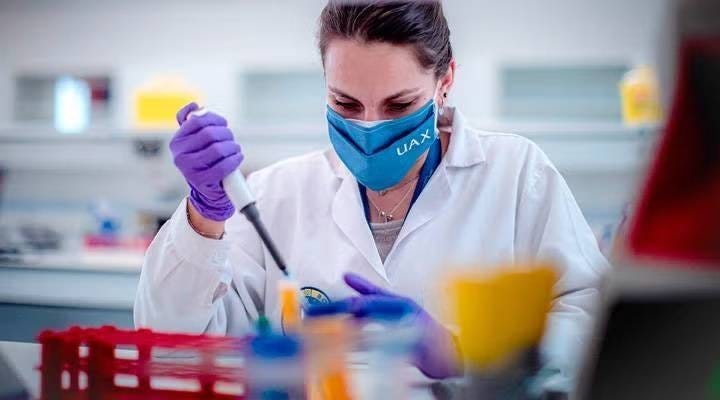









If you’re wondering exactly what a clinical and biomedical laboratory technician does, we invite you to explore our detailed article on the roles of these professionals, their importance in the healthcare sector and where to study for a higher-level qualification in clinical and biomedical laboratory technology
What does a clinical and biomedical laboratory technician do?
The work of these professionals is essential to the efficient running of any healthcare institution. Clinical and biomedical laboratory technicians have a range of responsibilities and make a significant contribution to the diagnosis and treatment of diseases. Some of the main tasks they carry out include:
- Sample analysis: Technicians are responsible for receiving biological samples, such as blood, urine and tissue, amongst others, and carrying out detailed analyses using a variety of methods and techniques. These analyses are crucial for identifying diseases, monitoring patients’ health and contributing to medical research.
- Equipment maintenance and calibration: To ensure the accuracy and reliability of test results, technicians must ensure that laboratory equipment is in perfect working order. This involves carrying out regular maintenance, calibrations and adjustments as required. The ability to work with complex instrumentation is an integral part of their daily work.
- Record-keeping and documentation: Maintaining accurate records is essential in the clinical laboratory. Technicians must meticulously document all procedures carried out, the results obtained and any relevant observations. This documentation is not only crucial for patient follow-up, but also for complying with quality standards and health regulations.
- Interprofessional collaboration: Effective communication and collaboration with other healthcare professionals, such as doctors, nurses and biochemists, are fundamental aspects of a laboratory technician’s work. They take part in multidisciplinary meetings to discuss results, interpret data and make decisions regarding patient treatment.
- Quality control: Technicians play an active role in quality control programmes to ensure the accuracy and reliability of test results. This involves carrying out regularly scheduled control tests, following standardised procedures and participating in external quality assessment schemes.
What is the salary of a laboratory technician?
A laboratory technician’s salary can vary considerably depending on various factors, such as experience, geographical location, the type of institution and the technician’s specialism. Generally speaking, the starting salary is usually in the region of around €25,300. As the technician gains experience and acquires additional skills, they can expect significant pay rises.
Study vocational training in clinical and biomedical laboratory science at Alfonso X el Sabio University (UAX)
Alfonso X el Sabio University (UAX) offers an excellent opportunity to study a vocational training course in clinical and biomedical laboratory science , as well as an online advanced diploma in clinical and biomedical laboratory science. Our programme provides comprehensive and up-to-date training, combining theoretical classes with practical sessions in laboratories equipped with the latest technology. What’s more, you’ll have the support of a highly qualified teaching team and the opportunity to undertake work placements at renowned hospitals and research centres. Studying at UAX gives you the advantage of a high-quality education backed by years of experience in training healthcare professionals. Find out more about our course and take the first step towards an exciting career in the field of clinical and biomedical laboratory science!