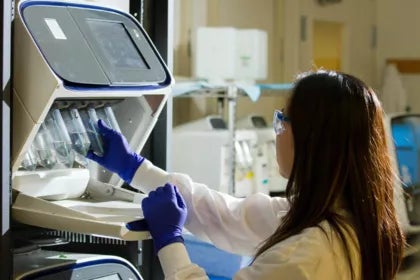
Industrial automation and robotics have become the driving force behind the Fourth Industrial Revolution. Companies are looking for specialised professionals who can design, programme and maintain increasingly sophisticated automated systems.
Table of Contents
Why choose the Higher National Diploma in Industrial Automation and Robotics?
What exactly does a technician in Industrial Automation and Robotics do?
Sectors with the highest demand for professionals
How much does an Industrial Automation and Robotics technician earn?
Why choose the Higher National Diploma in Industrial Automation and Robotics?
When you decide to study industrial automation and robotics, you’re preparing yourself to work at the cutting edge of technology. This sector combines engineering, computing and mechanics in a fascinating way. What’s more, the demand for these professionals is growing exponentially year on year.
The Higher Technical Diploma in Industrial Automation and Robotics provides you with the technical knowledge needed to stand out in a competitive job market. You’ll learn everything from robot programming to control system design, including predictive maintenance and industrial process analysis.
Alfonso X El Sabio University (UAX FP) offers this qualification online , guaranteeing the same academic excellence as in the face-to-face programme.
What exactly does a technician in Automation and Industrial Robotics do?
A technician specialising in this field carries out a range of essential functions for modern industry. Your work will involve:
· Programming robotic systems: You will configure industrial robots to carry out specific tasks with pinpoint accuracy, ranging from automated welding to the assembly of electronic components.
· Designing control systems: You will create interfaces that enable machines to communicate with one another and with human operators efficiently and safely.
· Carrying out predictive maintenance: You will use advanced sensors and algorithms to anticipate potential machinery faults, thereby avoiding costly production stoppages.
· Optimise production processes: You will analyse entire production lines to identify improvements that increase efficiency and reduce operating costs.
· Supervise automated facilities: You will monitor the operation of complex systems, intervening where necessary to ensure operational continuity.
Sectors with the highest demand for professionals
Career opportunities for graduates of this Higher National Diploma span virtually all industrial sectors:
· Automotive sector: Vehicle manufacturing plants are at the forefront of automation. Welding, painting and assembly robots require constant specialist supervision.
· Food industry: From processing to packaging, automation ensures hygiene and efficiency in food production.
· Pharmaceuticals and cosmetics: These sectors demand absolute precision in dosing and handling, where robotic systems are indispensable.
· Renewable energy: Wind farms and solar power stations incorporate automated systems to maximise energy generation.
· Logistics and warehousing: Smart warehouses with robots that sort, transport and manage stock autonomously.
· Aerospace industry: Manufacture of high-precision components using state-of-the-art robotic systems.

How much does an Industrial Automation and Robotics Technician earn?
The salary in industrial automation and robotics is one of the most attractive aspects of this profession. Senior technicians in this field enjoy very competitive salaries:
- Recent graduate: Between 22,000 and 28,000 euros per annum
- Experienced (3–5 years): Between 30,000 and 40,000 euros per year
- Senior specialist: Between 45,000 and 55,000 euros per annum
- Systems supervisor: Up to 65,000 euros per annum
These salaries can be significantly increased by shift allowances, specialisation in specific technologies or team coordination responsibilities.
Opportunities for specialisation and professional development
After completing your initial training, there are vast opportunities for specialisation, both at university level and through postgraduate study. We’ve set these out in detail below:
Options for further study at university (degree courses)
Thanks to the recognition of ECTS credits , a Higher-Level Technician can gain direct entry to university degrees related to engineering and technology, such as:
- Bachelor’s Degree in Artificial Intelligence and Computing
- Bachelor’s Degree in Computer Engineering (if you wish to specialise in programming applied to robotics)
- Bachelor’s Degree in Industrial Design Engineering and Product Development
Specialisation options through master’s or postgraduate programmes
Although official master’s degrees usually require a bachelor’s degree, there are master’s degrees and specialised programmes (non-official) that accept vocational training graduates. Some examples:
- Masters’ degrees in Industrial Automation
- Master’s in Robotics and Autonomous Systems
- Master’s in Industry 4.0 and Digital Transformation
Highly valued technical certifications
Another route is through professional certifications that boost employability:
- Certifications from Siemens, Schneider or Rockwell Automation (PLCs and automation)
- Certifications in collaborative robotics (cobots): Universal Robots, ABB, KUKA
- Certifications in industrial programming (TIA Portal, TwinCAT, LabVIEW)
- Specialised courses in AI applied to robotics or industrial IoT
Why choose UAX FP for your training?
At UAX FP, we offer the online Higher National Diploma in Industrial Automation and Robotics , an officially recognised qualification now in its seventh edition and fully accredited. Training with us opens the doors to a booming sector, where over 90 per cent of our students find employment within less than a year. You’ll learn to use key tools such as PLCs, sensors and control systems—all via a flexible online platform that adapts to your lifestyle.
What’s more, you’ll be backed by a university with over 25 years’ experience in linking education to the professional world.
If you’re looking for a dynamic, well-paid career with international prospects, this Higher National Diploma will provide you with the tools you need to excel in a constantly evolving job market.
Automation won’t wait. The future is being built today, and you can be part of it.
Do it at UAX!