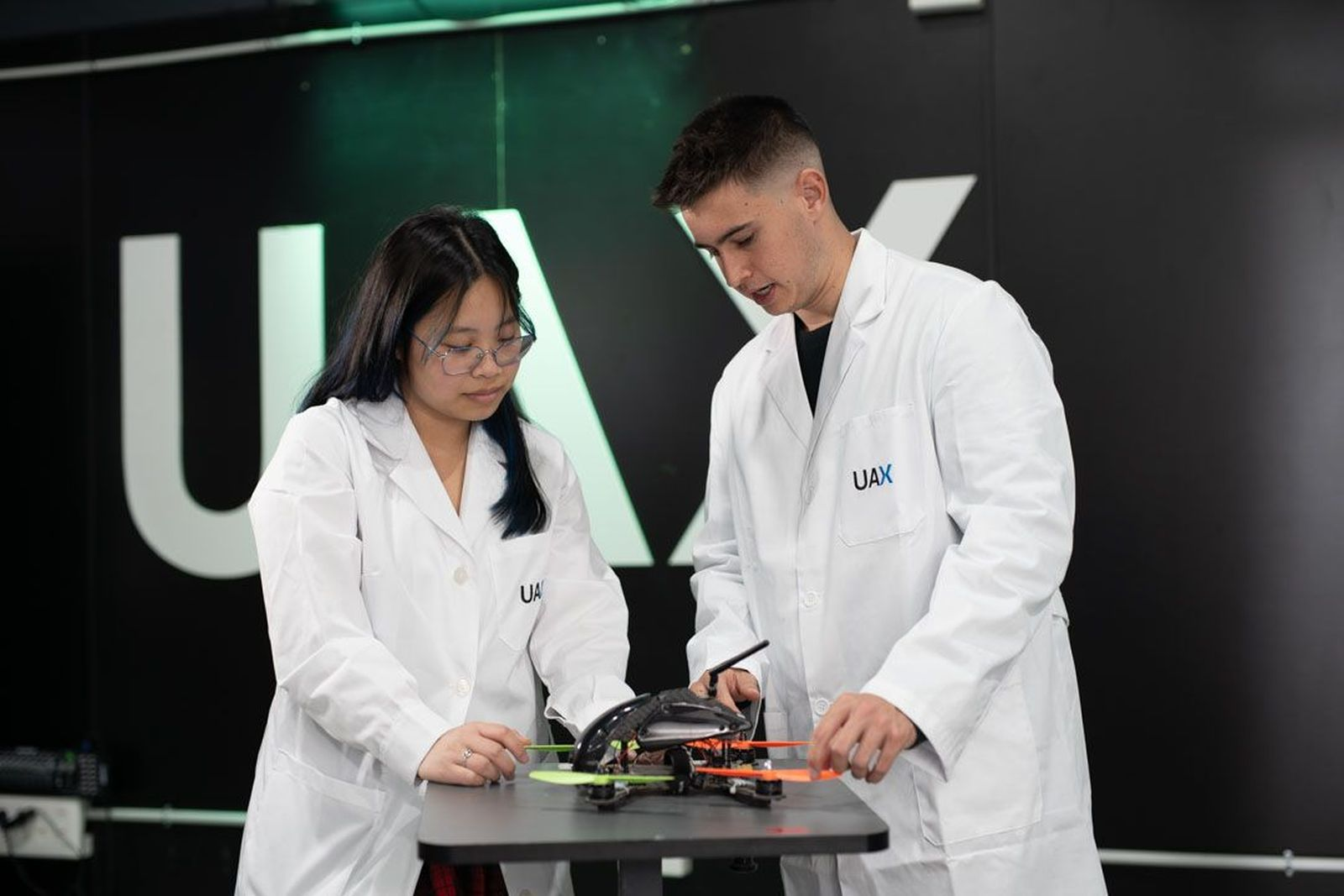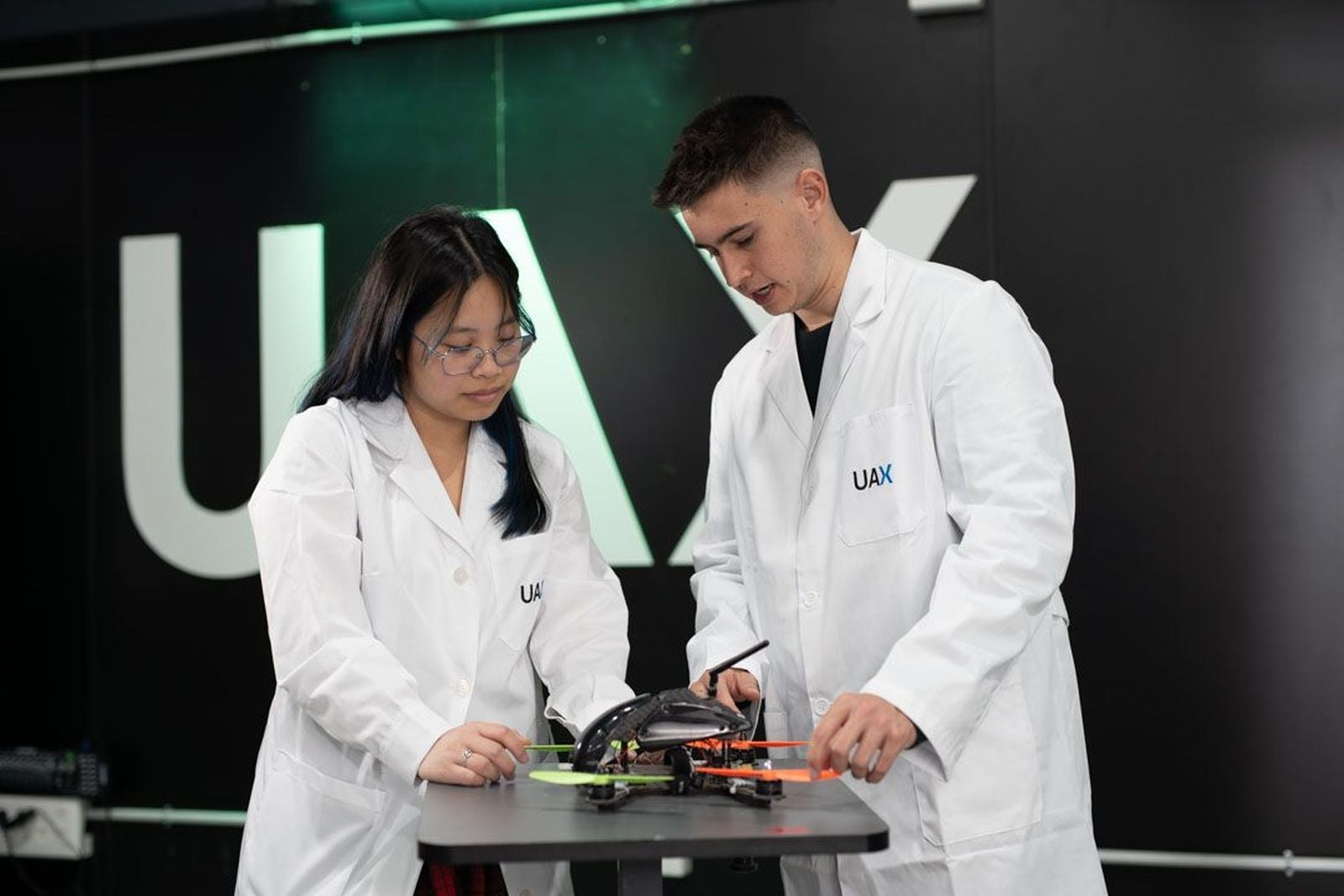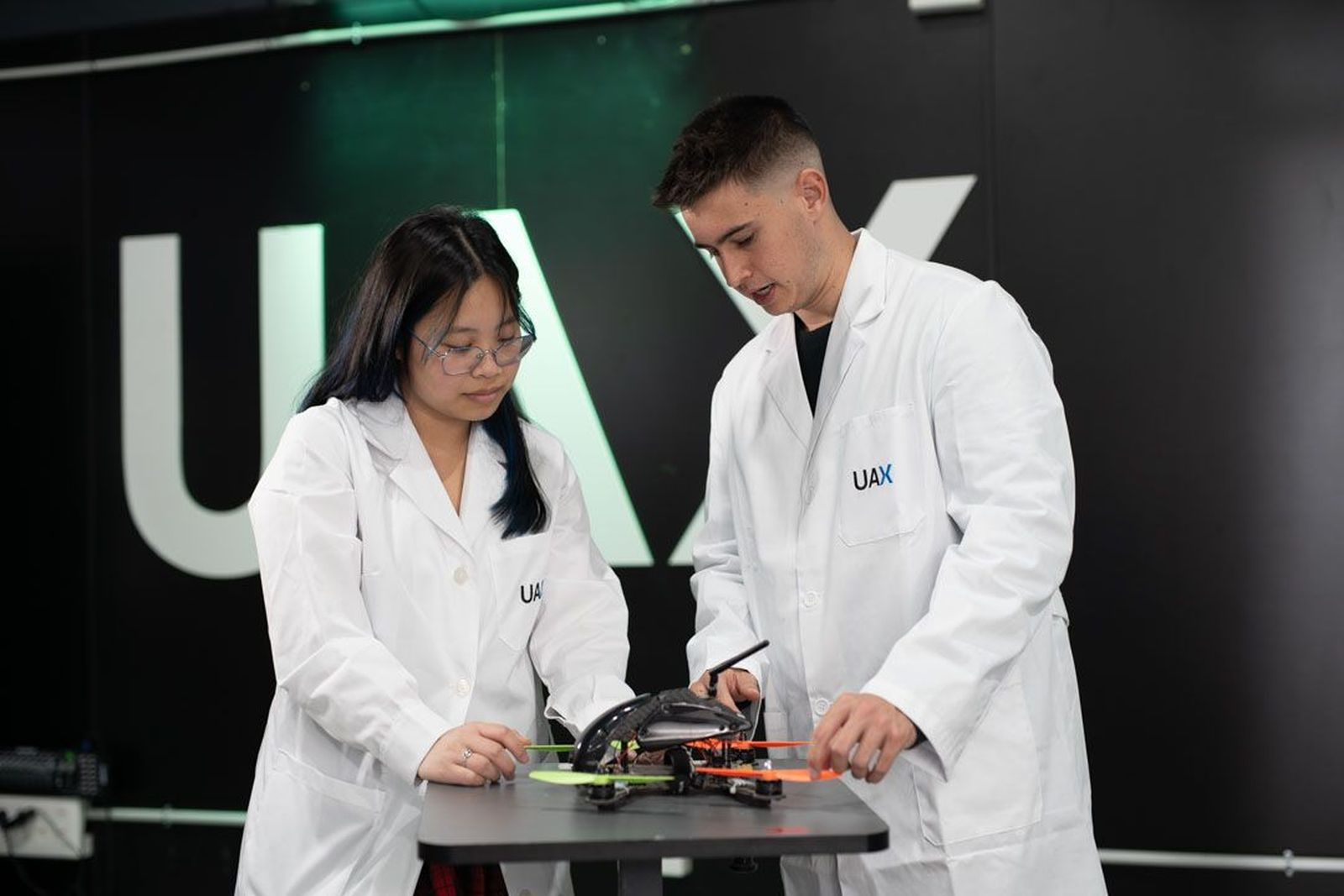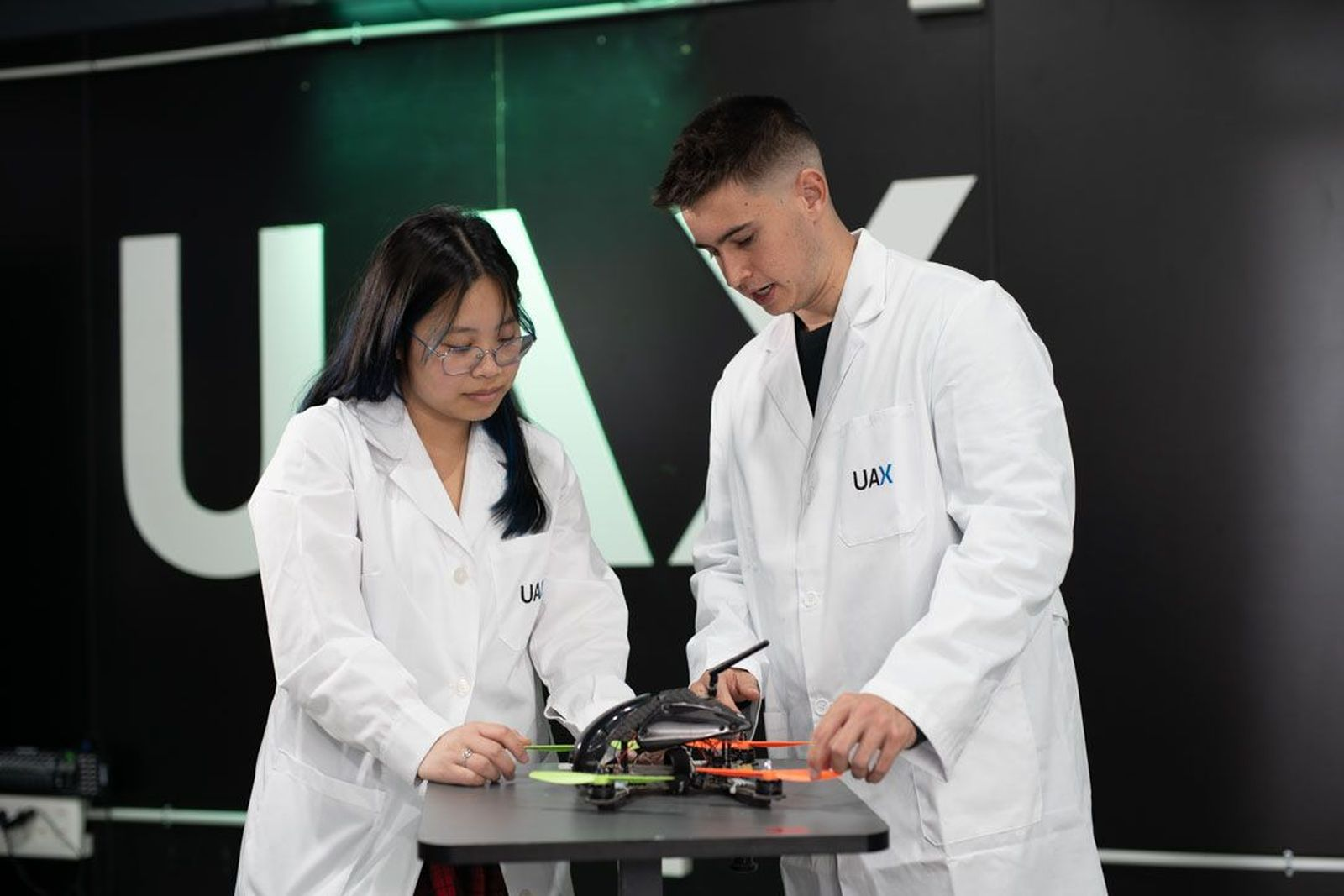
See all Online Master's Degrees in Health
See all Master's Degrees in Engineering
Most searched curriculums
The advance of science, technology and innovation requires profiles capable of understanding and modelling the most complex phenomena of reality. The combination of Physics and Mathematics is key in sectors such as energy, engineering, research, artificial intelligence and the aerospace industry. Prepare yourself at UAX to become a highly qualified professional and contribute knowledge and value from day one.
Because it combines two disciplines that are fundamental to understanding and modelling reality, preparing you to tackle complex scientific and technological challenges in key sectors.
98% EMPLOYABILITY
98% of our graduates get their first job after completing their degree.
8800 CONVENTIONS
Collaboration so that you can do your internship in the best companies in the sector.
95% ACTIVE TEACHERS
Your training, aligned with professional reality
The convergence of science, data and technology is driving high demand for STEM professionals with strong analytical skills and practical insight. The Double Degree in Engineering Physics + Mathematics provides you with a solid foundation for understanding, modelling and solving complex problems, combining scientific rigour with practical application in fields such as artificial intelligence, data science, quantum computing, energy and the technology sector.
In addition, you will develop strategic skills in the use of data for decision-making and a vision focused on innovation and the business environment.
During the dual degree:
The degree includes the Digital Business Certificate

All fields are required
UAX MAKERS
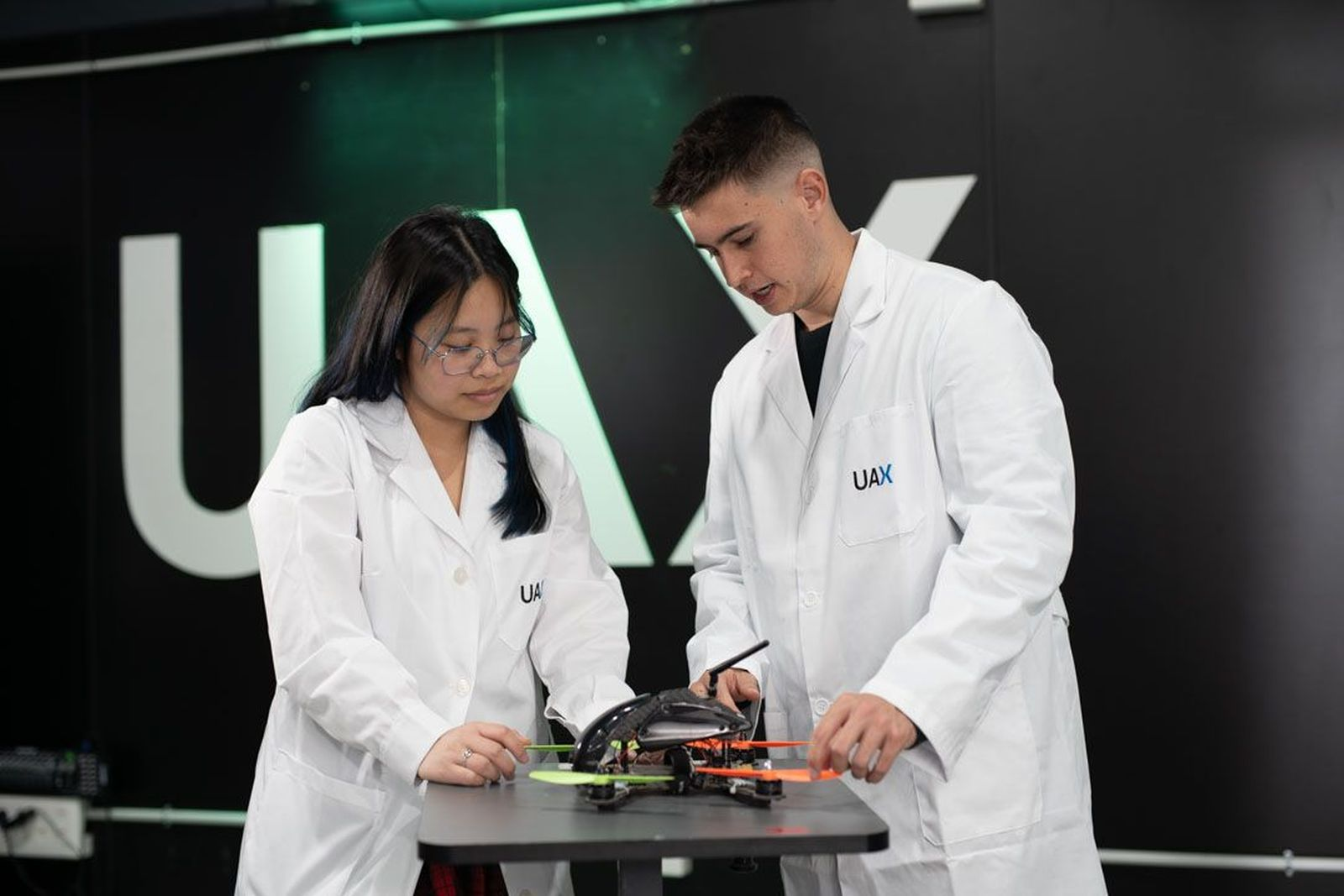
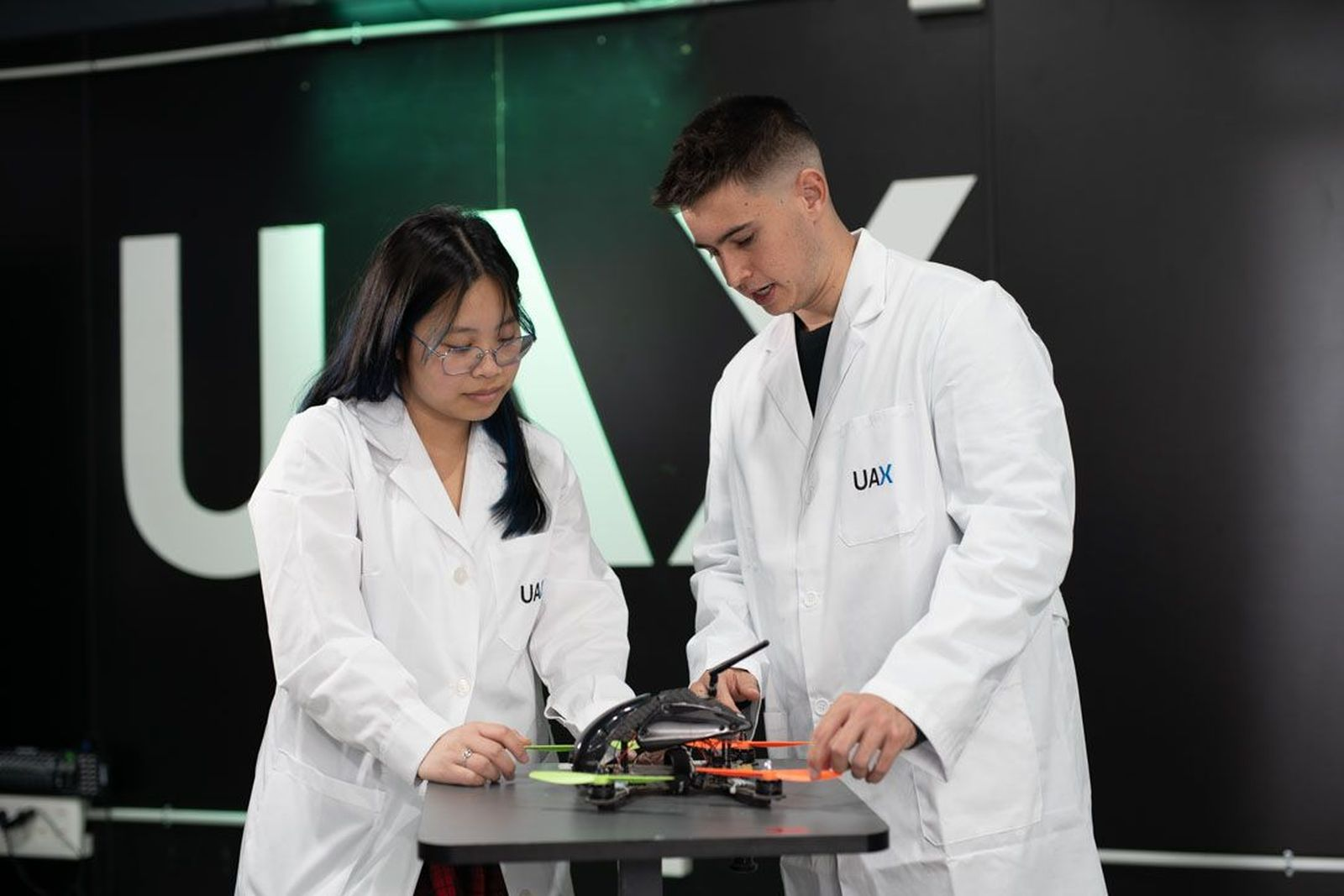
Work on real-world projects with companies. The UAX Makers model is based on collaborative work between students who team up to tackle a real-world project. To this end, we bring together students from different degree programmes, encouraging a diversity of approaches and teamwork as key to finding the best possible solution.
Use of artificial intelligence techniques to predict working hours in large international engineering projects.

Collaboration in solidarity projects in the field of diversity, inclusion, gender equality with organisations with wide recognition.

Use of Industry 5.0 techniques to build an analytical environment for real-time image processing and offer a unique user experience in the sector.
Collaboration in the design and development of an analytical architecture to derive patterns in global cybersecurity-related data.
Application of mathematical models and data analysis in the design of a health school for patients and families, improving management and communication in the health sector.

Build a solid foundation in Mathematical Engineering and Physics, enabling you to transition into a career where you can make a real difference.
Bachelor's Degree in Mathematical Engineering + Bachelor's Degree in Physics
First Year
FIRST TERM
| Code | Subjects | Character* | ECTS | ||||||||||||||||||||||||||||||||||||||||||||||||||||||||||||||||||||||||||||||||||||||||||||||||||||||||||||||||||||||||||||||||||||||||||||||||||||||||||||||||||||||||||||||||||||||||||||||||||||||||||||||||||||||||||||||||||||||||||||||||||||||||||||
|---|---|---|---|---|---|---|---|---|---|---|---|---|---|---|---|---|---|---|---|---|---|---|---|---|---|---|---|---|---|---|---|---|---|---|---|---|---|---|---|---|---|---|---|---|---|---|---|---|---|---|---|---|---|---|---|---|---|---|---|---|---|---|---|---|---|---|---|---|---|---|---|---|---|---|---|---|---|---|---|---|---|---|---|---|---|---|---|---|---|---|---|---|---|---|---|---|---|---|---|---|---|---|---|---|---|---|---|---|---|---|---|---|---|---|---|---|---|---|---|---|---|---|---|---|---|---|---|---|---|---|---|---|---|---|---|---|---|---|---|---|---|---|---|---|---|---|---|---|---|---|---|---|---|---|---|---|---|---|---|---|---|---|---|---|---|---|---|---|---|---|---|---|---|---|---|---|---|---|---|---|---|---|---|---|---|---|---|---|---|---|---|---|---|---|---|---|---|---|---|---|---|---|---|---|---|---|---|---|---|---|---|---|---|---|---|---|---|---|---|---|---|---|---|---|---|---|---|---|---|---|---|---|---|---|---|---|---|---|---|---|---|---|---|---|---|---|---|---|---|---|---|---|---|---|---|
| C0142300 | Algebra I | FB | 6 | ||||||||||||||||||||||||||||||||||||||||||||||||||||||||||||||||||||||||||||||||||||||||||||||||||||||||||||||||||||||||||||||||||||||||||||||||||||||||||||||||||||||||||||||||||||||||||||||||||||||||||||||||||||||||||||||||||||||||||||||||||||||||||||
Algebra ICódigo: C0142300 Imprimir Course 1: First-semester module. Foundation course. 6 credits. Profesores
Objectives This module, together with Algebra II, forms the subject of Algebra. This module, which forms part of the degree’s Core Curriculum, aims not only to ensure that students are familiar with the main fundamental theorems of linear algebra, but also to enable them to understand matrix calculus from a conceptual perspective and to apply it to solving problems typical of mathematical engineering; it therefore therefore, the foundation for other subjects and modules within the degree programme, such as Numerical Calculus, Operations Research, Stochastic Calculus and Artificial Intelligence. Prerequisites No prerequisites have been established. Competencies Basic and general competences: CB1 - Students have demonstrated knowledge and understanding in an area of study building on the foundation of general secondary education, typically at a level that, whilst drawing on advanced textbooks, also includes some aspects requiring knowledge from the cutting edge of their field of study. CB2 - Students should be able to apply their knowledge to their work or vocation in a professional manner and possess the skills typically demonstrated through the formulation and defence of arguments and the resolution of problems within their field of study. CB3 - Students should be able to gather and interpret relevant data (usually within their field of study) to make judgements that include reflection on relevant social, scientific or ethical issues. CB4 - Students should be able to communicate information, ideas, problems and solutions to both specialist and non-specialist audiences. Transversal competences: CT2 - Ability to draft and produce reports, papers and other documents in the field of Mathematical Engineering, communicating them clearly and effectively both in writing and orally. Specific competences: CE1 - To understand and use mathematical language. To acquire the ability to formulate propositions in different fields of mathematics, to construct proofs and to convey the mathematical knowledge acquired. CE2 - Be familiar with rigorous proofs of some classical theorems in different areas of mathematics. Learning outcomes - Is familiar with the main basic theorems of linear algebra. - Understands matrix calculus from the conceptual perspective provided by vector and affine spaces. - Applies knowledge of linear algebra to solve problems that may arise in engineering. - Apply basic concepts of linear systems to solve engineering problems. Course description 1. SYSTEMS OF LINEAR EQUATIONS. 1.1 Systems of linear equations. Types. Gauss-Jordan method. Discussion of solutions. 1.2 Matrices. Classification. Elementary transformations, Hermitian normal form and rank. Operations: addition, scalar multiplication and ‘trace’, ‘transposition’ and ‘inversion’. Properties. Regular matrices. Equivalence. 1.3 Matrix notation for systems of linear equations. Rouché–Frobenius theorem. 1.4 Determinants. Properties. Determinant-rank-inversion relation. Determinants and systems of linear equations: Cramer’s rule. 2. VECTOR SPACES. 2.1 Vector spaces. Further properties of addition and scalar multiplication. 2.2 Linear dependence and independence. Properties. Generating sets. Bases. Dimension. Coordinates of a vector in a given basis. Change of coordinates. 2.3 Vector subspaces. Vector subspaces of interest: intersection, linear envelope, row and column spaces of a matrix, solutions to a homogeneous system of linear equations. Equations and dimension of a vector subspace. Sum of vector subspaces. Dimension formula. Direct sum. Quotient vector space. 3. CLASSIFICATION OF ENDOMAPPINGS. 3.1 Linear mappings. Properties. Types. Kernel and image. 3.2 Matrix associated with a linear map. Relationship with the kernel and image; dimension formula. Changes of basis. 3.3 Operations with linear maps. Properties. 3.4 Linear forms and dual space. Dual basis. Nullator of a vector subspace. Transposed linear map. 4. DIAGONALISATION OF ENDOMORPHISMS. 4.1 Eigenvectors and eigenvalues of an endomorphism. Characteristic and minimal polynomials. Algebraic and geometric multiplicities. 4.2 Diagonalizable matrices. Eigen subspaces. Diagonal form and basis of eigenvectors. Symmetric matrices. 4.3 Non-diagonalizable matrices. Generalised eigenspaces. Maximal subspaces. Canonical form and Jordan basis. 4.4 Complex eigenvalues and eigenvectors. Real canonical form and Jordan basis. Learning activities AF1: Presentation of concepts related to the modules comprising each subject and the resolution of case studies enabling students to understand how to approach them, as well as other face-to-face group sessions such as discussion classes, group work, etc. AF2: Practical activities of increasing difficulty that enable students to gradually acquire the ability to solve problems independently. AF3: Independent study, report writing, practical work, etc., carried out by individual students or groups of students. AF4: Assessment tests. Assessment system and criteria Without prejudice to any other requirements that may be specified in the relevant course syllabus, as a general rule, failure to attend more than 70% of the course’s teaching activities requiring the student’s physical or virtual presence will result in the loss of the right to continuous assessment in the standard assessment period. In this case, the examination to be held during the official period established by the University shall be the sole assessment criterion, with the corresponding weighting as set out in the course syllabus. ---- The assessment process will consist of evaluating the extent to which the student has acquired the competences associated with the course. ASSESSMENT SYSTEMS The assessment systems for this course are: - AS1: Various types of exercises in which the student must answer different questions. - AS2: Reports on case studies presented throughout the course. - AS3: Exams covering the full range of learning activities. These systems contribute to a greater or lesser extent to the assessment of the basic and general competences (CB1 to CB4), cross-cutting competences (CT2) and specific competences (CE1 and CE2) assigned to this subject. ASSESSMENT CRITERIA The assessment systems described above are specified in the following assessment criteria: - There are two official examination sessions: the ordinary and the extraordinary. +++REGULAR EXAMINATION SESSION+++ The final mark for this sitting is the weighted average of a set of assessment tests detailed below: -- a case study, accounting for 30% of the final mark for the ordinary assessment period, which will be carried out during the teaching period in small groups (designated by the course coordinator) and which will require both the submission of exercises during the course of the exercise (SE1) and the submission of a report and its public defence (SE2) at the end of the teaching period. -- a non-exemption exam (SE3), to be taken individually during the teaching period, which will account for 20% of the final mark for the standard assessment period. -- a final exam (SE3) to be taken individually during the ordinary examination period in January (for further information, please consult the virtual campus), which assesses the entirety of the course content and will account for 50% of the final mark for the standard assessment period. *** The course is considered passed in the standard assessment period if the final mark is 5.0 or higher. +++SUPPLEMENTARY EXAMINATION PERIOD+++ If a student fails the course in the ordinary examination period, they may retake it in the extraordinary examination period. This consists of a single exam which will take place during the supplementary exam period, June–July (for further information, please consult the virtual campus), and which assesses the entirety of the course content. *** The module is considered passed in the extraordinary sitting if the final mark is 5.0 or higher. GRADES Article 5 of Royal Decree 1125/2003, of 5 September, establishes the grading system applicable to modules within degree programmes falling within the scope of the European Higher Education Area. This system is as follows: The award of the corresponding credits will require students to have passed the associated examinations or assessment tests. The level of learning achieved by students will be expressed as numerical marks on a scale of 0 to 10, to one decimal place, to which the corresponding qualitative grade may be added: - 0–4.9: Fail (SS). - 5.0–6.9: Pass (AP). - 7.0–8.9: Good (NT). - 9.0–10: Distinction (SB). The distinction of ‘First Class Honours’ shall be awarded to students who have obtained a mark of 9.0 or higher. The number of students awarded this distinction may not exceed five per cent of those enrolled in the subject in the relevant academic year, unless the number of enrolled students is fewer than 20, in which case only one ‘First Class Honours’ may be awarded. Timetable Click on this link to view the detailed timetable in Excel
Bibliography Basic: 1.- Juan De Burgos Román Algebra and Geometry. Definitions, Theorems and Results García Maroto Editores. 2010. ISBN: 9788492976942 2.- Luis Merino and Evangelina Santos Linear Algebra with Elementary Methods Paraninfo. 2010. ISBN: 978-84-9732-4 Supplementary: 3.- Gilbert Strang Introduction to Linear Algebra Wellesley Cambridge Press. 2008. ISBN: 8175968117 4.- Juan De Burgos Román Linear Algebra. 80 Useful Problems García Maroto Editores. 2007. ISBN: 9788493601805 Others: 5.- Eugenio Hernández Linear Algebra and Geometry 3rd ed. ADDISON WESLEY. 2012. ISBN: 9788478291298 6.- Jesús Rojo Linear Algebra McGraw-Hill. 2001. ISBN: 8448130162 7.- Jesús Rojo Exercises and Problems in Linear Algebra 2nd ed. McGraw-Hill. 2005. ISBN: 8448198581 8.- Stanley I. Grossman and José Job Flores Linear Algebra McGraw-Hill. 2012. ISBN: 978-607-15-07 |
|||||||||||||||||||||||||||||||||||||||||||||||||||||||||||||||||||||||||||||||||||||||||||||||||||||||||||||||||||||||||||||||||||||||||||||||||||||||||||||||||||||||||||||||||||||||||||||||||||||||||||||||||||||||||||||||||||||||||||||||||||||||||||||||
| C0142301 | Statistical analysis | FB | 6 | ||||||||||||||||||||||||||||||||||||||||||||||||||||||||||||||||||||||||||||||||||||||||||||||||||||||||||||||||||||||||||||||||||||||||||||||||||||||||||||||||||||||||||||||||||||||||||||||||||||||||||||||||||||||||||||||||||||||||||||||||||||||||||||
Statistical analysisCódigo: C0142301 Imprimir Course 1: First-semester module. Foundation course. 6 credits. Profesores
Objectives To provide students with the basic knowledge and tools of statistical analysis, covering both data representation and, above all, statistical inference, which will be essential for tackling related topics in subsequent courses. Prerequisites No prerequisites have been established. Competencies Basic and general competences: CB1 - Students have demonstrated knowledge and understanding in an area of study building on the foundation of general secondary education, typically at a level that, whilst drawing on advanced textbooks, also includes some aspects requiring knowledge from the cutting edge of their field of study. CB2 - Students should be able to apply their knowledge to their work or vocation in a professional manner and possess the skills typically demonstrated through the formulation and defence of arguments and the resolution of problems within their field of study. CB3 - Students should be able to gather and interpret relevant data (usually within their field of study) to make judgements that include reflection on relevant social, scientific or ethical issues. CB4 - Students should be able to communicate information, ideas, problems and solutions to both specialist and non-specialist audiences. CG3 - Ability to carry out work and projects related to mathematical engineering individually, in interdisciplinary teams or in multicultural contexts. Transversal competences: CT1 - Ability to apply acquired knowledge flexibly and creatively, as well as to adapt it to new contexts and situations. CT2 - Ability to draft and prepare reports, written work and other documents in the field of Mathematical Engineering, communicating them clearly and effectively both in writing and orally. Specific competences: CE3 - Propose, analyse, validate and interpret the most appropriate mathematical models and tools in real-world situations, in accordance with the objectives being pursued. CE5 - Identify the different phases of the mathematical modelling process, distinguishing between formulation, analysis, solution and interpretation of results. CE7 - Use computer applications for statistical analysis, numerical and symbolic calculation, graphical visualisation, optimisation and other purposes to solve problems. CE8 - Understand and use software that solves mathematical problems with applications in engineering, using the appropriate computing environment for each case. Learning outcomes - Applies the techniques, methods of representation and summarisation, and measures characteristic of Descriptive Statistics and Inferential Statistics. - Determines whether a dataset allows a specific hypothesis to be accepted or rejected, and the error involved in doing so. - Determine and quantify the degree of association between statistical variables. Course description 1. Elements of data analysis 2. Descriptive statistics: samples and distribution of sample characteristics 3. Probability distributions 4. Random variables 5. Statistical inference models. Statistics and their basic properties 6. Frequentist approach: point estimation, interval estimation and hypothesis testing 7. Bayesian approach: posterior distribution, credible intervals and Bayesian tests Learning activities AF1: Presentation of concepts related to the subjects comprising each module and the resolution of case studies enabling students to understand how to approach them, as well as other face-to-face group sessions such as discussion classes, group work, etc. AF2: Practical activities of increasing difficulty that enable students to gradually acquire the ability to solve problems independently. AF3: Independent study, report writing, practical work, etc., carried out by individual students or groups of students. AF4: Assessment tests. Assessment system and criteria Without prejudice to any other requirements that may be specified in the relevant course syllabus, as a general rule, failure to attend more than 70% of the course’s teaching activities requiring the student’s physical or virtual presence will result in the loss of the right to continuous assessment in the standard assessment period. In this case, the examination to be held during the official period established by the University shall be the sole assessment criterion, with the corresponding weighting as set out in the course syllabus. ---- ASSESSMENT SYSTEMS The assessment systems for this module are: - AS1: Assignment sheet. - AS2: Problem sheet with an oral presentation of the problems. - AS3: Exams covering the full range of course activities. ASSESSMENT CRITERIA The assessment methods described above are specified in the following assessment criteria: - There are two official examination sessions: the ordinary and the supplementary. +++REGULAR SESSION+++ The final mark for this sitting is the weighted average of a set of assessment tests detailed below: -- a set of exercises (SE1), accounting for 10% of the final mark for the ordinary assessment period, to be completed individually or in small groups during the term (for further information, please consult the timetable). -- a set of exercises and a presentation (SE2), accounting for 10% of the final mark for the ordinary assessment period, to be completed individually or in small groups at the end of the term (for further information, please consult the timetable). -- a mid-term exam (SE3) to be taken individually during the teaching period (for further information, please consult the timetable) and accounting for 20% of the final mark for the standard assessment period. -- a comprehensive exam (SE3) to be taken individually during the official February (ordinary) examination period, covering the entire syllabus, and accounting for 60% of the final mark for the ordinary examination period, provided that the minimum mark exceeds 4 out of 10. If this mark is not achieved, the final mark for the module will be a fail in the ordinary examination period. *** The course is considered passed in the ordinary examination period if the final mark is 5.0 or higher. +++SUPPLEMENTARY EXAMINATION+++ If a student fails the course in the standard assessment period, they may retake it in the supplementary assessment period. The supplementary sitting will take place during the July examination period (for further information, please consult the virtual campus). It consists of a single examination covering the entire course content. *** The course is considered passed in the supplementary sitting if the final mark is 5.0 or higher. Timetable Click on this link to view the detailed timetable in Excel
Bibliography Core: 1.- A. García Pérez Solved Problems in Basic Statistics. National University of Distance Education. 1998. ISBN: 978-84-362-37 2.- J. Gorgas García, N. Cardiel López, and J. Zamorano Calvo. Basic statistics for science students. UCM Publishing. 2011. ISBN: 978-84-691-89 3.- R. Mullor Ibañez Basic Statistics I. Introduction to Statistics. Published by the University of Alicante. 2017. ISBN: 978-84-9717-4 4.- R. Mullor Ibañez Basic Statistics II. Probability: Random Variables. Published by the University of Alicante. 2023. ISBN: 978-84-9717-8 Supplementary: 5.- González Rosales, Alfredo Applied Statistics: Madrid: García-Maroto, D.L. 2009. 2009. ISBN: 9788492976416 6.- Murray Spiegel PROBABILITY AND STATISTICS 4th ed.. McGraw-Hill Interamericana de España S.L. 2014. ISBN: 9786071511881 7.- Neuhauser, Claudia Mathematics for Science 2nd ed. Madrid: Pearson-Prentice Hall, 2004. 2004. ISBN: 9788420542539 |
|||||||||||||||||||||||||||||||||||||||||||||||||||||||||||||||||||||||||||||||||||||||||||||||||||||||||||||||||||||||||||||||||||||||||||||||||||||||||||||||||||||||||||||||||||||||||||||||||||||||||||||||||||||||||||||||||||||||||||||||||||||||||||||||
| C0142302 | Algebraic structures | OB | 6 | ||||||||||||||||||||||||||||||||||||||||||||||||||||||||||||||||||||||||||||||||||||||||||||||||||||||||||||||||||||||||||||||||||||||||||||||||||||||||||||||||||||||||||||||||||||||||||||||||||||||||||||||||||||||||||||||||||||||||||||||||||||||||||||
Algebraic structuresCódigo: C0142302 Imprimir Course 1: First-semester module. Compulsory. 6 credits. Profesores
Objectives This course has a twofold objective: on the one hand, students must learn to recognise that different mathematical tools share a common algebraic structure and therefore function in essentially the same way. On the other hand, students must learn to prove theorems and properties of mathematical objects using abstract reasoning. In this course, although some numerical calculations will be carried out, everything revolves around the use of symbols and their properties. Prerequisites No prerequisites have been established. Competencies Basic and general competences: CB2 - Students should be able to apply their knowledge to their work or vocation in a professional manner and possess the skills typically demonstrated through the development and defence of arguments and the resolution of problems within their field of study. CB3 - Students should be able to gather and interpret relevant data (usually within their field of study) to make judgements that include reflection on relevant social, scientific or ethical issues. CB4 - Students should be able to communicate information, ideas, problems and solutions to both specialist and non-specialist audiences. Transversal competences: CT2 - Ability to draft and produce reports, papers and other documents in the field of Mathematical Engineering, communicating them clearly and effectively both in writing and orally. Specific competences: CE1 - To understand and use mathematical language. To acquire the ability to formulate propositions in different fields of mathematics, to construct proofs and to convey the mathematical knowledge acquired. CE2 - Be familiar with rigorous proofs of some classical theorems in different areas of mathematics. CE4 - Formulate problems from a professional context, using mathematical language, in a way that facilitates their analysis and resolution. CE11 - Master the basic concepts of discrete mathematics, logic, algorithms, coding, operations research and artificial intelligence, and their application to solving engineering problems. Learning outcomes - Understands the basic concepts of group and ring theory. - Recognises basic structures in practical situations, such as: finitely generated Abelian groups, alternating and dihedral symmetric groups, the ring of integers, or the rings of polynomials in one and several variables with coefficients in an arbitrary ring. - Apply the knowledge acquired to real-world situations. Course description Groups: 1) Definition of a group and its properties 2) Examples: congruences, permutations, matrices, dihedral groups, the direct product 3) Subgroups 4) Lagrange’s theorem 5) Normal subgroups. Quotient group 6) Group homomorphisms 7) Isomorphism theorems Rings 1) Definition of a ring and properties 2) Subrings and ideals 3) Ring homomorphisms 4) The ring of polynomials in one variable, with coefficients in a field Learning activities AF1: Presentation of concepts related to the subjects comprising each module and the resolution of case studies that enable students to understand how to approach them, as well as other face-to-face group sessions such as discussion classes, group work, etc. AF2: Practical activities of increasing difficulty that enable students to gradually acquire the ability to solve problems independently. AF3: Independent study, report writing, practical work, etc., carried out by individual students or groups of students. AF4: Assessment tests. Assessment system and criteria Without prejudice to any other requirements that may be specified in the relevant course syllabus, as a general rule, failure to attend more than 70% of the course’s teaching activities requiring the student’s physical or virtual presence will result in the loss of the right to continuous assessment in the standard examination period. In this case, the examination to be held during the official period established by the University shall be the sole assessment criterion, with the corresponding weighting as set out in the course syllabus. ---- Continuous assessment consists of the following marks: 1) A set of exercises based on the syllabus covered at that time will be set. These will account for 20% 3) A piece of work will be submitted which expands on a topic from the course. This assignment will account for 20% The deadline for submission is the day of the official exam for this subject 4) The official written exam for the subject will be held, covering the course content. This mark will account for 60% If you fail the continuous assessment, the main assessment will count for 100% In the resit, no previous marks will be taken into account. A single exam covering the entire course content will be held. Timetable Click on this link to view the detailed timetable in Excel
Bibliography Essential: 1.- E. Bujalance, J. Etayo, J.M. Gamboa Rings and Commutative Algebras UNED. 2002. ISBN: 8436244486 2.- E. Bujalance, J. Etayo, J.M. Gamboa Elementary group theory UNED. 2002. ISBN: 8436244362 3.- J. Dorronsoro, E. Hernández Numbers, Groups and Rings Addison Wesley, UAM. 1996. ISBN: 0201653958 |
|||||||||||||||||||||||||||||||||||||||||||||||||||||||||||||||||||||||||||||||||||||||||||||||||||||||||||||||||||||||||||||||||||||||||||||||||||||||||||||||||||||||||||||||||||||||||||||||||||||||||||||||||||||||||||||||||||||||||||||||||||||||||||||||
| C0142303 | Fundamentals of Programming and Computing | FB | 6 | ||||||||||||||||||||||||||||||||||||||||||||||||||||||||||||||||||||||||||||||||||||||||||||||||||||||||||||||||||||||||||||||||||||||||||||||||||||||||||||||||||||||||||||||||||||||||||||||||||||||||||||||||||||||||||||||||||||||||||||||||||||||||||||
Fundamentals of Programming and ComputingCódigo: C0142303 Imprimir Course 1: First-semester module. Foundation course. 6 credits. Profesores
Objectives - Understand the basics of programming: Students will be able to understand the fundamentals of programming, including algorithmic logic and the use of control structures. - Develop Python skills: Students are expected to learn to programme effectively in Python, applying the principles of object-oriented programming and other key techniques. - Solve problems using programming: Students should be able to design algorithms and write code to solve a variety of computational problems. - Apply good coding practices: Students will acquire knowledge of writing clean, efficient and modular code, following industry standards and best practices. - Foster logical and analytical thinking: Throughout the course, students will develop skills to tackle complex problems in a structured and efficient manner. - Developing projects by applying programming concepts: Students will be able to integrate the knowledge acquired into programming projects that solve real or simulated problems, using software design and development techniques. - Understand and evaluate the different types of storage systems and how they affect the performance of a computer system. - Introduction to computer architecture and microprocessors. Prerequisites No prerequisites have been established. Competencies BASIC AND GENERAL COMPETENCIES: CB2 - Students should be able to apply their knowledge to their work or profession in a professional manner and possess the skills typically demonstrated through the development and defence of arguments and the resolution of problems within their field of study. CB4 - Students should be able to communicate information, ideas, problems and solutions to both specialist and non-specialist audiences. TRANSVERSAL COMPETENCIES: CT2 - Ability to draft and produce reports, written work and other documents in the field of Mathematical Engineering, communicating them clearly and effectively both in writing and orally. SPECIFIC COMPETENCIES: CE5 - Identify the different phases of the mathematical modelling process, distinguishing between formulation, analysis, solution and interpretation of results. CE7 - Use computer applications for statistical analysis, numerical and symbolic calculation, graphical visualisation, optimisation and other purposes to solve problems. CE8 - Understand and use software that solves mathematical problems with engineering applications, employing the appropriate computing environment for each case. Learning outcomes - Understand and apply the fundamentals of programming: Students will be able to explain and correctly use the basic concepts of programming, such as variables, data types, operators, flow control (conditionals and loops), and functions. -Develop Python programmes to solve specific problems: They will be able to design and write Python programmes that solve specific problems, using structured and object-oriented programming techniques. -Implement fundamental data structures: Students will know how to use lists, tuples, dictionaries and sets to manage and manipulate data efficiently. -Develop the ability to think algorithmically: They will be able to break down complex problems into simple steps and develop algorithms to solve them, using a logical and systematic approach. -Apply good programming practices: Students will write clean, readable code, following Python style conventions (PEP 8), with particular attention to modularity, code reusability and clear documentation. -Apply code debugging and testing techniques: Students will know how to identify, diagnose and correct errors in their programmes using debugging tools and carry out tests to ensure the reliability of the software. -Develop small applications and projects: They will be able to create functional applications that integrate the concepts learnt, such as small games, automation tools or data analysis programmes. -Understand the basic use of files and databases: They will be able to read and write files from their programmes, as well as perform basic operations with databases using standard Python libraries. -Collaborate on programming projects: Students will learn to work in teams, using version control (such as Git) to collaborate on programming projects, managing code versions and working collaboratively. Course description This course is designed to introduce students to the fundamental concepts of programming and computational logic, with a specific focus on the Python programming language and SQL. Python and SQL are widely used in the industry due to their simple syntax and readability, making them an excellent choice for beginners. Throughout the course, students will learn essential concepts such as control structures, data types, functions, and file management. Principles of algorithmic design and good coding practices will also be covered. Training activities AF1: Presentation of concepts related to the topics comprising each subject and the resolution of case studies that enable students to understand how to approach them, as well as other face-to-face group sessions such as discussion classes, group work, etc. AF2: Practical activities of increasing difficulty that enable students to gradually acquire the ability to solve problems independently. AF3: Independent study, report writing, practical work, etc., carried out by individual students or groups of students. AF4: Assessment tests. Assessment system and criteria Without prejudice to any other requirements that may be specified in the relevant course syllabus, as a general rule, failure to attend more than 70% of the course’s teaching activities requiring the student’s physical or virtual presence will result in the loss of the right to continuous assessment in the standard assessment period. In this case, the examination to be held during the official period established by the University shall be the sole assessment criterion, with the corresponding weighting as set out in the course syllabus. ---- Regular Examination Period: 1) Participation and attendance + completion of case studies (50%): a) Regular attendance at classes and scheduled activities. b) Active participation in discussions and debates. c) Correct and complete completion of case studies. d) If ULAB is used, it is assessed as a mid-term exam. 2) Final exam (50%): exam in the standard sitting, comprising 50% theoretical questions and 50% case studies. An average will be calculated from the continuous assessment and the final exam, even if the former is below 5. Extraordinary Examination Session (100% Exam): - In the supplementary sitting, the assessment will be based solely on an exam covering the entire course content. - The exam will account for 100% of the final mark. Timetable Click on this link to view the detailed timetable in Excel
Reading list Core: 1.- Al Sweigart Automate the Boring Stuff with Python, 3rd Edition: Practical Programming for Total Beginners No Starch Press. 2025. ISBN: 1718503407 2.- Charles Russell Severance Python for Everyone: Exploring Data with Python 3 Self-published. 2020. ISBN: 9798633985566 3.- Eric Matthes Python Crash Course, 3rd Edition: A Hands-On, Project-Based Introduction to Programming No Starch Press. 2023. ISBN: 1718502702 4.- F. Cuesta Introduction to Programming with Python Marcombo. 2019. ISBN: 978-842673616 5.- John M. Zelle Python Programming: An Introduction to Computer Science Franklin, Beedle & Associates. 2024. ISBN: 1590282973 6.- John V. Guttag Introduction to Computation and Programming Using Python, third edition: With Application to Computational Modelling and Understanding Data The MIT Press. 2021. ISBN: 0262542366 7.- Mark Lutz Learning Python O'Reilly Media. 2013. ISBN: 1449355730 |
|||||||||||||||||||||||||||||||||||||||||||||||||||||||||||||||||||||||||||||||||||||||||||||||||||||||||||||||||||||||||||||||||||||||||||||||||||||||||||||||||||||||||||||||||||||||||||||||||||||||||||||||||||||||||||||||||||||||||||||||||||||||||||||||
| C0142304 | Mathematical Foundations of Engineering I | FB | 6 | ||||||||||||||||||||||||||||||||||||||||||||||||||||||||||||||||||||||||||||||||||||||||||||||||||||||||||||||||||||||||||||||||||||||||||||||||||||||||||||||||||||||||||||||||||||||||||||||||||||||||||||||||||||||||||||||||||||||||||||||||||||||||||||
Mathematical Foundations of Engineering ICódigo: C0142304 Imprimir Course 1: First-semester module. Foundation course. 6 credits. Profesores
Objectives This module, which together with Mathematical Foundations of Engineering II forms part of Mathematical Analysis I, a module within the degree programme’s Core Curriculum, aims to provide the mathematical foundations necessary to understand, interpret and apply various concepts and theories, which are fundamental for a graduate in mathematics. Prerequisites No prerequisites have been established. Competencies BASIC AND GENERAL COMPETENCIES: CB1 - Students have demonstrated knowledge and understanding in an area of study building on the foundation of general secondary education, typically at a level which, whilst drawing on advanced textbooks, also includes some aspects requiring knowledge from the cutting edge of their field of study. CB2 - Students should be able to apply their knowledge to their work or vocation in a professional manner and possess the skills typically demonstrated through the formulation and defence of arguments and the resolution of problems within their field of study. CB3 - Students should be able to gather and interpret relevant data (usually within their field of study) to make judgements that include reflection on relevant social, scientific or ethical issues. CB4 - Students should be able to communicate information, ideas, problems and solutions to both specialist and non-specialist audiences. TRANSVERSAL COMPETENCIES: CT2 - Ability to draft and produce reports, papers and other documents in the field of Mathematical Engineering, communicating them clearly and effectively both in writing and orally. SPECIFIC COMPETENCIES: CE1 - To understand and use mathematical language. To acquire the ability to formulate propositions in different fields of mathematics, to construct proofs and to convey the mathematical knowledge acquired. SKILL 2 - Be familiar with rigorous proofs of some classical theorems in different areas of mathematics. SC3 - Propose, analyse, validate and interpret the most appropriate mathematical models and tools in real-world situations, in accordance with the objectives being pursued. Learning outcomes - Distinguish between and handle different sets of numbers. - Understands the main basic theorems of sequences and numerical series. - Knows the main basic theorems of limits, continuity and differentiability. - Calculates derivatives. - Applies knowledge of mathematical analysis to solve problems that may arise in engineering. Course description The content to be covered in this module is: Topic 1: Real numbers Topic 2: Complex numbers Topic 3: Numerical sequences Topic 4: Numerical series Topic 5: Limits and continuity Topic 6: Derivatives Topic 7: Applications of the derivative Topic 8: Graphical representation of functions Learning activities AF1: Presentation of concepts related to the subjects comprising each module and the resolution of case studies that enable students to understand how to approach them, as well as other face-to-face group sessions such as discussion classes, group work, etc. AF2: Practical activities of increasing difficulty that enable students to gradually acquire the ability to solve problems independently. AF3: Independent study, report writing, practical work, etc., carried out by individual students or groups of students. AF4: Assessment tests. Assessment system and criteria Without prejudice to any other requirements that may be specified in the relevant course syllabus, as a general rule, failure to attend more than 70% of the course’s teaching activities requiring the student’s physical or virtual presence will result in the loss of the right to continuous assessment in the standard assessment period. In this case, the examination to be held during the official period established by the University will be the sole assessment criterion, with the corresponding weighting as set out in the course syllabus. ---- The assessment process will consist of verifying and evaluating the student’s acquisition of the required competences. ASSESSMENT SYSTEMS The assessment systems for this module are: - AS1: Various types of exercises in which the student must answer different questions. - AS2: Reports on case studies presented throughout the course. - AS3: Exams covering the full range of learning activities. These systems contribute to a greater or lesser extent to the assessment of the basic and general competences (CB1 to CB4), cross-curricular competences (CT2) and specific competences (CE1 to CE3) assigned to this subject. The assessment process will consist of verifying and evaluating the student’s acquisition of these competences. ASSESSMENT CRITERIA The assessment systems described above are specified in the following assessment criteria. There are two official examination sessions: ordinary and supplementary. +++REGULAR EXAMINATION PERIOD+++ The final mark for this sitting is the weighted average of a set of assessment tests detailed below: - Assignment submissions (SE1), accounting for 20% of the final mark, to be completed individually or in small groups during the term. - Submission of a project (SE2), accounting for 20% of the final mark, to be completed individually or in small groups at the end of the term. - Two mid-term exams (SE3) to be taken individually during the term. Each will account for 30% of the final mark. *** The module is considered passed in the standard assessment period via continuous assessment if the final mark is 5.0 or higher. *** Otherwise, the student must sit the final exam in the ordinary examination period. Their mark in the ordinary examination period will correspond to the mark obtained in the final exam. +++SUPPLEMENTARY SESSION+++ If a student has not passed the course in the ordinary examination period, they may sit the extraordinary examination. The supplementary sitting will take place during the July examination period (for further information, please consult the Academic Calendar). It consists of a single examination covering the entire course content. *** The course is considered passed in the extraordinary sitting if the final mark is 5.0 or higher. GRADES Article 5 of Royal Decree 1125/2003, of 5 September, establishes the grading system applicable to modules within degree programmes falling within the scope of the European Higher Education Area. This system is as follows: The award of the corresponding credits will require students to have passed the associated examinations or assessment tests. The level of learning achieved by students will be expressed as numerical marks on a scale of 0 to 10, to one decimal place, to which the corresponding qualitative grade may be added: - 0–4.9: Fail (SS). - 5.0–6.9: Pass (AP). - 7.0–8.9: Good (NT). - 9.0–10: Distinction (SB). The distinction of ‘First Class Honours’ shall be awarded to students who have obtained a mark of 9.0 or higher. The number of students awarded this distinction may not exceed five per cent of those enrolled in the subject in the relevant academic year, unless the number of enrolled students is fewer than 20, in which case only one ‘First Class Honours’ may be awarded. Timetable Click on this link to view the detailed timetable in Excel
Bibliography Core: 1.- Michael Spivak Infinitesimal Calculus 2nd ed. Reverté. 1988. ISBN: 8429151362 Supplementary: 2.- Roland E. Larson, Robert P. Hostetler, Bruce H. Edwards Calculus and Analytic Geometry (Volume 1) McGraw-Hill. 2010. ISBN: 8448122291 |
|||||||||||||||||||||||||||||||||||||||||||||||||||||||||||||||||||||||||||||||||||||||||||||||||||||||||||||||||||||||||||||||||||||||||||||||||||||||||||||||||||||||||||||||||||||||||||||||||||||||||||||||||||||||||||||||||||||||||||||||||||||||||||||||
| C0142602 | Fundamentals of Physics I | FB | 6 | ||||||||||||||||||||||||||||||||||||||||||||||||||||||||||||||||||||||||||||||||||||||||||||||||||||||||||||||||||||||||||||||||||||||||||||||||||||||||||||||||||||||||||||||||||||||||||||||||||||||||||||||||||||||||||||||||||||||||||||||||||||||||||||
Fundamentals of Physics ICódigo: C0142602 Imprimir Course 1: First-semester module. Foundation course. 6 credits. Profesores
Objectives The aim of the course is to equip students with the necessary tools to tackle fundamental problems in the field of physics (historical context, kinematics, dynamics, energy and associated theorems, multi-particle systems), thereby providing them with the necessary foundation for subsequent courses. Prerequisites No prerequisites have been met. Competencies RK1 Understand the most important phenomena and theories in the various branches of physics, as well as their historical context RK3 Analyse the fundamental concepts and principles of physical systems to develop approximations that allow the construction of a simplified model RS3 Estimate orders of magnitude to interpret laboratory phenomena in the field of Physics and its related disciplines, as well as in Chemistry. RS4 Apply mathematical and numerical methods to the modelling and explicit solution of problems in physics and related disciplines, selecting the appropriate tools and interpreting results. RS5 Use appropriate electronic instruments and/or computer tools in modelling to find solutions to physics problems. Learning outcomes LA1 Identifies relevant physical principles and, where necessary, makes simplifications and uses estimates of orders of magnitude in order to model and solve practical problems. LA2 Handles fundamental concepts such as particle and field, force, work, etc., with ease, to correctly describe physical systems. LA3 Applies Newton’s laws appropriately to solving problems involving particles and systems of particles, and in relation to oscillatory motion. RA4 Understands the units of the International System and correctly assigns them to each of the physical quantities studied, as well as other units commonly used in the field of physics. RC1 Work independently on the management of projects related to the different areas of physics Description of the content - Historical introduction. - Particle kinematics. Types of motion. - Particle dynamics. - Work and energy and associated theorems. - Oscillatory motion. - Systems of particles. Geometry of masses. - Statics. - Elasticity. Training activities Training activity No. of hours* Contact hours (8–12)** % Contact time AP1.- Participatory lectures 50 2.78 100 AP2.- Seminars or practical application classes 30 1.67 100 AP3.- Practical activities (case studies, project work, simulations, etc.) 72 2 50 AP4.- Independent study 180 0 0 AP5.- Tutoring 36 0.6 30 AP6.- Knowledge tests 8 0.44 100 AP10.- Workshop and/or laboratory activities 74 4.11 100 TOTAL 450 11.60 Assessment system and criteria Assessment system Weighting % SE1.- Practical activities (case studies, problem-solving and challenges, project work, oral presentations, debates, etc.) 30 SE2.- Final knowledge assessments 50 50 SE3.- Laboratory practical notebook 20 Timetable Click on this link to view the detailed timetable in Excel
|
|||||||||||||||||||||||||||||||||||||||||||||||||||||||||||||||||||||||||||||||||||||||||||||||||||||||||||||||||||||||||||||||||||||||||||||||||||||||||||||||||||||||||||||||||||||||||||||||||||||||||||||||||||||||||||||||||||||||||||||||||||||||||||||||
| TOTAL: | 36 | ||||||||||||||||||||||||||||||||||||||||||||||||||||||||||||||||||||||||||||||||||||||||||||||||||||||||||||||||||||||||||||||||||||||||||||||||||||||||||||||||||||||||||||||||||||||||||||||||||||||||||||||||||||||||||||||||||||||||||||||||||||||||||||||
SECOND TERM
| Code | Subjects | Character* | ECTS | ||||||||||||||||||||||||||||||||||||||||||||||||||||||||||||||||||||||||||||||||||||||||||||||||||||||||||||||||||||||||||||||||||||||||||||||||||||||||||||||||||||||||||||||||||||||||||||||||||||||||||||||||||||||||||||||||||||||||||||||||||||||||
|---|---|---|---|---|---|---|---|---|---|---|---|---|---|---|---|---|---|---|---|---|---|---|---|---|---|---|---|---|---|---|---|---|---|---|---|---|---|---|---|---|---|---|---|---|---|---|---|---|---|---|---|---|---|---|---|---|---|---|---|---|---|---|---|---|---|---|---|---|---|---|---|---|---|---|---|---|---|---|---|---|---|---|---|---|---|---|---|---|---|---|---|---|---|---|---|---|---|---|---|---|---|---|---|---|---|---|---|---|---|---|---|---|---|---|---|---|---|---|---|---|---|---|---|---|---|---|---|---|---|---|---|---|---|---|---|---|---|---|---|---|---|---|---|---|---|---|---|---|---|---|---|---|---|---|---|---|---|---|---|---|---|---|---|---|---|---|---|---|---|---|---|---|---|---|---|---|---|---|---|---|---|---|---|---|---|---|---|---|---|---|---|---|---|---|---|---|---|---|---|---|---|---|---|---|---|---|---|---|---|---|---|---|---|---|---|---|---|---|---|---|---|---|---|---|---|---|---|---|---|---|---|---|---|---|---|---|---|---|---|---|---|---|---|---|---|---|---|---|---|---|---|
| C0142305 | Algebra II | FB | 6 | ||||||||||||||||||||||||||||||||||||||||||||||||||||||||||||||||||||||||||||||||||||||||||||||||||||||||||||||||||||||||||||||||||||||||||||||||||||||||||||||||||||||||||||||||||||||||||||||||||||||||||||||||||||||||||||||||||||||||||||||||||||||||
Algebra IICódigo: C0142305 Imprimir Course 1. Second-semester module. Foundation course. 6 credits. Profesores
Objectives This module, together with Algebra I, forms the subject Algebra. This module, which forms part of the degree’s Core Curriculum, aims not only to ensure that students are familiar with the main basic theorems of linear algebra, but also to enable them to understand matrix calculus from a conceptual perspective and to apply it to solving problems typical of mathematical engineering; it therefore therefore, the foundation for other subjects and modules within the degree programme, such as Numerical Calculus, Operations Research, Stochastic Calculus and Artificial Intelligence. Prerequisites Although no prerequisites have been established, it is advisable to have previously taken the course Algebra I or another course with similar competencies and learning outcomes. Competencies BASIC AND GENERAL COMPETENCIES: CB1 - That students have demonstrated knowledge and understanding in an area of study building on the foundation of general secondary education, typically at a level which, whilst drawing on advanced textbooks, also includes some aspects requiring knowledge from the cutting edge of their field of study. CB2 - Students should be able to apply their knowledge to their work or vocation in a professional manner and possess the skills typically demonstrated through the development and defence of arguments and the resolution of problems within their field of study. CB3 - Students should be able to gather and interpret relevant data (usually within their field of study) to make judgements that include reflection on relevant social, scientific or ethical issues. CB4 - Students should be able to communicate information, ideas, problems and solutions to both specialist and non-specialist audiences. TRANSVERSAL COMPETENCIES: CT2 - Ability to draft and produce reports, written work and other documents in the field of Mathematical Engineering, communicating them clearly and effectively both in writing and orally. SPECIFIC COMPETENCIES: CE1 - To understand and use mathematical language. To acquire the ability to formulate propositions in different fields of mathematics, to construct proofs and to convey the mathematical knowledge acquired. SC2 - Be familiar with rigorous proofs of some classical theorems in different areas of mathematics. Learning outcomes - Is familiar with the main basic theorems of linear algebra. - Understands matrix calculus from the conceptual perspective provided by vector and affine spaces. - Applies knowledge of linear algebra to solve problems that may arise in engineering. - Apply basic concepts of linear systems to solve engineering problems. Course description 1. QUADRATIC FORMS: CONCEPT AND CLASSIFICATION. 1.1 Bilinear forms. Properties. Associated matrix. Change of basis. Symmetric and antisymmetric bilinear forms. Degeneracy and positive definiteness. 1.2 Quadratic forms. Polar form of a quadratic form. Associated matrix. Conjugation. Signature. Classification. Diagonalisation by congruence. Sylvester’s criterion. 2. EUCLIDEAN VECTOR SPACES. 2.1 Scalar product. Properties. Associated matrix (Gram matrix). Change of basis. 2.2 Angle between two vectors. Orthogonality. Distance between two vectors. Orthogonal projection. Orthogonal complement of a vector subspace. 2.3 Orthogonal and orthonormal bases. Gram-Schmidt algorithm. Change of coordinates between orthonormal bases: orthogonal matrices. 2.4 Vector product. 3. AFFINE SPACES AND EUCLIDEAN AFFINE SPACES. 3.1 Affine spaces. Reference systems and coordinates. Change of reference system. 3.2 Affine varieties. Affine varieties of interest: affine variety generated by a set of points, intersection. Equations and dimension of an affine variety. Sum of affine varieties. 3.3 Relative positions between affine varieties. Orthogonal projection of a point onto an affine variety. Distance from a point to an affine variety. Distance between affine varieties. Metric problems in two- and three-dimensional Euclidean affine spaces. 4. CONIC SECTIONS, QUADRATIC CURVES AND MOTIONS. 4.1 Conic sections. General and reduced equations of a conic. Associated matrix: classification. Calculation of geometric elements. Metric invariants and reduced equation of conics. 4.2 Quadric surfaces. General and reduced equations of a quadric. Associated matrix: classification. Metric invariants and classification of quadric surfaces by invariants. 4.3 Affine transformations and movements. Examples. Matrix representation. Rigid movements. Fixed points and invariant manifolds. Classification of rigid movements in two- and three-dimensional Euclidean affine spaces. Learning activities AF1: Presentation of concepts related to the subjects comprising each module and the resolution of case studies enabling students to understand how to approach them, as well as other face-to-face group sessions such as discussion classes, group work, etc. AF2: Practical activities of increasing difficulty that enable students to gradually acquire the ability to solve problems independently. AF3: Independent study, report writing, practical work, etc., carried out by individual students or groups of students. AF4: Assessment tests. Assessment system and criteria Without prejudice to any other requirements that may be specified in the relevant course syllabus, as a general rule, failure to attend more than 70% of the course’s teaching activities requiring the student’s physical or virtual presence will result in the loss of the right to continuous assessment in the standard assessment period. In this case, the examination to be held during the official period established by the University shall be the sole assessment criterion, with the corresponding weighting as set out in the course syllabus. ---- The assessment process will consist of evaluating the extent to which the student has acquired the competences associated with the course. ASSESSMENT SYSTEMS The assessment systems for this course are: - AS1: Various types of exercises in which the student must answer different questions. - AS2: Reports on case studies presented throughout the course. - AS3: Exams covering the full range of learning activities. These systems contribute to a greater or lesser extent to the assessment of the basic and general competences (CB1 to CB4), cross-curricular competences (CT2) and specific competences (CE1 and CE2) assigned to this subject. ASSESSMENT CRITERIA The assessment systems described above are specified in the following assessment criteria: - There are two official examination sessions: the ordinary and the extraordinary. +++REGULAR EXAMINATION SESSION+++ The final mark for this sitting will be the weighted average of a set of assessment tests detailed below: -- a case study, accounting for 30% of the final mark for the ordinary assessment period, to be carried out during the teaching period in small groups (designated by the course coordinator) and which will require both the submission of exercises during the course (SE1) and the submission of a report (SE2) at the end of the teaching period. -- a non-exemption mid-term exam (SE3), which will be held in the classroom on an individual basis during the teaching period and will account for 20% of the final mark for the standard assessment period. -- a final exam (SE3) to be taken individually in the classroom during the ordinary examination period in May–June (for further information, please consult the virtual campus), which assesses the entirety of the course content, and which will account for 50% of the final mark for the standard assessment period, provided that the student achieves a mark of 4.0 out of 10.0 or higher. Otherwise (a mark lower than 4.0 out of 10.0), the mark for the course in the regular examination period will be that obtained in the final exam. *** Only the exams will be subject to review. ***** The module will be considered passed in the standard assessment period if the final mark is 5.0 out of 10.0 or higher. ******* If the right to continuous assessment is forfeited, the student must obtain a mark of 10.0 out of 10.0 in the ordinary examination session in order to pass the module. +++SUPPLEMENTARY EXAMINATION PERIOD+++ If a student fails to pass the course in the ordinary examination period, they may do so in the extraordinary examination period. In this session, there will be a single assessment, consisting of an exam to be held during the special session exam period, June–July (for further information, please consult the virtual campus), which will cover the entire syllabus of the course. ***** The course will be considered passed in the extraordinary sitting if the mark obtained in the exam is 5.0 out of 10.0 or higher. GRADES Article 5 of Royal Decree 1125/2003, of 5 September, establishes the grading system applicable to modules within degree programmes falling within the scope of the European Higher Education Area. This system is as follows: The award of the corresponding credits will entail having passed the associated examinations or assessment tests. The level of learning achieved by students shall be expressed as numerical marks on a scale of 0 to 10, to one decimal place, to which the corresponding qualitative mark may be added: - 0–4.9: Fail (SS). - 5.0–6.9: Pass (AP). - 7.0–8.9: Good (NT). - 9.0–10: Distinction (SB). The distinction of ‘First Class Honours’ shall be awarded to students who have obtained a mark of 9.0 or higher. The number of students awarded this distinction may not exceed five per cent of those enrolled in the subject in the relevant academic year, unless the number of enrolled students is fewer than 20, in which case only one ‘First Class Honours’ may be awarded. Timetable Click on this link to view the detailed timetable in Excel
Bibliography Essential: 1.- Juan De Burgos Román Algebra and Geometry. Definitions, Theorems and Results García Maroto Editores. 2010. ISBN: 9788492976942 2.- Luis Merino and Evangelina Santos Linear Algebra with Elementary Methods Paraninfo. 2010. ISBN: 978-84-9732-4 Supplementary: 3.- Gilbert Strang Introduction to Linear Algebra Wellesley Cambridge Press. 2008. ISBN: 8175968117 4.- Juan De Burgos Román Linear Algebra. 80 Useful Problems García Maroto Editores. 2007. ISBN: 9788493601805 Others: 5.- Eugenio Hernández Linear Algebra and Geometry 3rd ed. ADDISON WESLEY. 2012. ISBN: 9788478291298 6.- Jesús Rojo Linear Algebra McGraw-Hill. 2001. ISBN: 8448130162 7.- Jesús Rojo Exercises and Problems in Linear Algebra 2nd ed. McGraw-Hill. 2005. ISBN: 8448198581 8.- Stanley I. Grossman and José Job Flores Linear Algebra McGraw-Hill. 2012. ISBN: 978-607-15-07 |
|||||||||||||||||||||||||||||||||||||||||||||||||||||||||||||||||||||||||||||||||||||||||||||||||||||||||||||||||||||||||||||||||||||||||||||||||||||||||||||||||||||||||||||||||||||||||||||||||||||||||||||||||||||||||||||||||||||||||||||||||||||||||||
| C0142306 | Data Structures and Algorithms I | OB | 6 | ||||||||||||||||||||||||||||||||||||||||||||||||||||||||||||||||||||||||||||||||||||||||||||||||||||||||||||||||||||||||||||||||||||||||||||||||||||||||||||||||||||||||||||||||||||||||||||||||||||||||||||||||||||||||||||||||||||||||||||||||||||||||
Data Structures and Algorithms ICódigo: C0142306 Imprimir Course 1. Second-semester module. Compulsory. 6 credits. Profesores
Objectives The objectives of this course are: 1) To understand the function and importance of data structures: - To recognise the importance of selecting and designing appropriate data structures to optimise programme performance. - Distinguish between different categories of structures (linear, non-linear, dynamic, etc.) and their fields of application. 2) To design, implement and manipulate fundamental data structures: - To understand and work with basic structures such as arrays, lists, stacks, queues, trees and graphs. - Implement essential operations (insertion, deletion, traversal, search) whilst ensuring robustness and clarity in the code. 3) Analyse the computational complexity of algorithms: - Calculate and compare the time and space complexity of different operations and algorithms. - Use Big O notation to estimate the performance of solutions and propose improvements. 4) Apply algorithmic problem-solving methodologies: - Employ techniques such as recursion, divide and conquer or backtracking in problem-solving. - Select the most appropriate algorithmic strategy based on the type of problem and the available resources. 5) Develop programming skills and best practices: - Use a clear, modular and well-documented programming style. - Carry out testing and validation to ensure the correctness and reliability of implementations. 6) Promote critical thinking and decision-making skills: - Evaluate different approaches to the design of structures and algorithms to determine the most efficient option. - Justify the choice of a structure or algorithm based on functional requirements, time and space constraints, and possible use cases. 7) Foster the ability to learn independently and work in a team: - Participate in collaborative project work, exchanging ideas and reviewing code constructively. - Continue to expand knowledge of data structures and algorithms by consulting literature and external resources. Prerequisites It is recommended that students have (previously) taken the course ‘Fundamentals of Programming and Computers’ or another course with similar skills and learning outcomes. Competencies BASIC AND GENERAL COMPETENCIES: CB2 - Students should be able to apply their knowledge to their work or vocation in a professional manner and possess the skills typically demonstrated through the development and defence of arguments and the resolution of problems within their field of study. CB3 - Students should be able to gather and interpret relevant data (usually within their field of study) to make judgements that include reflection on relevant social, scientific or ethical issues. CB4 - Students should be able to communicate information, ideas, problems and solutions to both specialist and non-specialist audiences. CB5 - Students should have developed the learning skills necessary to undertake further study with a high degree of autonomy. CG2 - Ability to work independently and in an organised manner to develop solutions subject to strict time or budget constraints. TRANSVERSAL COMPETENCIES: CT1 - Ability to apply acquired knowledge flexibly and creatively, as well as to adapt it to new contexts and situations. CT2 - Ability to draft and produce reports, written work and other documents in the field of Mathematical Engineering, communicating them clearly and effectively both in writing and orally. CT3 - Ability to generate new ideas and incorporate them into daily work. SPECIFIC COMPETENCIES: CE8 - Knowledge of and ability to use software that solves mathematical problems with applications in engineering, utilising the appropriate computing environment for each case. CE11 - Mastery of the basic concepts of discrete mathematics, logic, algorithms, coding, operations research and artificial intelligence, and their application to solving engineering problems. CE14 – Develop and use tools for visualising large volumes of data in order to communicate the results of analyses carried out on them, adapting them to different audiences, both technical and non-technical. Learning outcomes This module shares learning outcomes with Data Structures and Algorithms II, albeit at a basic level. These learning outcomes are as follows: - Apply knowledge of algorithms and basic computational complexity to solve problems that may arise in engineering. - Identify and propose basic solutions to algorithm efficiency problems. - Calculate the efficiency of basic iterative algorithms by applying the appropriate calculation rules. - Design and scale basic algorithms for environments of varying size and complexity. - Solves problems that may arise in engineering by applying basic knowledge of the structure and programming of computer systems. Course description 1. Introduction to algorithm efficiency - Basic concepts of computational complexity: Notions of Big O, Big Theta and Big Omega. Evaluation of efficiency in terms of time (operations) and space (memory). - Case analysis: Worst case, average case and best case. Practical examples of simple algorithms (linear search, binary search) in Python to illustrate the concepts. - Introduction to optimisation: Identifying bottlenecks in Python code and initial optimisation techniques. 2. Abstract Data Type (ADT) - Definition of ADTs: Understanding data abstraction through defined operations (creation, insertion, deletion, search, etc.), regardless of the underlying implementation. - Examples of ADTs in Python: Using classes, methods and encapsulation to create ADTs that represent common entities (e.g., complex numbers, fractions, polynomials). 3. Linear and associative ADTs - Linear TADs: Lists, stacks and queues. Discussion of their fundamental operations, complexity and application in various engineering contexts. - Implementation in Python: Lists, queues and stacks using collections.deque. - Associative TADs: Hash tables (dictionaries in Python) and sets. Analysis of collisions, hash functions, and average and worst-case complexity. - Practical examples: Implementation of custom structures (specific stacks and queues), performance evaluation against predefined Python structures. 4. Tree Data Structures - Basic concepts: General trees, binary trees, search trees, balanced trees (AVL, Red-Black), etc. - Fundamental operations: Insertion, deletion, traversal (in-order, pre-order, post-order), search and rebalancing. - Implementation in Python: Representation of nodes and pointers, use of classes to encapsulate logic. Analysis of common use cases (file systems, hierarchical data organisation). 5. Graph Data Structures - Graph representation: Adjacency matrix and adjacency lists. Advantages and disadvantages of each approach. - Traversals and basic algorithms: Breadth-first search (BFS) and depth-first search (DFS). Applications in networks, maps and route-finding problems. - Introduction to more advanced algorithms: Shortest paths (Dijkstra, Floyd-Warshall), minimum spanning trees (Kruskal, Prim), depending on the scope of the course. - Implementation in Python: Use of dictionaries and lists to represent graph structures, together with functions to perform traversals and calculations. 6. Data structures on disk - Persistent storage: Concept of secondary storage structures (files, databases, etc.) and their impact on efficiency. - Introduction to on-disk indexes and trees: B-tree, B+tree. Differences from main memory structures and justification for their design. - Practical approach in Python: Use of libraries and storage formats (e.g., sqlite3, pickle) to illustrate how to handle data beyond main memory. 7. Application of data structures to problem-solving - Integration of content: Development of small projects or case studies requiring the selection and implementation of various data structures, analysing their performance with inputs of different sizes. - Optimisation and refactoring: Code improvement practices, profiling algorithms in Python (e.g. using the cProfile library), and justifying the changes made. - Collaborative work: Use of version control (Git) and simple agile methodologies (Scrum, Kanban) for carrying out projects. Learning activities AF1: Presentation of concepts related to the modules comprising each subject and the resolution of case studies that enable students to understand how to approach them, as well as other face-to-face group sessions such as discussion classes, group work, etc. AF2: Practical activities of increasing difficulty that enable students to gradually acquire the ability to solve problems independently. AF3: Independent study, report writing, practical work, etc., carried out by individual students or groups of students. AF4: Assessment tests. Assessment system and criteria Without prejudice to any other requirements that may be specified in the relevant course syllabus, as a general rule, failure to attend more than 70% of the course’s teaching activities requiring the student’s physical or virtual presence will result in the loss of the right to continuous assessment in the standard assessment period. In this case, the examination to be held during the official period established by the University shall be the sole assessment criterion, with the corresponding weighting as set out in the course syllabus. ---- REGULAR EXAMINATION PERIOD In the standard assessment period, the objective assessment of the student’s learning will be carried out through continuous assessment. To be eligible for continuous assessment, students must, as indicated above, attend at least 70% of the face-to-face sessions (both theoretical and practical). The weighting of the continuous assessment activities is distributed as follows: a) Practical 1 (7.5%). Assessment criteria: - Correct implementation of the basic data structures (lists, stacks, queues, trees) covered in class. - Organisation and clarity of the code, including appropriate use of functions and good programming practices. - Code documentation (docstrings and comments) explaining the logic of basic operations (insertion, deletion, search) and the chosen data structures. - Efficiency of operations (basic analysis of time and/or space complexity). b) Practical 2 (7.5%). Assessment criteria: - Use of advanced techniques or more complex structures (balanced trees, hash tables, graphs, etc.), justifying the choice according to the requirements of the problem set. - Correct organisation and modularity of the code (separation of responsibilities and use of appropriate patterns). - Validation of the solution (functionality tests, unit tests) and verification of the correct implementation of the structures. - Cleanliness, maintainability and readability of the code. c) Final Assignment (15%). Assessment criteria: - Integration of different data structures and algorithms studied throughout the course (e.g., graph search and traversal, sorting algorithms, hierarchical structures). - Design of an efficient and scalable solution that addresses a more complex problem, applying optimisation strategies and appropriate selection of structures/algorithms. - Quality of project documentation (detailed README, user guides, references to theoretical concepts). - Presentation of results (performance tests, comparison of complexities between different approaches and evaluation of scalability with increasing input sizes). d) Non-exemption mid-term exam (30%). Assessment criteria: - Understanding of the fundamentals of linear and non-linear data structures (lists, stacks, queues, trees, graphs). - Ability to design and propose basic algorithmic solutions, justifying the choice of the appropriate data structure. - Theoretical knowledge of the complexity of elementary operations (insertion, deletion, search) and their implications for performance. - Problem-solving and short exercises focused on the correct application of structures and algorithms for simple use cases. e) Final exam covering the entire course (40%). This is the standard examination and assesses all the content taught during the term. Assessment criteria: - Comprehensive mastery of the data structures and algorithms covered in the course: theory, application, optimisation and appropriate selection according to context. - Ability to analyse computational complexity (temporal and spatial) and identify potential bottlenecks in the implementation of structures. - Application of design patterns or best practices in solving more complex problems. - Both conceptual and practical questions, with an emphasis on identifying and comparing different algorithmic approaches and their optimisation. IMPORTANT: an average will only be calculated between the practicals, the mid-term exam and the final exam if the mark for each and every one of these assessment activities is 4.0 out of 10.0 or higher. In the event of failure to achieve continuous assessment due to unjustified attendance of less than 70%, the final mark for the module in the standard assessment period will be 40% of the mark obtained in the final exam. SUPPLEMENTARY SESSION In the supplementary sitting, the objective assessment of the student’s learning will be based on a single examination covering the entire course, which will therefore account for 100% of the final mark. Assessment criteria: It will consist of theoretical and practical questions covering the entire syllabus, including: - Fundamental concepts of basic and advanced data structures (lists, queues, stacks, trees, graphs, hash tables). - Algorithm design and analysis techniques (recursion, divide and conquer, greedy, etc.). - Use cases for these structures in common problems (sorting, searching, graph paths, etc.). - Complexity analysis and justification of design decisions. - Conceptual rigour, the ability to solve complex problems and clarity in justifying proposed solutions will be assessed. - A minimum mark of 5 out of 10 is required to pass the module. Timetable Click on this link to view the detailed timetable in Excel
Bibliography Core: 1.- Michael T. Goodrich, Roberto Tamassia, Michael H. Goldwasser Data Structures and Algorithms in Python Wiley. 2013. ISBN: 978-1-118-293 2.- Walter Bel Algorithms and Data Structures in Python UADER Publishing. 2020. ISBN: 978-950-9581- Supplementary: 3.- Mariona Nadal Data Structures and Algorithms Anaya Multimedia. 2022. ISBN: 978-84-415-45 Others: 4.- Kent D. Lee and Steve Hubbard Data Structures and Algorithms with Python Springer. 2015. ISBN: 978-331913071 |
|||||||||||||||||||||||||||||||||||||||||||||||||||||||||||||||||||||||||||||||||||||||||||||||||||||||||||||||||||||||||||||||||||||||||||||||||||||||||||||||||||||||||||||||||||||||||||||||||||||||||||||||||||||||||||||||||||||||||||||||||||||||||||
| C0142307 | Fundamentals of Engineering Physics | FB | 6 | ||||||||||||||||||||||||||||||||||||||||||||||||||||||||||||||||||||||||||||||||||||||||||||||||||||||||||||||||||||||||||||||||||||||||||||||||||||||||||||||||||||||||||||||||||||||||||||||||||||||||||||||||||||||||||||||||||||||||||||||||||||||||
Fundamentals of Engineering PhysicsCódigo: C0142307 Imprimir Course 1. Second-semester module. Foundation course. 6 credits. Profesores
Objectives The design of electrical circuits, and in particular logic circuits, which enable the processing, storage and transmission of information, is key in both classical and quantum computing. Such design is based not only on the practical applications of electromagnetism, but also and above all on the use of semiconductor devices, the technological implementation of solid-state physics—a branch of condensed matter physics that draws, in turn, on other branches of physics such as quantum mechanics. Through this module, which forms part of the Physics subject within the degree programme’s Foundation Module, a detailed analysis is carried out of the physical fundamentals of computational electronics, as well as basic logic circuits, with the aim of providing students with a better understanding of computing. Prerequisites No prerequisites have been established for this module. Competencies BASIC AND GENERAL COMPETENCIES: CB1 - Students have demonstrated knowledge and understanding in an area of study building on the foundation of general secondary education, typically at a level that, whilst drawing on advanced textbooks, also includes some aspects requiring knowledge from the cutting edge of their field of study. CB2 - Students should be able to apply their knowledge to their work or vocation in a professional manner and possess the skills typically demonstrated through the development and defence of arguments and the resolution of problems within their field of study. CB3 - Students should be able to gather and interpret relevant data (usually within their field of study) to form judgements that include reflection on relevant social, scientific or ethical issues. CB4 - Students should be able to communicate information, ideas, problems and solutions to both specialist and non-specialist audiences. TRANSVERSAL COMPETENCIES: CT2 - Ability to draft and produce reports, papers and other documents in the field of Mathematical Engineering, communicating them clearly and effectively both in writing and orally. SPECIFIC COMPETENCIES: CE10 - Mastery of the basic concepts of electromagnetism and circuit theory for solving engineering problems. Learning outcomes • Solves problems relating to the physical fundamentals of Computer Science of varying complexity • Applies the knowledge acquired to real-world situations • Conducts and verifies experiments on real-world cases • Conducts research projects on specific topics. Course description o Topic 1: Introduction. o Topic 2: Electrostatic field. o Topic 3: Magnetostatic field. o Topic 4: Electromagnetic induction; basic direct current and alternating current circuits. o Topic 5: Semiconductor devices. o Topic 6: Logic circuits. o Topic 7: Fundamentals of integrated circuits. o Topic 8: Sequential and combinational circuits. Teaching activities AF1: Presentation of concepts related to the subjects comprising each module and the resolution of case studies enabling students to understand how to approach them, as well as other face-to-face group sessions such as discussion classes, group work, etc. TA2: Practical activities of increasing difficulty that enable students to gradually acquire the ability to solve problems independently. AF3: Independent study, report writing, practical work, etc., carried out by individual students or groups of students. AF4: Assessment tests. Assessment system and criteria Without prejudice to any other requirements that may be specified in the relevant course syllabus, as a general rule, failure to attend more than 70% of the course’s teaching activities requiring the student’s physical or virtual presence will result in the loss of the right to continuous assessment in the standard assessment period. In this case, the examination to be held during the official period established by the University shall be the sole assessment criterion, with the corresponding weighting as set out in the course syllabus. ---- The assessment process will consist of evaluating the extent to which the student has acquired the competences associated with the course. REGULAR EXAMINATION PERIOD In the standard assessment period, the objective assessment of the student will consist of a continuous assessment process and a final examination. Continuous assessment will consist of the following tests: • Portfolio: individual in nature, accounting for 10% of the final mark. It will consist of solving various problems throughout the academic term. • Mid-term exam: this will account for 30% of the final mark. Taking this exam will not reduce or remove content from the final exam. The date will be announced in good time. As for the final exam, this is the standard exam, and it will assess all the course content. It will account for 60% of the final mark. A weighted average will only be calculated if the marks for continuous assessment and the final exam are both 4.0 or higher. The mark for continuous assessment will be calculated by weighting the portfolio and the mid-term exam. Furthermore, only the exams may be subject to review." In order for the student to benefit from continuous assessment, a minimum of 70% attendance at scheduled class hours (SESSION, WORKSHOP) will be required. If attendance is less than 70% without a valid reason, the module must be passed by sitting a final examination in an official examination session (ordinary or supplementary). In the ordinary examination session, the final mark will be 60% of the mark obtained in that examination. The module is considered passed in the ordinary sitting when the final mark is 5.0 or higher. REGULAR EXAMINATION PERIOD In the supplementary sitting, the student’s assessment will consist of a single examination covering all the course content, contributing 100% to the final mark. Timetable Click on this link to view the detailed timetable in Excel
Bibliography Core: 1.- Antonio M. Criado and Fabián Frutos Introduction to the Physical Foundations of Computer Science Paraninfo. 1999. ISBN: 8428326061 2.- Wolfgang Bauer and Gary D. Westfall Physics for Engineering and Science (Volume 2) McGraw-Hill. 2011. ISBN: 978-607-15-05 Supplementary: 3.- Hugh D. Young and Roger A. Freedman (Francis Sears and Mark Zemansky) University Physics (Volume 2) 12th ed. Addison-Wesley. 2009. ISBN: 9780321501219 |
|||||||||||||||||||||||||||||||||||||||||||||||||||||||||||||||||||||||||||||||||||||||||||||||||||||||||||||||||||||||||||||||||||||||||||||||||||||||||||||||||||||||||||||||||||||||||||||||||||||||||||||||||||||||||||||||||||||||||||||||||||||||||||
| C0142308 | Mathematical Foundations of Engineering II | FB | 6 | ||||||||||||||||||||||||||||||||||||||||||||||||||||||||||||||||||||||||||||||||||||||||||||||||||||||||||||||||||||||||||||||||||||||||||||||||||||||||||||||||||||||||||||||||||||||||||||||||||||||||||||||||||||||||||||||||||||||||||||||||||||||||
Mathematical Foundations of Engineering IICódigo: C0142308 Imprimir Course 1. Second-term module. Foundation course. 6 credits. Profesores
Objectives This module, which together with Mathematical Foundations of Engineering I forms part of Mathematical Analysis I, a module within the degree programme’s Core Curriculum, aims to provide the fundamentals of Riemann integration in one dimension, as well as to explore in depth the study of power series and the concept of polynomial approximation of functions. Prerequisites Although no prerequisites have been established, it is advisable to have previously taken the course Mathematical Foundations of Engineering I or another course with similar competencies and learning outcomes. Competencies BASIC AND GENERAL COMPETENCIES: CB1 - Students have demonstrated knowledge and understanding in an area of study building on the foundations of general secondary education, typically at a level which, whilst drawing on advanced textbooks, also includes some aspects requiring knowledge from the cutting edge of their field of study. CB2 - Students should be able to apply their knowledge to their work or vocation in a professional manner and possess the skills typically demonstrated through the development and defence of arguments and the resolution of problems within their field of study. CB3 - Students should be able to gather and interpret relevant data (usually within their field of study) to make judgements that include reflection on relevant social, scientific or ethical issues. CB4 - Students should be able to communicate information, ideas, problems and solutions to both specialist and non-specialist audiences. TRANSVERSAL COMPETENCIES: CT2 - Ability to draft and produce reports, papers and other documents in the field of Mathematical Engineering, communicating them clearly and effectively both in writing and orally. SPECIFIC COMPETENCIES: CE1 - To understand and use mathematical language. To acquire the ability to formulate propositions in different fields of mathematics, to construct proofs and to convey the mathematical knowledge acquired. SKILL 2 - Be familiar with rigorous proofs of some classical theorems in different areas of mathematics. SC3 - Propose, analyse, validate and interpret the most appropriate mathematical models and tools in real-world situations, in accordance with the objectives being pursued. Learning outcomes - Knows the main basic theorems of sequences and series of functions. - Knows the main basic theorems of integral calculus of real functions. - Calculates antiderivatives and improper integrals. - Manages and applies knowledge of mathematical analysis to solve problems that may arise in engineering. Course description Topic 0. Elementary functions Topic 1. Riemann integral. Topic 2. Integration techniques. Topic 2. Integration techniques. Topic 4. Polynomial approximation of functions: Taylor’s theorem. Topic 5. Series and sequences. Learning activities AF1: Presentation of concepts related to the subjects comprising each module and the resolution of case studies that enable students to understand how to approach them, as well as other face-to-face group sessions such as discussion classes, group work, etc. AF2: Practical activities of increasing difficulty that enable students to gradually acquire the ability to solve problems independently. AF3: Independent study, report writing, practical work, etc., carried out by individual students or groups of students. AF4: Assessment tests. Assessment system and criteria Without prejudice to any other requirements that may be specified in the relevant course syllabus, as a general rule, failure to attend more than 70% of the course’s teaching activities requiring the student’s physical or virtual presence will result in the loss of the right to continuous assessment in the standard assessment period. In this case, the examination to be held during the official period established by the University will be the sole assessment criterion, with the weighting corresponding to it according to the course syllabus. ---- The assessment system for the REGULAR EXAMINATION PERIOD consists of the following: - Continuous assessment (50%): + Submission of exercises (10%). + Group tests (20%). + Non-exemption mid-term exam (20%). - Final exam (50%): this is the regular assessment exam, which covers the entire course. A minimum mark of 4.0 out of 10.0 is required in this exam to be included in the average with the continuous assessment. In this case, the average is calculated even if the continuous assessment is failed. In the event of failure to achieve the continuous assessment mark due to unjustified attendance of less than 70%, the final mark for the course in the standard assessment period will be 50% of the mark obtained in the final exam. The assessment system for the EXTRAORDINARY SESSION consists of the following: - Exam covering the entire course (100%). Timetable Click on this link to view the detailed timetable in Excel
Bibliography Core: 1.- Michael Spivak Infinitesimal Calculus 2nd ed. Reverté. 1988. ISBN: 8429151362 Supplementary: 2.- Roland E. Larson, Robert P. Hostetler, Bruce H. Edwards Calculus and Analytic Geometry (Volume 1) McGraw-Hill. 2010. ISBN: 8448122291 |
|||||||||||||||||||||||||||||||||||||||||||||||||||||||||||||||||||||||||||||||||||||||||||||||||||||||||||||||||||||||||||||||||||||||||||||||||||||||||||||||||||||||||||||||||||||||||||||||||||||||||||||||||||||||||||||||||||||||||||||||||||||||||||
| C0142309 | Logic and Discrete Mathematics | OB | 6 | ||||||||||||||||||||||||||||||||||||||||||||||||||||||||||||||||||||||||||||||||||||||||||||||||||||||||||||||||||||||||||||||||||||||||||||||||||||||||||||||||||||||||||||||||||||||||||||||||||||||||||||||||||||||||||||||||||||||||||||||||||||||||
Logic and Discrete MathematicsCódigo: C0142309 Imprimir Course 1. Second-semester module. Compulsory. 6 credits. Profesores
Objectives Although this course covers several distinct topics, the objectives are essentially the same for each topic. These are: - To be able to prove statements rigorously using logic. - To be able to use discrete sets such as integers, congruences modulo n or graphs. Prerequisites No prerequisites have been established. Competencies BASIC AND GENERAL COMPETENCIES: CB2 - Students should be able to apply their knowledge to their work or vocation in a professional manner and possess the skills typically demonstrated through the development and defence of arguments and the resolution of problems within their field of study. CB3 - Students should be able to gather and interpret relevant data (usually within their field of study) to make judgements that include reflection on relevant social, scientific or ethical issues. CB4 - Students should be able to communicate information, ideas, problems and solutions to both specialist and non-specialist audiences. TRANSVERSAL COMPETENCIES: CT2 - Ability to draft and produce reports, papers and other documents in the field of Mathematical Engineering, communicating them clearly and effectively both in writing and orally. SPECIFIC COMPETENCIES: CE1 - To understand and use mathematical language. To acquire the ability to formulate propositions in different fields of mathematics, to construct proofs and to convey the mathematical knowledge acquired. SC2 - Be familiar with rigorous proofs of some classical theorems in different areas of mathematics. SC4 - Formulate problems from a professional context in mathematical language in a way that facilitates their analysis and resolution. CE11 - Master the basic concepts of discrete mathematics, logic, algorithms, coding, operations research and artificial intelligence, and their application to solving engineering problems. Learning outcomes - Solves logical problems of varying complexity. - Solves discrete mathematics problems of varying complexity. - Applies the knowledge acquired to real-life situations Course content To better adapt the content to the duration of the course, it has been divided into four main topics or blocks: 1) Set theory: an introduction to formal logic, Boolean algebra and binary relations. 2) Integers: solving equations involving integers using Euclid’s algorithm and modulo n operations. 3) Combinatorics: variations, permutations and combinations with and without repetition. 4) Graph theory: three problems are studied: when are two graphs equal? When is a graph planar? Including Euler’s formula and, finally, Eulerian and Hamiltonian paths are studied. Training activities AF1: Presentation of concepts related to the subjects comprising each module and the resolution of case studies that enable students to understand how to approach them, as well as other face-to-face group sessions such as discussion classes, group work, etc. AF2: Practical activities of increasing difficulty that enable students to gradually acquire the ability to solve problems independently. AF3: Independent study, report writing, practical work, etc., carried out by individual students or groups of students. AF4: Assessment tests. Assessment system and criteria Without prejudice to any other requirements that may be specified in the relevant course syllabus, as a general rule, failure to attend more than 70% of the course’s teaching activities requiring the student’s physical or virtual presence will result in the loss of the right to continuous assessment in the standard assessment period. In this case, the examination to be held during the official period established by the University shall be the sole assessment criterion, with the corresponding weighting as set out in the course syllabus. ---- REGULAR EXAMINATION PERIOD Continuous assessment will consist of a test following each of the four content blocks, with each test accounting for 10% of the final mark for the course in the standard assessment period. Under no circumstances will these tests exempt students from further study of the material. Once the teaching period has ended, the ordinary examination (final exam) will be held, accounting for the remaining 60%. This is a comprehensive exam covering the entire course. Furthermore, to be included in the average with the continuous assessment, a minimum mark of 4.0 out of 10.0 must be obtained in this exam. In this case, the average is calculated even if the continuous assessment is failed. In the event of losing the continuous assessment due to unjustified attendance of less than 70%, the final mark for the course in the ordinary examination period will be 60% of the mark obtained in the final exam. SUPPLEMENTARY SESSION In the supplementary sitting, the final mark for the module will be the mark obtained in the examination for that sitting, which will assess all the content covered. Timetable Click on this link to view the detailed timetable in Excel
Bibliography Core: 1.- José Dorronsoro, Eugenio Hernández Numbers, groups and rings Addison-Wesley / UAM. 1996. ISBN: 0201653958 |
|||||||||||||||||||||||||||||||||||||||||||||||||||||||||||||||||||||||||||||||||||||||||||||||||||||||||||||||||||||||||||||||||||||||||||||||||||||||||||||||||||||||||||||||||||||||||||||||||||||||||||||||||||||||||||||||||||||||||||||||||||||||||||
| C0142608 | Fundamentals of Chemistry | FB | 6 | ||||||||||||||||||||||||||||||||||||||||||||||||||||||||||||||||||||||||||||||||||||||||||||||||||||||||||||||||||||||||||||||||||||||||||||||||||||||||||||||||||||||||||||||||||||||||||||||||||||||||||||||||||||||||||||||||||||||||||||||||||||||||
Fundamentals of ChemistryCódigo: C0142608 Imprimir Course 1. Second-semester module. Foundation course. 6 credits. Profesores
Objectives The objectives set out in the Fundamentals of Chemistry module for the Bachelor’s Degree in Physics respect effective equality between women and men as established by Organic Law 3/2007 of 22 March, the principles of equal opportunities, non-discrimination and universal accessibility for people with disabilities, as established by Law 51/2003 of 2 December, and promote education for peace, non-violence and human rights, as established by Law 27/2005 of 30 November. The specific objectives proposed for the Fundamentals of Chemistry module are as follows: To provide training in science, with a particular focus on chemistry, enabling students to undertake the study of technological subjects. To ensure the acquisition of cross-curricular competences and skills that enable and enhance the application of the knowledge acquired. To foster innovation and the dissemination of scientific findings. To foster a commitment to ethical standards in both professional and social contexts. Prerequisites No prerequisites. Competencies RK2 Understand physically distinct phenomena and their underlying analogies in order to apply known solutions to new problems RS2 Carry out calculations, assessments, studies, reports and tasks to produce high-quality work in the field of Physics. RS3 Estimate orders of magnitude to interpret laboratory phenomena in the field of Physics and its disciplines, as well as in Chemistry. Learning outcomes RA1 List, at a basic level, the principles that explain the physicochemical properties of matter. LA2 Formulate and name simple inorganic compounds. RA3 Describe the main mechanisms involved in a chemical reaction, identify different types of reaction, determine the quantities of reactants, and use thermodynamic potentials to characterise the reaction energetically. LA4 Determine the mechanisms responsible for chemical equilibrium and explain how the parameters on which it depends act. RA5 Determines the acidity of a solution. RA6 Identifies some of the main organic functional groups and determines their most important chemical reactions. RA7 Analyses, evaluates and interprets the results obtained in problem-solving. Description of the content - Atoms and chemical bonding. Inorganic formulae and nomenclature. Intermolecular forces. - States of matter and phase diagrams. Fundamentals of thermochemistry. Mixtures. Solutions. - Chemical reactions: mechanisms and rates; stoichiometry. - Chemical equilibrium: constants; Le Chatelier’s principle. Solubility equilibrium. Acids and bases. - Oxidation-reduction reactions and electrochemistry. Introduction to organic chemistry. - Oxidation-reduction reactions and electrochemistry. Introduction to organic chemistry. Teaching activities AP1.- Participatory lectures AP2.- Seminars or practical application classes AP3.- Practical activities (case studies, project work, simulations, etc.) AP4.- Independent study AP5.- Tutoring AP6.- Knowledge assessments AP10.- Workshop and/or laboratory activities Assessment system and criteria REGULAR EXAMINATION SESSION Both parts, Chemistry and Physics: Same assessment system. The weighted average of both parts must achieve a mark of 5 (with a minimum mark of 4 in each part to be included in the average) to pass. IT WILL NOT BE POSSIBLE TO PASS THE COURSE BASED ON MID-TERM EXAMS. A) CONTINUOUS ASSESSMENT with Group Assignments - 15% practicals. Minimum mark of 5.0 to pass. - 10% Mid-term 1, treated as a group assignment - 5% class activities (group assignments on the virtual campus) - 5% inorganic chemistry problem-solving exam - 5% organic chemistry problem-solving exam B) FINAL EXAM - Two parts (Chemistry and Physics) - Students must sit the standard exam for both the Chemistry and Physics sections. - If a student has failed the laboratory exam for any of the organic or inorganic chemistry modules, they may also retake it in this final exam. - The mark obtained in the course activities will be retained for the calculation of the final mark. SPECIAL EXAMINATION SESSION In the final exam for the supplementary sitting, the entire course (Chemistry, Physics and Practical) will be assessed, and the mark for this exam will account for 100% of the final mark for the course. |
|||||||||||||||||||||||||||||||||||||||||||||||||||||||||||||||||||||||||||||||||||||||||||||||||||||||||||||||||||||||||||||||||||||||||||||||||||||||||||||||||||||||||||||||||||||||||||||||||||||||||||||||||||||||||||||||||||||||||||||||||||||||||||
| C0142609 | Basic experimental techniques | FB | 6 | ||||||||||||||||||||||||||||||||||||||||||||||||||||||||||||||||||||||||||||||||||||||||||||||||||||||||||||||||||||||||||||||||||||||||||||||||||||||||||||||||||||||||||||||||||||||||||||||||||||||||||||||||||||||||||||||||||||||||||||||||||||||||
Basic experimental techniquesCódigo: C0142609 Imprimir Course 1. Second-semester module. Foundation course. 6 credits. Profesores
Objectives To carry out laboratory measurements in accordance with established protocols, involving the calibration of instruments, the estimation of systematic and random uncertainties and the identification of strategies for their elimination, the collection of data and their mathematical analysis. Establish measurement protocols, particularly those relating to the safety of the experimenter. Prepare reports on measurement procedures, the analysis of results and the conclusions drawn. Prerequisites No prerequisites. Competencies RK1 Understand the most important phenomena and theories in the various branches of physics, as well as their historical context RK3 Analysing the fundamental concepts and principles of physical systems to develop approximations that enable the construction of a simplified model RS3 Estimate orders of magnitude to interpret laboratory phenomena in the field of Physics and its related disciplines, as well as in Chemistry. RS4 Apply mathematical and numerical methods to the modelling and explicit solution of problems in physics and related disciplines, selecting the appropriate tools and interpreting results. RS5 Use appropriate electronic instruments and/or computer tools in modelling to find solutions to physics problems. RC1 Work independently on the management of projects related to the different areas of physics Learning outcomes RA9 Carries out laboratory measurements following established protocols involving the calibration of instruments, the estimation of systematic and random uncertainties by identifying strategies for their elimination, the collection of data and their mathematical analysis. LA10 Follow measurement protocols, particularly those relating to the safety of the experimenter. LA11 Prepares reports on measurement procedures, the analysis of results and the conclusions drawn. Description of the content - Nature of physical phenomena and their measurement. - Processing of experimental data and calculation of errors. - General physics laboratory practicals related to Fundamentals of Physics I and Fundamentals of Physics II Learning activities AP1.- Participatory lectures AP2.- Seminars or practical application classes AP3.- Practical activities (case studies, project work, simulation, etc.) AP4.- Independent study AP5.- Tutoring AP6.- Knowledge assessments AP10.- Workshop and/or laboratory activities Assessment system and criteria Regular assessment VERY IMPORTANT: in order for students to benefit from continuous assessment during the standard assessment period, they must attend at least 70% of scheduled class hours (SESSION, LAB). Assessment system Weighting SE1.- Practical activities (case studies, problem-solving and challenges, project work, oral presentations, debates, etc.) 10 SE2.- Final knowledge tests (with a minimum of 4/10 to be included in the average with the other assessment methods) 50 SE3.- Laboratory practical notebook (students must submit the provided scripts from the practicals carried out for assessment) 40 Extraordinary examination The final mark for the module will correspond to 100% of the mark obtained in this exam |
|||||||||||||||||||||||||||||||||||||||||||||||||||||||||||||||||||||||||||||||||||||||||||||||||||||||||||||||||||||||||||||||||||||||||||||||||||||||||||||||||||||||||||||||||||||||||||||||||||||||||||||||||||||||||||||||||||||||||||||||||||||||||||
| TOTAL: | 42 | ||||||||||||||||||||||||||||||||||||||||||||||||||||||||||||||||||||||||||||||||||||||||||||||||||||||||||||||||||||||||||||||||||||||||||||||||||||||||||||||||||||||||||||||||||||||||||||||||||||||||||||||||||||||||||||||||||||||||||||||||||||||||||
Second Year
FIRST TERM
| Code | Subjects | Character* | ECTS | ||||||||||||||||||||||||||||||||||||||||||||||||||||||||||||||||||||||||||||||||||||||||||||||||||||||||||||||||||||||||||||||||||||||||||||||||||||||||||||||||||||||||||||||||||||||||||||||||||||||||||||||||||||||||||||||||||||||||||||||||||||||||||||||||||||||
|---|---|---|---|---|---|---|---|---|---|---|---|---|---|---|---|---|---|---|---|---|---|---|---|---|---|---|---|---|---|---|---|---|---|---|---|---|---|---|---|---|---|---|---|---|---|---|---|---|---|---|---|---|---|---|---|---|---|---|---|---|---|---|---|---|---|---|---|---|---|---|---|---|---|---|---|---|---|---|---|---|---|---|---|---|---|---|---|---|---|---|---|---|---|---|---|---|---|---|---|---|---|---|---|---|---|---|---|---|---|---|---|---|---|---|---|---|---|---|---|---|---|---|---|---|---|---|---|---|---|---|---|---|---|---|---|---|---|---|---|---|---|---|---|---|---|---|---|---|---|---|---|---|---|---|---|---|---|---|---|---|---|---|---|---|---|---|---|---|---|---|---|---|---|---|---|---|---|---|---|---|---|---|---|---|---|---|---|---|---|---|---|---|---|---|---|---|---|---|---|---|---|---|---|---|---|---|---|---|---|---|---|---|---|---|---|---|---|---|---|---|---|---|---|---|---|---|---|---|---|---|---|---|---|---|---|---|---|---|---|---|---|---|---|---|---|---|---|---|---|---|---|---|---|---|---|---|---|---|---|---|---|---|---|---|---|
| C0242300 | Differential calculus | FB | 6 | ||||||||||||||||||||||||||||||||||||||||||||||||||||||||||||||||||||||||||||||||||||||||||||||||||||||||||||||||||||||||||||||||||||||||||||||||||||||||||||||||||||||||||||||||||||||||||||||||||||||||||||||||||||||||||||||||||||||||||||||||||||||||||||||||||||||
Differential calculusCódigo: C0242300 Imprimir Year 2 Course. First-semester module. Foundation course. 6 credits. Profesores
Objectives This module, which together with Integral Calculus forms part of Mathematical Analysis II, a module within the degree programme’s Foundation Stage, aims not only to ensure that students are familiar with the main theorems relating to the differential calculus of functions of several variables, but also to enable them to understand differential calculus from a conceptual perspective and to apply it to solving engineering problems. Prerequisites None have been established, although it is highly recommended that students have previously taken the courses Mathematical Foundations of Engineering I and II or other courses with similar learning outcomes and competencies. Competencies BASIC AND GENERAL COMPETENCIES: CB1 - Students have demonstrated knowledge and understanding in an area of study building on the foundation of general secondary education, typically at a level that, whilst drawing on advanced textbooks, also includes aspects requiring knowledge from the cutting edge of their field of study. CB2 - Students should be able to apply their knowledge to their work or vocation in a professional manner and possess the skills typically demonstrated through the development and defence of arguments and the resolution of problems within their field of study. CB3 - Students should be able to gather and interpret relevant data (usually within their field of study) to make judgements that include reflection on relevant social, scientific or ethical issues. CB4 - Students should be able to communicate information, ideas, problems and solutions to both specialist and non-specialist audiences. TRANSVERSAL COMPETENCIES: CT2 - Ability to draft and produce reports, papers and other documents in the field of Mathematical Engineering, communicating them clearly and effectively both in writing and orally. SPECIFIC COMPETENCIES: CE1 - To understand and use mathematical language. To acquire the ability to formulate propositions in different fields of mathematics, to construct proofs and to convey the mathematical knowledge acquired. SKILL 2 - Be familiar with rigorous proofs of some classical theorems in different areas of mathematics. SC3 - Propose, analyse, validate and interpret the most appropriate mathematical models and tools in real-world situations, in accordance with the objectives being pursued. CE4 - Formulate problems from a professional context in mathematical language in a way that facilitates their analysis and resolution. Learning outcomes - Understands the main topological concepts in Rn. - Understands the main basic theorems of limits, continuity, differentiability and differential calculus of functions of several variables. - Calculates directional and partial derivatives, gradients and Hessians. - Applies the results to the calculation of relative and conditional maxima and minima. - Use the implicit and inverse function theorems to solve problems related to mathematical engineering. Course description The course covers the following topics: 1. Topological concepts of R^n. 2. Limits and continuity of functions of several variables. 3. Derivatives and differentiability of functions of several variables. 4. Higher-order derivatives and Taylor’s theorem. 5. Extremes of functions of several variables. 6. The inverse function theorem and the implicit function theorem. Learning activities AF1: Presentation of concepts related to the topics comprising each subject and the resolution of case studies that enable students to understand how to approach them, as well as other face-to-face group sessions such as discussion classes, group work, etc. AF2: Practical activities of increasing difficulty that enable students to gradually acquire the ability to solve problems independently. AF3: Independent study, report writing, practical work, etc., carried out by individual students or groups of students. AF4: Assessment tests. Assessment system and criteria ASSESSMENT SYSTEMS The assessment systems for this module are: - AS1: Various types of exercises in which the student must answer different questions. - AS2: Reports on case studies presented throughout the course. - AS3: Exams covering the full range of learning activities. These systems contribute to a greater or lesser extent to the assessment of the basic and general competences (CB1 to CB4), cross-cutting competences (CT2) and specific competences (CE1 to CE4) assigned to this subject. The assessment process will consist of verifying and evaluating the student’s acquisition of these competences. ASSESSMENT CRITERIA The assessment systems described above are specified in the following assessment criteria. There are two official examination sessions: ordinary and supplementary. +++REGULAR EXAMINATION PERIOD+++ The final mark for this sitting is the weighted average of a set of assessment tests detailed below: - SE1: Submission of exercises, accounting for 15% of the final mark. - SE2: Submission of an assignment, accounting for 15% of the final mark. - SE3: Two mid-term exams, each accounting for 15% of the final mark, to be held during the term, and a final exam (the ordinary session exam), accounting for 40%. In order for the continuous assessment (comprising the submission of exercises and the assignment, as well as the two mid-term exams) to be taken into account, students must achieve a mark of 4.0 or higher in the final exam of the standard sitting. Otherwise, their mark will correspond directly to that obtained in the final exam. The module is considered passed in the ordinary sitting if the mark obtained in accordance with the above guidelines is 5.0 or higher. +++SUPPLEMENTARY SESSION+++ If a student has not passed the course in the standard assessment period, they may sit the supplementary assessment. The supplementary sitting will take place during the July examination period (for further information, please consult the Academic Calendar). It consists of a single examination covering the entire course content. The course is considered passed in the extraordinary sitting if the final mark is 5.0 or higher. GRADES Article 5 of Royal Decree 1125/2003 of 5 September establishes the grading system applicable to modules within degree programmes falling under the European Higher Education Area. This system is as follows: The award of the corresponding credits will require students to have passed the associated examinations or assessment tests. The level of learning achieved by students will be expressed as numerical marks on a scale of 0 to 10, to one decimal place, to which the corresponding qualitative grade may be added: - 0–4.9: Fail (SS). - 5.0–6.9: Pass (AP). - 7.0–8.9: Good (NT). - 9.0–10: Distinction (SB). The distinction of ‘First Class Honours’ shall be awarded to students who have obtained a mark of 9.0 or higher. The number of students awarded this distinction may not exceed five per cent of those enrolled in the subject in the relevant academic year, unless the number of enrolled students is fewer than 20, in which case only one ‘First Class Honours’ may be awarded. Timetable Click on this link to view the detailed timetable in Excel
Bibliography Core: 1.- Jerrold E. Marsden Elementary Classical Analysis W. H. Freeman and Company. 1974. ISBN: 0716721058 Supplementary: 2.- Jerrold E. Marsden, Anthony J. Tromba Vector Calculus 3rd ed. Addison-Wesley Iberoamericana. 1991. ISBN: 0201629356 Others: 3.- James R. Munkres Analysis on Manifolds Addison-Wesley. 1991. ISBN: 0201315963 4.- Michael Spivak Calculus on Manifolds Addison-Wesley. 1971. ISBN: 9780805390216 |
|||||||||||||||||||||||||||||||||||||||||||||||||||||||||||||||||||||||||||||||||||||||||||||||||||||||||||||||||||||||||||||||||||||||||||||||||||||||||||||||||||||||||||||||||||||||||||||||||||||||||||||||||||||||||||||||||||||||||||||||||||||||||||||||||||||||||
| C0242301 | Differential Equations and Difference Equations | OB | 6 | ||||||||||||||||||||||||||||||||||||||||||||||||||||||||||||||||||||||||||||||||||||||||||||||||||||||||||||||||||||||||||||||||||||||||||||||||||||||||||||||||||||||||||||||||||||||||||||||||||||||||||||||||||||||||||||||||||||||||||||||||||||||||||||||||||||||
Differential Equations and Difference EquationsCódigo: C0242301 Imprimir Year 2 Course. First semester. Compulsory. 6 credits. Profesores
Objectives This module aims to contribute to the development of students’ skills and, in particular, to familiarise them with the various techniques for the analytical solution of ordinary differential equations and the most important difference equations. Prerequisites No prerequisites have been established for this course. However, it is highly recommended that students have taken or are currently taking courses in single and multiple real variable calculus. Competencies BASIC AND GENERAL COMPETENCIES: CB2 - Students should be able to apply their knowledge to their work or vocation in a professional manner and possess the skills typically demonstrated through the formulation and defence of arguments and the resolution of problems within their field of study. CB3 - Students should be able to gather and interpret relevant data (usually within their field of study) to form judgements that include reflection on relevant social, scientific or ethical issues. CB4 - Students should be able to communicate information, ideas, problems and solutions to both specialist and non-specialist audiences. CB5 - Students should have developed the learning skills necessary to undertake further study with a high degree of autonomy. CG2 - Ability to work independently and in an organised manner to develop solutions subject to strict time or budget constraints. CG3 - Ability to carry out engineering-related projects individually, in interdisciplinary teams or in multicultural contexts. TRANSVERSAL COMPETENCIES: CT1 - Ability to apply acquired knowledge flexibly and creatively, as well as to adapt it to new contexts and situations. CT2 - Ability to draft and produce reports, written work and other documents in the field of Mathematical Engineering, communicating them clearly and effectively both in writing and orally. CT3 - Ability to generate new ideas and incorporate them into daily work. SPECIFIC COMPETENCIES: CE1 - Understanding and using mathematical language. Acquiring the ability to formulate propositions in different fields of Mathematics, to construct proofs and to convey the mathematical knowledge acquired. CE2 - Be familiar with rigorous proofs of some classical theorems in different areas of mathematics. SC3 - Propose, analyse, validate and interpret the most appropriate mathematical models and tools in real-world situations, in accordance with the objectives being pursued. CE4 - Formulate problems from a professional context in mathematical language in a way that facilitates their analysis and solution. CE5 - Identify the different phases of the mathematical modelling process, distinguishing between formulation, analysis, solution and interpretation of results. CE7 - Use computer applications for statistical analysis, numerical and symbolic calculation, graphical visualisation, optimisation and other purposes to solve problems. CE8 - Understand and use software that solves mathematical problems with applications in engineering, utilising the appropriate computing environment for each case. Learning outcomes - Recognises and solves differential equations and systems of linear equations using different methods. - Understands the qualitative behaviour and phase diagrams of the solutions. - Applies basic numerical methods to the solution of differential equations. - Has a firm grasp of the basic concepts of difference equations, stability and asymptotic behaviour in linear systems. - Linearises and studies the equilibrium of non-linear systems. - Understands logistic models. Course description o Introduction to differential equations: general solution and initial value problems. o Differential equations and systems of first-order linear equations. o Higher-order linear equations. o Structure of the solution set. Fundamental matrices of a homogeneous linear system. o Method of varying parameters. o Exponential of a matrix. o Solving higher-order differential equations with constant coefficients. o Qualitative behaviour of the solutions to a system of equations with constant coefficients. o Phase diagram of plane systems. o Laplace transform and power series method for solving differential equations and linear systems. o Basic concepts of difference equations. o Linear systems: stability and long-term behaviour. o Non-linear systems: equilibria and linearisation. o Logistic model: bifurcations and transition to chaos. o Applications of signal theory to image processing and audio compression. Teaching activities AF1: Presentation of concepts related to the topics comprising each subject and the resolution of case studies enabling students to understand how to approach them, as well as other face-to-face group sessions such as discussion classes, group work, etc. AF2: Practical activities of increasing difficulty that enable students to gradually acquire the ability to solve problems independently. AF3: Independent study, report writing, practical work, etc., carried out by individual students or groups of students. AF4: Assessment tests. Assessment system and criteria The assessment process will consist of verifying and evaluating the student’s acquisition of the required competences. ASSESSMENT SYSTEMS The assessment systems for this module are: - AS1: Various types of exercises in which the student must answer different questions. - AS2: Reports on case studies presented throughout the course. - AS3: Exams covering the full range of learning activities. These systems contribute to a greater or lesser extent to the assessment of the core competences (CB2 to CB5), general competences (CG2 and CG3), cross-cutting competences (CT1 to CT3) and specific competences (CE1 to CE5, CE7 and CE8) assigned to this subject. REGULAR EXAMINATION PERIOD: The final mark for the ordinary assessment period will be calculated by weighting written assignments and exams as follows: - 60% of the mark obtained from the final examination (ordinary examination). - 20% of the mark obtained from a mid-term exam taken during the term. - 20% of the mark obtained from completing two assignments due during the term. To calculate the continuous assessment mark, a minimum of 3.5 must be obtained in the final exam. SUPPLEMENTARY SESSION: The supplementary sitting involves sitting a final exam covering the entire course. The mark for the extraordinary sitting will be calculated as follows: - 100% mark from the theoretical/practical exam. Timetable Click on this link to view the detailed timetable in Excel
Bibliography Essential: 1.- Dennis G. Zill Differential Equations with Modelling Applications Cengage Learning. 2019. ISBN: 6075266313 2.- Frank Ayres, Jr. Differential Equations McGraw-Hill. 1996. ISBN: 970 10 0004 8 3.- M. Braun Differential Equations and Their Applications Grupo Editorial Iberoamerica. 1983. ISBN: 968 7270 58 6 |
|||||||||||||||||||||||||||||||||||||||||||||||||||||||||||||||||||||||||||||||||||||||||||||||||||||||||||||||||||||||||||||||||||||||||||||||||||||||||||||||||||||||||||||||||||||||||||||||||||||||||||||||||||||||||||||||||||||||||||||||||||||||||||||||||||||||||
| C0242302 | Applied Statistics | OB | 6 | ||||||||||||||||||||||||||||||||||||||||||||||||||||||||||||||||||||||||||||||||||||||||||||||||||||||||||||||||||||||||||||||||||||||||||||||||||||||||||||||||||||||||||||||||||||||||||||||||||||||||||||||||||||||||||||||||||||||||||||||||||||||||||||||||||||||
Applied StatisticsCódigo: C0242302 Imprimir Year 2 Course. First semester. Compulsory. 6 credits. Profesores
Objectives This module, which together with Statistics I forms the Statistics course within the degree programme’s Foundation Module, aims not only to ensure that students are familiar with the main basic theorems of Statistics and their applications, but also to enable them to understand matrix calculus from a conceptual point of view and to apply it to solving engineering problems. Prerequisites No prerequisites have been defined, although it is essential to have previously taken the course Statistical Analysis or another course with similar competencies and learning outcomes. Competencies BASIC AND GENERAL COMPETENCIES: CB2 - Students should be able to apply their knowledge to their work or vocation in a professional manner and possess the skills typically demonstrated through the development and defence of arguments and the resolution of problems within their field of study. CB3 - Students should be able to gather and interpret relevant data (usually within their field of study) to form judgements that include reflection on relevant social, scientific or ethical issues. CB4 - Students should be able to communicate information, ideas, problems and solutions to both specialist and non-specialist audiences. CB5 - Students should have developed the learning skills necessary to undertake further study with a high degree of autonomy. CG2 - Ability to work independently and in an organised manner to develop solutions subject to strict time or budget constraints. TRANSVERSAL COMPETENCIES: CT1 - Ability to apply acquired knowledge flexibly and creatively, as well as to adapt it to new contexts and situations. CT2 - Ability to draft and produce reports, written work and other documents in the field of Mathematical Engineering, communicating them clearly and effectively both in writing and orally. CT3 - Ability to generate new ideas and incorporate them into daily work. SPECIFIC COMPETENCIES: CE1 - Understanding and using mathematical language. Acquiring the ability to formulate propositions in different fields of mathematics, to construct proofs and to convey the mathematical knowledge acquired. CE3 - Propose, analyse, validate and interpret the most appropriate mathematical models and tools in real-world situations, in accordance with the objectives being pursued. CE4 - Formulate problems from a professional context in mathematical language in a way that facilitates their analysis and resolution. CE5 - Identify the different phases of the mathematical modelling process, distinguishing between formulation, analysis, resolution and interpretation of results. CE6 - Plan the resolution of a problem in accordance with the available tools and the constraints of time and resources. CE7 - Use computer applications for statistical analysis, numerical and symbolic calculation, graphical visualisation, optimisation or other purposes to solve problems. CE8 - Understand and use software that solves mathematical problems with engineering applications, utilising the appropriate computing environment for each case. CE9 - Plan and develop projects in the field of Mathematical Engineering. CE12 - Master and apply concepts of statistics and statistical inference to large datasets. Learning outcomes - Understands the basic principles of experimental design and regression models. - Applies various techniques and models for the analysis of multivariate data. - Manages the elements of quality control. - Uses initial time series analysis and models to solve engineering problems of varying levels of difficulty. - Use statistical software and interpret its results. Course description Design of experiments. • Experimental designs. • Experimental strategy • Randomised single-factor experiment • Analysis of variance • Sample size determination for a randomised single-factor experiment Regression techniques • Linear regression • Non-linear regression • Multiple linear regression Multivariate inferential analysis and multivariate techniques • Multidimensional distributions • Properties of estimators • Maximum likelihood estimation • Obtaining an estimator of a distribution • Obtaining MV estimators for µ • Obtaining ML estimators for θ • Obtaining ML estimators for σ • Multivariate distributions • Multivariate inferential analysis • Multivariate techniques • Multiple linear regression Process control: quality analysis • Statistical quality control • Statistical process control Time series. Basic models • Representation • Classification of characteristic movements in a time series • Trend estimation • Characteristic movements in a time series • Estimation of seasonal variations • Forecasting Training activities AF1: Presentation of concepts related to the subjects comprising each module and the resolution of case studies enabling students to understand how to approach them, as well as other face-to-face group sessions such as discussion classes, group work, etc. AF2: Practical activities of increasing difficulty that enable students to gradually acquire the ability to solve problems independently. AF3: Independent study, report writing, practical work, etc., carried out by individual students or groups of students. AF4: Assessment tests. Assessment system and criteria REGULAR EXAMINATION PERIOD Continuous assessment: - (15% of the mark) First mid-term exam. - (15% of the mark) Second mid-term exam. - (30%) Active participation. Completion of exercises. - (40%) Final exam. Failure to attend more than 70% of the course’s teaching activities will result in the loss of the right to continuous assessment in the standard assessment period. In this case, the examination to be held during the official period established by the University will be the sole assessment criterion, with the corresponding weighting as set out in the course syllabus. SUPPLEMENTARY SESSION In this case, the course mark will be that of the extraordinary session exam. Timetable Click on this link to view the detailed timetable in Excel
Bibliography Core: 1.- Hair, J. F., Black, W. C., Babin, B. J., & Anderson, R. E. Multivariate Data Analysis (8th ed.) Cengage. 2019. ISBN: 978-1-292-314 2.- Montgomery, D. C. Design and Analysis of Experiments (9th ed.) Wiley. 2017. ISBN: 978-1-119-469 3.- Montgomery, D. C., Peck, E. A., & Vining, G. G. Introduction to Linear Regression Analysis (6th ed.) Wiley. 2021. ISBN: 978-1-119-648 4.- Montgomery, Douglas C. Probability and Statistics Applied to Engineering : McGraw-Hill. 1996. ISBN: 9701010175 5.- Rencher, A. C., & Christensen, W. F. Methods of Multivariate Analysis (3rd ed.). Wiley. 2012. ISBN: 978-0-470-380 6.- Rob J. Hyndman and George Athanasopoulos Forecasting: Principles and Practice (3rd edition, 2021) Otexts. 2021. ISBN: 0987507133 7.- Ruiz-Maya Pérez, Luis Statistics II: Inference 2nd ed. Madrid: AC, 2003. 2003. ISBN: 8472881962 8.- Visauta Vinacua, Bienvenido Statistical Analysis with SPSS for Windows 2nd ed.: McGraw-Hill. 2003. ISBN: 8448139933 |
|||||||||||||||||||||||||||||||||||||||||||||||||||||||||||||||||||||||||||||||||||||||||||||||||||||||||||||||||||||||||||||||||||||||||||||||||||||||||||||||||||||||||||||||||||||||||||||||||||||||||||||||||||||||||||||||||||||||||||||||||||||||||||||||||||||||||
| C0242303 | Data Structures and Algorithms II | OB | 6 | ||||||||||||||||||||||||||||||||||||||||||||||||||||||||||||||||||||||||||||||||||||||||||||||||||||||||||||||||||||||||||||||||||||||||||||||||||||||||||||||||||||||||||||||||||||||||||||||||||||||||||||||||||||||||||||||||||||||||||||||||||||||||||||||||||||||
Data Structures and Algorithms IICódigo: C0242303 Imprimir Year 2 Course. First semester. Compulsory. 6 credits. Profesores
Objectives The objectives of this module are: 1) To apply knowledge of algorithms and computational complexity - To develop the ability to use principles of complexity and algorithm analysis to solve engineering problems, selecting appropriate techniques that optimise performance and computational resources. 2) To identify and propose solutions to efficiency problems - Strengthen the ability to detect bottlenecks or inefficiencies in the design and execution of algorithms, proposing improvements based on complexity analysis and the choice of suitable data structures. 3) Calculate the efficiency of iterative algorithms by applying calculation rules - Refine the ability to estimate the computational cost of iterative algorithms (in terms of time and space), using appropriate notations and methods for calculating complexity (e.g. Big-O and Big-Theta notations). 4) Design and scale algorithms for environments of varying size and complexity - Develop the ability to devise algorithmic strategies, adapting their structure and execution methods to contexts with different data volumes and performance requirements. 5) Solve engineering problems by applying knowledge of system architecture and programming - Enable students to tackle and solve complex problems, effectively combining techniques of analysis, algorithm design and the application of programming principles in Python or other languages used in the professional field. Prerequisites It is essential to have previously completed the modules ‘Fundamentals of Programming and Computers’ and ‘Data Structures and Algorithms I’ or other modules with similar competencies and learning outcomes. Competencies BASIC AND GENERAL COMPETENCIES: CB2 - Students should be able to apply their knowledge to their work or vocation in a professional manner and possess the skills typically demonstrated through the development and defence of arguments and the resolution of problems within their field of study. CB3 - Students should be able to gather and interpret relevant data (usually within their field of study) to make judgements that include reflection on relevant social, scientific or ethical issues. CB4 - Students should be able to communicate information, ideas, problems and solutions to both specialist and non-specialist audiences. CB5 - Students should have developed the learning skills necessary to undertake further study with a high degree of autonomy. CG2 - Ability to work independently and in an organised manner to develop solutions subject to strict time or budget constraints. TRANSVERSAL COMPETENCIES: CT1 - Ability to apply acquired knowledge flexibly and creatively, as well as to adapt it to new contexts and situations. CT2 - Ability to draft and produce reports, written work and other documents in the field of Mathematical Engineering, communicating them clearly and effectively both in writing and orally. CT3 - Ability to generate new ideas and incorporate them into daily work. SPECIFIC COMPETENCIES: CE8 - Knowledge of and ability to use software that solves mathematical problems with engineering applications, utilising the appropriate computing environment for each case. CE11 - Mastery of the basic concepts of discrete mathematics, logic, algorithms, coding, operations research and artificial intelligence, and their application to solving engineering problems. CE14 – Develop and use tools for visualising large volumes of data in order to communicate the results of analyses carried out on them, adapting them to different audiences, both technical and non-technical. Learning outcomes This module shares learning outcomes with Data Structures and Algorithms I, albeit at an advanced level. These learning outcomes are as follows: - Apply knowledge of algorithms and computational complexity to solve problems that may arise in engineering. - Identify and propose complex solutions to algorithm efficiency problems. - Calculate the efficiency of complex iterative algorithms by applying the appropriate calculation rules. - Design and scale complex algorithms for environments of varying size and complexity. - Solves problems that may arise in engineering by applying in-depth knowledge of the structure and programming of computer systems. Course description 1. Analysis of Algorithm Efficiency - Fundamental concepts: time complexity (Big-O, Big-Theta, Big-Omega notations) and space complexity. - Analysis tools: recursion, iterative traversals and their impact on performance. - Practical examples in Python: empirical measurement of execution time (use of modules such as time and timeit) and preliminary code optimisation. 2. Algorithm Design - Design methodology: problem identification, definition of steps and structuring of the solution (pseudocode and flowcharts). - Effective use of data structures: lists, dictionaries, queues, stacks, trees (depending on the required complexity). - Verification and testing in Python: use of unittest and/or pytest to ensure the correctness and robustness of the solution. 3. Study of Algorithmic Techniques 3.1 Greedy Algorithms - Basic principles: selection of the best local option in the hope of obtaining the best global solution. - Classic implementations in Python: coin change, the knapsack problem, shortest paths (Prim/Kruskal algorithm for graphs). - Analysis of cases where the greedy approach works and where it does not. 3.2 Divide and Conquer - Basic strategy: breaking the problem down into smaller sub-problems, solving them, and combining the results. - Iconic examples: merge sort, quick sort, binary search, matrix multiplication. - Complexity analysis: recurrence relations and methods for solving them (recurrence trees). 4. Dynamic Programming - Concept of overlapping subproblems: when a large problem is solved using solutions to previously calculated subproblems. - Implementation techniques: - Top-Down (memoisation): use of dictionaries or lists in Python to store intermediate results. - Bottom-Up (tabulating): building solutions from the bottom up to the complete problem. - Case studies: Fibonacci sequence, the integer knapsack problem, sequence alignment, minimum paths in graphs, etc. 5. Backtracking - Principle of solution space exploration: searching for all feasible solutions and discarding those that do not meet the criteria. - Implementation in Python: - Use of recursive functions and auxiliary data structures. - Pruning to reduce the search space. - Examples: solving Sudoku puzzles, maze problems, n-queens, etc. 6. Branch and Bound - Differences from Backtracking: an approach more focused on global optimisation (bound) and ordered branch exploration. - Classic implementations: - Travelling Salesman Problem. - Optimised 0/1 knapsack problem. - Lower and upper bound techniques: use of estimates to guide the search for the optimal solution. 7. Application of Algorithmic Techniques to Problem Solving - Integrated projects in Python: designing applications or scripts that combine various algorithmic techniques depending on the type of problem. - Optimisation and tuning: use of appropriate data structures and continuous analysis of complexity for environments of different sizes. Training activities AF1: Presentation of concepts related to the topics comprising each subject and the resolution of case studies that enable students to understand how to approach them, as well as other face-to-face group sessions such as discussion classes, group work, etc. AF2: Practical activities of increasing difficulty that enable students to gradually acquire the ability to solve problems independently. AF3: Independent study, report writing, practical work, etc., carried out by individual students or groups of students. AF4: Assessment tests. Assessment system and criteria 1. Continuous assessment To be eligible for continuous assessment, students must attend at least 70% of face-to-face sessions (both theoretical and practical). The assessment is distributed as follows: a) Practical 1 (7.5%) Assessment criteria: - Correct implementation of basic algorithms and analysis of their efficiency: For example, initial iterative approaches, simple recursive algorithms (e.g., binary search, simple sorting), justifying the time and/or space complexity. - Code structure and clarity: Appropriate use of functions, modular organisation of the programme and application of style conventions (PEP 8 if using Python). - Documentation: Docstrings and comments explaining the logic of the algorithms, as well as brief complexity analyses (cost of the main operations). - Adherence to good programming practices and basic verification: Execution of unit tests or use cases demonstrating the correctness and robustness of the solution. b) Assignment 2 (7.5%) Assessment criteria: - Application of advanced or more specific algorithmic techniques (greedy, divide and conquer, etc.): Justification of the choice of technique and analysis of its effectiveness for the proposed problem (e.g., mergesort, quicksort, fractional knapsack greedy algorithm). - Correct organisation and modularity of the code: Separation of responsibilities, use of helper functions and good readability. - Validation of the solution: Functionality tests (including unit tests) to verify the correct implementation of the selected algorithmic technique. - Code readability and maintainability: Including documentation and any potential improvements identified following execution and testing. c) Final Assignment (15%) Assessment criteria: - Integration of multiple algorithmic techniques studied (dynamic programming, backtracking, branch and bound, etc.): Solve a complex problem requiring the combination of several approaches or, at the very least, justify the choice of the appropriate strategy. - Design of an efficient and scalable solution: Taking into account complexity analysis for different input sizes and optimising or comparing various approaches where relevant. - Quality of project documentation: Including a detailed README, an explanation of the solution’s architecture, and references to the theoretical concepts used. - Presentation of results and empirical evaluation: Performance tests (run times, algorithm comparisons), justification of the chosen data structures and strategies, and scalability with increasing inputs. d) Mid-term exam (30%) Assessment criteria: - Understanding of the fundamentals of algorithms and computational complexity: Big-O, Big-Theta, Big-Omega notations; identification of complexity in basic problems. - Knowledge of essential algorithmic techniques (greedy, divide and conquer, simple recursion): Ability to apply and justify the choice of a specific technique depending on the type of problem. - Design and proposal of basic solutions: Development of algorithms in pseudocode or Python, clearly indicating the complexity of the main operations. - Problem-solving and short exercises: Focused on the application of basic algorithmic techniques, as well as on the correctness and efficiency of solutions. e) Final exam (40%) Assessment criteria: - Comprehensive mastery of the techniques and strategies covered (greedy, divide and conquer, dynamic programming, backtracking, branch and bound, etc.): Both in terms of their theoretical foundations and their practical application. - Ability to analyse and optimise: Identification of bottlenecks, calculation of time and space complexity, and proposal of improvements where appropriate. - Solving complex problems and advanced use cases: Conceptual and practical questions that test the ability to distinguish between various techniques and choose the most appropriate one. - Consolidation and comparison of algorithmic approaches: Reasoned justification of why one method is better than another based on the nature of the problem and existing constraints. Minimum mark for each section In continuous assessment, it is compulsory to pass each block (practical work and exams). A mark of at least 4 out of 10 is required in each assessed activity in order to apply the weighted average. The final mark is calculated according to the percentages indicated for each section. 2. Non-continuous assessment In the event of failing to meet the minimum attendance requirement of 70%, explicitly opting out of continuous assessment, or failing it, the student must sit a regular examination (100%) or, where applicable, a resit. Assessment criteria for the ordinary/supplementary exam: Theoretical and practical questions covering the entire syllabus: - Fundamental concepts of algorithm analysis (computational complexity, notations). - Design and problem-solving techniques (greedy algorithms, divide and conquer, recursion, dynamic programming, backtracking, branch and bound). - Application of algorithms to common use cases (sorting, searching, resource optimisation, routing, etc.). - Assessment of complexity and justification of design decisions: Particular emphasis is placed on the ability to analyse, compare and implement algorithms efficiently. - Solving more complex engineering and/or computing problems: The ability to propose clear, justified and scalable solutions will be assessed. A minimum mark of 5 out of 10 is required to pass the module. Timetable Click on this link to view the detailed timetable in Excel
Bibliography Core: 1.- George T. Heineman, Gary Pollice, Stanley Selkow Algorithms in a Nutshell (2nd edition) O’Reilly Media. 2016. ISBN: 978-1-4919-01 2.- Mariona Nadal Data Structures and Algorithms Anaya Multimedia. 2022. ISBN: 978-844154519 Others: 3.- Thomas H. Cormen, Charles E. Leiserson, Ronald L. Rivest and Clifford Stein Introduction to Algorithms McGraw-Hill. 2022. ISBN: 978-607150285 |
|||||||||||||||||||||||||||||||||||||||||||||||||||||||||||||||||||||||||||||||||||||||||||||||||||||||||||||||||||||||||||||||||||||||||||||||||||||||||||||||||||||||||||||||||||||||||||||||||||||||||||||||||||||||||||||||||||||||||||||||||||||||||||||||||||||||||
| C0242304 | Differential geometry and applications | OB | 6 | ||||||||||||||||||||||||||||||||||||||||||||||||||||||||||||||||||||||||||||||||||||||||||||||||||||||||||||||||||||||||||||||||||||||||||||||||||||||||||||||||||||||||||||||||||||||||||||||||||||||||||||||||||||||||||||||||||||||||||||||||||||||||||||||||||||||
Differential geometry and applicationsCódigo: C0242304 Imprimir Year 2 Course. First semester. Compulsory. 6 credits. Profesores
Objectives The basic objective is for students to learn how to perform calculations on curves and surfaces in Euclidean space. It is not so much a matter of developing spatial awareness as of understanding the fundamental quadratic forms that define a surface and being able to deduce from them the curvatures and other differential invariants that characterise them. This objective focuses on the study of intrinsic and local geometry, as opposed to extrinsic geometry, which studies surfaces embedded within others, and global geometry, which studies the characterisation of the surface as a whole through characteristic classes. Prerequisites Although no prerequisites have been established, it is advisable to have previously taken the courses Mathematical Foundations of Engineering I and II and Algebra I and II, and to have taken or be taking Differential Calculus or other courses with similar competencies and learning outcomes. Competencies BASIC AND GENERAL COMPETENCIES: CB2 - Students should be able to apply their knowledge to their work or vocation in a professional manner and possess the skills typically demonstrated through the development and defence of arguments and the resolution of problems within their field of study. CB3 - Students should be able to gather and interpret relevant data (usually within their field of study) to form judgements that include reflection on relevant social, scientific or ethical issues. CB4 - Students should be able to communicate information, ideas, problems and solutions to both specialist and non-specialist audiences. CB5 - Students should have developed the learning skills necessary to undertake further study with a high degree of autonomy. CG2 - Ability to work independently and in an organised manner to develop solutions subject to strict time or budget constraints. TRANSVERSAL COMPETENCIES: CT1 - Ability to apply acquired knowledge flexibly and creatively, as well as to adapt it to new contexts and situations. CT2 - Ability to draft and produce reports, written work and other documents in the field of Mathematical Engineering, communicating them clearly and effectively both in writing and orally. SPECIFIC COMPETENCIES: SC1 - Understanding and using mathematical language. Acquiring the ability to formulate propositions in different fields of Mathematics, to construct proofs and to convey the mathematical knowledge acquired. SC2 - Be familiar with rigorous proofs of some classical theorems in different areas of mathematics. SC3 - Propose, analyse, validate and interpret the most appropriate mathematical models and tools in real-world situations, in accordance with the objectives pursued. CE4 - Formulate problems from a professional context in mathematical language in a way that facilitates their analysis and solution. CE5 - Identify the different phases of the mathematical modelling process, distinguishing between formulation, analysis, solution and interpretation of results. CE7 - Use computer applications for statistical analysis, numerical and symbolic calculation, graphical visualisation, optimisation and other purposes to solve problems. CE8 - Be familiar with and use software that solves mathematical problems with applications in engineering, using the appropriate computing environment for each case. Learning outcomes - Understands the fundamental algorithms for constructing Bézier curves, splines and spline surfaces and is able to implement them. - Applies the essential concepts of surfaces in space, plane and warped curves through computer-aided geometric design procedures. - Uses differential and integral calculus methods to study curves and surfaces in Euclidean space. - Knows how to parameterise some classical curves. - Applies Frenet’s trihedron for the local analysis of curves. - Understands the concepts of curvature and torsion, their properties and methods of calculation. - Knows how to parameterise some classical surfaces, including surfaces of revolution and ruled surfaces. - Knows how to calculate the normal and principal curvatures, the Gaussian curvature and the mean curvature on a surface. - Understands geodesics on a surface and their relationship with curves of minimum length between points on the surface. - Knows how to use computer software to visualise curves and surfaces and to calculate their elements. Description of the content 1) Curves in the plane and in space a) curves parameterised by arc length b) Frenet’s formulas 2) Surfaces in Euclidean space a) Regular parameterised surfaces: the tangent plane b) the first fundamental form c) applications: areas, lengths and angles 3) Local intrinsic geometry a) the Gauss map b) the second fundamental form c) applications: i) classification of points on a surface ii) principal directions and asymptotes iii) lines of curvature and asymptotes Learning activities AF1: Presentation of concepts related to the topics comprising each subject and the resolution of case studies enabling students to understand how to approach them, as well as other face-to-face group sessions such as discussion classes, group work, etc. AF2: Practical activities of increasing difficulty that enable students to gradually acquire the ability to solve problems independently. AF3: Independent study, report writing, practical work, etc., carried out by individual students or groups of students. AF4: Assessment tests. Assessment system and criteria The assessment process will consist of verifying and evaluating the student’s acquisition of the required competences. ASSESSMENT SYSTEMS The assessment systems for this module are: - AS1: Various types of exercises in which the student must answer different questions. - AS2: Reports on case studies presented throughout the course. - AS3: Exams covering the full range of learning activities. These systems contribute to a greater or lesser extent to the assessment of the core competences (CB2 to CB5), general competences (CG2), cross-cutting competences (CT1 and CT2) and specific competences (CE1 to CE5, CE7 and CE8) assigned to this subject. Continuous assessment consists of the following marks: 1) a curves exam in October, accounting for 10% 2) a surfaces exam on the last day of term (approx. 20 December), which will account for 20% 3) a set of exercises on any topic covered in the course, accounting for 10% 4) the official exam, which will account for 60% Students who fail to meet the continuous assessment requirements, primarily due to absences from class, will sit the official exam, which will count for 100% In the resit session, no marks will be carried over and the corresponding exam will count for 100% of the mark. Timetable Click on this link to view the detailed timetable in Excel
Bibliography Core: 1.- A.M. Amores Lázaro Basic Course on Curves and Surfaces Sanz y Torres. 2001. ISBN: 8488667779 2.- Carmo, Manfredo P. do Differential Geometry of Curves and Surfaces Madrid: Alianza, 1994. 1994. ISBN: 8420681350 |
|||||||||||||||||||||||||||||||||||||||||||||||||||||||||||||||||||||||||||||||||||||||||||||||||||||||||||||||||||||||||||||||||||||||||||||||||||||||||||||||||||||||||||||||||||||||||||||||||||||||||||||||||||||||||||||||||||||||||||||||||||||||||||||||||||||||||
| C0242603 | Mechanics and Waves I | OB | 6 | ||||||||||||||||||||||||||||||||||||||||||||||||||||||||||||||||||||||||||||||||||||||||||||||||||||||||||||||||||||||||||||||||||||||||||||||||||||||||||||||||||||||||||||||||||||||||||||||||||||||||||||||||||||||||||||||||||||||||||||||||||||||||||||||||||||||
Mechanics and Waves ICódigo: C0242603 Imprimir Year 2 Course. First semester. Compulsory. 6 credits. Profesores
Objectives This module, which together with Mechanics and Waves II forms the subject of Mechanics and Waves, has as its main objective to familiarise students with the Newtonian formulation of classical mechanics and to enable them to apply it correctly to the solution of mechanical problems. More specifically, students must understand the basic concepts of oscillatory motion, as well as its associated phenomenology; they must be able to describe both the kinematics and dynamics of a rigid body in the plane and in space; and they must understand the relationship between symmetries and conservation laws in physics. Prerequisites None Competencies RK1 Understand the most important phenomena and theories of the various branches of physics, as well as their historical perspective RK2 Understand physically distinct phenomena and their underlying analogies in order to apply known solutions to new problems RK3 Analysing the fundamental concepts and principles of physical systems to develop approximations that enable the construction of a simplified model RK5 Understand the scope and limitations of classical physics that led to the formulation of special and general relativity, as well as quantum mechanics, to address the new problems arising in modern physics. RK7 Understand the laws and principles of physics, identifying their logical and mathematical structure, their experimental basis and the phenomena described by them RK12 Understand the theories, laws and models governing physical phenomena related to mechanics RS1 Apply the most important knowledge, concepts and methods of the various branches of physics. RS4 Apply mathematical and numerical methods to the modelling and explicit solution of problems in physics and related disciplines, selecting the appropriate tools and interpreting results. Learning outcomes RA1 Applies Newtonian formulation appropriately to the solution of mechanical problems. LA2 Understands the basic concepts of wave motion, as well as the basic phenomenology of oscillatory motion, including coupled oscillations and resonance, and is able to solve problems involving free, forced and damped oscillations. LA3 Describes both the kinematics and dynamics of a rigid body in the plane and in space, and applies this knowledge to solving rigid-body problems. RA4 Relates symmetries and conservation laws in physics, applying them to solve practical exercises. Course description The course covers the following topics: 1. Particle kinematics. 2. Newtonian dynamics. 3. Oscillations. 4. Non-inertial reference frames. 5. Kinematics of rigid bodies. 6. Dynamics of rigid bodies. Training activities Learning activity No. of hours* Contact hours (8–12)** % Face-to-face AP1.- Participatory lectures 48 4 100 AP2.- Seminars or practical application classes 30 2.5 100 AP3.- Practical activities (case studies, project work, simulations, etc.) 72 3 50 AP4.- Independent study 120 0 0 AP5.- Tutoring 24 0.6 30 AP6.- Knowledge assessments 6 0.5 100 TOTAL 300 10.6 Assessment system and criteria The assessment process will consist of verifying and evaluating the student’s acquisition of the required competences. ASSESSMENT SYSTEMS The assessment systems for this module are: - AS1: Practical activities (case studies, problem-solving and challenges, project work, oral presentations, debates, etc.). - AS2: Final knowledge assessments. - AS4: Portfolio. ASSESSMENT CRITERIA The assessment methods described above are specified in the following assessment criteria. There are two official examination sessions: the ordinary and the supplementary. +++REGULAR SESSION+++ The final mark for this sitting is the weighted average of a set of assessment tests detailed below: - Practical activities (SE1), accounting for 20% of the final mark. - Final knowledge tests (SE2): two mid-term exams, each accounting for 15% of the final mark, and a final exam, accounting for 30%. - Portfolio (SE4), accounting for 20% of the final mark. This assessment system involves the completion and submission of exercises, which may be undertaken individually or in small groups. For continuous assessment (comprising practical activities, the portfolio and the two mid-term exams) to be taken into account, students must achieve a mark of 4.0 or higher in the final exam during the standard examination period. Otherwise, their mark will correspond directly to that obtained in that exam. The module is considered passed in the standard assessment period if the mark obtained in accordance with the above guidelines is 5.0 or higher. +++SUPPLEMENTARY SESSION+++ If a student has not passed the course in the standard assessment period, they may sit the supplementary assessment. The supplementary examination will take place during the July examination period (for further information, please consult the Academic Calendar). It consists of a single examination covering the entire course content. The course is considered passed in the extraordinary sitting if the final mark is 5.0 or higher. GRADES Article 5 of Royal Decree 1125/2003 of 5 September establishes the grading system applicable to modules within degree programmes falling within the scope of the European Higher Education Area. This system is as follows: The award of the corresponding credits will require students to have passed the associated examinations or assessment tests. The level of learning achieved by students will be expressed as numerical marks on a scale of 0 to 10, to one decimal place, to which the corresponding qualitative grade may be added: - 0–4.9: Fail (SS). - 5.0–6.9: Pass (AP). - 7.0–8.9: Good (NT). - 9.0–10: Distinction (SB). The distinction of ‘First Class Honours’ shall be awarded to students who have obtained a mark of 9.0 or higher. The number of students awarded this distinction may not exceed five per cent of those enrolled in the subject in the relevant academic year, unless the number of students enrolled is fewer than 20, in which case only one ‘First Class Honours’ may be awarded. Timetable Click on this link to view the detailed timetable in Excel
Bibliography Basic: 1.- A. Fernández Rañada Classical Dynamics Alianza. 1994. ISBN: 84-206-8133-4 Supplementary: 2.- J.R. Taylor Classical Mechanics Reverté. 2013. ISBN: 8429143122 Others: 3.- C. Kittel, W.D. Knight, M.A. Ruderman Mechanics Reverté. 1968. ISBN: 978-84-291-42 4.- S.T. Thornton, J.B. Marion Classical Dynamics of Particles and Systems Reverté. 1975. ISBN: 9788429140941 |
|||||||||||||||||||||||||||||||||||||||||||||||||||||||||||||||||||||||||||||||||||||||||||||||||||||||||||||||||||||||||||||||||||||||||||||||||||||||||||||||||||||||||||||||||||||||||||||||||||||||||||||||||||||||||||||||||||||||||||||||||||||||||||||||||||||||||
| TOTAL: | 36 | ||||||||||||||||||||||||||||||||||||||||||||||||||||||||||||||||||||||||||||||||||||||||||||||||||||||||||||||||||||||||||||||||||||||||||||||||||||||||||||||||||||||||||||||||||||||||||||||||||||||||||||||||||||||||||||||||||||||||||||||||||||||||||||||||||||||||
SECOND TERM
| Code | Subjects | Character* | ECTS | ||||||||||||||||||||||||||||||||||||||||||||||||||||||||||||||||||||||||||||||||||||||||||||||||||||||||||||||||||||||||||||||||||||||||||||||||||||||||||||||||||||||||||||||||||||||||||||||||||||||||||||||||||||||||||||||||||||||||||||||||||||||
|---|---|---|---|---|---|---|---|---|---|---|---|---|---|---|---|---|---|---|---|---|---|---|---|---|---|---|---|---|---|---|---|---|---|---|---|---|---|---|---|---|---|---|---|---|---|---|---|---|---|---|---|---|---|---|---|---|---|---|---|---|---|---|---|---|---|---|---|---|---|---|---|---|---|---|---|---|---|---|---|---|---|---|---|---|---|---|---|---|---|---|---|---|---|---|---|---|---|---|---|---|---|---|---|---|---|---|---|---|---|---|---|---|---|---|---|---|---|---|---|---|---|---|---|---|---|---|---|---|---|---|---|---|---|---|---|---|---|---|---|---|---|---|---|---|---|---|---|---|---|---|---|---|---|---|---|---|---|---|---|---|---|---|---|---|---|---|---|---|---|---|---|---|---|---|---|---|---|---|---|---|---|---|---|---|---|---|---|---|---|---|---|---|---|---|---|---|---|---|---|---|---|---|---|---|---|---|---|---|---|---|---|---|---|---|---|---|---|---|---|---|---|---|---|---|---|---|---|---|---|---|---|---|---|---|---|---|---|---|---|---|---|---|---|---|---|---|---|---|---|
| C0242305 | Integral calculus | FB | 6 | ||||||||||||||||||||||||||||||||||||||||||||||||||||||||||||||||||||||||||||||||||||||||||||||||||||||||||||||||||||||||||||||||||||||||||||||||||||||||||||||||||||||||||||||||||||||||||||||||||||||||||||||||||||||||||||||||||||||||||||||||||||||
Integral calculusCódigo: C0242305 Imprimir Year 2 Course. Second-term module. Foundation course. 6 credits. Profesores
Objectives This module, which together with Differential Calculus forms part of Mathematical Analysis II, a module within the degree programme’s Foundation Stage, aims primarily to provide students with a solid grounding in the Riemann integration of functions of several variables and in the fundamental tools of integral calculus in higher dimensions. In particular, the course will cover the integration of functions of several variables over different types of domains, delving into the conceptual and technical aspects that allow one-dimensional concepts to be extended to the multivariable case. Furthermore, Fubini’s Theorem and its applications to the calculation of iterated integrals will be studied, as well as the change of variable theorem, which allows integrals to be simplified through appropriate transformations. In addition, improper integrals in several variables will be analysed, with attention paid to convergence criteria and their correct interpretation. Furthermore, the study of line and surface integrals will be introduced, from both a geometric and analytical perspective, establishing their connection with scalar and vector fields. Finally, the main integration theorems of vector calculus will be presented, which relate integrals over domains to integrals over their boundaries and constitute fundamental tools in mathematics, physics and engineering. In this way, the course aims not only for students to understand the theoretical foundations of multivariable integration, but also to be able to apply them rigorously and competently in solving specific problems. Prerequisites None have been established, although it is highly recommended that students have previously taken the courses Mathematical Foundations of Engineering I and II and Differential Calculus, or other courses with similar competencies and learning outcomes. Competencies BASIC AND GENERAL COMPETENCIES: CB1 - Students have demonstrated that they possess and understand knowledge in a field of study building on the foundations of general secondary education, typically at a level which, whilst drawing on advanced textbooks, also includes aspects requiring knowledge from the cutting edge of their field of study. CB2 - Students should be able to apply their knowledge to their work or vocation in a professional manner and possess the skills typically demonstrated through the development and defence of arguments and the resolution of problems within their field of study. CB3 - Students should be able to gather and interpret relevant data (usually within their field of study) to make judgements that include reflection on relevant social, scientific or ethical issues. CB4 - Students should be able to communicate information, ideas, problems and solutions to both specialist and non-specialist audiences. TRANSVERSAL COMPETENCIES: CT2 - Ability to draft and produce reports, papers and other documents in the field of Mathematical Engineering, communicating them clearly and effectively both in writing and orally. SPECIFIC COMPETENCIES: CE1 - To understand and use mathematical language. To acquire the ability to formulate propositions in different fields of mathematics, to construct proofs and to convey the mathematical knowledge acquired. SKILL 2 - Be familiar with rigorous proofs of some classical theorems in different areas of mathematics. SC3 - Propose, analyse, validate and interpret the most appropriate mathematical models and tools in real-world situations, in accordance with the objectives pursued. CE4 - Formulate problems from a professional context in mathematical language in a way that facilitates their analysis and resolution. Learning outcomes - Understands the fundamental theorems of multiple integration and vector integration. - Calculates multiple, line and surface integrals. - Manages and applies knowledge of mathematical analysis to solve problems that may arise in engineering. Course description The course covers the following topics: 1. Integration of functions of several variables. 2. Fubini’s theorem. 3. The change of variables theorem. 4. Improper integrals. 5. Line and surface integrals. 6. Theorems of vector integration. Learning activities AF1: Presentation of concepts related to the topics comprising each subject and the resolution of case studies that enable students to understand how to approach them, as well as other face-to-face group sessions such as discussion classes, group work, etc. AF2: Practical activities of increasing difficulty that enable students to gradually acquire the ability to solve problems independently. AF3: Independent study, report writing, practical work, etc., carried out by individual students or groups of students. AF4: Assessment tests. Assessment system and criteria ASSESSMENT SYSTEMS The assessment systems for this module are: - SE1: Various types of exercises in which the student must answer different questions. These exercises take the form of two mid-term exams to be held during the academic term. - SE2: Reports on case studies presented throughout the course. This involves completing and submitting approximately four sets of exercises representative of the content covered in the course. - SE3: An exam covering the entire range of learning activities. Once the lectures have concluded, a final exam will be held covering the full syllabus of the course. ASSESSMENT CRITERIA The assessment systems described above are specified in the following assessment criteria. There are two official examination sessions: ordinary and supplementary. *** Ordinary sitting *** The final mark for this sitting is the weighted average of the assessment tests detailed below: - 2 non-exemption mid-term exams (SE1): 30% of the final mark (15% for each mid-term exam). - Exercise solutions (SE2): 15% of the final mark. - Final exam for the ordinary assessment period (SE3): 55% of the final mark. This exam will assess all the content covered in the course. For the continuous assessment (comprising the submission of exercises and the two mid-term exams) to be taken into account, students must achieve a minimum mark of 4.0 out of 10.0 in the final exam. In this case, the average will be calculated between the continuous assessment and this exam, even if the former is a fail. If the mark for the final exam is below 4.0 out of 10.0, the course mark will correspond to 55% of the mark obtained in that exam. The module is considered passed in the standard assessment period if the mark obtained in accordance with the above guidelines is 5.0 or higher. *** Extraordinary sitting *** If the student has not passed the course in the ordinary examination period, they may sit the extraordinary examination. The supplementary sitting will take place during the July examination period (for further information, please consult the Academic Calendar). It consists of a single examination covering the entire syllabus of the course. The module is considered passed in the resit if the final mark is 5.0 or higher. GRADES Article 5 of Royal Decree 1125/2003 of 5 September establishes the grading system applicable to modules within degree programmes falling within the scope of the European Higher Education Area. This system is as follows: The award of the corresponding credits will require students to have passed the associated examinations or assessment tests. The level of learning achieved by students will be expressed as numerical marks on a scale of 0 to 10, to one decimal place, to which the corresponding qualitative grade may be added: - 0–4.9: Fail (SS). - 5.0–6.9: Pass (AP). - 7.0–8.9: Good (NT). - 9.0–10: Distinction (SB). The distinction of ‘First Class Honours’ shall be awarded to students who have obtained a mark of 9.0 or higher. The number of students awarded this distinction may not exceed five per cent of those enrolled in the subject in the relevant academic year, unless the number of enrolled students is fewer than 20, in which case only one ‘First Class Honours’ may be awarded. Timetable Click on this link to view the detailed timetable in Excel
Bibliography Core: 1.- Jerrold E. Marsden Elementary Classical Analysis W. H. Freeman and Company. 1974. ISBN: 0716721058 2.- Jerrold E. Marsden, Anthony J. Tromba Vector Calculus 3rd ed. Addison-Wesley Iberoamericana. 1991. ISBN: 0201629356 Others: 3.- James R. Munkres Analysis on Manifolds Addison-Wesley. 1991. ISBN: 0201315963 4.- Michael Spivak Calculus on Manifolds Addison-Wesley. 1971. ISBN: 9780805390216 |
|||||||||||||||||||||||||||||||||||||||||||||||||||||||||||||||||||||||||||||||||||||||||||||||||||||||||||||||||||||||||||||||||||||||||||||||||||||||||||||||||||||||||||||||||||||||||||||||||||||||||||||||||||||||||||||||||||||||||||||||||||||||||
| C0242306 | Technical Communication in English | FB | 6 | ||||||||||||||||||||||||||||||||||||||||||||||||||||||||||||||||||||||||||||||||||||||||||||||||||||||||||||||||||||||||||||||||||||||||||||||||||||||||||||||||||||||||||||||||||||||||||||||||||||||||||||||||||||||||||||||||||||||||||||||||||||||
Technical Communication in EnglishCódigo: C0242306 Imprimir Year 2 Course. Second-term module. Foundation course. 6 credits. Profesores
Objectives Acquisition of the necessary skills using existing methods to reach a B2/C1 level, with particular focus on individual expression (spoken and written), the communicative process (speaking and listening), the correct use of spoken and written language (accuracy, coherence and appropriateness, lexical accuracy, spelling, vocabulary, pronunciation and creativity) and reading texts (reading, comprehension and critical thinking). The course will also provide an introduction to technical English in the fields of engineering, aeronautics and mechanics at this level. Students will be familiarised with basic technical vocabulary and introduced to B2-level texts within the scope of their degree programme. Prerequisites No prerequisites have been established for this module. Competencies BASIC AND GENERAL COMPETENCIES: CB3 - Students should be able to gather and interpret relevant data (usually within their field of study) to form judgements that include reflection on relevant social, scientific or ethical issues. CB4 - Students should be able to communicate information, ideas, problems and solutions to both specialist and non-specialist audiences. CB5 - Students have developed the learning skills necessary to undertake further studies with a high degree of autonomy. CROSS-CURRICULAR COMPETENCIES: CT4 - Ability to draft and produce reports, written work and other documents within the scope of the degree programme, communicating them clearly and effectively both in writing and orally using the English language. Learning outcomes o Writes reports and various types of documents in English on topics related to the degree programme. o Verbally expresses, argues and defends their own ideas, findings, proposals and assessments in English. Course description The content of this module is designed to enable students to acquire the skills of reading comprehension, listening comprehension, oral production and written production that will allow them to function effectively in a professional context in the English language. The course will cover a combination of basic English, including the study and refinement of language use in various everyday contexts, and technical English, including the study of vocabulary and concepts specific to different fields of specialisation. Unit 1 – Innovations 1.1 Eureka! (p. 4) – Talking about innovations. Grammar: Past and present perfect continuous 1.2 Smart wells (p. 6) – Clause linking;;;; Reporting jobs completed. Grammar: Past participle and cohesion 1.3 Lasers (p. 8) – Technical descriptions;;;; Section markers in a talk. Unit 2 – Design 2.1 Spin-offs (p. 10) – Function of a device;;;; Grammar: Present and past simple passive 2.2 Specifications (p. 12) – Necessity, ability, recommendation;; Grammar: Modals and semi-modals 2.3 Properties (p. 14) – Describing properties. Grammar: Phrases to encourage participation. Unit 3 – Systems 3.1 Problems (p. 20) – Low probability, reassurance. Grammar: Present continuous passive and phrases suggesting low risk 3.2 Solutions (p. 22) – Summarising, linking. Grammar: Non-defining relative clauses, present participle, ‘although’ 3.3 Controls (p. 24) – Contrasting, note-taking. Grammar: Contrastive linkers Unit 4 – Procedures 4.1 Shutdowns (p. 26) – Past events. Grammar: Two-part phrasal verbs 4.2 Overhaul (p. 28) – Past procedure; instructions. Grammar: Nouns derived from phrasal verbs. 4.3 Instructions (p. 30) – Instructions and simultaneous actions. Grammar: Oral vs written instructions. Unit 5 – Processes 5.1 Causes (p. 36) – Cause and effect. Grammar: Verb, noun and prepositional phrases of cause and effect. 5.2 Steps (p. 38) – Explaining a process. Grammar: Choosing active or passive. 5.3 Stages (p. 40) – Note-taking and writing up. Grammar: Gerunds and nouns as captions; lexical cohesion. Unit 6 – Planning 6.1 Risk (p. 42) – Degrees of certainty. Grammar: Phrases expressing degrees of certainty. 6.2 Crisis (p. 44) – Immediate and long-term plans. Grammar: Future/future perfect passive 6.3 Projects (p. 46) – Participating in meetings. Grammar: Phrases for chairing a meeting. Learning activities AF1: Presentation of concepts related to the topics comprising each subject and the resolution of case studies that enable students to understand how to approach them, as well as other face-to-face group sessions such as discussion classes, group discussions, etc. AF2: Practical activities of increasing difficulty that enable students to gradually acquire the ability to solve problems independently. AF3: Independent study, report writing, practical work, etc., carried out by individual students or groups of students. AF4: Assessment tests. Assessment system and criteria The assessment process will be carried out with the aim of achieving the learning outcomes set out in the course description. The tests carried out will assess the four language skills (reading comprehension, listening comprehension, written expression and oral expression). These tests will be: • Writing tests. • Written tests comprising multiple-choice, true or false, fill-in-the-blank and short-answer questions. • Reading and reading comprehension exercises. • Vocabulary and grammar exercises. • Completing and presenting assignments. • Listening comprehension tests. • Oral expression tests. CONTINUOUS ASSESSMENT Students will be assessed through continuous assessment, as follows: Mid-term test 1 (Total 35%): all four skills will be assessed Final exam (35%): all four skills will be assessed 1 Oral presentations (20%) (If the student passes the oral test with a minimum mark of 5 in class, the mark will be retained for the main examination session) Classwork (behaviour/attitude in class, attendance and active participation, completion of tasks): 10% IMPORTANT: In the event that a student has not taken any of the mid-term tests or fails them, the ordinary examination will account for 100% of the mark. In this case, students will be assessed as follows: Writing 25% Reading 25% Listening 25% Oral 25% Once all continuous assessment tests have been completed, if the overall average mark in any of the skills (reading, writing, listening and/or speaking) is below 2.5, no average can be calculated. In this case, the final mark will be a maximum of 3 and, therefore, the student must sit the corresponding ordinary examination session. FINAL EXAM: REGULAR EXAM SESSION WITHOUT CONTINUOUS ASSESSMENT AND/OR EXTRAORDINARY EXAM SESSION. Students will be assessed as follows: Writing 25% Reading 25% Listening 25% Oral 25% Timetable Click on this link to view the detailed timetable in Excel
Bibliography Core: 1.- Chris Jacques Technical English 4 Pearson. 2022. ISBN: 1292424478 |
|||||||||||||||||||||||||||||||||||||||||||||||||||||||||||||||||||||||||||||||||||||||||||||||||||||||||||||||||||||||||||||||||||||||||||||||||||||||||||||||||||||||||||||||||||||||||||||||||||||||||||||||||||||||||||||||||||||||||||||||||||||||||
| C0242307 | Partial Differential Equations | OB | 6 | ||||||||||||||||||||||||||||||||||||||||||||||||||||||||||||||||||||||||||||||||||||||||||||||||||||||||||||||||||||||||||||||||||||||||||||||||||||||||||||||||||||||||||||||||||||||||||||||||||||||||||||||||||||||||||||||||||||||||||||||||||||||
Partial Differential EquationsCódigo: C0242307 Imprimir Year 2 Course. Second semester module. Compulsory. 6 credits. Profesores
Objectives This course offers many possible approaches. One could study PDEs in n dimensions, or the properties of solutions to certain types of PDEs, etc., but this course has been designed to focus on the solution of PDEs in two and three variables. Prerequisites No prerequisites have been set for this course. However, it is highly recommended that students have taken or are currently taking courses in single and multiple real variable calculus, as well as Differential Equations and Difference Equations. Competencies BASIC AND GENERAL COMPETENCIES: CB2 - Students should be able to apply their knowledge to their work or vocation in a professional manner and possess the skills typically demonstrated through the development and defence of arguments and the resolution of problems within their field of study. CB3 - Students should be able to gather and interpret relevant data (usually within their field of study) to form judgements that include reflection on relevant social, scientific or ethical issues. CB4 - Students should be able to communicate information, ideas, problems and solutions to both specialist and non-specialist audiences. CB5 - Students should have developed the learning skills necessary to undertake further study with a high degree of autonomy. CG2 - Ability to work independently and in an organised manner to develop solutions subject to strict time or budget constraints. CG3 - Ability to carry out engineering-related projects individually, in interdisciplinary teams or in multicultural contexts. TRANSVERSAL COMPETENCIES: CT1 - Ability to apply acquired knowledge flexibly and creatively, as well as to adapt it to new contexts and situations. CT2 - Ability to draft and produce reports, written work and other documents in the field of Mathematical Engineering, communicating them clearly and effectively both in writing and orally. CT3 - Ability to generate new ideas and incorporate them into daily work. SPECIFIC COMPETENCIES: CE1 - Understanding and using mathematical language. Acquiring the ability to formulate propositions in different fields of Mathematics, to construct proofs and to convey the mathematical knowledge acquired. CE2 - Be familiar with rigorous proofs of some classical theorems in different areas of mathematics. SC3 - Propose, analyse, validate and interpret the most appropriate mathematical models and tools in real-world situations, in accordance with the objectives being pursued. CE4 - Formulate problems from a professional context in mathematical language in a way that facilitates their analysis and solution. CE5 - Identify the different phases of the mathematical modelling process, distinguishing between formulation, analysis, solution and interpretation of results. CE7 - Use computer applications for statistical analysis, numerical and symbolic calculation, graphical visualisation, optimisation and other purposes to solve problems. CE8 - Be familiar with and use software that solves mathematical problems with applications in engineering, using the appropriate computing environment for each case. Learning outcomes o Understands the classic examples of PDEs. o Solves Sturm-Liouville problems using Fourier series. o Solves some PDEs of varying levels of difficulty using the method of separation of variables. Course description Topic 1: Linear PDEs in 2 and 3 variables. Semilinear PDEs. The Pfaffian. General PDEs. Topic 2: Continuous functions and their completion to a Hilbert space via the Lebesgue integral. Basis theorem. Fourier basis and series expansions. Topic 3: The Sturm–Liouville problem. Eigenvalues and eigenfunctions. Topic 4: Solving linear second-order differential equations in two and three variables. Learning activities AF1: Presentation of concepts related to the subjects comprising each module and the resolution of case studies enabling students to understand how to approach them, as well as other face-to-face group sessions such as discussion classes, group work, etc. TA2: Practical activities of increasing difficulty that enable students to gradually acquire the ability to solve problems independently. AF3: Independent study, report writing, practical work, etc., carried out by individual students or groups of students. AF4: Assessment tests. Assessment system and criteria REGULAR EXAM SESSION - Two non-exemption tests will be held, each worth 15%. - A final exam covering the entire course will be held during the ordinary examination period, accounting for 70% of the mark. Important: to be included in the average mark, students must achieve a minimum of 4.0 out of 10.0 in the final exam. In this case, the average mark will be calculated even if the continuous assessment is failed. SUPPLEMENTARY EXAMINATION PERIOD - A comprehensive exam covering the entire subject will be held, accounting for 100% of the mark. Timetable Click on this link to view the detailed timetable in Excel
Bibliography Core: 1.- Gregorio Orozco and José Luis Guijarro Partial Differential Equations: A Mathematical Course Focused on Solving Problems in Physics and Engineering Bellisco. 2011. ISBN: 8495277166 |
|||||||||||||||||||||||||||||||||||||||||||||||||||||||||||||||||||||||||||||||||||||||||||||||||||||||||||||||||||||||||||||||||||||||||||||||||||||||||||||||||||||||||||||||||||||||||||||||||||||||||||||||||||||||||||||||||||||||||||||||||||||||||
| C0242308 | Introduction to Parallel and Distributed Programming | OB | 6 | ||||||||||||||||||||||||||||||||||||||||||||||||||||||||||||||||||||||||||||||||||||||||||||||||||||||||||||||||||||||||||||||||||||||||||||||||||||||||||||||||||||||||||||||||||||||||||||||||||||||||||||||||||||||||||||||||||||||||||||||||||||||
Introduction to Parallel and Distributed ProgrammingCódigo: C0242308 Imprimir Year 2 Course. Second semester module. Compulsory. 6 credits. Profesores
Objectives The objectives of this course are: 1) To understand the terminology and fundamentals of parallel, concurrent and distributed programming - To acquire basic knowledge and the appropriate terminology in this field. - To distinguish between the basic concepts related to parallelism and concurrency. 2) To appreciate the importance of design and theoretical approach to problem-solving - To understand why good planning and preliminary research are essential for developing efficient and correct solutions. - Recognise potential bottlenecks and the need to devise optimisation strategies prior to implementation. 3) Apply Python modules and libraries for parallel and distributed programming - Learn to design and implement concurrent, parallel or distributed solutions using Python’s native and installable tools. - Explore and use the various models and paradigms (multithreading, multiprocessing, etc.) according to the requirements of each problem. 4) Understand the scope and real-world applications of parallel programming - Identify the areas in which parallel and distributed programming is essential (simulation, scientific computing, graphics, computer vision, collaborative environments, the web and big data). - Assess the competitive advantages offered by parallel execution in terms of performance and reduced computation times. 5) Integrate theoretical content into practical development - Assimilate the fundamentals of Introduction to Parallel and Distributed Programming, Scientific Computing and Distributed Programming in order to apply them to projects. - Explore High-Performance I/O and Parallel Programming in depth to optimise communication and access to resources. - Understand parallel programming environments based on different models and paradigms, as well as the usefulness of accelerators. Prerequisites It is essential to have previously completed the modules ‘Fundamentals of Programming and Computers’ and ‘Data Structures and Algorithms I and II’, or other modules covering similar skills and learning outcomes. Competencies BASIC AND GENERAL COMPETENCIES: CB2 - Students should be able to apply their knowledge to their work or vocation in a professional manner and possess the skills typically demonstrated through the development and defence of arguments and the resolution of problems within their field of study. CB3 - Students should be able to gather and interpret relevant data (usually within their field of study) to make judgements that include reflection on relevant social, scientific or ethical issues. CB4 - Students should be able to communicate information, ideas, problems and solutions to both specialist and non-specialist audiences. CB5 - Students should have developed the learning skills necessary to undertake further study with a high degree of autonomy. CG2 - Ability to work independently and in an organised manner to develop solutions subject to strict time or budget constraints. CG3 - Ability to carry out engineering-related projects individually, in interdisciplinary teams or in multicultural contexts. TRANSVERSAL COMPETENCIES: CT1 - Ability to apply acquired knowledge flexibly and creatively, as well as to adapt it to new contexts and situations. CT2 - Ability to draft and produce reports, written work and other documents in the field of Mathematical Engineering, communicating them clearly and effectively both in writing and orally. CT3 - Ability to generate new ideas and incorporate them into daily work. SPECIFIC COMPETENCIES: CE5 - Identify the different phases of the mathematical modelling process, distinguishing between formulation, analysis, solution and interpretation of results. CE6 - Plan the resolution of a problem in accordance with the available tools and time and resource constraints. SC7 - Use computer applications for statistical analysis, numerical and symbolic calculation, graphical visualisation, optimisation or other purposes to solve problems. CE8 - Understand and use software that solves mathematical problems with engineering applications, utilising the appropriate computing environment for each case. CE9 - Plan and develop projects in the field of Mathematical Engineering. Learning outcomes - Has acquired the basic knowledge and appropriate terminology relating to the world of parallel/concurrent/distributed programming. - Understands the importance of correct design and theoretical study in solving problems through software. - Uses existing Python modules to design and implement solutions to concurrent, parallel and distributed problems. - Understands the potential use of parallel programming in a wide range of real-world fields: simulation, scientific computing, graphics and computer vision, collaborative environments, the web, big data, etc. Course description 1) Introduction to Parallel and Distributed Programming - Basic concepts of concurrency and parallelism: differences and motivations. - Historical development and justification of the need for parallel (multiprocessor, multithreaded) and distributed (clusters, clouds) systems. - Main challenges: synchronisation, communication, scalability and load balancing. 2) Scientific Computing: Requirements - Issues of high computational cost in scientific environments (simulations, numerical analysis, big data). - Methods for utilising available computing capacity: algorithm optimisation, exploitation of hardware architecture (multicore, GPUs). - Introduction to Python libraries and frameworks for large-scale scientific tasks (NumPy, SciPy, etc.), which are then used with parallel paradigms. 3) Distributed Programming - Communication models in distributed environments: message passing (MPI), queueing systems, MapReduce and similar. - Building applications that coordinate multiple nodes (clusters, containers, cloud environments). - Synchronisation mechanisms and fault management (fault tolerance, data replication, resilience). 4) High-Performance I/O - Strategies for optimising data flow and reducing bottlenecks in disk or network access. - Distributed and parallel file systems (HDFS, Lustre, etc.). - Buffering, caching and data partitioning techniques for HPC (High-Performance Computing) environments. 5) Parallel Programming - Parallelism paradigms in Python: threads (threading module), processes (multiprocessing module) and alternatives (futures, asyncio). - Concurrent programming patterns (producer-consumer, map-reduce, pipelines). - Security and consistency issues: mutual exclusion, locks, semaphores and risks (race conditions, deadlocks). 6) Model/Paradigm-Based Parallel Programming Environments - Overview of frameworks and libraries: mpi4py for MPI, Dask and PySpark for distributed data management, amongst others. - Choice of models based on application type (data-intensive vs. computation-intensive). - Performance validation and scalability metrics (speed-up, efficiency, throughput). 7) Accelerators - Use of GPUs and coprocessors to accelerate computationally intensive tasks. - Integration with Python (CUDA-Python, Numba, libraries that utilise the GPU). - Hybrid models combining multicore CPUs and GPUs to optimise algorithm execution in real-world scenarios. Training activities AF1: Presentation of concepts related to the modules comprising each subject and the resolution of case studies that enable students to understand how to approach them, as well as other face-to-face group sessions such as discussion classes, group work, etc. AF2: Practical activities of increasing difficulty that enable students to gradually acquire the ability to solve problems independently. AF3: Independent study, report writing, practical work, etc., carried out by individual students or groups of students. AF4: Assessment tests. Assessment system and criteria REGULAR EXAMINATION PERIOD In the ordinary assessment period, the objective assessment of student learning will be carried out through continuous assessment. The weighting of the continuous assessment activities is distributed as follows: a) Practical 1 (7.5%) Assessment criteria: - Correct implementation of the parallelism techniques (multithreading or multiprocessing) covered in class. - Organisation and clarity of the code, appropriate use of data structures and Python libraries. - Code documentation (docstrings and comments) explaining the logic and the concurrency patterns chosen. - Efficiency of the solution in terms of speed-up compared to the sequential version (if applicable). b) Assignment 2 (7.5%) Assessment criteria: - Use of specific libraries for distributed programming (e.g., MPI, PySpark) and justification for their use. - Correct architecture of the distributed solution (communication between nodes, load balancing, scalability). - Validation of results and verification of correct operation in a distributed environment or simulated cluster. - Cleanliness, maintainability and readability of the code. c) Final Practical (15%) Assessment criteria: - Integration of knowledge of concurrency (multithreading, multiprocessing) and distribution (clusters, containers, use of HPC libraries). - Design of an efficient and scalable solution that addresses a complex problem in big data, machine learning or scientific computing, applying parallelism and distribution strategies. - Quality of project documentation (detailed README, user guides, references to theoretical concepts). - Presentation of results (performance graphs, tests on different input sizes and evaluation of scalability). d) Non-exemption mid-term exam (30%) Assessment criteria: - Understanding of the fundamentals of concurrency in Python (use of threads, processes and thread-safety). - Ability to design and propose basic parallel solutions. - Theoretical knowledge of the main distributed programming models (MPI, MapReduce, etc.) and their advantages. - Problem-solving and short exercises focused on performance verification and the management of shared states. e) Final exam covering the entire course (40%) Assessment criteria: - Comprehensive mastery of parallel and distributed programming: concurrency theory, synchronisation, deadlocks, scalability and distributed architectures. - Application of design patterns for concurrent and distributed systems. - Ability to identify bottlenecks and propose performance improvements. - Both conceptual and practical questions, with an emphasis on solving real-world problems and optimising parallel and/or distributed systems. IMPORTANT: an average will only be calculated between the practicals, the mid-term exam and the final exam if, in each and every one of these assessment activities, the mark is equal to or higher than 4.0 out of 10.0. SPECIAL EXAMINATION SESSION In the extraordinary assessment period, the objective assessment of the student’s learning will be based on a single exam covering the entire course, which will therefore account for 100% of the final mark. Assessment criteria: It will consist of theoretical and practical questions covering the entire syllabus, including: - Concurrency concepts in Python (processes, threads, GIL). - Synchronisation and communication techniques (locks, semaphores, queues). - Distributed programming libraries (MPI, PySpark, Dask, etc.). - Design and optimisation of parallel and distributed systems (cluster deployment, scalability, fault tolerance). Conceptual rigour, the ability to solve complex problems and clarity in justifying proposed solutions will be assessed. A minimum mark of 5 out of 10 is required to pass the module. Timetable Click on this link to view the detailed timetable in Excel
Bibliography Essential: 1.- Giancarlo Zaccone Python Parallel Programming Cookbook Packt Pub Ltd. 2015. ISBN: 1785289586 |
|||||||||||||||||||||||||||||||||||||||||||||||||||||||||||||||||||||||||||||||||||||||||||||||||||||||||||||||||||||||||||||||||||||||||||||||||||||||||||||||||||||||||||||||||||||||||||||||||||||||||||||||||||||||||||||||||||||||||||||||||||||||||
| C0242309 | Numerical methods | OB | 6 | ||||||||||||||||||||||||||||||||||||||||||||||||||||||||||||||||||||||||||||||||||||||||||||||||||||||||||||||||||||||||||||||||||||||||||||||||||||||||||||||||||||||||||||||||||||||||||||||||||||||||||||||||||||||||||||||||||||||||||||||||||||||
Numerical methodsCódigo: C0242309 Imprimir Year 2 Course. Second semester module. Compulsory. 6 credits. Profesores
Objectives The course Numerical Methods introduces students to fundamental methods, together with the associated concepts, developed to solve mathematical problems approximately when it is not possible to obtain an analytical solution. It focuses not only on obtaining the approximate solution but also, and above all, on analysing the error made in that approximation, its stability, and the efficiency of the methods applicable to solving a problem. Students’ theoretical and practical learning is complemented by the computational implementation of the methods, strengthening their programming skills and their ability to critically analyse the results obtained. In this context, the learning objectives are: - To understand the fundamental principles of numerical methods and their importance in solving mathematical and, consequently, engineering problems. - To analyse and evaluate the numerical errors associated with the different methods, including their origin, propagation and minimisation. - To develop the ability to select the most appropriate numerical method for solving a given mathematical problem. - To implement numerical algorithms using modern computational tools, such as Python or MATLAB. - To interpret and validate the results obtained using numerical methods, considering their accuracy and applicability. - Apply the knowledge acquired to practical problems related to mathematics and engineering, fostering a critical and reflective approach. Prerequisites A solid foundation in differential and integral calculus in one variable (Mathematical Foundations of Engineering I and II) is recommended, as well as in linear algebra (Algebra I and II). Knowledge of Python programming is also advisable. Competencies BASIC AND GENERAL COMPETENCIES: CB2 - Students should be able to apply their knowledge to their work or vocation in a professional manner and possess the skills typically demonstrated through the development and defence of arguments and the resolution of problems within their field of study. CB3 - Students should be able to gather and interpret relevant data (usually within their field of study) to form judgements that include reflection on relevant social, scientific or ethical issues. CB4 - Students should be able to communicate information, ideas, problems and solutions to both specialist and non-specialist audiences. CB5 - Students should have developed the learning skills necessary to undertake further study with a high degree of autonomy. CG2 - Ability to work independently and in an organised manner to develop solutions subject to strict time or budget constraints. TRANSVERSAL COMPETENCIES: CT1 - Ability to apply acquired knowledge flexibly and creatively, as well as to adapt it to new contexts and situations. CT2 - Ability to draft and produce reports, written work and other documents in the field of Mathematical Engineering, communicating them clearly and effectively both in writing and orally. CT3 - Ability to generate new ideas and incorporate them into daily work. SPECIFIC COMPETENCIES: CE1 - Understanding and using mathematical language. Acquiring the ability to formulate propositions in different fields of mathematics, to construct proofs and to convey the mathematical knowledge acquired. CE2 - Be familiar with rigorous proofs of some classical theorems in different areas of mathematics. SC3 - Propose, analyse, validate and interpret the most appropriate mathematical models and tools in real-world situations, in accordance with the objectives being pursued. CE4 - Formulate problems from a professional context in mathematical language in a way that facilitates their analysis and solution. CE5 - Identify the different phases of the mathematical modelling process, distinguishing between formulation, analysis, solution and interpretation of results. CE6 - Plan the resolution of a problem in accordance with the available tools and the constraints of time and resources. CE7 - Use computer applications for statistical analysis, numerical and symbolic calculation, graphical visualisation, optimisation or other purposes to solve problems. CE8 - Understand and use software that solves mathematical problems with engineering applications, employing the appropriate computing environment for each case. CE11 - Master the basic concepts of discrete mathematics, logic, algorithms, coding, operations research and artificial intelligence, and their application to solving engineering problems. CE15 - Understand different simulation models, stochastic simulation, and the management and planning of logistics systems; and use software to solve cases involving production management and planning models. Learning outcomes o Understands and implements the various methods for solving linear systems, both direct and iterative. o Handles the various matrix factorisations. o Calculates and plots interpolation polynomials and cubic spline interpolation functions of a real-variable function. o Approximates the value of definite integrals and the roots of a non-linear equation with a given degree of accuracy, choosing the most appropriate method for the situation. o Understands, analyses and applies the basic methods for calculating the eigenvalues and eigenvectors of a matrix, understands its singular value decomposition and applies the algorithms used to calculate it. Course description This course is structured around 5 topics: - Topic 1. Introduction to numerical methods. - Topic 2. Non-linear equations. - Topic 3. Numerical interpolation. - Topic 4. Numerical differentiation and integration. - Topic 5. Numerical linear algebra. Teaching activities AF1: Presentation of concepts related to the subjects comprising each module and the resolution of case studies enabling students to understand how to approach them, as well as other face-to-face group sessions such as discussion classes, group work, etc. TA2: Practical activities of increasing difficulty that enable students to gradually acquire the ability to solve problems independently. AF3: Independent study, report writing, practical work, etc., carried out by individual students or groups of students. AF4: Assessment tests. Assessment system and criteria The assessment process will consist of evaluating the extent to which the student has acquired the competences associated to the module by the student. ASSESSMENT SYSTEMS The assessment systems for this module are: - AS1: Various types of exercises in which the student must answer different questions. - AS2: Reports on case studies presented throughout the course. - AS3: Exams covering the full range of learning activities. These systems contribute to a greater or lesser extent to the assessment of the basic and general (CB2 to CB5, CG2), cross-curricular (CT1 to CT3) and specific (CE1 to CE, CE11 and CE15) competences assigned to this subject according to the degree programme’s verification report. The assessment systems described above are specified in the following assessment criteria: There are two official examination sessions: the ordinary and the extraordinary. +++REGULAR EXAM SESSION+++ The final mark for this sitting will be the weighted average of a set of assessment tests detailed below: -- a case study, accounting for 30% of the final mark for the ordinary assessment period, to be carried out during the teaching period in small groups (designated by the course coordinator) and for which will require both the submission of exercises during its completion (SE1) and the submission of a report (SE2) at the end of the teaching period. -- a non-exemption mid-term exam (SE3), to be taken in the classroom on an individual basis during the teaching period and which will account for 20% of the final mark for the standard assessment period. -- a final exam (SE3) to be taken individually in the classroom during the the standard assessment period, in May–June (for further information, please consult the virtual campus), which assesses the entirety of the course content, and which will account for 50% of the of the standard assessment period, provided that the student achieves a mark of 4.0 or 4.0 out of 10.0. Otherwise (a mark lower than 4.0 out of 10.0), the course mark for the standard assessment period will be the mark obtained in the final exam. *** Only the exams will be subject to review. ***** The module will be considered passed in the standard assessment period if the final mark is 5.0 out of 10.0 or higher. +++SUPPLEMENTARY EXAMINATION PERIOD+++ If the student fails the course in the regular examination period, they may retake it in the extraordinary sitting. In this sitting, there will be a single assessment, consisting of an exam to be held during the extraordinary examination period, June–July (for further information, please consult the virtual campus), and which will assess the entirety of the course content. ***** The module will be considered passed in the supplementary sitting if the mark obtained in that exam is 5.0 out of 10.0 or higher. Timetable Click on this link to view the detailed timetable in Excel
Bibliography Core: 1.- Burden, Richard L. Numerical Analysis 7th ed. Mexico City: Thomson, 2002. 2002. ISBN: 9706861343 2.- Sánchez, Juan Miguel Problems in Numerical Calculus for Engineers with Applications Madrid: McGraw-Hill, 2005. 2005. ISBN: 8448129512 Supplementary: 3.- Vázquez Espí, Carlos Numerical Analysis / Madrid: García-Maroto, 2013. 2013. ISBN: 9788415793069 Others: 4.- Demidovich, B. P. Fundamental Numerical Calculus 3rd ed. Madrid: Paraninfo, 1988. 1988. ISBN: 842830887X 5.- Gerald, Curtis F. Numerical Analysis with Applications 6th ed. Mexico [etc.]: Pearson Educación, 2000. 2000. ISBN: 9684443935 |
|||||||||||||||||||||||||||||||||||||||||||||||||||||||||||||||||||||||||||||||||||||||||||||||||||||||||||||||||||||||||||||||||||||||||||||||||||||||||||||||||||||||||||||||||||||||||||||||||||||||||||||||||||||||||||||||||||||||||||||||||||||||||
| C0242604 | Thermodynamics | OB | 6 | ||||||||||||||||||||||||||||||||||||||||||||||||||||||||||||||||||||||||||||||||||||||||||||||||||||||||||||||||||||||||||||||||||||||||||||||||||||||||||||||||||||||||||||||||||||||||||||||||||||||||||||||||||||||||||||||||||||||||||||||||||||||
ThermodynamicsCódigo: C0242604 Imprimir Year 2 Course. Second semester module. Compulsory. 6 credits. Profesores
Objectives The aim of the course is to equip students with the necessary tools to understand thermodynamic processes and the principles and laws that govern them, so that they are able to successfully analyse and solve problems within the field of thermodynamics. Prerequisites None Competencies RK1 Understand the most important phenomena and theories in the various branches of physics, as well as their historical context RK2 Understand physically distinct phenomena and their underlying analogies in order to apply known solutions to new problems RK3 Analysing the fundamental concepts and principles of physical systems to develop approximations that enable the construction of a simplified model RK7 Understand the laws and principles of physics, identifying their logical and mathematical structure, their experimental basis and the phenomena described by them RS1 Apply the most important knowledge, concepts and methods from the various branches of physics. RS4 Apply mathematical and numerical methods to the modelling and explicit solution of problems in physics and related disciplines, selecting the appropriate tools and interpreting results. RS10 Apply the principles and laws of thermodynamics involved in the analysis of physical phenomena. Learning outcomes LA1 Identifies the essential aspects of physical phenomena, describing them quantitatively and qualitatively using thermodynamic formalism RA2 Presents and interprets thermodynamic information (graphs, tables, etc.) LA3 Understands the First Law as a general principle of energy conservation, with a state function, internal energy. LA4 States the Laws of Thermodynamics, analyses their implications and applies them to problem-solving RA5 Understands how entropy and its properties account for the thermodynamic behaviour of systems. RA6 Identifies thermodynamic potentials and analyses the thermodynamic behaviour of systems. Description of the content - Zeroth Law. Concept of temperature. - Thermodynamic relations. - Fundamental thermodynamic equation. - Thermodynamic processes - First law: work, internal energy and heat. Enthalpy. - Second law: entropy. - Thermodynamic potentials, equilibrium and stability. - Open systems, phase transitions, critical points. - Third law. Training activities Training activity No. of hours* Contact hours (8–12)** % Face-to-face AP1.- Participatory lectures 24 4 100 AP2.- Seminars or practical application classes 15 2.5 100 AP3.- Practical activities (case studies, project work, simulations, etc.) 36 3 50 AP4.- Independent study 60 0 0 AP5.- Tutoring 12 0.6 30 AP6.- Knowledge tests 3 0.5 100 Assessment system and criteria Assessment system Weighting min. % Weighting Max. % SE1.- Practical activities (case studies, problem-solving and challenges, project work, oral presentations, debates, etc.) 20 20 SE2.- Final knowledge assessments 60 60 SE4.- Portfolio 20 20 |
|||||||||||||||||||||||||||||||||||||||||||||||||||||||||||||||||||||||||||||||||||||||||||||||||||||||||||||||||||||||||||||||||||||||||||||||||||||||||||||||||||||||||||||||||||||||||||||||||||||||||||||||||||||||||||||||||||||||||||||||||||||||||
| C0242608 | Mechanics and Waves II | OB | 6 | ||||||||||||||||||||||||||||||||||||||||||||||||||||||||||||||||||||||||||||||||||||||||||||||||||||||||||||||||||||||||||||||||||||||||||||||||||||||||||||||||||||||||||||||||||||||||||||||||||||||||||||||||||||||||||||||||||||||||||||||||||||||
Mechanics and Waves IICódigo: C0242608 Imprimir Year 2 Course. Second semester module. Compulsory. 6 credits. Profesores
Objectives This course, together with "Mechanics and Waves I", forms part of the Mechanics and Waves module. Its main objective is for students to become familiar with Lagrangian mechanics and Hamiltonian mechanics, two reformulations of Newtonian mechanics upon which much of modern fundamental physics is built (including Quantum Field Theory and General Relativity). In addition to understanding the conceptual foundations of these formalisms, students should be able to apply them to the solution of mechanical problems. Furthermore, an introduction to the two-body problem will be presented, and the dynamics of particles interacting through central forces and the resulting orbits will be discussed. Finally, the consequences of abandoning the classical notion of absolute space and time and adopting the postulates of Special Relativity in the construction of a mechanical theory will be explored. Prerequisites No prerequisites Learning Outcomes RK1 Understand the most important phenomena and theories in the various branches of physics, as well as their historical context RK2 Understand physically distinct phenomena and their underlying analogies in order to apply known solutions to new problems RK3 Analysing the fundamental concepts and principles of physical systems to develop approximations that enable the construction of a simplified model RK5 Understand the scope and limitations of classical physics that led to the formulation of special and general relativity, as well as quantum mechanics, to address the new problems arising in modern physics. RK7 Understand the laws and principles of physics, identifying their logical and mathematical structure, their experimental basis and the phenomena described by them RK12 Understand the theories, laws and models governing physical phenomena related to mechanics RS1 Apply the most important knowledge, concepts and methods of the various branches of physics. RS4 Apply mathematical and numerical methods to the modelling and explicit solution of problems in physics and related disciplines, selecting the appropriate tools and interpreting results. Learning outcomes RA5 Applies the Lagrangian and Hamiltonian formulations appropriately to the solution of mechanical problems. RA6 Formulates the equations of motion for central forces, solving them completely and obtaining the solutions for the motion and trajectories. LA7 Formulates and solves the equations of a system that deviates from its equilibrium position, classifying said equilibrium. RA8 Deepens their understanding of the fundamentals of special relativity and its most significant physical consequences, achieving proficiency in the study of particle kinematics and dynamics within the context of Minkowski spacetime. Course description - Lagrangian mechanics. - The two-body problem. Central forces. Orbits. - Hamiltonian mechanics. - Relativistic mechanics. Teaching activities AP1.- Interactive lectures AP2.- Seminars or practical application classes AP3.- Practical activities (case studies, project work, simulation, etc.) AP4.- Independent study Assessment system and criteria EN The assessment process will consist of verifying and evaluating the student's acquisition of the required competencies. ASSESSMENT SYSTEMS The assessment systems for this course are: - SE1: Practical activities. These consist of two mid-term exams taken during the teaching period. - SE2: Final knowledge assessment. This corresponds to a final exam covering the entire course syllabus. - SE4: Portfolio. This assessment method involves the completion and submission of approximately four sets of exercises, which may be carried out individually or in small groups depending on the progress of the course. ASSESSMENT CRITERIA The assessment methods described above are specified through the following assessment criteria. There are two official examination sessions: ordinary and extraordinary. ORDINARY SESSION The final mark for this session is the weighted average of the assessment components detailed below: - Practical activities (SE1): 25% of the final mark (12.5% for each mid-term exam). - Final knowledge assessment (SE2): 60% of the final mark. - Portfolio (SE4): 15% of the final mark. For the continuous assessment (comprising the portfolio and the two mid-term exams) to be taken into account, students must achieve a minimum mark of 4.0 in the final exam of the ordinary session. Otherwise, the final mark will correspond directly to the mark obtained in that exam. The course is considered passed in the ordinary session if the final mark is 5.0 or higher. EXTRAORDINARY SESSION If a student does not pass the course in the ordinary session, they may sit the extraordinary session. The supplementary session takes place during the July examination period (for further information, please consult the Academic Calendar). It consists of a single exam covering the entire course content. The mark in the supplementary session corresponds directly to the mark obtained in this exam. The course is considered passed in the extraordinary session if the final mark is 5.0 or higher. GRADING SYSTEM Article 5 of Royal Decree 1125/2003, of 5 September, establishes the grading system applicable to modules within degree programmes in the European Higher Education Area. To obtain the corresponding credits, students must pass the exams or assessment tests associated with the course. The level of learning achieved by students will be expressed using numerical grades on a scale from 0 to 10, to one decimal place, to which a qualitative grade may be added: - 0–4.9: Fail (SS). - 5.0–6.9: Pass (AP). - 7.0–8.9: Good (NT). - 9.0–10: Excellent (SB). The distinction “Honours” (Matrícula de Honor) may be awarded to students who obtain a grade of 9.0 or higher. The number of such distinctions may not exceed five per cent of the students enrolled on the course during the relevant academic year, unless the number of enrolled students is fewer than 20, in which case only one “Honours” distinction may be awarded. ESP The assessment process will consist of verifying and evaluating the student’s acquisition of the required competences. ASSESSMENT SYSTEMS The assessment systems for this module are: - AS1: Practical activities. These consist of two mid-term exams throughout the term. - AS2: Final knowledge tests. These consist of a final exam covering the entire syllabus of the module. - AS4: Portfolio. This assessment method involves completing and submitting approximately four sets of exercises, which may be undertaken individually or in small groups depending on the progress of the course. ASSESSMENT CRITERIA The assessment systems described above are specified in the following assessment criteria. There are two official examination sessions: the ordinary and the supplementary. REGULAR EXAMINATION PERIOD The final mark for this sitting is the weighted average of the assessment tests detailed below: - Practical activities (SE1): 25% of the final mark (12.5% for each mid-term exam). - Final knowledge assessments (SE2): 60% of the final mark. - Portfolio (SE4): 15% of the final mark. For continuous assessment (comprising the portfolio and the two mid-term exams) to be taken into account, students must achieve a minimum mark of 4.0 in the final exam of the ordinary assessment period. Otherwise, their mark will correspond directly to that obtained in that exam. The module is considered passed in the standard examination period if the final mark is 5.0 or higher. SUPPLEMENTARY SESSION If a student has not passed the course in the standard assessment period, they may sit the supplementary assessment. The supplementary sitting will take place during the July examination period (for further information, please consult the Academic Calendar). It consists of a single examination covering the entire course content. The mark for the supplementary sitting corresponds directly to the mark obtained in this examination. The module is considered passed in the extraordinary sitting if the final mark is 5.0 or higher. GRADES Article 5 of Royal Decree 1125/2003 of 5 September establishes the grading system applicable to modules within degree programmes falling within the scope of the European Higher Education Area. This system is as follows: The award of the corresponding credits will entail having passed the associated examinations or assessment tests. The level of learning achieved by students will be expressed as numerical marks on a scale of 0 to 10, to one decimal place, to which the corresponding qualitative grade may be added: - 0–4.9: Fail (SS). - 5.0–6.9: Pass (AP). - 7.0–8.9: Good (NT). - 9.0–10: Distinction (SB). The distinction of ‘Honours’ shall be awarded to students who have obtained a mark of 9.0 or higher. The number of students receiving this distinction may not exceed five per cent of those enrolled in the subject in the relevant academic year, unless the number of enrolled students is fewer than 20, in which case only one ‘First Class Honours’ may be awarded. Bibliography Basic: 1.- A. Fernández Rañada Classical Dynamics 1st ed. Alianza. 1994. ISBN: 8420681334 2.- H. Goldstein Classical Mechanics Addison-Wesley. 1950. ISBN: 9780201025101 3.- J.R. Taylor Classical Mechanics Reverté. 2013. ISBN: 8429143122 4.- S.T. Thornton, J.B. Marion Classical Dynamics of Particles and Systems Reverté. 1975. ISBN: 9788429140941 |
|||||||||||||||||||||||||||||||||||||||||||||||||||||||||||||||||||||||||||||||||||||||||||||||||||||||||||||||||||||||||||||||||||||||||||||||||||||||||||||||||||||||||||||||||||||||||||||||||||||||||||||||||||||||||||||||||||||||||||||||||||||||||
| TOTAL: | 42 | ||||||||||||||||||||||||||||||||||||||||||||||||||||||||||||||||||||||||||||||||||||||||||||||||||||||||||||||||||||||||||||||||||||||||||||||||||||||||||||||||||||||||||||||||||||||||||||||||||||||||||||||||||||||||||||||||||||||||||||||||||||||||
Third Year
FIRST TERM
| Code | Subjects | Character* | ECTS | ||||||||||||||||||||||||||||||||||||||||||||||||||||||||||||||||||||||||||||||||||||||||||||||||||||||||||||||||||||||||||||||||||||||||||||||||||||||||||||||||||||||||||||||||||||||||||||||||||||||||||||||||||||||||||||||||||||||||||||||||||||||
|---|---|---|---|---|---|---|---|---|---|---|---|---|---|---|---|---|---|---|---|---|---|---|---|---|---|---|---|---|---|---|---|---|---|---|---|---|---|---|---|---|---|---|---|---|---|---|---|---|---|---|---|---|---|---|---|---|---|---|---|---|---|---|---|---|---|---|---|---|---|---|---|---|---|---|---|---|---|---|---|---|---|---|---|---|---|---|---|---|---|---|---|---|---|---|---|---|---|---|---|---|---|---|---|---|---|---|---|---|---|---|---|---|---|---|---|---|---|---|---|---|---|---|---|---|---|---|---|---|---|---|---|---|---|---|---|---|---|---|---|---|---|---|---|---|---|---|---|---|---|---|---|---|---|---|---|---|---|---|---|---|---|---|---|---|---|---|---|---|---|---|---|---|---|---|---|---|---|---|---|---|---|---|---|---|---|---|---|---|---|---|---|---|---|---|---|---|---|---|---|---|---|---|---|---|---|---|---|---|---|---|---|---|---|---|---|---|---|---|---|---|---|---|---|---|---|---|---|---|---|---|---|---|---|---|---|---|---|---|---|---|---|---|---|---|---|---|---|---|---|
| C0242601 | Electromagnetism I | OB | 6 | ||||||||||||||||||||||||||||||||||||||||||||||||||||||||||||||||||||||||||||||||||||||||||||||||||||||||||||||||||||||||||||||||||||||||||||||||||||||||||||||||||||||||||||||||||||||||||||||||||||||||||||||||||||||||||||||||||||||||||||||||||||||
Electromagnetism ICódigo: C0242601 Imprimir Course 3. First-semester module. Compulsory. 6 credits. Profesores
Objectives Students will learn the fundamental concepts of electromagnetism: its place in the history of physics, with particular emphasis on the effective application of vector calculus tools to relevant problems in electrostatics, magnetostatics and boundary value problems. Prerequisites None Competencies RA1 Has a firm grasp of the basic description of the creation of electromagnetic fields by charges and currents and of the action of fields on charges. RA2 Understands how material media behave in the presence of electric and magnetic fields and knows how to calculate these fields. RA3 Understands and applies analytical and numerical techniques relating to boundary value problems for potential. RA4 Understands and knows how to use Maxwell’s equations in their differential and integral forms. Learning outcomes o RK1 Understand the most important phenomena and theories in the various branches of physics, as well as their historical context o RK2 Understand physically distinct phenomena and their underlying analogies in order to apply known solutions to new problems o RK3 Analyse the fundamental concepts and principles of physical systems to develop approximations that allow the construction of a simplified model o RK7 Understand the laws and principles of physics, identifying their logical and mathematical structure, their experimental basis and the phenomena described by them o RK11 Understand the fundamentals and basic concepts of electric and magnetic fields, as well as the interrelationship between these fields and their unification in electromagnetism o RS1 Apply the most important knowledge, concepts and methods from the various branches of physics. o RS4 Apply mathematical and numerical methods to the modelling and explicit solution of problems in physics and related disciplines, selecting the appropriate tools and interpreting results. Course description Topic 1. Electrostatics Topic 2. Magnetostatics and Electric Current Topic 3. Boundary value problems Learning activities Learning activity | No. of hours (8–12) | Contact hours | % Contact time AP1.- Participatory lectures | 48 | 4| 100 AP2.- Seminars or practical application classes |30 |2.5 |100 AP3.- Practical activities (case studies, project work, simulations, etc.) |72 |3 |50 AP4.- Independent study |120 |0 |0 AP5.- Tutoring| 24 |0.6 |30 AP6.- Knowledge tests |6 |0.5 |100 TOTAL 300 10.6 Assessment system and criteria Regular assessment period: Assessment system Weighting % SE1.- Practical activities (case studies, problem-solving and challenges, project work, oral presentations, debates, etc.) 30 SE2.- Final knowledge tests 60 SE4.- Portfolio 10 Extraordinary assessment. In the resit, the exam will account for 100% of the final mark. Bibliography Essential: 1.- Griffiths, David J Introduction to Electrodynamics / David J. Griffiths Harlow, UK Pearson. 2014. ISBN: 1108420419 2.- Richard P. Feynman, Robert B. Leighton, Matthew Sands The Feynman Lectures on Physics, Vol. II The New Millennium Edition: Mainly Electromagnetism and Matter Basic Books. 2011. ISBN: 9780465024940 |
|||||||||||||||||||||||||||||||||||||||||||||||||||||||||||||||||||||||||||||||||||||||||||||||||||||||||||||||||||||||||||||||||||||||||||||||||||||||||||||||||||||||||||||||||||||||||||||||||||||||||||||||||||||||||||||||||||||||||||||||||||||||||
| C0342300 | Extension of Numerical Methods | OB | 6 | ||||||||||||||||||||||||||||||||||||||||||||||||||||||||||||||||||||||||||||||||||||||||||||||||||||||||||||||||||||||||||||||||||||||||||||||||||||||||||||||||||||||||||||||||||||||||||||||||||||||||||||||||||||||||||||||||||||||||||||||||||||||
Extension of Numerical MethodsCódigo: C0342300 Imprimir Course 3. First-semester module. Compulsory. 6 credits. Profesores
Objectives The objectives of the course are for students to learn the various numerical methods for solving differential equations, to become proficient in the use of numerical simulation libraries, and to learn how to analyse signals using the Fourier and Laplace transforms. In addition, students will aim to apply these methods to problems of relevance in mathematical engineering. Prerequisites It is essential to have previously completed the courses Differential Equations and Difference Equations, Partial Differential Equations and Numerical Methods, or other courses with similar competencies and learning outcomes. Competencies BASIC AND GENERAL COMPETENCIES: CB2 - Students should be able to apply their knowledge to their work or vocation in a professional manner and possess the skills typically demonstrated through the development and defence of arguments and the resolution of problems within their field of study. CB3 - Students should be able to gather and interpret relevant data (usually within their field of study) to form judgements that include reflection on relevant social, scientific or ethical issues. CB4 - Students should be able to communicate information, ideas, problems and solutions to both specialist and non-specialist audiences. CB5 - Students should have developed the learning skills necessary to undertake further study with a high degree of autonomy. CG2 - Ability to work independently and in an organised manner to develop solutions subject to strict time or budget constraints. TRANSVERSAL COMPETENCIES: CT1 - Ability to apply acquired knowledge flexibly and creatively, as well as to adapt it to new contexts and situations. CT2 - Ability to draft and produce reports, written work and other documents in the field of Mathematical Engineering, communicating them clearly and effectively both in writing and orally. CT3 - Ability to generate new ideas and incorporate them into daily work. SPECIFIC COMPETENCIES: CE1 - Understanding and using mathematical language. Acquiring the ability to formulate propositions in different fields of Mathematics, to construct proofs and to convey the mathematical knowledge acquired. CE2 - Be familiar with rigorous proofs of some classical theorems in different areas of mathematics. SC3 - Propose, analyse, validate and interpret the most appropriate mathematical models and tools in real-world situations, in accordance with the objectives being pursued. CE4 - Formulate problems from a professional context in mathematical language in a way that facilitates their analysis and solution. CE5 - Identify the different phases of the mathematical modelling process, distinguishing between formulation, analysis, solution and interpretation of results. CE6 - Plan the resolution of a problem in accordance with the available tools and the constraints of time and resources. CE7 - Use computer applications for statistical analysis, numerical and symbolic calculation, graphical visualisation, optimisation or other purposes to solve problems. CE8 - Understand and use software that solves mathematical problems with engineering applications, employing the appropriate computing environment for each case. CE11 - Master the basic concepts of discrete mathematics, logic, algorithms, coding, operations research and artificial intelligence, and their application to solving engineering problems. CE15 - Understand different simulation models, stochastic simulation, and the management and planning of logistics systems; and use software to solve cases involving production management and planning models. Learning outcomes - Model discrete phenomena using difference equations. - Models problems in the experimental sciences using differential equations, and stationary and transient boundary value problems. - Understands the concepts of bifurcation and chaos. - Knows how to approximate the solution of ordinary differential equations using the method best suited to the specific circumstances. - Understands and applies the concepts of the Fourier transform and the Laplace transform to solve mathematical engineering problems of varying levels of complexity. Course description The behaviour of linear models and non-linear differential equations is studied, identifying both the stability of the models and their long-term behaviour. Various numerical methods for solving linear and non-linear ordinary differential equations are defined and understood, with a focus on the computational implementation of several of these models, such as the Euler method, the predict-correct methods, and the fourth-order Runge-Kutta method. Numerical methods for solving higher-order ODE systems and systems of ODE are also developed. In this context, non-linear ODE systems are also studied, and their main applications in the field of mathematical engineering are explored, such as population studies, applications in industrial chemistry or electronics, as well as transport phenomena. The final part of the course focuses on signal analysis, starting with linear and non-linear regression methods and concluding with the use of Fourier and Laplace transforms. Teaching activities AF1: Presentation of concepts related to the subjects comprising each module and the resolution of case studies that enable students to understand how to approach them, as well as other face-to-face group sessions such as discussion classes, group work, etc. AF2: Practical activities of increasing difficulty that enable students to gradually acquire the ability to solve problems independently. AF3: Independent study, report writing, practical work, etc., carried out by individual students or groups of students. AF4: Assessment tests. Assessment system and criteria REGULAR EXAMINATION PERIOD The assessment system comprises three parts: - SE1: 20% These are workshops held in class on the computational implementation of numerical methods - SE2: 20% These are practical case studies assessed via a final report. Generally, 2 to 4 are carried out during the course - SE3: 60% These are written knowledge tests. There is a mid-term exam halfway through the course, accounting for 20%, and a final exam accounting for the remaining 40%. SPECIAL EXAMINATION SESSION The supplementary sitting involves sitting a final exam covering the entire course. The mark for the supplementary examination will be calculated as follows: - 100% Mark for the theoretical/practical exam. Timetable Click on this link to view the detailed timetable in Excel
Bibliography Core: 1.- D. A. Ovalle, M. Á. Bernal-Yermanos and J. A. Posada-Restrepo Mathematics for Engineering. Numerical Methods with Python Grancolombiano Polytechnic. 2017. ISBN: 978-958-8721- 2.- Steven Chapra and Raymond Canale Numerical Methods for Engineers McGraw-Hill Interamericana de España S.L.. 2011. ISBN: 6071504996 |
|||||||||||||||||||||||||||||||||||||||||||||||||||||||||||||||||||||||||||||||||||||||||||||||||||||||||||||||||||||||||||||||||||||||||||||||||||||||||||||||||||||||||||||||||||||||||||||||||||||||||||||||||||||||||||||||||||||||||||||||||||||||||
| C0342301 | Object-Oriented Development | OB | 6 | ||||||||||||||||||||||||||||||||||||||||||||||||||||||||||||||||||||||||||||||||||||||||||||||||||||||||||||||||||||||||||||||||||||||||||||||||||||||||||||||||||||||||||||||||||||||||||||||||||||||||||||||||||||||||||||||||||||||||||||||||||||||
Object-Oriented DevelopmentCódigo: C0342301 Imprimir Course 3. First-semester module. Compulsory. 6 credits. Profesores
Objectives This module is divided into a series of modules aimed at improving and refining the techniques students use in programming and testing applications. The modules comprising the course are: 1. Advanced Data Structures. This module introduces students to specialised techniques for defining data structures that model reality. 2. Algorithmic Techniques. This module examines different approaches to algorithmic problem-solving that can be applied at various stages of computer-based problem-solving. 3. Programme Testing. The aim of this module is to make students aware of the importance of testing in all development work. Students will also be taught the most common techniques for testing programmes and computer systems. Prerequisites It is essential to have previously completed the modules Fundamentals of Programming and Computers, Data Structures and Algorithms I and II, and Introduction to Parallel and Distributed Programming, or other modules with similar competencies and learning outcomes. Competencies BASIC AND GENERAL COMPETENCIES: CB2 - Students should be able to apply their knowledge to their work or vocation in a professional manner and possess the skills typically demonstrated through the development and defence of arguments and the resolution of problems within their field of study. CB3 - Students should be able to gather and interpret relevant data (usually within their field of study) to form judgements that include reflection on relevant social, scientific or ethical issues. CB4 - Students should be able to communicate information, ideas, problems and solutions to both specialist and non-specialist audiences. CB5 - Students should have developed the learning skills necessary to undertake further study with a high degree of autonomy. CG2 - Ability to work independently and in an organised manner to develop solutions subject to strict time or budget constraints. CG3 - Ability to carry out engineering-related projects individually, in interdisciplinary teams or in multicultural contexts. TRANSVERSAL COMPETENCIES: CT1 - Ability to apply acquired knowledge flexibly and creatively, as well as to adapt it to new contexts and situations. CT2 - Ability to draft and produce reports, written work and other documents in the field of Mathematical Engineering, communicating them clearly and effectively both in writing and orally. CT3 - Ability to generate new ideas and incorporate them into daily work. SPECIFIC COMPETENCIES: CE5 - Identify the different phases of the mathematical modelling process, distinguishing between formulation, analysis, solution and interpretation of results. CE6 - Plan the resolution of a problem in accordance with the available tools and time and resource constraints. SC7 - Use computer applications for statistical analysis, numerical and symbolic calculation, graphical visualisation, optimisation or others to solve problems. CE8 - Understand and use software that solves mathematical problems with engineering applications, utilising the appropriate computing environment for each case. CE9 - Plan and develop projects in the field of Mathematical Engineering. Learning outcomes - Understands the object-oriented programming paradigm, its theoretical foundations and the guidelines for its practical application. - Correctly applies the concepts of objects and classes, the relationships of generality and inheritance, and the mechanisms associated with polymorphism in the construction of correct and easily maintainable programmes. - Is able to design and test programmes in specific object-oriented environments. - Knows how to apply object libraries and frameworks to application development. Course description 1. Introduction to OOP. 1.1. Software development phases. Methodologies. 1.2. Design diagrams. UML language. 2. Classes in Python. 2.1. Imperative programming. 2.2. Objects and classes. 2.3. Encapsulation. 2.4. Modularity. 3. Class inheritance. 3.1. Class hierarchy. Encapsulation. 3.2. Abstract classes and interfaces. 3.3. Error handling. Exceptions. 3.4. Collections and generics. Inner classes. 3.5. Polymorphism. Concurrency. Functional interfaces. 4. User interface design. 4.1. Elements of graphical user interfaces. 4.2. Geometric layout of components. Layouts. 4.3. Event handling. Listeners. 4.4. The Qt and Django frameworks. 4.5. Use of graphics. 5. Design patterns. 5.1. General concepts of patterns. 5.2. Representative examples in Python. Learning activities AF1: Presentation of concepts related to the subjects comprising each module and the resolution of case studies that enable students to understand how to approach them, as well as other face-to-face group sessions such as discussion classes, group work, etc. AF2: Practical activities of increasing difficulty that enable students to gradually acquire the ability to solve problems independently. AF3: Independent study, report writing, practical work, etc., carried out by individual students or groups of students. AF4: Assessment tests. Assessment system and criteria The assessment process will take into account the various competencies. <b>Regular assessment period</b> The assessment will consist of the following parts: - 60% from two theory/practical exams. - 40% from laboratory practicals. Half of this corresponds to the first exam and the other half to the second exam. <b>Extraordinary examination session</b> The assessment will consist of a single part (100%), comprising a theoretical/practical exam. Timetable Click on this link to view the detailed timetable in Excel
Bibliography Essential: 1.- David A. Ham Object-Oriented Programming in Python for Mathematicians (3rd Edition) Independent. 2023. ISBN: 979-886257750 2.- Krzysztof Postek, Alessandro Zocca, Joaquim A. S. Gromicho and Jeffrey C. Kantor Hands-On Mathematical Optimization with Python Cambridge University Press. 2025. ISBN: 1009493507 3.- Luciano Ramalho Fluent Python: Clear, Concise, and Effective Programming (2nd Edition) O'Reilly Media. 2022. ISBN: 1492056359 4.- Steven F. Lott and Dusty Phillips Python Object-Oriented Programming (4th Edition) Packt Publishing. 2021. ISBN: 1801077266 |
|||||||||||||||||||||||||||||||||||||||||||||||||||||||||||||||||||||||||||||||||||||||||||||||||||||||||||||||||||||||||||||||||||||||||||||||||||||||||||||||||||||||||||||||||||||||||||||||||||||||||||||||||||||||||||||||||||||||||||||||||||||||||
| C0342302 | Operational research | OB | 6 | ||||||||||||||||||||||||||||||||||||||||||||||||||||||||||||||||||||||||||||||||||||||||||||||||||||||||||||||||||||||||||||||||||||||||||||||||||||||||||||||||||||||||||||||||||||||||||||||||||||||||||||||||||||||||||||||||||||||||||||||||||||||
Operational researchCódigo: C0342302 Imprimir Course 3. First-semester module. Compulsory. 6 credits. Profesores
Objectives The general objectives of the course are for students to: o Model basic problems in Operations Research. o Understand the fundamentals of the simplex algorithm and duality. o Solve linear programming problems and interpret the results correctly. o Understand the classical models of integer programming. o Apply non-linear optimisation conditions in simple cases . o Solve typical Operational Research problems using software, particularly those involving linear programming. Prerequisites No prerequisites have been set for this course. However, it is highly recommended that students have completed the courses Algebra I and II, as well as having prior experience in the programming languages Python and VBA (Visual Basic for Applications). Competencies Basic and general competences: CB2 - Students should be able to apply their knowledge to their work or vocation in a professional manner and possess the skills typically demonstrated through the development and defence of arguments and the resolution of problems within their field of study. CB3 - Students should be able to gather and interpret relevant data (usually within their field of study) to form judgements that include reflection on relevant social, scientific or ethical issues. CB4 - Students should be able to communicate information, ideas, problems and solutions to both specialist and non-specialist audiences. CB5 - Students should have developed the learning skills necessary to undertake further study with a high degree of autonomy. CG2 - Ability to work independently and in an organised manner to develop solutions subject to strict time or budget constraints. CG3 - Ability to carry out engineering-related projects individually, in interdisciplinary teams or in multicultural contexts. Transversal competences: CT1 - Ability to apply acquired knowledge flexibly and creatively, as well as to adapt it to new contexts and situations. CT2 - Ability to draft and produce reports, written work and other documents in the field of Mathematical Engineering, communicating them clearly and effectively both in writing and orally. CT3 - Ability to generate new ideas and incorporate them into daily work. Specific competences: CE1 - Understanding and using mathematical language. Acquiring the ability to formulate propositions in different fields of mathematics, to construct proofs and to convey the mathematical knowledge acquired. CE2 - Be familiar with rigorous proofs of some classical theorems in different areas of mathematics. CE3 - Propose, analyse, validate and interpret the most appropriate mathematical models and tools in real-world situations, in accordance with the objectives being pursued. CE4 - Formulate problems from a professional context in mathematical language in a way that facilitates their analysis and solution. CE5 - Identify the different phases of the mathematical modelling process, distinguishing between formulation, analysis, solution and interpretation of results. CE6 - Plan the resolution of a problem in accordance with the available tools and time and resource constraints. CE7 - Use computer applications for statistical analysis, numerical and symbolic calculation, graphical visualisation, optimisation or other purposes to solve problems. CE8 - Understand and use software that solves mathematical problems with engineering applications, utilising the appropriate computing environment for each case. CE9 - Plan and develop projects in the field of Mathematical Engineering. CE11 - Master the basic concepts of discrete mathematics, logic, algorithms, coding, operations research and artificial intelligence, and their application to solving engineering problems. Learning outcomes o Model basic problems in Operational Research. o Understands the fundamentals of the simplex algorithm and duality. o Solve linear programming problems and interpret the results correctly. o Understands the classical models of integer programming. o Apply non-linear optimisation conditions in simple cases. o Solve typical Operational Research problems using software, particularly those involving linear programming. Course description CLASSICAL MODELLING PROBLEMS IN OPERATIONS RESEARCH LINEAR PROGRAMMING - Theoretical foundations of the simplex algorithm - Simplex algorithm - Initialisation of the algorithm: the penalty method and the two phases - Theoretical foundations of duality - Dual simplex algorithm - Initialisation of the algorithm: artificial constraint method - Sensitivity analysis and post-optimisation INTEGER PROGRAMMING - Branch-and-bound method NON-LINEAR PROGRAMMING - Karush-Kuhn-Tucker conditions Training activities AF1: Presentation of concepts related to the topics comprising each subject and the resolution of case studies enabling students to understand how to approach them, as well as other face-to-face group sessions such as discussion classes, group work, etc. AF2: Practical activities of increasing difficulty that enable students to gradually acquire the ability to solve problems independently. AF3: Independent study, report writing, practical work, etc., carried out by individual students or groups of students. AF4: Assessment tests. Assessment system and criteria ASSESSMENT SYSTEMS SE1: Various types of exercises in which students must answer different questions. SE2: Reports on practical case studies presented throughout the course. SE3: Exams covering the entire range of learning activities. ASSESSMENT WEIGHTINGS The final mark for the course in the REGULAR EXAMINATION PERIOD will be calculated as a weighted average of projects and examinations as follows: - Continuous assessment (60%) + Mid-term exam (20%) + Python project (40%) - Final exam (40%) SE1 and SE2: Python project (40%); SE3: Mid-term exam + Final exam (20%+40%) The final mark for the module in the EXTRAORDINARY EXAMINATION SESSION will be calculated as the weighted average of projects and exams as follows: - Continuous assessment (40%) + Python project (40%) - Final exam (60%) SE1 and SE2: Python project (40%); SE3: Final exam (60%) Timetable Click on this link to view the detailed timetable in Excel
Bibliography Essential: 1.- José Niño Mora Introduction to Decision Optimisation: Methods and Models in Operations Research. Ediciones Pirámide. 2021. ISBN: 9788436845280 Supplementary: 2.- Hillier, Frederick S. Operations Research 7th ed.: McGraw-Hill Interamericana. 2002. ISBN: 9701034864 3.- Taha, Hamdy A. Operations Research 9th ed.: Pearson Education. 2012. ISBN: 9786073207966 |
|||||||||||||||||||||||||||||||||||||||||||||||||||||||||||||||||||||||||||||||||||||||||||||||||||||||||||||||||||||||||||||||||||||||||||||||||||||||||||||||||||||||||||||||||||||||||||||||||||||||||||||||||||||||||||||||||||||||||||||||||||||||||
| C0342303 | Optimisation and Control Techniques | OB | 6 | ||||||||||||||||||||||||||||||||||||||||||||||||||||||||||||||||||||||||||||||||||||||||||||||||||||||||||||||||||||||||||||||||||||||||||||||||||||||||||||||||||||||||||||||||||||||||||||||||||||||||||||||||||||||||||||||||||||||||||||||||||||||
Optimisation and Control TechniquesCódigo: C0342303 Imprimir Course 3. First-semester module. Compulsory. 6 credits. Profesores
Objectives The course in Optimisation and Control for Mathematical Engineers covers key techniques such as the Calculus of Variations, which optimises functionals using the Euler-Lagrange equation, applied to problems such as the brachistochrone problem. In Control, dynamic systems are studied, with PID controllers and optimal control based on Pontryagin’s principle. Dynamic Programming is introduced to solve complex sequential problems, using Bellman’s optimality principle, applicable to both discrete and continuous problems. Prerequisites We recommend knowledge of differential and integral calculus, differential equations and statistics. Knowledge of Python programming is advised. Skills BASIC AND GENERAL COMPETENCIES: CB1 - Students have demonstrated knowledge and understanding in an area of study building on the foundations of general secondary education, typically at a level which, whilst drawing on advanced textbooks, also includes aspects requiring knowledge from the cutting edge of their field of study; CB2 - Students should be able to apply their knowledge to their work or vocation in a professional manner and possess the skills typically demonstrated through the development and defence of arguments and the resolution of problems within their field of study; CB3 - Students should be able to gather and interpret relevant data (usually within their field of study) to make judgements that include reflection on relevant social, scientific or ethical issues; CB4 - That students are able to communicate information, ideas, problems and solutions to both specialist and non-specialist audiences; CB5 - Students should have developed the learning skills necessary to undertake further study with a high degree of autonomy. CG2 - Ability to work independently and in an organised manner to develop solutions to the various problems that may arise in the field of mathematical engineering, subject to strict time or budget constraints. CG3 - Ability to carry out work and projects related to mathematical engineering individually, in interdisciplinary teams or in multicultural contexts. TRANSVERSAL COMPETENCIES: CT1 - Ability to apply acquired knowledge flexibly and creatively, as well as to adapt it to new contexts and situations CT2 - Ability to draft and prepare reports, written work and other documents in the field of Mathematical Engineering, communicating them clearly and effectively both in writing and orally. CT3 - Ability to generate new ideas and incorporate them into daily work. SPECIFIC COMPETENCIES: CE1 - Understanding and using mathematical language. Acquiring the ability to formulate propositions in different fields of mathematics, to construct proofs and to convey the mathematical knowledge acquired. CE3 - Propose, analyse, validate and interpret the most appropriate mathematical models and tools in real-world situations, in accordance with the objectives being pursued. CE4 - Formulate problems from a professional context in mathematical language in a way that facilitates their analysis and resolution. CE5 - Identify the different phases of the mathematical modelling process, distinguishing between formulation, analysis, resolution and interpretation of results. CE6 - Plan the resolution of a problem in accordance with the available tools and the constraints of time and resources. CE7 - Use computer applications for statistical analysis, numerical and symbolic calculation, graphical visualisation, optimisation or other purposes to solve problems. CE8 - Understand and use software that solves mathematical problems with engineering applications, utilising the appropriate computing environment for each case. CE9 - Plan and develop projects in the field of Mathematical Engineering. CE11 - Master the basic concepts of discrete mathematics, logic, algorithms, coding, operations research and artificial intelligence, and their application to solving engineering problems. Learning outcomes o Apply techniques for analysing partial differential equations in variational formulation. o Understands results regarding the existence and uniqueness of weak solutions for different types of PDEs. o Formulates and solves dynamic programming equations in various situations. o Understands and applies the fundamental results of the calculus of variations. o Models deterministic control problems. o Understands the fundamentals of stochastic control. o Understands the Kalman filter model in the discrete case. o Applies numerical techniques to control problems. Course description Topic 1. Calculus of Variations Topic 2. Optimal control techniques Topic 3. Dynamic programming Topic 4. Linear quadratic control and Kalman filtering Upon completion of the course, the student will be able to: - Understand and apply the calculus of variations to optimise functionals, using the Euler-Lagrange principle in path problems and other contexts. - Master classical control and optimal control techniques, including the design and analysis of controllers and the application of Pontryagin’s principle - Develop skills in dynamic programming to decompose and solve complex sequential problems, applying Bellman’s optimality principle in discrete and continuous scenarios. - Integrate theoretical and practical knowledge to model, analyse and solve real-world optimisation and control problems in various areas of engineering and the applied sciences. - Use advanced computational tools to implement and simulate optimal solutions in dynamic systems and decision-making processes. Learning activities AF1: Presentation of concepts related to the modules comprising each subject and the resolution of case studies that enable students to understand how to approach them, as well as other face-to-face group sessions such as discussion classes, group work, etc. AF2: Practical activities of increasing difficulty that enable students to gradually acquire the ability to solve problems independently. AF3: Independent study, report writing, practical work, etc., carried out by individual students or groups of students. AF4: Assessment tests. Assessment system and criteria REGULAR EXAM SESSION Continuous assessment: o Participation and attendance + mid-term exam + assignments (30%): - Regular attendance at classes and scheduled activities. - Active participation in discussions and debates - Correct and complete completion of exercises - Use Case - If ULAB is available, it will count as a mid-term exam within the continuous assessment or Final exam (70%): standard exam covering the entire syllabus. IF THE ATTENDANCE THRESHOLD (70%) IS NOT MET, CONTINUOUS ASSESSMENT WILL BE FAILED WITH A ZERO AND WILL BE AVERAGED WITH THE FINAL EXAM. SUPPLEMENTARY SESSION (100% Exam): In the supplementary sitting, assessment will be based solely on an exam covering the entire course content. The exam will account for 100% of the final mark. Timetable Click on this link to view the detailed timetable in Excel
Bibliography Basic: 1.- D. O. Anderson and John B. Moore Optimal Control: Linear Quadratic Methods Dover Publications. 2007. ISBN: 9780486457666 2.- Donald E. Kirk Optimal Control Theory: An Introduction Dover Publications. 2024. ISBN: 048632432X 3.- Frederick S. Hiller and Gerald J. Lieberman Introduction to Operations Research McGraw-Hill. 1991. ISBN: 8486862450 4.- Robert Grover Brown and Patrick Y. C. Hwang Introduction to Random Signals and Applied Kalman Filtering Wiley. 2012. ISBN: 0470609699 |
|||||||||||||||||||||||||||||||||||||||||||||||||||||||||||||||||||||||||||||||||||||||||||||||||||||||||||||||||||||||||||||||||||||||||||||||||||||||||||||||||||||||||||||||||||||||||||||||||||||||||||||||||||||||||||||||||||||||||||||||||||||||||
| C0342304 | Complex variables and Fourier analysis | OB | 6 | ||||||||||||||||||||||||||||||||||||||||||||||||||||||||||||||||||||||||||||||||||||||||||||||||||||||||||||||||||||||||||||||||||||||||||||||||||||||||||||||||||||||||||||||||||||||||||||||||||||||||||||||||||||||||||||||||||||||||||||||||||||||
Complex variables and Fourier analysisCódigo: C0342304 Imprimir Course 3. First-semester module. Compulsory. 6 credits. Profesores
Objectives Understand, study and apply theoretical and practical results concerning Analytic Functions, in particular Elementary Functions and their compositions. Understand and apply the Cauchy-Gousart theorem and the Cauchy integral formula in its various forms for functions of a complex variable to the integration of holomorphic functions. Understand and correctly apply Cauchy’s residue theorem and its applications. Understand the discrete Fourier transform and its properties, and apply it to signal theory: the fast Fourier transform, signal filtering; and apply it to image processing and audio compression. Prerequisites No prerequisites have been established. Competencies BASIC AND GENERAL COMPETENCIES: CB2 - Students should be able to apply their knowledge to their work or vocation in a professional manner and possess the skills typically demonstrated through the development and defence of arguments and problem-solving within their field of study. CB3 - Students should be able to gather and interpret relevant data (usually within their field of study) to make judgements that include reflection on relevant social, scientific or ethical issues. CB4 - Students should be able to communicate information, ideas, problems and solutions to both specialist and non-specialist audiences. CB5 - Students should have developed the learning skills necessary to undertake further study with a high degree of autonomy. CG2 - Ability to work independently and in an organised manner to develop solutions subject to strict time or budget constraints. CG3 - Ability to carry out engineering-related projects individually, in interdisciplinary teams or in multicultural contexts. TRANSVERSAL COMPETENCIES: CT1 - Ability to apply acquired knowledge flexibly and creatively, as well as to adapt it to new contexts and situations. CT2 - Ability to draft and produce reports, written work and other documents in the field of Mathematical Engineering, communicating them clearly and effectively both in writing and orally. CT3 - Ability to generate new ideas and incorporate them into daily work. SPECIFIC COMPETENCIES: CE1 - Understanding and using mathematical language. Acquiring the ability to formulate propositions in different fields of Mathematics, to construct proofs and to convey the mathematical knowledge acquired. CE2 - Be familiar with rigorous proofs of some classical theorems in different areas of mathematics. SC3 - Propose, analyse, validate and interpret the most appropriate mathematical models and tools in real-world situations, in accordance with the objectives being pursued. CE4 - Formulate problems from a professional context in mathematical language in a way that facilitates their analysis and solution. CE5 - Identify the different phases of the mathematical modelling process, distinguishing between formulation, analysis, resolution and interpretation of results. CE7 - Use computer applications for statistical analysis, numerical and symbolic calculation, graphical visualisation, optimisation and other purposes to solve problems. CE8 - Be familiar with and use software that solves mathematical problems with applications in engineering, using the appropriate computing environment for each case. Learning outcomes - Understands the basic concepts of holomorphic functions. - Solves integrals by applying Cauchy’s residue theorem. - Understands the Fast Fourier Transform and signal filtering, applying them to various engineering problems: signals, images and audio. Course description - Introduction: complex numbers. - Analytic functions. - Elementary functions. - Cauchy’s integral theorem and formula for functions of a complex variable. - Cauchy’s residue theorem and applications. - Signal theory: Fast Fourier transform, signal filtering. - Applications of signal theory to image processing and audio compression. Teaching activities AF1: Presentation of concepts related to the topics comprising each subject and the resolution of case studies enabling students to understand how to approach them, as well as other face-to-face group sessions such as discussion classes, group work, etc. AF2: Practical activities of increasing difficulty that enable students to gradually acquire the ability to solve problems independently. AF3: Independent study, report writing, practical work, etc., carried out by individual students or groups of students. AF4: Assessment tests. Assessment system and criteria The assessment process will consist of verifying and evaluating the student’s acquisition of the required competences. ASSESSMENT SYSTEMS The assessment systems for this module are: - AS1: Various types of exercises in which the student must answer different questions. - AS2: Reports on case studies presented throughout the course. - AS3: Exams covering the entire range of course activities. ASSESSMENT CRITERIA The assessment methods described above are specified in the following assessment criteria: - There are two official examination sessions: the ordinary and the supplementary. +++REGULAR SESSION+++ The final mark for this sitting is the weighted average of a set of assessment tests detailed below: -- two sets of exercises (SE1), each accounting for 7.5% of the final mark for the ordinary assessment period, to be completed individually or in small groups during the academic term (for further information, please consult the timetable). -- a report (SE2) on a case study, accounting for 15% of the final mark for the ordinary assessment period, to be completed individually or in small groups at the end of the teaching term (for further information, please consult the timetable). -- two mid-term exams (SE3) to be taken individually during the teaching period (for further information, please consult the timetable) and accounting for 35% of the final mark for the standard assessment period. *** The module is considered passed in the standard assessment period if the final mark is 5.0 or higher; otherwise, the student may sit the standard assessment exam: this consists of a single exam covering the entire syllabus. +++SUPPLEMENTARY SESSION+++ If a student does not pass the course in the ordinary examination period, they may do so in the extraordinary examination period. The supplementary examination period will take place during the July examination period (for further information, please consult the virtual campus). It consists of a single examination covering the entire syllabus of the course. *** The course is considered passed in the extraordinary sitting if the final mark is 5.0 or higher. GRADES Article 5 of Royal Decree 1125/2003 of 5 September establishes the grading system applicable to modules within degree programmes falling within the scope of the European Higher Education Area. This system is as follows: The award of the corresponding credits will require students to have passed the associated examinations or assessment tests. The level of learning achieved by students will be expressed as numerical marks on a scale of 0 to 10, to one decimal place, to which the corresponding qualitative grade may be added: - 0–4.9: Fail (SS). - 5.0–6.9: Pass (AP). - 7.0–8.9: Good (NT). - 9.0–10: Distinction (SB). The distinction of ‘Honours’ shall be awarded to students who have obtained a mark of 9.0 or higher. The number of students receiving this distinction may not exceed five per cent of those enrolled in the subject in the relevant academic year, unless the number of enrolled students is fewer than 20, in which case only one ‘First Class Honours’ may be awarded. Timetable Click on this link to view the detailed timetable in Excel
Bibliography Essential: 1.- Murray R. Spiegel Complex Variable McGraw-Hill. 2011. ISBN: 6071505518 2.- Ruel V. Churchill and James Ward Brown Complex Variables and Applications 7th ed. McGraw-Hill. 2010. ISBN: 8448142128 |
|||||||||||||||||||||||||||||||||||||||||||||||||||||||||||||||||||||||||||||||||||||||||||||||||||||||||||||||||||||||||||||||||||||||||||||||||||||||||||||||||||||||||||||||||||||||||||||||||||||||||||||||||||||||||||||||||||||||||||||||||||||||||
| TOTAL: | 36 | ||||||||||||||||||||||||||||||||||||||||||||||||||||||||||||||||||||||||||||||||||||||||||||||||||||||||||||||||||||||||||||||||||||||||||||||||||||||||||||||||||||||||||||||||||||||||||||||||||||||||||||||||||||||||||||||||||||||||||||||||||||||||
SECOND TERM
| Code | Subjects | Character* | ECTS | ||||||||||||||||||||||||||||||||||||||||||||||||||||||||||||||||||||||||||||||||||||||||||||||||||||||||||||||||||||||||||||||||||||||||||||||||||||||||||||||||||||||||||||||||||||||||||||||||||||||||||||||||||||||||||||||||||||||||||||||||||||||||
|---|---|---|---|---|---|---|---|---|---|---|---|---|---|---|---|---|---|---|---|---|---|---|---|---|---|---|---|---|---|---|---|---|---|---|---|---|---|---|---|---|---|---|---|---|---|---|---|---|---|---|---|---|---|---|---|---|---|---|---|---|---|---|---|---|---|---|---|---|---|---|---|---|---|---|---|---|---|---|---|---|---|---|---|---|---|---|---|---|---|---|---|---|---|---|---|---|---|---|---|---|---|---|---|---|---|---|---|---|---|---|---|---|---|---|---|---|---|---|---|---|---|---|---|---|---|---|---|---|---|---|---|---|---|---|---|---|---|---|---|---|---|---|---|---|---|---|---|---|---|---|---|---|---|---|---|---|---|---|---|---|---|---|---|---|---|---|---|---|---|---|---|---|---|---|---|---|---|---|---|---|---|---|---|---|---|---|---|---|---|---|---|---|---|---|---|---|---|---|---|---|---|---|---|---|---|---|---|---|---|---|---|---|---|---|---|---|---|---|---|---|---|---|---|---|---|---|---|---|---|---|---|---|---|---|---|---|---|---|---|---|---|---|---|---|---|---|---|---|---|---|---|
| C0242605 | Electromagnetism II | OB | 6 | ||||||||||||||||||||||||||||||||||||||||||||||||||||||||||||||||||||||||||||||||||||||||||||||||||||||||||||||||||||||||||||||||||||||||||||||||||||||||||||||||||||||||||||||||||||||||||||||||||||||||||||||||||||||||||||||||||||||||||||||||||||||||
Electromagnetism IICódigo: C0242605 Imprimir Course 3. Second-semester module. Compulsory. 6 credits. Profesores
Objectives The aim of this module is to provide students with a basic understanding of electrodynamics and its relationship with special relativity. Prerequisites No prerequisites Competencies RK1 Understand the most important phenomena and theories in the various branches of physics, as well as their historical context RK2 Understand physically distinct phenomena and their underlying analogies in order to apply known solutions to new problems RK3 Analysing the fundamental concepts and principles of physical systems to develop approximations that enable the construction of a simplified model RK7 Understand the laws and principles of physics, identifying their logical and mathematical structure, their experimental basis and the phenomena described by them RK11 Understand the fundamentals and basic concepts of electric and magnetic fields, as well as the interrelationship between these fields and their unification in electromagnetism RS1 Apply the most important knowledge, concepts and methods from the various branches of physics. RS4 Apply mathematical and numerical methods to the modelling and explicit solution of problems in physics and related disciplines, selecting the appropriate tools and interpreting results. Learning outcomes LA5 Understands the relevant aspects of the propagation of electromagnetic waves in free space and in the presence of boundaries RA6 Identifies the mechanisms of electromagnetic wave emission. RA6 Analyses the phenomena of propagation and emission of electromagnetic waves. LO7 Demonstrates an understanding of the close relationship between electromagnetism and the theory of relativity. Course description Topic 1: Conductors in electrostatic equilibrium Topic 2: Electrodynamics -Electromotive force -Electromagnetic induction -Maxwell’s equations -Electromagnetic waves Topic 3: Electromagnetism and relativity. Topic 4: Electromagnetic radiation and radiating systems. Teaching activities AP1.- Interactive lectures AP2.- Seminars or practical application classes AP3.- Practical activities (case studies, project work, simulation, etc.) AP4.- Independent study AP5.- Tutoring AP6.- Knowledge tests Assessment system and criteria Continuous assessment Activity Weighting (%) SE1.- Practical activities 40 Mid-term exam (20%). Submission of questions and problems not solved in class (20%). SE2.- Final knowledge tests. 60 For component SE1 to count towards the final mark, a minimum mark of 4/10 must be obtained in the final exam during the standard examination period. In any other case, this section will be weighted at 0/10. Extraordinary final assessment In the resit session, the exam mark counts for 100% of the final mark. Bibliography Essential: 1.- Griffiths, David J. Introduction to Electrodynamics Pearson. 2014. ISBN: 9781292021423 2.- Jackson, J.D. Classical Electrodynamics, Cambridge University Press. 2017. ISBN: 9781119770763 Supplementary: 3.- R.P. Feynman, R.B. Leighton, M. Sands The Feynman Lectures on Physics, Vol. II: The New Millennium Edition: Mainly Electromagnetism and Matter: 02 Inter-American Educational Fund. 1972. ISBN: 9780465040841 |
|||||||||||||||||||||||||||||||||||||||||||||||||||||||||||||||||||||||||||||||||||||||||||||||||||||||||||||||||||||||||||||||||||||||||||||||||||||||||||||||||||||||||||||||||||||||||||||||||||||||||||||||||||||||||||||||||||||||||||||||||||||||||||
| C0242606 | Experimental Laboratory I | OB | 6 | ||||||||||||||||||||||||||||||||||||||||||||||||||||||||||||||||||||||||||||||||||||||||||||||||||||||||||||||||||||||||||||||||||||||||||||||||||||||||||||||||||||||||||||||||||||||||||||||||||||||||||||||||||||||||||||||||||||||||||||||||||||||||
Experimental Laboratory ICódigo: C0242606 Imprimir Course 3. Second-semester module. Compulsory. 6 credits. Profesores
Objectives The objective of this course is to introduce students to experimentation in physics, data analysis, and error propagation in the fields of mechanics, electromagnetism, and thermodynamics. Prerequisites No prerequisites Learning Outcomes RK2 Understand physically distinct phenomena and their underlying analogies in order to apply known solutions to new problems RS2 Carry out calculations, assessments, studies, reports and tasks to produce high-quality work in the field of Physics. RS3 Estimate orders of magnitude to interpret laboratory phenomena in the field of Physics and its disciplines, as well as in Chemistry. RS5 Use appropriate electronic instruments and/or computer tools in modelling to find solutions to physical problems. Learning outcomes LA1 Understands the principles, techniques and measuring instruments, as well as the phenomena of interest in Mechanics and Waves, Thermodynamics and Electromagnetism. LA2 Uses measurement equipment appropriately and efficiently (Mechanics and Waves, Thermodynamics and Electromagnetism), following measurement protocols, particularly those relating to the safety of the experimenter. LA3 Is able to assess the limitations of measurement methods due to interference, the simplicity of models, and effects that are neglected in the measurement method (Mechanics and Waves, Thermodynamics and Electromagnetism). RA4 Plots data graphically, extracts information from the plot, analyses the data, models it and compares the results obtained with physical laws relating to Mechanics and Waves, Thermodynamics and Electromagnetism. RA5 Documents the measurement process in terms of its basis, the instrumentation required and the conditions under which it is valid, carrying out a complete analysis in accordance with the IMRD format (Mechanics and Waves, Thermodynamics and Electromagnetism). RC1 Work independently on the management of projects related to the different areas of physics Course description Six experiments will be carried out: Mechanics Labs: Free fall Thermodynamics Labs: 2. Ideal gas law 3. Thermal conductivity 4. Adiabatic gas law Electromagnetism Labs: 5. Magnetic field in coils 6. Faraday’s law of induction Training activities AP1.- Participatory lectures AP2.- Seminars or practical application classes AP3.- Practical activities (case studies, project work, simulation, etc.) AP4.- Independent study AP5.- Tutoring AP6.- Knowledge assessments AP10.- Workshop and/or laboratory activities Assessment system and criteria 1. Writing of laboratory reports (SE1 + SE3, 40%), of which one must be in article format (SE2, 20%): a PDF produced using LaTeX with the provided template and written in English. The remaining reports may be in any format preferred by the student, although LaTeX remains mandatory............. 60% 2. Laboratory notebook (SE3)............................................................................... 20% 3. Oral exam (SE2)............................................................ 20% |
|||||||||||||||||||||||||||||||||||||||||||||||||||||||||||||||||||||||||||||||||||||||||||||||||||||||||||||||||||||||||||||||||||||||||||||||||||||||||||||||||||||||||||||||||||||||||||||||||||||||||||||||||||||||||||||||||||||||||||||||||||||||||||
| C0342305 | Stochastic calculus | OB | 6 | ||||||||||||||||||||||||||||||||||||||||||||||||||||||||||||||||||||||||||||||||||||||||||||||||||||||||||||||||||||||||||||||||||||||||||||||||||||||||||||||||||||||||||||||||||||||||||||||||||||||||||||||||||||||||||||||||||||||||||||||||||||||||
Stochastic calculusCódigo: C0342305 Imprimir Course 3. Second-semester module. Compulsory. 6 credits. Profesores
Objectives The aim of this course is to provide students with a solid grounding in the analysis and modelling of stochastic processes, equipping them to tackle dynamic problems subject to uncertainty in various contexts. By the end of the course, students will be able to: - Understand the fundamentals of stochastic processes and their relevance in modelling random phenomena. - Analyse and characterise Markov chains, applying their properties to the solution of mathematical problems and real-world applications. - Develop a deep understanding of martingales and their fundamental properties, applying them to the analysis of games of chance, finance and other stochastic systems. - Model random phenomena using Brownian motion, understanding its properties and its role as the basis for stochastic calculus. - Gain an introduction to stochastic calculus through stochastic integration and the application of Itô’s formula, applying it to the solution of stochastic differential equations. - Formulate and solve stochastic problems using a theoretical and analytical approach, with applications in physics, financial engineering and other fields of mathematical engineering. Prerequisites No prerequisites have been established for this module. However, it is highly recommended that students have taken or are currently taking the statistics modules within the degree programme. Competencies BASIC AND GENERAL COMPETENCIES: CB2 - Students should be able to apply their knowledge to their work or vocation in a professional manner and possess the skills typically demonstrated through the development and defence of arguments and the resolution of problems within their field of study. CB3 - Students should be able to gather and interpret relevant data (usually within their field of study) to form judgements that include reflection on relevant social, scientific or ethical issues. CB4 - Students should be able to communicate information, ideas, problems and solutions to both specialist and non-specialist audiences. CG2 - Ability to work independently and in an organised manner in developing solutions subject to strict time or budget constraints. CG3 - Ability to carry out engineering-related projects individually, in interdisciplinary teams or in multicultural contexts. CG4 - Ability to assess the social repercussions and impact of mathematical engineering solutions and proposals, and to ensure compliance with quality standards and regulations applicable to the degree programme. TRANSVERSAL COMPETENCIES: CT1 - Ability to apply acquired knowledge flexibly and creatively, as well as to adapt it to new contexts and situations. CT2 - Ability to draft and prepare reports, written work and other documents in the field of Mathematical Engineering, communicating them clearly and effectively both in writing and orally. CT3 - Ability to generate new ideas and incorporate them into daily work. SPECIFIC COMPETENCIES: CE1 - Understanding and using mathematical language. Acquiring the ability to formulate propositions in different fields of mathematics, to construct proofs and to convey the mathematical knowledge acquired. CE3 - Propose, analyse, validate and interpret the most appropriate mathematical models and tools in real-world situations, in accordance with the objectives being pursued. CE4 - Formulate problems from a professional context in mathematical language in a way that facilitates their analysis and resolution. CE5 - Identify the different phases of the mathematical modelling process, distinguishing between formulation, analysis, resolution and interpretation of results. CE6 - Plan the resolution of a problem in accordance with the available tools and time and resource constraints. CE7 - Use computer applications for statistical analysis, numerical and symbolic computation, graphical visualisation, optimisation or other purposes to solve problems. CE12 - Master and apply concepts of statistics and statistical inference to large datasets. Learning outcomes o Understands the theoretical foundations and basic properties of stochastic processes. o Can determine whether a stochastic process satisfies the Markov condition of independence between the future and the past, given the present. o Works with stochastic models (Markov chains, queueing models). o Is able to analyse the various properties of Markov chains in discrete and continuous time. o Apply the techniques of stochastic processes, in particular Markov chains, to the formulation of stochastic and Markov models of real-world phenomena. o Understands Wiener processes and their properties, as well as the principles of stochastic integration. Course description Topic 0. Review of probability theory. - Probability spaces, random variables and probability distributions. - Expectation, variance and covariance. - Generating functions and Laplace transforms. - Random vectors and joint probability distributions. - Multivariate normal distribution. Topic 1. Introduction to stochastic processes. Definition and classification of stochastic processes. Discrete-time and continuous-time processes. Autocorrelation function. Weak and strong stationarity. Topic 2. Discrete-time Markov chains. - Definition and fundamental properties. - Transition matrices and regular chains. - Stationary distribution and convergence. - Applications in mathematical modelling. Topic 3. Discrete-time martingales. - Definition and properties of martingales. - Martingales, submartingales and supermartingales. - Convergence theorems for martingales. - Applications in finance. Topic 4. Continuous-time Markov chains. - Continuous-time Markov processes. - Infinitesimal generators and transition semigroups. - Poisson processes. - Birth-death processes. Topic 5. Brownian motion. - Definition and construction of Brownian motion. - Fundamental properties: continuity, independence of increments and normal distribution. - Brownian motion in several dimensions. - Applications in physics and finance (asset pricing models). Topic 6. Introduction to stochastic calculus: stochastic integration. - Itô integral and fundamental properties. - Itô’s formula and applications. - Applications in financial engineering and modelling of dynamical systems. Teaching activities AF1: Presentation of concepts related to the modules comprising each subject and the resolution of case studies enabling students to understand how to approach them, as well as other face-to-face group sessions such as discussion classes, group work, etc. AF2: Practical activities of increasing difficulty that enable students to gradually acquire the ability to solve problems independently. AF3: Independent study, report writing, practical work, etc., carried out by individual students or groups of students. AF4: Assessment tests. Assessment system and criteria The final mark for the module in the REGULAR EXAMINATION PERIOD will be calculated as a weighted average of projects and examinations as follows: - Continuous assessment (60%): + Submission of exercises (20%). + Practical group activities (20%). + Non-exemption mid-term exam (20%). - Final exam for the entire course (40%): a minimum mark of 4.0 is required to be included in the average. If the final exam mark is 4.0 or higher, it is averaged with the continuous assessment, even if the student has failed the continuous assessment. SE1: Assignment submission (20%), SE2: Practical group activities (20%) and SE3: Exams (60%) The final mark for the module in the EXTRAORDINARY SESSION is derived from 100% of the mark for the final exam in that session. Timetable Click on this link to view the detailed timetable in Excel
Bibliography Basic: 1.- Richard Durrett Essentials of Stochastic Processes Springer. 2018. ISBN: 3319833316 |
|||||||||||||||||||||||||||||||||||||||||||||||||||||||||||||||||||||||||||||||||||||||||||||||||||||||||||||||||||||||||||||||||||||||||||||||||||||||||||||||||||||||||||||||||||||||||||||||||||||||||||||||||||||||||||||||||||||||||||||||||||||||||||
| C0342306 | Cryptography and Security | OB | 6 | ||||||||||||||||||||||||||||||||||||||||||||||||||||||||||||||||||||||||||||||||||||||||||||||||||||||||||||||||||||||||||||||||||||||||||||||||||||||||||||||||||||||||||||||||||||||||||||||||||||||||||||||||||||||||||||||||||||||||||||||||||||||||
Cryptography and SecurityCódigo: C0342306 Imprimir Course 3. Second-semester module. Compulsory. 6 credits. Profesores
Objectives In this course, we will lay the foundations of modern cryptography, a discipline that is fundamental to ensuring security in digital systems and communications. Cryptography is essential for protecting sensitive information, guaranteeing privacy and building trust in the digital age. Why is cryptography important? Cryptography is not only essential for security, but also plays a key role in: • Secure machine learning and privacy-preserving AI. • Blockchain and distributed systems. • Secure communications in IoT and cloud computing. • Digital identity and authentication systems. • Data privacy and GDPR compliance. Prerequisites No prerequisites have been set for this module. However, it is strongly recommended that students have taken or are currently taking the programming modules within the degree programme. Competencies BASIC AND GENERAL COMPETENCIES: CB2 - Students should be able to apply their knowledge to their work or vocation in a professional manner and possess the skills typically demonstrated through the development and defence of arguments and the resolution of problems within their field of study. CB3 - Students should be able to gather and interpret relevant data (usually within their field of study) to make judgements that include reflection on relevant social, scientific or ethical issues. CB4 - Students should be able to communicate information, ideas, problems and solutions to both specialist and non-specialist audiences. CB5 - Students should have developed the learning skills necessary to undertake further study with a high degree of autonomy. CG1 - Critical and self-critical thinking, and the ability to demonstrate attitudes consistent with ethical and deontological principles. CG2 - Ability to work independently and in an organised manner in developing solutions subject to strict time or budget constraints. CG3 - Ability to develop engineering-related projects individually, in interdisciplinary teams or in multicultural contexts. CG4 - Ability to assess the social repercussions and impact of mathematical engineering solutions and proposals, and to ensure compliance with quality standards and regulations applicable to the degree programme. TRANSVERSAL COMPETENCIES: CT1 - Ability to apply acquired knowledge flexibly and creatively, as well as to adapt it to new contexts and situations. CT2 - Ability to draft and prepare reports, written work and other documents in the field of Mathematical Engineering, communicating them clearly and effectively both in writing and orally. CT3 - Ability to generate new ideas and incorporate them into daily work. SPECIFIC COMPETENCIES: CE5 - Identify the different phases of the mathematical modelling process, distinguishing between formulation, analysis, solution and interpretation of results. CE6 - Plan the resolution of a problem in accordance with the available tools and time and resource constraints. SC7 - Use computer applications for statistical analysis, numerical and symbolic calculation, graphical visualisation, optimisation or others to solve problems. CE8 - Understand and use software that solves mathematical problems with engineering applications, utilising the appropriate computing environment for each case. CE9 - Plan and develop projects in the field of Mathematical Engineering. CE11 - Master the basic concepts of discrete mathematics, logic, algorithms, coding, operations research and artificial intelligence, and their application to solving engineering problems. Learning outcomes o Understands the basic principles of coding and information theory. o Understands and applies with confidence the principles of coding aimed at data compression, error correction and security. o Understands the current state of cryptographic techniques and their historical development. o Is proficient in the main encryption algorithms for both private-key and public-key systems. o Understand and apply the main cryptographic protocols, their objectives and techniques. o Implements and programs some simple cryptographic protocols. Course description The module is worth 6 ECTS credits and covers: • Theoretical foundations: mathematical principles underpinning cryptographic systems, including information theory, number theory and computational complexity. • Symmetric cryptography: stream and block ciphers, including DES and AES, and their modes of operation. • Hash functions: cryptographic hash functions, their properties and applications in integrity verification and digital signatures. • Asymmetric cryptography: public-key cryptosystems such as RSA, the Diffie-Hellman key exchange and ElGamal. • Elliptic curve cryptography (ECC): modern cryptographic systems based on elliptic curves, which offer greater security with smaller key sizes. • Post-quantum cryptography: an introduction to cryptographic systems resistant to attacks using quantum computing. Learning activities AF1: Presentation of concepts related to the modules comprising each subject and the resolution of case studies enabling students to understand how to approach them, as well as other face-to-face group sessions such as discussion classes, group work, etc. AF2: Practical activities of increasing difficulty that enable students to gradually acquire the ability to solve problems independently. AF3: Independent study, report writing, practical work, etc., carried out by individual students or groups of students. AF4: Assessment tests. Assessment system and criteria In the course’s virtual classroom, you will be able to view in detail the activities you must complete, as well as the submission dates, assessment criteria and rubrics for each one. REGULAR EXAM SESSION To pass the course in the standard assessment period, you must achieve a mark of 5.0 out of 10.0 or higher in the final course mark (weighted average) and, additionally: IMPORTANT: The average mark for all course activities must be 5.0 out of 10.0 or higher in order to be included in the calculation of the final mark. Furthermore, the exam mark must be 4.0 out of 10.0 or higher to be included in the average with the marks for the course activities. The final mark for this assessment period will be based on the following assessment system: Continuous assessment (40% of the final mark) • Participation in the forum and daily attitude in the classroom: 5% of the final mark. • Practical sessions TP1 and TP2: 15% each (30% in total). – TP1: Implementation of classical cryptographic systems or mathematical fundamentals. – TP2: Implementation of attacks on cryptographic protocols. • Forum participation: 5% of the final mark. • Attitude and classroom work: 5% of the final mark. – Comprehensive project involving symmetric and/or asymmetric cryptography. Final exam (60% of the final mark) The final exam will assess your overall understanding of cryptography, including: • Theoretical concepts and mathematical foundations. • Analysis of cryptographic protocols. • Security evaluation and vulnerability analysis. • Problem-solving using appropriate cryptographic techniques. SPECIAL EXAMINATION SESSION To pass the module in the supplementary examination, students must achieve a mark of 5.0 or above out of 10.0 in the final module mark (weighted average). Students must submit any assignments that were not passed in the regular assessment period, after receiving the relevant feedback from the lecturer, as well as any that were not previously submitted. The following assessment criteria apply: • Both the average of the assignments and the exam mark must be ≥ 5.0. • The final weighted average must be ≥ 5.0. Timetable Click on this link to view the detailed timetable in Excel
Bibliography Essential: 1.- Luis Hernández Encinas Cryptography Los libros de la Catarata. 2016. ISBN: 9788490971079 2.- María Isabel González Vasco and Ángel Luis Pérez del Pozo Essential Cryptography: Basic Principles for the Design of Secure Schemes and Protocols University Press. 2021. ISBN: 978-958-792-2 3.- Pino Caballero Gil Introduction to Cryptography RA-MA S.A. Publishing House. 2002. ISBN: 9788478975204 |
|||||||||||||||||||||||||||||||||||||||||||||||||||||||||||||||||||||||||||||||||||||||||||||||||||||||||||||||||||||||||||||||||||||||||||||||||||||||||||||||||||||||||||||||||||||||||||||||||||||||||||||||||||||||||||||||||||||||||||||||||||||||||||
| C0342307 | Data Management | OB | 6 | ||||||||||||||||||||||||||||||||||||||||||||||||||||||||||||||||||||||||||||||||||||||||||||||||||||||||||||||||||||||||||||||||||||||||||||||||||||||||||||||||||||||||||||||||||||||||||||||||||||||||||||||||||||||||||||||||||||||||||||||||||||||||
Data ManagementCódigo: C0342307 Imprimir Course 3. Second-semester module. Compulsory. 6 credits. Profesores
Objectives This course aims to provide students with the knowledge and skills necessary to manage, transform and analyse data effectively, using various techniques for exploration, dimensionality reduction, clustering and knowledge extraction. Prerequisites No prerequisites have been set for this module. However, it is strongly recommended that students have taken or are currently taking the programming modules within the degree programme. Competencies BASIC AND GENERAL COMPETENCIES: CB2 - Students should be able to apply their knowledge to their work or vocation in a professional manner and possess the skills typically demonstrated through the development and defence of arguments and the resolution of problems within their field of study. CB3 - Students should be able to gather and interpret relevant data (usually within their field of study) to form judgements that include reflection on relevant social, scientific or ethical issues. CB4 - Students should be able to communicate information, ideas, problems and solutions to both specialist and non-specialist audiences. CB5 - Students should have developed the learning skills necessary to undertake further study with a high degree of autonomy. CG1 - Critical and self-critical thinking, and the ability to demonstrate attitudes consistent with ethical and deontological principles. CG2 - Ability to work independently and in an organised manner in developing solutions subject to strict time or budget constraints. CG3 - Ability to develop engineering-related projects individually, in interdisciplinary teams or in multicultural contexts. CG4 - Ability to assess the social repercussions and impact of mathematical engineering solutions and proposals, and to ensure compliance with quality standards and regulations applicable to the degree programme. TRANSVERSAL COMPETENCIES: CT1 - Ability to apply acquired knowledge flexibly and creatively, as well as to adapt it to new contexts and situations. CT2 - Ability to draft and prepare reports, written work and other documents in the field of Mathematical Engineering, communicating them clearly and effectively both in writing and orally. CT3 - Ability to generate new ideas and incorporate them into daily work. SPECIFIC COMPETENCIES: CE3 - Propose, analyse, validate and interpret the most appropriate mathematical models and tools in real-life situations, in accordance with the objectives being pursued. CE4 - Formulate problems from a professional context in mathematical language in a way that facilitates their analysis and resolution. CE5 - Identify the different phases of the mathematical modelling process, distinguishing between formulation, analysis, solution and interpretation of results. CE6 - Plan the resolution of a problem in accordance with the available tools and time and resource constraints. CE7 - Use computer applications for statistical analysis, numerical and symbolic calculation, graphical visualisation, optimisation or other purposes to solve problems. CE8 - Understand and use software that solves mathematical problems with engineering applications, utilising the appropriate computing environment for each case. CE9 - Plan and develop projects in the field of Mathematical Engineering. CE12 - Master and apply concepts of statistics and statistical inference to large datasets. CE13 - Use data science methods (management, machine learning) as part of the process of analysing large datasets in computing environments. CE14 – Develop and use tools for visualising large volumes of data in order to communicate the results of analyses carried out on them, adapting them to different audiences, both technical and non-technical. Learning outcomes o Understands techniques applicable to the processing of raw data to refine and prepare it before proceeding to its analysis. o Understands methods for dealing with missing data and detecting erroneous data o Understands transformation techniques to reduce the dimensionality of large volumes of data. o Understands various clustering techniques and knows how to apply them to obtain homogeneous groups. o Is able to carry out a complete process of cleaning and transforming a dataset. o Understands the fundamentals of data extraction and analysis, and their relationship with other disciplines. o Understands classification, association and dependency techniques for knowledge extraction. Course description The Data Management module consists of the following topics: o Topic 1. Fundamentals of data management. o Topic 2. Data Storage I: SQL o Topic 3. Knowledge Extraction Techniques o Topic 4. Data Storage II: NoSQL Upon completion of the course, the student will be able to: - Manage and store data efficiently, understanding different models and architectures. - Transform data, correcting errors and handling missing values. - Explore and select relevant data, applying exploratory analysis and visualisation. - Reduce dimensionality, using techniques such as PCA and t-SNE to optimise analysis. - Apply clustering and knowledge extraction methods, such as clustering, classification and association rules. - Implement solutions in Python, developing models applicable to real-world problems. Training activities AF1: Presentation of concepts related to the modules comprising each subject and the resolution of case studies that enable students to understand how to approach them, as well as other face-to-face group sessions such as discussion classes, group work, etc. AF2: Practical activities of increasing difficulty that enable students to gradually acquire the ability to solve problems independently. AF3: Independent study, report writing, practical work, etc., carried out by individual students or groups of students. AF4: Assessment tests. Assessment system and criteria REGULAR EXAM SESSION: Continuous assessment: - Participation and attendance + completion of case studies (50%): - Regular attendance at classes and scheduled activities. - Active participation in discussions and debates - Correct and complete completion of case studies. - Final exam covering the entire course (50%). The mark for continuous assessment activities must be 5.0 out of 10.0 or higher to be included in the final mark. Similarly, the final exam mark must also be 5.0 out of 10.0 or higher to be included in the final mark. SITTING: 100% exam. Timetable Click on this link to view the detailed timetable in Excel
Bibliography Basic: 1.- Anne-Christine BISSON SQL: Fundamentals of the Language ENI Editions. 2021. ISBN: 9782409030376 2.- E. Redmond and J. R. Wilson Seven Databases in Seven Weeks: A Guide to Modern Databases and the NoSQL Movement Pragmatic Bookshelf. 2012. ISBN: 9781934356920 3.- K. Chodorow MongoDB: The Definitive Guide (3rd ed.) O’Reilly Media. 2019. ISBN: 9781491954461 4.- R. Elmasri and S. B. Navathe Fundamentals of Database Systems (7th ed.) Pearson. 2015. ISBN: 9780133970777 |
|||||||||||||||||||||||||||||||||||||||||||||||||||||||||||||||||||||||||||||||||||||||||||||||||||||||||||||||||||||||||||||||||||||||||||||||||||||||||||||||||||||||||||||||||||||||||||||||||||||||||||||||||||||||||||||||||||||||||||||||||||||||||||
| C0342308 | Numerical simulation | OB | 6 | ||||||||||||||||||||||||||||||||||||||||||||||||||||||||||||||||||||||||||||||||||||||||||||||||||||||||||||||||||||||||||||||||||||||||||||||||||||||||||||||||||||||||||||||||||||||||||||||||||||||||||||||||||||||||||||||||||||||||||||||||||||||||
Numerical simulationCódigo: C0342308 Imprimir Course 3. Second-semester module. Compulsory. 6 credits. Profesores
Objectives The course objectives are divided into two main groups. On the one hand, students will learn the main numerical methods for solving partial differential equations (PDEs). On the other hand, students will learn the main techniques for analysing and processing the solutions obtained. The first group is divided into explicit and implicit methods for solving PDEs, together with methods for finding special solutions (such as stationary solutions) to PDEs. The second group is divided into algorithms for handling large matrices and the use of functionals and functional analysis to understand and analyse the solutions to PDEs obtained through the first group of objectives. Prerequisites No prerequisites have been established for this module. However, it is highly recommended that students have taken or are currently taking the modules in the Numerical Calculus subject area, as well as the programming modules within the degree programme. Competencies BASIC AND GENERAL COMPETENCIES: CB2 - Students should be able to apply their knowledge to their work or vocation in a professional manner and possess the skills typically demonstrated through the development and defence of arguments and the resolution of problems within their field of study. CB3 - Students should be able to gather and interpret relevant data (usually within their field of study) to form judgements that include reflection on relevant social, scientific or ethical issues. CB4 - Students should be able to communicate information, ideas, problems and solutions to both specialist and non-specialist audiences. CB5 - Students should have developed the learning skills necessary to undertake further study with a high degree of autonomy. CG2 - Ability to work independently and in an organised manner to develop solutions subject to strict time or budget constraints. TRANSVERSAL COMPETENCIES: CT1 - Ability to apply acquired knowledge flexibly and creatively, as well as to adapt it to new contexts and situations. CT2 - Ability to draft and produce reports, written work and other documents in the field of Mathematical Engineering, communicating them clearly and effectively both in writing and orally. CT3 - Ability to generate new ideas and incorporate them into daily work. SPECIFIC COMPETENCIES: CE1 - Understanding and using mathematical language. Acquiring the ability to formulate propositions in different fields of mathematics, to construct proofs and to convey the mathematical knowledge acquired. CE2 - Be familiar with rigorous proofs of some classical theorems in different areas of mathematics. SC3 - Propose, analyse, validate and interpret the most appropriate mathematical models and tools in real-world situations, in accordance with the objectives being pursued. CE4 - Formulate problems from a professional context in mathematical language in a way that facilitates their analysis and solution. CE5 - Identify the different phases of the mathematical modelling process, distinguishing between formulation, analysis, solution and interpretation of results. CE6 - Plan the resolution of a problem in accordance with the available tools and the constraints of time and resources. CE7 - Use computer applications for statistical analysis, numerical and symbolic calculation, graphical visualisation, optimisation or other purposes to solve problems. CE8 - Understand and use software that solves mathematical problems with engineering applications, employing the appropriate computing environment for each case. CE11 - Master the basic concepts of discrete mathematics, logic, algorithms, coding, operations research and artificial intelligence, and their application to solving engineering problems. CE15 - Understand different simulation models, stochastic simulation, and the management and planning of logistics systems; and use software to solve cases involving production management and planning models. Learning outcomes o Understands the practical fundamentals of finite element methods; and the techniques used to implement them for solving problems in polygonal domains. o Uses some numerical simulation packages. Course description - Introduction to simulation using differential equations. The main solutions for first- and second-order differential equations will be reviewed. - Finite difference method and Crank-Nicholson method. Both explicit and implicit finite difference methods and the Crank-Nicholson method will be studied and implemented to obtain solutions for: - Numerical solution of the wave equation. - Numerical solution of the heat equation. - Numerical solution of the Laplace equation. - Solving partial differential equations with different types of boundary conditions. Homogeneous and non-homogeneous boundary conditions will be examined. - Treatment of sparse matrices. A study will be conducted on how to numerically implement the solution of sparse matrices and its benefits compared to conventional methods for solving systems of equations. - Finite element method. An introduction to the finite element method and variational formulation will be provided. The method will first be implemented for solving ODEs and subsequently for solving second-order PDEs. Teaching activities AF1: Presentation of concepts related to the modules comprising each subject and the resolution of case studies enabling students to understand how to approach them, as well as other face-to-face group sessions such as discussion classes, group work, etc. AF2: Practical activities of increasing difficulty that enable students to gradually acquire the ability to solve problems independently. AF3: Independent study, report writing, practical work, etc., carried out by individual students or groups of students. AF4: Assessment tests. Assessment system and criteria REGULAR EXAM SESSION Continuous assessment: - Workshops and assignments (35%). *** Assignments accounting for more than 25–30% of the overall mark will be weighted with a mark out of 10. - Ordinary examination (65%): final (covering the entire course). *** A minimum mark of 4.5 out of 10.0 is required in this exam to be included in the overall assessment alongside the workshops and assignments. The course is considered passed in the standard assessment period if the final mark is 5.0 out of 10.0 or higher. SUPPLEMENTARY SESSION In the supplementary sitting, the student will be examined on all the content covered in the course in a single exam. The mark for this sitting will be that obtained in this exam (neither the workshops nor the assignments will be taken into account). The course is considered passed in the extraordinary sitting if the final mark is 5.0 out of 10.0 or higher. Timetable Click on this link to view the detailed timetable in Excel
Bibliography Basic: 1.- Juan Carlos Jiménez Bedolla Numerical Methods using Python National Autonomous University of Mexico. 2022. ISBN: 978-607-30-58 2.- O. C. Zienkiewicz The Finite Element Method Reverté. 2010. ISBN: 978-84-291-91 3.- Steven Chapra and Raymond Canale Numerical Methods for Engineers McGraw-Hill Interamericana de España S.L.. 2011. ISBN: 6071504996 |
|||||||||||||||||||||||||||||||||||||||||||||||||||||||||||||||||||||||||||||||||||||||||||||||||||||||||||||||||||||||||||||||||||||||||||||||||||||||||||||||||||||||||||||||||||||||||||||||||||||||||||||||||||||||||||||||||||||||||||||||||||||||||||
| C0342309 | Artificial intelligence | OB | 6 | ||||||||||||||||||||||||||||||||||||||||||||||||||||||||||||||||||||||||||||||||||||||||||||||||||||||||||||||||||||||||||||||||||||||||||||||||||||||||||||||||||||||||||||||||||||||||||||||||||||||||||||||||||||||||||||||||||||||||||||||||||||||||
Artificial intelligenceCódigo: C0342309 Imprimir Course 3. Second-semester module. Compulsory. 6 credits. Profesores
Objectives The course ‘Introduction to Artificial Intelligence’ is designed to provide Mathematical Engineering students with an overview of the fundamental concepts, techniques and applications of AI. The course covers everything from basic principles, such as the definition and impact of AI on different industries, to the development of practical models. Students will learn to implement classification models (basic and advanced) and regression models, explore data analysis through time series, and be introduced to neural networks and unsupervised learning. A practical approach is prioritised, using tools and languages such as Python to solve real-world problems whilst developing a solid theoretical foundation. Upon completion of the course, students will be able to (learning objectives): - Acquire a broad understanding of the subject and its most common applications. - Implement different models using the syntax of the Python programming language. - Learn and analyse how to train Artificial Intelligence models - Apply AI models to a variety of real-world problems. Prerequisites We recommend having knowledge of the Python programming language, as it will be used as the main programming language in this course. It is recommended that you have taken courses in numerical analysis, optimisation and control techniques, and linear algebra. Skills BASIC AND GENERAL COMPETENCIES: CB2 - Students should be able to apply their knowledge to their work or vocation in a professional manner and possess the skills typically demonstrated through the development and defence of arguments and the resolution of problems within their field of study. CB3 - Students should be able to gather and interpret relevant data (usually within their field of study) to form judgements that include reflection on relevant social, scientific or ethical issues. CB4 - Students should be able to communicate information, ideas, problems and solutions to both specialist and non-specialist audiences. CB5 - Students should have developed the learning skills necessary to undertake further study with a high degree of autonomy. CG1 - Critical and self-critical thinking, and the ability to demonstrate attitudes consistent with ethical and deontological principles. CG2 - Ability to work independently and in an organised manner in developing solutions subject to strict time or budget constraints. CG3 - Ability to develop engineering-related projects individually, in interdisciplinary teams or in multicultural contexts. CG4 - Ability to assess the social repercussions and impact of mathematical engineering solutions and proposals, and to ensure compliance with quality standards and regulations applicable to the degree programme. TRANSVERSAL COMPETENCIES: CT1 - Ability to apply acquired knowledge flexibly and creatively, as well as to adapt it to new contexts and situations. CT2 - Ability to draft and prepare reports, written work and other documents in the field of Mathematical Engineering, communicating them clearly and effectively both in writing and orally. CT3 - Ability to generate new ideas and incorporate them into daily work. SPECIFIC COMPETENCIES: CE3 - Propose, analyse, validate and interpret the most appropriate mathematical models and tools in real-life situations, in accordance with the objectives being pursued. CE4 - Formulate problems from a professional context in mathematical language in a way that facilitates their analysis and resolution. CE5 - Identify the different phases of the mathematical modelling process, distinguishing between formulation, analysis, resolution and interpretation of results. CE6 - Plan the resolution of a problem in accordance with the available tools and time and resource constraints. CE7 - Use computer applications for statistical analysis, numerical and symbolic calculation, graphical visualisation, optimisation or other purposes to solve problems. CE8 - Understand and use software that solves mathematical problems with engineering applications, utilising the appropriate computing environment for each case. CE9 - Plan and develop projects in the field of Mathematical Engineering. CE11 - Master the basic concepts of discrete mathematics, logic, algorithms, coding, operations research and artificial intelligence, and their application to solving engineering problems. CE12 - Master and apply concepts of statistics and statistical inference to large datasets. CE13 - Use data science methods (management, machine learning) as part of the process of analysing large datasets in computing environments. CE14 - Develop and use tools for visualising large volumes of data in order to communicate the results of analyses carried out on them, adapting them to different audiences, both technical and non-technical. Learning outcomes o Understand the historical development of Artificial Intelligence and identify the characteristics of an intelligent system/agent. o Identify which type of search (blind/heuristic/adversarial) is most suitable for solving a given problem and implement that search mechanism. o Design an appropriate heuristic for a given problem. o Identify which type of learning (supervised, unsupervised) is most suitable for a given problem and implement the most appropriate learning strategy. o Solves problems of varying complexity using artificial intelligence techniques. o Apply advanced artificial intelligence techniques to the design and development of applications. Course description The Artificial Intelligence module of the Bachelor’s degree in Mathematical Engineering at Alfonso X el Sabio University covers the following topics: - Topic 0. Fundamentals of AI. - Topic 1. Classification models. - Topic 2. Regression models. - Topic 3. Time series and AI. - Topic 4. Introduction to Neural Networks. - Topic 5. Unsupervised and Reinforcement Learning Models. Training activities AF1: Presentation of concepts related to the subjects comprising each module and the resolution of case studies enabling students to understand how to approach them, as well as other face-to-face group sessions such as discussion classes, group work, etc. AF2: Practical activities of increasing difficulty that enable students to gradually acquire the ability to solve problems independently. AF3: Independent study, report writing, practical work, etc., carried out by individual students or groups of students. AF4: Assessment tests. Assessment system and criteria REGULAR EXAMINATION PERIOD (continuous assessment + final exam): +++ Continuous assessment: participation and attendance + completion of case studies (50%). - Regular attendance at classes and scheduled activities. - Active participation in discussions and debates. - Correct and complete completion of case studies. +++ Final exam: exam in the standard assessment period covering all course content (50%). - A minimum mark of 4.0 is required in this exam for it to be included in the calculation of the final mark alongside the continuous assessment. In such cases, the average will be calculated even if the mark obtained in the latter is below 5.0. SUPPLEMENTARY SESSION: In the supplementary sitting, assessment will be based solely on an exam covering all course content. The exam will account for 100% of the final mark. Timetable Click on this link to view the detailed timetable in Excel
Bibliography Basic: 1.- Charu C. Aggarwal Linear Algebra and Optimization for Machine Learning Springer. 2020. ISBN: 3030403432 2.- Eloy Vicente Cestero and Alfonso Mateos Caballero Artificial Intelligence: Mathematical, Algorithmic and Methodological Foundations 978-84-09-46911-6. 2023. ISBN: 8409469111 3.- John D. Kelleher, Brian Mac Namee and Aoife D'Arcy Fundamentals of Machine Learning for Predictive Data Analytics, second edition: Algorithms, Worked Examples, and Case Studies The MIT Press. 2020. ISBN: 0262044692 4.- Peter J. Brockwell (Author), Richard A. Davis Introduction to Time Series and Forecasting (Springer Texts in Statistics) 3rd ed. Springer International Publishing AG. 2016. ISBN: 9783319298528 |
|||||||||||||||||||||||||||||||||||||||||||||||||||||||||||||||||||||||||||||||||||||||||||||||||||||||||||||||||||||||||||||||||||||||||||||||||||||||||||||||||||||||||||||||||||||||||||||||||||||||||||||||||||||||||||||||||||||||||||||||||||||||||||
| TOTAL: | 42 | ||||||||||||||||||||||||||||||||||||||||||||||||||||||||||||||||||||||||||||||||||||||||||||||||||||||||||||||||||||||||||||||||||||||||||||||||||||||||||||||||||||||||||||||||||||||||||||||||||||||||||||||||||||||||||||||||||||||||||||||||||||||||||
Year 4
FIRST TERM
| Code | Subjects | Character* | ECTS | ||||||||||||||||||||||||||||||||||||||||||||||||||||||||||||||||||||||||||||||||||||||||||||||||||||||||||||||||||||||||||||||||||||||||||||||||||||||||||||||||||||||||||||||||||||||||||||||||||||||||||||||||||||||||||||||||||||||||||||||||||||||
|---|---|---|---|---|---|---|---|---|---|---|---|---|---|---|---|---|---|---|---|---|---|---|---|---|---|---|---|---|---|---|---|---|---|---|---|---|---|---|---|---|---|---|---|---|---|---|---|---|---|---|---|---|---|---|---|---|---|---|---|---|---|---|---|---|---|---|---|---|---|---|---|---|---|---|---|---|---|---|---|---|---|---|---|---|---|---|---|---|---|---|---|---|---|---|---|---|---|---|---|---|---|---|---|---|---|---|---|---|---|---|---|---|---|---|---|---|---|---|---|---|---|---|---|---|---|---|---|---|---|---|---|---|---|---|---|---|---|---|---|---|---|---|---|---|---|---|---|---|---|---|---|---|---|---|---|---|---|---|---|---|---|---|---|---|---|---|---|---|---|---|---|---|---|---|---|---|---|---|---|---|---|---|---|---|---|---|---|---|---|---|---|---|---|---|---|---|---|---|---|---|---|---|---|---|---|---|---|---|---|---|---|---|---|---|---|---|---|---|---|---|---|---|---|---|---|---|---|---|---|---|---|---|---|---|---|---|---|---|---|---|---|---|---|---|---|---|---|---|---|
| C0342602 | Quantum Physics I | OB | 6 | ||||||||||||||||||||||||||||||||||||||||||||||||||||||||||||||||||||||||||||||||||||||||||||||||||||||||||||||||||||||||||||||||||||||||||||||||||||||||||||||||||||||||||||||||||||||||||||||||||||||||||||||||||||||||||||||||||||||||||||||||||||||
Quantum Physics ICódigo: C0342602 Imprimir Year 4 Course. First semester. Compulsory. 6 credits. Profesores
Objectives The aim of this course is for students to develop their initial skills in Quantum Physics, the latest of the major branches of physics and one of the most topical fields due to its technological applications, and, more specifically, in Old Quantum Theory. Students are expected to acquire a conceptual understanding of the physics underlying the phenomena that led to the formal development of this area of knowledge, using the earliest mathematical formulations and concepts such as the quantisation of energy in interactions and the wave-particle duality-particle duality of both electromagnetic radiation and matter. Students must also be able to solve relatively complex problems in Old Quantum Theory. Prerequisites None Competencies RK1 Understand the most important phenomena and theories of the various branches of physics, as well as their historical perspective RK2 Understand physically distinct phenomena and their underlying analogies in order to apply known solutions to new problems RK3 Analysing the fundamental concepts and principles of physical systems to develop approximations that enable the construction of a simplified model RK5 Understand the scope and limitations of classical physics that led to the formulation of special and general relativity, as well as quantum mechanics, to address the new problems arising in modern physics. RK6 Understand the principles of mathematics and statistics that underpin the study of physics in classical and quantum systems RK7 Understand the laws and principles of physics, identifying their logical and mathematical structure, their experimental basis and the phenomena described by them RK8 Understand the fundamental concepts of quantum physics in the modelling of phenomena at the atomic and subatomic scales RS1 Apply the most important knowledge, concepts and methods from the various branches of physics. Learning outcomes RA1 Apply the experimental foundations of quantum physics and its postulates to discuss laboratory exercises and/or experiments effectively. RA2 Applies the mathematical formulation of quantum mechanics appropriately to simple one-dimensional and three-dimensional systems to successfully complete practical activities. LA3 Understand the dual nature of microscopic entities and its implications for their characteristics and description. RA4 Understands the experimental foundations of quantum physics and is proficient in handling the orders of magnitude of various physical quantities at the atomic scale. Course description Topic 1: Thermal radiation and Planck’s postulate. Topic 2: Particle properties of electromagnetic radiation. Topic 3: De Broglie’s hypothesis and the wave properties of matter. Topic 4: Classical and semi-classical atomic models. Topic 5: Wave formulation of quantum mechanics. Topic 6: The time-independent Schrödinger equation. Topic 7: Schrödinger’s atomic model. Training activities Training activity No. of hours* Contact hours (8–12)** % Face-to-face AP1.- Participatory lectures 48 4 100 AP2.- Seminars or practical application classes 30 2.5 100 AP3.- Practical activities (case studies, project work, simulations, etc.) 72 3 50 AP4.- Independent study 120 0 0 AP5.- Tutoring 24 0.6 30 AP6.- Knowledge assessments 6 0.5 100 TOTAL 300 10.6 Assessment system and criteria The assessment process will consist of evaluating the extent to which the student has acquired the skills associated with the module. REGULAR EXAMINATION PERIOD – CONTINUOUS ASSESSMENT Continuous assessment will consist of the following tests: -- a case study, accounting for 20% of the final mark for the course, which students will undertake in small groups throughout the term; this practical case study will involve the submission of one or more deliverables, each of which will be assessed and will carry a corresponding weighting in the case study mark. Submission dates will be announced in good time. -- a mid-term exam, accounting for 20% of the final mark for the course. The date of the first exam, which will cover topics 1 to 3, will be announced in good time (it will take place during November). -- a final exam, accounting for 60% of the final course mark, which will assess all the content (topics) covered and will take place on the date set by the university for the standard examination session (officially announced at the start of the term). ***** The weighted average of all these assessment tests will be calculated solely and exclusively if the mark obtained in the final exam is 4.0 out of 10 or higher. In turn, only the exams will be subject to review. ***** The student will have passed the course in the ordinary examination period if, and only if, they obtain a final mark (weighted average of all assessment tests) of 5.0 out of 10 or higher. Otherwise, the student may pass the course in the supplementary examination period. SUPPLEMENTARY SESSION In this sitting, the student will be examined on all the content (topics) covered in a final exam to be held on the date set by the university for the supplementary sitting. The mark for this sitting will be solely and exclusively that obtained in this exam, and the module will be considered passed if the mark is 5.0 out of 10 or higher. Timetable Click on this link to view the detailed timetable in Excel
Bibliography Essential: 1.- Juan José Gómez Cadenas Quantum Mechanics: Introduction and Applications Ediciones Paraninfo. 2012. ISBN: 8498825126 2.- Robert Martin Eisberg and Robert Resnick Quantum Physics: Atoms, Molecules, Solids, Nuclei and Particles Limusa S.A. de C.V. (Mexico). 1978. ISBN: 978-968180419 Supplementary: 3.- Alberto Galindo and Pedro Pascual Quantum Mechanics Reverte Publishing. 1991. ISBN: 8429158801 4.- Ramón Fernández and José Luis Sánchez 100 Problems in Quantum Physics Alianza Editorial. 2001. ISBN: 8420686336 Others: 5.- David J. Griffiths Introduction to Quantum Mechanics Cambridge University Press. 2018. ISBN: 1107189632 6.- J. J. Sakurai J.J. Sakurai – Modern Quantum Mechanics Addison-Wesley. 2017. ISBN: 1108422411 |
|||||||||||||||||||||||||||||||||||||||||||||||||||||||||||||||||||||||||||||||||||||||||||||||||||||||||||||||||||||||||||||||||||||||||||||||||||||||||||||||||||||||||||||||||||||||||||||||||||||||||||||||||||||||||||||||||||||||||||||||||||||||||
| C0442300 | Machine Learning | OB | 6 | ||||||||||||||||||||||||||||||||||||||||||||||||||||||||||||||||||||||||||||||||||||||||||||||||||||||||||||||||||||||||||||||||||||||||||||||||||||||||||||||||||||||||||||||||||||||||||||||||||||||||||||||||||||||||||||||||||||||||||||||||||||||
Machine LearningCódigo: C0442300 Imprimir Year 4 Course. First semester. Compulsory. 6 credits. Profesores
Objectives This course aims to introduce the basic and advanced concepts of Machine Learning in a step-by-step manner. The course begins by covering the fundamentals of supervised machine learning, before moving on to deep learning models. The course will conclude with unsupervised analysis models. The knowledge required to understand the neural network models presented in this course includes fundamental theoretical concepts, as well as the ability to build your own models using the Python programming language. To achieve this, we will combine theoretical concepts with use cases, which will allow us to verify the results obtained in real-world problems. Prerequisites We recommend having knowledge of the Python programming language, as it will be used as the main programming language in this Machine Learning course. Skills BASIC AND GENERAL COMPETENCIES: CB1 - That students have demonstrated knowledge and understanding in an area of study building on the foundations of general secondary education, typically at a level which, whilst drawing on advanced textbooks, also includes aspects requiring knowledge from the cutting edge of their field of study; CB2 - Students should be able to apply their knowledge to their work or vocation in a professional manner and possess the skills typically demonstrated through the development and defence of arguments and the resolution of problems within their field of study; CB3 - Students should be able to gather and interpret relevant data (usually within their field of study) to make judgements that include reflection on relevant social, scientific or ethical issues; CB4 - That students are able to communicate information, ideas, problems and solutions to both specialist and non-specialist audiences; CROSS-CURRICULAR SKILLS: CT2 - Ability to draft and produce reports, written work and other documents in the field of Mathematical Engineering, communicating them clearly and effectively both in writing and orally. SPECIFIC COMPETENCIES: CE1 - To understand and use mathematical language. To acquire the ability to formulate propositions in different fields of Mathematics, to construct proofs and to convey the mathematical knowledge acquired. SKILL 2 - Be familiar with rigorous proofs of some classical theorems in different areas of mathematics. SC3 - Propose, analyse, validate and interpret the most appropriate mathematical models and tools in real-world situations, in accordance with the objectives being pursued. CE4 - Formulate problems from a professional context in mathematical language in a way that facilitates their analysis and resolution. Learning outcomes o Understands the relationship between the complexity of learning models, the characteristics of training data and overfitting, and knows the mechanisms to avoid it. o Develops the ability to design the stages of a complete data analysis process based on machine learning techniques o Knows how to correctly apply machine learning techniques to obtain reliable and meaningful results. o Is familiar with the most representative and current techniques of unsupervised, semi-supervised and supervised learning, with and without reinforcement. o Understands deep learning techniques o Identifies the appropriate data analysis techniques depending on the problem o Uses the most up-to-date tools and working environments in the field of machine learning. o Understands techniques for analysing complex data of various types. Course description Topic 0. Fundamentals of machine learning Topic 1. Classification and regression models Topic 2. Neural networks Topic 3. Convolutional Neural Networks (CNNs) Topic 4. Recurrent neural networks (RNNs) Topic 5. Natural Language Processing Topic 6. Unsupervised models By the end of the course, students will be able to: - Acquire a broad understanding of Machine Learning and its most common applications. - Implement different models using the Python programming language syntax. - Learn and analyse how to train Machine Learning models. - Apply Machine Learning models to a variety of real-world problems. - Understand and correctly use the tools and techniques for deploying pre-trained models. Training activities AF1: Presentation of concepts related to the subjects comprising each module and the resolution of case studies that enable students to understand how to approach them, as well as other face-to-face group sessions such as discussion classes, group work, etc. AF2: Practical activities of increasing difficulty that enable students to gradually acquire the ability to solve problems independently. AF3: Independent study, report writing, practical work, etc., carried out by individual students or groups of students. AF4: Assessment tests. Assessment system and criteria REGULAR EXAMINATION PERIOD (weighting of case studies: 50%, weighting of the exam: 50%): 1) Participation and attendance + completion of case studies (50%): a) Regular attendance at classes and scheduled activities. b) Active participation in discussions and debates c) Correct and complete completion of case studies 2) Final exam (50%): exam in the standard assessment period comprising 50% theoretical questions and 50% case studies. A minimum mark of 3 is required to pass the module. IF ATTENDANCE IS LESS THAN 70%, THE CONTINUOUS ASSESSMENT WILL BE SUSPENDED WITH A ZERO AND WILL BE AVERAGED WITH THE FINAL EXAM SUPPLEMENTARY SESSION (100% Exam): In the supplementary sitting, the assessment will be based solely on an exam covering the entire course content. The exam will account for 100% of the final mark. Timetable Click on this link to view the detailed timetable in Excel
Bibliography Basic: 1.- Charu C. Aggarwal Linear Algebra and Optimization for Machine Learning Springer. 2020. ISBN: 3030403432 2.- Eloy Vicente Cestero and Alfonso Mateos Caballero Artificial Intelligence: Mathematical, Algorithmic and Methodological Foundations 978-84-09-46911-6. 2023. ISBN: 8409469111 3.- John D. Kelleher, Brian Mac Namee and Aoife D'Arcy Fundamentals of Machine Learning for Predictive Data Analytics, second edition: Algorithms, Worked Examples, and Case Studies The MIT Press. 2020. ISBN: 0262044692 4.- Peter J. Brockwell (Author), Richard A. Davis Introduction to Time Series and Forecasting (Springer Texts in Statistics) 3rd ed. Springer International Publishing AG. 2016. ISBN: 9783319298528 |
|||||||||||||||||||||||||||||||||||||||||||||||||||||||||||||||||||||||||||||||||||||||||||||||||||||||||||||||||||||||||||||||||||||||||||||||||||||||||||||||||||||||||||||||||||||||||||||||||||||||||||||||||||||||||||||||||||||||||||||||||||||||||
| C0442301 | Management and Production Models | OB | 6 | ||||||||||||||||||||||||||||||||||||||||||||||||||||||||||||||||||||||||||||||||||||||||||||||||||||||||||||||||||||||||||||||||||||||||||||||||||||||||||||||||||||||||||||||||||||||||||||||||||||||||||||||||||||||||||||||||||||||||||||||||||||||
Management and Production ModelsCódigo: C0442301 Imprimir Year 4 Course. First semester. Compulsory. 6 credits. Profesores
Objectives Management and Production Models offers Mathematical Engineering students a comprehensive overview of project management and production, combining mathematical techniques with agile methodologies such as Scrum and Kanban. The course will explore processes, tools and models applied to the planning, execution and optimisation of projects in various production environments. Throughout the course, students will acquire the skills to: - Apply mathematical models to project management, inventory optimisation, task sequencing and queue management. - Implement agile methodologies using tools such as Jira and Figma to organise workflows and improve productivity. - Model and solve reliability, replacement and maintenance problems in various production contexts. - Understand and apply simulation models, including the generation of random numbers and variables for analysis and decision-making. - Integrate mathematical techniques with modern management approaches to improve efficiency and adaptability in production. This module combines theory and practice through applied case studies and software tools, equipping students to tackle the challenges of project management in industrial and technological environments. Prerequisites No specific prior knowledge is required, but a foundation in mathematics is recommended. Competencies BASIC AND GENERAL COMPETENCIES: CB2 - Students should be able to apply their knowledge to their work or vocation in a professional manner and possess the skills typically demonstrated through the development and defence of arguments and problem-solving within their field of study. CB3 - Students should be able to gather and interpret relevant data (usually within their field of study) to make judgements that include reflection on relevant social, scientific or ethical issues. CB4 - Students should be able to communicate information, ideas, problems and solutions to both specialist and non-specialist audiences. CB5 - Students should have developed the learning skills necessary to undertake further study with a high degree of autonomy. CG1 - Critical and self-critical thinking, and the ability to demonstrate attitudes consistent with ethical and deontological principles. CG2 - Ability to work independently and in an organised manner in developing solutions subject to strict time or budget constraints. CG3 - Ability to carry out engineering-related projects individually, in interdisciplinary teams or in multicultural contexts. CG4 - Ability to assess the social repercussions and impact of mathematical engineering solutions and proposals, and to ensure compliance with quality standards and regulations applicable to the degree programme. TRANSVERSAL COMPETENCIES: CT1 - Ability to apply acquired knowledge flexibly and creatively, as well as to adapt it to new contexts and situations. CT2 - Ability to draft and produce reports, written work and other documents in the field of Mathematical Engineering, communicating them clearly and effectively both in writing and orally. CT3 - Ability to generate new ideas and incorporate them into daily work. SPECIFIC COMPETENCIES: CE3 - Propose, analyse, validate and interpret the most appropriate mathematical models and tools in real-life situations, in accordance with the objectives pursued. CE4 - Formulate problems from a professional context in mathematical language in a way that facilitates their analysis and resolution. CE5 - Identify the different phases of the mathematical modelling process, distinguishing between formulation, analysis, solution and interpretation of results. CE6 - Plan the resolution of a problem in accordance with the available tools and time and resource constraints. CE7 - Use computer applications for statistical analysis, numerical and symbolic calculation, graphical visualisation, optimisation or other purposes to solve problems. CE8 - Understand and use software that solves mathematical problems with engineering applications, utilising the appropriate computing environment for each case. CE9 - Plan and develop projects in the field of Mathematical Engineering. CE12 - Master and apply concepts of statistics and statistical inference to large datasets. CE13 - Use data science methods (management, machine learning) as part of the process of analysing large datasets in computing environments. CE14 – Develop and use tools for visualising large volumes of data in order to communicate the results of analyses carried out on them, adapting them to different audiences, both technical and non-technical. CE15 - Understand different simulation models, stochastic simulation, and the management and planning of logistics systems; and use software to solve cases involving production management and planning models. Learning outcomes o Identifies and classifies various models of inventory, task sequencing, project planning and queuing, along with their elements and properties. o Recognises reliability, replacement and maintenance problems, models them and resolves them. o Solves management and production planning model cases using software. Course description This module provides Mathematical Engineering students with a practical overview of project management and production using agile methodologies such as Scrum and Kanban. The use of digital tools such as Jira and Figma to plan, execute and monitor projects in production environments will be explored. Key concepts in project management will be addressed, including agile planning, team management, process simulation and workflow optimisation, integrating mathematical approaches to decision-making and continuous improvement. General content Unit 1: Fundamentals of Project Management Introduction to project management: basic principles and historical development. Comparison between traditional and agile methodologies. Key roles in project management: Product Owner, Scrum Master and development team. Application of mathematical models in project management. Unit 2: Agile Methodologies and Management Tools Introduction to Scrum and Kanban: principles and differences. Using Jira for agile project management. Organising the backlog, prioritising tasks and planning sprints. Implementing Kanban and Scrum boards in Jira. Visual work management and workflow optimisation. Unit 3: Project Planning with Jira Creating and managing the backlog: epics, user stories and tasks. Task estimation and resource allocation. Developing the project schedule and tracking progress. Workload analysis and optimisation of team performance. Unit 4: Project Execution and Monitoring Monitoring the team’s work using Jira. Use of burn-down charts and cumulative flow diagrams. Quality control and risk management in agile projects. Incident resolution and reporting in Jira. Unit 5: Design and Prototyping with Figma Introduction to Figma as a prototyping tool. Creating wireframes and interactive prototypes. Team collaboration and real-time prototype review. Design documentation and preparation for development. Unit 6: Project Closure and Assessment Validation of deliverables and project closure. Evaluation of results and performance metrics. Reflection on processes and continuous improvement. Ethics and best practices in agile project management. Skills - Understanding and applying agile methodologies in project management. - Use digital tools such as Jira and Figma to plan, execute and monitor projects. - Develop analytical skills for optimising workflows and resource allocation. - Implement mathematical models for decision-making in project management. - Solve problems through visual management and the simulation of production scenarios. Who it is aimed at This course is aimed at Mathematical Engineering students and professionals who wish to apply agile methodologies in project management, combining analytical approaches with digital tools to improve efficiency and productivity. Participant requirements To get the most out of this course, the following is recommended: Basic knowledge of applied mathematics. Internet access and proficiency in digital tools. Familiarity with collaborative working environments. Methodology The course takes a practical approach, where students will directly apply concepts to real-world projects using Jira and Figma. Active learning will be encouraged through simulations, case studies and teamwork. Theoretical classes will be combined with practical sessions on digital tools, ensuring an applied and dynamic learning experience. Training activities AF1: Presentation of concepts related to the modules comprising each subject and the resolution of case studies that enable students to understand how to approach them, as well as other face-to-face group sessions such as discussion classes, group work, etc. AF2: Practical activities of increasing difficulty that enable students to gradually acquire the ability to solve problems independently. AF3: Independent study, report writing, practical work, etc., carried out by individual students or groups of students. AF4: Assessment tests. Assessment system and criteria CONTINUOUS ASSESSMENT: Continuous assessment is based on the student’s active participation and progress in the following areas: 30% Practical exercises: Students must complete exercises related to project management, the use of Jira for Scrum and Kanban, and prototype design in Figma. These exercises will assess the understanding and application of key concepts, such as sprint planning, backlog management and prototyping. Format: Individual exercises with regular submissions. 30% Practical Project: During the course, students will develop a project in which they will apply agile methodologies (Scrum or Kanban) and use Jira and Figma. Assessment stages: - Definition of scope and objectives. - Creation and management of the backlog in Jira. - Designing the prototype in Figma. - Presentation and defence of the final project. Each phase must be passed with a minimum of 5 out of 10 to progress to the next one. 40% Theory Exam: A multiple-choice exam will be held to assess understanding of theoretical concepts such as agile methodologies, key roles in project management and the use of tools such as Jira and Figma. To pass the continuous assessment, you must achieve at least a 5 in each of the assessed areas. Attendance and Assignments The minimum attendance requirement is 70% to be eligible for the continuous assessment. Practical activities and the project must be submitted by the specified deadlines. Late submissions will only be accepted in justified cases. REGULAR EXAMINATION PERIOD: Students who do not pass the continuous assessment will have a second chance in the ordinary assessment period. 60% Practical Component: Completion of a practical exercise applying knowledge of agile management, Jira and Figma. 40% Theoretical component: Multiple-choice exam with three options per question, with no penalty for incorrect answers. To pass the standard assessment, a minimum mark of 5 is required in both parts (practical and theoretical). SPECIAL EXAMINATION SESSION: The format of the supplementary sitting will be the same as for the ordinary sitting: 60% Practical Section: Completion of a practical exercise in which students will apply the knowledge they have acquired. 40% Theoretical Part: Multiple-choice exam with three options per question, with no penalty for incorrect answers. To pass the resit, students must achieve a minimum mark of 5 in both parts. Bibliography Essential: 1.- Chopra, Sunil; Meindl, Peter Supply Chain Management: Strategy, Planning, and Operation Pearson Education. 2022. ISBN: 9780132743952 2.- Heizer, Jay; Render, Barry; Munson, Chuck Operations Management: Sustainability and Supply Chain Management (Also known in Spanish as "Principles of Operations Management") Pearson Education. 2009. ISBN: 978-607-442-0 3.- Nahmias, Steven; Olsen, Tava Lennon Production and Operations Analysis Waveland Press. 2021. ISBN: 978-147864766 |
|||||||||||||||||||||||||||||||||||||||||||||||||||||||||||||||||||||||||||||||||||||||||||||||||||||||||||||||||||||||||||||||||||||||||||||||||||||||||||||||||||||||||||||||||||||||||||||||||||||||||||||||||||||||||||||||||||||||||||||||||||||||||
| C0442302 | Network optimisation | OB | 6 | ||||||||||||||||||||||||||||||||||||||||||||||||||||||||||||||||||||||||||||||||||||||||||||||||||||||||||||||||||||||||||||||||||||||||||||||||||||||||||||||||||||||||||||||||||||||||||||||||||||||||||||||||||||||||||||||||||||||||||||||||||||||
Network optimisationCódigo: C0442302 Imprimir Year 4 Course. First semester. Compulsory. 6 credits. Profesores
Objectives - Correctly identifies various situations as network problems and uses the appropriate model. - Understands and implements the appropriate algorithms to solve network problems. - Knows how to apply heuristic methods to combinatorial optimisation problems. Prerequisites No prerequisites have been established for this module. However, it is strongly recommended that students have completed all the mathematics modules of the degree programme, as well as the programming modules from the first two years. Competencies Basic and general competences: CB1 - Students have demonstrated knowledge and understanding in an area of study building on the foundation of general secondary education, typically at a level that, whilst drawing on advanced textbooks, also includes some aspects requiring knowledge from the cutting edge of their field of study. CB2 - Students should be able to apply their knowledge to their work or vocation in a professional manner and possess the skills typically demonstrated through the formulation and defence of arguments and the resolution of problems within their field of study. CB3 - Students should be able to gather and interpret relevant data (usually within their field of study) to make judgements that include reflection on relevant social, scientific or ethical issues. CB4 - Students should be able to communicate information, ideas, problems and solutions to both specialist and non-specialist audiences. CB5 - Students should have developed the learning skills necessary to undertake further study with a high degree of autonomy. CG2 - Ability to work independently and in an organised manner to develop solutions subject to strict time or budget constraints. CG3 - Ability to carry out engineering-related projects individually, in interdisciplinary teams or in multicultural contexts. Transversal competences: CT1 - Ability to apply acquired knowledge flexibly and creatively, as well as to adapt it to new contexts and situations. CT2 - Ability to draft and produce reports, written work and other documents in the field of Mathematical Engineering, communicating them clearly and effectively both in writing and orally. CT3 - Ability to generate new ideas and incorporate them into daily work. Specific competences: CE1 - Understanding and using mathematical language. Acquiring the ability to formulate propositions in different fields of mathematics, to construct proofs and to convey the mathematical knowledge acquired. CE3 - Propose, analyse, validate and interpret the most appropriate mathematical models and tools in real-world situations, in accordance with the objectives being pursued. CE4 - Formulate problems from a professional context in mathematical language in a way that facilitates their analysis and resolution. CE5 - Identify the different phases of the mathematical modelling process, distinguishing between formulation, analysis, resolution and interpretation of results. CE6 - Plan the resolution of a problem in accordance with the available tools and the constraints of time and resources. CE7 - Use computer applications for statistical analysis, numerical and symbolic calculation, graphical visualisation, optimisation or other purposes to solve problems. CE8 - Understand and use software that solves mathematical problems with engineering applications, utilising the appropriate computing environment for each case. CE9 - Plan and develop projects in the field of Mathematical Engineering. CE11 - Master the basic concepts of discrete mathematics, logic, algorithms, coding, operations research and artificial intelligence, and their application to solving engineering problems. Learning outcomes o Able to correctly identify various situations as network problems and apply the appropriate model. o Knows the appropriate algorithms for solving network problems. o Implements algorithms for the computational solution of network problems. o Knows how to apply heuristic methods to combinatorial optimisation problems. Course description Topic 1. Introduction to graph theory: graphs, trees and tree structures. Topic 2. The shortest path problem. Topic 3. Flow problems (maximum flow, minimum cost flow, etc.). Topic 4. Graph traversals: Eulerian and Hamiltonian cycles. Topic 5. Combinatorial optimisation problems. Teaching activities AF1: Presentation of concepts related to the subjects comprising each module and the resolution of case studies enabling students to understand how to approach them, as well as other face-to-face group sessions such as discussion classes, group work, etc. AF2: Practical activities of increasing difficulty that enable students to gradually acquire the ability to solve problems independently. AF3: Independent study, report writing, practical work, etc., carried out by individual students or groups of students. AF4: Assessment tests. Assessment system and criteria The assessment process will consist of verifying and evaluating the student’s acquisition of the required competences. ASSESSMENT SYSTEMS The assessment systems for this module are: - AS1: Various types of exercises in which the student must answer different questions. - AS2: Reports on case studies presented throughout the course. - AS3: Exams covering the full range of learning activities. These systems contribute to a greater or lesser extent to the assessment of the competences assigned to this subject. ASSESSMENT WEIGHTS The final mark for the module in the REGULAR EXAMINATION PERIOD will be calculated as a weighted average of projects and examinations as follows: - Continuous assessment (60%) + Mid-term exam (20%) + Project (20%) + Assignment submissions (20%) - Final exam (40%) SE1: Assignment submission (20%), SE2: Project (20%) and SE3: Mid-term exam + Final exam (20%+40%) The final mark for the module in the EXTRAORDINARY EXAMINATION SESSION will be calculated as a weighted average of projects and exams as follows: - Continuous assessment (20%) + Project (10%) + Assignment submission (10%) - Final exam (80%) SE1: Assignment submission (10%), SE2: Project (10%) and SE3: Final exam (80%) Timetable Click on this link to view the detailed timetable in Excel
Bibliography Basic: 1.- Ana María Vieites Rodríguez, Felicidad Aguado Martín, Felipe Gago Couso, Manuel Ladra González, Gilberto Pérez Vega and Concepción Vidal Martín Graph Theory. Exercises and Solved Problems Paraninfo Editions. 2014. ISBN: 9788428337076 2.- José Niño Mora Introduction to decision optimisation: Methods and models of operational research. Pirámide Editions. 2021. ISBN: 9788436845280 Supplementary: 3.- Hillier, Frederick S. Operations Research 7th ed.: McGraw-Hill Interamericana. 2002. ISBN: 9701034864 4.- Taha, Hamdy A. Operations Research 9th ed.: Pearson Education. 2012. ISBN: 9786073207966 |
|||||||||||||||||||||||||||||||||||||||||||||||||||||||||||||||||||||||||||||||||||||||||||||||||||||||||||||||||||||||||||||||||||||||||||||||||||||||||||||||||||||||||||||||||||||||||||||||||||||||||||||||||||||||||||||||||||||||||||||||||||||||||
| C0442303 | Simulation of Logistics Systems | OB | 6 | ||||||||||||||||||||||||||||||||||||||||||||||||||||||||||||||||||||||||||||||||||||||||||||||||||||||||||||||||||||||||||||||||||||||||||||||||||||||||||||||||||||||||||||||||||||||||||||||||||||||||||||||||||||||||||||||||||||||||||||||||||||||
Simulation of Logistics SystemsCódigo: C0442303 Imprimir Year 4 Course. First semester. Compulsory. 6 credits. Profesores
Objectives • Possesses and understands knowledge relating to product design: structural and mechanical characteristics, material properties, reliability, manufacturing, etc. • Possesses and understands knowledge relating to finite element method (FEM) methodology, applications, calculation and interpretation of results. • Understands, possesses and applies knowledge relating to the analysis of drawings, computer-aided design systems and 3D design techniques through the use of specific software. • Understands and possesses knowledge of the finite element method and applies it to the simulation of 3D objects using specific software. • Gathers the data required to complete graphic design exercises and 3D object simulations using specific software. • Solves production management and planning models using specific software. Prerequisites No prerequisites have been established for this module. However, it is highly recommended that students have taken or are currently taking the modules Physical Foundations of Engineering, Differential Equations and Difference Equations, Numerical Simulation, and Optimisation and Control Techniques. Competencies Basic and general competences: CB2 - Students should be able to apply their knowledge to their work or vocation in a professional manner and possess the skills typically demonstrated through the development and defence of arguments and the resolution of problems within their field of study. CB3 - Students should be able to gather and interpret relevant data (usually within their field of study) to form judgements that include reflection on relevant social, scientific or ethical issues. CB4 - Students should be able to communicate information, ideas, problems and solutions to both specialist and non-specialist audiences. CB5 - Students should have developed the learning skills necessary to undertake further study with a high degree of autonomy. CG1 - Critical and self-critical thinking, and the ability to demonstrate attitudes consistent with ethical and deontological principles. CG2 - Ability to work independently and in an organised manner in developing solutions subject to strict time or budget constraints. CG3 - Ability to develop engineering-related projects individually, in interdisciplinary teams or in multicultural contexts. CG4 - Ability to assess the social repercussions and impact of mathematical engineering solutions and proposals, and to ensure compliance with quality standards and regulations applicable to the degree programme. Transversal competences: CT1 - Ability to apply acquired knowledge flexibly and creatively, as well as to adapt it to new contexts and situations. CT2 - Ability to draft and prepare reports, written work and other documents in the field of Mathematical Engineering, communicating them clearly and effectively both in writing and orally. CT3 - Ability to generate new ideas and incorporate them into daily work. Specific competences: CE3 - Propose, analyse, validate and interpret the most appropriate mathematical models and tools in real-world situations, in accordance with the objectives being pursued. CE4 - Formulate problems from a professional context in mathematical language in a way that facilitates their analysis and resolution. CE5 - Identify the different phases of the mathematical modelling process, distinguishing between formulation, analysis, solution and interpretation of results. CE6 - Plan the resolution of a problem in accordance with the available tools and time and resource constraints. CE7 - Use computer applications for statistical analysis, numerical and symbolic calculation, graphical visualisation, optimisation or other purposes to solve problems. CE8 - Understand and use software that solves mathematical problems with engineering applications, utilising the appropriate computing environment for each case. CE9 - Plan and develop projects in the field of Mathematical Engineering. CE12 - Master and apply concepts of statistics and statistical inference to large datasets. CE13 - Use data science methods (management, machine learning) as part of the process of analysing large datasets in computing environments. CE14 – Develop and use tools for visualising large volumes of data in order to communicate the results of analyses carried out on them, adapting them to different audiences, both technical and non-technical. CE15 - Understand different simulation models, stochastic simulation, and the management and planning of logistics systems; and use software to solve cases involving production management and planning models. Learning outcomes o Understands different simulation models and the applicable methodology. o Understands classical techniques for generating random numbers and variables. o Develops stochastic simulation models and applies them to specific cases. o Understands specific simulation software or general-purpose software and applies it to simulation models in logistics systems, distribution models, transport, location, etc. Course description 1. Introduction 1.1 Course overview. 1.2 Review of basic concepts. • Design considerations. • Structural and mechanical properties of materials. • Concept of rigid and elastic solids. Assumptions. Stresses, loads and strains. • Main properties of materials: Young’s modulus, Poisson’s ratio. • Principal stresses and strains. Equivalent stresses. • Material strength criteria. • Reliability characteristics. • Maintenance considerations. • Manufacturing considerations. • Creativity in design. 2. System Modelling 2.1 Working environment and movements. • CATIA working environment and main functionalities. • Mechanical design module. 2.2 Sketcher. • Fundamentals and environments of the 2D sketching module. • References and constraints. • 2D drawing tools. 2.3 Part Design. • Fundamentals of 3D modelling. • Sketch-based features. • Dress-up features. • Multi-body design. 2.4 Materials and rendering. • Applying materials. • Rendering tool. 2.5 Exercises. 3. System simulation 3.1 Finite element method (FEM) simulation methodology. • Finite element method (FEM) methodology and calculation method. 3.2 Models and meshing. • Preparation of CAD models, import, simplifications, FEM model. • Meshing of parts. Meshing considerations. Selection of meshing type. 3.3 Structural-elastic module. • Application of loads and constraints to the model. • Convergence. Analysis of results. Validation of results. • Post-processing. 3.4 Modal analysis. • Implementation of model loads and constraints. • Convergence. Analysis of results. Validation of results. • Post-processing. 3.5 Thermal analysis. • Implementation of model loads and constraints. • Convergence. Analysis of results. Validation of results. • Post-processing. 3.6 Exercises. 4. Simulation of logistics and production processes 4.1 Simulation of logistics and production processes. 4.2 Exercises. Training activities AF1: Presentation of concepts related to the modules comprising each subject and the resolution of case studies that enable students to understand how to approach them, as well as other face-to-face group sessions such as discussion classes, group work, etc. AF2: Practical activities of increasing difficulty that enable students to gradually acquire the ability to solve problems independently. AF3: Independent study, report writing, practical work, etc., carried out by individual students or groups of students. AF4: Assessment tests. Assessment system and criteria Without prejudice to any other requirements that may be specified in the relevant course syllabus, as a general rule, failure to attend more than 70% of the course’s teaching activities requiring the student’s physical or virtual presence will result in the loss of the right to continuous assessment in the standard assessment period. In this case, the examination to be held during the official period established by the University shall be the sole assessment criterion, with the corresponding weighting as set out in the course syllabus. ---- REGULAR EXAMINATION PERIOD: • Continuous assessment test 1 – 25% • Case study and presentation – 20% • Continuous assessment test 2 – 55% (Score >= 5) If you have to sit the exam in the regular assessment period, this exam accounts for 80% of the total mark. SUPPLEMENTARY EXAMINATION PERIOD: • Case study – 20% • Exam – 80% Timetable Click on this link to view the detailed timetable in Excel
Bibliography Core: 1.- Eduardo Torrecilla Insagurbe The Great Book of CATIA Alfaomega Publishing Group. 2013. ISBN: 978-607-707-8 2.- Singiresu S. Rao The Finite Element Method in Engineering Butterworth-Heinemann (Elsevier). 2011. ISBN: 978-1-85617-6 |
|||||||||||||||||||||||||||||||||||||||||||||||||||||||||||||||||||||||||||||||||||||||||||||||||||||||||||||||||||||||||||||||||||||||||||||||||||||||||||||||||||||||||||||||||||||||||||||||||||||||||||||||||||||||||||||||||||||||||||||||||||||||||
| TOTAL: | 30 | ||||||||||||||||||||||||||||||||||||||||||||||||||||||||||||||||||||||||||||||||||||||||||||||||||||||||||||||||||||||||||||||||||||||||||||||||||||||||||||||||||||||||||||||||||||||||||||||||||||||||||||||||||||||||||||||||||||||||||||||||||||||||
SECOND TERM
| Code | Subjects | Character* | ECTS | ||||||||||||||||||||||||||||||||||||||||||||||||||||||||||||||||||||||||||||||||||||||||||||||||||||||||||||||||||||||||||||||||||||||||||||||||||||||||||||||||||||||||||||||||||||||||||||||||||||||||||||||||||||||||||||||||||||||||||||||||||||||
|---|---|---|---|---|---|---|---|---|---|---|---|---|---|---|---|---|---|---|---|---|---|---|---|---|---|---|---|---|---|---|---|---|---|---|---|---|---|---|---|---|---|---|---|---|---|---|---|---|---|---|---|---|---|---|---|---|---|---|---|---|---|---|---|---|---|---|---|---|---|---|---|---|---|---|---|---|---|---|---|---|---|---|---|---|---|---|---|---|---|---|---|---|---|---|---|---|---|---|---|---|---|---|---|---|---|---|---|---|---|---|---|---|---|---|---|---|---|---|---|---|---|---|---|---|---|---|---|---|---|---|---|---|---|---|---|---|---|---|---|---|---|---|---|---|---|---|---|---|---|---|---|---|---|---|---|---|---|---|---|---|---|---|---|---|---|---|---|---|---|---|---|---|---|---|---|---|---|---|---|---|---|---|---|---|---|---|---|---|---|---|---|---|---|---|---|---|---|---|---|---|---|---|---|---|---|---|---|---|---|---|---|---|---|---|---|---|---|---|---|---|---|---|---|---|---|---|---|---|---|---|---|---|---|---|---|---|---|---|---|---|---|---|---|---|---|---|---|---|---|
| C0342603 | Experimental Laboratory II | OB | 6 | ||||||||||||||||||||||||||||||||||||||||||||||||||||||||||||||||||||||||||||||||||||||||||||||||||||||||||||||||||||||||||||||||||||||||||||||||||||||||||||||||||||||||||||||||||||||||||||||||||||||||||||||||||||||||||||||||||||||||||||||||||||||
Experimental Laboratory IICódigo: C0342603 Imprimir Year 4 Course. Second semester. Compulsory. 6 credits. Profesores
Objectives The objective of this course is to introduce students to experimentation in optics and electronics. Prerequisites No prerequisites Learning Outcomes Understand phenomena of physically different nature and their underlying analogies for the use of already known solutions to new problems. RS3 Estimate orders of magnitude to interpret laboratory phenomena in the field of Physics and its disciplines, as well as in Chemistry. RS4 Apply mathematical and numerical methods in the modelling and explicit resolution of problems in Physics and related disciplines, selecting appropriate tools and interpreting results. / Apply mathematical and numerical methods in the modelling and explicit resolution of problems in Physics and related disciplines, selecting appropriate tools and interpreting results. RS5 Use appropriate electronic instruments and/or computer tools in modelling to find solutions to physical problems. / Use appropriate electronic instruments and/or computer tools in modelling in order to find solutions to physical problems. RC1 Carry out independent work in the management of projects related to the various areas of physics. / Develop independent work in the management of projects related to the various areas of physics. Learning outcomes RA1 Understands the principles, techniques and measuring instruments, as well as the phenomena of interest in Mechanics and Waves, Thermodynamics and Electromagnetism. LA2 Uses instrumentation appropriately and efficiently (Mechanics and Waves, Thermodynamics and Electromagnetism), following measurement protocols, particularly those relating to the safety of the experimenter. LA3 Is able to assess the limitations of measurement methods due to interference, the simplicity of models, and the effects that are neglected in the measurement method (Mechanics and Waves, Thermodynamics and Electromagnetism). RA4 Plots data graphically, extracts information from the plot, analyses the data, models and compares the results obtained with physical laws relating to Mechanics and Waves, Thermodynamics and Electromagnetism. RA5 Documents the measurement process in terms of its basis, the instrumentation required and the conditions under which it is valid, carrying out a complete analysis in accordance with the IMRD format (Mechanics and Waves, Thermodynamics and Electromagnetism). Course description Optics and electronics laboratory practices. Data processing, analysis techniques and error calculation. Training activities Learning activity No. of hours* Contact hours (8–12)** % Face-to-face AP1.- Participatory lectures 6 0.33 100 AP2.- Seminars or practical application classes 6 0.33 100 AP3.- Practical activities (case studies, project work, simulations, etc.) 18 0.5 50 AP4.- Independent study 180 0 0 AP5.- Tutorials 36 0.6 30 AP6.- Knowledge tests 6 0.33 100 AP10.- Workshop and/or laboratory activities 198 11 100 TOTAL 450 13.09 Assessment system and criteria SE1.- Practical activities (case studies, problem-solving and challenges, project work, oral presentations, debates, etc.) 20 AS2.- Final knowledge tests 40 EC3.- Laboratory practical notebook 40 |
|||||||||||||||||||||||||||||||||||||||||||||||||||||||||||||||||||||||||||||||||||||||||||||||||||||||||||||||||||||||||||||||||||||||||||||||||||||||||||||||||||||||||||||||||||||||||||||||||||||||||||||||||||||||||||||||||||||||||||||||||||||||||
| C0442304 | Big data science | OB | 6 | ||||||||||||||||||||||||||||||||||||||||||||||||||||||||||||||||||||||||||||||||||||||||||||||||||||||||||||||||||||||||||||||||||||||||||||||||||||||||||||||||||||||||||||||||||||||||||||||||||||||||||||||||||||||||||||||||||||||||||||||||||||||
Big data scienceCódigo: C0442304 Imprimir Year 4 Course. Second semester. Compulsory. 6 credits. Profesores
Objectives The Big Data Science course provides an overview of the management and analysis of large volumes of data, covering everything from storage and processing to analysis and visualisation. It explores fundamental concepts, techniques for storing and processing data efficiently, and modern architectures that combine different processing approaches. Methods for preparing, cleaning and transforming data are also covered, as well as techniques for analysing and interpreting results. Furthermore, ethical and legal aspects related to the use of data are discussed, and future trends in the field are analysed. Prerequisites No prerequisites have been established for this module. However, it is advisable to have completed the other modules in the Data Science subject area, namely Data Management and Machine Learning, as well as all the programming modules in the degree programme. Competencies BASIC AND GENERAL: CB2 - Students should be able to apply their knowledge to their work or vocation in a professional manner and possess the skills typically demonstrated through the development and defence of arguments and the resolution of problems within their field of study; CB3 - Students should be able to gather and interpret relevant data (usually within their field of study) to form judgements that include reflection on relevant social, scientific or ethical issues; CB4 - Students should be able to communicate information, ideas, problems and solutions to both specialist and non-specialist audiences; CB5 - Students should have developed the learning skills necessary to undertake further study with a high degree of autonomy. CG1 - Critical and self-critical thinking, and the ability to demonstrate attitudes consistent with ethical and deontological principles. CG2 - Ability to work independently and in an organised manner in developing solutions subject to strict time or budget constraints. CG3 - Ability to develop engineering-related projects individually, in interdisciplinary teams or in multicultural contexts. CG4 - Ability to assess the social repercussions and impact of mathematical engineering solutions and proposals, and to ensure compliance with quality standards and regulations applicable to the degree programme. TRANSVERSAL SKILLS: CT1 - Ability to apply acquired knowledge flexibly and creatively, as well as to adapt it to new contexts and situations CT2 - Ability to draft and prepare reports, written work and other documents in the field of Mathematical Engineering, communicating them clearly and effectively both in writing and orally. CT3 - Ability to generate new ideas and incorporate them into daily work. SPECIFIC: CE3 - Propose, analyse, validate and interpret the most appropriate mathematical models and tools in real-life situations, in accordance with the objectives being pursued. CE4 - Formulate problems from a professional context in mathematical language in a way that facilitates their analysis and resolution. CE5 - Identify the different phases of the mathematical modelling process, distinguishing between formulation, analysis, solution and interpretation of results. CE6 - Plan the resolution of a problem in accordance with the available tools and the constraints of time and resources. CE7 - Use computer applications for statistical analysis, numerical and symbolic calculation, graphical visualisation, optimisation or other purposes to solve problems. CE8 - Understand and use software that solves mathematical problems with engineering applications, utilising the appropriate computing environment for each case. CE9 - Plan and develop projects in the field of Mathematical Engineering. CE12 - Master and apply concepts of statistics and statistical inference to large datasets. CE13 - Use data science methods (management, machine learning) as part of the process of analysing large data sets in computing environments. CE14 – Develop and use tools for visualising large volumes of data in order to communicate the results of analyses carried out on them, adapting them to different audiences, both technical and non-technical. Learning outcomes o Understands, loads and maintains a data warehouse. o Applies data processing techniques: batch processing and streaming processing, hybrid architectures, clustering and MapReduce. o Understands the main differences between Apache and Oracle projects. o Compares and selects the most appropriate platform for various engineering-related problems. o Knows how to apply techniques for evaluating, comparing, analysing and using data models. o Understands and respects the ethical and legal issues surrounding Big Data. o Apply different data visualisation techniques. o Understands how to carry out a complete Big Data process. Course description Topic 1. Introduction to big data management Topic 2. Data preparation and ETL design Topic 3. Fundamentals of Big Data Topic 4. Data architecture Topic 5. Big Data and emerging trends Topic 6. Data analytics. Design of visualisation systems. Upon completion of the course, students will be able to: - Introduction to Big Data: Understand the basic concepts, characteristics and challenges associated with managing large-scale data. - Data Preparation: Learn techniques for cleaning, transforming and integrating data using ETL processes to ensure data quality. - Fundamentals of Big Data: Become familiar with the key technologies, tools and principles of the Big Data ecosystem, along with ethical and legal challenges. - Data Architecture: Design and analyse modern architectures such as data lakes, data warehouses and scalable, efficient hybrid systems. - Big Data Trends: Identify technological advancements and how artificial intelligence drives analysis and innovation in the field of big data. - Data Analytics: Acquire skills to interpret, validate and analyse data effectively for decision-making. - Visualisation Systems: Design clear and useful visualisations that enable results to be communicated in a comprehensible and actionable manner. Training activities AF1: Presentation of concepts related to the modules comprising each subject and the resolution of case studies enabling students to understand how to approach them, as well as other face-to-face group sessions such as discussion classes, group discussions, etc. AF2: Practical activities of increasing difficulty that enable students to gradually acquire the ability to solve problems independently. AF3: Independent study, report writing, practical work, etc., carried out by individual students or groups of students. AF4: Assessment tests. Assessment system and criteria REGULAR EXAMINATION PERIOD: case studies: 50%; final exam for the entire module (multiple-choice): 50%. - The case studies will account for 50% of the final assessment. - The multiple-choice test will account for 50% of the final mark. An average will be calculated between the case studies and the multiple-choice test provided that the mark for the latter is 4.0 out of 10.0 or higher; in this case, the course will be passed even if the case studies are failed. *** Case studies: - Regular attendance at classes and scheduled activities. - Active participation in discussions and debates - Correct and complete completion of the case studies *** Questionnaire: standard examination. SUPPLEMENTARY EXAMINATION PERIOD: 100% final exam covering the entire course. In the supplementary assessment, the mark will be based solely on an exam covering the entire course content. The exam will account for 100% of the final assessment. Timetable Click on this link to view the detailed timetable in Excel
Bibliography Basic: 1.- AnHai Doan, Alon Halevy and Zachary Ives Principles of Data Integration Morgan Kaufmann Publishers Inc. 2012. ISBN: 9780124160446 2.- Big Data: Principles and Best Practices of Scalable Real-Time Data Systems Nathan Marz et al Wiley India. 2015. ISBN: 9351198065 3.- Foster Provost and Tom Fawcett Data Science for Business: What You Need to Know about Data Mining and Data-Analytic Thinking O'Reilly Media. 2013. ISBN: 9781449374266 4.- Joe Reis and Matt Housley Fundamentals of Data Engineering: Design and Develop Robust Data Systems Marcombo. 2023. ISBN: 8426736882 5.- Kieran Healy Data Visualisation: A Practical Introduction Princeton University Press. 2018. ISBN: 0691181624 6.- Martin Kleppmann Designing Data-Intensive Applications: The Big Ideas Behind Reliable, Scalable, and Maintainable Systems O'Reilly Media. 2017. ISBN: 1449373321 7.- Tom White Hadoop: The Definitive Guide: Storage and Analysis at Internet Scale O'Reilly Media. 2015. ISBN: 1491901632 8. Wes McKinney Python for Data Analysis: Data Wrangling with Pandas, Numpy, and Jupyter O'Reilly Media. 2022. ISBN: 109810403X |
|||||||||||||||||||||||||||||||||||||||||||||||||||||||||||||||||||||||||||||||||||||||||||||||||||||||||||||||||||||||||||||||||||||||||||||||||||||||||||||||||||||||||||||||||||||||||||||||||||||||||||||||||||||||||||||||||||||||||||||||||||||||||
| C0442305 | Planning and Management of Mathematical Engineering Projects | OB | 6 | ||||||||||||||||||||||||||||||||||||||||||||||||||||||||||||||||||||||||||||||||||||||||||||||||||||||||||||||||||||||||||||||||||||||||||||||||||||||||||||||||||||||||||||||||||||||||||||||||||||||||||||||||||||||||||||||||||||||||||||||||||||||
Planning and Management of Mathematical Engineering ProjectsCódigo: C0442305 Imprimir Year 4 Course. Second semester. Compulsory. 6 credits. Profesores
Objectives 1) To understand the importance of project management in the context of engineering, recognising its impact on the efficiency and success of projects. 2) Develop skills in the use of planning and management tools applied to mathematical engineering projects. 3) Identify and apply the key roles of a project manager, including leadership, decision-making and resource management. 4) Analyse and manage the main phases of a project, addressing integration, scope, deadlines, costs, quality and risks. 5) Develop skills in leadership and team management, including strategies for conflict management and staff supervision. 6) Apply methodologies for the efficient management of resources and communications, ensuring the correct presentation of results. 7) Assess the economic viability and risk management of engineering projects, incorporating principles of applied accounting. 8) Understand and implement current quality standards and regulations in the development and execution of projects. 9) Foster critical thinking and problem-solving skills in multidisciplinary and intercultural environments. 10) Apply knowledge to R&D&I projects, integrating innovative methodologies for the planning and execution of technological projects. Prerequisites No prerequisites have been established for this module. However, it is advisable to have taken the module Management and Production Models. Competencies BASIC AND GENERAL: CB2 - Students should be able to apply their knowledge to their work or vocation in a professional manner and possess the skills typically demonstrated through the development and defence of arguments and the resolution of problems within their field of study; CB3 - Students should be able to gather and interpret relevant data (usually within their field of study) to form judgements that include reflection on relevant social, scientific or ethical issues; CB4 - Students should be able to communicate information, ideas, problems and solutions to both specialist and non-specialist audiences; CB5 - Students should have developed the learning skills necessary to undertake further study with a high degree of autonomy. CG1 - Critical and self-critical thinking, and the ability to demonstrate attitudes consistent with ethical and deontological principles. CG2 - Ability to work independently and in an organised manner in developing solutions subject to strict time or budget constraints. CG3 - Ability to develop engineering-related projects individually, in interdisciplinary teams or in multicultural contexts. CG4 - Ability to assess the social repercussions and impact of mathematical engineering solutions and proposals, and to ensure compliance with quality standards and regulations applicable to the degree programme. TRANSVERSAL SKILLS: CT1 - Ability to apply acquired knowledge flexibly and creatively, as well as to adapt it to new contexts and situations CT2 - Ability to draft and prepare reports, written work and other documents in the field of Mathematical Engineering, communicating them clearly and effectively both in writing and orally. CT3 - Ability to generate new ideas and incorporate them into daily work. SPECIFIC: CE3 - Propose, analyse, validate and interpret the most appropriate mathematical models and tools in real-life situations, in accordance with the objectives pursued. CE4 - Formulate problems from a professional context in mathematical language in a way that facilitates their analysis and resolution. CE5 - Identify the different phases of the mathematical modelling process, distinguishing between formulation, analysis, solution and interpretation of results. CE6 - Plan the resolution of a problem in accordance with the available tools and time and resource constraints. CE8 - Understand and use software that solves mathematical problems with applications in engineering, utilising the appropriate computing environment for each case. CE9 - Plan and develop projects in the field of Mathematical Engineering. CE15 - Understand different simulation models, stochastic simulation, and the management and planning of logistics systems; and use software to solve cases involving production management and planning models. Learning outcomes o Recognises and appreciates the importance and necessity of project management. o Uses support tools for project planning and management. o Understands the key responsibilities of a project manager. o Analyses and makes decisions regarding the management and planning of the different phases of a project, such as planning, integration, scope, deadlines, costs, procurement and quality, as conceived for the study of the subject. o Identifies and analyses the resources, communications and risks involved in the development process of an engineering project. o Understands the phases of the implementation and management of R&D&I projects. o Understands and adheres to the quality standards and regulations applicable to the project and the degree programme. Description of the content - Context of Project Management. - Project Management processes. - Planning and Management of Project Integration. - Project Scope Planning and Management. - Context of Project Management: Introduction to project management, its importance and its impact on engineering. - Project Management Processes: Management phases and methodologies, from project initiation to closure. - Project Integration Planning and Management: Coordination of the various elements and processes to ensure project consistency. - Project Scope Planning and Management: Definition, delimitation and control of project objectives and deliverables. - Schedule Planning and Management: Strategies and tools for project scheduling and control. - Cost Planning and Management: Estimation, budgeting and control of project costs. - Quality Planning and Management: Application of standards and methodologies to ensure the quality of the project and its outcomes. - Communications Management: Strategies and tools to ensure effective communication between project stakeholders. - Human Resources Planning and Management: Allocation, development and management of the project team. - Leadership, Conflict Management and Staff Management: Skills for decision-making, motivation and conflict resolution within project teams. - Communications Planning and Management: Design and implementation of strategies for the effective transmission of information within the project. - Feasibility and Risk Management: Analysis of project feasibility and implementation of strategies to mitigate risks. - Project Procurement Management: Management of the procurement of goods and services required for the project. - Presentation of Results: Techniques and tools for documenting and presenting the project’s progress and results. - R&D&I Projects: Management of research, development and innovation projects in technological and scientific environments. - Project Accounting: Accounting and financial principles applied to the financial management of projects. Training Activities AF1: Presentation of concepts related to the modules comprising each subject and the resolution of case studies enabling students to understand how to approach them, as well as other face-to-face group sessions such as discussion classes, group work, etc. AF2: Practical activities of increasing difficulty that enable students to gradually acquire the ability to solve problems independently. AF3: Independent study, report writing, practical work, etc., carried out by the student or a group of students. AF4: Assessment tests. Assessment system and criteria REGULAR EXAM SESSION • Assignment + Presentation 30% (≥5) a. The use of generative text AI is prohibited. • Continuous assessment test 1 – 20% • Continuous assessment test 2 (Final exam) – 50% (≥5) SESSION 2 • Assignment 20% (≥5) a. The use of text-generating AI is prohibited. • Final exam – 80% (≥5) Timetable Click on this link for the detailed timetable in Excel
Bibliography Core: 1.- José Juan Déniz Mayor Fundamentals of Financial Accounting: Theory and Practice Delta Publicaciones. 2007. ISBN: 978-84-96477- 2.- Project Management Institute (PMI) A Guide to the Project Management Body of Knowledge (PMBOK® Guide) – Seventh Edition and The Standard for Project Management Project Management Institute. 2021. ISBN: 978-1-62825-6 |
|||||||||||||||||||||||||||||||||||||||||||||||||||||||||||||||||||||||||||||||||||||||||||||||||||||||||||||||||||||||||||||||||||||||||||||||||||||||||||||||||||||||||||||||||||||||||||||||||||||||||||||||||||||||||||||||||||||||||||||||||||||||||
| C0442306 | Final Year Project | OB | 12 | ||||||||||||||||||||||||||||||||||||||||||||||||||||||||||||||||||||||||||||||||||||||||||||||||||||||||||||||||||||||||||||||||||||||||||||||||||||||||||||||||||||||||||||||||||||||||||||||||||||||||||||||||||||||||||||||||||||||||||||||||||||||
Final Year ProjectCódigo: C0442306 Imprimir Year 4 Course. Second semester. Compulsory. 12 credits. Profesores
Objectives The aim of the Final Year Project (FYP) in a university degree programme is to demonstrate the student’s ability to apply, in an integrated manner, the knowledge acquired throughout the degree programme to the resolution of a specific problem, case study or project within their field of study. Through the TFG, the aim is for the student to develop key skills such as research, critical analysis, scientific methodology and the communication of results, thereby contributing significantly to their professional development. Furthermore, the project must demonstrate academic rigour and originality, whether through a theoretical, experimental or applied approach. Prerequisites To enrol in the TFG, students must be in a position to complete, during the academic year in question, all the credits required to obtain the official degree. Special authorisation from the Rector will be required if the total number of credits for which the student intends to enrol, for the purposes of the preceding paragraph, exceeds one hundred and thirty per cent of the expected course load for the final year of the relevant degree programme. Competencies Basic and general competences CB2 - Students should be able to apply their knowledge to their work or vocation in a professional manner and possess the skills typically demonstrated through the development and defence of arguments and the resolution of problems within their field of study. CB3 - Students should be able to gather and interpret relevant data (usually within their field of study) to form judgements that include reflection on relevant social, scientific or ethical issues. CB4 - Students should be able to communicate information, ideas, problems and solutions to both specialist and non-specialist audiences. CB5 - Students should have developed the learning skills necessary to undertake further study with a high degree of autonomy. CG1 - Critical and self-critical thinking, and the ability to demonstrate attitudes consistent with ethical and deontological principles. CG2 - Ability to work independently and in an organised manner in developing solutions subject to strict time or budget constraints. CG3 - Ability to develop engineering-related projects individually, in interdisciplinary teams or in multicultural contexts. CG4 - Ability to assess the social repercussions and impact of mathematical engineering solutions and proposals, and to ensure compliance with quality standards and regulations applicable to the degree programme. Transversal competences CT1 - Ability to apply acquired knowledge flexibly and creatively, as well as to adapt it to new contexts and situations CT2 - Ability to draft and prepare reports, written work and other documents in the field of Mathematical Engineering, communicating them clearly and effectively both in writing and orally. CT3 - Ability to generate new ideas and incorporate them into daily work. Specific competences Final Year Project (FYP) – Ability to independently carry out, present and defend a project in the field of professional digital content production and management, synthesising and integrating the competences acquired during the course. Learning outcomes Written final year project report. The report shall be a structured presentation of the elements on which the work is based, the objectives, the phases followed, the methodologies used, a description of how the stated objectives were achieved and conclusions, together with the bibliography used in the development of the work. Description of the content Original work carried out individually, consisting of a comprehensive project in the field of Mathematical Engineering of a professional nature, synthesising the skills acquired during the course. Learning activities AF6: Completion of an individual project, preparation of the descriptive report, assessment and defence of the Final Year Project before an examination board. A total of 300 hours are allocated, of which 3% corresponds to tutorials with the project supervisor. Assessment system and criteria Assessment of the Final Year Project requires the student to have previously passed all the Basic Training, Compulsory Training and Elective modules (in the latter case, chosen by the student) corresponding to the degree programme’s curriculum. It also requires the approval, with justification, of the thesis supervisor or, failing that, the Head of Studies for the degree programme. The assessment systems and criteria are as follows: SE6: Presentation and defence of the TFG – 80% of the final mark. SE7: Assessment of the written report produced by the student for the TFG – 20% of the final mark. The ‘presentation and defence’ referred to in assessment system SE6 is public in nature, that is, it takes place before an assessment panel. |
|||||||||||||||||||||||||||||||||||||||||||||||||||||||||||||||||||||||||||||||||||||||||||||||||||||||||||||||||||||||||||||||||||||||||||||||||||||||||||||||||||||||||||||||||||||||||||||||||||||||||||||||||||||||||||||||||||||||||||||||||||||||||
| C0442603 | Quantum Physics II | OB | 6 | ||||||||||||||||||||||||||||||||||||||||||||||||||||||||||||||||||||||||||||||||||||||||||||||||||||||||||||||||||||||||||||||||||||||||||||||||||||||||||||||||||||||||||||||||||||||||||||||||||||||||||||||||||||||||||||||||||||||||||||||||||||||
| TOTAL: | 36 | ||||||||||||||||||||||||||||||||||||||||||||||||||||||||||||||||||||||||||||||||||||||||||||||||||||||||||||||||||||||||||||||||||||||||||||||||||||||||||||||||||||||||||||||||||||||||||||||||||||||||||||||||||||||||||||||||||||||||||||||||||||||||
ELECTIVE COURSES
| Code | Subjects | Character* | ECTS |
|---|---|---|---|
| N/A | Elective | OP | 12 |
| TOTAL: | 12 | ||
Year 5
FIRST TERM
| Code | Subjects | Character* | ECTS | ||||||||||||||||||||||||||||||||||||||||||||||||||||||||||||||||||||||||||||||||||||||||||||||||||||||||||||||||||||||||||||||||||||||||||||||||||||||||||||||||||||||||||||||||||||||||||||||||||||||||||||||||||||||||||||||||||||||||||||||||||||||
|---|---|---|---|---|---|---|---|---|---|---|---|---|---|---|---|---|---|---|---|---|---|---|---|---|---|---|---|---|---|---|---|---|---|---|---|---|---|---|---|---|---|---|---|---|---|---|---|---|---|---|---|---|---|---|---|---|---|---|---|---|---|---|---|---|---|---|---|---|---|---|---|---|---|---|---|---|---|---|---|---|---|---|---|---|---|---|---|---|---|---|---|---|---|---|---|---|---|---|---|---|---|---|---|---|---|---|---|---|---|---|---|---|---|---|---|---|---|---|---|---|---|---|---|---|---|---|---|---|---|---|---|---|---|---|---|---|---|---|---|---|---|---|---|---|---|---|---|---|---|---|---|---|---|---|---|---|---|---|---|---|---|---|---|---|---|---|---|---|---|---|---|---|---|---|---|---|---|---|---|---|---|---|---|---|---|---|---|---|---|---|---|---|---|---|---|---|---|---|---|---|---|---|---|---|---|---|---|---|---|---|---|---|---|---|---|---|---|---|---|---|---|---|---|---|---|---|---|---|---|---|---|---|---|---|---|---|---|---|---|---|---|---|---|---|---|---|---|---|---|
| C0342600 | Electronics | OB | 6 | ||||||||||||||||||||||||||||||||||||||||||||||||||||||||||||||||||||||||||||||||||||||||||||||||||||||||||||||||||||||||||||||||||||||||||||||||||||||||||||||||||||||||||||||||||||||||||||||||||||||||||||||||||||||||||||||||||||||||||||||||||||||
ElectronicsCódigo: C0342600 Imprimir Course 5. First-semester module. Compulsory. 6 credits. Profesores
Objectives This course will lay the foundations of electronics and electronic circuits, providing students with the knowledge necessary to analyse electronic circuits and understand their uses and applications. Furthermore, it will introduce students to electronic design and its applications in everyday life. The most important electronic components will be studied, starting with RLC circuits, covering both direct and alternating current, followed by operational amplifiers and diodes, and concluding with BJT and MOSFET transistors. Particular emphasis will be placed on the applications of these circuits, such as the description of power supply circuits or the main logic gates. Prerequisites None Competencies RK1 Understand the most important phenomena and theories in the various branches of physics, as well as their historical context RK3 Analyse the fundamental concepts and principles of physical systems to develop approximations that enable the construction of a simplified model RC4 Understand the processes involved in obtaining, the physical principles underlying, and the applications of various types of materials. Learning outcomes RA1 Analyses direct current and alternating current circuits. RA2 Understands the fundamental devices—diodes and bipolar and field-effect transistors—and their description using simple functional models. LA3 Understand the main applications of the transistor in amplifier circuits: basic amplifier circuits and operational amplifiers. LO4 Designs circuits using operational amplifiers. LA5 Understands and uses electronic simulation software. RA6 Understands the applications of transistors in digital electronics. Course description - Ohm’s Law and Kirchhoff’s Laws, analysis of direct current circuits. - Analysis of RLC circuits. AC circuits. Transient phenomena, analysis of AC circuits. Steady-state phenomena. -Network analysis. Thevenin and Norton - Biasing. Small-signal equivalent model. Single-stage amplifiers. Frequency response. Cascading of amplifier stages. - Operational amplifiers and applications. Ideal operational amplifier. - Amplifiers. Equivalent circuits of amplifiers. Feedback. Frequency domain analysis. Amplification stages. - Introduction to semiconductor theory. P-n junction. Diode, bipolar junction transistor (BJT) and MOSFET. Characteristic equations. Amplifying function of the BJT and MOSFET. Training activities Training activity No. of hours* Contact hours (8-12)** % Face-to-face AP1.- Participatory lectures 24 4 100 AP2.- Seminars or practical application classes 15 2.5 100 AP3.- Practical activities (case studies, project work, simulations, etc.) 36 3 50 AP4.- Independent study 60 0 0 AP5.- Tutoring 12 0.6 30 AP6.- Knowledge tests 3 0.5 100 TOTAL 150 10.6 Assessment system and criteria Assessment will consist of the following components: Continuous assessment (40%): -Portfolios 10% -Case studies/problem solving: 30% Objective assessment (60%): -Term exam: 60% Timetable Click on this link for the detailed timetable in Excel
Bibliography Basic: 1.- Charles, K., & Alexander, S. Fundamentals of Electrical Circuits McGraw-Hill Interamerican. 2013. ISBN: 978-607-15-09 |
|||||||||||||||||||||||||||||||||||||||||||||||||||||||||||||||||||||||||||||||||||||||||||||||||||||||||||||||||||||||||||||||||||||||||||||||||||||||||||||||||||||||||||||||||||||||||||||||||||||||||||||||||||||||||||||||||||||||||||||||||||||||||
| C0342604 | Optics | OB | 6 | ||||||||||||||||||||||||||||||||||||||||||||||||||||||||||||||||||||||||||||||||||||||||||||||||||||||||||||||||||||||||||||||||||||||||||||||||||||||||||||||||||||||||||||||||||||||||||||||||||||||||||||||||||||||||||||||||||||||||||||||||||||||
OpticsCódigo: C0342604 Imprimir Course 5. First-semester module. Compulsory. 6 credits. Profesores
Objectives - To understand how the particle and wave nature of light has evolved with the progress of scientific research in physics. - Recognise the different optical processes that occur when light propagates through a medium. - Understand Fermat’s principle and its physical implications. - Understand the principles and laws of geometric optics. - Determine the position and characteristics of images formed by optical systems. - Understand how optical instruments (microscopes and telescopes) work. - Identify the possible states of polarisation of light and how light can be polarised. - Apply Malus’s law. - Understand Fresnel’s equations and how to apply them. - Calculate the rate of energy flow using the Poynting vector and its time average. - Understand the phenomenon of interference and the calculation of intensities. - Understand the function of Michelson’s interferometer and Fabry-Perot’s interferometer. - Understand the physical meaning of coherence and the distinction between spatial and temporal coherence. - Describe diffraction through a single slit. - Distinguish between Fraunhofer and Fresnel approximations in the theory of diffraction. - Describe how diffraction gratings work. - Understand the mechanisms of radiation-matter interaction: absorption, spontaneous emission and stimulated emission. - Analyse the main characteristics of laser radiation, how a laser works and some types of lasers. Prerequisites None Competencies RK1 Understand the most important phenomena and theories of the different branches of physics, as well as their historical perspective. RK2 Understand physically distinct phenomena and their underlying analogies for applying known solutions to new problems. RK3 Analyse the fundamental concepts and principles of physical systems to make approximations that enable the construction of a simplified model. RK4 Understand the most relevant physical principles for their practical application to the most important areas of optics. RK7 Understand the laws and principles of Physics, identifying their logical and mathematical structure, their experimental basis and the phenomena described by them. / Understand the laws and principles of Physics, identifying their logical and mathematical structure, their experimental basis and the phenomena described by them. RS1 Apply the most important knowledge, concepts and methods of the different branches of Physics. / Apply the most important knowledge, concepts and methods of the different branches of Physics. RS4 Apply mathematical and numerical methods in the modelling and explicit resolution of problems in Physics and related disciplines, selecting appropriate tools and interpreting results. / Apply mathematical and numerical methods in the modelling and explicit resolution of problems in Physics and related disciplines, selecting appropriate tools and interpreting results. Learning outcomes LA1 Describes and analyses optical processes within the framework of a wave model, including the phenomena of propagation, polarisation, interference and diffraction, applying them to problem-solving. LA2 Understands the concept of coherence. LA3 Understands the principles of different types of interferometers and diffraction gratings and knows how to apply this knowledge to problem-solving LA4 Describes and analyses the principles of Geometric Optics and their application to the study of optical systems. RA5 Explains and analyses the foundations of modern optics and understands the principles underlying laser devices and the techniques used in the generation of light pulses. Course description - Properties of light. - Geometrical optics. - Optical instruments. - Wave optics: reflection, refraction, polarisation. - Interference (introduction to coherence theory, superposition of fields, interferometers). - Scalar theory of diffraction (Fraunhofer and Fresnel approximations). Resolving power of instruments. Diffraction gratings. Introduction to spatial frequency filtering. - Emission and absorption of radiation. - Introduction to modern optics. Amplification of stimulated radiation: the laser. Teaching activities Training activity No. of hours* Contact hours (8–12)** % Face-to-face AP1.- Participatory lectures 24 4 100 AP2.- Seminars or practical application classes 15 2.5 100 AP3.- Practical activities (case studies, project work, simulations, etc.) 36 3 50 AP4.- Independent study 60 0 0 AP5.- Tutoring 12 0.6 30 AP6.- Knowledge tests 3 0.5 100 Assessment system and criteria Assessment system Weighting % SE1.- Practical activities (case studies, problem-solving and challenges, project work, oral presentations, debates, etc.) 20 AS2.- Final knowledge tests 60 SE4.- Portfolio 20 Timetable Click on this link to view the detailed timetable in Excel
Bibliography Basic: 1.- Guenther, Robert D. Modern Optics/ 2nd ed. Oxford University Press, 2015. ISBN: 9780198824329 2.- Hecht, Eugene Optics 3rd ed. : Pearson Addison-Wesley. 2000. ISBN: 9788478290253 |
|||||||||||||||||||||||||||||||||||||||||||||||||||||||||||||||||||||||||||||||||||||||||||||||||||||||||||||||||||||||||||||||||||||||||||||||||||||||||||||||||||||||||||||||||||||||||||||||||||||||||||||||||||||||||||||||||||||||||||||||||||||||||
| C0342606 | Solid-state physics | OB | 6 | ||||||||||||||||||||||||||||||||||||||||||||||||||||||||||||||||||||||||||||||||||||||||||||||||||||||||||||||||||||||||||||||||||||||||||||||||||||||||||||||||||||||||||||||||||||||||||||||||||||||||||||||||||||||||||||||||||||||||||||||||||||||
Solid-state physicsCódigo: C0342606 Imprimir Course 5. First-semester module. Compulsory. 6 credits. Profesores
Objectives To introduce students to the fundamental concepts of the solid state. To learn about and understand crystal structures, types of atomic bonds and their implications for the properties of solids. To understand the mechanical, thermal, electronic and magnetic properties of solids Prerequisites No prerequisites Competencies RK1 To be familiar with the most important phenomena and theories in the various branches of physics, as well as their historical context RK2 Understand physically distinct phenomena and their underlying analogies in order to apply known solutions to new problems RK3 Analysing the fundamental concepts and principles of physical systems to develop approximations that enable the construction of a simplified model RK7 Understand the laws and principles of Physics, identifying their logical and mathematical structure, their experimental basis and the phenomena described by them RS3 Estimate orders of magnitude to interpret laboratory phenomena in the field of physics and its disciplines, as well as in chemistry RS5 Use appropriate electronic instruments and/or computer tools in modelling to find solutions to physical problems. RS7 Apply the principles of solid-state physics in the design of devices and circuits. RC4 Understand the processes of production, the physical principles and the applications of various types of materials. Learning outcomes LA1 Analyses the most common defects observed in crystals and their relationship to some of their physical properties. RA2 Understand the relationship between structure, bonding characteristics and properties of solids, as well as the phenomenon of vibration in crystal lattices and the models used to model them. RA3 Understands the emergence of cooperative phenomena such as ferromagnetism or superconductivity. LA4 Demonstrates proficiency in the use of instrumentation (Solid-State Physics), following measurement protocols, particularly those relating to the safety of the experimenter. RA5 Consistently documents the measurement process in the laboratory with regard to its rationale, the instrumentation required and the conditions under which it is valid, carrying out a complete analysis in accordance with the IMRD format (Solid-State Physics). RA6 Applies the knowledge acquired to formulate and solve typical problems in solid-state physics, identifying the relevant physical principles. Course description -Topic 1: Chemical bonding (ionic, covalent, metallic, hydrogen bonding and Van der Waals forces) -Topic 2: Crystal structure (Bravais lattices, atomic packing fraction, defects...) -Topic 3: Reciprocal lattice and X-ray and neutron diffraction patterns. -Topic 4: Lattice vibrations. -Topic 5: Thermal properties of solids. -Topic 6: Free electron model (Drude model, quasi-free electrons, Bloch’s theorem) -Topic 7: Band theory and tight-binding theory. -Topic 8: Introduction to electronic properties and transport (insulators, conductors and semiconductors) -Topic 9: Cooperative phenomena (magnetism and superconductivity). Teaching activities AP1.- Participatory lectures AP2.- Seminars or practical application classes AP4.- Independent study AP5.- Tutoring AP6.- Knowledge tests AP10.- Workshop and/or laboratory activities Assessment system and criteria A. Continuous assessment and main examination: 30% of the continuous assessment will consist of two problem-solving activities carried out in class, each accounting for 15%. The remaining 10% of the continuous assessment will be the portfolio, comprising three submissions to be completed during the course The ordinary examination is not part of the continuous assessment and will account for 60% of the mark. The minimum mark required to be included in the average with the continuous assessment is 4. B. Supplementary Examination: The module may be passed in the resit by means of a comprehensive assessment covering the entire syllabus, which will account for 100% of the final mark. A mark of 5 or above is required to pass the module in this mode. |
|||||||||||||||||||||||||||||||||||||||||||||||||||||||||||||||||||||||||||||||||||||||||||||||||||||||||||||||||||||||||||||||||||||||||||||||||||||||||||||||||||||||||||||||||||||||||||||||||||||||||||||||||||||||||||||||||||||||||||||||||||||||||
| C0342607 | Statistical physics | OB | 6 | ||||||||||||||||||||||||||||||||||||||||||||||||||||||||||||||||||||||||||||||||||||||||||||||||||||||||||||||||||||||||||||||||||||||||||||||||||||||||||||||||||||||||||||||||||||||||||||||||||||||||||||||||||||||||||||||||||||||||||||||||||||||
Statistical physicsCódigo: C0342607 Imprimir Course 5. First-semester module. Compulsory. 6 credits. Profesores
Objectives The objectives of the course are to familiarise students with the methodology and fundamental content of statistical physics (statistics of many bodies, classical and quantum statistics). Prerequisites No prerequisites Competencies RK1 To be familiar with the most important phenomena and theories in the various branches of physics, as well as their historical context RK2 Understand physically distinct phenomena and their underlying analogies in order to apply known solutions to new problems RK3 Analyse the fundamental concepts and principles of physical systems to develop approximations that enable the construction of a simplified model Learning outcomes LA1 Is familiar with the different statistical ensembles and understands their connections with entropy and thermodynamic potentials. RA2 Identifies the different statistical models (Maxwell-Boltzmann, Bose-Einstein and Fermi-Dirac) and understands their limitations. RA3 Knows and describes the fundamental postulates of statistical physics. LA4 Applies the knowledge acquired to formulate and solve typical problems in statistical physics, identifying the relevant physical principles. Course description • Unit 0: Motivation and fundamentals of thermodynamics. • Unit 1: Fundamental postulates of Statistical Physics. • Unit 2: Fermion and boson systems. Learning activities AP1.- Interactive lectures AP2.- Seminars or practical application classes AP3.- Practical activities (case studies, project work, simulation, etc.) AP4.- Independent study AP5.- Tutoring AP6.- Knowledge tests Assessment system and criteria Continuous Assessment Assessment Component Weighting min–max (%) SE1.- Practical activities. 40 Mid-term exam (20%). Submission of questions and problem sets not solved in class (20%). SE2.- Knowledge tests. 60 In order for the SE1 component to be included in the final mark, a minimum mark of 4/10 must be obtained in the final exam; otherwise, SE1 will be weighted as 0/10. Extraordinary Final Assessment The extraordinary final exam will account for 100% of the course mark. |
|||||||||||||||||||||||||||||||||||||||||||||||||||||||||||||||||||||||||||||||||||||||||||||||||||||||||||||||||||||||||||||||||||||||||||||||||||||||||||||||||||||||||||||||||||||||||||||||||||||||||||||||||||||||||||||||||||||||||||||||||||||||||
| C0442604 | Experimental Laboratory III | OB | 6 | ||||||||||||||||||||||||||||||||||||||||||||||||||||||||||||||||||||||||||||||||||||||||||||||||||||||||||||||||||||||||||||||||||||||||||||||||||||||||||||||||||||||||||||||||||||||||||||||||||||||||||||||||||||||||||||||||||||||||||||||||||||||
| TOTAL: | 30 | ||||||||||||||||||||||||||||||||||||||||||||||||||||||||||||||||||||||||||||||||||||||||||||||||||||||||||||||||||||||||||||||||||||||||||||||||||||||||||||||||||||||||||||||||||||||||||||||||||||||||||||||||||||||||||||||||||||||||||||||||||||||||
SECOND TERM
| Code | Subjects | Character* | ECTS |
|---|---|---|---|
| C0442600 | Final Year Project | OB | 12 |
| C0442602 | Outline of the subject | OB | 6 |
| C0442605 | Introduction to quantum computing and information | OB | 6 |
Introduction to quantum computing and informationCódigo: C0442605 Imprimir Course 5. Second-semester module. Compulsory. 6 credits. Objectives To understand the fundamentals of quantum mechanics as applied to computing (superposition, entanglement, measurement). Master the notation and operations involving qubits, quantum gates and reversible logic circuits. Understand and apply fundamental quantum algorithms to search, factorisation and simulation problems. Develop skills in using quantum programming libraries (Qiskit) to implement algorithms and circuits. Analyse current technological limitations and advances in quantum hardware. Prerequisites No prerequisites, although knowledge of linear algebra (vectors, matrices, eigenvalues), differential and integral calculus, and basic probability is recommended. A basic understanding of quantum mechanics and experience in Python programming (preferably with libraries such as Qiskit) is advisable. Skills RK9 Understand the fundamental concepts of quantum information theory and quantum computing, including examples of quantum algorithms and their modelling. RS2 Carry out calculations, assessments, studies, reports and tasks to produce high-quality work in the field of Physics. RC2 Manage information relating to the fields of study in Physics and other related disciplines for professional practice. RCE3 Acquire IT knowledge and skills enabling the development of methods and technologies applicable to the relevant fields of knowledge Learning outcomes RA1 Performs basic operations with quantum bits. RA2 Applies quantum entanglement as a technological tool in scientific phenomena. RA3 Understands and applies quantum cryptography. LA4 Implements simple quantum logic circuits. LA5 Understands and applies simple quantum algorithms in the modelling of physics-related problems. Course description Topic 1. Fundamentals of quantum computing and quantum computers Topic 2. Hilbert spaces Topic 3. Quantum circuits and gates Topic 4. Bell states and QFT Topic 5. Quantum algorithms I and II Topic 6. VQE and QAOA Training activities Training activity No. of hours* Contact hours (8–12)** % Face-to-face AP1.- Participatory lectures 24 4 100 AP2.- Seminars or practical application classes 15 2.5 100 AP3.- Practical activities (case studies, project work, simulations, etc.) 36 3 50 AP4.- Independent study 60 0 0 AP5.- Tutoring 12 0.6 30 AP6.- Knowledge tests 3 0.5 100 TOTAL 150 10.6 Assessment system and criteria Participation and continuous assessment (50%) Regular attendance and participation in class. Quantum programming exercises and practicals. Mid-term exam Final exam (50%) Written and practical assessment covering the entire syllabus. A minimum mark of 4 is required in the final exam to pass the course. |
|||
| C0442606 | External academic placements | OB | 6 |
| TOTAL: | 30 | ||
ELECTIVE SUBJECTS
| Code | Subjects | Character* | ECTS |
|---|---|---|---|
| N/A | Elective | OP | 6 |
| TOTAL: | 6 | ||
List of Elective Courses
SECOND TERM
| Code | Subjects | Character* | ECTS | ||||||||||||||||||||||||||||||||||||||||||||||||||||||||||||||||||||||||||||||||||||||||||||||||||||||||||||||||||||||||||||||||||||||||||||||||||||||||||||||||||||||||||||||||||||||||||||||||||||||||||||||||||||||||||||||||||||||||||||||||||||||
|---|---|---|---|---|---|---|---|---|---|---|---|---|---|---|---|---|---|---|---|---|---|---|---|---|---|---|---|---|---|---|---|---|---|---|---|---|---|---|---|---|---|---|---|---|---|---|---|---|---|---|---|---|---|---|---|---|---|---|---|---|---|---|---|---|---|---|---|---|---|---|---|---|---|---|---|---|---|---|---|---|---|---|---|---|---|---|---|---|---|---|---|---|---|---|---|---|---|---|---|---|---|---|---|---|---|---|---|---|---|---|---|---|---|---|---|---|---|---|---|---|---|---|---|---|---|---|---|---|---|---|---|---|---|---|---|---|---|---|---|---|---|---|---|---|---|---|---|---|---|---|---|---|---|---|---|---|---|---|---|---|---|---|---|---|---|---|---|---|---|---|---|---|---|---|---|---|---|---|---|---|---|---|---|---|---|---|---|---|---|---|---|---|---|---|---|---|---|---|---|---|---|---|---|---|---|---|---|---|---|---|---|---|---|---|---|---|---|---|---|---|---|---|---|---|---|---|---|---|---|---|---|---|---|---|---|---|---|---|---|---|---|---|---|---|---|---|---|---|---|
| C0442331 | Financial Mathematical Analysis | OP | 6 | ||||||||||||||||||||||||||||||||||||||||||||||||||||||||||||||||||||||||||||||||||||||||||||||||||||||||||||||||||||||||||||||||||||||||||||||||||||||||||||||||||||||||||||||||||||||||||||||||||||||||||||||||||||||||||||||||||||||||||||||||||||||
Financial Mathematical AnalysisCódigo: C0442331 Imprimir Year 4 Course. Second semester. Elective. 6 credits. Profesores
Objectives This course aims to provide students with a solid foundation in discrete-time financial models, focusing on the valuation of assets and derivatives, portfolio theory and the fundamental principles of financial engineering. Upon completion of the course, students will be able to: - Understand and apply the fundamental concepts of financial mathematics, including the time value of money and interest rates. - Analyse derivative financial products, such as European and American options, forwards and futures, using discrete models such as the binomial model. - Understand and apply the no-arbitrage principle and the fundamental theorem of financial valuation in real and simulated contexts. - Assess the risk and expected return of financial assets, designing efficient portfolios using optimisation techniques. - Use mathematical tools for financial risk hedging, with direct applications to financial engineering and quantitative management. Prerequisites Students wishing to enrol in this course are advised to have passed courses related to linear algebra and differential calculus in one and several variables, integral calculus in one variable, and both univariate (minimum requirement) and multivariate descriptive and inferential statistics. It is also advisable for students to be familiar with the use of computational tools for modelling and quantitative analysis (such as Python, R, etc.). Competencies BASIC COMPETENCIES CB2 - Students should be able to apply their knowledge to their work or vocation in a professional manner and possess the skills typically demonstrated through the development and defence of arguments and the resolution of problems within their field of study. CB3 - Students should be able to gather and interpret relevant data (usually within their field of study) to make judgements that include reflection on relevant social, scientific or ethical issues. CB4 - Students should be able to communicate information, ideas, problems and solutions to both specialist and non-specialist audiences. CB5 - Students should have developed the learning skills necessary to undertake further study with a high degree of autonomy. GENERAL COMPETENCIES CG1 - Critical and self-critical ability to address the challenges of their work as a mathematical engineer, and the ability to demonstrate attitudes consistent with the ethical and deontological principles governing scientific innovation and professional practice as a mathematical engineer. CG2 - Ability to work independently and in an organised manner to develop solutions to the various problems that may arise in the field of mathematical engineering, subject to strict time or budget constraints. CG3 - Ability to carry out work and projects related to mathematical engineering individually, in interdisciplinary teams or in multicultural contexts. CG4 - Ability to assess the social repercussions and impact of mathematical engineering solutions and proposals, and to ensure compliance with quality standards and regulations applicable to the degree programme. TRANSVERSAL COMPETENCIES CT1 - Ability to apply acquired knowledge flexibly and creatively, as well as to adapt it to new contexts and situations. CT2 - Ability to draft and prepare reports, written work and other documents in the field of Mathematical Engineering, communicating them clearly and effectively both in writing and orally. CT3 - Ability to generate new ideas and incorporate them into daily work. SPECIFIC COMPETENCIES CE3 - Propose, analyse, validate and interpret the most appropriate mathematical models and tools in real-world situations, in accordance with the objectives being pursued. CE4 - Formulate problems from a professional context in mathematical language in a way that facilitates their analysis and resolution. CE5 - Identify the different phases of the mathematical modelling process, distinguishing between formulation, analysis, solution and interpretation of results. CE6 - Plan the resolution of a problem in accordance with the available tools and time and resource constraints. CE7 - Use computer applications for statistical analysis, numerical and symbolic computation, graphical visualisation, optimisation or others to solve problems. CE8 - Understand and use software that solves mathematical problems with engineering applications, employing the appropriate computing environment for each case. CE9 - Plan and develop projects in the field of Mathematical Engineering. CE12 - Master and apply concepts of statistics and statistical inference to large datasets. CE13 - Use data science methods (management, machine learning) as part of the process of analysing large datasets in computing environments. CE14 – Develop and use tools for visualising large volumes of data in order to communicate the results of the analyses carried out on them, adapting them to different audiences, both technical and non-technical. Learning outcomes - Understands the basic concepts of financial mathematics. - Is familiar with discrete models of evolution over time and in the values of variables. - Is familiar with and understands basic derivative products such as options, bank accounts and bonds. - Understands the relationship between risk and return in a portfolio. Course description - Elementary market model. - Types of assets based on risk. - One-step binomial model. Call and put options. - Time value of money, interest rates. Price dynamics, risk and expected return. - Discrete-time models. No-arbitrage principle. - Fundamental theorem of financial valuation. - Portfolio optimisation. Efficient frontier. - Forward and futures contracts. - Valuation of European options. Put-call parity. - American options. - Risk hedging: Applications to financial engineering. - Variable and stochastic interest rates in binomial trees. Teaching activities AF1: Presentation of concepts related to the subjects comprising each module and the resolution of case studies that enable students to understand how to approach them, as well as other face-to-face group sessions such as discussion classes, group work, etc. AF2: Practical activities of increasing difficulty that enable students to gradually acquire the ability to solve problems independently. AF3: Independent study, report writing, practical work, etc., carried out by individual students or groups of students. AF4: Assessment tests. Assessment system and criteria SE1: Various types of exercises in which students must answer different questions. SE2: Reports on practical case studies presented throughout the course. SE3: Exams covering the full range of learning activities. REGULAR EXAM SESSION - Case studies: 50%. To be completed during the term. - Final exam (ordinary assessment): 50%. This will cover all course content. The course mark for the ordinary assessment period will be the weighted average of both assessment activities, provided that the final exam mark is 4.0 out of 10 or higher. Otherwise, the final mark will be that obtained in the final exam (fail). SUPPLEMENTARY SESSION In the supplementary sitting, the course mark will be the mark obtained in a final exam (supplementary sitting exam), which will cover all course content. Timetable Click on this link to view the detailed timetable in Excel
|
|||||||||||||||||||||||||||||||||||||||||||||||||||||||||||||||||||||||||||||||||||||||||||||||||||||||||||||||||||||||||||||||||||||||||||||||||||||||||||||||||||||||||||||||||||||||||||||||||||||||||||||||||||||||||||||||||||||||||||||||||||||||||
| C0442332 | Data visualisation | OP | 6 | ||||||||||||||||||||||||||||||||||||||||||||||||||||||||||||||||||||||||||||||||||||||||||||||||||||||||||||||||||||||||||||||||||||||||||||||||||||||||||||||||||||||||||||||||||||||||||||||||||||||||||||||||||||||||||||||||||||||||||||||||||||||
Data visualisationCódigo: C0442332 Imprimir Year 4 Course. Second semester. Elective. 6 credits. Profesores
Objectives - To identify and classify different types and sources of data in order to apply the most appropriate visualisation techniques according to their nature. - Develop skills in visualising ordinal and numerical data, using principles of visual coding to represent patterns and relationships. - Apply multivariate visualisation techniques, such as scatter plots and Chernoff faces, to explore and represent relationships between multiple variables. - Work with structured and unstructured data, using visualisations such as graphs, networks, text and data flows to facilitate understanding. - Master the use of tools to create dynamic and interactive visualisations, both in desktop applications and web environments. - Understand the current state of data visualisation, evaluating emerging approaches and tools in the field. - Communicate clearly and effectively through visualisations, to convey data patterns and results in an understandable way. - Propose alternatives for visualising a dataset using different approaches and tools, adapting the visualisation to the needs of the context. - Recognise and apply the phases of a data visualisation project, using specialised software to plan, design and implement effective visualisations. Prerequisites Students wishing to enrol in this module are advised to have successfully completed modules related to linear algebra and differential and integral calculus in one and several variables, both univariate and multivariate descriptive and inferential statistics, as well as the fundamentals of programming and algorithms. Finally, students should be familiar with Python programming, including data structures (lists, dictionaries, arrays), flow control and functions, as well as having experience with related working environments (Jupyter Notebooks, GitHub, etc.). Competencies BASIC COMPETENCIES CB2 - Students should be able to apply their knowledge to their work or vocation in a professional manner and possess the skills typically demonstrated through the development and defence of arguments and problem-solving within their field of study. CB3 - Students should be able to gather and interpret relevant data (usually within their field of study) to form judgements that include reflection on relevant social, scientific or ethical issues. CB4 - Students should be able to communicate information, ideas, problems and solutions to both specialist and non-specialist audiences. CB5 - Students should have developed the learning skills necessary to undertake further study with a high degree of autonomy. GENERAL COMPETENCIES CG1 - Critical and self-critical ability to address the challenges of their work as a mathematical engineer, and the ability to demonstrate attitudes consistent with the ethical and deontological principles governing scientific innovation and professional practice as a mathematical engineer. CG2 - Ability to work independently and in an organised manner to develop solutions to the various problems that may arise in the field of mathematical engineering, subject to strict time or budget constraints. CG3 - Ability to carry out work and projects related to mathematical engineering individually, in interdisciplinary teams or in multicultural contexts. CG4 - Ability to assess the social repercussions and impact of mathematical engineering solutions and proposals, and to ensure compliance with quality standards and regulations applicable to the degree programme. TRANSVERSAL COMPETENCIES CT1 - Ability to apply acquired knowledge flexibly and creatively, as well as to adapt it to new contexts and situations. CT2 - Ability to draft and prepare reports, written work and other documents in the field of Mathematical Engineering, communicating them clearly and effectively both in writing and orally. CT3 - Ability to generate new ideas and incorporate them into daily work. SPECIFIC COMPETENCIES CE3 - Propose, analyse, validate and interpret the most appropriate mathematical models and tools in real-life situations, in accordance with the objectives being pursued. CE4 - Formulate problems from a professional context in mathematical language in a way that facilitates their analysis and resolution. CE5 - Identify the different phases of the mathematical modelling process, distinguishing between formulation, analysis, solution and interpretation of results. CE6 - Plan the resolution of a problem in accordance with the available tools and time and resource constraints. CE7 - Use computer applications for statistical analysis, numerical and symbolic calculation, graphical visualisation, optimisation or other purposes to solve problems. CE8 - Understand and use software that solves mathematical problems with engineering applications, utilising the appropriate computing environment for each case. CE9 - Plan and develop projects in the field of Mathematical Engineering. CE12 - Master and apply concepts of statistics and statistical inference to large datasets. CE13 - Use data science methods (management, machine learning) as part of the process of analysing large data sets in computing environments. CE14 – Develop and use tools for visualising large volumes of data in order to communicate the results of the analyses carried out on them, adapting them to different audiences, both technical and non-technical. Learning outcomes - Knows different techniques for constructing data visualisations. - Knows different methods for design, visual coding and interaction with data. - Understands the current state of the art in data visualisation. - Is able to communicate patterns found in data clearly and effectively. - Use tools that enable the creation of data visualisations. - Use tools that generate interactive visualisations in a web environment. - Recognise the stages involved in a data visualisation project using any specific software tool. - Knows and proposes alternative ways of visualising the same dataset. Course description - Data types and data sources. - Visualisation of information for ordinal and numerical data. - Visualisation of multivariate data: scatter plots, Chernoff faces. - Visualisation of structured data: graphs and network representations. - Visualisation of unstructured data: text, data streams, etc. - Visualisation tools for dynamic data. Training activities AF1: Presentation of concepts related to the modules comprising each subject and the resolution of case studies that enable students to understand how to approach them, as well as other face-to-face group sessions such as discussion classes, group work, etc. AF2: Practical activities of increasing difficulty that enable students to gradually acquire the ability to solve problems independently. AF3: Independent study, report writing, practical work, etc., carried out by individual students or groups of students. AF4: Assessment tests. Assessment system and criteria SE1: Various types of exercises in which students must answer different questions. SE2: Reports on practical case studies presented throughout the course. SE3: Exams covering the full range of learning activities. REGULAR EXAM SESSION - Case studies: 50%. To be completed during the term. - Final exam (ordinary assessment): 50%. This will cover all course content. The course mark for the ordinary examination period will be the weighted average of both assessment activities, provided that the final exam mark is 4.0 out of 10 or higher. Otherwise, the final mark will correspond to that obtained in the final exam (fail). SUPPLEMENTARY SESSION In the supplementary sitting, the course mark will be the mark obtained in a final exam (supplementary sitting exam), which will cover all course content. Timetable Click on this link to view the detailed timetable in Excel
|
|||||||||||||||||||||||||||||||||||||||||||||||||||||||||||||||||||||||||||||||||||||||||||||||||||||||||||||||||||||||||||||||||||||||||||||||||||||||||||||||||||||||||||||||||||||||||||||||||||||||||||||||||||||||||||||||||||||||||||||||||||||||||
| C0442333 | Work Placements | OP | 12 | ||||||||||||||||||||||||||||||||||||||||||||||||||||||||||||||||||||||||||||||||||||||||||||||||||||||||||||||||||||||||||||||||||||||||||||||||||||||||||||||||||||||||||||||||||||||||||||||||||||||||||||||||||||||||||||||||||||||||||||||||||||||
Work PlacementsCódigo: C0442333 Imprimir Year 4 Course. Second semester. Elective. 12 credits. Profesores
Objectives Work placements are a training activity undertaken by students and supervised by the University with the aim of applying and complementing the knowledge acquired through academic study, to familiarise students with the realities of the professional field in which they will work after graduation, and to develop the skills that will facilitate their entry into the labour market. Prerequisites Curricular work placements may only be undertaken once the student is enrolled primarily in fourth-year modules of the degree programme. Skills Basic and general skills CB2 - Students should be able to apply their knowledge to their work or vocation in a professional manner and possess the skills typically demonstrated through the development and defence of arguments and the resolution of problems within their field of study. CB3 - Students should be able to gather and interpret relevant data (usually within their field of study) to make judgements that include reflection on relevant social, scientific or ethical issues. CB4 - Students should be able to communicate information, ideas, problems and solutions to both specialist and non-specialist audiences. CB5 - Students should have developed the learning skills necessary to undertake further study with a high degree of autonomy. CG1 - Critical and self-critical thinking, and the ability to demonstrate attitudes consistent with ethical and deontological principles. CG2 - Ability to work independently and in an organised manner in developing solutions subject to strict time or budget constraints. CG3 - Ability to develop engineering-related projects individually, in interdisciplinary teams or in multicultural contexts. CG4 - Ability to assess the social repercussions and impact of mathematical engineering solutions and proposals, and to ensure compliance with quality standards and regulations applicable to the degree programme. Transversal competences CT1 - Ability to apply acquired knowledge flexibly and creatively, as well as to adapt it to new contexts and situations CT2 - Ability to draft and prepare reports, written work and other documents in the field of Mathematical Engineering, communicating them clearly and effectively both in writing and orally. CT3 - Ability to generate new ideas and incorporate them into daily work. Learning outcomes Written report on the work carried out at the workplace. In this report, the student will set out, in detail, the activities undertaken during the placement. Description of the content The content of the external placements is linked to the student’s professional development within a workplace. There will be a prior collaboration agreement between the workplace and the University which will expressly set out the activities to be carried out by the student during their time there. The basic and specific activities to be carried out by the student at the workplace will be specified before the external placement begins and may relate to various professional aspects within the scope of the subjects comprising the degree programme. Training activities AF5: Personal work and professional development at the workplace. This comprises a total of 300 hours, with 100% attendance at the workplace. Assessment system and criteria SE4: Assessment by the workplace supervisor regarding the work carried out at the workplace during the work placement – 70% of the final mark. SE5: Assessment by the academic tutor of the progress made during the work placement – 30% of the final mark. |
|||||||||||||||||||||||||||||||||||||||||||||||||||||||||||||||||||||||||||||||||||||||||||||||||||||||||||||||||||||||||||||||||||||||||||||||||||||||||||||||||||||||||||||||||||||||||||||||||||||||||||||||||||||||||||||||||||||||||||||||||||||||||
| C0442632 | Photonics | OP | 6 | ||||||||||||||||||||||||||||||||||||||||||||||||||||||||||||||||||||||||||||||||||||||||||||||||||||||||||||||||||||||||||||||||||||||||||||||||||||||||||||||||||||||||||||||||||||||||||||||||||||||||||||||||||||||||||||||||||||||||||||||||||||||
PhotonicsCódigo: C0442632 Imprimir Course 5. Second-semester module. Elective. 6 credits. Objectives To introduce students to photonics Learning outcomes LA1 Understands the field of light generation, detection and control, including the physical phenomena involved. LO2 Understands the fundamentals of light propagation through a material medium, as well as the problems this presents, and is familiar with various technological solutions to these problems. LO3 Demonstrates an understanding of the basic operating principles of devices used in photonics, and is familiar with their different types and the general characteristics of each, within the sensor-actuator context RA4 Is familiar with various current applications of photonics in order to develop an intuition for identifying new uses. Course description - Light emitters: types and properties of emission. Photon statistics in laser, thermal and quantum radiation - Filters and monochromators. Polarizers. Interferometers. - Lasers: balance equations, gain, threshold, resonators, types. - Photodetectors: types and characteristics. - Light propagation in optically anisotropic media, optical waveguides, photonic crystals and non-linear media. - Optical Kerr effect. - Temporal and chromatic dispersion. Kramers-Kronig relations. Attenuation and amplification. - Modulation of light: longitudinal (electro-optical, acousto-optical and magneto-optical effects), transverse and frequency modulation. Modulators. - Other optical devices. Photonic sensors and actuators. - Integrated photonic systems. - Applications of photonics in various scientific and technical fields Training activities Training activity No. of hours* Contact hours (8–12)** % Face-to-face AP1.- Participatory lectures 5 0.83 100 AP2.- Seminars or practical application classes 4 0.67 100 AP3.- Practical activities (case studies, project work, simulations, etc.) 17 1.42 50 AP4.- Independent study 60 0 0 AP5.- Tutoring 12 0.6 30 AP6.- Knowledge tests 2 0.33 100 AP10.- Workshop and/or laboratory activities 48 8.33 100 Assessment system and criteria Regular assessment period: Practical activities 15% (SE1) Final exam 60% (SE2) A minimum mark of 4/10 is required to pass the module Laboratory practicals 25% (SE3) Regular assessment: Final exam 100% |
|||||||||||||||||||||||||||||||||||||||||||||||||||||||||||||||||||||||||||||||||||||||||||||||||||||||||||||||||||||||||||||||||||||||||||||||||||||||||||||||||||||||||||||||||||||||||||||||||||||||||||||||||||||||||||||||||||||||||||||||||||||||||
| TOTAL: | 30 | ||||||||||||||||||||||||||||||||||||||||||||||||||||||||||||||||||||||||||||||||||||||||||||||||||||||||||||||||||||||||||||||||||||||||||||||||||||||||||||||||||||||||||||||||||||||||||||||||||||||||||||||||||||||||||||||||||||||||||||||||||||||||
*Character: BT: Basic Training, Ob: Required, Op: Optional
ULABS are applied labs where you will work from the first courses on real projects with companies, applying scientific, mathematical and technological knowledge to high-impact challenges. You will learn by doing, in small, multidisciplinary teams, using professional tools and agile methodologies such as Scrum and Design Thinking.
During the programme you will develop key competencies in artificial intelligence, data analysis, simulation, modelling and programming, as well as communication, project management and decision-making skills in real environments. All projects are aligned with the SDG 2030 and the results will become part of your professional portfolio, directly reinforcing your employability.
Some of the current projects:
You will work with real software and technologies such as Python, Power BI, Spark and simulation platforms, in an environment connected to the company and accompanied at all times by the teaching staff.
As a student at UAX Business & Tech you will have access to a wide range of academic stays and international internships, which will allow you to develop a global vision and enrich your training in top-level university and professional environments.
You will be able to carry out international placements at leading universities in strategic destinations such as the USA, UK, Europe, Asia and Latin America, through different mobility programmes:
Academic exchange programmes:
In addition, you will be able to carry out international internships in countries such as the USA, the UK, Germany or Asia (China, Japan, South Korea), applying your knowledge in real and highly technological environments.
An international experience that strengthens your scientific, professional and personal profile, and prepares you to work in a global market.
In the Double Degree in Mathematical Engineering + Physics at UAX you will be taught by 95% of professors who combine teaching with professional activity, providing a practical and up-to-date vision from leading companies and institutions.
The faculty is made up of PhDs and researchers with a solid academic background, together with professionals with extensive experience in data science, artificial intelligence, mathematical modelling, applied physics, industry and technology consultancy. Many of them have led high-impact projects in international environments and actively collaborate with leading companies.
Among the profiles of the teaching staff, the following stand out:
A faculty that not only teaches theory, but also accompanies you in real projects and prepares you to successfully face the scientific and technological challenges of the professional world.
See the complete list
The Double Degree in Engineering Physics + Mathematics at UAX offers you a high-level training experience through external internships in leading companies in different sectors, where you will be able to apply your scientific, mathematical and technological knowledge in real environments and инноваdores.
You will work directly with leading companies in technology, industry, energy, consulting, banking and infrastructure, participating in projects related to data analysis, modelling, artificial intelligence, process optimisation and applied engineering, laying the foundations for a solid professional career with high employability.
Some of the collaborating entities in external internships:
An opportunity to connect theory with practice, work in professional teams and enhance your scientific and technological profile in a highly competitive global market.
Hear first-hand accounts from businesses and students, be inspired by the creativity and ingenuity of our maker projects, and discover what life is like on our campus, which is brimming with activities and events to suit all tastes.
Companies are an integral part of your daily life on campus. You’ll take part in innovation projects, have your skills certified, and be offered work placements from your first year onwards. Companies such as Avanade, CIMPA and Sener are already developing talent and working on projects alongside our students.

Take a look at our facilities
Request visitFocus on a curriculum that maximises employability

Training in key technology-driven areas such as machine learning, artificial intelligence, computing and development.
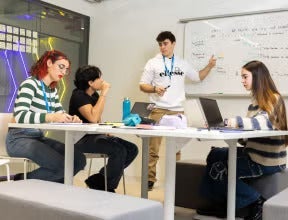
30 ECTS of training in key business areas such as strategic management, user experience and digital product innovation.

Build your own portfolio of real-world innovation projects with companies, gain hands-on experience through internships from the early years of the programme and the opportunity to complete international placements.

You will develop soft skills and become certified in areas such as Agile methodologies, communication, leadership, analytical and disruptive thinking.

Data Driven Thinking as a driver for decision making and professional certification in advanced analytics from IBM.
The Double Degree in Mathematical Engineering + Physics opens up career opportunities in strategic sectors such as:
Training with high employability, with job placement rates close to 98% in less than six months, and projection in a global market that demands highly qualified STEM profiles.
Faculty
Engineer and PhD in Chemistry, specialist in AI and Data Science, with more than 20 years of experience and a solid track record in international projects in Big Data, machine learning and quantum computing. He is co-founder of OncomIA, a biomedical company that applies advanced technology in the fight against cancer. He is currently Head of Studies in Mathematical Engineering and Physics at UAX, where he teaches artificial intelligence and quantum computing.
José Antonio holds a degree in materials physics from the Complutense University of Madrid. He carried out studies at the Instituto de Microelectrónica de Madrid (CSIC) on optical properties of quantum semiconductor nanostructures, having published in high impact scientific journals (Physical Review Letters, Applied Physics Letters, Physical Review B, etc). As a university lecturer, he has 25 years of experience teaching mainly mathematics and physics, currently teaching, among other subjects, linear algebra, numerical methods and quantum physics. He is also Coordinator of the degree in Mathematical Engineering and Coordinator of Internships in the technological area of the Business & Tech faculty.
Senior Industrial Engineer with more than 11 years of experience in optimising operational and strategic processes in multinational companies. PMP, Six Sigma Green Belt (UPC) and Cyber Security Professional (ISMS Forum). He has performed "Project Management Office" functions in more than 30 Engineering and Construction projects of mainly Energy, Gas and Petrochemical plants.
Degree in Mathematics from the UAM. I obtained the Diploma of Advanced Studies at the UCM for my work on the classification of differentiable subvarieties in Lie geometry and Plücker geometry. With more than 25 years of teaching experience, he holds professional certifications in Differential Equations for Engineers, Particle Physics and Introduction into General Theory of Relativity. He teaches undergraduate courses in Mathematical Engineering and Physics in Algebraic Structures, Differential Equations, Differential Geometry and others.
In shared spaces on campus, in joint innovation projects and through internships from the first years.
Academic and professional mentoring programme that focuses your efforts and achievements towards your best profile.
You will be trained through innovation projects with real companies and students from other degrees, developing products and solutions based on technology.
+700h of certified training in new technologies, advanced analytics and professional skills.
Internships and placements in strategic markets such as Asia, Europe or the USA and a progressive bilingual model.
Scholarships and Financial Aid for Studying at UAX
We know that studying is an investment. That’s why we want to remove financial barriers and make things easier for you. Fill in the form and let our advisers help you find the scholarships, agreements and personalised financial support that best suit your situation.

Comunidad de Madrid
Ayudas para alumnos con discapacidad igual o superior al 33% que cursen estudios en las universidades o centros superiores de enseñanzas artísticas de la Comunidad de Madrid.

Ministerio de Educación, Formación Profesional y Deportes
Conoce la información sobre las becas y ayudas convocadas por el ministerio de educación, formación profesional y deporte, según los diferentes tipos y niveles de enseñanza.

Atracción al Talento Investigador Predoctoral
Apoyo financiero para estudiantes sobresalientes que quieran desarrollar investigaciones innovadoras y contribuir al avance del conocimiento en sus disciplinas.
Si ya has decidido dar el paso, formaliza tu matrícula con antelación y benefíciate de una ayuda directa. Una forma de premiar tu compromiso y planificar tu futuro con ventaja.

Estudiantes de Iberoamérica
Programa dirigido a ciudadanos iberoamericanos o extranjeros con residencia legal en países de influencia de la OEI. La beca cubre un 50% de descuento sobre el coste total de docencia.

Estudiantes de Ecuador
Programa dirigido a ciudadanos con nacionalidad y/o residencia ecuatoriana que deseen realizar una maestría en línea en España. La beca cubre un 50% de descuento sobre el coste total de docencia.

2025 II Edición
Ayudas para estudiantes de FP de grado superior, grado, posgrado o máster matriculados en universidades españolas con convenio Santander. Un complemento económico para apoyarte durante la realización de tus prácticas profesionales.
Si tienes un familiar directo (hasta 2º grado) matriculado en UAX, puedes beneficiarte de una ayuda del 5% sobre el importe de docencia. Porque estudiar en familia es aún mejor.
Si te graduaste en UAX y ahora estás pensando en cursar una nueva titulación, queremos seguir acompañándote. Por eso te ofrecemos una ayuda del 10% sobre el importe de docencia.
Estudiar dos titulaciones a la vez es un reto, y queremos apoyarte. Si ya estás en UAX y te matriculas en una segunda carrera, contarás con una ayuda sobre tu reserva y matrícula.
Si quieres seguir formándote con nosotros y pasar de Ciclos Formativos a Grado, de Grado a Grado o de Grado a Postgrado, apostamos por ti con una ayuda de hasta el 25% sobre la docencia.
Si tienes un buen expediente académico, queremos reconocer tu talento con una beca pensada para estudiantes de nuevo ingreso. (Excluye grado en Medicina).
Si eres deportista de alto rendimiento, en UAX queremos ayudarte a compaginar tu pasión con tus estudios. Te ofrecemos ayudas específicas que pueden llegar hasta el 50% del importe de tu matrícula.
Renowned for helping you build your career
The rankings place UAX among Spain’s top universities for graduate employability, innovation and an educational model that is closely aligned with the world of work.

Forbes ranks UAX as the private university with the most graduates working in its area (nearly 90%), thanks to a unique educational model firmly linked to the labour market through more than 8,800 agreements with companies.

The prestigious ranking of the BBVA Foundation and the IVIE recognises us as the university with the best job placement in Spain in 2023, consolidating our model focused on the real employability of our graduates.

The Coordenadas Institute of Governance and Applied Economics places UAX as the private university of reference in Madrid, highlighting our practical training model aligned with the reality of the market.

UAX obtains the highest rating of 5 stars and the overall "Excellent" badge for Employability, Teaching, Academic Development, Facilities, Online Teaching and Good Governance in the prestigious international QS Stars rating.

UAX is recognised as the second most innovative university in Spain, the only private university among the top three in the ranking. This recognition highlights our transversal commitment to AI and training in sustainability.

Según la Lista Forbes 2025, UAX se sitúa en el TOP 2 Universidades españolas referentes en la adopción de IA Generativa en la formación de sus estudiantes, desarrollando herramientas y modelos de aprendizaje innovadores alineados con la evolución tecnológica.
The UAX promotes the culture of quality among the university community through the UAX Quality System (SIUAX), for which the University Management is ultimately responsible, ensuring that the planning of the system is implemented to effectively meet the quality objectives, the satisfaction of needs, requirements and expectations of customers and interested parties.
The responsible bodies are:
This organisational structure channels a bidirectional communication of the different improvement actions that allow and ensure the construction of the quality culture in the University.
Queries, complaints and claims
We listen to the real demands of our students and employees, because we believe in the continuous improvement of results. Therefore, we always want to listen to everything you want to tell us.
If you already belong to UAX, through the virtual campus in the section Customer service: complaints, suggestions and congratulations, entering your username and password.
Telephone: 91 810 94 00
E-mail: paramejorar@uax.es
Opening hours: Monday to Friday from 9:00 am to 6:00 pm