See all Online Master's Degrees in Health
See all Master's Degrees in Engineering
Most searched curriculums
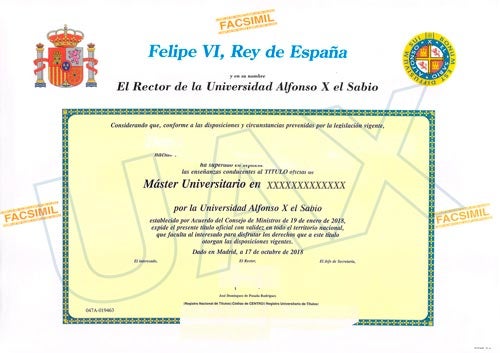
Official Qualification
Official 9-month qualification worth 60 ECTS
Specialise in AI, machine learning, deep learning, natural language processing, computer vision and generative AI. You’ll learn through a flexible online approach and work with tools such as Python, TensorFlow, PyTorch, Scikit-learn and cloud environments to apply artificial intelligence to real-world projects involving data, automation and digital transformation.
Artificial Intelligence is revolutionising every sector, creating a massive demand for professionals capable of designing, developing and implementing intelligent solutions that deliver real value to organisations.
This Online Master’s Degree in Artificial Intelligence prepares you, in just 9 months, to lead digital transformation projects at companies such as Avanade by Microsoft, Hispasat, Accenture, Telefónica and IBM. Throughout the programme, you will combine the technical fundamentals of artificial intelligence, data science and machine learning with the development of projects addressing real-world business challenges.
Furthermore, you will gain experience in cloud technologies, data management and processing, MLOps methodologies, generative AI and agile project management, learning how to deploy artificial intelligence solutions from start to finish and how to take models into production environments with a real impact on the business.
Work with the technology stack most in demand by businesses and gain practical experience with the tools used in real-world artificial intelligence projects. Throughout the programme, you’ll learn to develop machine learning and deep learning models using Python, TensorFlow, PyTorch and Scikit-learn, applying advanced techniques in data analysis, automation and artificial intelligence.
In addition, you will work in professional development and experimentation environments such as Google Colab and RStudio, as well as with data processing and management technologies such as Hadoop, Elasticsearch and Solr.
The Master’s programme will also enable you to develop projects on market-leading cloud platforms such as AWS, Microsoft Azure and Google Cloud, preparing you to design, deploy and scale artificial intelligence solutions in real-world business environments.
All of this is achieved through a practical methodology based on current use cases in Machine Learning, Natural Language Processing (NLP), Computer Vision and Generative AI, combining technical skills with agile methodologies such as Scrum to tackle real-world business challenges.
Find out about all the tools you’ll learn to use in this document.
This programme is designed to train you to become a well-rounded professional, ready to tackle any challenge. You will develop advanced technical skills to implement end-to-end AI solutions in business environments, focusing on the following key areas:
It analyses, processes and visualises data to extract valuable insights and support business decision-making.
It develops predictive models and algorithms capable of automating processes and solving complex problems.
It uses advanced neural networks to tackle highly complex challenges across various sectors.
It designs solutions capable of understanding, interpreting and generating human language, ranging from chatbots to intelligent assistants.
It implements image recognition, video and visual diagnostic solutions for industrial, health and security applications.
Learn how to use generative models to create content, automate tasks and develop new AI applications.
Deploy, monitor and optimise artificial intelligence models in cloud environments using MLOps best practices.
Work with the industry-standard ecosystem: Python, R, Scikit-learn, TensorFlow and PyTorch in cloud environments such as Google Colab.
Applies agile methodologies such as Scrum, Lean and Kanban to manage and lead artificial intelligence projects.
Master the most widely used technologies in artificial intelligence, data science and cloud computing, working with tools such as Python, TensorFlow, PyTorch, Scikit-learn, Google Colab, RStudio, AWS, Azure, Google Cloud, Hadoop, Elasticsearch and Solr through practical case studies based on real-world scenarios.

Transform the way you work with generative artificial intelligence. This micro-credential enables you to apply tools such as ChatGPT, Copilot or Gemini in information analysis, content creation and decision-making, integrating innovative solutions in an ethical and responsible way in real professional environments.

Develop your professional potential through leadership and interpersonal skills. This micro-credential provides you with the keys to manage teams, communicate effectively and solve problems in real-world environments, combining personal leadership techniques with practical productivity and collaboration tools.
Master's Degree in Artificial Intelligence
First Year
FIRST FOUR-MONTH PERIOD
| Code | Subjects | Character* | ECTS | ||||||
|---|---|---|---|---|---|---|---|---|---|
| SM142000 | AI in the business world | OB | 6 | ||||||
AI in the business worldCódigo: SM142000 Imprimir Course 1: First-semester module. Compulsory. 6 credits. Profesores
Objectives ▪ RK3: Explain the existing rules and regulations in AI environments ▪ RK5: Identify the uses and applications of AI ▪ RK6: Interpret the process of generating an AI model, its phases and its deployment deployment ▪ RODS: Develops effective communication, teamwork, , creativity and ethical leadership from a cross-disciplinary perspective and with clear inspiration drawn from democratic principles and values, as well as the to operate with integrity in a professional environment ▪ Has a thorough understanding of the various stages involved in managing an automated learning project and the most common tools required to carry out this task successfully ▪ Implements the legal and regulatory requirements within the scope of an AI project to ensure that its implementation will not result in compliance issues for the organisation ▪ Apply the regulations governing the use of AI algorithms ▪ Core competencies: • Students will learn about the main use cases and specific examples of the application of AI in the business world, as well as the basic concepts required to function as a data scientist within an organisation ▪ Specific skills: • Concepts will be explored relating to the more effective implementation of analytical and artificial intelligence models in the areas of legislation, project management, best design practices and behavioural economics, as well as advanced analytics project management. Course description 1. Artificial Intelligence in the business world: As an introduction, we will look at how, first and foremost, the availability of large amounts of data, as well as the tools for processing it, and the artificial intelligence models derived from them, have completely revolutionised industries and the world which we live, and what this has meant for different organisations and business sectors 2. Data Governance: We will explore and work on, both theoretically and practically, the key concepts of data governance and its lifecycle within the organisation, from the perspective of the data user, as well as from the perspective of the data owner or the person responsible for data quality and availability. 3. BECO and Design: General Principles of Behavioural Economics and Data-Driven Design and their relevance to the creation and development of analytical projects. 4. Project Management: The project management lifecycle within the organisation. Concepts of planning, time management, teams and dependencies, and the principles of the agile philosophy of project development. 5. Ethical and Legal Aspects: An overview of the environments and regulations affecting Artificial Intelligence models, key legislative initiatives currently underway, and ethical considerations to bear in mind when developing models. 6. MLOps: integrating AI with operational systems: we will explore in how to effectively integrate machine learning into the business world, how to harness the benefits of the cloud to deploy models at scale, apply DevOps practices for efficient management, and learn from real-world use cases across various industries. We will also maintain a focus on the latest trends in machine learning. Assessment system and criteria In the course/module’s virtual classroom, you will be able to view in detail the activities you are required to complete, as well as the submission dates, assessment criteria and marking schemes for each of them. Your final mark will be based on the following assessment system: 50 per cent of your mark will be based on your continuous assessment. The following will be taken into account: Individual and/or group activities: these are included in the continuous assessment. The final exam for the module will account for: 50% of the final mark. Bibliography Essential: 1. Daniel Kahneman Thinking, Fast and Slow Penguin Books. 2011. ISBN: 9780141033570 2. Ken Schwaber & Jeff Sutherland The Scrum Guide Scrum.org. 2024. ISBN: 0000000000 3. Zhamak Dehghani Data Mesh: Delivering Data-Driven Value at Scale O’Reilly. 2022. ISBN: 1492092398 |
|||||||||
| SM142001 | Mathematics and Statistics for AI | OB | 6 | ||||||
Mathematics and Statistics for AICódigo: SM142001 Imprimir Course 1: First-semester module. Compulsory. 6 credits. Profesores
Objectives Knowledge - Recognises the most commonly used statistical theories in AI environments. - Describes the metrics used in the calibration of AI models. Skills - Applies the statistics associated with the most common AI algorithms. - Identifies the algorithm required to tackle an AI problem. Competencies - Fairly evaluates different AI-based solutions and selects the most effective one for achieving the stated objectives. - Assesses the quality of an AI model based on metrics for comparing different algorithms Course description Unit 1: Specialisation in statistics for the description and analysis of large datasets. Unit 2: Estimation theory Unit 3: Statistical decision-making and classification Unit 4: Bayesian statistics Unit 5: Statistical data generation: synthetic datasets and imputation of missing data Unit 6: Complex graph theory and its applications to AI Assessment system and criteria Assessment system 50% of the mark will be based on continuous assessment (two practical assignments, the final mark for which will be the average of both assignments). 50% of the mark will be based on the final examination. Ordinary examination session To pass the module in the ordinary assessment period, students must achieve a mark of 5.0 out of 10 or higher in the final mark (weighted average) for the module and, in addition: The average mark for all activities (practical assignments) must be 5.0 out of 10 or higher to be included in the overall average with the exam. Similarly, the exam mark must be 5.0 out of 10 or higher to be included in the overall average with the activities. Extraordinary examination session To pass the module in the resit, students must achieve a final mark of 5.0 out of 10 or higher. Students must submit any assignments that were not passed during the ordinary assessment period, after receiving the relevant feedback from the lecturer, or any assignments that were not submitted at all. Addendum Core competencies Students will be able to understand the characteristics that distinguish the development of a supervised learning model for explanatory purposes from one for predictive purposes, and in particular the differences in the evaluation metrics used for each. Specific competences Students will be able to understand the types of data and applications for which different architectures are appropriate, such as neural networks or graph-based models. Bibliography Core: 1. Albert, Réka, and Albert-László Barabási Statistical Mechanics of Complex Networks Reviews of Modern Physics 74.1: 47. 2002. ISBN: 0034-6861 2. Boccaletti, Stefano, et al. Complex networks: Structure and dynamics " Physics Reports 424.4–5, pp. 175–30. 2006. ISBN: 0370-1573 3. Boccaletti, Stefano, et al. The structure and dynamics of multilayer networks Physics Reports 544.1, pp. 1–122. 2014. ISBN: 00000-00000 4. Euler, Leonhard. Leonhard Euler and the Königsberg bridges Scientific American. 1953. ISBN: 0036-8733 5. Gareth, J.; Witten, D.; Hastie, T. and Tibshirani, R An Introduction to Statistical Learning: With Applications to R Springer. 2017. ISBN: 9788074350887 6. Hastie, T.; Tibshirani, R. and Friedman, J. “The Elements of Statistical Learning: Data Mining, Inference and Prediction (2nd ed.) 2nd ed. Springer. 2017. ISBN: 9780387848570 7. Newman, Mark EJ. The Structure and Function of Complex Networks " SIAM Review 45.2. pp. 167–256. 2003. ISBN: 0036-1445 8. Partida, Alberto, Regino Criado, and Miguel Romance Identity and access management: resilience against intentional risk for blockchain-based IoT platforms Electronics 10.4: 378. 2021. ISBN: 2079-9292 |
|||||||||
| SM142002 | Programming and development environment for AI | OB | 6 | ||||||
Programming and development environment for AICódigo: SM142002 Imprimir Course 1: First-semester module. Compulsory. 6 credits. Profesores
Objectives Through the course’s four teaching modules, the aim is to develop the following competences and learning outcomes: According to the MUIA course description, this module requires the following learning outcomes: In terms of knowledge or content: RK1: Understands the most commonly used programming languages, libraries and frameworks in the field of AI. In terms of skills: RC3: Has a command of the various stages involved in managing a machine learning project and the most common tools for carrying out this task successfully. RC5: Adapt the various available technologies and algorithms for use in solving AI problems. In terms of skills: RS2: Has a command of the most common libraries and tools in the field of artificial intelligence. ▪ Core competences: students will be able to understand the role played by the libraries and programming environments covered in the module. ▪ Specific competences: students will be able to use the libraries and programming environments covered in the module. ▪ Learning outcomes: Students will produce the following learning outcomes: A Python programme using the libraries studied in Module 2. An R programme using the libraries studied in Modules 4–6. Both programmes will be developed in an IDE. Course content description The first module will focus on introducing Python as one of the industry standards, not only for machine learning processes but for the industry in general. We will learn more about the main IDEs used, and we will give a brief overview of SQL as a language for analysing our data. The second module explains the core Python modules that form the basis of Python programming for artificial intelligence. Examples of these specialised modules include Pandas, NumPy and SciPy. We will also introduce the use of Python visualisation libraries such as Matplotlib and Seaborn. The third module will introduce two of the main artificial intelligence frameworks: SKLearn, which focuses on traditional models, and TensorFlow, which is more geared towards deep learning. We will conclude with an introduction to version control using Git. The fourth, fifth and sixth modules follow the same structure as the first two, but this time using R as the programming language, with a particular focus on its native features and libraries for data analysis (dplyr, data.table) and visualisation, such as ggplot2. Assessment system and criteria In the course/module’s virtual classroom, you will be able to view in detail the activities you are required to complete, as well as the submission dates, assessment criteria and marking schemes for each one. Your final mark will be based on the following assessment system: 50% of the mark will be based on the assignments (one in Python and one in R) The final exam for the course will account for the remaining 50 per cent of your mark. Bibliography Essential: 1. Chang, Winston R Graphics Cookbook O’Reilly Media. 2013. ISBN: 9781449316952 2. Healy, Kieran Data Visualisation: A Practical Introduction Princeton University Press. 2019. ISBN: 9780691181622 3. Luciano Ramalho Fluent Python: Clear, Concise, and Effective Programming 2nd ed. O’Reilly. 2022. ISBN: 9781492056355 4. Marc Lutz Learning Python: Powerful Object-Oriented Programming 6th ed. O’Reilly. 2025. ISBN: 9781098171308 5. SAS Viya Machine Learning Node Reference SAS Institute Inc. 2023. ISBN: 0000000000 6. Wickham, Hadley; Mine Çetinkaya-Rundel and Garrett Grolemund R for Data Science (2nd ed.) O’Reilly Media. 2023. ISBN: 9781492097402 |
|||||||||
| SM142003 | AI Techniques: Classification and Clustering | OB | 6 | ||||||
AI Techniques: Classification and ClusteringCódigo: SM142003 Imprimir Course 1: First-semester module. Compulsory. 6 credits. Profesores
Objectives The course ‘AI Techniques: Classification and Clustering’ aims to provide comprehensive training that combines sound theoretical knowledge with practical skills applicable in the field of Artificial Intelligence. Specific objectives include mastering the theoretical foundations of the main classification and clustering techniques, such as k-NN, SVM, Naive Bayes, K-means and DBSCAN, as well as understanding feature engineering as an essential process for optimising the performance of AI models. Furthermore, the course aims to familiarise students with the most widely used tools and libraries in the AI environment, such as Scikit-learn, Pandas and NumPy, so that they can apply this knowledge to practical problems. In terms of skills, students will be able to evaluate and select the most appropriate algorithms for solving specific classification and clustering problems, design and carry out feature engineering processes to optimise datasets, implement practical solutions using industry-standard tools, and analyse the results obtained to fine-tune models effectively. Active participation in collaborative projects and discussions is also encouraged, fostering critical thinking and creative problem-solving. Assessment for the module will combine the acquisition of theoretical knowledge with practical skills. Continuous assessment will account for 50 per cent of the final mark and will include active participation in forums and discussions, the completion and submission of individual or group practical assignments, and the completion of quizzes and self-assessment tasks. The remaining 50 per cent of the mark will be allocated to the final exam, which will assess both theoretical knowledge and the ability to apply it in a structured context. To pass the module, students must achieve a minimum mark of 5 out of 10 in both assessment components. Course description The course ‘AI Techniques: Classification and Clustering’ covers the theoretical and practical foundations required to apply advanced classification and clustering techniques in the field of Artificial Intelligence. It is structured into six core modules covering the following content: Feature Engineering: An introduction to techniques for selecting and generating variables to optimise AI models. This module explores the fundamental principles for transforming and preparing data, thereby improving the effectiveness of algorithms. Classification with SVMs (Support Vector Machines): Analysis of the theoretical foundations and practical applications of Support Vector Machines, a key statistical technique for classification. Classification using k-Nearest Neighbours (k-NN): A study of the k-Nearest Neighbours algorithm, an essential tool for proximity-based classification, with an emphasis on its implementation and practical applications. Classification with Naive Bayes: A review of the Naive Bayes probabilistic method, including its statistical foundations and its use in real-world classification scenarios. Clustering with K-means: An introduction to this popular clustering method, focusing on its theoretical understanding, practical implementation and applications. Clustering with DBSCAN (Density-Based Spatial Clustering of Applications with Noise): An introduction to the density-based clustering algorithm, ideal for working with complex and noisy datasets. These modules have been designed to provide a thorough and practical understanding of the main classification and clustering techniques, encouraging active learning through activities and projects. Assessment system and criteria The assessment system for the module ‘AI Techniques: Classification and Clustering’ combines practical activities and knowledge tests, with the aim of measuring both the acquisition of theoretical skills and the ability to apply them in real-world contexts. The final mark is divided into two main components: Continuous assessment (50 per cent): This includes active participation in forums and discussions, the timely submission of Feedback exercises (1 and 2), and the completion of questionnaires or self-assessment tasks. These activities help to consolidate the concepts taught and assess the student’s progress throughout the course. Final exam (50%): This consists of a test that assesses both the theoretical knowledge acquired and its application to practical problems. To pass the module, students must achieve a minimum mark of 5 out of 10 in both the continuous assessment and the final exam. Continuous assessment aims to encourage active participation, collaborative work and practical learning, whilst the final exam ensures that essential knowledge has been understood and can be applied effectively. Addendum The course ‘AI Techniques: Classification and Clustering’ is delivered online, which allows for flexibility in learning and enables students to organise their time independently. The virtual sessions, both synchronous and asynchronous, are designed to encourage interaction between students and the lecturer, promoting active and collaborative learning. Learning materials: Students will have access to a variety of resources, including learning guides, theoretical content enriched with links and a bibliography, self-assessment exercises and practical activities. All material will be available in the virtual classroom for reference at any time. Duration and course load: The module carries 6 ECTS credits, comprising 22 hours of online classes and 18 hours of tutorials. These hours are supplemented by time spent on independent study and practical activities, ensuring a well-rounded education. Teaching support: The lecturer will be available to answer questions and provide support through weekly tutorials and the virtual classroom’s messaging system. Students are encouraged to use these channels to get the most out of the course. Bibliography Core: 1. Burger, Scott V. Introduction to Machine Learning with R O’Reilly. 2018. ISBN: 9781491976449 2. Eric Matthes Python Crash Course (3rd ed.) No Starch Press. 2023. ISBN: 9781593276034 3. Fernández-Avilés, Gema Fundamentals of Data Science with R McGraw Hill. 2024. ISBN: 9788448636289 4. Lantz, Brett Machine Learning with R (3rd ed.) Packt Publishing Ltd. 2019. ISBN: 9781788295864 |
|||||||||
| SM142004 | AI techniques: Regression, deep learning and others | OB | 6 | ||||||
AI techniques: Regression, deep learning and othersCódigo: SM142004 Imprimir Course 1: First-semester module. Compulsory. 6 credits. Profesores
Objectives In terms of knowledge acquisition, the module aims to enable students to understand the key programming languages, libraries and frameworks used in artificial intelligence, as well as the statistical theories most commonly applied in this field. Students are also expected to be able to classify and compare different families of algorithms and to identify their practical applications. With regard to the development of skills, students must develop the ability to evaluate AI-based solutions and determine their effectiveness. They must also be able to apply technologies and algorithms to solve specific problems and use deep learning techniques to tackle complex challenges. As for assessment criteria, active participation in forums and discussions is required, as well as the completion and submission of individual and group assignments. The final exam accounts for 50 per cent of the final mark. Course content The course is organised into six modules. The Linear Regression module covers its theoretical foundations and practical applications for identifying linear relationships and making predictions. The Logistic Regression module addresses classification techniques based on probability assignment. The Random Forest Regression module introduces the use of decision trees to handle non-linear data and how to combine these to create more accurate and complex models. The Deep Learning and LSTM module explores neural networks and recurrent networks specialising in sequential data. The Convolutional Networks module focuses on three-dimensional feature extraction and its application in computer vision. Finally, the Reinforcement Learning module teaches reward-based learning techniques for sequential decision-making. Assessment system and criteria The assessment system includes continuous assessment, which accounts for 50 per cent of the final mark and takes into account participation in forums and the completion of individual and group practical activities. The remaining 50 per cent is based on the final exam. In the event of a fail, the resit session allows students to retake both the practical activities and the exam, provided they have followed the instructions and received the relevant feedback. Addendum Students are advised to keep a logbook to record their progress and to participate actively in the online classes, although these will also be available in recorded format for reference. Lecturers are available for tutorials, which can be requested via email or through the virtual campus messaging system. The suggested reading list includes texts on statistics, regression and deep learning, by authors recognised in both academic and professional circles. Bibliography Core: 1. David W. Hosmer, Jr., Stanley Lemeshow, Rodney X. Sturdivant Applied Logistic Regression (3rd ed.) Wiley. 2013. ISBN: 9780470582473 2. Douglas C. Montgomery, Elizabeth A. Peck, G. Geoffrey Vining Introduction to Linear Regression Analysis Wiley. 2006. ISBN: 9780471754954 3. Josh Patterson, Adam Gibson Deep Learning: A Practitioner’s Approach O’Reilly. 2017. ISBN: 9781491914250 4. Joseph M. Hilbe Logistic Regression Models CRC Press. 2009. ISBN: 9781420075755 5. Peter Bruce, Andrew Bruce and Peter Gedeck Practical Statistics for Data Science 2nd ed. Marcombo. 2022. ISBN: 9788426734433 6. Sheldon M. Ross An Introduction to Statistics Reverté. 2007. ISBN: 9788429150391 |
|||||||||
| TOTAL: | 30 | ||||||||
SECOND FOUR-MONTH PERIOD
| Code | Subjects | Character* | ECTS | ||||||||||||||||||||||||||||||||||||||||||||||||||||||||||||||||||||||||||||||||||||||||||||||
|---|---|---|---|---|---|---|---|---|---|---|---|---|---|---|---|---|---|---|---|---|---|---|---|---|---|---|---|---|---|---|---|---|---|---|---|---|---|---|---|---|---|---|---|---|---|---|---|---|---|---|---|---|---|---|---|---|---|---|---|---|---|---|---|---|---|---|---|---|---|---|---|---|---|---|---|---|---|---|---|---|---|---|---|---|---|---|---|---|---|---|---|---|---|---|---|---|---|
| SM142007 | Calibration, metrics and explainability of AI models | OB | 6 | ||||||||||||||||||||||||||||||||||||||||||||||||||||||||||||||||||||||||||||||||||||||||||||||
Calibration, metrics and explainability of AI modelsCódigo: SM142007 Imprimir Course 1. Second-term module. Compulsory. 6 credits. Profesores
Objectives To understand the importance of explainability in AI models To learn how to explain AI models using XAI with tools such as SHAP or alternatives. To learn about and understand the key metrics associated with regression models To recognise and understand the key metrics associated with classification models Understand data imbalance and learn about balancing techniques Course content 1. XAI: definition, concepts and properties 2. Stability 3. Introduction to AI model metrics 4. Performance metrics for regression models 5. Performance metrics for classification models 6. Balanced data Assessment system and criteria - Final exam for the module (70% of the mark). - Practical assignment (30% of the mark). Timetable Click on this link to view the detailed timetable in Excel
Bibliography Essential: 1. Kuhn, M. and Johnson, K. Feature Engineering and Selection: A Practical Approach for Predictive Models Chapman and Hall/CRC. 2019. ISBN: 9781138079229 2. Provost, F., & Fawcett, T. Data Science for Business: What You Need to Know about Data Mining and Data-Analytic Thinking O’Reilly Media. 2013. ISBN: 9781449374266 Supplementary: 3.- A. Barredo, N. Díaz-Rodríguez, J. Del Ser, A. Bennetot, S. Tabik, A. Barbado, S. García, S. Gil-López, D. Molina, R. Benjamins, R. Chatila, F. Herrera Explainable Artificial Intelligence (XAI): Concepts, taxonomies, opportunities and challenges towards responsible AI Information Fusion (58) 82–115. 2020. ISBN: 15662535 4. Iqbal H. Sarker Machine Learning: Algorithms, Real-World Applications and Research Directions SN Computer Science 2, 160. 2021. ISBN: 2662995X |
|||||||||||||||||||||||||||||||||||||||||||||||||||||||||||||||||||||||||||||||||||||||||||||||||
| SM142008 | External academic placements | OB | 6 | ||||||||||||||||||||||||||||||||||||||||||||||||||||||||||||||||||||||||||||||||||||||||||||||
External academic placementsCódigo: SM142008 Imprimir Course 1. Second-term module. Compulsory. 6 credits. Profesores
|
|||||||||||||||||||||||||||||||||||||||||||||||||||||||||||||||||||||||||||||||||||||||||||||||||
| SM142009 | Master’s Thesis | OB | 6 | ||||||||||||||||||||||||||||||||||||||||||||||||||||||||||||||||||||||||||||||||||||||||||||||
Master’s ThesisCódigo: SM142009 Imprimir Course 1. Second-term module. Compulsory. 6 credits. Profesores
|
|||||||||||||||||||||||||||||||||||||||||||||||||||||||||||||||||||||||||||||||||||||||||||||||||
| SM142010 | Advanced Deep Learning and Use Cases: Data-Driven Environments | OB | 6 | ||||||||||||||||||||||||||||||||||||||||||||||||||||||||||||||||||||||||||||||||||||||||||||||
| SM142011 | Natural Language Processing (NLP) and Generative AI | OB | 6 | ||||||||||||||||||||||||||||||||||||||||||||||||||||||||||||||||||||||||||||||||||||||||||||||
| TOTAL: | 30 | ||||||||||||||||||||||||||||||||||||||||||||||||||||||||||||||||||||||||||||||||||||||||||||||||
*Character: BT: Basic Training, Ob: Required, Op: Optional
The main reason why UAX attracts students like you is the opportunity to balance your personal, professional and academic life. What sets us apart is a barrier-free approach, centred on you and your desire to learn.
What is our approach like?
In addition, you’ll have full access to our campus in Madrid to carry out administrative tasks, get answers to your questions and enjoy the facilities it has to offer.
Our degree is official, verified by the Council of Universities and fully valid in Spain, as well as in the European Higher Education Area.
It is recognised by the Education Systems of Latin America, being recognised and approved by the different Ministries of Education in Latin America:
SENESCYT, MEN (MinEducation), SEP, Mescyt, among others, automatically.
This Master’s Degree in Artificial Intelligence is open to students who have completed one of the following degree programmes or similar:
In addition, students from the following degree programmes may be eligible for the master’s programme by completing basic supplementary modules:
The flexibility of online learning, with opportunities to connect
Take your exams online wherever you are or, if you prefer, in person at our designated centres in Spain and Latin America, subject to availability and capacity.
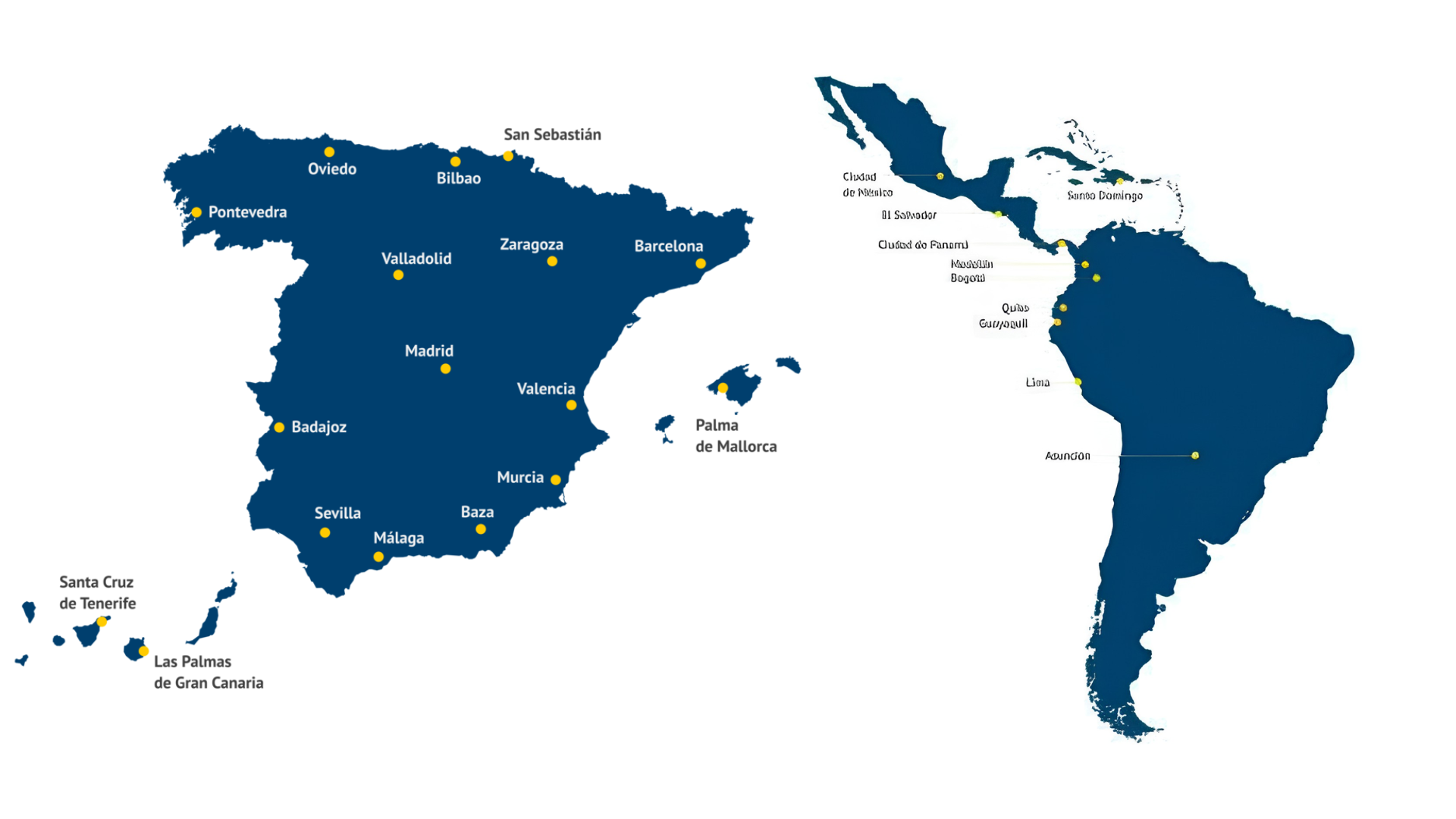
What’s more, as a student at UAX Online, you’ll have access to our Campus Hubs – a network of exclusive physical spaces where you can study, access libraries, work in co-working areas and connect with other students. Because studying online doesn’t mean studying alone.
Campus Hubs available in: Alcobendas, Alcorcón, Valencia San Vicente, Murcia, Barcelona, Málaga, Seville and Arganda.
Access is via your UAX student card, subject to availability and the opening hours of each centre.

Senate
PhD (cum laude) in Computer Science from the University of Salamanca, with a European distinction. ANECA-accredited lecturer. Over 20 years’ experience as an ICT lecturer and supervisor of undergraduate and postgraduate dissertations. Head of the DevSecOps Centre of Excellence at Santander Digital Services. Extensive experience in the management and implementation of software projects.

PhD candidate in Finance and Quantitative Economics, with a Master’s degree in Quantitative Economics and Data Science. He holds a Certificate in Quantitative Risk Management (CQRM) and has over 15 years’ teaching experience. His research focuses on dynamic and stochastic systems applied to economics and finance.

Senior Data Manager at IKEA. Master’s degrees in Big Data Analytics and Artificial Intelligence. Extensive experience in cloud development, data platforms, data governance and MLOps. Has collaborated with various research teams and taught at European universities.

She holds a degree in Telecommunications Engineering from the Polytechnic University of Madrid and a Master’s degree in Deep Learning. She currently works as a Technical Specialist in the Data & AI division at Microsoft.

Data Scientist at IBM Spain, specialising in the application of advanced algorithms for time series forecasting and predictive modelling, using advanced techniques such as LSTM and Prophet for the analysis of financial and industrial data. Develops Retrieval-Augmented Generation (RAG) solutions to improve response generation in GenAI systems, optimising access to relevant information in generative models.

Computer Science graduate from the Polytechnic University of Madrid. Over 20 years’ experience teaching ICT at companies and universities. Member of the DevSecOps team at Santander Digital Services, coordinating and participating in the implementation of conversational assistants integrated with predictive and generative AI solutions, such as Google Dialogflow, Azure OpenAI and AWS Bedrock.

PhD in Geomatics Engineering from the Polytechnic University of Madrid, Master’s degree in Disaster Prevention and Management, and Industrial Engineer. Specialises in machine learning, geostatistics and intelligent systems, applying these techniques to research into seismic vulnerability and risk management at the urban level.

He holds a degree in Mathematics from the University of Valencia, specialising in Bayesian statistics. He has experience in the field of data science and statistical modelling. He currently works as a data scientist in the consultancy department at Management Solutions, where he carries out advanced analytics projects and develops complex models for the financial sector.

Industrial Engineer, MBA and Master’s in Data Science & Business Analytics, with over 20 years’ experience in consultancy within the energy and infrastructure sectors. He currently heads the data analytics and business intelligence unit at SEURECA-VEOLIA and is a PhD candidate in the Information and Communication Technologies programme.

A Computer Science graduate and Executive MBA holder with over 15 years’ experience leading IT strategies in the pharmaceutical, manufacturing and education sectors. An expert in digital transformation, ERP, CRM and data analytics. He is currently CIO at Alcaliber, where he drives global projects focused on innovation and operational efficiency.

Computer Science graduate from the Pontifical University of Salamanca. Master’s degree in Business Administration. Over 20 years’ experience in IT environments. Expert in designing efficient cloud environments. He is head of the DevOps Hub Europe at Santander Digital Services.

She holds a PhD in Data Analysis from the Complutense University of Madrid. She currently works at the ISPA’s Biostatistics and Epidemiology Platform and collaborates with various biomedical research groups at hospitals across Spain and Europe.

Computer Science graduate from the University of Huelva. Experience in DevOps environments and cloud architectures. Specialised in deployment automation, access management and infrastructure design. Experience in migrating on-premises systems to the cloud and delivering training in this field.

She holds a degree in Business Administration, specialising in Data Science and Big Data. With over 20 years’ experience in banking, she is currently part of the Artificial Intelligence team at Banco Santander, where she leads global initiatives in generative AI applied to business. An expert in data analytics, CRM and systems integration, with a focus on the connection between business and technology.
Scholarships and financial support for studying at UAX
We know that studying is an investment. That’s why we want to remove financial barriers and make things easier for you. Fill in the form and let our advisers help you discover the scholarships, agreements and personalised financial support that best suit your situation.
If you have a strong academic record, we would like to recognise your talent with a scholarship designed for new students. (Excludes the degree in Medicine).
*Terms and conditions to be published
If you have an immediate family member (up to second degree of kinship) enrolled at UAX, you can benefit from a 5 per cent discount on tuition fees. Because studying as a family is even better.
Studying for two degrees at the same time is a challenge, and we want to support you. If you’re already at UAX and enrol on a second degree programme, you’ll receive a grant towards your booking fee and tuition fees.
If you graduated from UAX and are now thinking of studying for a new degree, we want to continue supporting you. That’s why we’re offering you a 10% discount on tuition fees.
If you’re a high-performance athlete, at UAX we want to help you balance your passion with your studies. We offer specific grants that can cover up to 50 per cent of your tuition fees.
If you’ve already decided to take the plunge, enrol early and benefit from a direct grant. It’s a way of rewarding your commitment and giving you a head start in planning your future.
Attracting Pre-doctoral Research Talent
Financial support for outstanding students who wish to carry out innovative research and contribute to the advancement of knowledge in their disciplines.

2025, 2nd Edition
Grants for students on higher-level vocational training, undergraduate, postgraduate or master’s programmes enrolled at Spanish universities with a Santander agreement. A financial supplement to support you whilst undertaking your work placements.
If you’d like to continue your studies with us and progress from vocational training to a bachelor’s degree, from one bachelor’s degree to another, or from a bachelor’s degree to a postgraduate degree, we’re here to support you with a grant covering up to 25 per cent of your tuition fees.

Students from Ecuador
This programme is aimed at citizens with Ecuadorian nationality and/or residence who wish to undertake an online master’s degree in Spain. The scholarship covers a 50 per cent discount on the total tuition fees.

Students from Ibero-America
This programme is aimed at Ibero-American citizens or foreign nationals legally resident in countries within the OEI’s sphere of influence. The scholarship covers a 50 per cent discount on the total tuition fees.

Ministry of Education, Vocational Training and Sport
Find out about the scholarships and grants offered by the Ministry of Education, Vocational Training and Sport, categorised by type and level of education.
That’s what the rankings say
Alfonso X el Sabio University (UAX) is ranked amongst the best universities in Spain according to the leading rankings.

UAX obtains the highest rating of 5 stars and the overall "Excellent" badge for Employability, Teaching, Academic Development, Facilities, Online Teaching and Good Governance in the prestigious international QS Stars rating.

According to the Forbes 2025 List, UAX is positioned in the TOP 2 Spanish Universities in the adoption of Generative AI in the training of its students, developing innovative learning tools and models aligned with technological evolution.

UAX is recognised as the second most innovative university in Spain, the only private university among the top three in the ranking. This recognition highlights our transversal commitment to AI and training in sustainability.

Forbes ranks UAX as the private university with the most graduates working in its area (nearly 90%), thanks to a unique educational model firmly linked to the labour market through more than 8,800 agreements with companies.
The prestigious ranking of the BBVA Foundation and the IVIE recognises us as the university with the best job placement in Spain in 2023, consolidating our model focused on the real employability of our graduates.

The Coordenadas Institute of Governance and Applied Economics places UAX as the private university of reference in Madrid, highlighting our practical training model aligned with the reality of the market.

The Master’s Degree in Artificial Intelligence prepares you to design, develop and implement solutions based on artificial intelligence, machine learning and generative AI in business environments. You will acquire the technical and strategic skills required to take on some of the roles most in demand within organisations.
Yes. The UAX Master’s Degree in Artificial Intelligence is an official qualification, accredited by the Council of Universities and fully recognised in Spain and within the European Higher Education Area (EHEA).
Furthermore, it is recognised in numerous Latin American countries and may be recognised or accredited by the relevant educational bodies in accordance with the regulations in force in each country.
The Master’s Degree in Artificial Intelligence lasts 9 months; the programme is designed to give you a comprehensive overview of areas such as data science, machine learning, deep learning, generative AI, MLOps and cloud computing in less than a year.
During this period, you will combine technical training, applied projects and work placements to develop the skills most in demand in the artificial intelligence job market.
Yes. UAX’s online Master’s in Artificial Intelligence is delivered using a flexible approach, designed to enable you to balance your studies with your professional and personal life. You’ll have access to live classes, content available 24/7, a virtual campus, practical activities, multimedia resources and support from the teaching and tutoring team.
The programme is geared towards active learning, with case studies, projects and assessments tailored to the online environment, so that you can progress step by step and apply the knowledge you’ve gained in real-world contexts. UAX’s online methodology includes live classes, a virtual campus, personalised support, continuous assessment and multimedia resources.
The Online Master’s Degree in Artificial Intelligence will enable you to master the AI techniques most in demand by businesses, such as:
Furthermore, by studying artificial intelligence , you’ll learn about agile methodologies such as Agile, SCRUM, Lean and Kanban, preparing you to work in high-performing teams.
From day one, you’ll be connected to the business world through workshops and work placements at leading companies in the technology sector, such as Avanade by Microsoft, Hispasat, Accenture, Telefónica and IBM, amongst others.
Yes. You’ll learn the fundamentals and applications of generative AI, working with models capable of generating content, automating processes and solving real-world business challenges.
The Master’s programme prepares you for roles such as Data Scientist, Machine Learning Engineer, AI Developer, Generative AI Specialist, NLP Specialist, Computer Vision Engineer, MLOps Engineer, AI Consultant, AI Product Manager or AI Project Manager.
Yes. The Master’s programme combines the development of applied projects with External Academic Placements (6 ECTS | 150 hours), which are compulsory unless they can be recognised as equivalent to professional experience.
The placements take place during the second term and allow you to apply the knowledge you have acquired in real professional settings, under the supervision of an academic tutor and a company mentor. Furthermore, you will have access to opportunities at leading organisations such as Avanade by Microsoft, Hispasat, Accenture, Telefónica and IBM.
Artificial Intelligence encompasses systems capable of performing tasks that require human intelligence. Machine learning enables these systems to learn from data. Deep learning is a branch of machine learning based on advanced neural networks, designed to solve more complex problems.
We need to know a little bit about you so that we can provide you with a personalised service.
All fields are required
Other related qualifications
We offer a wide range of academic programmes, so you’re sure to find one that suits you.
Master's Degree in Digital Twins and AI for Industry (Online)
In collaboration with:

Start:
October
Length:
9 months

Online Master's Degree in Cybersecurity
Start:
October
Length:
9 months

Online University Master's Degree in Big Data for Business
Start:
October
Length:
9 months

Online Master's Degree in Business Management and Administration (MBA)
Start:
October
Length:
9 months

Online Master's Degree in Project Organisation and Management
Start:
October
Length:
9 months

Master's Degree in Occupational Risk Prevention (online)
In collaboration with:

Start:
October
Length:
9 months

Máster Universitario Online en Marketing Digital
Start:
October
Length:
9 months

Online Master's Degree in Renewable Energies
Start:
October
Length:
9 months

Master's Degree in Cybersecurity
Start:
October
Length:
9 months
Enquiries, complaints and claims
We respond to the genuine needs of our students and staff, because we believe in the continuous improvement of our results. That is why we always want to hear whatever you have to say.

If you are already part of UAX, please visit the ‘Customer Service: complaints, suggestions and compliments’ section on thevirtual campus , logging in with your username and password.