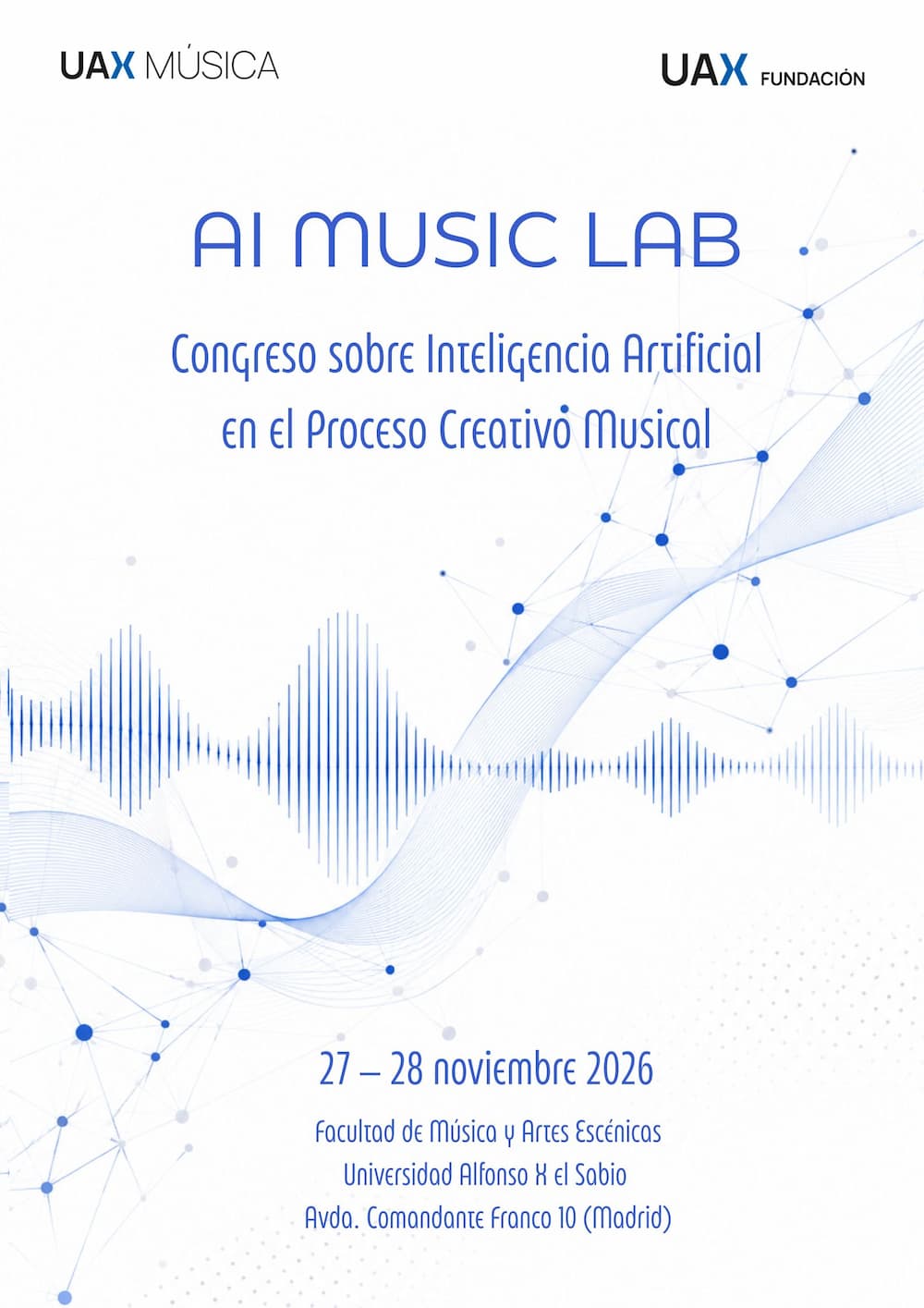
Conference on Artificial Intelligence in the Musical Creative Process
A pioneering conference in Spain on artificial intelligence applied to music creation, bringing together professionals from the fields of research, art and technology to explore new creative, productive and aesthetic processes in the field of sound.
All artistic expression is intertwined with the technologies of its time. Contemporary music draws on a long tradition of engagement with digital technology, which began in the 1950s with magnetic recording and was cemented in 1958 when Max Mathews programmed ‘Music I’ at Bell Laboratories – the first software for digital sound creation.
That initial disruption took the form of two major trends:
This gave rise to centres such as CCRMA (Stanford), where FM synthesis was developed and patented.
Interest in artificial intelligence applied to sound creation is therefore not new. However, recent advances in deep learning, neural networks and language models, together with the possibility of training models locally and using open-source platforms, are radically transforming the relationship between creator and machine.
AI Music Lab was established in response to this pivotal moment: a scientific and artistic forum to analyse the state of the art, assess the actual capabilities of these tools and discuss their aesthetic, ethical, educational and professional impact.

To analyse the current state of AI technologies applied to music and sound creation.

To disseminate the results of research, creative and knowledge transfer projects in this field.

To promote the use of open-source technologies that enable the entire process of training and using models to be audited.

To create a forum for dialogue between academia, the music industry, technology platforms and the artistic community.

To reflect on the ethical, legal and aesthetic issues raised by AI in music.
1. Composition and AI-assisted creation
2. Neural synthesis, timbre and synthetic speech
3. Sound design for audiovisual and immersive media
4. AI in production, mixing and mastering
5. Restoration, source separation and sound heritage
6. Improvisation and real-time human–machine interaction
7. New interfaces and digital instrument-making using machine learning
8. Open-source AI and collaborative ecosystems
9. Ethics, authorship and rights in AI-generated music
10. Aesthetics and criticism of new forms of sound expression
11. AI applied to music education and musicology
Each thematic area is broken down into one or more lines of research that guide the submission of papers, posters and presentations.

Research into generative models (transformers, diffusion, VAEs, GANs, autoregressive models) for music generation, including their capabilities, limitations, biases, aesthetic possibilities, comparative analysis and quality assessment.

Explore new creative roles with AI: collaboration, musical prompt design, human–model iteration, and reflections on authorship and creative agency.

It places AI within the tradition of 20th-century generative music (Xenakis, Hiller, Cope), exploring continuities, breaks and reinterpretations through the lens of deep learning.

The use of language models to create and transform lyrics: prosody, rhyme, coherence, style, translation and the relationship between text and melody across different genres and languages.